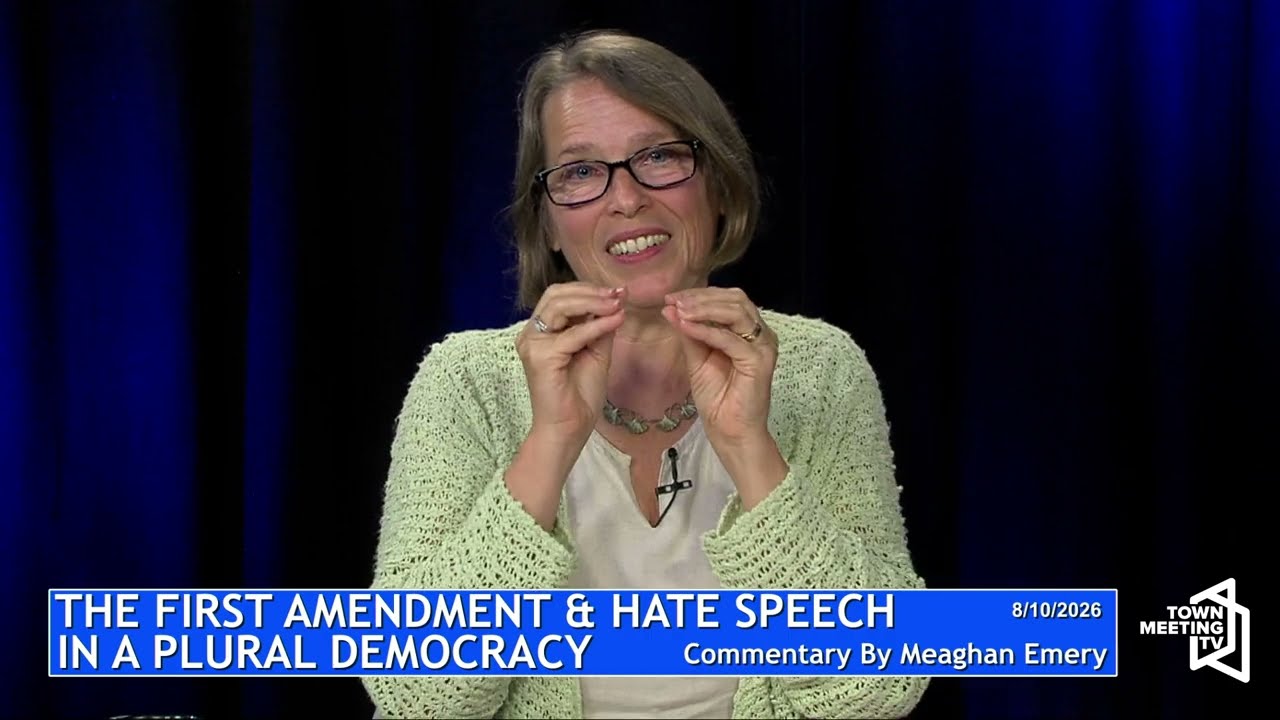
Meaghan Emery Commentary on the First Amendment & Hate Speech In A Plural Democracy
Watch on YouTubeVideo summary
Meaghan Emery, a professor of French and cultural studies at the University of Vermont, introduces herself by highlighting her long-standing focus on pluralism within France's national identity. Her academic work examines how contemporary French society confronts difficult historical legacies, including collaboration with Nazi Germany during World War II, the repression of memory regarding the Holocaust, the Algerian War, and the ongoing struggles faced by overseas departments in the Caribbean and Indian Ocean. Emery emphasizes that these issues are not isolated to France but resonate globally as non-majority groups seek integration into democratic societies like America's, often facing challenges similar to those experienced historically in Europe.
The core of her commentary addresses the urgent need to condemn hate speech while navigating the complexities of free expression under the First Amendment. Emery argues that rights such as freedom of religion, press, assembly, and petitioning the government are interconnected; compromising one inevitably weakens all others. She illustrates this with recent events in South Burlington, where a woman wearing a hijab was physically assaulted and another forum attendee targeted a Jewish candidate based on her identity and social media posts. These incidents demonstrate how hate speech can escalate into physical violence and harassment, transforming verbal attacks into criminal acts that threaten the safety of marginalized communities within plural democracies.
Emery draws upon Albert Camus's novel *The Plague* to propose an antidote to rising hatred: a combination of "good doctoring," dialogue, and militant defense of human rights. She suggests that just as doctors must treat patients with care while remaining vigilant against the spread of disease, citizens must respond to hate speech not only by speaking truth but also by listening actively and maintaining their own humanity amidst anger. This approach requires recognizing the shared dignity in others even when disagreeing vehemently, ensuring that our fight for justice does not inadvertently harm innocent people or allow hatred to fester unchecked through social media amplification and coordinated harassment campaigns.
Ultimately, Emery calls for a collective commitment to peacebuilding within local communities, schools, and legislative bodies rather than allowing political conflicts in the Middle East to fracture American society along religious lines. She urges leaders to clearly condemn hate speech while backing it up with constructive discourse that fosters understanding among Jewish, Muslim, and other diverse groups. By cherishing our constitutional freedoms without self-censorship yet engaging thoughtfully and kindly with one another, we can create an environment where peacemaking thrives in everyday spaces like streets, auditoriums, and classrooms, ensuring that justice prevails through unity rather than division.
Read the full video transcript
Yes, hello. My name is Megan Emery and I
am a professor of French at the
University of Vermont. I have been there
since 2002, so that makes 24 years. And
from the very beginning, I have worked
on uh plural France. Um that is the
topic of my my dissertation, which I
defended in 2001. It was titled Writing
the Fine Line, Rearticulating French
National Identity and the Divides. And I
just wanted to give you this background
um so that you could know a little bit
about who I am. So, my dissertation
focused on three groups within the
French population. And I'm talking about
the 20th and 21st century, so
contemporary France, who are challenging
the French
to face up to troubling events of the
recent past.
That is collaboration with Nazi Germany
and the extermination of millions of
Jews and other undesirables, quote
unquote,
and the repression of that memory.
The Algerian War and the difficult
integration of the subsequent waves of
citizens from overseas.
And the ongoing decimation of the
overseas departments, um
primarily in the Caribbean, but also in
the Indian Ocean and in French
Polynesia,
which are struggling with the
consequences of departmentalization and
their inception into Europe still to
this day.
So,
I wanted first to thank Channel 17. Uh
that's that's an old habit. Sorry, Town
Meeting TV.
Um I used to be on the board of Channel
17. I am a former South Burlington City
Councilor. I served for 14 years. Um and
served also as the president and
treasurer of what was then the Channel
17 board. So, I um deeply, deeply
grateful
that this organization exists, that it
brings uh local government to to
people's screens so that they can hold
their elected officials accountable, and
that they can know more about their
local community. It is a really
essential service, what I consider to be
an essential service, and I would hope
all people out there watching agree with
me.
Otherwise, why would you be watching,
right? Um
So
I I also wanted to
let you all know that I am affiliated
with the Jewish Studies and the
Holocaust Studies programs at the
University of Vermont.
And I want to also let everyone know
that I am not a specialist in US Jewish
Studies or in US history for that
matter.
And yet, why am I here? I am here
because of recent events that have
occurred in South Burlington, that is my
hometown.
But also in the region and in our
country. I wanted to specifically
address
hate crimes and hate speech and and
like my dissertation
outlines, it doesn't affect just one
group. It affects the non-majority
groups, right? And those groups that are
just like in the French Republic, they
are seeking to integrate into the
American Republic. And it is
you know, like a
something that reoccurs in our history
where from time to time non-majority
groups have difficulty integrating into
American society. And we have seen that
of late. And I think that people
who encounter this with the best
intentions sometimes do not know how to
react or what to say.
And to be quite honest, quite simple.
You condemn it.
You condemn hate speech in all its
forms.
And in a free society, the best the best
remedy is to respond with good speech.
That is something that I've heard First
Amendment specialists say at the
University of Vermont, which is a public
institution. Therefore, the First
Amendment it applies in all that we do
on our campus. And um
we nevertheless do have rules and
regulations that people must follow. Um,
we are not the mall in Washington, D.C.
We are a university campus. And uh we
have rules
uh that are put into place so that
students feel safe. So that they are
free to engage in in learning. Um, that
is indeed our industry.
Um
and to that end um, I wanted to tell you
that for what question. That's what any
good professor will ask before they
start any kind of discussion with a
class.
Why are we talking about this? Right?
For what purpose?
And so I wanted to give you some
background um, about my area
specialization, but what it has taught
me with regard to possible responses to
to hate speech, which are hate acts, and
and can fall sadly over into hate
crimes. Um, especially when there is
harassment or there is physical assault
um, or there is of course um, as as we
have seen um, worse
uh with regard to loss of life, uh the
burning of of an edifice and so on and
so forth. Um so
let's get to it.
I
wanted to to also
tell you some courses that I've taught.
I think that's that's important. Um I
have some books here laid out in front
of me. I might show them to the screen.
I tend to um
like to bring books because they are my
companions. I spend a lot of time
reading.
And when I teach, uh because I am not an
historian, I'm a cultural studies
specialist, we are reading literature.
We are reading people's ideas about what
is happening at the time of the writing
of that literature. And it's
fascinating. Um I also wanted people to
know that whenever I'm putting together
a course, I focus on um discourse of
hope in addition to discourse that is
quite realist and can be quite jarring.
Um we're dealing with histories
uh where there are millions of people
who were enslaved,
uh who were persecuted, who were killed
uh maliciously.
Um and
uh today they are still
uh seeking to be included. Um
the majority group is is very jealous
of of you know it's it's power.
So, some of the courses I've taught
uh in 20th century French literature, a
course called resistance and memory with
a focus on World War II,
um and the response of French
intellectuals
at the time when Jews and others,
including French resistance, uh but also
the handicapped, the homosexual
population, the disabled, they were
being rounded up not only by German
soldiers and officers, but by French
police officers as part of the Holocaust
or what um professionally we'd call the
Shoah.
I also uh teach a course called
multiethnic France, and that's based on
20th and 21st century French literature
with a focus on authors arising from the
experience of immigration.
The French tend not to see their country
as a country of immigration like the
United States.
It's
very I would say common for the French
to say that they are a country born from
the monarchy and that gives them a very
different perspective on the question of
what it means to be a plural democracy.
Uh
The next course
based on French culture was called
France's culture wars and that focused
on the painful birth of the French
Republic.
We all think of Bastille Day, right?
July 14th,
which was just under a month ago and
that is the day when there were
Parisians who took a nearly empty uh
prison in Paris
and
violently attacked the guards, beheaded
them, put their heads on stakes.
It was considered to be one of the the
first acts of that revolution which did
not succeed within that 18th century. It
took indeed nearly a century for that
revolution to succeed and that is what I
cover in that course and that goes
uh even beyond
1880. It goes through 1940.
Uh so, you know, a century and a half
later after the revolution where we have
the the French Parliament voting to
instate a dictator
um in response to the German invasion of
France in World War II. And that
dictator named Philippe Pétain
uh
who was not considered a president, he
was considered head of state. He was
elected by the Parliament, not by the
French
voters, and they have direct suffrage.
No electoral college there.
Um, he was in fact a very eager
collaborator with the Nazi regime and
went over and above what the Nazi
regime, the Third Reich, was asking of
the French. Uh, not only did he send
men,
he sent
women, separated them from their
children, he sent the elderly, and then
he finally sent children themselves,
separated from their parents.
And these are crimes that have
that had been kept silent.
It was
for 30 to 40 years
after the liberation in 1945.
And so the course that I taught called
the French Jews Revolution, which was a
sophomore
seminar in the Honors College at the
University of Vermont, um, that's what I
discuss is how Jewish writers
broke that silence and and made the
French face the crimes that had been
committed uh, in the name of the French
state and therefore the French people.
Um, so that's some of my background. I
just wanted you to know,
uh, that before I start.
The other part of this discussion, and
I'm not used to discussing all alone by
myself, I usually have people around me.
Um, so hopefully,
um, I um, I'm able to discuss with
myself in a way that is interesting to
you all.
Um, it's the First Amendment, right, to
our US Constitution, and it is the first
of the first 10 Bill of Rights.
Therefore, uh, just like Article 1
outlining,
uh, the duties of of the the
legislature, our US legislature,
um, in Washington now.
It is the most important one and let me
read it to you in full.
Congress shall make no law respecting an
establishment of religion
or prohibiting the free exercise thereof
or abridging the freedom of speech
or of the press
or the right of the people peaceably to
assemble
and to petition the government for a
redress of grievances.
So, there's a lot there and as someone
a good friend said to me,
there is a reason and I'm quoting him.
There is a reason
that these rights were lumped together
under the first amendment. We can't pick
and choose and expect the rest to
survive.
And that is indeed true.
If we assume that we can exercise our
free speech and trample on people
because of their religion,
we will have lost all of the rights
guaranteed under that first amendment.
If we expect that we can speak freely
and yet we restrict the press
our free speech rights will soon be
curtailed.
If we think we can speak freely but we
don't allow people to gather and to
protest peacefully
our free speech is in danger.
And that includes petitioning the
government for a redress of grievances.
So, that means holding our elected
officials accountable
which can take form
forum actually the forum can be various
it could be within the legislative hall
and chamber itself. It could be through
a letter. It could be through social
media. That is one way that our elected
officials speak with us. And and if they
are speaking to us through social media,
that is a That is an avenue for the
constituents
to to hold that elected official
accountable.
And if that elected official denies that
right, well, then our free speech rights
are in fact at risk.
So, I do encourage all Americans and and
those of you watching here in the
Burlington area to to hold this First
Amendment and all of the rights,
right?
Freedom of practicing any religion or no
religion, right?
Abridging
means that
they cannot stop us from speaking
freely. They cannot stop our press,
right?
They being those in power, right? And
they cannot stop us from assembling or
from petitioning the government and
holding our elected officials
accountable. All of that together
in one, right? We cannot
remove one and expect the others to
survive. And I love that expression from
that friend of mine.
All right. So,
we have
uh
witnessed in in South Burlington, um
what I would say is two crimes, um
recently,
within the month of July.
Most recently, there was a woman who was
physically assaulted on our City Center
street, Market Street, around noon.
The police responded and it is being
dealt with as a hate crime.
And I think that is just and right.
Um this is a woman who was wearing a
hijab and a woman of color. And
um all of this was captured on tape,
a friend's cell phone.
Um and we have learned that those cell
phones come in handy these days.
Um also in the month of July, there was
a candidate's forum held at our
municipal offices at 180 Market Street.
And Town Meeting TV was there like a
good public servant um to record and
make sure that the public could see uh
the various candidates who were up for
election and that included for our State
Senate um and that night it was for
Chittenden Southeast because that is
South Burlington is in that district and
the candidates for governor. And it was
a Democratic Committee so these were the
Democratic candidate candidates.
And very sadly
um there was a man uh who I would call a
former friend
um who stood up and targeted one of the
candidates on stage
uh because of her identity. I differ in
his opinion that it was because of
things that she had stated in social
media
uh because there are other members
uh of the uh South Burlington delegation
who were sitting on that stage uh so who
we've elected and the incumbents who
have likewise
uh supported in this case Israel.
Um
so for one person to be targeted um
was a clear violation I would say of
uh this right of the people to peaceably
assemble and to engage in free speech
and free discourse and respecting the
rights of people who worship a religion
different or the same.
Um in this case it was a Jewish man who
was targeting a Jewish woman.
So
I think that the rules um
are something that we need to to think
about. Uh first of all, local rules with
regard to the Democratic Committee and
they have discussed and I think it is
unfortunate, um having to
uh you know preview and review questions
on cards prior to them being asked of
the candidates sitting on stage. Um that
is already an obstacle, right? To to
free speech rights. There those would be
a curated set of questions. And so the
officials who would be leading that
discussion um would be in effect
censoring, right? Playing that role of
deciding which questions
deserve airtime and which questions do
not deserve airtime. And and that is
quite a power to hand to a a party or or
any
um official uh acting in in you know in
that way.
Um
So the first thing that I did, I was
witness to this, I was sitting in the
auditorium, was I asked uh the person
recording um so the town meeting TV crew
member if there could be an edit to that
tape because as a scholar and here I'm
going to refer to Declining the
Stereotype by Mireille Rosello, okay? I
got this from the UVM library.
And I used this book when I was writing
my dissertation
that any kind of
seed that is planted in the mind, a seed
of hate,
even though we respond with good speech
afterwards, and fortunately the
candidate who was targeted did respond
with good speech. Um
but any seed that is planted, right? It
will grow. It will fester, and it will
grow. Declining the stereotype means um
it's in fact it's a it's a play on words
um that we might say, "Oh, let's not use
that stereotype." That's good speech,
right? Condemning bad speech.
But
like in any good um
German student's mind, declining also
means that it takes on different forms,
and that it can be
um used in different ways once it's put
out there on the airwaves. And indeed,
that is what has occurred. Um that
initial instance of hate speech has been
amplified uh not only through
YouTube, because town meeting TV
recordings are are placed at the right
uh free to it's free access on YouTube,
um but that uh man who asked that
question,
uh he finally got to the question after
after attacking the the candidate on the
stage, uh he then
pursued her uh through various means. Um
so, from Front Porch Forum,
and not just once, uh and not just him,
he had a whole group of people uh who
had, in fact, I believe, instigated him
to to do this and to an effect ambush
the the candidate on that stage.
And so, some of those people uh
they have amplified it further, again
through Front Porch Forum and Facebook,
Substack,
and it goes on and on. Uh those are the
those are the those are the ones I know
of.
I'm not going to name names here today.
Um
I am happy to take questions. Uh you all
can find me. I'm a professor at the
University of Vermont, so you can all
find me if you wish to to ask questions.
Um but I was very disturbed by what I
believe to be a setup,
and it was politically motivated, and I
I'm going to leave it at that.
So, what I did was I engaged um when the
crew member said that they could not
edit the tape. I engaged with the
executive director, Megan O'Rourke. I
hold great respect.
I hold her in great respect.
And I I raised the concern that I just
outlined to you about how stereotypes
that once that seed is planted, it grows
in in ways that we just cannot control.
And um
she
Megan O'Rourke, she went on then and um
forwarded this all to the
Anti-Defamation League. And in fact, the
Anti-Defamation League um has been very
very critical of hate speech,
particularly since COVID, when meetings
moved online, and there was an outbreak
of what is called Zoom bombing, right?
Where people maliciously would appear on
screen or without the camera on, and
would disrupt an otherwise orderly
meeting or discussion. Um often with
very graphic or racist or anti-Semitic
hate speech.
And so we have as a society had to come
to
uh
accept uh different means of of access
to those public discussions, right? So
for instance, um we no longer have
screen sharing with people who are in
the public.
Um
we no longer uh allow threatening
messages in the chat boxes. All of that
is very closely monitored.
Um
and there is also um
the locking meetings after they have
begun. There are now waiting rooms. We
turn off the private chat, etc. etc. Um
so I did liken what occurred on July 9th
in that auditorium in a a meeting uh and
candidate forum that was being taped to
Zoom bombing.
And I uh
unfortunately
um
could not do much more than that other
than raise a concern. And very
graciously, Megan O'Rourke invited me to
come here today and to speak. Um so here
I am.
So
it's very difficult to regulate free
speech even in broadcast media. So the
radio and TV.
Um in fact um
the FCC even though they have guidelines
stating that hate speech cannot occur,
what they call indecent or profane
speech cannot occur
uh between the times I believe it's 8:00
a.m. uh to 10:00 p.m.
Um
it's still very difficult to to restrain
it. And that speech uh sometimes uh
leads to fines.
Um that has not been done in this case.
Um so
what I
I therefore wanted uh to say
is that
it comes down to us and it comes down to
what we can Sorry, it's 6:00 a.m. to
10:00 p.m. Not 8:00 a.m. 6:00 a.m. to
10:00 p.m. It comes down to us and how
we act with our fellow citizens. And
um I I think that it's really important
that we
cherish our free speech rights.
And in order to cherish those rights, we
should not censor ourselves.
But we should be thoughtful
about how we engage with one another.
And that is why I brought
the plague.
All right. So this is by Albert Camus.
He is one of my authors.
And in the plague um he
uh gives an allegory for the French
intellectual resistance and how they
were combating
not only
the the Nazis but also
the French collaborators and this this
element of hate, right? He compared to a
little bacillus, right? The plague
bacillus.
And just like declining the stereotype,
once it infects, it grows, right? And
how can we stop that growth?
Well, what he suggests is that it comes
down to good doctoring.
And the main character is a doctor
who tends to the ill.
And he's not alone, just like the French
resistance, there was a group of people
from various backgrounds and walks of
life who were engaged in resisting
the the hate that was
an epidemic in France and in French
territories during World War II and
indeed in in Western Europe.
Um and what is the antidote in addition
to being good doctors and doctoring and
working every day and trying to
tend to the ill and to
ensure that hate is not left to fester,
that we find remedies for it which come
in the form of dialogue and good speech,
right? So, dialogue. That means not just
talking but also listening. There's an
exchange to that. Okay. But in addition
to dialogue, it means that we
can be militant about our ideas. We can
be very very forceful when we have
strong emotions which we do,
particularly when
there are injustices all around, right?
Um
but we also need to remember that we are
human
and we need to identify in the person
that we are angry with
their humanity.
And our own humanity.
Which means that
we
make sure that there is not harm
that could lead to
unintended consequences. So that we are
constantly reminding ourselves that we
live in society and that that person
that we feel great anger toward is a
human being with a family, right? And
perhaps a symptom of something greater.
So perhaps not the true target, right?
Um
but we also have to remember our own
humanity. And for that we have to be
kind to ourselves. We have to laugh. We
have to find joy. We have to
as Camus'
character, the doctor and his good
friend who put together these sanitation
teams um do one evening um
they go for a swim
in the Mediterranean.
Um and it's a moment that normally would
not be allowed, right? People were not
allowed to go into the water and to swim
because of that illness, right? We all
remember what COVID-19 was like.
And
they because of
their situation as doctors, they're the
one doctor, the other is not. Uh they're
able to get past the guard
and they are able to swim in unison
and to feel alive and and to feel the
the coolness of that water
and to feel the harmony of their
strokes.
And so when we are fighting for rights,
when we are fighting for justice, and
these are righteous fights, right?
And we need free speech in order to do
that.
We have to respect
the right to free speech of the other.
We have to respect the humanity of the
other. We have to respect freedom of the
press,
freedom of
religion, and the the right to to
practice any religion, the freedom to
assemble, right?
And also,
we have to hold our elected officials
accountable, right? And all of that
we should do with joy
in addition to
>> [laughter]
>> laser-sharp focus,
right?
And
that's basically what I wanted to say
today. And if it ever comes
before
uh
a legislative body again or some kind of
body of of, you know,
some weight in our community,
I would hope and I would demand
that our leaders speak out clearly in
condemning hate in whatever form it
takes,
and that they back it up with good
speech,
right?
So, I'm I am happy to
uh speak with anyone. Um
I
I guess I I will just say just a couple
more things, and I
I did bring this with me, and I I I'm
going to say it because I have been in
contact with people, um and they they
did um respond positively to this. So, I
am going to
um site um just a passage from chapter
six in this book. It's called Zionism an
emotional state. It's by Derek J.
Penslar.
He was invited to UVM
to speak about 2 years ago.
And in the section titled Hating
Zionism, Hating Jews,
he wrote,
"If you
If you define Zionism as the national
liberation movement of the Jewish people
and Israel as central to contemporary
Jewish life, and if in your view the
only legitimate expression of Zionism is
Jewish sovereignty and hegemony within
the land of Israel,
then someone who opposes Israel as a
Jewish state is ipso facto an
anti-Semite.
Yet,
the act of cementing diasporic diaspora
jewelry with with Israel and arguing
that all Jews do or must support the
country in its current form
open Jews worldwide to accusations that
they are responsible for Israel's
actions.
In fact, most American Jews do feel
emotionally attached to Israel,
but the depth, intensity, and valence of
those attachments vary greatly.
The same can be said for Jews within
Israel itself.
Hostility toward Jews founded on
assumptions about their bonds with
Israel
are clearly anti-Semitic.
Violence, harassment, or discrimination
against Jews is criminal,
whether its motives are anti-Semitic or
not.
And I
want to say
to all of
the members of the Jewish community that
did ask me
to work on these kinds of forums. So, it
was not only Megan O'Rourke's invitation
that brought me here today, it was
members of the Jewish community who are
hurting since July 9th.
I want you to know that I hear you, and
I hope that you can listen to one
another as well.
I hope that we as a country can listen
to you.
I hope that we all listen to the
Palestinian voices.
And I hope that we as Americans
recognize our place in this conflict.
We cannot battle this conflict here in
our country against
the American Jews and the American
Muslims.
This is not for us
to to
uh
place this and litigate this on the
backs
of our Jewish and Muslim brothers and
sisters.
And I ask everyone out there in the
audience
to love
the Americans
who are struggling and who are in deep
pain over what is happening in the
Middle East, just as we all are, but we
must understand that it's much more
difficult for those who have historical
and emotional ties to that part of the
world, right?
And let us focus on the peacemakers.
Let us be peacemakers.
And let us make sure that peacemaking
happens in our streets
and in the auditoriums
and in our schools
and in our classrooms.
Thank you very much.