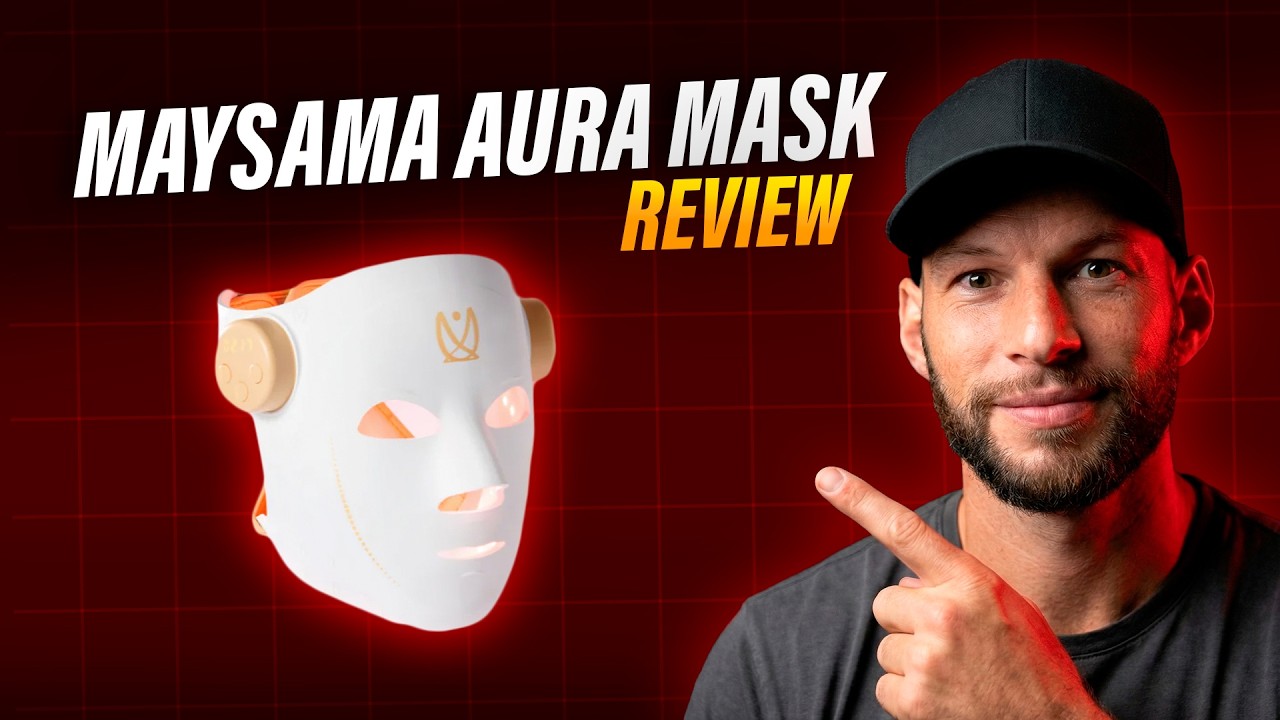
Maysama Aura Review: My Testing Revealed a Big Problem
Watch on YouTubeVideo summary
The Maysama Aura is a second-generation semi-molded silicone LED light therapy mask designed primarily for female users, featuring an adjustable chin strap and a removable battery system. While the reviewer praises its comfortable fit and straightforward operation with built-in timers and pulsing capabilities, there are notable ergonomic drawbacks. The design creates pressure on larger noses and can induce feelings of claustrophobia after just a few minutes of use. Additionally, because LEDs do not extend to cover the entire chin or directly reach the lips due to the strap mechanism, light coverage is uneven across certain facial areas despite being adequate for general rejuvenation needs.
A significant issue identified in this review concerns the optical power output, which falls far short of the manufacturer's claims. Although Maysama states an intensity of 26 milliwatts per centimeter squared, independent testing revealed that the average radiance is closer to just over one and a half milliwatts per centimeter squared across most of the mask surface. This low power level means users would need extended session times to achieve therapeutic doses for anti-aging benefits, which conflicts with the comfort limitations mentioned earlier. The discrepancy between marketing data from internal factory labs and independent third-party testing highlights that while light directly above individual LEDs is powerful, it drops off rapidly over just a few millimeters, resulting in poor overall energy distribution across the face.
Ultimately, the mask receives a mid-pack score of 65 out of 100 due to these power deficiencies, placing it behind other options available on the market despite its good design and features like smart dosing modes. The reviewer suggests that consumers looking for better value or higher light output should consider alternatives such as the CurrentBody Series 2 mask or the Morite MTO Glow Mask, which offer superior LED counts and more consistent coverage. While the pulsing technology is a unique selling point supported by the founder's specific philosophy, it does not compensate for the lack of raw power intensity. The video concludes with an appreciation for Maysama's transparency in sharing third-party lab data but maintains that higher-powered masks remain preferable for effective treatment without requiring excessively long wear times.
Read the full video transcript
This is the Mace Armor Aura LED mask.
It's a second generation mask from this
company. And a lot of things have
changed with this one. It is now a what
I call semioft molded silicon mask. So
instead of the older flat design, this
one has been contoured, I guess you'd
call it, shaped to a person's face. It's
just using the red and the near infrared
LEDs, but it also incorporates pulsing.
Now, this is something that the founder
of Mesama is very fond of. I have my
thoughts on it. I will share them later.
But what I'm going to do first is review
this mask using my scoring system and uh
we're going to see how well it compares
to the rest of the masks out there
because there's a lot today. I've
reviewed about 30 of them as well. So,
anyway, let's go. I'm affiliated with
some of the companies mentioned in this
video and I will earn a commission if
you buy through my links or discount
codes. Products were provided to me free
of charge and all opinions are my own.
This is not medical advice. Okay, so
first up we have fit. Now, this mask is
quite unique in two ways actually. Uh
first, it's got a removable battery.
More on that later, but it has this
adjustable chin strap down here. Now,
we've seen masks that have the chin
strap. Uh the current body mask, the
series 2 mask, has that builtin. I
really like it. The new maid red light
ml glow mask, it's a hard shell mask and
that has an adjustable pivoting chin
strap, which I think is really cool.
Now, this mask is a little bit different
because it is adjustable. So, there's
Velcro there so you can attach it, which
means you can adjust the fit, which is
great. Uh, more on the chin strap later
because there are some things I don't
like about it. But anyway, in terms of
fit, it is pretty good. It's rather
snug. Uh, fits well to the face. I do
feel a little bit of pressure on the
nose. Now, remember, I do have a larger
nose and of course I am a guy. Shock
horror. Um, so Mama was saying that 98%
of their customers are female and this
was designed for females, which makes
sense. So, as I always do, I let my wife
try it. She used it for a few sessions.
She liked it, but after a few minutes,
she actually said, I hadn't heard her
say this about any other masks. She said
she felt a little bit claustrophobic,
which surprised me because I thought
this was quite comfortable to wear.
Anyway, that was her feedback. The only
big issue for me, like I said, was the
uh nose pressure. Yeah, I've got a
larger nose, so it probably won't affect
you. And I guess because of the nose
pressure and the way this is shaped,
like it's it's quite close with the nose
down here. I did feel a little bit of
restriction when I was talking and
breathing. Uh the talking more because
of the chin strap, the breathing just
because of how it's designed around the
nose. Overall though, it was pretty
comfortable to wear. It stayed in place,
easy to put on. So, I'm giving it a
score of 12 1/2 out of 15 for Fetch.
Okay. Now, what about operation? Well,
to be honest, it's it's great. I mean,
it's really great. First thing is, as we
saw before, the battery is built in. So,
there's no chords. I love that. Uh, on
the other side, you have the controller.
Now, the controller here is pretty
basic, which is a good thing. You've got
P for pulsing, you've got a timer
button, you've then got the power/ mode
button. So, when you turn it on, you
simply hold down the power button for
one or two seconds, and there we go. It
starts running. It defaults to 6
minutes. Now, there is a little built-in
timer here. It also makes an audible
beep, which is great. You can change uh
whether you want pulsing on or off. So,
at the moment, it is pulsing, hence why
it's got the green light there that
turns off the pulsing. And you can
adjust the times as well. 1 3 6 or 10.
It's all straightforward, simple. I
mean, the buttons make sense. I like it.
It comes with both an instruction manual
and a quick start guide. And it's all
been designed really well. Look, it's
silicon. It's flexible. Great for
travel. I think the fact that you can
remove the battery is handy because you
can take this away to your charging port
and you don't need the mask with you as
well. In fact, you can actually buy
spare uh batteries. I think they're
about $30 odd dollars. I suggest you do
that because I just think it's a good
idea and if one goes flat, you've always
got to spare. Uh or if you go away
traveling. But it is USBC, so it's super
simple to charge. And uh it does come
with a travel pouch as well. So
therefore, operation, I'm giving it a 10
out of 10. Honestly, it's great. Like
really good. So that means for this
round, I'm giving it a score of 22.5 out
of 25. Yeah, it's really good score. So
well done. Let's go. Okay, so now we
look at wavelengths. Now, this mask has
two wavelengths, 630 nm and 830 nm neon
infrared light. These two are probably
they're really good wavelengths. In
fact, if I had to design a mask that
only had two wavelengths, I'd be tempted
to run with these two actually. Um,
yeah. So, look, no complaints there. In
terms of skin rejuvenation, anti-aging,
all the benefits you want from an LED
mask, you're going to get them with
these two wavelengths. However, one
could argue that it would be nice to see
660 in there, maybe 810,
maybe a higher wavelength um near Freid
as well. Um or even an amber at 590. But
look, I don't want to take this away
from a summer because they have used two
wavelengths that are credible. They're
going to work. We know that. So, I'm
giving the Aura Mask a score of six out
of 10 for wavelengths. By the way, I
should mention I validated the
wavelengths using my spectrometer. And
yeah, they all do match the marketing
claims, which is good to see. Okay, now
we have the power round. And this is
where this mask it fell down a little
bit because it's unfortunate because in
the manual, I don't know if you can see
here, but uh it states that the optical
power is 26 m over centime squared and
the pulsing figure was 41. But anyway,
we're going we're going off the uh
continuous wave reading of 26 m. I mean,
that's that's quite high. It's you know,
it is what it is. However, when I test
it with my spectrometer that I have here
that I've been using for years and
aligns really well with um independent
lab testing, I am not getting those
figures. Uh in fact, I had figures way
way less than that. Nearly like 10% of
that value. Now, I took a bunch of
readings and it came out with an average
of 5.5 m over centime squared. Now, I I
wanted to show you that because the
number is well off and yeah, that's
surprising. It's well off the claim 26,
right? It means we're getting an average
jewels over centime squared figure of
1.98, effectively two two jewels. This
is low. Um, as you can see on screen,
we've determined the optimal dose for
skin anti-aging benefits to be between 5
and 9 jewels over centime squared. This
came out just under two. So, it's on the
lower side, which is very frustrating.
Um, because so far it's been a great
mask, right? So, it means for this part
of the review I've got to give it a
score of 3 out of 15 based on the
template that I use. But again, it's not
end of the world because maybe you just
need to set it to 10 minutes and just do
two 10-minute rounds. It does become a
20-minut session, though, and that's a
long time wearing a mask, especially
when my wife said she started feeling
claustrophobic in this after about 3 or
4 minutes. So, I don't see her doing 20
minutes in this thing. Okay, so for
round two, the Aura mask is getting a
score of 9 out of 25. Yeah, it takes a
big hit here, doesn't it? Now, by the
way, if you are looking for masks that
have the optimal power figure, be sure
to go over to my mask shopping tool.
I'll put a link to it down below. It's
where I've put the data for 30 something
masks now I've tested in the last 18
months. You can go in there and sort by
any metric you can imagine. Does it have
blue wavelength? What is the price
range? What do I score really high on
comfort? So, uh it's free to use. Links
are down below. Check it out. It's kind
of fun to use. All right. Now, we're
looking at coverage quality. So, first
up, I look at LEDs. Now, this mask has
155 LEDs. You can see them all shining
here. And each LED is dual chip. What
that means is every little spot you see
here actually has two chips in it. One
chip is putting out the red that you
see. Another one is putting out
invisible near infrared. That means
there are a total of 310 LED chips in
this mask. What does that mean? Look,
some of the best masks I've tested in
terms of LED count are around the 7 800
figure, even higher. Some of the worst
masks are, I think, 100, low 100. So,
look, it is on the lower side. Uh, but
it's still adequate. It just means with
less LEDs, you have less light coverage.
So, pretty much when I was taking those
ratings before, that was right over the
LED. I was seeing anything from what two
and a half to maybe I think the highest
read I saw was like an 8 m over centime
squared but the second you move in
between it drops right down to one or
less. So ideally a mask would have a lot
of LEDs. Now misama do say how this has
been designed for optimal skin contact
and you don't lose light to reflection.
Yeah that's true but I mean it's true
for every mask out there that fits
snugly on the face which most of them
do. The thing I like to reward here is
how many LEDs. So, look, 310 is good.
I'm going to give it a eight out of 10
because 500 LEDs would be even better. I
simply measure the coverage of the LEDs
in various areas on my face. And yeah, I
do my best. So, pretty much what was
good here, it was good coverage up
around the forehead, cheeks. In fact,
the nose has good coverage, nose bridge,
and the nose itself. Uh there is decent
coverage in the lips because uh as you
can see it is quite a small mouth
opening. But when you turn it around
you'll see that the LEDs don't come
right up to the base of the lips. So let
me show you with it on the LED is about
here. So you're not actually getting
direct coverage on the lips. Still it's
okay. Uh the chin of course we're
getting coverage on the chin. However,
if you look at this the chin strap, what
do you notice? That's That's zipped up
for me, right? You've got a heap of LEDs
on this side and nothing over here
because that is Velcro.
See what I mean? So, yes, you do have a
chin strap, but you're only getting
coverage on half your chin. So, I'm
giving it some points there, but not a
perfect score. And the other weak point
is probably around the eyes. Uh, look,
it looks good, but remember, just
because there's silicon there doesn't
mean there's LEDs. So for reference, the
LED is
there.
Okay. So effectively, you're getting the
LEDs way down here. I would like to see
one even further up. So it's good, but
it's not getting top scores for eye
coverage, but it still does get a good
score here. And the total I'm giving it
is 13 out of 15. Remember, if you want
to geek out on all my scores, uh I share
the whole scorecard. I share a lot of my
raw data uh over in that mask shopping
tool. You can click on the mask and pull
it up. So, go have a look at that. It
even shows all my comments that may not
make it across in this video. So, an 8
plus a 13 means this round the mask is
getting a 21 out of 25. Okay. And now we
come to price. Now, the retail price is
$575
at least at the time of filming. I've
been given a discount code and link. It
is all down below. So, using those
discounts, you can get this shipped to
your door in the USA for $519.
$519. Shipping is only $2, which is kind
of cool. Uh, yeah, it's a it's on the
expensive side for masks, but that's
where the premium masks uh are sort of
priced at. I should mention as well, at
the time of filming, the mask is only
being sent to the US, UK, and Europe.
There is no shipping to Australia or
Canada or other locations, which is a
bit of a bummer, but it may change. So,
with this price, I'm giving it a score
of 10 out of 20. All right. Now, we have
peace of mind. Now, this mask comes with
a 2-year warranty. That is good because
anything with a battery, you know, you
want you want the longer warranty
period. Um, it is good, though. You can
pop them off and replace them. So, if
your battery does die, uh, I guess it's
good from a company point of view as
well. they can just send you a
replacement one of these instead of a
full mask. Saying that, I did notice
some manufacturing defects. See up
around here when I took the battery off,
I was like, "Oh, that's all come loose."
So, I wonder if over time that would get
worse. Anyway, 2-year warranty. It's
good. Could be better, but 2 years is
good. As for returns, they've got a 30
days return policy, but there is a 10%
restocking fee, which could be better.
And then finally, Mesama was founded in
2020 and entered the LED space in 2023.
So, they've been around for a while.
I've reviewed um the mask product before
the Mason Primer. U so yeah, I know the
company. I have spoken to the founders.
Actually, I'm meant to be doing an
interview with the founder very soon as
well. Why am I interviewing here? We're
going to go through something I haven't
really talked about yet, and that is the
pulsing. Now, before I tally up the
scores and and give my final
recommendations, I do want to talk about
this. So, this mask uses pulse light.
It's very fast pulse light, so you
cannot see it as in you don't see the
flashing. If some panels pulse at say 5
or 10 hertz or something, you you see
it. You don't see this. It's pulsing at
something like 1200 Hz, which is
extremely quick. I have covered pulsing
in the past and um Bev the founder has
actually said hey look I don't agree
with your views and stuff on the pulsing
and uh I'd love to talk to you more
about it which is what we're going to do
in that interview. So look I don't see
this as go buy this because it's got
pulsing in it. However may some believe
it is a big um selling point and a big
additional feature. That's my school of
thought on it at this point in time. One
other thing I want to mention because
there's a lot of features about this
mask on their website that I haven't
really touched on. One of them is the
smart dosing. I thought, "Oh, this is
really cool." But all it is is uh it's
got three modes, right? Red and near
infrared, red only or near infrared
only. Now, as you change the mode, the
preset timer will change. So, what it
means is if you're only using red
instead of red and infrared, the timer
goes from 6 minutes up to 10 minutes
because you need more energy because
you've turned off half the lights. That
makes sense. I mean, it's it's pretty
Yeah, I feel like it's been hyped up a
little bit, but anyway, that that's kind
of cool. However, as we noticed with my
testing, I don't know if their smart
dosing is built on solid figures because
yeah, there was a big discrepancy there.
So, that is a bit of a concern. One
thing though that did intrigue me was
the smart dosing doesn't account for
pulsing because if you pulse a light it
means it goes on off on off on off right
even state this on their website saying
how pulsing allows the cells and tissue
to cool ever so slightly in between
light pulses effectively what you're
doing when you're pulsing light is
you're delivering less energy in the
same amount of time so I Thought when I
turned pulsing off the timer would also
go up, but it didn't. But anyway, okay.
So, let's tally up the score here. Now,
it ends up with a total of 65 out of
100. This puts it just into the silver
class. And if I pull up the shopping
tool over at Light Therapy Insiders, I
see that it ranks about 13th. Uh, so
it's midpack with all the masks I have
tested. I feel like maybe the score is a
little bit too harsh because, yeah, it
does fit well. It does a good job in
terms of operations. Good coverage as
well. It just it was let down with that
power reading. Now, I am going to do a
big comparison series. I did one in
2025. I'm going to do another one in
2026 with all of these new masks cuz
there are a lot on the market. I've also
invested a lot of money in a
professional, very professional, I mean,
this is kind of professional, but proper
integrating sphere that is going to
capture all the light and it's going to
tell me without having to move the
device around. It's going to tell me
exactly how much light is being emitted.
So, I'll be working that into my
comparison and I will overhaul the
scoring system to make it a little bit
more fair based on what I have learned
over the last 18 months of reviewing
masks. Still good mask. Could be better.
Probably a little bit too expensive for
the lack of power, but again, it is
welldesigned and has some good features.
What could you get instead? Well, if
you're wanting to stick with soft shell
masks that have the under chin strap,
then the obvious option is the current
body mask. This is the series 2 mask. It
also was a silver, has a few more LEDs,
has a few more wavelengths in there. The
chin strap isn't adjustable, but it is a
little bit cheaper and it is comfortable
to wear um with really good reviews as
well. So, check that out. If you're
happy to go to a hard shell mask, as in
you don't expect to travel with it and
you don't have little kids that may jump
all over it or pets, uh, then I'd
suggest the Morite MTO glow mask. That's
that's got a lot of LEDs. And because it
sits off your face, you actually get
really good coverage. Like really good
coverage. Plus, it's got some blue light
in there. It's not the best blue light
for acne, but it is in there. Um, and
it's got a chin strap. All right. So,
those are two really good options. But
if you want pulsing then yeah I mean go
with this. Okay. And if you're still on
the fence with pulsing hang around for
my interview which will be out in the
next month or so. Okay. So what
happened? Obviously my numbers were
quite low and I reached out to me
because they had on their website that
they had lab data and obviously their
claim numbers were a lot higher. So I
wanted to see this lab data. Turns out
the lab data was actually just from
their factory, which I never really rely
on because it's very easy to fudge and a
factory wants to put out good numbers
for their clients products, right? But
Mama were very keen to figure out what
was actually going on with their mask,
which is amazing and good job, Mama. So,
what they did is they sent their mask to
Light Lab International, which is, I
guess, the go-to lab for all things red
light therapy testing. and they asked
Light Lab to do thorough testing and and
determine exactly what was going on with
their mask. Now, testing red light
therapy products is very complex.
Testing red light therapy masks is
something that like I don't even know
where to begin in terms of how to test
it. So, it is a it's a tricky thing to
do. Now, Mama did the full test and
they're sharing all their lab tests over
on their website. I'll put a link to
that down below so you can go and geek
out and and crunch the numbers if you
wish. But what does it all mean? Well,
they were concerned how low my testing
numbers were. So, they wanted Light Lab
International to see if my numbers were
correct. Again, it's very tricky to test
a mask, but still the numbers came back
from Light Lab International. They got
three key numbers. The first one is
their total radiant flux. This is the
total amount of light that's put out
from this mask. and it came out to be
484 m. Now, look, this is not something
I've tested or reported on in the past.
So, without comparison, it's a little
bit meaningless and uh it's a little bit
hard to use. However, Light Lab
International also did some calculated
radiance figures. I say calculated
because it's very hard to do very
accurate uh radiance measurements with a
spectrometer. Given the shape of the
mask, given there's lots of readings,
it's very tricky. So anyway, I won't get
into all the details, but pretty much
they came up with two figures. The first
figure was the average radiance across
the whole entire mask. And this figure
was 1.46 m over centime squared, which
is very low. I mean, yeah, that's a very
low number. Uh, and it's obviously lower
than my tested number where I test more
over the LEDs, not right over them, just
sort of around them. uh but not the
blank white spaces because my readings
are very very low. So that's the first
number. The second number was a figure
directly over the LED. Now this figure
came out to be 63.7 m over centime
squared. Now remember this is right
above the LED on the mask. As soon as
you move away from the LED that number
is going to drop off. Now 63 m is quite
a high number. I mean we see there's
numbers from LED panels at 6 in though.
So if you get close to a panel, it's
going to be in the hundreds. But still,
it's it's a decent number. However, the
key thing to note is that only 2% of the
total area of the mask was putting out
this figure. 2% 2.2% to be more precise.
The rest of that area of the mask, 97%
is putting out a very low figure because
there's no LEDs there. So you're just
getting the light bleeding across, which
is why the average across the mask is
only 1.46 m. So what does this all mean?
Well, you see this is the problem with
masks. Right over the LED, you're
getting a lot of energy. You're getting
a ton of energy in this place. 63 m. The
moment you move away from that half a
centimeter, a couple millimeters for
instance, it drops right down close to
zero. You get a little bit of light
leakage, but it's nowhere near 60. And
this is why coverage and the amount of
LEDs in a mask is so critical. Higher
LED counts and better coverage is I
mean, it's superior. It's going to lead
to a much better blend of light on the
face, which is why I still think like
off the face masks and even panels are
going to deliver a much better balance
blend of light on the face rather than
all these dots all over your face. But
anyway, I wanted to share this data with
you. What I want to do in 2027 is try
and come up with a standard on how we
can test masks in a much more accurate
way, in a way that's transparent and and
fair so you can compare from one mask to
another. It's a massive undertaking. I
don't even really know where to begin.
But hey, look, that's the update. Credit
to Mama for um doing all of this and
sharing all the data. I wish more
companies did this. Hopefully, they
will. Uh what does it mean for you?
Look, I still think my recommendations
stand um even with this extra
information because as you can see, it's
right above the LED. It's powerful, but
that's only 2% of the whole entire mask.
So, um, yeah, hopefully that helps.