Video summary
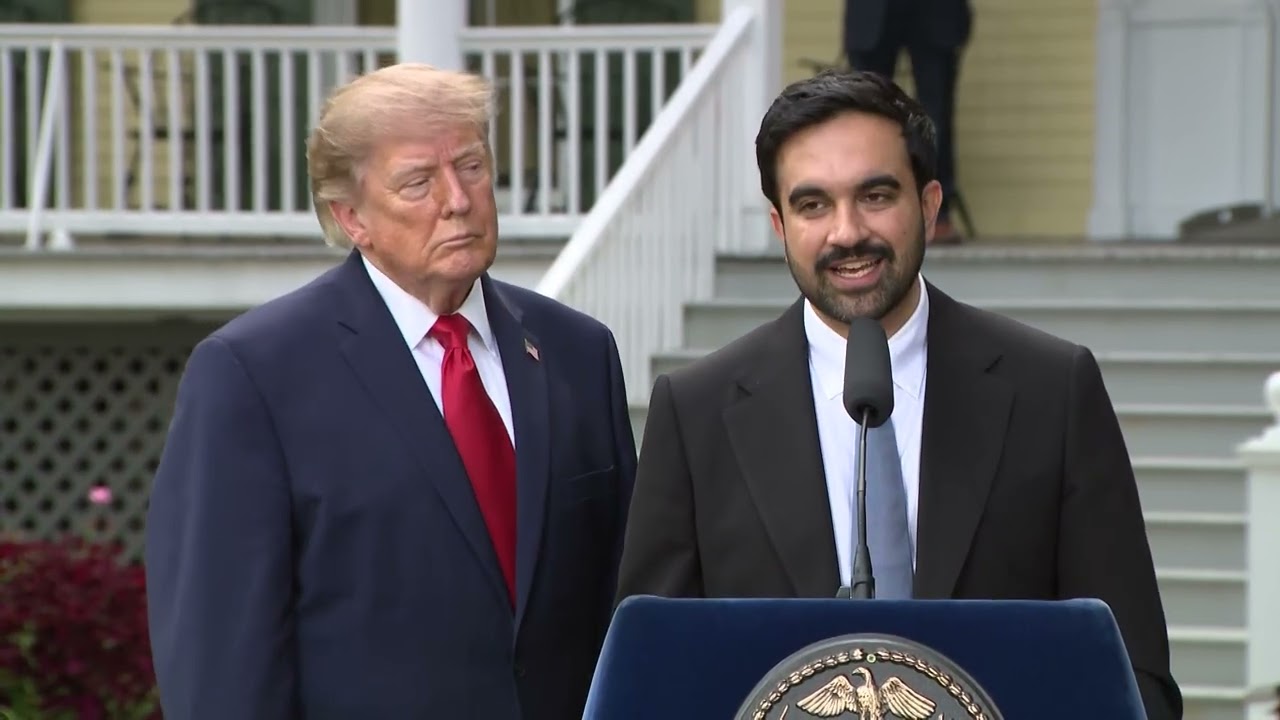
Mayor Eric Adams hosted President Donald Trump at Gracie Mansion for a press availability focused on improving life in New York City, specifically addressing the cost of living crisis and economic growth. During their meeting, the two leaders discussed several key topics that consistently arise in their conversations, including how to utilize government power to support residents. A central point of discussion was the potential development of Sunnyside Yard, a project that could create an entirely new neighborhood with approximately 12,000 homes and 30,000 jobs. The mayor expressed his appreciation for the President's interest in this initiative, noting that while significant federal approvals and funding would be required, the location holds great potential to transform a currently underutilized area into a thriving community where working families can afford to live.
The dialogue also touched upon critical issues of affordability and immigration, with both leaders acknowledging deep disagreements on certain policies while maintaining a willingness to collaborate on tangible outcomes. President Trump addressed questions regarding his administration's stance on media outlets, defending his decision to restrict access for certain news organizations as an obligation to prevent "fake news" and protect national security. He highlighted the economic successes of his term, including record investment numbers and the resolution of conflicts abroad, while emphasizing that he does not seek positive coverage but rather believes in fair reporting. On the topic of Temporary Protected Status (TPS), particularly for Haitian communities, the mayor reiterated his strong commitment to protecting these residents, arguing that their stability is vital to the city's economy and social fabric.
Throughout the event, the atmosphere remained cordial despite political differences, with President Trump expressing hope that Mayor Adams would become a great leader in New York City. The President shared personal anecdotes about Gracie Mansion, recalling his own history with the building and its significance as a home for previous mayors, while also mentioning a specific detail about getting married in the blue room at City Hall. The discussions were productive, leading to an agreement to elevate the conversation on Sunnyside Yard from general talks to technical and operational levels between teams at City Hall and the White House. This shift aims to move beyond high-level concepts to address the specific legal authorizations and financing mechanisms necessary to bring the project to fruition.
In conclusion, the press availability underscored a pragmatic approach where political opponents set aside ideological differences to pursue concrete benefits for New Yorkers. The mayor emphasized that his strategy involves meeting with anyone who can deliver relief to the city's residents, citing previous successes such as securing the release of detained students and advancing the Sunnyside Yard project as evidence that these conversations are worthwhile. While acknowledging ongoing tensions regarding immigration enforcement and media criticism, both leaders agreed that focusing on deliverables like housing construction and job creation offers a path forward for the city. The meeting ended with a shared commitment to continuing these efforts, ensuring that the voices of millions of New Yorkers struggling with high costs remain at the forefront of their collaborative agenda.
Read the full video transcript
Good afternoon everyone. This afternoon,
President Trump and I met at Gracie
Mansion to discuss the city we both are
so fortunate to serve, New York City.
Each time the president and I speak, it
is about the same topics. How to improve
the lives of New Yorkers and how to use
the power of government to take on the
cost of living crisis to grow our
economy and to build a better, stronger
New York. Each day, millions of New
Yorkers struggle to get by. In a city
where a decent life costs too much,
where a future of possibility and
prosperity feels forever just one
paycheck out of reach, where dignity is
not accorded to all, but only afforded
by some. I have said time and again that
I will work with anyone, no matter what
party they belong to, no matter how much
we may disagree on other topics, whoever
has the power and the will to lift that
weight off New Yorkers backs. At a time
where hundreds of thousands of New
Yorkers are asking the questions of how
they can afford this city, I appreciate
the conversation the president and I
have had on the subject of how we can
make it easier to afford life in this
great city that we call our home. With
that, we will take questions just before
if the president if you want to add any
remarks.
>> Well, thank you very much, Mr. Mayor.
I've been at Gracie Man. we were
discussing quite a few times over the
years a lot and it sort of feels like a
home and it's a special place, a very
special uh a beautiful place when you go
inside and I've seen it with numerous
different mayors and I said some great
ones and some not so great ones. So
hopefully you're going to be a great
one. I'll be able to say you're going to
be a great one and you're off to a
start. So I just uh want to thank the
mayor for the invitation. I'm in New
York to do the United Nations tomorrow.
Tomorrow I have a lot of meetings right
now today, very important meetings with
heads of different countries. But uh
this is like a little bit of old home
week for me because so many things we've
done so many things from the beautiful
home or house or building standing right
behind me. Uh and if you have any
questions, we'd love to take them. Thank
you.
>> Thank you, Mr. President. Thank you, Mr.
Mayor. We're going to start with NJ
Briquette and please wait for the
microphone. Thank you.
>> Thank you. Um Mr. President, Mr. Mayor,
there aren't too many Democrats who
would roll out the red carpet for Donald
Trump. You did that today. What tangible
results, achievements, could you point
to from your relationship with the
president?
You know, one of the focuses of the
conversation that the president and I
have been having is about the
possibility of building more housing
here in New York City. We've spoken
about Sunnyside Yard and it's a real
pleasure that just today we've agreed to
set up a new level of that conversation
between our housing and operations team
at city hall and the White House team
because what we're speaking about is
12,000 homes, 30,000 jobs, the prospect
of an entire new neighborhood in a city
where housing is the number one cost.
And I appreciate the president, his
interest in this. And we also know the
president not just as the leader of the
country, but also as someone who has
built quite a lot of housing here in our
city. I don't know, Mr. President, you
want to add anything?
>> Well, I can tell you that Sunnyside's a
big job. I've been watching that for 35
years. Everybody's wanted to do
something with Sunnyside Yards. Well, we
met at the White House a couple of
times, but we met at the White House. Uh
the mayor brought that up, the
possibility of doing Sunnyside Yards.
It's a very uh I would say that was a
very federal oriented job. You're going
to need a lot of federal approvals and
probably some federal money to do it.
But uh it's always been a great
location. I owned a building in
Sunnyside. It was a great building. I
know it very well. So when he mentioned
Sunnyside Yards, they've been talking
about developing that for 50 years. So
maybe they have a shot at doing it.
>> Thank you. Next, we'll go to Jared in
the first row. Please wait for the
microphone.
Mr. Mayor, Mr. President, this is the
first time that a sitting president has
visited Gracie Mansion in decades. Mr.
President, on the way here, you posted
that this is one of your favorite places
in the world. Why is that? And Mr.
Mayor, what did you show the president?
What did you want to see?
>> Well, I can say from my standpoint, I
love New York and this represents New
York. This is where the mayor lived and
uh continues to live. and we were
discussing it a long time ago when you
first got elected. I said, "Well, you're
going to move because you you were maybe
having some doubts about moving in
because it is a little bit on the
luxurious side." And I said, "When
you're the mayor, you have to live
there." So, uh, and he's done that. And
it was very nice inside, beautifully
kept, and but it's a very, very, uh,
representative place of New York. Very
important place.
You know, we we appreciate the
president's commitment to the city and
today, you know, the the president
shared many of his memories of having
been to Gracie Mansion before, having
been out here uh as well on the lawn and
we appreciated the conversation of how
we can work together to deliver a lower
cost of living for New Yorkers.
>> Thank you. We'll go to Gloria next.
>> Thank you. Uh so, Mr. President, you
spoke about Sunnyside Yards. Are you
committing to supporting that project?
And it sounds like you also talked about
affordability. You have dismissed that
in the past. Uh but that is one of Mayor
Mandani's key uh agenda items. So did
you talk about affordability and did you
is there anything you can do for
affordability uh for New Yorkers?
>> Well, I know a lot about affordability
because I did that housing. I did many
many uh low-income and moderate income
buildings over the years and had great
success with it. We have uh we really
were it was very important. I would
think that Sunnyside would have to have
a a component at least a pretty
substantial component of exactly that.
So yeah, we discussed that if if you do
Sunnyside, I think you're going to have
to have that kind of a component.
>> Thank you. We're going to go to Laura
and this will be the last question for
the president.
Thank you. Mayor, to you first. What's
your response to President Trump banning
outlets from the White House grounds?
Did you challenge him at all about this
in your meeting with him? Historians and
legal scholars have called it textbook
authoritarianism. And Mr. President, are
you banning outlets like MS Now, CNN,
and uh Politico in order to distract
from the Iran war and high gas prices?
Yeah, I I I told the president uh that
we're going to have all of the members
of the press here on the lawn and that
is something that I believe in is as is
everyone, no matter the opinion or the
critique that we engage. And Mr.
President,
>> it's interesting because uh they said
they were going to boycott me, but they
never boycott me. So, I wasn't very
worried about that. Look at all that
press. But uh, no, I'm not. I'm only
doing it because I think the press also
has an obligation. And you know, I won
in a landslide. I won the election in a
landslide. I've done great things. I've
done a lot of great things. I've settled
eight wars. We have the best economic
numbers for the country in the history
of our country. We have 21 trillion
dollars pouring in. The biggest number
ever, any country was three. Nobody's
ever done what we've done. I never get
anything positive. It's always negative.
uh even having to do with the war. We've
done so well. We have to look they're
not going to have a nuclear weapon. Let
me just put it that way. And they're not
doing well. They're not doing in fact I
have meetings on it today. They're
they're doing very poorly. Uh you would
think that an outlet would write at
least reasonably well, but never. If you
look at CNN is fake news. If you look at
MS Now, I don't even know what MS Now
is. I guess it's the MSNBC, what it used
to be, or MSDNC as some people call it.
That's Democrat National Committee. But
it's just biased news. And I think that
these outlets have an obligation to be
fair. And if they're fake news, I really
think I have an obligation not to allow
them into another very special house.
This is a special house, Gracie Mansion.
Well, the White House is the most
special of all houses. I have to say,
and I don't even think the mayor would
argue with that. And I think I have an
obligation not to let fake news. They're
very bad for the country, very bad for
national security. So, I have that
obligation. And so we'll see how it
works out.
>> Thank you. That's all the time the
president has. Thank you all so much.
>> Talk about TPS which affects so many
who have their TPS.
>> The mayor will stay to take a few
questions. Um
>> you want to talk about TPS. A lot of New
Yorkers are here on protected status and
it's been removed.
>> Well, the mayor feels very strongly
about it. I can tell you and he did
bring it up, but he feels very very
strongly about it.
>> How do you feel? Will you change
anything?
>> I feel strongly about a lot of things. I
feel strongly about taking care of
people and that's what we do and we're
doing a good job of it.
>> Thank you, Mr. President.
>> Thank you so much.
>> Thank you very much. Thank you very
much.
>> Appreciate.
>> All right. The mayor will have time for
a few more questions. Um we can go to
New York one. Got Kelly Mana over here.
>> Hi. Right over here. How are you? The
president is still here.
>> The president is still here. I want to
follow up on what he said about the
mayor. The mayor you said, Mr.
presidential mayor. Before you go, the
president is saying he can answer a
couple more questions.
>> Oh, okay. Great. Um, so for both of you
then, um, Mr. Mayor, the president said
that he hopes that you'll be a great
mayor. I wonder, um, what your thoughts
are about that. Also, tell us what the
conversation was around TPS and
immigration overall. And also a question
for the president. What made you think
about today's um I guess uh discussion
and your time with the mayor that made
you think he was going to be a great
mayor or that you hope he's going to be
great when you've had so many criticisms
for him in the past?
>> You know, I I'll leave it to New Yorkers
on your first question to make their
judgments. Um, on on your second
question, as the president said, uh, I
shared my my very strong opinions about
how we can keep New Yorkers safe, how we
can keep immigrant New Yorkers safe, and
how important immigrant New Yorkers,
especially Haitian New Yorkers, are not
only to the fabric of our city, but also
to our city's economy, to so many of the
industries that build our city and the
stability that is in the president's
hands. And I appreciate the conversation
that we had and and the consideration to
that end. And I'll you had your third
question for the president.
>> No, I I certainly hope he will be a
great mayor. You have to understand I
want what's good for New York. I want
what's good for the country. So if I had
a choice of having him be a bad mayor or
horrible mayor, I don't want that. I
want him to be a great mayor. And he
certainly got potential. Got great
potential.
>> Thank you so much. That's all the time
we have. Thank you all.
>> Thank you very much. Thank you very
much.
You talk
All right, we're going to start with
Miles from Bloomberg. We have time for a
few more.
>> And this time, let's wait for the
microphone, please.
>> Good to see you yell without the mic, no
matter who it's for.
Mr. Mayor, uh can you tell us can you
tell us um just you know now he's not
here. So um what was your what was your
reaction to um some of the things he
said up there specifically about TPS? Um
what was the conversation about TPS?
Were you in there with Steven Miller?
What was what was his and Susie Wilds's
thought on on TPS, a big issue that's
happening in this in this city?
>> So I appreciated the conversation. It
was a productive conversation. Steven
Miller was was not a part of the
conversation. And it was myself, uh, the
president, Susie Wilds, my chief of
staff, El Bisgard Church. And
the what I made the case about is just
how critical this is to so many New
Yorkers. And how I hear about this not
just from those New Yorkers, not just
from their families, but also from their
pastors, from developers, from
executives in healthcare and
hospitality. the especially when we're
talking about Haitian New Yorkers, we
are talking about one of the most
critical communities in our city. And
when we're talking about the status,
we're talking about something that can
either deliver or deny stability in
their lives and the lives of those who
love them. And so I I made very clear
this is a priority for me, a priority
for our city, and I appreciated the
consideration.
>> Thank you, Miles. We're going to go next
to Sahaley from City and State.
>> Okay, never mind. We're gonna go to
Morgan Mai.
Thank you so much.
>> Hi, Mr. Mayor.
>> Hey, Morgan. How's it going?
>> I'm good, thank you. Um, I just want to
know what went into this meeting. Did
you reach out to him? Was this part of
your conversation from the last time?
Um, and and what did you guys do inside?
Did you show them around? Uh, did you
show them what's new? Did they test out
the beds? No. Um, then also, um, I just
had to ask as well, uh, that did you
guys also discuss, um, federal funding
when it comes to, um, the, uh,
counterterrorism funding for the NYPD
and the missing funding? Hogal had said
that she was hoping that you would talk
about it.
>> We we had a wide-ranging conversation.
It extended from a conversation around
the importance of our police department.
It went to TPS. Uh it also extended to
Sunnyside Yard. And to your the first
part of your question, I appreciated
not only having that conversation with
the president, making the case on behalf
of New Yorkers, the president also has
many memories of Gracie Mansion. He's
been here a number of times. I shared
with the president also that I recently
learned that he actually got married in
the blue room at city hall um which is
where many of us spend a lot of our time
with press conferences and Q&As's um and
with the president sharing the historic
nature of this building not only as it
has been home to mayor Fieruardia but
also that it has so much of the history
of this country there's a cannonball
from the revolutionary war there's a
fireplace uh from from the residence
where Aaron Burr died after his duel
with Alexander Hamilton. Uh so that is
all a part of this building as well.
>> All right, we're going to have time for
a few more. We're going to go to cranes.
Uh Jack on the other end there.
>> If you could just wait for the
microphone. Thank you.
>> Hi, Mr. Mayor. Um back to Sunnyside
Yards. Um or Sunnyside Yard. Uh 21
billion was the number that uh you all
put out before. Is that something you
actually think that the federal
government will put forward? Did you
talk about the kind of dollar amount?
And then also, um, this is the kind of
thing that can get kicked down the road.
Um, are you able to give us any kind of
timeline of when you would like to see
actual movement on the Sunnyside
Sideyard project?
>> We are sincerely
interested and committed to this as an
idea, which is why it's been the focus
of the conversations I've had with the
president, not only in this meeting, but
also in the prior meeting at the White
House. And again, what we're talking
about is something very rare in our
city. It's the possibility of
constructing an entirely new
neighborhood. Uh and again, it's only
possible with federal partnership
because of not only the scale of funding
required, but also the authorization in
constructing a platform that would then
serve as the foundation for about 12,000
homes, about 30,000 jobs. And it would
be transformative, not only in terms of
working people uh who could create this,
but also and and be paid enough to be
able to afford to live in the city, but
also working people who could actually
live in a neighborhood that today is a
trainard. Thank you. We've got time for
two more. We're going to go to Jeff Maze
and we'll finish with Joe and Nuda.
>> Just wait for the microphone.
>> How you doing, Jeff?
>> Half a tan suit.
>> So, yeah. I mean, you know, I had to
wear before summer was over. Well,
summer is over. Summer's done.
>> I'm still wearing it anyway. Um,
>> I want to ask a little bit about how
this meeting came about. Um, could you
tell us a little more? Did you invite
him? um you know did you expect to have
certain things uh addressed while here?
Did you have a sort of agenda before uh
meeting him uh when he came here? And
then the second question is Hakeim Jeff
was strongly criticized for meeting with
Jared Kushner, president's adviser. Um
do you think you should be criticized
for taking time to meet with the
president? Look, I think the
I I said this in my opening remarks that
I committed over the course of the
campaign as well as while being in
office that I would meet with anyone,
work with anyone that could deliver for
New Yorkers. And in the previous
meetings I've had with President Trump,
we've been able to secure the release of
a New York City college student who had
been detained by ICE. Uh we've been able
to move forward what has been a
long-standing dream uh about the
construction of Sunnyside Yard. And we
know we have significant way to go, but
these meetings do truly assist in in
that path. And to me, the question
always is how can we deliver for the
city? How can we deliver for the people
of the city? And so having a
conversation about potentially building
12,000 homes, about the importance of of
our Haitian neighbors here in this city,
those are conversations that are
worthwhile to have. And to the first
question, uh, this was part of a
conversation I was having with the
president and I invited the president um
to to come to Gracie Mansion and he had
also remarked to me in prior
conversations about how much how many
memories he has of of this as as a home
for prior mayors and I thought it would
be a good location for a continuation of
the conversation of how to deliver for
the people who are being priced out of
the city.
>> Last question will go to Joe.
>> Mr. Anuda,
>> Mr. Mr. Mayor, how are you
>> doing? Well, how are you?
>> Um, I'm well. Two questions. Um, you
said that you're taking the conversation
about Sunnyside Yard to the next level.
Can you give us any detail about what
that means? I mean, you've already
brought the plan to him before. So, what
does the next level mean?
>> So, the the conversations have been
continuing uh about this project. What
today we made an agreement on was that
the conversation would now be elevated
to a place where it's going to also be
technical between our housing teams, our
operations teams and the White House.
And that is critically important because
as you heard earlier from the question
from cranes, yes, there's an aspect of
this that is about financing. There's
also an aspect of this about technical
and and legal authorization of the
construction of a platform. That's what
this kind of a conversation facilitates.
>> Okay. And then my second question, um I
think a lot of people see your strategy
around the president curbing criticism
of him. I I feel like you don't often
launch personal attacks against him. Um
you don't talk about how often you speak
or what you speak about u when we
typically ask you at press conferences.
And I think a lot of people see that as
a way to kind of uh avoid incurring his
wrath in a way uh especially with
immigration enforcement. But we've seen
since January that uh ICE arrests have
increased um since you became mayor. So
I'm wondering, do you still think that
this tactic is worth it to sort of take
a softer touch with the president in
exchange for maybe sparing New York City
more enforcement? And is there a point
where this no longer makes sense for
you?
>> You know, the president and I have both
been very frank about the many
disagreements that we have and
immigration is one of those places. uh
we've both spoken about very different
approaches, very different beliefs and I
will continue to have conversations with
the president and frankly with anyone
who can deliver relief to the people of
the city. And to me, you know, in in the
past meeting at the meeting we spoke
about Sunnyside Yard, we introduced that
conversation. 30 minutes after the last
meeting, he he called me to let me know
that the list of students that we had
put forward to him that he was going to
release one of them. Soon after that, he
released another one of them. And
frankly, if if a meeting can be the
difference between detention and
dignity, it's a meeting worth taking. Uh
all while being honest about the
disagreements that we do have.
>> Thank you. That's all the time we have.
Thank you.