Video summary
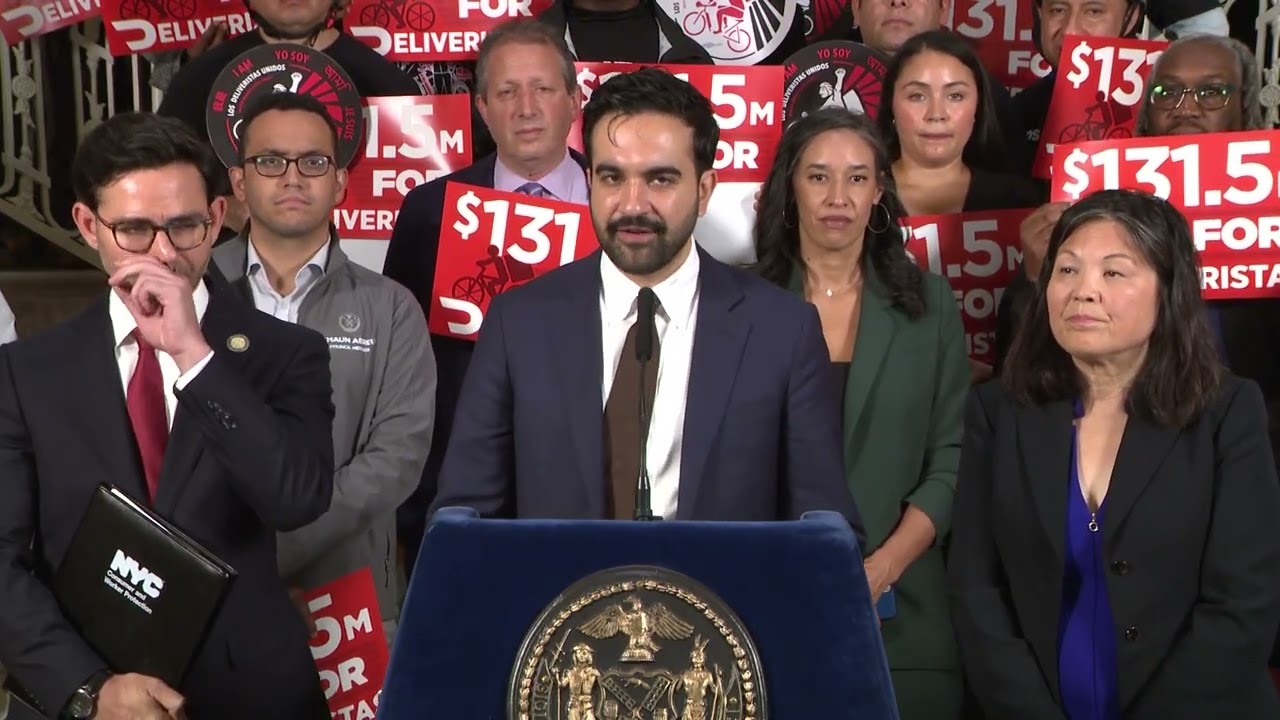
New York City Mayor Zohran Mamdani has announced a landmark $131.5 million settlement against Door Dash, representing the largest labor enforcement action in municipal history. The Department of Consumer and Worker Protection determined that the delivery company systematically underpaid over 260,000 workers between April 2022 and June 2026 by excluding specific work categories, such as canceled trips and time spent crossing city limits, from their pay calculations. While $16 million of the settlement is allocated for penalties and administrative costs, more than $115 million will be distributed directly to affected workers starting in late October without the need for individual claims.
To prevent future abuses, the agreement mandates that Door Dash submit detailed monthly data for three years regarding minimum pay rates, trip disclosures, and tip transparency. The city is also implementing a new system where delivery workers, partnered with the Workers Justice Project and the Workers Algorithm Observatory, can directly record app data to share with authorities. This initiative allows workers to independently verify compliance and crowdsource oversight against what officials describe as "greedy algorithms," effectively shifting enforcement power from corporate consultants to the workers themselves.
The announcement featured speeches from Deputy Mayor Julie Sue, DCWP Commissioner Sam Lavine, City Council members, and Workers Justice Project Executive Director Leia Gualpa, who emphasized that this victory validates worker organizing and government partnership. During the event's Q&A session, officials clarified that Door Dash's obligations began immediately regardless of software rollout timelines, addressed concerns about data privacy by affirming workers' ownership of their data, and confirmed that similar algorithmic exploitation is a broader issue across various industries. The administration also took time to address unrelated questions regarding the Mayor's meeting with President Trump on housing projects in Sunnyside Yard and his stance against Prime Minister Benjamin Netanyahu.
In addition to labor issues, Mayor Mamdani discussed ensuring staff support and compliance at a youth detention facility, highlighting observed improvements in skills training, recreation areas, artwork, and karaoke competitions aimed at equipping young people with the tools to flourish upon returning home. Addressing affordability, the Mayor noted President Biden's shift in rhetoric regarding the term "affordable" and confirmed high-level conversations between their housing operations teams and the White House to develop large-scale affordable housing. He emphasized that the Sunnyside Yard project aims to create a new neighborhood by building atop an existing rail yard, targeting significant affordable housing portions to support working New Yorkers, particularly Haitian communities vital to the city's economy, while discussions with the President extend beyond housing to include broader affordability issues like groceries and rent freezing.
Read the full video transcript
How are you?
>> Yes,
>> good morning everyone.
>> Good morning. Mayor Mom Donnie promised
just outside on those steps on the day
he took office that we would tell a new
story of our city. Not a tale of one
city governed by the 1%. Not a tale of
two cities, the rich versus the poor,
but a tale of eight and a half million
New Yorkers. So often, many of those New
Yorkers are those we depend on every
day, yet who operate in the shadows.
They are somehow ever present, but still
invisible.
Today, we're here to announce what
happens when their stories are told.
What happens when government listens and
we take action?
Hundreds of thousands of delivery
drivers work in the city every day. Door
Dash built a system that was quietly
leaving out categories of trips and on
call time. So the real amount of work by
deliveristas wasn't counted.
Worse, that practice was hidden from
workers, making it almost impossible for
them to know when they were underpaid.
Some were paid late, some weren't paid
at all. 260,000 workers denied a just
day's pay for a hard day's work, while
the company who profited from their
labor hid behind an app.
Today, we make things right, giving $115
million
straight back to those workers.
But today's settlement isn't just about
looking back. It's also about preventing
the abuses in the future. Because the
most effective enforcement isn't just
about what government can get for
workers. It's about workers having a
greater ability to protect their own
rights. For the first time, the city's
settlement gives workers an active role
in enforcing their rights. an approach
that we are taking across the
administration.
Workers themselves in partnership with
the workers justice project and the
workers that's right
and the workers algorithm observatory
will share their trip and pay data
directly with the DCWP on an ongoing
basis.
The city will not rely solely on Door
Dash's account of whether deliveristas
are being paid properly for all their
work. Workers own voices, their own data
will guide our oversight of compliance
and ensure that workers receive every
cent they're owed. In this city, no
one's earnings should be obscured behind
an app. No one's hours determined by an
algorithm. and no worker who makes our
city run should be treated as invisible
in it. And today we take a big step in
getting closer to the city that Mayor
Mandani promised.
With that, it is always my pleasure to
introduce New York City's mayor,
Zoronwame
Mdani.
Good morning everyone.
>> Morning.
>> It is a pleasure to be here today
alongside friends and partners as we
celebrate a major victory for the
working people who call New York City
home. The largest enforcement action in
New York City history. I want to
acknowledge that we have leaders here
both inside and outside of city
government. We have our deputy mayor for
economic justice, Julie Sue. We we have
our commissioner of the department of
consumer and worker protection, Sam
Lavine.
>> We have
you heard from our deputy mayor about
the importance of the workers justice
project in both this work and all that
will come from it. We are proud to have
Liia Gualpa, the executive director of
the workers justice project.
We also have Rosendo Takam, one of the
first deliveristas to file a complaint
with DCWP about his experience.
And I want to thank, you will see here,
city council members who have been on
the front lines of this fight for so
many years. We have majority leader Sha
Breu who's here, also the chair
of the city council's transportation
committee. We have council member and
former assembly colleague Harvey Epstein
who is here. The chair on the committee
on consumer and worker protection. We
have council member Sandy Nurse who is
here.
>> If ever you need a public bathroom and
you find one, you should thank Sandy.
>> And we have council member Jen Gutierrez
who is here.
>> One of the foremost voices and fighters
for universal child care this city has
ever known. And it is a pleasure because
we are also finally joined by someone
who once knew this building, then was
the controller, and soon will be a
congressman from our city, Bradlander.
>> Now, two months ago, Tony Shu, the CEO
of Door Dash, gave business owners a
piece of advice. A CEO, he said, has to
take the greedy algorithm and keep going
all the way to see if there is more. In
computer science, a greedy algorithm is
one that makes the most optimized, best
short-term outcome choice at every step
and never weighs the consequences. New
York City and the tens of thousands of
delivery workers who call our city home
have reckoned with greed as a business
model for far too long. Every day in
heat, in snow and in rain, delivery
workers carry goods and food to every
corner of the city. Early morning egg
sandwiches, late night lain and the
emergency Pepto-Bismol that could not
have come sooner. Thousands of them
deliver for Door Dash and thousands of
them have felt the human cost of the
greedy algorithm. For years, Door Dash
failed to count every hour worked by
delivery workers. This was not a
rounding error or an accidental mistake.
In 2023, when the city began enforcing a
minimum pay rate for delivery workers,
Door Dash left time out of the count,
time on canceled trips, and trips that
crossed city limits. Investigators at
our incredible Department of Consumer
and Worker Protection went through
terabytes of Door Dash's own data. After
analyzing 152 million payments and 110
million hours of work, they arrived at a
staggering conclusion. Door Dash had
underpaid more than 260,000
delivery workers across New York City
between April of 2022 and June of 2026,
often in violation of the minimum pay
rate. Today, after years of corporate
greed and impunity, we are holding Door
Dash to account.
I am proud to announce that Door Dash
will pay more than $131 million, the
largest settlement for food delivery
workers ever secured in American
municipal history, and a landmark win
for those who have been mistreated and
abused for years with nowhere to turn.
City Hall will not sit idly by while a
mega corporation that made nearly a
billion dollars in profits last year
rips off the working people who keep our
city moving. Thanks to the work of DCWP,
Door Dash will now have to pay more than
$115 million directly to more than
260,000
delivery workers. No worker will have to
file a claim or submit evidence. Our
administration has already identified
who is owed. And in late October,
workers will receive an email detailing
their exact amount. But we know
accountability does not end when a check
clears. That is why, as the deputy mayor
said, for three years, Door Dash must
also send DCWP detailed data every month
to check compliance on minimum pay,
maximum distance, trip disclosures, and
pay and trip and tip transparency
rather. To ensure those numbers are
accurate, we are relying on the people
who know this work best, the workers
themselves. As you have heard, the
Workers Justice Project and the Workers
Algorithm Observatory are engineering
software that lets delivery workers
record the Door Dash app and share it
directly with the city. For the first
time, workers will have the power to
crowdsource data and investigate the
blackbox algorithms that dictate their
schedules and pay. Door Dash cannot
prevent or penalize a worker for using
this tool. And if Door Dash tries, we
will fasttrack any retaliation case to
get that worker reinstated. Today's win
builds on the work we have been doing
since January to ensure that every
delivery worker is paid what they are
owed. That includes a settlement of more
than $5 million in back pay and
penalties from Uber Eats, Hungry Panda,
and Fantoine, and more than $104 million
won in additional tips. To every
delivery worker, check your email in
late October at the address you last
used with Door Dash. If you have
questions about what you are rightfully
owed, go to nyc.gov/door
dash. And to any corporation that has
built a business model on greedy
algorithms and worker exploitation,
consider this your notice. If you keep
trying to rip off New Yorkers, we will
be happy to make history again. This is
New York City, where hard work pays and
greed will cost you. Thank you.
>> And now with that, if you will please
join me in welcoming someone without
whom we would not be able to stand here
today, our commissioner of DCWP, Sam
Lavine.
>> Thank you so much, Mr. Mayor. What a
great day.
>> We are in excellent company today. I'm
grateful to be joined, of course, by the
mayor, by a champion for workers, Julie
Sue, deputy mayor Julie Sue, soon to be
Congressman Lander, as well as our
steadfast allies on the council, uh,
Harvey Epstein, Sandy Nurish, Jennifer
Gutierrez, and Shauna Breu. But most
importantly, I am thrilled to be here
with the delivery workers who make our
city run.
without whom this victory would not have
been possible. I am incredibly proud
today to announce this historic victory
for New York City workers. As the mayor
said, our action against Door Dash is
the largest labor enforcement action in
New York City history, recovering more
than 131 million with 115 million of
that dollars going directly into the
pockets of hardworking deliveristas who
were denied the pay that they earned.
But as grand as that figure sounds, this
case is really humble origins began when
ordinary delivery workers, some on the
stage, came to our department concerned
that Door Dash was paying them late or
not paying them at all. They stepped
forward despite the risks to themselves,
despite the constant threat of
deactivation, and despite the cynicism
so many people understandably feel about
whether the government can actually
deliver for them.
Then DCWP's lawyers and investigators
got to work. Through interviews with
dozens of workers and rigorous analysis
of billions of rows of pay data, we
found for years that Door Dash had
underpaid thousands of deliveristas for
their work and failed to pay thousands
more on time. I think there are a few
important lessons in what happened next.
First, this validates Mayor Mandani's
historic investment in DCWP, the largest
investment in worker protection in the
history of New York City. This
investigation began during the last
administration, but thanks to the
mayor's investment, we were able to
accelerate our work dramatically. And
Door Dash understood, as every company
operating in the city should now
understand, that if we could not reach
an agreement that made workers whole, we
were prepared to take them to court.
It's clear that the mayor's investment
in enforcement is already paying
dividends directly into workers'
pockets. But this case stands for more
than that. This case shows that in New
York City, the collective power of
workers can still prevail against
concentrated corporate power. So-called
gig companies built a business model
around isolating workers, making it
harder for them to organize, harder for
them to bargain collectively, harder to
even know what the worker next to them
is, whether they were being paid more or
less for the same job. Algorithms,
greedy algorithms, made that model ever
more powerful. They allowed companies to
make millions of individualized
decisions about workers, their pay,
their assignments, even whether they
could continue working while workers
themselves were left in the dark. This
case rejects that model. It shows what
happens when workers stand together, as
we see behind me, and when they are
backed by a city government relentlessly
committed to enforcing their rights.
Because in New York City, algorithms
don't make the rules. the people do. And
that principle is reflected in the
settlement itself. I spent years as a
federal regulator watching large
technology companies mislead the
government, ignore court orders, and
cheat consumers and workers. And too
often, government responded by
outsourcing compliance monitoring to
expensive consultants. Sometimes the
very firms seeking business from the
companies they were supposed to monitor.
We're doing something a little different
here in New York City. Door Dash will be
required to regularly submit data to
DCWP where our own staff will analyze uh
will analyze it to make sure workers are
being paid what the law requires. But
we're not stopping there. Working with
the Workers Justice Project and the
Workers Algorithm Observatory, we are
engineering software allowing workers to
share their own Door Dash data directly
with DCWP.
That gives us an independent way to
detect underpayment, compare what the
company tells us with what workers are
actually experiencing, and take swift
enforcement actions if those numbers
don't match. I'm enormously proud that
we are putting this power not in the
hands of management consultants, but in
the hands of workers themselves.
And that brings me back to where this
case began. With the workers who knew
something was wrong and were willing to
speak up about it. Door Dash had the
technology, the data, the enormous
power, the greedy algorithm over the
people who worked on its platform. But
workers had each other and they had a
government willing to listen, to
investigate, and to act. Workers spoke
up. We followed the facts. And together
we turn billions of rows of corporate
data into tens of millions of dollars
back in workers pockets. This is truly
what happens when workers stand together
and government has their back. And I'm
so grateful to everyone here for making
this victory happen. Thank you so much.
>> Our next speaker is Councilman Harvey
Epstein.
Who's got the power?
>> Who's got the power?
>> Thank you all for being here. For folks
who don't know me, my name is Harvey
Epstein, council member in district 2.
Um, and I really want to thank the
mayor, the deputy mayor, the uh the
commissioner about the work that they're
doing. We talked earlier in the year
about the need to having more power,
more tools at our disposal to do this
type of enforcement action. And the
mayor and the deputy mayor listened and
they this is historic investment in
DCWP. And it's really showing this year
alone, I don't know, we've done six,
seven, eight of these press conferences
in in a nine-month year where we're
talking time and time again how workers
are getting screwed over, but government
is here to respond. this $131.5
million enforcement action against Door
Dash. That is historic. I really want to
thank the mayor for his leadership, for
your team putting this amazing team
together to talk about how delivery
workers day-to-day were getting abused
and how corporations were taking
advantage.
Door Dash underpaid 260,000 workers,
260,000 New Yorkers who are low-wage
workers just trying to survive. A
corporation thought they'd take
advantage of those individuals because
they had no power. But today, we're
sending a different message. We're
saying they have power because of
organizations like Workers Justice
Project. We're saying they have power
because of DCWP.
We're saying they do have power because
of the mayor of the city of New York.
Those tools now are available to them. I
want to thank my council colleagues
before because before I got here, we
talked about changing the laws on
minimum wage for workers. We're talking
about rules around deactivation and my
colleagues who stand behind me were
there on the forefront making sure that
happened. This partnership,
this historic partnership is
transformative for low-wage New Yorkers,
for New Yorkers who felt like they were
being forgotten. We are sending the
message out to every single corporation
that hires or engages with low-income
New Yorkers. We're watching. We're going
to continue to watch. And for those
workers out there who hear us today, if
you have a concern or you have a
question, come forward. You have a city
who's willing to listen. You have a
council that wants to hear from you
because we together can make the
difference for workers across this city.
This is a huge victory for low-income
workers. And I want to make sure that
people understand how huge this is. But
this may not be the last one this month.
This may not be the last. Definitely not
the last one this year. So workers and
people out there know together we can
fight for a better New York. Thank you
all for letting me be here.
>> Our next speaker is also someone without
whom we would not be all standing here.
It's executive director of the workers
justice project Leia Gualpa.
>> Thank you so much.
>> Woo. Okay. Well, uh, well, thank you so
much to the mayor, the deputy mayor, the
commissioner, the council members, and
everybody here who has had the workers
justice project, but workers back since
day one. And today is not just a
beautiful day. It's a powerful day for
the liaristas across the city.
Today, workers who have been fighting
for years are seeing the power of their
organizing
and are seeing justice being delivered
to them.
My name is Liha Walpa and I'm the
executive director of the workers
justice project which is the home of
Losistas.
And let me tell you who Losista are.
It's a powerful union of app delivery
workers who took the streets
when the city shut down, organized,
built power, fought for respect for new
rights. And today, that organizing has
led to a historic victory. Wow. $131
million settlement.
putting hardearned wages back into the
hands of their families and their homes.
Thank you, Mr. Mayor Mandani.
Thank you, Commissioner. Thank you,
Deputy Mayor Julius Sue, and the entire
DCWT
uh DCWP team who have been standing
since day one against corporate greed,
helping make this victory possible.
Thank you for building a true
partnership where workers can trust the
city, their city government that will
stand and will fight with them for them.
But also, thank you to Loistas Unidos,
the workers, the leaders.
>> First and most Rosendo who had the bolds
and the courage to stand up to Door
Dash.
And then to the organizers who are
agitating in the street to all the
workers saying you also need to come
forward. Antonio, Allejo, William, Jose,
Abu Bakr, Celu, Ria, Maria, and also
Aadu
and the entire team
who work every day to build that bridge
of trust between workers and their city
government.
And we know that's not easy.
It takes enormous cou courage from a
deliverista, a leader and a worker
to look in the eyes of another worker
and say the following. Let's trust our
city government
when the federal government have
abandoned them. Let's organize and
protest against greedy corporations like
Door Dash when ICE is targeting them in
their own streets.
Let's speak up about corporate abuse
even when the own apps are threatening
them to retaliate and fire them.
These are the workers and the leaders
that took those risks. They protested
outside of Door Dash when ICE was
around.
They spoke to the press even when they
had fear of deactivation
and potential ICE targeting.
and they kept showing up demanding their
pay, respect and justice they deserve.
And today
this city government, this
administration, this commissioner have
shown that workers shown workers that
their trust is have not been misplaced.
That this is what true partnership looks
like. Government is standing with
workers. workers building power and
together creating conditions for workers
who keep organizing and for b for
fighting back for everything they
deserve.
And let this message go directly to Uber
Eats, Grapop, Door Dash, and every
little tiny corporations that is trying
to grow big in this city.
Don't mess with loist.
Do not mess with angry, pissed-off
workers.
>> We will organize. We will fight back. We
will definitely come after you. And it
is time for every app to end unjusty
activation because oh yeah, we're coming
after you.
And make sure you give workers
everything they demand, but particularly
the dignity and the respect they
deserve.
Because of you workers, the liberistas
leaders will have power in the city.
And let's make it clear to the apps.
You're messing with the wrong New
Yorkers. Not in our city, not in our
streets, not with the liberistas.
This is our city. This is our power.
Deliverista
>> power.
>> Power.
>> Deliverista power.
>> Power.
power.
>> Power.
>> As you've already heard, every
enforcement effort by government is a
partnership with workers willing to come
forward even when there's great risk.
Maybe especially when there's great
risk. And our next speaker is Rosendo
Takam, one of those workers.
Buenos
deliver.
DC
Victoria.
Boy,ch.
deliver.
Fore! Foreign! Foreign!
Fore
regal.
Victoria,
Victoria.
Gracias.
>> And now the mayor will sign the check.
All right.
All right, now we'll time have time for
some on topic questions before we take
off-topic questions afterwards. So,
please questions about the deliverist's
announcement to start. We'll start with
James from Pix 11. And if you could just
wait for the microphone. Thanks, James.
>> Thank you. I appreciate you. James for
from Pix 11. Uh congratulations. Uh just
so we get the math right, it's 260,000
deliveries. That's about $500 a piece.
Is that correct? And can when we've done
any stories in the past that have
involved uh inequality regarding
deliveristas, uh the comproller had been
part of this and the former comproller,
we've done many stories with him about
this very thing. Uh did it play any role
in conjunction with DCWP? Thank you. I I
will let our commissioner add some
specific details, but before doing so,
what I will say is you are correct that
this is about roughly 260,000 workers.
Of those, more than 27,000
will be receiving more than $1,000. Uh
about a little over 4,000 will be
receiving more than $5,000.
And what this speaks to is not only the
largest delivery workers settlement
action in municipal history, but also
New York City's largest ever labor
enforcement action. And what is so
exciting is, as you've heard other
speakers say today, we know thatund more
than 115 million will go directly to
workers. And then of the remaining 16
million, it's civil penalties, its
costs. It's also the kind of investment
that is required to create the app that
the workers will now be able to use to
record their experience with Door Dash.
Because what we're looking for is to not
just protect these workers, not just to
protect the incredible worker who
stepped forward, but also to protect
every worker that joins this workforce
in the days, weeks, months, and years to
come. Commissioner, if you want to add
anything.
>> I I would just add briefly, we work
closely with the controller on these
cases all the time. This is one that we
did on our own. Uh, our new research and
analytics division, which we announced
the launch of last week, played a key
role in crunching these numbers and
delivering this victory for tens of
thousands of New York City workers.
>> Thank you, Commissioner. Other on topic
questions. Um,
>> hi. Thank you, M. Mayor on.
>> Yes.
>> Okay. Hi, Claudi from the city reporter.
Um, you talked about the uh software
that is being developed um to track
worker complaints. How long has that
been in the works for and what's the
plan to get it up and running fully
because Door Dash um only has to comply
for this for the next three years? Um so
what's the plan there?
>> Yeah, I'll add it over the commission.
>> Sure. Well, let me just start by saying
the Door Dash's obligations to comply
with the settlement start today. We're
not waiting for the software to be
developed. Door Dash will be obligated
to submit regular reports to us, much
more granular than they have to do under
the ordinary minimum pay law. Uh, we are
also requiring Door Dash to regularly
attest under oath that they are in
compliance with the law. With respect to
the app, this is something we've been
thinking about for a long time. I
mentioned in my remarks my experience in
Washington where I saw companies like
Meta ignore court orders over and over
and over again, treat the law as a
suggestion. That isn't going to be how
things go in New York City. That's why
we were so intent on giving workers the
power themselves to collect this data,
transmit it to us so we can respond to
violations. uh we're going to roll out
that software as soon as possible. You
know, we we now have the funding to put
it in place, but Door Dash's obligation
to follow the law starts today.
>> And just before we go to the next
question, I want to just add that um
this is also part of a larger commitment
to holding these delivery companies
accountable. You have heard many of us
on this stage and beyond speak about the
importance of uh interrogating the
algorithms that are behind the
incentives for delivery workers when
they make their deliveries and what they
are pushed to do. I just want to invite
up our city council member Shauna who's
been a real champion and focus on how to
hold these kinds of companies
accountable in case you have anything
you want to add.
>> Well, well, thank you for calling me,
Mr. Mayor. I think that what what the
commissioner has done as well with uh
doing information sharing with the DA's
office has also been important for DCWP
data sharing has been important in terms
of enforcement actions not only at the
civil level but also criminal penalties
as well. Um the the council's done a lot
with tipping transparency laws. Uh we've
done a lot with pay transparency as well
and it's the commissioner's job and he's
doing a great job at enforcing those
laws and giving it teeth and so looking
forward to that continuing partnership.
Thank you, Mr. Mayor.
>> Thank you. All right, we'll go down the
line. We'll go to Sophia and then we'll
go to Laura.
>> Thank you.
>> Um, so I have one quick question which
is is this new data going to be made
public just like the other data is each
quarter? And then my second question is,
you know, all of these delivery workers
are on the streets navigating the
cycling infrastructure. They're riding
bikes and mopeds. Um, and they're
dealing with the dangers of riding bikes
in the city. Do you see these kinds of
settlements as related to street safety
and to your vision zero safe systems
approach goals? I think that they are
all part of how we can protect workers
because we know that it is delivery
workers who spend the most amount of
hours on our streets. They are the most
exposed to either the presence or the
absence of street safety infrastructure.
And we want to make sure that not only
are delivery workers being paid for the
work that they do. not only are we
holding app companies accountable to the
law here in our city, but also that
delivery workers are safe when they are
using uh our streets. And you know, one
of the reasons that I wanted to
acknowledge our city council member uh
Sandy Nurse, who was just here with us,
was that one of the other things we've
heard from delivery workers is can they
access a bathroom? And the other day
when the the mayor of Mexico City was
here, we met with a number of members of
the workers justice project and one of
the things that Leia so proudly showed
was a bathroom access card and a
reflection of the fact that here in New
York City, it is now the law that if you
are delivering for a restaurant, you are
allowed to use the bathroom of that
restaurant. So all of this to us is is
part and parcel of it. Uh commissioner,
the question on the
>> uh a lot of the data Door Dash is going
to be turning over is proprietary, so it
won't be made public. And I think that
speaks to what is so remarkable about
about this settlement. Council passed a
really strong minimum pay rate law. It's
complicated though. Uh the mayor has
been committed to a government that can
actually hold these companies
accountable that's not afraid of
complicated problems. And one of the
things I'm really proud of is that we
have some of the best data scientists
and economists in the world. We're
recruiting, by the way, nyc.gov/job
who are able to actually crunch. I mean,
think about all the delivery data New
York City generates. Folks all over the
city delivering thousands of p thousands
of packages every day. We're going to be
able to track that to a very granular
level and make sure that this kind of
mass underpayment doesn't happen again
in New York City.
>> Thank you, Commissioner. Okay, we'll
take two more on topics before we clear
the podium. You want to just go down the
line? Go ahead, sir. And then we'll go
to Laura from Bloomberg.
>> Hi. Uh, give me one second while I pull
up my question. Sorry. Um, so this this
could be answered by you or uh maybe the
head of DCWP. Uh, is there any concern
uh because uh Mr. Lavine just said that
this is proprietary data. Is there any
concern regarding this uh recording app
that you guys have announced that they
might come back and say, "Well, that's
our data. It's not theirs to even record
uh that they might sort of try to draw a
line about it being theirs."
>> I'll say it in short and then I'll pass
it over to the commissioner to say it in
long. No,
>> you know, for too long we have had this
economy where these app companies
collect vast amounts of data on
individual workers, but neither
individual workers nor government
enforcers have visibility into what's
happening across the board. What we're
doing with this settlement is we are
ending that asymmetry. We are
recognizing for the workers behind me,
the deliveries they make, that's their
data. The pay they earn, that's their
pay. The disclosures they get, those are
their disclosures. So there's nothing
inappropriate at all about having that
data directly transmitted to us and it's
making sure that the kind of
underpayment scheme we saw here is not
going to be repeated in this city.
>> Hi
>> Laura, go ahead.
>> Hey, um, thank you. Um, I I have a
two-part question. Um, the first is, uh,
have the other, as far as you're aware,
have other apps like Uber and GrubHub
been compliant under the minimum pay
rule? And then could you tell us um as
far as the use of these uh greedy
algorithms go, is this a a problem
that's limited to delivery apps or is
this something that you're seeing at
other kinds of companies and other kinds
of industries? Since everything uses
tech these days,
>> we are seeing across a number of
different companies and a number of
different industries a pursuit of profit
no matter the cost. And we want to make
it very clear that it does not matter
how profitable your company is, how
large your company is, you have to abide
by the laws of New York City. They are
not suggestions, they are requirements.
And we are so appreciative of the
workers who step forward and alert us to
these violations because without them,
we would not be able to have put into
place what is the largest labor
settlement in New York City history. and
I'll pass it over uh to the commissioner
to your first question.
>> Yeah.
>> Well, this is absolutely a huge problem
and one of the things I find interesting
and I I wonder if the DM deputy mayor
would agree with me. You know, in
Washington, everyone's searching, well,
what are we going to do about all these
algorithms? What are we going to do
about AI? We're showing what to do right
here in New York City. We're saying we
don't care what the algorithm spits out.
If you're a delivery worker, you're
entitled to about $22 an hour in the
city of New York. And what this
enforcement action shows is that we can
actually deliver on that commitment and
put money back in people's pockets. So
this is a problem across the economy and
New York City is showing the way for how
government can address it.
>> And then just just the first question,
are Uber and GrubHub compliant under the
minimum pay rule as far as you're aware
>> law? Sorry.
>> Thank you. Thank you to uh future
Congressman Lander. It is indeed a law
and if they're not compliant, we're
going to have another big event like
this one.
>> Thank you. Yeah, I know we have time for
just one more actually from channel 7
last on topic.
>> Hi.
>> If you just wait for the microphone,
Jen, thank you.
>> Good morning, Darla Miles, channel 7.
Good morning, everyone.
>> Good to see you.
>> Good to see you as well, mayor. Um, I
just what we're hearing from you and
your commissioner this morning is that
these are very clear algorithms, a very
clear uh pursuit of corporate profits
kind of under the radar and and uh
thinking that the law is an option to to
quote what you said. So, I just wanted
to know if you can uh directly respond
to how Door Dash is characterizing this.
Uh, simply put, we screwed up. Our
mistakes meant some dashers were
underpaid or paid late. While these
mistakes weren't intentional, that
doesn't make them okay. We pride
ourselves in excellence. So, can you
just speak to directly on the notes app?
>> I mean, they're saying kind of like,
"Oops, my bad." You know, can you
respond directly to what Door Dash is
saying? You know, I' I've never heard
someone describe a $131.5 million
settlement in that kind of a language.
We are speaking about something that was
sustained, something that was rampant
for a quarter of a million workers and
something that would never have been
acknowledged, let alone rectified were
it not for the courage of these very
workers. And we also know that when
workers step forward, they are typically
not welcomed in doing so. That is why we
are also making clear that if any worker
is retaliated against for the use of the
app that we are now developing alongside
workers justice project we're going to
fasttrack their retaliate the the
retaliatory proceedings and to Door Dash
we want to make it very very clear that
we will continue to hold them
accountable as we will any other company
and we are not going to abide by the
flagrant violation of the law no matter
the tone and the tenor of that kind of a
statement. Thank you very much.
>> Thank you to our speakers. Thank you so
much.
>> We'll just have you guys move this way.
>> Then we'll have speakers.
Hey, nice to see you.
>> We'll just give everyone a minute.
All right, we're gonna start with Josie
from the Daily News. We got time for off
topics. We might just give everyone one
more minute
for the sound.
We need the elevator music back.
>> I I can hear you though.
>> I think we'll be waiting for a long
time.
>> Um, so yesterday at your press
conference, you mentioned that you and
President Trump uh talked about the
importance of the police department
here. I'm wondering if you can elaborate
a little bit on that. And I'm wondering
if uh off of your remarks on Sunday if
one of the areas you found common ground
with the president on was a crackdown on
quality of life concerns. Um I know you
had talked about it on Sunday as uh a
little bit different uh trees, potholes,
etc. And the president has embraced some
version of like broken windows policing.
So, I'm wondering if you found common
ground in that area or others regarding
>> the conversation as it pertained to
policing was just a shared appreciation
of the men and women of the NYPD. Uh, my
remarks on on Sunday at the U20 forum
were about the importance of responding
to
potholes that need to be paved over,
trees that need to be planted, the
concerns that New Yorkers have on their
block. Uh, but the conversation with the
president was a much just broader
appreciation.
>> Thank you, Josie. All right, we'll go
down the line. We'll go to Kelly from
New York One.
Hi, Mr. Mayor. How are you? I'm good. I
wanted to ask you, right now the city
council's holding an oversight hearing
on the signal chat and what went wrong
there. Nobody from your administration
actually showed up. I wanted to know why
and why your your administration doesn't
think it's important to show up to this
type of an oversight hearing. And then I
also wanted to get your response. Um,
the prime minister Benjamin Netanyahu
today put out something on social media
in particular. He said, just a sec. Let
me just try to find it. Um, he said in
particular
that shame on you, Mr. Mom Donnie. Shame
on you for supporting the Hamas
terrorist monsters who butchered our
people. Shame on you for inciting riots
against New York Jews. I'm coming to the
UN. I'm going to tell the truth about
our heroic soldiers. and I'm going to
tell the truth about you and I wanted to
get your response to that post as well.
>> Well, we all know that what the prime
minister has said in that video is not
true. Um, what we do know to actually be
the truth when it comes to the prime
minister is that he is the subject of an
international criminal court arrest
warrant for alleged war crimes and
crimes against humanity. And as the
prime minister, he is the architect of
horrific genocide against Palestinians.
and that just a few days ago his
military killed an 11-year-old boy in
what is deemed to be a safe zone in
Gaza. So that is what I have to say uh
to to his video. And then to your
earlier question as it pertains to
Signal, you know, as I said alongside my
chief counsel, uh our administration
took corrective action to ensure that
we're in accordance with the city's
recordkeeping laws. And I'm confident in
the testimony that our administration is
providing today uh that it will be
sufficient in answering the council's
questions.
>> Thanks, Kelly. We can go to Joe next to
her.
>> If you can just pass it down to brother
Anuda.
>> Thank you.
>> Here you go.
>> Brother Anuda, how are you?
>> I'm good. How are you doing, Mr. Mayor?
>> Doing all right.
>> Um I had another follow-up question
about uh your conversation with the
president yesterday. There was some
reaction to the Sunnyside Yard uh
discussion from local Queens officials,
Julie Juan and uh Donovan Richards. And
um the Queensboro president basically
said he thought that there were other
better uses uh maybe more efficient ways
to build housing that didn't involve
building a super expensive platform over
this uh railard. and council member one
basically suggested, you know, the local
community wasn't consulted. The gist was
kind of you're planning this thing with
Trump without including the the
neighborhood of Sunnyside. What would be
your response to those
>> reactions?
>> What we're speaking about would be the
largest housing project in New York City
since the early 1970s. the largest
development in more than 50 years, which
would construct 12,000 homes, 30,000
jobs, and as the president said himself
yesterday, a significant number of those
homes would be affordable to to New
Yorkers in terms of an intentional rate.
And to me, this is such a priority
because of the fact that when we look at
the cost of living crisis in our city,
the number one driver is a lack of
housing. and I will do everything in my
power to build more housing in this city
and working with the president to
fulfill an idea that has existed for 50
to 60 years. That to me is is clearly an
example of what what could be done.
Thank you.
>> Thank you, Joe. We'll go next to Craig
from the Post. If you could just pass
the mic down.
>> Hi, Mr. Mayor. How are you
>> doing? Well, I just found out that the
post was apparently founded on the porch
of Gracie Mansion. Oh, you're getting it
delivered now.
>> No, no, no. That was It was It was
founded.
>> They just founded.
>> No, no. The first conversation about the
creation of the New York Post
>> was founded. Okay.
>> Was founded. Yes.
>> Alexander Hamilton. Yes. Um, so just
following back up on the Israeli prime
minister. So, you've called for his
arrest. You've called for the federal
government
>> to honor the ICC's warrant. Was this
brought up with the president yesterday
during your discussion at Gracie
Mansion? And if it wasn't, why wasn't
that brought up? And then separately,
just circling back to the the influencer
hearing that's happening with the
council members right now. So there was
a memo that we obtained that went out
earlier this year from your chief
counsel that explicitly said not to use
WhatsApp or signal, not with the caveat
of if you have the permission. So how do
you answer for the statement that was
put out from city hall afterwards that
um from your lawyer Ramsey Kazim that
you could they could use signal with
permission? Was this was not being
truthful? was not being understanding
that this memo went out. I know there's
a training also in March. So, how do you
how do you square that circle?
>> Well, I I think to
uh quote the the chief counsel, there
are trainings and there are retrainings
and that will continue because for us
being in accordance with the
recordkeeping laws of the city is of
paramount importance. Um I will defer to
the chief counsel to answer uh more
specifically to your question. When it
comes to your first question, the focus
of the conversation that I had with the
president was New York City and New
Yorkers. Uh that is a conversation that
spanned Sunnyside Yard, as the president
said, about Haitian New Yorkers. Uh as
well as an appreciation of our of our
police department. Uh and when it comes
to the prime minister though, I've I've
made very clear where I stand on that.
>> So it didn't come up.
>> You did not bring it up.
>> Focus was on the city.
>> Thank you, Craig. All right, we've got
time for two more. We're going to go to
Heather.
>> Hi, Mayor. How are you
>> doing? Well, how are you?
>> Good. I want to ask about the Horizon's
juvenile facility in um the Bronx.
>> Yes, please. Today, Council Member
Stevens and the Legal Aid Society as
well as other community members are
having another visit of the site. They
visited back in July. I asked you if you
were planning to visit yourself. You
said that you were working internally on
setting something up and making changes
regarding the oversight of um
overcrowding, security, and safety. Were
you invited to go on this tour today?
Have you set a date to go see the
facility? and what internal
conversations are you having about
making changes and addressing
particularly the overcrowding and the
safety in that facility?
>> So since uh you last asked me that
question, I did uh visit the facility.
uh visited both Horizon and Crossroads
and we are firmly committed to not only
providing the staff there with the
support that they need, but also
ensuring that we are in full compliance
because this is critically important in
living up to not only the intent that we
have of our administration, but also um
the importance of ensuring that we are
providing all of the kinds of services
that young people in detention need.
What did you observe there?
>> I I think it was uh maybe about a little
more than a month ago. I can get back to
you on the exact dates of it. Um what I
observed there is
both the improvements that our ACS staff
have been able to deliver with newfound
support as well as the need for this to
be something that is sustained. And we
need to provide not only you know I I
was able to go with with a number of um
the New Yorkers who were being held
there into something called elite lounge
where they were being taught skills
about I think it that day it was it was
running what was effectively a coffee
shop. I saw the recreation area. I saw
the incredible artwork that a lot of
those young people have come together to
be a part of. Uh there was also they
were preparing for a karaoke competition
and so so I heard a song that they were
putting together. Uh but to me these
these are young people who at some point
will be returning home and we need to
ensure that they are equipped with the
skills, the education, the training so
that they can flourish in our society.
We're committed to doing that.
>> Thank you, Heather. Last question will
go to Jack.
>> Hi, Mr. Mayor. How's it going?
>> How's it going?
>> Um yesterday we heard the president say
a word he doesn't use often, which is
affordable. You mentioned that earlier.
um he's previously called it a hoax, a
conj job, things like that. Um do you
think he's changed or shifted on the
issue, at least the rhetoric? Do you
take any credit for that? Um how do you
approach kind of that question of
affordability with him? And then I'd
love to get specifics on this. Uh when
you think of Sunnyside Yard and the
affordable aspect of it, kind of what
percentage of afford affordable housing
are we thinking there? What's a what's a
goal for you? You know, I I want to be
honest with you that that is exactly the
reason why we're setting up the
conversations at the highest level
between our housing operations teams as
well as the White House, which is what
the president and I agreed to do coming
out of yesterday's meeting. Uh it will
be a focus, however, is developing that
scale of housing, ensuring that a
significant portion is affordable, and
also constructing what will effectively
be an entirely new neighborhood uh in
New York City. Because as we know, one
of the most difficult things in our city
is to find land. And what this project
would do is effectively create new land
by creating a structure at top what is
currently a railard. And then to to your
first question, you know, what I've said
publicly and also said to the president
is anything that could help a working
New Yorker's life, that's what I want to
focus on. That's what I want to talk
about. And I appreciated the president's
consideration of that when it comes to
building more housing than we've seen in
this city since the early 1970s and uh
the importance of stability in Haitian
New Yorkers lives and just how critical
of a role they play in this city not
only as New Yorkers but also as the New
Yorkers who are oftentimes powering our
economy whether it is in health care,
hospitality, construction and and I
shared that I'm hearing this not only
from those New Yorkers, not only from my
personal um experiences of of seeing and
meeting these New Yorkers, but also from
their pastors, from developers, from the
executives of hospitals, from across the
board in the city.
>> Discussed any other parts of your
affordability agenda with him? You know,
groceries, freezing the rent, anything
else related to that or is it just
specifically housing?
>> It's it's a widespends
to be the focus.
>> Thank you all.
>> Thank you all very much.