Maximizing Mission Impact Through Strategic Technology Planning and Budgeting
Watch on YouTubeVideo summary
Strategic technology planning is essential for nonprofit organizations aiming to transition from reactive maintenance to achieving mission-aligned impact, yet many remain stuck in operational stages focused merely on keeping systems running. According to Melanie Myers of Tech Impact, the sector currently consists of thirty-five percent of organizations that treat technology as overhead, twenty percent that have adopted strategic roadmaps with leadership involvement, and only five percent that utilize technology as a transformative asset for automation and AI readiness. To bridge this gap, effective planning must rest on four key pillars: establishing robust infrastructure through scalable cloud solutions rather than aging on-premise servers; unifying productivity tools to eliminate data silos while ensuring proper licensing and staff training; cleaning and integrating data before implementing artificial intelligence with strict governance; and assigning clear ownership for security risk assessments to protect sensitive information.
Implementing these strategies requires balancing immediate tactical fixes with long-term goals, a process that demands strong leadership buy-in and the formation of a dedicated technology committee to foster organizational alignment. Leaders are encouraged to consider outsourcing routine infrastructure management if it allows internal staff to concentrate on mission-critical outcomes, while also leveraging external resources like Tech Soup for budgeting worksheets, hardware discounts, and security consultations. As organizations evaluate various AI tools such as Co-Pilot, Claude, and Gemini, they must remember that while these technologies offer significant potential for automating repetitive tasks, successful adoption involves careful budgeting, ensuring human review of outputs, and taking advantage of available credits like Microsoft Azure grants to mitigate costs.
Funding considerations present a specific challenge for smaller nonprofits with budgets under $250,000, as capacity-building grants typically support transformational projects rather than ongoing managed IT services. Although some programs assess organizational needs, funders rarely cover the costs of continued support beyond the initial year, leaving organizations responsible for sustaining their technology standards after the grant period ends. Consequently, strategic planning must include realistic financial projections that account for these limitations, ensuring that the organization can maintain necessary security patches, disaster recovery protocols, and system updates without relying solely on short-term funding.
Ultimately, maximizing mission impact through technology requires a commitment to continuous plan reviews and a culture that embraces change despite initial resistance from staff. By aligning tactical needs with strategic objectives and utilizing available resources to build capacity, nonprofits can move beyond the majority of organizations that operate reactively toward a future where technology serves as a powerful engine for growth and efficiency. The path forward involves not just adopting new tools, but fundamentally shifting how an organization views its technological assets—from overhead costs to strategic investments that directly enhance its ability to serve its community effectively.
Read the full video transcript
She's going to have a lot to share with
you. So, I'm going to turn it over to
you. Welcome Melanie Myers from Tech
Impact. You guys have already seen how
you can engage today. Make sure you type
your questions in the Q&A if it's a long
question. If it's in the chat, I'm sure
we can grab it. And this is being
recorded. We're going to send you the
recording and the slides to you later
today or early in the morning. Melanie,
over to you. Have a great webinar.
>> Hello everybody. Thank you for joining
this afternoon. Um, a little bit about
Tech Impact because you're probably
like, who is Tech Impact? Unless you're
familiar with us, but we are a nonprofit
serving nonprofits
um, with hands-on technology assistance.
We do everything from full managed IT
support to organization. You know, we're
going to talk a lot about strategic
planning for technology today. We do a
lot of strategy, security assessments,
cloud adoption projects. Um we have an
innovation team that does a lot of AI
work, um digital marketing, web
services, and then we have our own
workforce development um program where
we teach young adults IT skills and help
place them in formidable careers.
Uh we are 20ome years in existence. So
if you've never heard of Tech Impact, we
are long-term partners with Tech Soup.
So, it's um you know, happy to introduce
ourselves and glad you're here today. Um
little bit about me. I have my formal
title. Sounds really fancy, VP of
partnerships and growth, but really I'm
like a lot of you. I started out my
career in a nonprofit. Um serve, you
know, served about a staff of 20. Not
much, but we, you know, we were uh maybe
not big in staff size, but our impact
was big. And I was that young person who
walked into the office, not young
anymore, but I was young. And I became
what we call an accidental techie. Um, I
was the most techsavvy person on staff.
I stayed at that organization for about
20 years. And before I left there, I was
in charge of IT, our data management,
our marketing, our big events and
sponsorship. So, I was truly a um a
unicorn like most of you, wearing many
hats and really got to learn throughout
that 20 years, evolve, develop, and then
about seven or eight years ago, I joined
Tech Impact to really
take what I've learned and help spread
that wisdom to other nonprofits.
Today we're going to talk about the
importance of a strategic tech plan you
know and within that strategy we're
going to look at infrastructure
productivity collaboration again big
buzzword but really important AI and
advanced data um and then how we you
know how you handle governance security
resources and how you take it from an
idea to an actual plan.
And of course, I talk to a lot of
nonprofits and budget, money, resources
are always some of the top concerns when
looking at any investment in it.
So, like I said, I talk to an incredible
amount of nonprofits on a daily basis. I
would say
probably
about 20 25 nonprofits a week. Um, I'm
really, I would say, in my infancy at
using AI. I do know that we have strong
AI governance security policies. Um, and
I record all of my meetings with the
nonprofits that I meet with. Again, that
information stays siloed. But really, I
wanted to share this slide. I was uh
doing a lot of work today with AI and I
asked AI. I said from the nonprofits
that I'm talking to on a daily basis,
can you give me where the n, you know,
this is a good idea, like good way to
see where the nonprofit sector is in
terms of technology, but I'm like, can
you summarize those conversations and
tell me where our sector is as a whole?
Um it's really interesting to to see um
how that information was summarized and
it and I am vetting this this is you
know something where I'm meeting with
these nonprofits and this just kind of
put it in the numbers but I completely
look at this I review it and I'm like
yep this is this is a great summary. So
right now I think our sector as a whole
um is more reactive to technology. Um
that there's really no roadmap. There's
no like hardware life cycle budget. We
have aging devices. We're trying to
figure out how to budget for those
devices and really no support when
something breaks. Uh about 35% are
operational. They're keeping the lights
on. um they have you know managed
support and core cloud tools
they have basic security and IT spending
but I think technology is still treated
as an overhead um 20% of those are
really strategic you know technology
supporting their mission they have a
multi-year roadmap and replacement
cycles you know any good managed service
provider can get you there pretty easily
and leadership's involved in in risk
planning and leadership really sees the
investment of it tied to the
organization's growth and outcome. And
then we have that 5% that are really
transformational.
Maybe they're not reach more of the
transformational aren't reaching out to
us, but you know they're seeing really
where technology can multiply their
impact. They have mature governance and
data strategy. They're using automation.
They're AI ready. They're continuously
improving on what they have in place.
And then technology is managed as a
strategic asset, not overhead. So what
the importance I want you to take away
today is
investing in a strategic tech plan will
move the organization from really
reactive to a missionaligned investment.
And I think if we can start to move the
needle um you know from eight out of 10
nonprofits just keeping the systems on
and seeing where technology can take
them.
I think we would be you know much better
as a sector. So I didn't create any
polls for this webinar. Sorry, I did a
lot of last minute updates today, but I
would really like you to put in the chat
like where you fall on the on the
spectrum of technology today. Are you
one reactive, two operational, three
strategic, and four transformational? I
think that there's no it's a
judgment-free zone as well. So, um be
interested to hear where everybody is.
Four. Oh, we got a four in the house.
That's awesome. Two moving towards
three. Strategic.
Great. So, I'm going to know reactive
moving the two. I think then this will
help me um really understand where I
need to spend the most time then as we
we go through this deck. But I'm seeing
a lot of twos to threes which is
actually
actually really critical in a time of
creating a tech roadmap because we all
want to be fours right um and if we can
find the money and and put the energy
around four um definitely would excel
your impact.
All right I'm great to see that. Um all
right let's move to the next slide. So
then why create a strategic plan right?
Um, we have plans for everything else.
We have marketing plans, we have
fundraising plans, and I think most
nonprofits
don't have a technology plan. Um, but
again, you have a strategic plan that
should tie along with all those other
plans and technology needs to be added
to the the mix. I think what we need to
do is focus on assessing what we have,
aligning that, prioritizing it, where
we're going to do the investment, and
then measure that return on investment.
Um, so I guess I could read the bullet
points I have on here, but I think some
of the core things that that jump out to
me uh with talking to nonprofits
is again cyber security. Security is
always at top of mind with nonprofits
and that's where we're really trying to
move the sector to say it's great that
you know you might have computers, you
might be using a cloud platform such as
Google or Microsoft, but have you really
evaluated are those secure and have you
deployed security best practices? And
then if you're a HIPPA organization or
you have more sensitive clientele, do we
need to take you to a higher level in
terms of your cyber security? Also, with
the, you know, inflection of AI, cyber
security is getting harder and harder to
manage and I think we're only at the
cusp of it and and it's something that
we continuously have to stay on top of
and then helping our nonprofit clients.
I you know we want to get the most of
out our of our staff. So by having clean
systems you're going to help
productivity. Again we you know
modernize infrastructure and systems. I
still talk to nonprofits that have
onremise servers that really haven't
fully adopted cloud systems
and you want to prepare for growth and
future needs. So, you know, and then I
think the biggest thing that I hear from
nonprofits at all is we're all still
kind of playing with AI, but you know,
evaluating your AI readiness, and
there's a lot more to it than just
playing a little bit on chat, GPT,
Copilot, or Gemini.
So, when I look at a strategic tech
plan, this is the vision that kind of
comes into my head. You have the overall
governance and then you're kind of
breaking it up. Is our infrastructure
sound? Do we have the right productivity
and collaboration tools? Our data
systems, digital strategy, again, AI
support, and then cyber security. Um,
that's how my brain kind of looks at it.
But it's important that especially for
nonprofits because
you want to tie your investments
directly to support your mission.
We have limited resources. I know that,
right? And but you also want to get the
most out of those investments to help
with your impact.
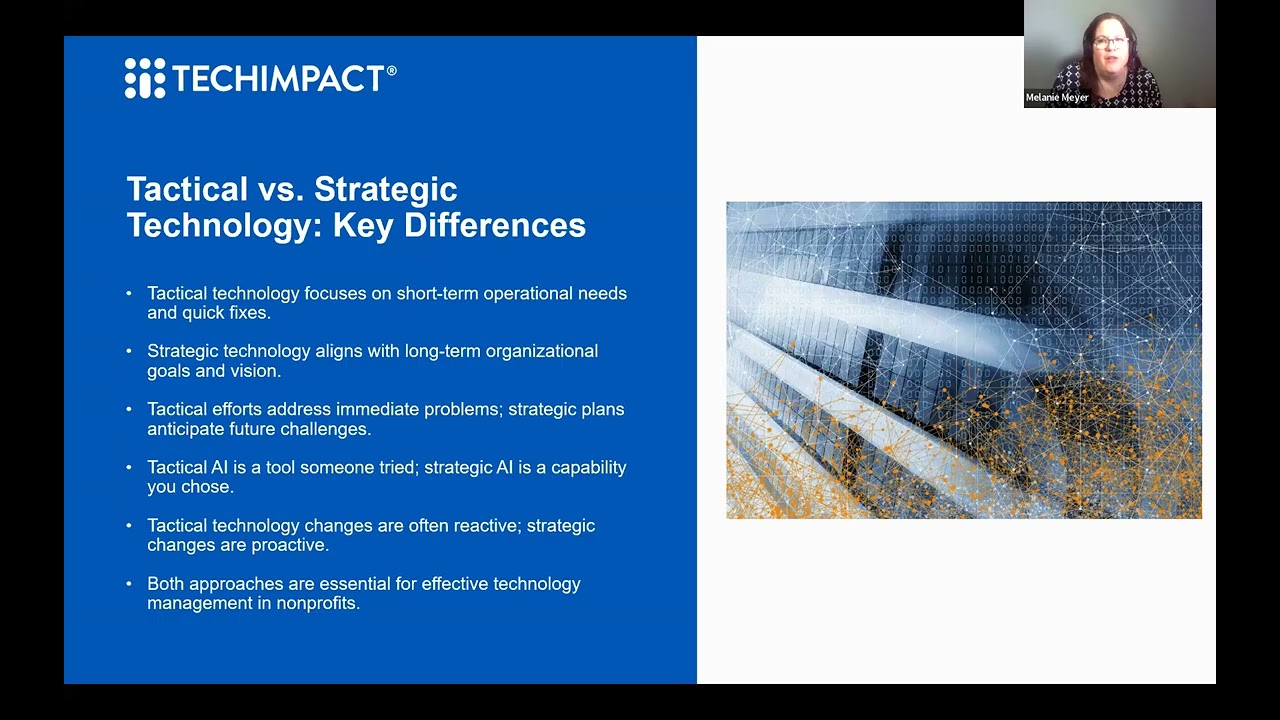
Again, there's also tactical versus
strategic. And so, as we go, some of the
tactical might fall in the strategic
depending where you are in terms of your
road map. But, you know, think of
tactical tech focuses on short-term
operational needs. Printer goes, you
replace a printer. Um, we need to
update a software. That's just a little
tactical thing. Just your strategic tech
should align with your long-term
organizational goals and vision.
Um, you know, tactical AI, we talked
about it a couple times. Is it a tool
someone tried or are you really thinking
about strategically how AI is cap, you
know, what if it's capable of and how
can you tie AI and automation maybe
together to automate and and use AI?
Um,
and feel free to ask any questions as
I'm presenting. Um, I do have it open
and we'll respond as I can or we I'll
answer them live. So you don't have to
wait for a question slide or or
something else to as we progress.
So this is a sample of maybe
organization A, you know, they're
they're challenged.
They are reactive, you know, decisions.
Um
they're not really uh they got aging
infrastructure, inconsistent replacement
cycle for hardware. They have
disconnected system and information
lives in silos. They have li limited you
know leadership has limited visibility
into tech spending. Uh growing cyber
security and risk and then unclear
ownership of who actually owns it. I
think this happens at a lot of smaller
nonprofits I talked to. You know they
just don't have the expertise on staff
that someone really has clear ownership
of it. So as you know every nonprofit is
faced with technology evolving and if
you don't have clear ownership or where
you're headed you're going to have some
issues. So again the su success metrics
is you go into um you know strategic
road map and I'll tell you how we can
kind of see where we need to dive deeper
in as you do your strategic tech plan
but no tech planning they got a tech
plan you know their target was an
approved three-year roadmap put that in
place hardware life cycle you know you
get a funded replacement cycle or at
least I should say a budgeted
replacement cycle Um, you want a
technology bud budget right now? You
have a a a security budget. I mean, a
technology budget you can you can plan a
budget for for the next 3 years. Um, and
then again, it's all about measurable
outcomes, right? 20 to 40% might be an
example. 20 40% of
the spend now staff you like think about
all that time staff are searching for
what they need to find, right? Where is
it living? would of that so you're
improving you know productivity.
Again you can create the plan but it's
always good on a quarterly basis review
it and make sure that you're progressing
against whatever plan you put in place.
Now most of you are saying you're kind
of in between a a two and a three. So
really you can go from
strategy being you know really from
operations to transformational impact
and you have a different vision when it
comes to your IT tech is working well
and now you want to say you know data is
valuable but distributed across systems
big pain point of nonprofits manual
processes still limit staff capacity how
can we you know leverage automation to
do that um reporting is effort inensive
and backwardlooking right like let's get
some live dashboards let's get some real
time reporting AI is experimental and in
you know lack formal governance maybe
look at and have a focus session on AI
and how how you see AI fitting within
your organization a lot of times AI and
automation kind of go hand in hand what
do we you know get leadership together
and say, "What are we spending a lot of
time on? Where could we make some
improvements in our day-to-day work?"
And then come out, you know, with three
to four things where you're going to
tackle and we're going to, you know,
really embrace AI and automation to get
this done. And then innovation and
technology are are consistent. They're
not consistently measured and you want
to do it. So um this is you know 2020 to
you know the measurable outcomes would
be target reduction and manual
administration effort adoption of
collaboration and knowledge standards
and then real time executive dashboards
and performance visibility like I think
that's where every nonprofit dreams to
be um and it's just it it's a struggle
to get there.
Uh John has a question. What is your
opinion of the new AI website building
agents?
We deployed one and it totally rebuilt
our website in minutes based upon our
URL. Later it was just a matter of
setting up from our integrations. It's
insane, right? I mean
for I what I feel bad for and I'm just
going to say this is how AI is going to
replace some stuff. I think it's a real
advantage to nonprofits that you can
have AI build you a website. I think
there's still expertise that's needed um
with any tech project overview, maybe
some additional input, but it's insane.
Like we have this new system internally
and most of the reporting is SQL based.
I don't know how to write SQL. Um, but I
tell you what, AI does. And it's really
insane how I'm not a coder, but I can
kind of interpret the code and make my
own reports based off that. So, I think
my only advice is if you're using any AI
tool, just make sure that it's paid and
private and and in your own environment
and their security best practices.
Everybody wants to know about this
website AI builder.
Now, everyone's going to have these
really fancy AIs. I mean, I'm telling
you, from the beginning of co-pilot till
now,
I've seen a difference in in four to six
months. So, I think anything like an AI
website builder and all that, it's going
to continuously learn and continuously
to improve. In my opinion,
this is the big thing. Are you including
everybody who should be included in that
strategic pet plan? I know my previous
org, we would go through strategic
planning as an organization
and
I think when you're going through
strategic planning, having somebody who
has well-versed knowledge and everywhere
that tech can help aid move your
organization forward should have a seat
at the table. Um, but if you're looking
for, you know, every who's going to work
on your strategic tech plan, who should
be involved, who you should be getting
input from within the organization,
you're going to want to make sure you
include representatives from all
organizational departments, whether
that's marketing, finance, programs.
Um, but make sure that the more you have
at the table, the better it is going to
be for you in the long run. again IT
staff, someone with technical expertise,
leadership
if you can get them at the table
and then end users I think are the most
critical and then external adviserss or
consultants with specialized you know
expertise if you need it. I think the
most important part of any strategic
plan
when I sat on the side of it, all I
heard was complaints, complaints,
complaints, but nobody was ever happy
with our systems and all that. And I
think when you're running it for it, for
a staff, you kind of like put up a
little bit of a wall cuz you're you're
tired, right? You're exhausted. And you
know, we have different end users. Some
of those that em embrace change and some
of those that fight change. Um, so if I
could look back at my 20 years at that
organization, I would have formed a tech
committee because I didn't have a tech
committee. I kind of lived in a silo and
I would get all the viewpoints and have
them at the table so they understood the
constraints, the budgetary constraints
and were involved in helping
get to a better a better state and I
would have kept them informed and and
involved. So that way when I wanted to
facilitate change or I wanted to do
something there was not so much
resistance on the other end and no one
could see the true value or the or what
I was trying to solve on that end.
I'm trying to keep up with uh we have a
lot of working groups regarding our tech
decision. So our staff guides a lot of
the decision- making. It creates a lot
of buy in. Exactly. If someone buys in,
they help change the mindset of other
employees. And once you get that buy in,
everybody helps facilitate the change
versus fighting the change cuz they can
see the end result uh you know and what
we're trying to achieve.
Um my chat section is so small. So
Molly, you can really use Claw to help
you build a website. I kind of want to
play with it and test it. Um,
I'm sorry. I can't um my display is
really bad and I can't see all the chat.
So, if you have questions, I can see the
questions and answers really good. So,
if you have questions, make sure you're
putting them over in the question
section.
Hopefully most of you uh on here have a
strong infrastructure or you're on the
path to getting a strong infrastructure.
If you do not, do not be ashamed because
probably 10 out of my 25 calls a week
in, you know, organizations are falling
a little bit behind with infrastructure.
So again, you want to keep hardware up
to date and have a solid replacement
cycle. Maintain regular updates and
patch management for all infrastructure.
Um, establish clear disaster recovery
and business continuity plans and ensure
scalability and accommodate
organizational growth and challenge and
needs. So what that means is make sure
your computers that you are giving to
staff are up to date that you have patch
management on or some type of remote
tool that can keep that management you
know those patches up to date. Make sure
you have anti virus web protection tools
on those device that you don't let them
fall behind and operating systems right
um keep on top of when Microsoft might
be ending support.
Um I'm not sure if there's anything else
anyone would add to that. Um if you have
servers, do you need the servers, right?
Um there's so many functions that
Microsoft and Google can do now in terms
of replacing
hard infrastructure. You would think,
you know, that we are beyond that, but
organizations are still purchasing
servers and still investing in hardware
at that level.
um a great way to rate your
infrastructure. There's going to be a
couple of these checklists through um it
just starts help kick off you know as
you form this tech committee and you
start evaluating where you are. This is
an easy checklist to go through and say
you know it's effective don't really
need to address it. we can check the box
off whether it needs work. And then also
it if it's creating big issues and it
becomes a priority, you're going to want
to move that to the top of your your
fix.
So is everyone pretty secure on their
infrastructure? Like my assessment is
yes. And I and probably people who are
no don't want to admit it. Um, but you
know, if if you need help, TechUp has a
bunch of incredible resources to
purchase hardware.
Oh, that's a good question.
Um,
Justin, are you here? Can you talk about
Teu Cloud support? I can talk about our
support for hardware and devices and
managed it.
Um,
hopefully he's still here. Justin from
TechUp.
>> Yes, Melanie, I'm here. [laughter] So,
the uh the the difference between cloud
support and devices is really um
simplified as licensing for your
hardware versus the physical devices
you're using. You can source, of course,
both of those through um Tech Soup. And
if you need any help or guidance um to
get to get to the appropriate resources,
please uh feel free to drop me an email.
John, I will put my email in the chat
for you.
>> And you can pick up Tech Impact as we
come in. We put our remote management
tools are it's more of a
all-encompassing managed IT support. So
we would use our agents. We would deploy
our virus tools. We would help you
manage um your 365 Google tenant adding
and removing onboarding users and really
kind of get really get a deep knowledge
of you and then kind of help you evolve
your tech stack. So it's a it comes at a
a monthly fee. Um but it's where I think
we serve over 400 nonprofits with
managed IT support. Um so we support
their day-to-day IT functions
and we do a lot of cloud adoption
projects. A lot of organizations like to
move from Google to Microsoft or they
have been in split system. So we combine
them in one system or they want to
enhance their security in their cloud
environment and we'll kind of assess
where they are and help tighten the back
end of those solutions.
So, let's talk about productivity and
collaboration.
And I think a lot of us nonprofits
now there's so many resources and
there's so many ways to
help staff adopt
technology. Um, I go back 20 years ago.
it was a struggle, you know, to get
people to to do and put together those
trainings and get staff together to do
it. Um, so I think training is always
going to be an issue. You need to allow
your staff time to train. You need to
point them in the right direction for
training. And then,
you know, I would add that to any road
map. Training is absolutely essential.
whether or not you're putting in new new
data systems, whether or not you're, you
know, you have some staff that struggle
with day-to-day Word and PowerPoint and
all that is that you're giving them the
time and the resources for training. Um,
something I did um long time ago, but I
think it would still work, is that staff
did want did not want to do training.
They didn't want to take the time. So, I
started putting incentive in gift cards
like who could do the most training um
or I'd have different staff present to
at staff meetings on training. So, um I
think the most important thing is
allowing the time and having the right
resources.
Um
again, you want to help staff work
smarter. So, can the staff easily find
information? Are your files organized?
Are your security security groups, you
know, clean?
Are teams collaborating in one system?
Do we have silos everywhere? Does
someone have a a Google workspace with
some documents, a Slack channel? Um, it
can get really hard. Again, strong
policies. We save everything here. It's
done. But a lot of organizations I find
are using um staff go where they're
comfortable. There's, you know, it's so
funny because it's like Windows versus
Mac, um, Microsoft versus Google. Staff
get a preference and they kind of stick
with that preference. Um, now I think
it's going to be the different AI tools
like, oh my gosh, there's Claude,
there's Chat GPT, and then there's going
to be strong adherence to to either one.
Um, but it is interesting to listen to
nonprofits and see where they struggle.
But if you own it, if you need processes
in that, everything has to live in one
unified system. Doesn't matter where
that unified system is because you're
going to secure that unified system,
right? You're going to continuously
improve and invest in that system. So
get it right. Choose a Microsoft, choose
a Google, and and go there. Um
then once you really truly adopt one of
those systems, you can work on
automation. You can look at evolving
those systems around security automation
and adoption. And then again ongoing
training is is always an issue. Uh
something else I think too like if you
ever need help in terms of understanding
the licensing um talked to a lot of
nonprofits that Microsoft and Google
really keep us on our toes toes. I don't
know how I said that but our toes in
terms of licensing. So again reach out
to TechUp cloud services if you want to
learn more about Microsoft licensing and
do you have the right licensing for your
organization. Um feel free to reach out
to Tech Impact. we'll, you know, we'll
see if you have the right licensing and
help provide guidance around there.
So, I think you could take is your
staff, you know, you want to rate your
productivity and collaboration. Again,
same boring checklist. I can't believe
I'm still doing checklist, but um you
want to see,
you know, you want to rate what you're
using. Is is it good for the
organization? Um the one thing I will
say out of here too is conference video
calls also as part of your
infrastructure and your productivity and
collaboration really ask yourself about
your phone system. Is your current phone
system working for you? Um we're seeing
a lot of organizations go to teams voice
which we're doing u much much more of
those projects. There's zoom voice and
all that. So you know replacing that
antiquated hardware or moving from you
know a voice over IP system
to um
you know to moving to one of these
things that are built in your unified
system. When you say write licensing
what do you mean by that? Uh for example
Microsoft licensing there are three
levels available to nonprofits. Well
there's business and then there's
enterprise. Any organization over 300
staff should be on Microsoft Enterprise
licensing. Any organization under 300
should be on Microsoft Business. Under
Microsoft Business, where most
nonprofits fall under the 300, there is
a business basic license, there is a
business standard license, and there is
a business premium license.
So, in terms of your end users need,
Microsoft is really good about mixing.
You can mix and match like mix and match
licensing. So what we recommend for a
lot of organizations is to be at that
business premium license because it's
the most robust license used by
nonprofits. It allows us to not only
give you email,
um you get all the office productivity
suites such as Word, PowerPoint, Excel,
but there's also other licensing that is
in there that helps us manage the
workstations, right? To entra join them,
Entra Azure, but basically do identity
management with Microsoft and join those
workstations. We can also configure
enhanced security policies for device
management and all that. So that is
understanding you wouldn't necessarily
give that $5.50 license to a volunteer
who just checks email. We would put them
on a business basic license. So
understanding the tier of licensing and
making sure that it is that you're
applying them right to the type of staff
or type of emails that you have. Same
with Google. Google has your free for
nonprofit. They have the business
standard which is like I think $616
a month and then they have the endpoint
protection.
We will say whatever security features
you want to deploy be by Google then
we'll recommend the right licensing for
that. The only thing is is Google as of
right now you cannot mix and match
licensing. So if you want to use some of
the advanced security features of
Google, all users have to be moved up to
a paid license. So that was a lot.
Hopefully that helped some of you
understand the the licensing. And yes,
Microsoft did get rid of the 10 free
business premiums they used to give to
nonprofits.
But when you really look at it, uh we
have some nonprofits. They're
nonprofits, but they're not Microsoft
eligible. And when you look at the pain
point of how much they have to pay for
licensing, I think it's like $25 per
user per month. That $5.50 looks way
more attractive. Um, but it is rough
when you get a nonprofit that's not
eligible that does have to pay the
higher cost.
All right, we're halfway through. Any
questions? I'm sorry. I'm going to take
a sip of water.
So now we're going to go in the AI and
advanced data.
Again, data ties.
Incredible. You know, like AI, you're
going to be it goes back to the same
thing. I've been in this tech space too
long. Everything always goes back to
clean data. Everything. Um if you look
at everything, it's cleaning your data,
scrubbing your data. um what goes in
comes out. It's still going to apply
here even as you want to use AI.
So again, you're going to want to
evaluate your data and strategic systems
effectively. So I think this is the
biggest point for organizations but it's
the thing I've seen move the most
especially with the API and integrations
you know old school was everything needs
to live in one system and this is the
only system we use and then you know to
see that evolution of data go from one
system everything goes to then okay we
have siloed systems systems and then hey
now there are tools where we can
integrate systems and tie things in via
integration and then you have platform
developers that are actually building
out these integrations to kind of you
know they see the importance of it but
maybe I'm really dating myself but I go
back as old when I knew there were
really only two you know development or
or fundraising solutions now there's
probably thousands on the market um So,
I think it's gotten easier, but also I
think it can get a lot messier with
all the different systems of choice.
I used to we I mean I'm so old I go back
to an access database
um and I used to manage that and then it
would be built in different stuff. So I
think you need to always assess your
systems against your needs regularly. Um
this is sometimes where I would pull in
an outside consultant and maybe this is
their dayto-day and they know the entire
architecture of data systems and can
really help you. You're going to want to
evaluate your data accur, you know, your
accuracy. Is it right? Can you use it?
Um, I know that was a exhausting
part of my job was getting people to
enter information correctly in the
systems. And then the chief executive
would come and they're like, I want to
go to this funer. Can you pull me this
report? And I'd have to be honest and
I'm like, I think it's about 40%
accurate based on what we've put in. Um,
so again, you're going to want to review
your systems integrations,
talk to your users, where are they
having issues, what can we improve, and
then identify gaps for improve
improvement and upgrades.
Then again, are you taking advantage of
automation? Um, this will probably date
me, but I had built I had a someone
build a SQL system and I called them
push notifications. Basically what I was
doing was automation but at that time
that was my term. Um but look at your
repetitive tasks. Is there anything that
you can automate?
Improve operational efficiency. I know
that we've seen a lot of organizations
do it in notifications.
Um I know we use it on our project teams
for for client data transfer. Right? if
you're always doing the same repetitive
task is looking how to automate it.
Again, it increases data accuracy. If
you force someone to put something in a
system and then it automates something,
your accuracy is going to get improved.
Make sure anything you put in place is
scalable.
And obviously, our goal overall is to
reduce any organizational cost over
time.
Um, you know what? This is a question.
Is your organization ready for AI? Maybe
on a scale from one to three. We'll do a
a quick put it in the comments. So, like
one, we're just playing with AI. No one
really using it. two, you know, we've
talked about it at a at a b, you know,
at a leadership level and we're looking
how it can do to where you three as you
fully embraced AI and it's embedded in
your day-to-day work. So, everyone kind
of put that in the chat.
Oh, look at all these new
one.
I do know something about Dothandria
getting old
and again accounting and finance I agree
gain um we do a a Microsoft um a
automation project um which hiring
especially if you have a lot of staff
coming on and on and that's really huge
a one with AI one. Oh, game. Maybe we
might have to talk. You can uh share how
you're a three and you've actually fully
embraced all AI. Three. Three. One.
Three. Wow. Haven't even talked about
it. Damn. One to two.
Um, yeah. So,
if you're at a one, you're probably
where most nonprofits are. Um, you know,
I think the biggest thing is nonprofits
are like what AI tool and learning the
differences. I know we have formed an AI
committee and everybody wants to have
something built out like custom agents
and that and that committee really
weighs
those AI initiatives and what is going
to get built out and what's going to
come down to fruition. Um, because who
doesn't want to do less manual work? if
AI and automation could help us add my
name to the list. This is what I want to
do. But I think it's important to
actually have a committee with
leadership and somebody who's helping
evolve that. You want to know who owns
AI, who owns it, who owns the decisions.
Um I think the biggest decision is what
do you want to use it for and what AI
tool is best for that. Um I also heard
from uh did everybody see that Claude?
um not that they're giving their tool
away for nonprofits, but they actually
have a fellows program attached to it
where you can get a Claude fellows to
help you incorporate AI in your
nonprofit. So, you might want to Google
that and check that out and see if
that's right for your nonprofit.
AI tools aren't free, right? You have
the if you want to really use it, you're
going to have to budget for them. Uh,
another thing is if you're doing any
custom agent builds or if you're I guess
maybe I should explain that. So AI is
AI, right? We use it all in our
dayto-day. I know it helps me with
writing.
One of the worst things that like I
dread having to start something from
draft and start to write an email or a
letter. Love AI can start it for me. I
can tweak it and send it out and I look
so much smarter.
And I think we're all kind of putting
information. Can you find information on
this example of a custom agent? We have
a customer um that we built an agent for
and it's a closed agent, but basically
it tell the agent tells
what AI is going to pull from. So it's
controlled sources. So like if you have
a data system that would be your
controlled source. So we say take these
five or six data sources. This is how we
want the output of anything we run
through this agent. And theirs was built
to automate surveys. So it takes the
surveys from multiple constituents,
feeds it through the AI agent, and then
gives them a report that's formatted the
same as every other report. and it
basically summarizes the key points of
that along with any other, you know,
data points they might need. Um, so they
had a custom agent built so that they
can control what that agent was putting
out. It's probably a really horrible
explanation and I'm probably our AI
people would yell at me like why are you
doing that? Um,
but really you have to think about
how, right? like what it is it that you
want it to do and then define how you
implement it, what it's going to cost.
Every time that organization runs that
agent,
it takes tokens or credits to run that
agent. So, anytime you're budgeting, you
have to budget for that. One thing I did
learn while doing that that thing is
that nonprofits get I think it's $2,000
a year in Azure credits from Microsoft.
I have now learned that if you're going
to build an agent in Microsoft and you
need those tokens or credits that you
can use that Microsoft grant for that
AI, you know what I mean? For the pull
of those agents. So, if anybody is
paying for that, definitely go and get
the Azure $2,000 credit so you can run
it in the background.
Hold on. I'm looking. You can see every
time I look over here, I'm looking to
see if there's questions.
Every like nonprofits, you run your
computers under the ground. I think like
business, they're like they replace them
every 3 years. There's not profits. I
just expect it's going to be every five.
Did somebody tell me I'm not that old?
Or did you say, "Yeah, you're old."
[laughter]
Um, all right. Great.
Well, we'll get to questions at the end.
Biggest thing about AI, always have a
human reviewer. Someone always have to
has to review what goes out before it
goes out.
So here you want to rate your AI and
data readiness.
Um do we know what we collect? Who's
responsible for it? Um is it accurate,
current? Um
are we I mean I think this is where
sometimes most organizations unless they
have the expertise in house this is
usually where they outsource the
assessment of this or the the strategic
planning of this.
I also want to say as we go through here
like every strategic tech plan is
different.
You might not need to focus on your
infrastructure. You might not need to
focus on your productivity and
collaboration tools. Maybe you just need
to look at your data and your AI and
your outcome and measurement and
reporting and maybe just focus on there.
As long as the other things are good,
running well, I'm going to put my focus
into really our data and strategic
systems because these are really the
ones that run the organization. They do
your day-to-day function. Productivity
needs to be solid. But really these data
systems are key. You make a change in
any kind of data or strategic system,
the pain is felt throughout the entire
organization because it revolves around
everything that you do.
And then I'm going to preach about
governance and security.
Somebody needs to own it. I I mean some
like you got to know somebody's got to
have overall ownership whether that is
outsourced whether it's internal but you
need somebody to you know as you do
anything in technology
security is going to protect the plan
governance is going to direct it and
training makes it stick so strategy is
going to need all three of those
considered I think that one quote makes
me sound so smart but that was AI and
I'm not going to lie. I put the slide
together and I'm like, can you give me a
quote and it did it. Um, but again,
security,
anytime you put anything into the
environment, anytime anything changes,
security is always a core component. You
also can't implement a data system
without having somebody own it and
continue to nurture it, continue to make
sure it's, you know, the training is
there for all staff. I know it's hard,
especially a lot of us are one person
managing all of that for an
organization. Time constraints.
Um, but if maybe you're more successful
than I was when I first started out,
maybe I was too young for anybody to
listen to me at that time. Um, no, I'm
complaining, but I really did take that
organization,
you know, further. And I'll have to say
a lot of that goes back to Tech Soup
being an incredible resource as you're
someone who's navigating technology like
uh you know Tech Soup was my best friend
back in the day. Maybe I'll age myself
too. I don't know if Tech Soup started
doing this again but I used to get uh
what was it? Cup the soup. It actually
was a soup recipe. I can't remember how
often they used to send those. Does
anybody remember that when you would get
the soup recipe?
Um, so as we we finalize,
you're going to want to align your tech
with organizational mission for for the
maximum impact. Look at your mission
obviously and then how can you use
technology. You're going to want to
balance the tactical infrastructure
needs with long-term strategic goals.
Maybe outsourcing the tactical
infrastructure, the help desk, the
workstation upgrades, the planning.
Maybe that's something you want to
outsource and you just don't, you know,
maybe look at the return on investment
in there. If I leave this to someone
else and I can focus over here, is that
a viable solution.
You again leadership has to have buyin
like you have to involve leadership in
all technology
priorit.
know that we had some weaknesses. I was
kind of the one person. So, I was able
to form a board committee that really
helped me with marketing,
communications, and technology. And it
was great to have those board members
kind of be contributors to that.
Again, you're going to want to
prioritize infrastructure and pro
productivity because those have to be
solid before you move on to anything
else. Continuously update the plan every
three years.
Phase your approach. Try to get funding
for it. Try to work it into some already
existing grants. I think that's the
question organizations ask me enough. Do
I know a funer? If I knew a funer, I'd
probably be the most popular person. Um,
everybody would be coming to me. You
want to keep everybody, you know, up to
date on your progress.
And again, security, governance, and
training, they're they're just absolute
essentials. So, you need to make time
for them for them and have the right
staffing for it.
Some great resources. Uh there's a Tech
Soup digital assessment tool for
nonprofits.
We have a technology budgeting
worksheet. Um probably getting close to
absolute with AI because I think you
just say, "Give me a sample budget." Um,
we have a free nonprofit policy builder.
Um, cyber security
consultation. We can kind of go over
your security. I do recommend that every
organization, even if you have a managed
service provider, that you do an annual
security risk assessment. Hold on, I'm
all caught up here. Uh it is the one
thing with the emerging technologies
with cyber security
um having somebody come in and and do
that assessment
um probably will help guide a lot of
what you need to do under strategy
because if you're failing in cyber
security um you have some gaps
and then there's a link to tech soup for
computers and discounted hardware and
then managed IT services support from
tech soup if if you're interested in
learning more about managed IT support
and then my email address if you want to
email me. Um,
all right, John.
Oh, John, that's a great question.
There are many different types of AI. I
mean there's claude chat GPT co-pilot
Gemini
and really organizations are kind of
looking at the pricing of all those and
saying what is it that we want to
accomplish and what AI tool is best to
embed in our organization. Um, I know
Co-Pilot,
I'm lucky enough to have it. Um,
actually uses CL like it's such a a big
thing. I would not say that I'm an
expert in it, but right now we're doing
some like open AI workshops. Um,
so
yeah, each there's there's multiple AI
tools you can use and work within your
organization.
Um Kat, do capacity building or
technology grants typically cover
managed IT service and other funders you
see doing that consistently for
organizations under 250K? So I'm taking
your annual budgets under 250.
Um, so for a very small nonprofit, I
think
Justin, are we is there uh still
anything in the DRP?
Do you have a link on that or is that
us?
>> I don't I don't have a direct link, but
what were were you thinking of DRP or or
or CTO for the sector?
>> Yeah. Yeah, something like that. We do
there are some programs that Techup and
US are doing together to for
organizations to help assess where you
are. Um,
and then you're you're a very small
nonprofit where one volunteer holds the
admin credentials, right? There's always
that with when the volunteer holds the
information. But Cat, if you want to
email me, I'll give you I'll give you
some resources. Um but typically
capacity building grants are to make you
know they'll be like big
transformational projects but we don't
see a lot of funders funding managed IT
support services. They might fund the
first year we'll get you to standards
and then um usually managed IT support
is on the organization to to pay.
Um well it looks like we have six
minutes left. Are there any other
questions?
Anything I missed that you uh you want
to discuss or I'm really good on the
fly. Do you have a question?
All right. Well, if no one has any
questions, we can leave a little early.
you can get back to doing your email if
you haven't been doing it during this
webinar was great. Thank you for
listening and everybody have a wonderful
day.