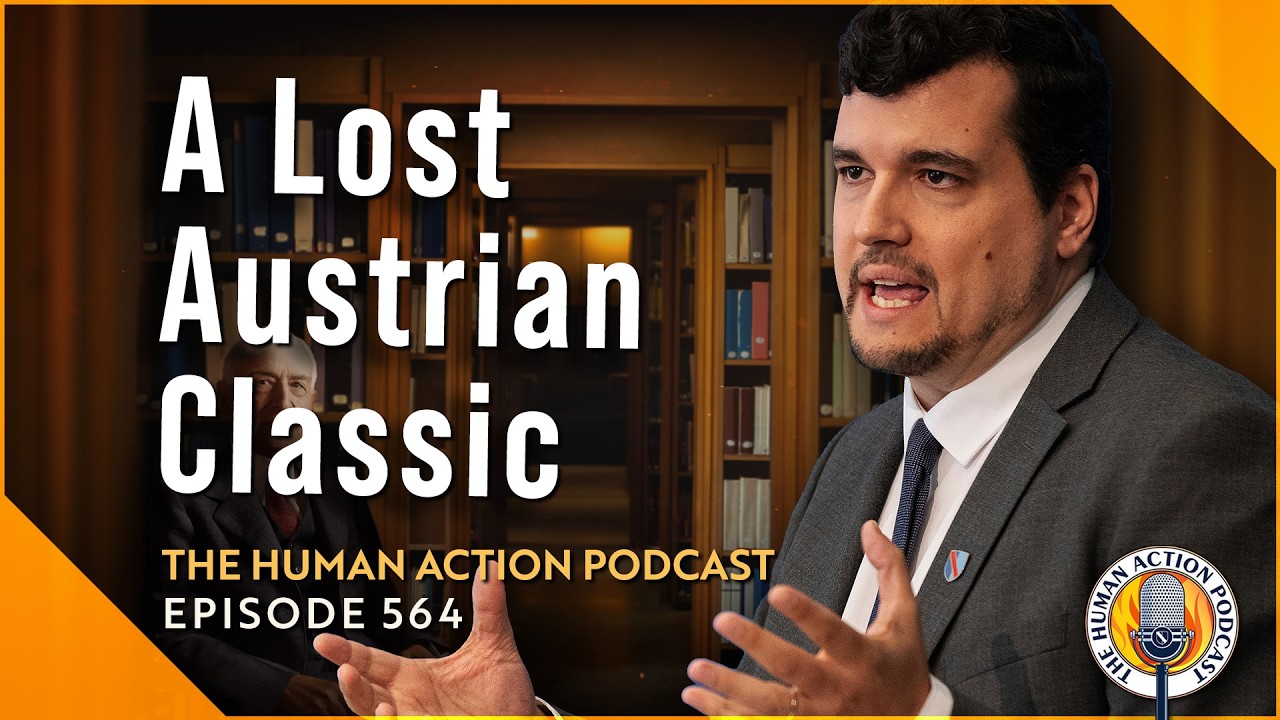
Video summary
Matt McCaffrey announces the upcoming publication of Frank Fetter's long-lost manuscript, *The Development of Economic Theory from Adam Smith to John Stuart Mill*, which chronicles the evolution of economic thought between 1776 and 1848. Discovered among Fetter's papers after his death in 1949, this largely drafted work represents a late-career retrospective intended to identify persistent errors in classical economics that survived into the mid-20th century despite the marginalist revolution. The book is designed for readers with an intermediate understanding of Austrian economics and offers a systematic, textual analysis of key figures such as Adam Smith, David Ricardo, and Thomas Malthus, contrasting Fetter's focused engagement with specific arguments against broader historical surveys like those by Murray Rothbard.
A central theme of the manuscript is the rejection of the Whig theory of history, which views economic progress as a linear march toward truth; instead, Fetter portrays economic history as a cyclical struggle where new ideas often merely repackage old errors, such as labor theories of value and cost-of-production thinking. The text delves into the complexities of eclectic historical figures like James Lauderdale, who held proto-Austrian views on value yet advocated for deficit spending, while also rehabilitating Jean-Baptiste Say by correcting misconceptions that he merely popularized Smith or believed in an impossible version of Say's Law. Special attention is given to Ricardo's internal tensions between his labor theory of value and his sophisticated theory of rent, illustrating how Fetter worked to reconcile conflicting ideas within classical frameworks to explain land rents without influencing market prices.
The analysis extends to other critical topics including Thomas Robert Malthus's theories on population, value, price, and income distribution, effectively exposing flaws in classical thought while advocating for a modern Austrian perspective. McCaffrey emphasizes that Fetter's clear writing style provides an engaging window into economic history, distinguishing the work through its detailed examination of specific arguments rather than general narratives. The segment concludes with McCaffrey thanking his interviewer and encouraging listeners to purchase the book upon its release, while promising a future episode of the *Human Action* podcast dedicated to exploring this significant material in greater depth.
Read the full video transcript
[music]
This is the Human Action podcast where
we debunk the economic, political, and
even cultural myths of the days. Here's
[music] your host, Dr. Bob Murphy.
>> Matt, welcome back to the Human Action
Podcast.
>> Thanks so much for having me, Bob. I
appreciate it.
>> Sure thing. Yeah, nice to see you. So,
you're here in your capacity uh to talk
tell us about this new forthcoming book.
I think it's my understanding is it's
like literally at the printers right now
uh on Frank Fred Feder's work. So what
what happened? What is this project?
Tell us about it.
>> Well, so the the book we're talking
about today is actually the first of two
volumes uh that are forthcoming uh that
contain a variety of rare and uh
previously unpublished works by Frank
Federer, the great sort of American
Austrian economist. And the book that
we're talking about today specifically
is an unpublished volume on the history
of economic thought. So it's a book that
covers uh uh as the title says the
development of economic theory from Adam
Smith to John Stewart Mill. So roughly
1776 to 1848 that crucial period of
classical economics before the
marginalist revolution and before people
like Manger began to to really
revolutionize the way that we thought
about economic theory.
Yeah. And this is great. I know. I was
really eager when I saw that this was
coming out that uh so for people who are
interested in like the history of
economic thought like one of the fun
things is when you see like an old giant
like like Shumpeter's history like I
just loved reading that just to see like
oh some guy that you respect but also
who lived a long time ago to see from
that person's vantage point what they
said about you know earlier economists
because they don't you know they they
came from a different tradition. So I
was really interested to see this. Maybe
before we dive into the contents though
and you know summarize some of the main
points that you found in this just to
get give people a little bit of a a
grounding here. So Federer I think a lot
of people to the extent that they know
who he is via the Austrian channel it's
because of his work on the on interest
theory capital and interest theory and I
know Mises and Rothbart were were big
fans of his work and in what's called
the capital his capitalization theory
the idea of um you know interest is not
due to the productivity of capital. He
thought that was just a category error
that no you you look you like to
evaluate a tractor and and what's its
current price you look forward and see
what are the rents that it's going to
allow the owner to acrue over you know
in the future as a flow over time and
then you discount those future income
items to the present using some kind of
subjective discount rate that we could
call time preference if you want and
then that's how you would do it. So for
him the idea that interest flows from
the the productivity of capital he just
thought was you know category error. So
anyway that he was essential in the
development of what Mises would call the
pure time preference theory of interest.
I just wanted to explain to people this
is the guy we're talking about but here
Matt it's not his writing so much on
capital interest theory per se but more
his discussion of the history of
economic thought. Yeah, that's exactly
right. And Federer made many
contributions to economic theory over
the course of his career, but one area
where neither he nor many of the early
Austrians contributed at least
explicitly consciously was to going back
and sort of re-evaluating the history of
economic thought. Obviously you do have
Bomba's capital and interest volumes the
first one which you know is a a vast
historical survey of previous theories
of capital and interest but for the most
part the Austrians the early Austrians
at least weren't consciously thinking
about themselves as historians of
economic thought and neither did Feder
for most of his career until that is he
undertook this project the project that
became this uh this this book that's
soon to be published uh which in a way
for him is kind of a retrospective on a
lot of what he and what the Austrians
had done uh via looking back at
classical economics because as Federer
got older and after he retired from his
his uh his regular teaching and research
duties, he began to uh go back and look
more at the history of economic theory.
And what he realized pretty quickly was
that there were a lot of old uh errors
um that had emerged in the classical
period. but that had continued on way
past the marginalist revolution um which
was always a sort of incomplete
revolution and they survived into uh
what was then contemporary economic
theory in the 1930s and 1940s and one of
the reasons he wanted to write this book
was to to take a look back and see what
economists got right in the early days
and also what they got wrong.
>> Okay, great. Let me just give some
guidepost here for the listeners so they
don't get lost. So when you're talking
about like this is just big picture
stuff folks like classical economics
what we mean is you know Adam Smith uh
David Ricardo David Hume I guess would
be in there. Um and then the the
marginalist revolution is also sometimes
referred to as the subjectivist
revolution but that occurs in the early
1870s. You know a big one from an
Austrian point of view is 1871 with
Manger's uh treatise um where the the
transition was like how do you explain
value and the interaction with
subjective value with objective market
price and the idea was in the
marginalist revolution that's where the
name comes from. It's oh it's not that
to use a colloquial example
why does do diamonds have a higher
market price than water like a unit of
diamonds versus a unit of water you know
pound of diamonds versus a pound of
water a gallon of diamonds versus a
gallon of water and it's you know it's
not because of their objective
usefulness as a class but on the margin
like you know for most people one
additional pound of diamonds is going to
be worth a lot more than an additional
pound of water you know that kind of
thing. So that's what we mean by
referring to these broad periods of
classical versus marginal. Um and and
and the classical economists tended to
have like an objective cost or labor
theory of value and to explain market
prices. When you just went and looked at
their actual explanations, like what
explains this regularity in the market,
their explanations tended to go towards
things, well, it takes this many labor
hours to make a stage coach and that's
why blah blah blah blah as opposed to
starting out with, well, people like the
taste of oranges and that's where we
start to understand how come, you know,
the farmers plant more oranges. So
anyway, that's what we're talking about.
Um, before we get too deep into it
though, Matt, can you explain so why why
are you here talking about like how did
was Feder's manuscript just sitting
around and then you discovered it or
what happened there?
>> Yeah, so I I've been working in and
around Federer for a number of years
now. I've always found him just to be a
particularly interesting economist, not
least because he is very neglected even
by contemporary Austrians who I think
have a lot to to learn from him. So I've
been working uh on various projects
relating to Feder for a few years and
that included looking at some of his
unpublished papers and lots of his
correspondence and things like that. So
I published a few papers about Federer
and his relationship to the Austrians
and some of his contributions to
economics. But as a part of this larger
project uh amongst his unpublished
papers, one of the things I discovered
was this uh largely drafted volume on
the history of economic thought and it's
something that he had been working on in
his later years. So starting he sort of
officially retired in the late 1920s,
but he he lived until 1949. He died when
he was 86. So he lived to a ripe old age
and he was very productive right up
until the end. And one of the last
things he was working on was this much
larger project, as I say, a kind of a
retrospective project looking back at
the history of economic thought in light
of all of the progress that had been
made by him and by the Austrians and
others uh closely related to them. So
he'd had this long he had been working
on this project for a number of years
and uh at least the first part of it was
nearing completion. It was mostly
drafted. uh but then he uh he he passed
away and so was never able to put the
finishing touches on it or or finally
see it uh see it published. In any case,
I came across the manuscript amongst his
papers and started to read it and I very
quickly realized that this was uh a bit
of a hidden gem and I thought it really
deserved to be read after all these
years because I I think it's extremely
interesting. It offers a unique
perspective on the history of economics
and a unique perspective on people like
Adam Smith and David Ricardo and Thomas
Robert Mthus and and and many others.
>> Mhm.
>> So I undertook to transcribe and edit
the manuscript and and prepare it for
publication. And it's taken me a good
many years, but uh finally it's uh I
think it's uh I'm hoping it's going to
uh it's going to pay off u because
people will finally get to to read this
uh this kind of hidden gem.
Were was his original was it handwritten
or did he had it typed?
>> Uh it was a bit of both. So if you look
through the chapters, the manuscripts
for the chapters, um some of them had
been revised multiple times, typed,
corrected, typed again, and so on.
others. Some of the later chapters were
in earlier stages. There's really I
think only one chapter that was truly
incomplete. Um but most of the others
had attained at least one full draft and
most of them had been revised at least
once or twice. So there's a whole range.
So, you've got some typed ones and
you've got many many hundreds of pages
of handwritten manuscripts which took me
way way too long to uh to interpret and
to uh and to transcribe properly.
>> Well, that's why I'm asking because I
know like the further back you go, it's
like the guys would would write the
stuff out then give it to a secretary
who would type it up and everything. So,
I'm just wondering if that's where you
Yeah,
>> exactly. Exactly. I mean, if you look at
some of these uh manuscript pages,
they're just an absolute mess of lines
that have been crossed out and arrows
pointing here and there suggesting where
things would be moved. So, it's it's
like archaeology in a way. It's like
going through you have to try and figure
out
>> which pen or pencil he was using at each
stage so you can figure out the order of
the revisions and figure out what the
final version was supposed to be. And uh
it took forever. This was uh uh
basically my uh COVID lockdown project
if you want if you want an indication of
how long I've been working on it.
>> Okay, great. So, we uh salute you for
your service. But that partly explains
why this has remained hidden to the
world until now. Like it there was a lot
of rehabilitation that had to be done to
bring this thing to make it available to
us in a book form.
>> Exactly. Um, so before we get into some
of the contents, I know you have some
thoughts here on like maybe the things
we can highlight for the listeners to
give them a taste and you know this
episode serving sort of as a commercial
for them to go get the book of course.
Um, but some people might be intimidated
say wait a minute this is a professional
economist at the end of his career
writing up like is this really
technical? So I guess like what who what
audience would you say is appropriate
for this book?
So, in general, I would say that this is
for someone with an intermediate level
of experience, at least that you should
have at least a little bit of reading of
Austrian economics under your belt
before you undertake this. Um, so this
should probably not be the very first
book you ever read in economics. Uh but
uh if you have studied some Austrian
economics and you know maybe a little
bit about the history of economics in
general, you know who Adam Smith was and
you know he opposed mercantalism and uh
you know that uh you know David Ricardo
uh discovered what we now call the law
of comparative advantage. Maybe you know
some of these basic background facts but
uh but not much beyond that. um then
this is a very I think a good place to
start reading in the history of
economics and it's a good way of
understanding if for instance what
you're looking for is a way to
understand a little bit better what came
before Manger and the Austrians uh what
made and why they were really different
then this is I think a particularly good
place to start because it's a very
systematic treatment it tends to go very
slowly and methodically through key
chapters of Smith and Ricardo and Mphus
and others Uh so it's a good way to
learn a little bit more about exactly
what those men thought about many
specific topics in in economic theory.
>> And I guess even now as you were
answering it occurred to me that even
though Federer as a professional
economist is writing on other economists
you know back in the day it still would
be accessible to the lay person the lay
reader because economics wasn't highly
mathematical you know back then. So you
know it was all verbal exposition
anyway. So
>> exactly and a lot of the classical
economists were kind of trying to feel
their way through these topics for the
first time as well and try and figure
out the basic definitions of terms and
things like that. So Feder talks a lot
about those kinds of things. So it's
accessible in that sense as well
[clears throat]
>> because those classical economists they
didn't have a lot of prior knowledge to
build on. They were originating a lot of
these ideas themselves. So in the sense
that the story starts there, it's uh
it's not a bad place to to sort of pick
up a lot of these threads.
>> Uh so maybe one last sort of
housekeeping item for people just to get
the context if somebody has already
started or gone through like Rothbird's
history of thought like do you have any
thoughts on you know how does how does
Feder's history compare to Rothbart's if
we're talking about the same period of
of who they're the topics they're
covering?
>> Absolutely. So I I think Federer is
actually a really nice compliment to
Rothbart in the sense that uh they each
each one sort of fills gaps that the
other leaves. So the the scope of
Feder's book is very different from
Rothbart. So Rothbart's project he
wanted to survey all of economics
>> and plus a lot of political philosophy
and history and biography and so on
going all the way back to the ancients
right up to the the present time.
Federer's ambitions were were smaller.
He focuses in this volume just on
classical economics but the way that he
writes is very different from Rothbart.
So obviously Rothbart is a very uh you
know he's a very exciting writer. He
likes to he likes to be controversial.
Um uh he likes to criticize and again
he's across multiple disciplines some
economics some political philosophy uh
you know criticizing people for not
being free market enough and these kinds
of things. So a lot of that broader
context and the biographical details so
on you won't get from Feder from him
it's a more focused concentrated
economic discussion focusing on a lot of
these fundamentals of economic theory.
So with Rothbart you get the big sort of
sweeping narrative of economics as he as
he saw it. With Feder, it's more
specific, you know, it's it's looking
more closely at the the key chapters on
value theory in a book like Smith's
Wealth of Nations, for example, and
going careful as carefully as you can
through what Smith actually wrote about
the division of labor or the theory of
value or what have you. Uh, and doing
that for a lot of these main a lot of
the principal texts of classical
economics. So you get this is something
that you don't get so much in Rothbart
who tends to take a more of a a kind of
a general survey approach. Um you don't
see a lot of detailed textual analysis
in Rothbard's book. Um he you know often
times he'll sort of skip straight to the
conclusion. Um or he'll just give you a
sort of a general idea what the
arguments were. Uh so Federer is is so
is much more focused in that sense and
he gives you a much better sense of how
these men wrote and how they thought and
and so on.
>> Okay, great. Um maybe just in terms of
and you alluded to this a little bit
already, but like what what Feder's big
picture theme is in this I think it'd be
helpful to remind listeners of this
notion of what's called the wig theory
of history wig of whi and and how and so
can you explain what that term means
because that gets thrown around a lot
just in case people are afraid to ask
and look dumb but what does that mean
exactly and then is that what feder is
doing? Does he adopt that view in this
history of thought?
>> No. Oh no, certainly not. So the wig
theory of history as applied to
economics at least is generally the idea
that the history of economics should be
looked at as a history of upward linear
progress where every generation fixes
some problems from the previous
generation, adds its own insights, and
there's a constant sort of building and
refining of economics where we're
constantly making progress and improving
and so on. And this kind of way of
looking at history has been used uh to
sort of to justify disregarding the
history of economics because if what we
have right now is all present and
correct and it's the best we possibly
could have there's really not much
reason to go back and read the classics
or or care much about what Smith or
Ricardo said.
>> Yeah.
>> Can I stop you Matt just for a second?
>> Yeah. when I was in grad school and I
can't remember who said this to me, but
I know like I heard this and it's almost
going to sound like it it's a like a
straw man or like a like I'm setting up
a someone to knock down or something,
but no, this really somebody actually
said he was wondering why like Austrian
types like why we cared about the past.
And he he used the analogy he said
that'd be like if you went to MIT to
learn physics and they had you read
reading Isaac Newton like they don't do
that like just you know what I mean? So
again, this idea that all you need to do
is look in the like the last 10 years in
the economics journals and the top
journals and whatever was published
there, that's the best theory we have to
explain, you know, apartment rents or
wage levels and business cycles because
anything in the past that economists
came up with that was a good idea, we
would have retained and anything that
they came with as a dumb idea, we would
have falsified and and I mean that was
literally he he didn't understand why
would So anyway, so go ahead. [laughter]
>> Yeah. No, but it's it's it's a good
point and a lot of economists do think
this way and I think it's because of the
difference between uh it's a confusion
of sort of the methods of the natural
sciences and the methods of the social
sciences and this is a theme that
obviously Austrians have written about
quite a lot over the over the decades.
uh but just very quickly in natural
sciences if we proceed by hypothesis
testing experimenting and so on then it
makes more sense to think that we would
constantly be making progress and
discarding errors and making making new
discoveries and so on. But of course
things are not like this in the social
sciences. We don't have the same kind of
uh uh the same kind of empirical methods
uh are not relevant as in the national
as in the natural sciences. And
therefore we do you know the history of
economics uh contains many examples of
very intelligent sometimes well-meaning
economists making errors uh and those
errors persisting over time or dying out
and then coming back like economic
zombies and so on. Um so it's by no
means the history it's the history of
economics a history of sort of steady
upward progress you know towards towards
the promised land and so on. Uh it's
it's rather a history of you know errors
uh sometimes compounding sometimes
reappearing and so on. uh but it's a
it's a constant battle and in a way this
is a a part of the the big theme of uh
one of the underlying themes or
motivations of of Feder's book uh is
this constant change in economics and uh
the way he puts it is that he he in the
first chapter of the book he frames it
as a constant sort of battle of
replacement between the old political
economy and the new political economy.
So basically as he points out that ba in
every generation since Adam Smith and
even before people had talked about an
older political economy for Adam Smith
that was mercantalism and then the new
political economy uh of someone like
Smith comes in and overthrows the old
and replaces it but then in the next
generation the cycle repeats and there's
some new body of ideas that comes in.
though uh so the new becomes the old and
then a new or new replaces it so on um
so it's a a bit of an endless process or
or cycle uh and Federer pointed out that
in his time as he was drafting this book
in the 1940s it was the new political
economy so-called uh of canes that was
overthrowing a lot of what were viewed
as older uh ideas in uh in economics so
he he noted this cycle over and over
again. And this is one of the reasons
why he wanted to go back to the history
of economic thought precisely because a
lot of the ideas that were perceived as
new were actually just really the old
ones but just kind of dressed up in new
clothing, you know, for the for the 20th
century. So he wanted to go back and
kind of correct the record a little bit
and show that, you know, a lot of ideas
in, you know, then modern economics
could be traced back to Ricardo or maybe
to Mus or to some of these older
thinkers. Uh, and then he in turn wanted
to examine those ideas and see if they
were actually correct and uh and and
worth keeping or not. Um, and the punch
line is that many of them weren't in
fact correct or worth keeping.
>> Yeah. Yeah. So I'm my understanding is
right that's a theme of this work that
in particular saying even though you
know primmaaccia writing from the
vantage point of you know the 1930s and
40s one might have thought oh yeah
everyone has any trained economist knows
who Mouthus is and Ricardo but their
ideas have long been discarded
and and you're saying or Feder was
arguing that no actually you can still
see like there's a through line and and
those you know some of that that
Malthusian and Ricardian tradition is
alive and well even though ostensibly
everyone knows there were errors with
that and we were supposed to have moved
on yet it's persisted. Can you just
elaborate a little bit on that? First of
all, is that did I get it right? Is that
is that what he's saying? That is what
fed that is what Feder is saying and
basically what he wanted to do was try
and uh criticize a broader idea that had
become popular in economics in the early
20th century. Um and in fact some even
some Austrians embraced versions of this
view uh which was based on the idea that
um since Manger and his contemporaries
had sort of begun to revolutionize
economics that we'd made a lot of
progress and you know by let's say the
1920s or so pretty much all economists
agreed you know there weren't really
even distinct schools of thought very
much anymore. Most people agreed on the
the essence of economics. Uh and that
was based on you know the new marginal
utility theory from Manganger and uh
Jevans and Fra and others who who
developed it. So Federer is kind of
critiquing this view in a way and saying
actually
despite all the good work that people
like Manger and the others did they
hadn't really thoroughly [snorts]
revolutionized economics. their ideas
hadn't fully taken hold and in fact
there were many ideas in economics in
Feather's time and even to some extent
today in the 21st century that you can
still trace back to ideas from the
classical economists and in particular
some of their uh some of their their uh
bad ideas um related to for example cost
of production or labor theories of value
and the kinds of things that Manger and
others have worked so hard to overturn.
turn. Um, but again, Federer points out
that many of these things had had
survived in economics, sometimes in
slightly different phrasing, you know,
dressed up slightly differently, uh, but
they had continued. And in his view,
that was a big negative for for
economics because it was holding back
progress and it was basically preventing
economics from becoming a better, truer
social science.
>> Yeah. I mean, the obvious thing is, of
course, Malthusianism
is alive and well in the environmental
camp, you know, like like a lot of
people like that's that's still there. I
mean, you could you could argue, well,
yeah, but those aren't that's not the
economics profession, but certainly
Mouthys found a home elsewhere even
after he was officially uh falsified and
you know, we should have discarded his
views. Um, so how do you want to take
this? I know we just don't have too much
time left here. I know um you had
mentioned to me that like this guy Lord
Lauderdale, do you maybe want to talk
about him?
>> Yeah. So Lord Lauderdale is one of the
major figures who studied in the book
who I think is probably likely to be
unknown by virtually anybody listening
to this.
>> So he uh his name was James Mland, but
he was the eighth Earl of Lauderdale.
And he was uh not quite a contemporary
of Smith. He wrote a uh a couple of
decades after Smith published the uh the
wealth of nations, but he was an an
early political economist who's an
extremely interesting eclectic figure in
economics. He's very interesting
personally too amongst other things. He
uh uh he was famous. He fought a duel
with Benedict Arnold over free speech.
Uh I'm not sure who was defending free
speech in the in the debate, but um he
was a very eclectic oddball sort of a
guy, but he produced uh a lengthy essay
on political economy that Federer talks
about across two chapters in this book.
And one of the reasons I say it's
eclectic is that in the the first
chapter Federer talks about Lauderdale's
value theory which in a way is sort of
protosubjectivist.
It kind of it it touches on a variety of
themes um that are critical of say of
Adam Smith for example and Smith's
versions of the the labor theory of
value and kind of proposes some some new
more subjectivist alternatives. So in
this sense, in this chapter, Lauderdale
comes across as being kind of a a bit of
a protoostrian and uh and a good guy.
And then in the very next chapter,
Federer looks at Lauderdale's more
macroeconomic
writings uh which are very distinctly
protoanesian basically um all about the
the glories of deficit spending and
things like this. So uh Lord is a very
odd figure. You don't get very many
people like this in the history of
economic thought uh who uh are pretty
good on some issues and then
astoundingly bad on on other issues. So
he's a a very interesting figure and
those chapters I think are well worth
reading especially because I I doubt
very many people will know who he is.
>> Okay. So, speaking of um Adam Smith, I
know uh as you do too, of course, M
Rothbard is is pretty vicious in his own
history of thought visav Smith and I and
then I know some people are geez
Rothbird, you know, what the heck, you
know, he's just and I think some of it
might be I'm just curious your take,
Matt. Um I think some of it's like when
people say they hate the Beatles and
it's like you hate the Beatles or it's
just you think they're overrated, you
know, that kind of thing. So anyway, so
can you maybe comment on that just to be
fun, but you know what you think about
Rothbart's treatment, but also how how
does Feder, you know, does does he hold
up Adam Smith as the father of modern
economics or so forth?
>> Yes, exactly. So in the case of
Rothbart, one of the things that you
always need to remember is that on
Rothbart's side, he really enjoys
winding people up, right? And if if
there's a controversial way to say
something, he's going to say it that way
rather than the the blander, more
balanced version, right? So Rothbard
perhaps infamously, uh I think he calls
Smith an ineterate plagiarist, right? Um
so
>> not just a plagiarist, an ineterate
plagiarist. That's the worst kind.
[laughter]
>> Exactly. So what what he ultimately
means by that and and which is not in
dispute among historians of thought is
that Smith did borrow ideas sometimes
liberally from other thinkers without
attributing them uh in what
[clears throat] we would regard today as
the proper way. Right.
>> Right
>> now it's worth pointing out that
standards for these kinds of things and
authorship and so on were regarded very
differently in Smith's time. So whether
or not plagiarist is entirely fair, you
know, I'll I'll leave for others uh
leave for others to to judge. But that's
Rothbart's approach. Federer's approach
is also critical of Smith and most of
the other classical economists.
But he is a good deal more fair and
balanced I would say. So he when he goes
through the details of things like value
theory and so on, he he is critical of
Smith and he says Smith is vague here.
he's confused. He contradicts himself
and so on. And so he will he does make a
number of these kinds of claims. At the
same time, he's also uh he gives credit
where credit is due and says, "Look,
Smith was ultimately an advocate for
commercial freedom. That's what his fame
is mainly based on. He did a lot of he,
you know, his work had very good effects
in that sense. Smith was a an opponent
of monopoly and special privileges for
business and so on. This is something
that Federer really really cared about
by the way. Um so it makes sense that
again he would pay tribute to Smith in
this regard. And he points out other
things like the fact that Smith was in a
great writer and the wealth of nations
is a very well-ritten book. It's a
classic of the western cannon and all of
this kind of stuff. So he is critical
but he is perfectly willing to
>> [snorts]
>> uh to to give credit where credit is due
essentially. Um and so he does. Uh so in
that sense maybe it's not quite as fun
as reading Rothbart's account of it. uh
but you will get you will get a
different uh a different picture of it
even if on a lot of critical issues.
Feder and Rothbart agree.
Um, and then is is Feder also like I
know Rothbart and other a lot of modern
Austrians who care about the history of
thought will say just to continue this
theme that part of the reason they don't
like this idea of holding up Adam Smith
as the father of modern economics is
then that kind of solidifies
you know like the the English you know
British tradition as the as where we get
economics from as opposed to going via
the French and that that's more you know
subjectivist marginalist in terms of
Yeah, if you have to go back in the day
and pick some early economists or
writers on political economy, it's the
French guys that are way better than the
the English writers in in terms of like
modern Austrians think is that does that
carry through in Fed's view too?
>> Yes, for sure. So the only French
economist he talks about at any length
is Sean Baptist but he gives say three
three chapters of his book and
[clears throat] he in in Feder's view
say was basically the greatest of the
classical economists
uh and was marketkedly different from uh
Adam Smith but also from his
contemporaries like Mthus and Ricardo
and he talks at a good deal of length
about how se's value and distribution
theory were really again kind of protos
subobjectivist or we could say
protoastustrian in that sense uh in the
sense that se did have a firmer grasp
than any of his contemporaries on the
subjective elements in value um that
generate the system of of market prices.
So he he is uh he he heaps a lot of
praise on say uh in that in that regard.
And he also has an excellent he begins
his three chapters on say with an
excellent survey of history of economic
thought texts from his own time uh and
their treatment of SE and shows that
they were extremely unfair to uh to SE
and had really slighted most of his
contributions especially in areas uh on
sort of value and price and distribution
and these kinds of things where say
really excelled. um in those areas uh
[clears throat] he had really been
unfairly treated in the history of
economic thought. Happily today that
attitude towards say has has changed a
little bit but in in Feder's time it was
a very common thing to say that say
wasn't really original. He was just a
popularizer of Adam Smith. That's a
phrase you'll see many many times in the
literature and Federer I think does a
really effective job of showing why
that's not the case and why say was was
really an excellent economist. Yeah. And
just to underscore, and I know you, you
know, this is consistent with what you
just said, but just to make sure people
didn't miss it, that
uh a lot of modern economists to the
extent that they know anything about say
at all will say, "Oh, it's SE's law."
And they'll say, "Oh, what does that
mean?" They say, "Oh, supply creates its
own demand." And that's obviously
stupid. No, it doesn't. Say thought
recessions were impossible. And if you
go and read, I'm not talking to you,
man. I'm talking to the if you go and
read the chap like the you know the the
the part of his essay where that comes
from and you read it and I was like show
me a sentence in there that you think is
false. You know what I'm saying? Like in
other words, it's the way it gets
condensed into the thing that then
Kanes, you know, knocks down in his
general theory to say, "Oh, the class,
you know, all the my orthodox free
market friends believe in Se's law."
And, you know, he gives some
mathematical version of that's clearly
not true. And then says, "See these
idiots walking around, they don't think
recession." And it's it's I know I'm
going off on a soapbox rant here, man,
but it's part of what Se is doing in
that essay is explaining, hey, we all
know that there's downturns in business
and I want to say to you it doesn't
really make sense to say it's because of
a lack of money or just an unwillingness
to spend and here's why. Right? So to
say didn't believe that recessions were
possible doesn't make any sense. His
whole point was to say a popular
explanation for why this periodically
happens in the business world doesn't
make sense if you think it through. Blah
blah blah blah, you know. Anyway, okay,
I'm done ranting. Um, do you want to say
anything before we move on?
No, no, just that it's uh that say is uh
is one of those economists who really
deserves to be rehabilitated and that's
one of the nice things about this book
is that it it provides uh some really
solid foundation for doing that. So
>> yeah, ironically I think there's
actually a William Hut book called a
rehabilitation of S's law. So there's a
good book folks you should go check it
out. Um, okay. Well, maybe I don't want
to put you on the spot here, but are you
able to without having it in front of
you, give us a taste because I know part
of what he does here is really dig deep
into Ricardo and not just kind of give a
thing you'd get like in a survey
undergrad class of and Ricardo believe,
you know, when it comes to rent and it
was like the, you know, the surplus land
and blah blah that he he digs deep and
kind of shows like, oh, Ricardo believed
in a labor theory, but then he's got his
rent theory and and the tension. Anyway,
do you can you give us a taste of that?
Like I said, I don't mean to put you on
the spot.
>> No, that's quite all right. So, this is
by far sort of the biggest chunk of the
book or the theme that recurs most often
is this issue of the theory of value and
then related to it, the theory of rent.
So between Mthus and Ricardo,
Feder has, I don't know, eight or nine
chapters devoted to systematically
unpacking these topics and explaining
why they matter and where they got it
wrong and so on. So he he there's, you
know, over the course of a couple of
hundred pages, he pretty systematically
goes through their texts. he develops
amongst other things he tries to explain
what Ricardo's labor theory of value was
because um for those of you who don't
read in this literature that in itself
is one of the most debated questions in
the history of economic thought because
nobody can seem to agree on what
Ricardo's theory of value actually was.
So Federer tries to he offers his own
sort of interpretation on it. Like I
say, he sticks very close to the text um
and also draws on a number of other sort
of supporting writings of Ricardo as
well. So he tries to show what this
labor theory of value is that Ricardo
believed and what the problems with it
were. And then related to that is the
big question of the theory of rent. So
this is another thing that today I think
people know a lot less about because it
doesn't get discussed as much. But in
the 20 in the the 19th century the
theory of rent was an incredibly
important component of economics of
political economy precisely because of
the way that Maltus and Ricardo had
discussed it. though in their system I
can't explain the entire thing but
suffice it to say rent is is crucial a
component of their explanation of how
economic growth happens and ultimately
how economic decline happens and how you
end up with sort of stagnation and so on
that's the very pessimistic side of
mthus that that uh that people do
recognize and Ricardo kind of partially
believed this as well but the
relationship between the two things is
that if you have a labor theory of value
where the uh you know there are many
different variations but whether it's
the sort of the uh uh the quantity of
labor hours but you know in the used in
production or something like this um no
matter what version of it is if you
ultimately believe that labor is what is
what is the ultimate determinant of a
market price in some way then you have
to be able to explain how other things
don't influence market price. And one of
the really big things for Ricardo and
for Mus and for others was showing that
uh the price of land the say rent income
from land was not a part of the of how
prices were determination. So in their
own ways they developed some pretty a
fairly
complex sophisticated wrong but
sophisticated theory of rent to try and
explain how [snorts]
uh rent doesn't influence prices
uh in the same way that uh that labor
would um because people like Ricardo
they recognized that if you allow rent
to enter into price as they would say um
then you don't have a labor theory value
anymore. Then you have some kind of
multicause theory of value and that was
very messy. They realized that there
were sort of logical problems,
consistency problems with that. And so a
lot of what Ricardo does and a lot of
his influence in economics was based on
his theory of rent which he developed
essentially as a way to salvage the
labor theory of value.
>> Okay, great. Yeah, just to give people a
a little bit more. So thank you for
doing that, Matt. just to um give a hint
as to in case you didn't understand the
tension. So uh it's tricky like if I'm
telling people about oh what a classical
economist thought I might say oh he
advanced a cost or ultimately labor
theory of value and say well which is it
Murphy and the thing is for some of them
at least not I won't pick a particular
person but just to keep this vague and
abstract the idea was yeah in any given
transaction you might say oh how come
that stage coach traded for that many
pigs and you could push it and say oh
well it's a cost of production like you
know what what would it how much would
you have to hire like you have to have
this many man hours and this much lumber
and whatever to build the stage coach
and so it would cost such and such and
that's to raise the pigs and blah blah
blah would cost this many land hour or
man hours and so that's what but then
you could say okay so that's not a labor
theory that like that's the cost of
production but then the point was you
could keep doing that to each of the
components and say oh but the lumber why
did the lumber cost such and such you
know to go into the cost of the stage
coach and you say oh well cuz you had to
hire some guys to go cut down some trees
and and so at each stage when you keep
pushing it back one component of the
input into that thing would have been
the labor power and so you could so I
you know they so some of them had this
view that if you just kept tracing it
backwards ultimately the true scarce
thing like the break you know B r a ke
on
output flowing in into human possession
to serve as a satisfying you know wants
and enjoyments would be the
unwillingness or the you know the the
disutility of working because the idea
was that you know the soil doesn't
lament shooting weed But to to get some
guy to get off his butt and go, you
know, harvest it, that's the thing that
you got to induce him. And so, you know,
nature's bounty is what it is. And it's
not that that's an independent thing.
You don't have to give incentives to the
land to prod. Right? So, that was where
they were coming from. And among other
things, Bombber just said, "No, that's
just wrong." That if you own land, then
you in a sense, you know, withhold its
product from the market because you can.
It's scarce. And what are you talking
about? Like, that's it's the fact that
the land doesn't care, but the owner
does. the owner could say, "No, I I
don't need to sell it to you at a zero
price, even if it doesn't quote cost me
anything." So, anyway, just to give a
taste on what Matt's talking about and
Ricardo believing in some sense in a
labor theory, but also being one of the
famous expositors of explaining the
rents that agricultural land gets in a
marketplace. You think, doesn't he see
that? I guess you're saying, Matt, that
Feder spent some time showing Ricardo
was kind of doing mental somersaults to
try to keep those two things alive.
>> Yeah, exactly. that and as I say this is
a big theme uh in the book and it
relates to a lot of other topics as well
like the theory of population which is
Thomas Robert Mulvis's uh attempt at a
contribution to economics and so on. So
there are a lot of these uh intertwined
topics relating to value and price and
the distribution of uh of income and so
on. uh and I think that does a pretty
good job of providing his own exposition
of what the classical thought and also
what's wrong with it and uh and why we
should have a more uh modern Austrian
view of things. Okay, great. Well, this
is a good place for us to wrap up. So
folks, uh we've been talking to Matt
McCaffrey who is the editor and the
person who brought to life to make it
available to us the development of
economic theory from Adam Smith to John
Stewart Mill by Frank Feder resurrecting
it from his manuscript. So Matt, thanks
for spending years bringing this thing,
you know, to to our uh ability to read
it and thank you for your time here
today.
>> Well, thanks so much for having me, Bob.
It's great to talk about this and yeah,
I just if uh any listeners, if you're
interested in these kinds of topics, uh
please when the book is available, which
should be in the next couple of months,
please go ahead uh read it, buy it even
if you want. Um but uh um but uh do at
least ha have a look because I think
it's really fun to read uh and it's a
great window into all kinds of topics
related to uh to economics. So um so so
please do give it a read. Yeah, I think
when it is available, I'll folks I'll do
a, you know, an episode of the human
action podcast where I'll grab, you
know, something that is in my wheelhouse
and and expound on that just to remind
you and [music] give you a taste in
another commercial for the book cuz this
is important stuff. And Feder is a
really clear writer, too. That's what
he's great. Okay. Well, thanks Matt.
Thank you everybody for tuning in. See
you next time.
[music] Check back next week for a new
episode of the Human Action podcast. In
the meantime, you can find more content
[music] like this on mises.org.
[music]