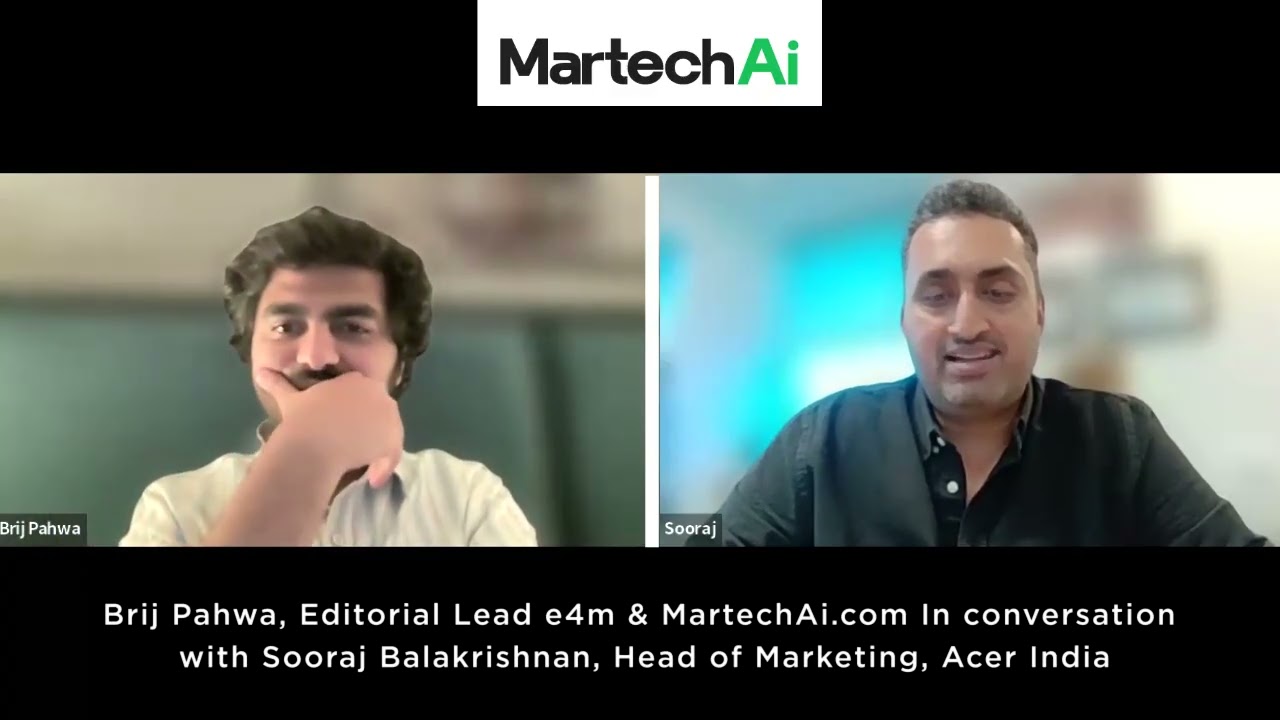
Marketing Has an AI Problem Few Discuss | Acer’s Sooraj Balakrishnan
Watch on YouTubeVideo summary
The interview highlights a fundamental paradigm shift in modern marketing, moving away from traditional persuasion toward active consumer participation. Suraj Balakrishnan of Acer argues that today's consumers are no longer passive recipients of brand messages but rather expect to interact with brands, shape conversations, and co-create experiences. This evolution requires marketers to build platforms where customers feel a sense of ownership and advocacy for the brand story, effectively trading some control for deeper engagement. In this environment, successful strategies focus on creating meaningful shared experiences through communities and user-generated content rather than relying solely on perfectly orchestrated broadcast messages that push information at an audience.
Navigating the fragmented attention economy demands highly personalized approaches where brands seamlessly integrate into a consumer's specific journey across various platforms. Instead of generic one-to-many messaging, Acer leverages AI to optimize communications based on real-time context, such as tailoring laptop features like battery life or weight specifically for travel scenarios identified by users online. The customer journey has also become non-linear and complex; consumers may discover products through creators, validate them via reviews, research using LLMs, visit physical stores, and compare prices across marketplaces all in a single session. Consequently, marketers must ensure brand credibility at every touch point rather than trying to control the sequence of interactions, as influence now flows cross-functionally between e-commerce sites like Flipkart or Amazon and exclusive retail locations, often resulting in an approximate 50/50 split in sales contribution from both channels.
The rise of Generative AI introduces new challenges regarding visibility and content strategy, particularly with Large Language Models (LLMs) curating search results for consumers. To remain relevant when a user asks an AI assistant like ChatGPT or Gemini to recommend products within a specific budget range, brands must practice "Generative Engine Optimization" by creating fresh, high-quality content that answers questions directly and maintains positive sentiment on forums like Reddit and Quora. While there is concern about generic campaigns produced by LLMs leading to homogenization, Suraj emphasizes that AI should serve as an enabler for consistency rather than the primary driver of creative thinking. He warns against outsourcing critical problem-solving and brand identity entirely to algorithms, advocating instead for a hybrid approach where human insight guides the use of technology to maintain distinctiveness while leveraging AI's efficiency in data analysis and content optimization.
Looking ahead, Acer is pushing heavily on-device artificial intelligence to address consumer concerns about cost and privacy associated with cloud-based models. By utilizing proprietary LLMs embedded directly into hardware, Acer offers tangible benefits such as reduced subscription costs by avoiding token limits and enhanced security that keeps personal health or company data local rather than sending it to public clouds. Despite the rapid evolution of marketing technology stacks involving multiple vendors for analytics and delivery, Suraj insists that foundational knowledge of consumer psychology cannot be outsourced to AI tools. He concludes that while martech will become increasingly prevalent over the next two years, successful marketers must remain grounded in understanding human behavior, pain points, and brand positioning before deploying advanced technologies, ensuring they act as intelligent stewards of data rather than mere prompt managers.
Read the full video transcript
Hello, well, and welcome everyone. This
is Bridge Pawar again, and today I have
with me Suraj Balakrishnan who is the
head of marketing
for Acer in India and Bangladesh. Uh
hi Suraj, how are you doing?
>> I'm great, and I'm so happy to be here
talking to you, and it's an important
topic which we're discussing, so I hope
I can contribute to this discussion.
>> Interesting. So,
Suraj, we we are seeing a revolution of
sorts, right?
I mean,
a lot of people who were before us sat
through the dot-com revolution, right? I
think this is bigger than that, the
revolution from artificial intelligence.
And marketing leaders today are dealing
with a rare convergence of forces, if I
would say. Uh you know, AI is changing
how campaigns are made and measured.
Consumer attention is fragmented.
CFOs are demanding clearer ROI.
In this environment, what is the single
biggest mindset shift that marketers
like you need to make?
>> Great question.
I think in this age, I think what we
should look at is the shift is from
persuasion to participation. I think
that's very important aspect look at it.
See, if you look at consumers, they're
not no longer passive audience per se,
you know, they're receiving brand
message, they want to interact with
brands, they want to shape
conversations, they want to share
experiences, they want to influence how
brands evolve, right? And that's
important aspect. So, as marketers, we
must create opportunities for customers
to participate through communities,
user-generated content, reviews,
co-creation, feedback, brand experience,
all of that. Uh it's important that they
feel part of the brand than just being a
passive
listener for in that sense. And when
they start contributing to a brand
story, they develop a stronger sense of
ownership and advocacy. And and that
means maybe we give up some control,
right, in that sense, right? So,
I think being a perfectly orchestrated
broadcast message might not be the the
the way to go forward, but it's more
important to build a platform where the
brand and its customer can create
meaningful experiences together. So, I
think I think the shift is that, you
know,
marketers per se should should go away
from just persuading, pushing the
message, but rather make the audience
participate in their brand.
>> Interesting.
You know, but you know, with with social
media booming, with
you you know, you talked about
participation.
Participation is increasingly becoming
um
uh
you know,
a lot of a lot of brands are now
approaching their audiences via social
media, via creator-led communities,
right? And that makes
uh
um experiencing a brand with smaller
attention
uh even more difficult, right? Because
that particular creator is showing it to
a lot of
people. So, how do you use the term
experiences? If you can delve deep into
it, how do you create personalized
experiences today when every brand is
almost essentially sending the same
message every day to the consumer?
>> I think what's most important is that,
you know, how do we make our brand
relevant to their current journey,
right? So, when users are experiencing
something on on various platforms, how
does a brand seamlessly integrate into
that platform? How do you ensure that
platform gives you the experience which
the brand also is trying to give you? Um
you know, when when you look at, for
example, if somebody is is is on a
travel uh website or looking at
something related to travel, um
it's important that we communicate to
the person in a way which connects to
that person related to travel, for
example. So, the messaging, for example,
I mean, if you take our example, then,
you know,
how do you make your travel better with
the lightest,
you know, laptop with the longest
battery, for example, right? So, in a
sense, AI helps us to kind of optimize
the message
in those platforms and in those
instances where,
as as a user, when when they when they
kind of go through that journey, they're
able to get the relevant context from
the brand. Instead of just fitting a
message which is, you know, meant for
all, right? I think that's the most
important aspect. I mean, it's it's not
one-to-many, it's it's one-to-one is
what we really need to push for. And
definitely, in that sense,
some of the tools which we use really
help us to kind of contextualize the
kind of ad we put out, and I think
that's where we really need to
push more and more.
And when you when you say create
experiences as well,
you know, it's important that we make
them part brand, what I was saying
before. So, it could be that right from
listening to them closely
through, you know, through AI and other
tools to kind of summarize what the
customers are saying,
and then giving back to the community on
on what their expectation is, and then
kind of taking it from there is very
important rather than, you know, we
deciding what the customer wants. It's
it's the other way around, right? And
when they co-create things with us, when
they co-create experiences, when they go
and tell their friends that they had a
great experience with the next YZ
product, and that's that's when the
brand gets built. And that's something
which is very important, and
that's where I think with the help of AI
and lot of the martech tools which which
is using AI very efficiently these days,
I think that's something which
all marketers should should kind of
use for, more of one-on-one versus
one-to-many.
>> Interesting. Now, since we are on this
topic of customer experience,
I would want to get an insight from you.
>> [clears throat]
>> How
is a consumer behaving today? You know,
I I for sure know that you know, Acer
has grown its
you know,
exclusive store networks significantly.
You know, you are doing selling through
D2C platforms as well.
What's the percentage of buying? So, in
terms of direct online buy to a customer
stepping into a retail store and
buying an Acer laptop. If you can tell
me the exact percentage percentages if
you have.
>> Yeah, so if you look at it,
obviously before retail was such a big
part of our lives, lot of the people go
to the stores and you know, they do the
purchase
and and that's about it. But the
influence of e-commerce has been
tremendous in all all industries, I'm
sure.
But especially in our in our electronics
industry, e-commerce is really
you know,
broken lot of barriers in terms of
reach.
Right? So, what's happening is that you
know, we are able to I'm talking about
let's say our own D2C website, right?
So, for example, that I can reach up to
almost 20,000 pin codes, which is a huge
number.
Right? But the influence of retail has
not gone down in that sense even though
the e-commerce has grown quite a lot.
What's happening is it's creating more
of omni-channel experience. You know, if
you look at how customers are behaving,
they go to online, they see the product,
they read the reviews, they come to
retail store, they experience the
product and wherever they are getting a
good experience, they tend to buy from
there and that could be right from
you know, availability of product, how
the product is showcased, right from
offers, what kind of you know, discounts
are getting, EMIs, all that kind of
stuff, right? So, there's a lot of
influence points there.
So, it's it's the the the journey is not
very linear in that sense.
Um But the influence is
cross-functional. So,
so in our case, you know, we are
depending on season or
some quarter e-commerce is a little bit
higher
while the other quarters retail is
higher, but
you can almost say 50/50 is our
contribution from retail and and
e-commerce. And when I say retail, there
is the large format retailers like your
Chroma Reliance of the world and our
exclusive stores. And then you have
Flipkart, Amazon, and then to some
extent quick commerce as well
and our D2C site.
But I think it's it's a it's an era
where they all coexist and that's
important to kind of understand how they
both play a role in kind of influencing
each other's platform.
>> And so so you're saying it's 50/50?
>> It's 50/50, yes.
>> Now since it's 50/50 and you know, a lot
of people are now it's you know,
directly getting products through your
first D2C website or the
the the the larger e-commerce websites.
The consumer journey is no longer you
know, a neat funnel like it used to be a
neat funnel, right? Consumer may
discover a brand through a creator,
you know, compare products on YouTube. A
lot of people like me would go to
YouTube before buying a laptop, see a
see an influencer's video on
right?
How should marketers redesign, you know,
journeys when discovery, consideration,
conversion are all happening at once?
>> Yeah, that's a good great question. I
touched upon the non-linearity of the
journey
before, but that's something which we
see more and more.
I mean the the whole old school thought
of you know, awareness and consideration
and conversion and then to some extent
retention, you know, came in after that.
I think that's no longer the only way to
think of marketing because if you look
at how it is it's a network of
influence, right? A customer may
discover through a creator a product and
then they might validate that same thing
through reviews online and then they go
to a store to experience it and then
they go to a marketplace to compare it
and then you know they might even use an
AI assistant to research about it.
Right? So the the the whole aspect is
that the task is not to control the
sequence.
It's to ensure the brand remains
credible and easy to choose when the
consumer enters the brand journey.
That's very important for any marketer
to understand. More and more you try to
control the sequence, it's not going to
happen.
So you should accept that the journey is
now completely or almost non-linear
especially in our categories where there
is a lot of research, there is a lot of
touch points. This is a heavy investment
in terms of buying a product like a
laptop or a tablet or any of those kind
of devices. So the journey is no longer
linear, right? So
and that also affects your measurement
to a large extent. Like you know when as
a marketer you have to report back to
your bosses internally and then you're
trying to justify okay yeah this
investment has given me
you know conversion or this investment
has given me clicks. It's it's no longer
a very linear measurement as well,
right? So I think that's also important
for anybody to understand that
it's a it's a culmination of a lot of
touch points and culmination of a lot of
the activities you do to ensure that
your brand remains credible and it's
it's something which they get an
experience
across all touch points which is
consistent with the brand values.
>> And that that takes me to another
interesting question. I mean I think
it's very interesting.
A lot of consumers are now researching
via
you know
LLMs, right?
The Geminis, the OpenAIs of the world,
right? And
and
and they are trained on of course global
data sets including yes of course
essential Indian local data sets as
well.
How does a marketer like you
for a customer like me who is going
and trying [clears throat] to find a
laptop within the range of 50 to 60,000
goes to open AI and open AI starts
giving me suggestions.
How do you ensure that Acer goes right
at the top of that that that suggestion
box?
Essentially which is right you know now
being called A G O.
Um you know in in marketing terms. But
how do you ensure that?
>> Yeah, that's something which I think all
brands should start doing more and more
of A G O or G E O uh because it's
it's important that you make your
content friendly for a for an AI engine
to kind of recommend. Right? So
the most important aspect is lot of
questions and answers. The kind of
recommendations which you throw from a
from a reputed website. So it's if you
look at SEO, yes it had similar
principles of you know backlinking of of
having your website recommended by a
trusted uh source and all of that. So so
those concepts still remain uh
prevalent. But what's most important is
that you have enough content across
website which answers lot of questions
because what happens in in a in a in a
chat GPT or a Gemini or publicity is
because lot of questions get asked.
Right? So lot of content series has to
kind of answer the questions.
But what um people miss is that um your
your AI engines need um you know content
which is fresh. Right? Um what I see lot
of people agencies do is that they just
repurpose content from chat GPT or
Gemini and they put that up as as an
article or as as a content for them to
crawl.
But more and more what we are seeing is
that um the AI engines have crawled the
website anyway.
So,
uh what it's looking for are fresh
content. So,
um it's also important that, you know,
you write your own content, which is
something which is uh useful for a user
in a very relevant format, which is more
of answering questions,
um
giving useful tips, all of those kind of
content,
um ensuring that, you know, you have
very less negative
uh
commentaries on on on websites like
Quora, Reddit, and and all of those
places.
>> Uh but I think that's what I was coming
to my next question, but yes, please go
ahead and answer.
>> Yeah, so so a lot of these uh people uh
do kind of research of brands with uh
with with Quora and Reddit as well. So,
you need to manage your conversations
there. I mean, um
Instagram or or Twitter is is not enough
to kind of manage that kind of
conversations. You have to ensure that
Reddit, Quora, all are part of your
generative engine optimization strategy,
where, you know, you're able to control
the narrative to large extent.
>> And that makes it very difficult. Sorry,
I'm I'm sorry, I'm cutting you. I think
that makes it very difficult for you as
a marketer now because, you know, you
are not you you
you you don't know for sure where, you
know, which link ChatGPT picks up,
right? To answer a user's question,
right? It can pick up an Amazon link, it
can pick up a Flipkart link. So, for
example, right? So, I just did a live
test. I just I just told my OpenAI
system, "Suggest me a laptop within the
range of 50-60K, top five suggestions,
no context. No no context, just a normal
laptop." So, the first suggestion comes,
Samsung Galaxy Book 4. Second comes,
Acer Aspire Go 14. You see? Now, I'm not
saying that Acer is not, you know,
on the second rank compared to Samsung.
Right? But I'm just saying
a lot, you know, you can't you can never
be sure, right? Which link it picks up
to suggest uh you know, your product.
So, doesn't it make your life as a
marketer very difficult?
>> It does, for sure. Uh no doubt about it.
But, what we have to at least ensure is
that the sites which it surely ranks.
Now, we have a lot of martech tools to
also understand which are the website
which these ChatGPT and Gemini ranks, uh
you know, on their list. So, as as a
marketer, you should definitely cover
those websites depending on what
industry you are in uh to ensure those
websites are very um
are covered in a way which is uh you
know, friendly for ChatGPT. Um see,
sometimes you might have so much of
uh products being sold in the market
that there might be
um a lot of comments on both sides, good
and bad. Right? And some brands might
have might be very new, might not have
enough negative
uh comments which gets pushed up into a
a place of a number one rank or whatever
because they have only sold limited
numbers and they only have limited
comments which are positive, right? So,
ChatGPT can also get influenced by such
instances as well. So, the I the
objective is for any any research which
you're doing not to depend only on AI
research, but do your own experience, do
your own um you know, uh kind of
research, going to the store, um you
know, reading actual reviews on on
places like Amazon or or other places um
and and also
um ensure that, you know, you have good
support and service near your place. All
of those are very important as well. Um
but uh as as a base rule, what you need
to know is using these martech tools,
understand which are the top ranking
websites for your industry which ChatGPT
and similar uh AI engines crawl and
ensure your content is positive and you
have enough content
there in those sites to kind of start
ranking and start recommending.
>> And which websites are web- websites are
these?
Just for my own
>> in In our case, for example, Reddit is
very important.
>> Mhm.
>> Then you have your tech websites like
your Digit, your 91 Mobiles, your
MySmartPrice, all of those as well. Uh
we have also seen, uh for example, Bajaj
Finance ranking very highly. Um you
know, um for for what reasons?
Uh maybe people are seeking Bajaj
Finance websites for getting a good uh
kind of, you know, uh EMI offers um
from their side.
On laptops, right? So, uh there are some
outliers like that, but then uh once you
know which are the ones which are
ranking, you need to work with that that
publisher or that website to see enough
content. And uh and start uh ensuring
that these AI engines start recommending
those.
>> Mhm. So, Samsung source was Flipkart.
Acer's Now, I've asked it to give me
sources. I'm just behaving like a
general consumer in this.
>> Sure.
>> So, Samsung's source is Flipkart. Acer's
source is 91 Mobiles. That's an insight
for you.
>> Yeah, so that's that's right. So, we do
work with uh publishers like that so
that, you know, and 91 is is a is a
top-ranked site in uh in the in the AI
engine, right? So,
um
so, that's why we work with such
publishers to ensure that, you know,
people when they search for it, uh
uh you know, such uh articles get
published. See, this aspect is, you
know, you can make a great product,
right? But if you're not uh putting the
right content out, uh then how will they
discover? Now, people's mind are getting
influenced so much with AI uh AI
recommendation that, you know, they they
they they do research for their medical
problems, personal problems, their
buying
uh suggestions. Everything is now
dependent on how, you know, AI is
recommending, right? So, you have to
accept that AI is a big part of
anybody's recommendation. They don't
want to ask like before you have word of
mouth as big
marketing jargon, but these days uh I
think that's coming slowly down and uh
in the in the generation now who's
influencing, they want to depend on AI
to kind of make up their mind more than
asking people around.
>> You know,
you know, because it's easy. You can ask
it questions, etc., etc., etc. But you
know,
I I'm you know, as a general consumer,
right? It's very difficult because if I
ask for five suggestions, right? As you
said, you know, as a consumer, they
should go out, they should research,
they should go to different stores. But
as a general consumer, if I'm asking for
five suggestions,
in the top five, it will if it leaves a
brand out,
right? Even if I'm going to a store,
right? To check, I'm only going to
research on the five suggestions that it
has given me. So, the sixth one which
has been left out, I'm not even going
and researching for it in the store,
right? And just a just a
just just an observation. But you know,
we were talking about content and let
let me just, you know, take the
conversation ahead. Uh you know,
gen AI LLMs, you know, they have made
content production faster, of course,
cheaper.
Uh but it has also generated,
you know, a lot of similar-looking
campaigns and a lot of generic
communication. Like I I I see a lot of
similar sort of campaigns all around
LinkedIn, Instagram, etc.
Do you think AI will make brand
differentiation harder with this? And
what should marketers do to protect
their distinctiveness? Because there was
a time when brands used to pride in
their, you know, distinctiveness. And
which is nowhere to be seen now because
the campaigns are being made by LLMs,
you know,
trained on similar data sets globally.
>> [snorts]
>> I have a different opinion on that. I
think what's all important is that AI
also helps you with consistency, right?
Uh, AI gets trained on what you input.
Right? And if you're inputting the right
brand signals, right brand, you know,
identity, and right brand tonality, and
then all of that,
>> Mhm.
>> AI will give you a creative which is in
the line of what a brand should stand
for and what the creative should look
like or a campaign should look like.
>> Mhm.
>> It happens probably with maybe uh,
smaller brands who are trying to, you
know, generate a lot of content and they
want to, you know, make it very
distinctive, etc. And then they're
they're trying that. But if you look at
large brands, um, including us and all
of that, I think what's also important
is that, um,
you know,
let's say we depend on humans to kind of
ensure consistency.
>> Mhm.
>> Uh, it could be a person in an agency
who might be doing that work for you and
then marketer to ensure brand guidelines
are met, all of that. Um, but then, you
know, people change and all of that. In
that, you know, instance, you know, you
can also lose out on some of the
tonalities and all of that which you
built and what made a brand stand out.
But I feel AI can also add to the
consistency of messaging across and not
just creating different campaigns. So,
uh, that's the advantage of having a
model or a trained AI engine which gives
you outputs which are, uh, consistent to
the values which you which you have. So,
there is that aspect of AI, but I agree
what you what you're saying that, you
know, there are there are a lot of
campaigns which are just thrown in the
in the social media, created of
generative engines, and, you know,
it might look flashy, it might have some
clever headlines. Uh, but I think for a
brand,
um, to have some identity, it's
important to be consistent in the way
you're talking, the way your your colors
are used, all of that basics which we
have all grown up with. I think that's
not get lost just because AI is there. I
mean,
the the the important aspect is AI
should not drive what you're what you're
doing. AI should be the an enabler or or
a part of your campaign. I think what
people are kind of going
kind of going wrong is that they are
depending everything on AI.
And you are outsourcing your thinking
also into AI. Right? So, if you look at
the kind of especially the the younger
generation,
they don't do anything on their own.
They they outsource everything, creative
thinking, problem-solving, everything to
to to AI tool, right? So, I think that's
where as a marketer you should not do
that. I think you should definitely use
AI as as part of it, but not your the
whole driving engine of your marketing.
>> Interesting.
Well,
you know, Acer has also, you know,
emphasized that consumer consumers
understand AI online, but are still
learning what AI built into a device can
do, right? And which which is actually
true, right? A lot of people still think
AI is an online thing, right?
Uh but a lot of hardware products are
integrating artificial intelligence
systems into them.
How are you How are you making the
benefits of AI PCs tangible? Because I
know for sure that Acer brands a lot of
its PCs under the AI
symbolism.
Uh so, how are you making the benefits
of AI PCs tangible and relevant rather
than simply using AI as a product label?
>> Yeah, that's that's a question which uh
we have all grappled with, but I think
we have answers for that. And the answer
is uh the token. Okay?
Uh if you look at any of the AI
cloud-based model, you need to pay for
it to beyond a point, right? And that's
where I think on device AI is going to
greatly help in saving money for you.
I think people are not talking enough
about the kind of savings you're able to
do when you have on device AI
capabilities.
Right? So, um you know, if you look at
ChatGPT, if you look at any of those,
beyond a point your models need to be
paid monthly subscription, and that. And
there is otherwise there is limitation
of usage. So, I think that's a great
start for for anybody to understand why
you need on-device AI.
Because without on-device AI, you are
able to do a lot of the productivity
task, your creative task, you know,
using all of that on-device, which is
which doesn't consume tokens, which
means you don't have to pay extra for
that. Right? That's one benefit. The
second part is security. Right? The
amount of things you are you are kind of
feeding the cloud-based AI models you
are about your personal data, your
health data, your you know, com- company
data. All of those are something which
you know, it's out in the public. So,
security definitely is a major problem.
And and especially
with with on-device AI, you know, we
build our product with
best of the best security chips on it.
So, that none of the data goes away from
from our system, the personal system
which we use. So, I think those two are
>> Is it a proprietary LLM or is it
via another LLM?
>> So, we have proprietary LLM on the
devices which helps you in lot of the
optimization right from battery to
organizing your your photos to all of
those kind of things in the background
including certain softwares which helps
you to do some productivity, creativity
task and all of that.
And beyond that, you know, if you look
at you know,
some of the softwares like let's say
even Photoshop to to Microsoft Office to
all of that, they are slowly going to
move more into on-device AI so that
their cloud-based usage also can come
come down in terms of you know,
tokenization all of that. Right? I think
that's important in terms of
understanding where on-device AI helps
compared to just you know, cloud-based
AI. So, I think it's more to do with
education. We need to ensure that you
know, we talk more and more about the
kind of savings you're able to do, kind
of security you're able to provide when
it is on-device AI. and and and that's
that's most important aspect to ensure
that you know
people understand why on device why
everyone or people like Acer is really
pushing on device AI. It's just not a
jargon to put in front of a product
name. The actual benefit is that you are
actually saving money in in usage.
>> Mhm.
Tokens, interesting.
Uh I think
considering the conversation we have
had, I think we are in the right point
for me to ask you. Um what is Suraj's
marketing stack or MarTech stack look
like at Acer? Is it a fragmented one? Is
it using a lot of different stacks built
into one? Is it using one company's
stack?
What are the pain points? What are the
What are the advantages of that
particular stack?
I don't I'm not sure if you'd be able to
name it or not, but if you
can give us some insights into it.
>> Yeah, I think it's a MarTech is evolving
very fast, okay? Um you know, we are
seeing very innovative companies coming
up with very good solutions which you
know, we feel is uh useful for us. Uh so
at this point, we are not limited to one
provider for our MarTech stack. Uh so we
do use different tools for our use
cases.
Uh right from marketing data analytics
to campaign optimization,
campaign delivery, all of those uh
across our e-commerce channel, our
social, then you know, in terms of
contextual creativity, all of that. So
there is definitely
maybe three three to four vendors who
work with us in that sense uh to provide
the MarTech stack. And we keep that
option open because uh the it's it's
still a very fast-growing industry and
it's not it's not a stagnated industry
where you know, you are just going to
one vendor who is who has all the
answers for your you know your
questions.
>> What is the pain point for you right now
in terms of understanding the consumer
which
you know
which one of the vendors is solving?
>> I think
>> Maybe a real life example if you can
share.
>> Yeah, so one one of the
things we are trying to look at is you
know when we get lot of incoming calls
for example, right? How do we ensure the
tonality of the call is captured
correctly? And how do we analyze what is
the the kind of feedback he or she is
giving? And this is post post and pre
pre even when I say pre it is basically
the calls which comes to us to the to
the call center or to the store.
And post is obviously the feedback call.
So what we're trying to understand is
how do you because India is such a
complex geography with so many different
accents and the usage of language and
all of that. Right? It's not that simple
unlike in in some of the other
countries, right? So I think that's
something which we still feel there is a
gap in terms of tonality understanding
of of feedbacks or calls which comes
through where an AI system is able to
completely summarize in the right way. I
think that's one pain point which we
have seen.
>> I think that takes me to my next
question which is about AI agent. So a
lot of companies are employing AI agents
to do that. But we have seen cases where
you know
AI agents for customer experience.
>> Mhm.
>> Consumer [clears throat] experience and
a lot of cases where it has gone
horribly wrong. Of course there are a
lot of built-in use cases.
But where do you stand on AI agent
because because it's still still
evolving.
You know a lot of marketers are still
grappling up with how to use them, how
not to use them. Where do you draw
boundary in terms of personalization
because an AI agent can really penetrate
that personalization boundary. So what
Where do you stand on it?
>> I think there are some companies who
have done the AI agent quite well.
But, I feel the one which is on
chat-based AI agents, I think has
progressed much faster compared to
call-based chat agents.
So, we have seen, I know, right from day
to a lot of these brands using very
very well kind of
integrated the AI agents to kind of talk
to the customer.
But, our case is usually more technical.
So, there are a lot of nuances in our
case if it is a customer call which is
coming through a call center or somebody
calling our store. So,
the the kind of questions they might be
asking may not be
easy for an agent to answer very easily,
right? So,
it depends on industry, I feel. I think
again, this not be a broad brush kind of
a solution.
We need to understand who's our customer
and will the customer really benefit
from deploying an AI agent. Will it Will
it backfire on us or will it be
something which can add value? Right?
So, for example, when there are very
high volumes of calls coming in, right?
Then, maybe having an agent to filter
through calls and ensure that, you know,
only the right call goes to human agent
and and the other calls which are maybe
easier to handle, simple questions, that
could be something an agent can do.
But, as the complexity of the of the
product you're selling is higher, I
think human intervention still required
and it'll still take a little bit more
time for especially the voice-based
agents to catch up to how a human can
respond to to another one. But, only one
point which I just want to add to the
benefit of an AI agent again is when you
have attrition especially in in call
centers kind of a industry, Uh,
agents can help kind of ensure that, you
know, your uh um customer experience
while calling is not jeopardized to very
large extent, right? So, you can still
have AI agent kind of handling lot of
the initial customer experience and then
pass on to somebody relevant after that.
So, I think there is that benefit,
especially in industry like us. Um,
but otherwise, uh, I feel it should not
be it should not be completely handed
over to an AI agent as of now.
>> Interesting. Interesting. So, you know,
it's very interesting to note that, you
know, when the artificial intelligence
boom came in, people were talking about
how, you know, human intervention will
become totally redundant. And slowly we
are realizing that, you know, human
intervention is as important as it was
before.
I was at Cannes this year and the the
whole conversation has now changed in
how humans can enable better use of
AI. But I think it's a very interesting
conversation. My
final question to you,
if you want to add something else, you
can add in it. Where do you see, you
know, marketing evolve
especially for a brand like Acer over
the next 2 years?
>> See, I think let's talk about where
marketing should not change. Okay, what
marketing should not change is the basic
understanding of consumer behavior.
I think,
uh, more and more marketers who come to
the to the industry, what I've seen is
that
they depend on lot of these tools to to
kind of understand, but then the basic
psyche, consumer understanding, consumer
behavior, that's something which any
marketer should be very, very thorough
about. Who's their customer? What is
their pain point? What are we trying to
solve? Where are they experiencing the
brand? How should the brand be
positioned
in those touch points? What is the kind
of messaging you want to leave behind?
All of those things where a customer is
uh, is is having a touch point and and
having their experiences very important
for any market you to understand. I
think that's the basics which I feel a
lot of people are missing, right? So,
consumer understanding is something
which should not be outsourced to an AI.
And that's something you should learn.
You should go to the store. You should
maybe sell a product, understand where
the pain points are, experience it
yourself. Then use tools which are
there, you know, AI, martech tools, all
of that to kind of better the the
campaign and the experiences what you're
providing, right? I think that's the
basic which I just want to touch upon.
Where do we see evolving? I think
AI will definitely become very
prevalent, for sure. I think martech
tools
is going to be an important aspect to
how marketing will be evolving. Because
more and more of the way agencies are
now evolving is through martech tools,
is by using devices, you know,
or kind of
I would say services which rely on AI.
So, definitely there'll be a lot of
evolution on that aspect. But I still
I'm very profound proponent of having
the basics in place before use any tool,
right? So, I think that's where I just
want to leave so that
any up and coming marketer should not
feel that, you know, their job is just,
you know, prompt managers. Right? I
think that's That's something which
I feel a lot of youngsters just are
experts in prompting without
understanding the basics of where the
marketing is.
>> I think if Suraj writes his own
autobiography, it will be
an an old school marketer with new age
capabilities.
>> Well, yeah, you can say that.
>> [laughter]
>> Yeah, that's that's something which I
can put in my autobiography.
>> Interesting.
Thank you for those insights.
You know, it's very clear that the next
phase of marketing will not just be
shared by technology but how
intelligently we use you know data
communities you know as we spoke in our
conversation and the customer
understanding all together.
Thank you for your time. I think it's
very interesting conversation.
Great chatting with you.
For watching.
>> [music]