Video summary
Marine energy encompasses a diverse range of technologies designed to harness power from the sea, primarily focusing on wave and tidal resources, though it also includes concepts like thermal and salinity gradients. While offshore wind is often grouped with these technologies due to shared infrastructure needs, the core focus here is on converting the immense kinetic and potential energy of water into electricity. Tidal stream devices function similarly to underwater wind turbines, capturing energy from fast-flowing water funneled through gaps in coastlines or estuaries, whereas tidal range projects utilize the height difference between high and low tides, operating much like traditional hydroelectric dams. Wave energy presents even greater variety, utilizing mechanisms that respond to linear motions like heave and sway, angular movements such as roll and pitch, pressure changes beneath the surface, or the direct overtopping of structures by breaking waves to drive turbines.
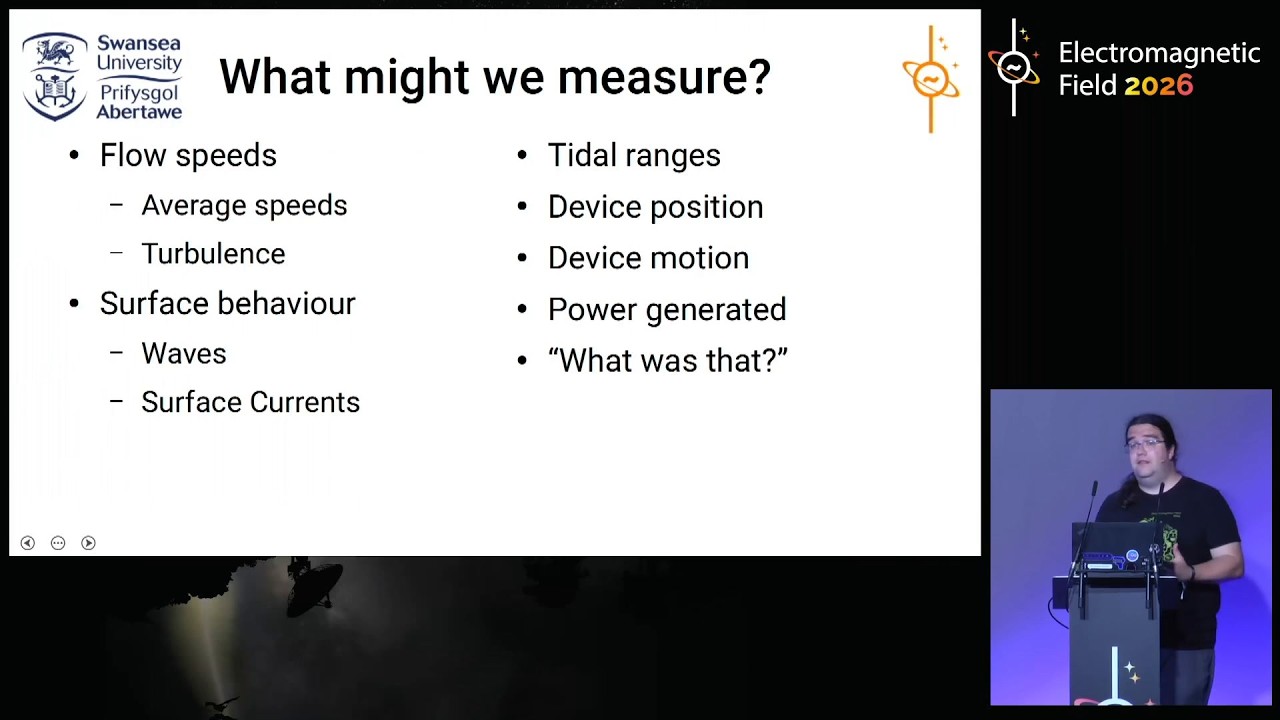
The significance of marine energy lies in its potential to provide sustainable, low-carbon power for a nation surrounded by water, particularly given the UK's vast coastline and its possession of the second-largest tidal range on Earth. Beyond simply feeding electricity into the national grid, these devices can play a crucial role in replacing diesel generators in remote offshore communities. However, realizing this potential requires overcoming significant engineering challenges related to data collection and device reliability in harsh environments. Researchers must measure complex variables such as flow speeds, turbulence, and surface currents to validate computer models and ensure device longevity, while also monitoring position and power generation to troubleshoot issues before they escalate.
The speaker shares firsthand experiences from developing practical testing devices, highlighting both the successes and the inevitable failures that come with working at sea. One project involved a floating turbine platform built with repurposed bridge sections and housed in a shipping container, which successfully gathered data despite water eventually breaching its dry electronics compartment. Another initiative utilized a large seabed-mounted acoustic Doppler profiler to measure underwater currents, but this device faced mechanical wobbling caused by wake interactions and suffered from galvanic corrosion on its metal connectors due to saltwater exposure. The recovery of these submerged units proved particularly difficult when electronic release mechanisms failed, forcing the team to deploy a grappling hook as a last resort to retrieve the equipment without damaging critical components.
Ultimately, these field tests underscore the importance of robust design and adaptive problem-solving in marine energy development. Although the sea is unforgiving and determined to find ways to breach protective barriers, every failure provides valuable data that informs future improvements. The lessons learned from managing turbulence, corrosion, and recovery logistics allow engineers to build more resilient devices capable of operating effectively in real-world conditions. By combining computer modeling with rigorous physical testing, researchers can refine their understanding of marine environments, leading to better technologies that can harness the ocean's power reliably and sustainably for the future.
Read the full video transcript
[applause]
>> Oh, well, thank you very much and good
afternoon. And I think given the
conditions today, it's a warm welcome
whether you intended it or not. So,
if anybody does get too hot and has to
walk out in the middle of the talk, I
won't hold it against you.
So, uh
as you've just heard, I'm going to talk
a little bit about marine energy and
what I mean by that.
I'll go through some of the different
devices that are out there and talk a
little bit about some of the projects
I've been involved with, most of which
have involved Raspberry Pi's and things
that are very familiar to EMF and in one
case a grappling hook, which I think was
the story I promised in the abstract.
So, hopefully we'll get there in time.
Um I did realize when putting this
together, it could easily have been a
90-minute talk. I'm not going to make
you sit through that, but if you've got
any questions or if there's anything
that you want to know more about
afterwards, come and find me in the Q&A
tent.
So, to begin at the beginning, as it
were,
what is marine energy or at least what
do I mean when I'm talking about marine
energy?
Well, as far as I'm concerned, it's
anything where we're taking energy from
the sea.
Okay? And generally that's going to be
to turn it into electricity,
uh although not exclusively.
Now, there's a lot of different ways we
can do that.
I'll tell you that wave and tidal
energy, wave and tidal power, are the
two that you're most likely to come
across, most likely to see.
Uh
wave energy comes in quite a lot of
varieties. We'll talk about it in a
minute.
Tidal splits quite nicely into tidal
stream energy, where we're taking
advantage of the flow of water from
place to place, or tidal range, where
we're taking advantage of that height
difference between high tide and low
tide.
They're not the only ways of doing it.
There are a couple of others that are
perhaps
a little less uh commercial uh that are
being investigated. So, you can take
advantage of the temperature difference
between bits of water, particularly
somewhere that's a little hotter than
the UK normally is. You can use the
temperature difference between different
depths of water or different areas to
generate power.
And you can also do the same sort of
thing by taking advantage of different
salinities, different salt
concentrations in the water. They're a
bit fancy. They're a little bit
different. I don't know an awful lot
about those, too, but they're
interesting bits of technology.
I'm also giving you a bit of an
honorable mention to offshore wind.
The actual energy bit of offshore wind,
I don't think counts as marine energy,
but there's an awful lot that it has in
common in terms of the structures, the
moorings, and working in a marine
environment. So, you'll often find it
included on the list.
Now,
the next thing to go through is like,
well, why does this matter? Why is it
important?
Well, as far as I'm concerned, the UK is
surrounded by water. We're an island
with other islands.
Uh so, we've got an awful lot of
coastline, an awful lot of sea we can
look at.
And water carries a lot of energy. I
think at this point we're all pretty
familiar with the idea of wind turbines
and how they generate electricity.
Water can carry 800 times the energy in
the same space.
So, with smaller, differently designed
devices, admittedly, we can get a lot
more energy out of similar amounts of
space.
It's not just the amount of coastline
we've got that's an advantage for the UK
here as well.
We're home to the second largest tidal
range on the planet.
The Bristol Channel, Severn Estuary,
going to get 10 m between high water and
low water. You think that's over a
little over 6 and 1/2 hours between one
and the other. That's a lot of water
that's got to move from one place to
another, and a lot of energy that could
be harvested.
There's a lot of wave energy as well,
particularly off the northwest of
Scotland, waves coming all the way
across the Atlantic. And all these are
ways with which we could get
sustainable, low-carbon, and perhaps
locally produced power. There's an awful
lot of assumption that these sort of
devices are looking at putting
electricity onto the grid, and that is
something that's happening. That is
already in place. But you can also look
at using them to replace diesel in
offshore communities and things like
that. So, there's a couple of other
places we can use it.
So, to look at a few in a little bit
more detail,
tidal stream, and I will admit this is
where my experience is a little bit more
so.
This is again using that fast-flowing
water.
And when we find good places to look at
tidal stream energy, it's pretty much
anywhere where water driven by the tides
is going to be funneled through some
sort of gap.
And that might be around headlands. You
can think of it as one half of a funnel.
Uh between islands and sort of those
channels.
But also places like estuaries. So, I've
mentioned the Severn
uh in the Bristol Channel.
The water can accelerate as it moves
upstream. It's all very local and very
specific.
And it's one of those things where it's
important to remember that space is
three-dimensional in this context. So,
it can as well as having the coastlines
coming in, you've also got the fact that
the shape of the seabed, the bathymetry,
can also become shallow. And you can get
that sort of acceleration effect there
as well.
There are a few different types of tidal
stream device out there, but mostly they
end up looking like underwater wind
turbines.
So, to give you some examples,
uh two real devices, these are not uh
these are not renders.
So, on the left-hand side there, you've
got a device from a company called
Andritz Hydro.
You need to double-check the specific
model in the picture,
but that's about 18 m diameter on the
rotor in the front of that one. So, this
is not a small device. It's designed to
sit on the seabed, generate electricity,
and come to the surface as little as you
can get away with.
On the right, you've got a different
approach. This is a floating platform.
So, this was one that was being tested
in Canada, hence the color scheme.
Um and this has got six smaller rotors.
And the rotors on this are about 6 m in
diameter. Okay? Advantage of being on
the surface, it's a lot easier to get
there for work, for maintenance, and
things like that. So, two different
approaches both being pursued
commercially at this point.
So, moving on,
we then have tidal range. And this has
hit the news in the UK at various
points. There's been a few different
proposals.
Tidal range uses that change in height
of the tide instead of the speed of
flowing water. So, if you'll indulge my
inner physicist, if tidal stream is
taking kinetic energy more directly with
water flowing over the blades,
tidal range is more about gravitational
potential, taking advantage of that
change in height over the tide.
Mechanically, they're quite simple. You
build a wall that's big enough to hold
the water back until the height
difference either side of it is large
enough to drive some turbine. You let
your water through, generate your
electricity.
And once things equalize, you wait until
the height difference builds up again in
the other direction,
and let your water back through. So,
these are lagoons, barrages, and there's
a few examples of those around the
world, and there's been a few proposals
in the UK as well.
And tech- from a technological
standpoint, these look a lot like
hydroelectric power. So, your typical
sort of dam with turbines at the bottom,
it's the same sort of idea.
And so,
a little bit of a diagram to hopefully
illustrate what I was going on about in
terms of the different water levels
either side.
Um
And again, you're going to hit some
midpoint at low and high water, but you
can design a device that generates in
both directions.
So, that's the tidal side covered off.
On to wave energy.
Now, this is a little less my field, but
very interesting, there's an awful lot
of energy in the waves, and we're mostly
talking about swell waves near the coast
in this context, where the wind has
driven over the surface
to give us the waves there.
There's a much wider range of devices
for wave energy that are being
investigated.
Now, I've got three categories here, and
they're not particularly exhaustive, but
you can have devices that move with the
waves,
but you've got six different kind of
directions you could react to. So,
whether that's surge, sway, and heave
are your three kind of linear motions,
or roll, pitch, and yaw are your angular
motions. You can design a device that
would work with either, or a device that
would work with more than one of these
in combination.
Or you might design a device that works
with one
and unintentionally reacts with the
other, and that's a little bit of a
bigger problem to deal with.
The other torque devices you can get
might be something that reacts to
pressure change.
So, you imagine the waves coming towards
the shore, you've got a change in the
height of the water. That change in
height gives you a change in pressure
below the surface.
And you can then generate electricity
from that either directly, and there's a
lot of research going on looking at
materials which give you kind of a
capacitor effect that you can turn
directly into electricity.
Or you might use something that can
inflate and deflate under pressure,
pumping a fluid, often air, through a
turbine. And that is actually a theme
for a lot of marine energy devices. It's
how do we turn energy that's from the
sea into something that spins that we
can hook up to a generator. Cuz taking a
spinning object connected to a generator
to make electricity is something we've
been doing for quite a long time now.
And so, it's a common theme in a lot of
those designs.
The last category is quite fun. Designed
for something we'd call overtopping,
which is, as it sounds like, you have
your structure, might be fixed to a
shore, might be floating.
As the waves come up to it, they run up
the device or break over the top, dump
water into the top of the device, and as
it empties through, drives a mechanism.
So again, typically drive a turbine to
give electricity.
So, there's a few more options there.
And there are to give you a little
diagram of what some of these might look
like.
So, we have items that float on the
surface and react to the motion of the
waves. We might have what we call the
point absorbers there that are designed
to bob up and down in the waves that
again react against something on the
seabed. There's been some paddle type
devices that have been tested. And these
last ones I think are quite a clever
little bit of physics in terms of how
they operate. So, by having this kind of
overhanging wall, as the water outside
comes up and down, the water inside is
going to try and do the same, pushing
air through the turbine to generate
electricity. And there's been a few of
these tested as well.
So, that's a fairly quick overview
of where some of this energy comes from.
Now, let's talk a little bit about what
I've been involved with and the work
I've been doing, and then I can get on
to the tech of the stories.
Uh
in terms of the work we do as a research
group at the university, we do computer
modeling, trying to better understand
how things
behave, do measurements, often to back
up that computer model or to improve it.
And we also try and do testing, taking
devices and putting them into a real
environment. Okay, so taking them at sea
or close to, and seeing how they perform
against what we expect. Your computer
model's only as good as the assumptions
you've made and the data you've got to
begin with.
So, we build on that.
But what sort of data are we interested
in? And some of them you be able to take
a good guess at.
If we're looking at something like tidal
stream, we're going to want to know what
the flow speeds of the water are,
both in terms of its average speed, give
us some idea of how much power we can
generate, but also things like
turbulence. If you've been on an
aircraft where you've experienced
turbulence, that's a fluctuation in the
plane's movement. You get the same thing
with bits of the structure of a marine
energy device,
and that might affect how much energy
you can convert to electricity at that
point in time, but it also starts to
think develop things like fatigue and
how that might impact on the lifetime of
these devices. So, it's a level of
detail that we're interested in looking
at, particularly as we already got these
in the water.
We might be interested in the surface
behavior.
So, if we're looking at the waves,
couple of ways we can measure that. You
can put a device that's going to float
on the surface, measure its motion, and
it can report some detail about what the
waves are that have made it move around.
Or you can use things like radar. You
pick radar off the surface and use some
information there.
Or we can look at what's going on with
the surface currents, and this was some
work a colleague of mine did previously.
Um we fly a drone over a tidal area,
take some good quality video of the
surface, and then from that work out
what the currents are doing at the
surface. You get a sort of 2D map of
that top layer.
Doesn't tell you anything about what's
going on lower down. So, if you're going
to be putting a turbine deeper in the
water, that might not be enough
information.
But it gets you a large amount of data
quite quickly.
We might be interested in measuring
tidal ranges. I would say we tend to
gather that information cuz we're doing
something else. The UK's quite lucky.
We've got quite a lot of historic tidal
range data that's already available. So,
we will measure it,
but we're not often depending on those
measurements uh for the work we've been
doing at least.
And if we're testing a real device,
well, we want to know where it is.
Is it staying where we put it?
Uh has it wandered off a lot? Do we need
to phone someone to go and get it?
Or is it moving as we expect it to?
And I've said position and motion there
as two slightly different categories.
The position might be slightly longer
term,
whereas the motion might be how it's
reacting as it generates power sort of
second by second. That's a slightly more
fine-grained detail.
If we're testing something where we're
generating electricity or trying to,
then we're going to want to know how
much power have we generated or could we
generate?
And the last category is one that I
think anyone who's been involved in a
project that maybe hasn't gone quite to
plan will value. It's the what was that
information.
Something unexpected happens.
There's a lot of value in knowing when
did it happen so you can go and look at
the data later. Whether that is that was
a strange noise. I don't think we should
have heard that.
Or actually someone's just gone
screaming past in a motorboat with a
huge amount of wake. Let's look at the
data and see if that affected what was
going on. And both of those are examples
that I've had
when doing real tests.
So,
some things we might look at measuring.
A lot of data, maybe a lot of sensors
and devices that we have to get to talk
to each other.
Now, to try and get to some of the
stories of some of the tech,
two different devices that I've been
involved with over the last few years.
One of them is a full-scale but
small-capacity turbine. So, what I mean
is it's not designed to generate an
awful lot of power.
Um and it's an open turbine design, and
by that I mean, if you want to go online
and grab the CAD and have a look at it,
it's all freely available.
Okay. And that's the RRS or Remote River
Energy System.
Did a lot of testing with it in
Pembrokeshire, and I'll show you a
picture of that in a minute.
We also have one which I think is more
technologically interesting.
And that's what we call the converging
beam acoustic Doppler profiler. It's a
little bit of a mouthful, hence the
abbreviation.
And this is something that sits on the
seabed for a month or more at a time.
And it measures those flows beneath the
surface. So, I mentioned earlier how you
couldn't get that with the drone, and
that's surface data. This is one of the
ways we can get that information.
And I'll talk about that in a moment.
So, to start with the turbine,
we started with a simple mechanical
device. So, we weren't generating
electricity with it. Uh it actually had
a water pump off the back of it. We were
using that as our kind of way of
measuring how effective it had been.
And it's an odd thing to say, but as a
university, we're not trying to make
money directly from this device. So, it
was never designed to be the best device
we could build, but something that was
practical to put together with local
suppliers and local businesses as well.
It's a floating platform, with the
turbine behind it on an arm that can
rotate and extend into the water.
Which is very nice cuz you tow it out,
and you only actually need that deep
water once you get onto site.
And you'll see a picture in a minute
where you can see the blades on it.
It's got a shipping container, so all
your electronics are mostly in the dry.
Still got some things beneath the
surface that you have to think about.
And the design we went with was
something that was
Okay. Low cost for something that is
effectively a boat. Um but then we put
some expensive sensors on it for the
science that we can then take use make
use of.
And so that gives us this device here.
So, it you see it's a floating platform
made out of a couple of repurposed
sections of bridge.
Uh which is a nice little tidbit that
says fair amounts of recycling before we
even started.
You see the shipping container in the
middle to give us that working
environment.
And the two turbine blades on the back.
Now, why two rather than three from the
pictures earlier?
Well, if you've got two turbine blades,
it's a lot easier to just have some box
section metal for the hub. Makes it a
lot easier to manufacture.
And you've only got to pay for two
blades.
You know, there's that.
For scale, that's 3 m from tip to tip on
those blades. So, not huge.
Now, trying to build this, obviously
trying to put electronics
subsurface to measure things like the
loads on those blades. Um
And that's quite tricky. Got things that
are rotating, things that are obviously
going to get wet. So, you know, try to
do things properly. Spend a bit of money
on the connectors. So, you might see
this black electrical cable running
across there. So, we've got everything
through one nice, fairly expensive
electrical connector that's designed to
be, I think, good for 100 m, which we're
definitely not putting it that deep.
There you go.
And work from there. Excellent. Should
be fine. We've got our mechanical seals.
Plenty of gaskets in there along with
some grease to seal it, all done up
nicely. The blades could be put on
without disturbing it, so we could test
that it was all waterproof before we
left the university.
And then we got it back. And for those
of you who can see the images more
clearly, yes, that's water inside what
should have been our nice dry electrical
space. So, it's safe to say that the sea
is nothing if not determined, and it
doesn't matter how much you want to keep
something dry, it will find a way to
where it takes you.
So, So, the sort of thing we looked at.
In terms of the technology, this was all
feeding back to a Raspberry Pi and
laptops in that uh
control cabin. So, fairly simple,
but gave us good data for what we were
looking at.
So, to move on to the Doppler profiler,
this was based off existing technology.
So, you can buy these devices off the
shelf
that sit typically at the bottom of the
sea or on the surface, and they use the
Doppler shift. So, I think we're
probably all familiar with the sound of
a siren on an emergency vehicle going
past. You get a higher pitch as it
approaches, lower pitch as it goes
further away. You can use sound under
water to do the same thing. So, beams of
ultrasound send a ping from the device.
It scatters off in uh particles in the
water.
The Doppler shift lets you work out the
speed and the time it took from sending
that pulse
to getting your echo. Lets you know how
far away from the sensor it was. So,
with one sensor,
you're getting velocities of the water
at multiple depths as you go through.
So, if you're trying to work out how
deep your turbine goes, it's quite a lot
of useful information.
Downside is these beams spread apart.
So, typically if you're in 20 m of
water, your beams would be 10 or 20 m
apart at the surface.
And that's fine if you could assume that
the water is all doing the same thing
across that space,
but if you look at the photo I'll put up
at the end, we know that that's not
true.
So, how can we work around that and get
better information, particularly around
things like turbulence that are quite
small variations?
Now, unfortunately, that means you need
to build a bigger device.
The standard devices are quite small.
We're looking at about less size,
and and they're sitting at the seabed,
and you get that divergence problem. If
you want the beams to converge instead,
they've got to start further apart. So,
that means more sensors, power supply,
and something to coordinate them
together.
Trying to build something that was
robust, fairly simple to build, and try
to avoid needing a big enough boat with
a crane to put it in the water.
And we ended up with this.
So, again for scale. That's a diggy
trailer in the middle.
Um corner to corner on this device is 10
m. So, from your little sort of cake tin
size device, that's quite an increase.
But, it means we could get that better
quality data.
The electronics went into a titanium
canister that sat in the center.
And again, Raspberry Pi with a clock,
which is quite important cuz 20 m under
the sea, you've not got the internet to
set the time on that one.
Okay. And again, some nice waterproof
connectors to connect the data.
And this is where you start running into
some of the issues of dealing with the
sea.
If you see the picture up at the top
right, those connectors are no longer
the bright shiny brass color they went
in.
And unfortunately, you put two different
metals in a conductive liquid like salt
water, and you get a battery, and one of
them gets eaten. And unfortunately for
us, that looked like those connectors.
Which we didn't think was going to
happen, but it's something we learned
the hard way.
Now,
in terms of the device, we had some
mechanical issues. The Raspberry Pi
actually did its job. That worked really
well.
It wobbled.
And this is one of those wonderful
things where you get a nice bit of
positive feedback,
and you don't know any of this is
happening until you've recovered it, cuz
it's 20 m below the sea, and you can't
talk to it.
So, one of the arms sat there with a
little bit of a wake behind it, and it
wobbled. So, then the wake wobbled,
which made it wobble more.
And yeah, not ideal. So, we did have to
do a little bit of a redesign.
And then we have the bit where we get to
the grappling hook.
It was quite a big device. We didn't
want to use a crane if we could help it.
So, some of my colleagues had designed a
system where those blue barrels we saw
in the middle were filled with water
when we put it in the the sea,
and a compressed air tank to empty them
and allow it to float to the surface
when we were finished with it. With an
acoustic trigger. Send a little coded
message by the old sound from the
surface,
release the valve on that tank,
and up it comes 10 minutes later.
Lovely. Tested several times, worked
every time.
Until we needed it.
We even had a backup option.
Send a different code, it releases a
buoy that will float to the surface of
the rope, so we can tow it from there
and lift it. And that didn't work
either.
Cuz the battery in the box at the top on
the boat with us had been damaged.
So, imagine we've then got equipment 20
m beneath us, it's got to be recovered
that day.
And that's where the grappling hook
comes out. And I invite you to imagine
having to make that decision of, "Yeah,
stick a great big lump of iron down
vaguely near it
and hope that you grab a bit of the
structure and not any of the bits of the
electronics or the batteries."
But we recovered it successfully and
we've got some lessons for next time for
building another one. And in the
meantime, we've got more information
about what's going on at sea, so we can
build better marine energy devices and
work from there.
So, with that,
I'll leave you with a lovely picturesque
view of part of Southwest Wales where we
were doing that testing. And you can see
just on the surface some of that
variation.
Thank you all very much for tolerating
that talk in the heat. If you want to
know any more, I will be in the Q&A tent
shortly.
>> [applause]
>> Well done. Great work.