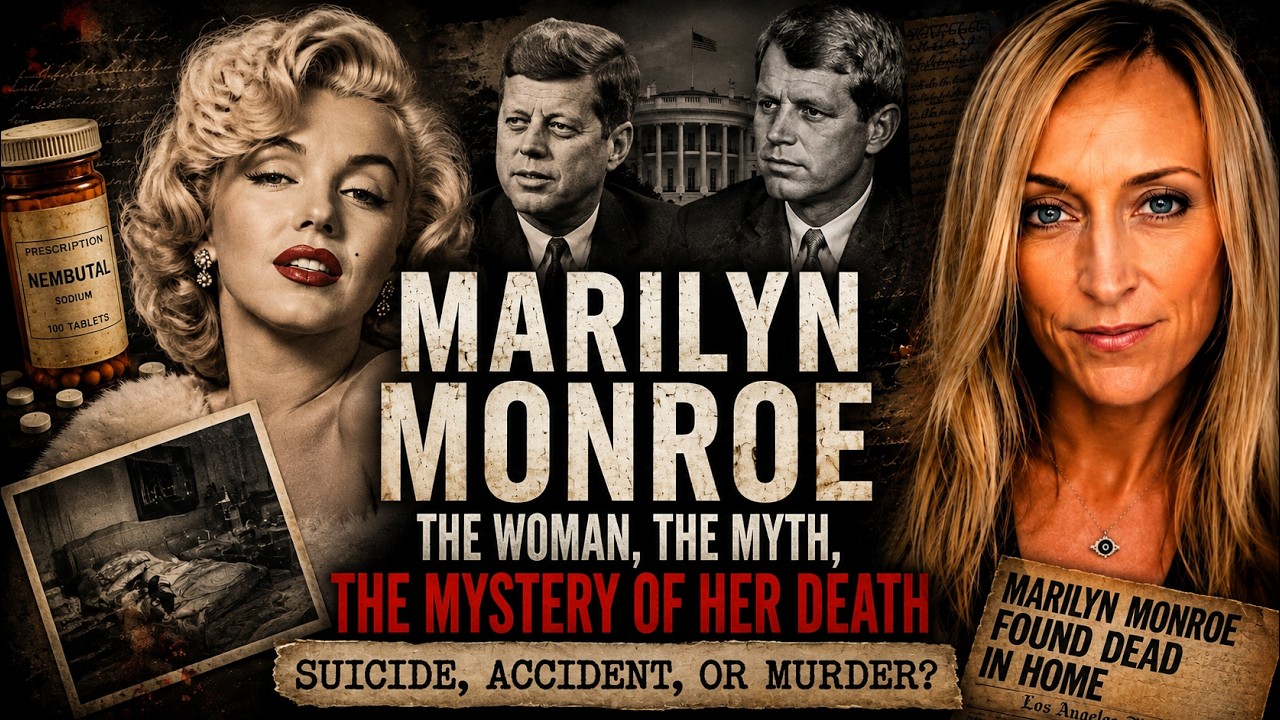
Video summary
Marilyn Monroe transcended the status of mere celebrity to become a global symbol and enduring mystery, representing an image constructed by Hollywood rather than just a person born into fame. Born Norma Jean Mortenson in 1926, she spent her childhood navigating instability between foster homes and relatives, driven by a deep-seated search for security, love, and a sense of belonging that she never fully found. Although the world saw only the glamorous blonde bombshell who could command attention with her voice and presence, the reality behind the myth was a woman struggling to be taken seriously as an actress and respected as a human being. Hollywood crafted her persona through makeup, hair, and scripted roles, yet Monroe herself spent her career attempting to reveal the real woman beneath the character, only to find that the public remained obsessed with the fantasy while ignoring Norma Jean's desperate need for validation.
The narrative of her life became increasingly turbulent as she navigated high-profile marriages to Joe DiMaggio and Arthur Miller, both of which ended in divorce amidst personal struggles with emotional instability, miscarriages, and a heavy reliance on prescription medications. Her entry into the orbit of the Kennedy family added another layer of complexity, fueled by legends of romantic relationships with President John F. Kennedy and Attorney General Robert F. Kennedy that remain disputed due to conflicting testimonies and lack of definitive documentary evidence. While she famously sang "Happy Birthday" to President Kennedy in 1962, creating an iconic cultural moment, the subsequent theories suggesting she possessed sensitive information about Cold War operations or government secrets led to persistent speculation that she was silenced to prevent exposure, a claim that has fueled decades of conspiracy theories involving organized crime and intelligence agencies.
On August 5, 1962, Monroe was found deceased in her Los Angeles home with an official ruling of probable suicide by barbiturate poisoning, yet numerous inconsistencies regarding the investigation, such as the absence of pill residue in her stomach and discrepancies in witness accounts, have kept the case open to debate. A formal review by the Los Angeles County District Attorney's Office twenty years later concluded there was no credible evidence to support a homicide conspiracy, maintaining that her death was consistent with suicide or accident; however, this official conclusion has not satisfied those who believe the establishment covered up the truth. The enduring mystery of Monroe's death may be less about identifying a specific killer and more about how society failed the vulnerable woman behind the icon, projecting its fears regarding power, politics, and sexuality onto her life and tragic end. Ultimately, the story of Marilyn Monroe serves as a haunting reflection on how the world consumed her image while denying Norma Jean the chance to live out her potential as a respected actress and person who simply wanted to be loved.
Read the full video transcript
There are some people who become famous
and then there are people who become
something much larger than fame. They
become an image, a symbol, a fantasy,
and eventually a mystery.
Marilyn Monroe was all of those things.
to the world. She was the ultimate
blonde bombshell, the woman in the white
dress, the breathy voice, the beauty who
could walk into a room and make everyone
look at her. But Marilyn Monroe was not
born Marilyn Monroe. She was born Norma
Jean Mortonson. And behind the image of
the world's most famous blonde was a
woman who spent much of her life
searching for something she never really
had as a child, security.
love and a place where she belonged.
But in August of 1962,
at only 36 years old, Marilyn Monroe was
found unalived in her Los Angeles home.
The official conclusion was probable
selfdeion.
But almost immediately, people began
asking questions. Why were there
inconsistencies surrounding the
investigation?
What happened during Marilyn's final
hours?
What exactly was her relationship with
President John F. Kennedy? What about
his brother, Attorney General Robert F.
Kennedy? Did Marilyn really possess
information that could have endangered
the Kennedy family?
Was she threatening to expose secrets,
or is the truth much more tragic and
much less mysterious?
Today we're going to walk through the
life of Marilyn Monroe. From Normma Gene
to a Hollywood icon to a woman who found
herself at the center of one of
America's most enduring mysteries.
Welcome back to Esoteric Atlanta. This
is the story of Marilyn Monroe. But
before we get into it, you guys, if you
could do me a huge favor, if you are not
subscribed, go ahead and hit that
subscribe button and give us a like. If
you want to help the algorithms out, you
can leave us a comment. If you have
nothing to say, just put your country
flag in there. It would be nice to see
where you're listening from. You can
also help us out by hitting the hype
button from your smartphone or your
iPad. A very very special thanks to all
of our patreons and our producers and
our Substack donors as well as our
YouTube memberships. You guys know that
we make nothing doing this. This is all
a labor of love and especially since
YouTube is now changing their terms and
services yet again. Your support means
the world to us. If you would like to
help support the work that we do here on
Essoteric Atlanta, you can find those
links down in the description box below.
[music]
Let me show you
the sky below you.
>> [bell]
>> Now, just a quick note before we get
into the episode today. This is part of
a much larger deep dive that we're doing
that we've been working on for many
weeks now and of course have many more
weeks left to go. And this is our deep
dive into the 13 Bloodline families as
researched by Fritz Springmemmy in the
1990s.
So a lot of these episodes are found
here on YouTube as well as the
uncensored episodes are over on our
Rumble channel. Again, you guys know
that it is complicated here on YouTube.
We have a lot of changing rules all the
time and we constantly have to be be
updated on the community guidelines, but
thankfully we can speak freely over on
Rumble. So the actual look at Fritz's
the actual look at his writing is over
on our Rumble channel, whereas the more
modified and curated episodes are here
on YouTube. So if you're not subscribed
to our backup channel, our uncensored
channel over on Rumble, please go ahead
and do so. that way you will be notified
anytime we drop a video over there.
Also, just a heads up you guys, I have
opened up a Substack. I'm new to
Substack. I'm still learning Substack,
but so far I really, really like it. Um
Todd is also on Substack. So is
Catherine. So is Hillis. A lot of people
are over there. And here's the thing
about Substack. It kind of works as like
a Twitter, a blog post. Um, you can also
put videos and podcasts over there too.
And it also is not censored. Now, the
beautiful thing about Substack, for me
anyway, is that a lot of times as as I
get emails from you guys, you're not
getting notified when videos have
dropped. And I can understand that
YouTube has billions and billions of
channels. And I think sometimes the ball
gets dropped. That's nothing I can do
about that. As a content creator, I
don't control that on YouTube. That's
totally a YouTube issue. But I can
control it over on Substack. So if you
subscribe to my Substack, every time I
release a video or every time I'm about
to go live, I will make a post, an
article on Substack, which will then be
emailed to you. So this is a way for me
to actually notify you when we have a
video dropping or when we have an
upcoming live. It's also a way I can
keep connected with you guys in case
something does happen here on YouTube.
So, please go ahead and follow the link
down below and subscribe to our
Substack. It's free. Um, and it's just a
way for us to keep in contact. With that
being said, guys, let's go ahead and get
into Marilyn Monroe. You guys know we
couldn't cover we could not cover the
Kennedys. And if you haven't heard the
Kennedys episode from Fritz Spring Meer,
please go ahead and do so. I'll link
that down in the description box below.
Of course, we spoke about Jane Mansfield
and her connection and the weirdness
around her, but we could not ignore
Marilyn Monroe. I almost did ignore
Marilyn Monroe because I felt like her
story has been told so many times and
most people are absolutely aware of the
conspiracies and the mysteries
surrounding her unaliving. Again, I have
to be careful with the words I say
because of YouTube. But nonetheless, you
guys, I thought, what the hell? Let's go
ahead and get into it. Let's talk about
Marilyn Monroe. Um, this is going to
potentially be um, we're dropping this
on Wednesday the 26th. And as this video
drops, and as of my recording this
video, I don't know you guys, but I
might have to serve jury duty starting
tomorrow, August 27th, I have to call
them tonight at 7:00 p.m. to see if I am
going to be called in for jury duty. And
so I have no idea how if I'm called in
and I have to sit on a jury, I have no
idea how long uh that's going to take
obviously because I don't know what kind
of of of case it is. Um I'm actually
kind of funny in the fact that I don't
really mind sitting on juries. I kind of
like jury duty. I just hate the buildup
to jury duty, especially um especially
in a city. Smaller towns, it's probably
not that big of a deal. But first and
foremost, I got to call in tonight to
see if I'm even needed at the
courthouse. And if I'm not needed,
that's it. I'm done. I don't have to go
in. But if I do get called in, I might
be sitting at the courthouse all day um
all day uh before I know if I'm on a
case or not. So uh if I am on a case,
again, I don't know how long it will be.
And so there might be a period of time
where we're just doing episodes and
stuff on the weekends. It just depends
on what's going on with jury duty. The
good news is, according to my friend who
is an attorney here in Atlanta, if I
have to go, if you go in on a Monday,
that might be um a heavy case. A lot of
like unaliving trials, like we're going
to talk about an unaliving today, those
are juries are usually sequestered on
Mondays. But my friend was like
Thursdays are typically like no big deal
cases, like easy cases. So that's the
good news is if I am on a jury, it might
not be that big of a deal. So, with that
being said, guys, we'll just play it by
ear, but if I'm missing next week,
that's why I am on jury duty. So, with
that being said, let's go ahead and get
into the episode today.
Before there was Marilyn Monroe, there
was Normma Jean. [music] She was born on
June 1 of 1926 in Los Angeles. Her
childhood was anything but glamorous.
Her mother, Glattis Baker, struggled
with serious mental health problems,
[music] and Normmaene spent much of her
childhood moving between foster homes
and relatives. She experienced
instability [music]
from an incredibly young age. She didn't
grow up surrounded by Hollywood glamour.
She grew up wondering where she
belonged. And this is important because
when we eventually meet Marilyn Monroe,
the glamorous, seemingly confident
woman, there is still a little girl
underneath that image. A girl who
desperately wanted to be loved. And
perhaps that is one of the greatest
tragedies of Marilyn's story. Hollywood
eventually gave Normma Jeene everything
she thought she wanted. fame, money,
attention, millions of people telling
her she was beautiful. But none of those
things necessarily gave her what she had
been searching for. [music] In 1942, at
just 16 years old, Normma Jeene married
James Dy. The marriage was partially a
practical solution for her unstable
situation, but it wouldn't last. During
World War II, Normma Gene began working
in a factory and then something happened
that would completely change her life. A
photographer discovered her. Her
photographs began appearing in
magazines. And suddenly, Normmaene
discovered that she could make money
from something Hollywood would
eventually turn into her greatest asset,
her appearance. By 1946, she had signed
with 20th Century Fox. But Normma Gene
needed a new name. The studio wanted
something glamorous, something that
sounded like a movie star and Normmaene
Mortisen or Baker became [music] Marilyn
Monroe. Now, just a pause, I do know
that most people know her as Normma Gene
[music] Baker, but she was actually born
Normmaene Mortensson. And so, I thought
that was really important in honoring
her to like honor her actual birth name.
Now, we do know that her mother uh was
not totally sure who her father was. And
so, her last name did eventually change
to Baker [music]
before she became Marilyn Monroe, but
just in honoring her life, she was born
Normmaene [music] Mortonson.
So, I want you guys to think about this
for a moment. The woman the world would
eventually consider the ultimate symbol
of femininity was in part a creation.
The hair, the makeup, the voice, the
clothes, the walk, the name. Hollywood
wasn't simply discovering Marilyn
Monroe. Hollywood was creating Marilyn
[music] Monroe. And Marilyn herself
would spend the rest of her career
trying to convince Hollywood that there
was a real woman underneath the
character. By the early 1950s, Marilyn's
career began accelerating. She appeared
in increasingly [music]
important films. And then came 1953,
Niagara, Gentlemen Prefer Blondes, How
to Marry a Millionaire. Suddenly,
Marilyn Monroe wasn't simply an actress.
She was an international [music]
phenomenon.
But there was a problem. The more famous
Marilyn became, the less control she had
over Marilyn Monroe. Hollywood wanted
the blonde bombshell. They didn't
necessarily want the complicated woman
underneath. And Marilyn knew it. She
wanted to be taken seriously as an
actress. [music]
She began studying acting. She moved
toward New York. She became involved
with the actor studio and she eventually
created Marilyn Monroe Productions in an
effort to gain more control over her
career. That decision is incredibly
important because Marilyn wasn't simply
a naive [music] actress being
manipulated by Hollywood. She was
becoming increasingly intelligent about
the business world around her. She
understood her value. She understood
contracts. She understood publicity.
and she understood that powerful people
surrounded [music] her.
Marilyn's personal life was just as
turbulent as her professional one.
[music] In 1954, she married baseball
legend Joe Deaggio. They were one of the
most famous couples in America, but the
marriage lasted only months. There were
reports of jealousy, arguments with
tension surrounding Maryland's enormous
public sexuality. They divorced in 1954.
[music]
Then came playwright Arthur Miller.
Miller was completely different from the
men Hollywood associated with Marilyn.
He was intellectual, political, a
serious writer. Marilyn married Miller
in 1956. And for a time, she seemed to
be searching for a different
>> [music]
>> identity.
Not the sensual symbol, not the fantasy,
not the blonde bombshell, but a woman
who wanted to be [music] respected.
Their relationship eventually
deteriorated. They [music] divorced in
1961.
And by this point, Marilyn's life was
becoming increasingly complicated. Her
career was unstable. Her marriages had
failed. She was dealing with emotional
problems. She had undergone medical
procedures and psychiatric treatments.
And she was increasingly dependent on
prescription medications.
Then Marilyn Monroe entered the world of
the Kennedy family.
This is where the story becomes
controversial because there is a
difference between what we know, what
witnesses claimed, [music] and what
later people would allege. And with
Marilyn Monroe, those three categories
have often been blurred together. We
know Marilyn moved in the same social
circles as the Kennedy family. We know
she was connected to actor Peter
Lofford, who was married to President
Kennedy's sister, Patricia. And we know
Marilyn appeared at a major Kennedy
event in May of 1962.
But the alleged romantic relationships
are much harder to establish with
certainty. For decades, biographers and
journalists have claimed that Marilyn
had a relationship with both John F.
Kennedy and Robert F. Kennedy. Other
researchers have disputed or rejected
those claims. There is no definitive
surviving document that proves the
relationship in the way popular culture
often portrays them. But there were
enough stories, witnesses, and [music]
associations to create one of the most
persistent legends in American history.
Then came May 19th, 1962.
But before we get into that, let's hear
a word from our sponsor.
Looking for a workout that leaves you
feeling stronger, more stable, and more
grounded in your body? Well, meet the
60inute all levels fusion flow from
Fusion Body Studio. This class was led
by and created by me. I'm a KPJ
authorized teacher and with us we have
senior teacher [music] Todd Rodrik
demonstrating. This is a full body flow
that [music] combines strength,
stability, movement, and breath into one
powerful practice. And guess what? No
props are needed and it's designed for
all levels. So whether you're just
getting started or looking to deepen
your [music] practice, this class is for
you. And yes, you're guaranteed to
sweat. [music]
I mean, frankly, I don't make workouts
where you don't sweat. But this isn't
just another workout. The Fusion Body
Method uses movement as foundation for
creating a stronger connection between
the body and the mind [music] and the
spirit. So you can finish your practice
feeling grounded, centered, strong, and
peaceful in your body. Ready to try
Fusion Body Studio? New members get a
7-day free trial. And when you sign up,
be sure to use discount code Bryce 20,
that's B R I20, all caps at checkout to
receive 20% off your first 6 months
[music] with us. So grab some space,
leave the props behind, and come move
with us. Start your 7-day free trial
today at Fusion Buddy Studio and
discover what happens when movement
becomes your [music] foundation for
living.
Marilyn Monroe traveled to New York to
appear at President Kenny's birthday
celebration at Madison Square Garden.
The event was actually a Democratic
Party fundraiser and birthday salute,
and Marilyn was the star attraction. She
walked onto the stage wearing an [music]
extremely tight shimmering dress and
then she sang, "Happy Birthday, Mr.
President." The performance became
legendary. President Kennedy appeared
afterward and made a joke about the
performance. The image of Marilyn Monroe
singing to the President of the United
States became permanently embedded in
American culture. The event itself is
completely documented by the Kennedy
Library.
But almost immediately, people began
reading something else into it. Was this
simply a celebrity performing for the
president, or was there something more
intimate [music] between Marilyn and
JFK? The answer, as always, remains
disputed.
The stories became even more complicated
when Robert Kennedy entered the picture.
Robert F. Kennedy was the attorney
general of the United States, and
according to various accounts, Marilyn
also had a relationship with him. Some
accounts portray Bobby as becoming
romantically involved with Marilyn.
Others say the relationship has been
exaggerated or fabricated. And this is
where we have to be careful because some
of the most sensational stories about
Marilyn and Robert Kennedy came years
after her passing. Some were based on
questionable witnesses. Some came from
books and [music] private investigators.
And some stories contradicted documented
Kennedy travel schedules. One major
biographical assessment argued that
there was no credible evidence
establishing an affair between Monroe
and Robert Kennedy and [music]
specifically challenged claims that he
was with Marilyn on the night of her
passing.
But the allegations never have
disappeared [music] and eventually they
became connected to something even
darker. The theory that Marilyn Monroe
knew [music] too much. This is where the
theories began. Some researchers claimed
Marilyn had become aware of sensitive
information through her association with
the Kennedys. And remember when this was
happening? This was at the height of the
Cold War. The United States [music] was
dealing with the Soviet Union. The
three-letter agency was involved in
covert operations. The Bay of Pigs had
happened. The Cuban Missile Crisis was
approaching. The Kennedy administration
was surrounded by secrecy. And Marilyn
was supposedly close enough to powerful
people to hear things ordinary Americans
would never hear. Some theories claimed
that she kept notes. Some claimed she
had a diary.
Some claimed that she had threatened to
expose the Kennedys. Others went much
further. They claimed she knew about
government activities involving Cuba.
And then came the most explosive theory
of all, that Marilyn Monroe was unalived
to prevent her from talking. But here's
the important question.
Do we have [music] enough evidence?
On Saturday, August 4th of 1962,
Marilyn Monroe was at her Brentwood
home. She was 36 years old. Her
publicist had been around. [music] Her
psychiatrist, Dr. Ralph Grimson had been
treating her. Her housekeeper, Ununice
Murray, was also present. Marilyn had
been struggling. She had experienced
emotional instability. She had
previously ODed. She had been taking
powerful prescription medications. That
evening, something happened that would
become one of the greatest mysteries
surrounding [music]
her passing.
Marilyn went into her bedroom and at
some point the people around her
realized they could not reach her. Her
bedroom door was locked, her light was
on and she was not answering. At
approximately 3:30 in the morning on
August 5th, she was discovered deleted.
The initial reports described her
[music] as lying face down on the bed
with a telephone receiver nearby. There
were empty medical bottles and the house
was suddenly the center of an enormous
police [music] investigation. The first
reports described an apparent OD. But
this was Marilyn Monroe. So the [music]
world wanted more.
The medical evidence established that
Marilyn had been unal alive from acute
barbituate [music] poisoning.
The manner of death became the
controversial part. The official
conclusion was probable selfdeion.
Not simply selfdeion, but probable
selfdeion.
And that distinction matters. The
coroner and the investigators examined
her psychiatric history, her behavior,
and the circumstances [music]
surrounding her final days. The official
conclusion was that she had most likely
intentionally taken a lethal amount of
her meds. The questions immediately
emerged. Why was there no obvious
residue in her stomach? [music]
How did she obtain such a large quantity
of said meds? Why were there
discrepancies in accounts of her final
hour? Why did some witnesses tell
different versions of events? And what
happened to certain pieces of
information and alleged documentations?
These questions became [music] fuel for
decades of speculation.
The Los Angeles Times later noted that
the absence of pill residue in her
stomach became a major point of [music]
conspiracy speculation, although
investigators concluded that the rugs
have been absorbed and distributed
through her body. And now we arrive at
the main theory. And this theory goes
something like this. Marilyn had a
relationship with the Kennedy brothers.
She knew things that she was not
supposed to know. She had supposedly
threatened to expose them. Robert
Kennedy traveled to Los Angeles. He
confronted Marilyn. She was unalived.
And then powerful people supposedly
helped cover things up. Some versions of
this theory involved the three-letter
agency. Some involved organized crime.
Most involve everything. And some
versions claim that Robert Kennedy
himself was physically present at
Maryland's home shortly before her
passing. because there is no established
evidence proving that Robert Kennedy had
unalived Marilyn Monroe and the evidence
regarding his whereabouts on August 4th
of 1962 is disputed in popular accounts.
Some later witnesses claimed he was in
Los Angeles. Other evidence and
testimony placed him in Northern
California. The former LAPD chief, Daryl
Gates, later said his sources indicated
[music] that Kennedy had been in Los
Angeles while also saying that he did
not believe Kennedy had actually seen
Maryland that day. Other witnesses
claimed otherwise. That distinction
[music] is crucial. Being in Los Angeles
is not evidence of analying and being
associated with Maryland is not evidence
of a conspiracy, but those unresolved
stories help create this legend.
And then there were stories about
Marilyn's supposed diary. Some
conspiracy accounts claimed that Marilyn
had written down sensitive information
about the Kennedys. The story became
that the diary disappeared. And if that
were true, it would be obviously
significant. Claims about a missing red
diary became a part of the controversy
[music] surrounding the later
investigation, but the existence and
significance of such a document were
themselves disputed. The FBI does have a
substantial file on Marilyn Monroe, but
the existence of an FBI file does not
establish that she [music] was unalived
or that the Kennedys ordered her
unaliving. 20 years after Marilyn's
death, the controversy became serious
enough that the Los Angeles County
District's Attorney's Office conducted
[music] a formal review. This was not
simply a journalist asking questions.
This was an official examination of the
allegations. [music]
Investigators reviewed evidence. They
examined the claims of homicide. They
looked at allegations involving the
police, the coroner, and the Kennedys.
And what did they conclude according to
them and their official narrative,
surprise, surprise, was that they found
no credible evidence supporting a
analying conspiracy. The 1982 review did
acknowledge factual discrepancies and
unanswered questions, but did it did
not, funnily enough, establish an
unalivvening. The district attorney
concluded that Maryland's unaliving was
consistent with was consistent with
selfdeion or accidental deletion [music]
and that there was no basis for opening
a criminal investigation into unaliving
charges. So officially she was not
unalived
but culturally we still have questions.
And this is where I think Marilyn
Monroe's story becomes much more
interesting than the conspiracy itself.
Because maybe the real mystery isn't who
unalived Marilyn. Maybe the real mystery
is how did the world fail Marilyn
Monroe. Think about the life she lived.
A childhood marked by instability. A
woman transformed into a product. A
person whose sensuality became a
commodity. Three marriages, [music]
multiple miscarriages and reproductive
struggles. Professional pressures.
psychiatric treatment and a desperate
desire to be taken [music] seriously.
Marilyn Monroe had spent her entire life
trying to become somebody. And perhaps
the tragedy is that the world became
obsessed with Marilyn Monroe while never
really seeing Normma Gene. [music]
There is something haunting about
watching Marilyn sing to John [music] F.
Kennedy in May of 1962
because we know what happened next.
She is standing in front of thousands of
people. The entire country is watching.
[music]
She's glamorous. She is beautiful. She
looks almost untouchable.
And yet, less than 3 months later, she
would be gone.
On August 5th, 1962,
she was only 36 years old.
The official cause of death was
barbbituate poisoning. The official
manner of death is still only [music]
probable selfdeion.
And despite decades of books,
documentaries, investigations, and
theories, we still don't see the
narrative changing. And we still have
questions. We still see inconsistencies.
There are still conflicting testimonies.
And there are many of us who believe the
official story cannot possibly explain
everything. Marilyn Monroe became a
canvas onto [music] which America could
project its fears. Hollywood,
sensuality, power, politics, the
Kennedys, the three-letter agency, the
Cold War, and dying.
But perhaps the most haunting thing
about Marilyn Monroe isn't the mystery
of how she left. It's the mystery
[music] of who she might have become if
she had lived.
Because Norma Gene never really got the
chance to find out.
She wanted to be an actress. She wanted
to [music] be respected. She wanted to
be loved. She wanted to be more than
just a photograph, more than a blonde,
more than a fantasy. And perhaps that's
the final irony of Marilyn Monroe. She
spent her entire life trying to become a
real person [music] in a world that had
already decided she was only a myth.
So, what do you think? Was Marilyn
Monroe's death a tragic [music]
selfdeion?
Or do you believe there was something
more happening behind the scenes?
And if you do believe there was a
conspiracy, [music] who do you think was
responsible? And what evidence convinces
you? Thank you guys for sitting through
this one. As I said earlier, I
potentially might be on jury duty next
week, but I really would like to do a
live around Marilyn Monroe, and I would
like to potentially have an open panel
where people can come up and discuss
this [music] because I am stumped by
Maryland. Personally, I think there's
more to her passing. I don't think that
she [music] selfdeleted.
Um, but I'm very um unsure about her
actual relationship with the Kennedys. I
have questions around that. Um, I also
know that there are many people who
believe that she herself was a
three-letter agency asset.
And I I I actually can see how people
would believe that. I don't know. I
still don't I'm not I don't have clarity
on that. People also said that about Jay
Mansfield [music]
as well. We know that Hollywood is
deeply involved in the three-letter
agency, especially [music] ALS actors.
So, that's that's not
without realm of reasoning that that
there's definitely a patterning there.
And we also have the newer conspiracy
theories of Britney [music] Spears's
connection to uh Marilyn Monroe, which
is an interesting one. So, as as soon as
I can figure out my schedule, um I will
schedule a live for [music] us to go
deeper into Marilyn's story. And let me
know in the comment section if you would
like to do this live [music] as an open
panel where you two can jump on with me,
an open line, and talk about your
opinions surrounding Marilyn Monroe. I
will say again that with every situation
we know that the powers that be the
establishment also put out what we call
junk conspiracy. [music] So every
conspiracy theory we have to be very
careful with because the powers that be
know that there are people that will not
buy the narrative. And so they sometimes
throw in fake information to get us into
what's called a junk conspiracy
culde-sac where we're spinning around
chasing our tails getting further
[music] away from the truth of the
matter. And so with that being said, I
can't wait to hear your opinions and
potentially do an [music] open panel
with you guys after I figure out what's
going on with my jury duty. All right,
you guys. I'll talk to you soon. [music]