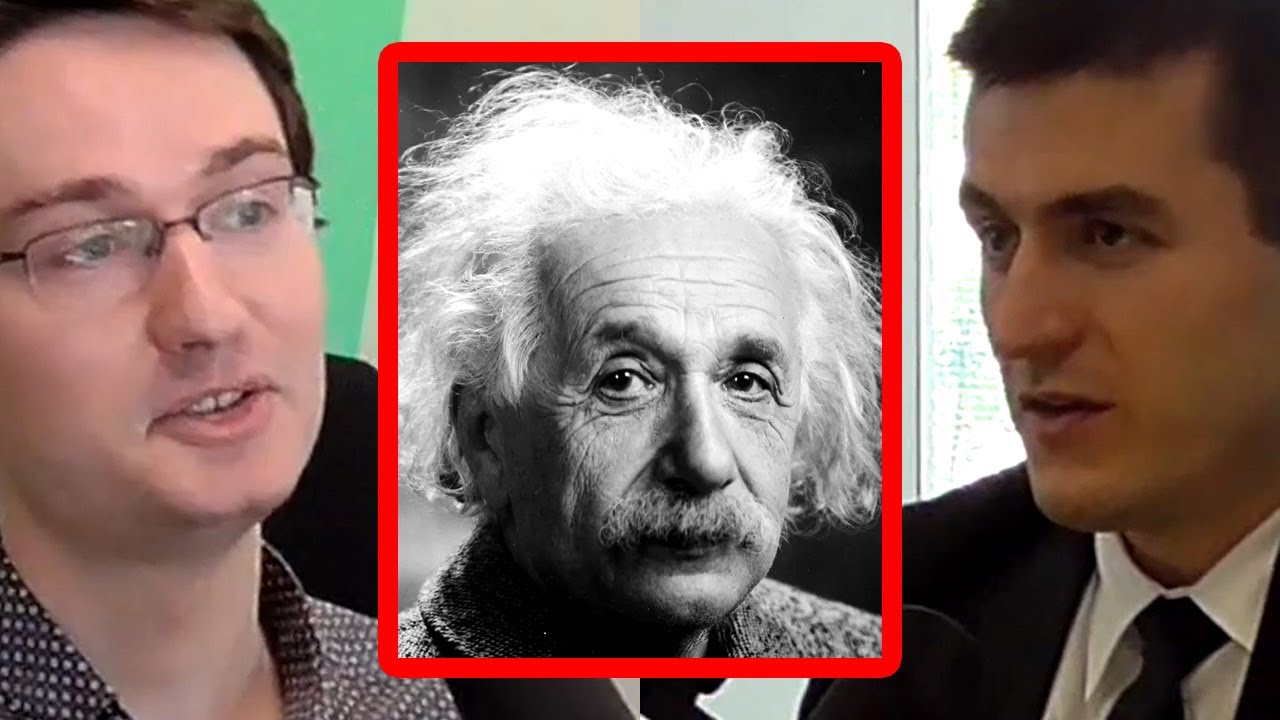
Many People are Einstein but in the Patent Clerk Days - François Chollet | AI Podcast Clips
Watch on YouTubeVideo summary
François Chollet challenges the prevailing narrative of an impending intelligence explosion, arguing that it relies on a flawed definition of intelligence isolated to the brain alone. He posits that true intelligence is not merely a property of neural hardware but emerges from the complex interaction between a biological agent (the brain and body) and its environment. Consequently, simply scaling up computational power or tweaking algorithms in isolation cannot lead to exponential growth in capability; instead, any improvement in one component inevitably reveals new bottlenecks elsewhere within this coupled system. This perspective directly counters the common assumption held by many physicists and AI researchers that human brains represent a theoretical limit which can be surpassed merely through better information processing systems. Central to Chollet's argument is the distinction between potential intelligence and expressed intelligence, using Albert Einstein as a prime example of how genius requires more than just high cognitive capacity. He suggests that while there are likely many individuals today who possess "Einstein-level" raw smarts, they do not demonstrate this brilliance because they lack access to sufficiently difficult problems or environments where such capabilities can be exercised and refined. Intelligence is defined by the meeting of great problem-solving abilities with a correspondingly significant challenge; without an environment that offers complex tasks to solve, high IQ scores remain just numbers representing untapped potential rather than actualized achievement. The transcript highlights how Chollet critiques the "intelligence explosion" hypothesis as naive because it ignores the necessity of environmental coupling for progress. He illustrates this by noting that even today's most brilliant minds often fail to make breakthroughs in major scientific fields not due to a lack of brain power, but because they are solving problems that do not yet demand their full potential or exist within an environment conducive to such expression. The logic that building something on par with the human brain will automatically trigger recursive self-improvement is rejected; instead, Chollet asserts that for intelligence to grow exponentially, both the agent and its surrounding world must evolve together in tandem. Ultimately, Chollet concludes that the mystery of why we have not yet seen superhuman AI stems from this fundamental misunderstanding of what drives intelligent behavior. The universe can be viewed as a vast space of problems with varying degrees of difficulty, populated by agents like humans and animals who roam within it to find challenges they can solve. When an agent encounters a problem that matches its capabilities, intelligence is demonstrated; otherwise, only latent potential exists. By reframing the search for artificial general intelligence away from isolated algorithmic scaling toward the co-evolution of agents and environments, Chollet offers a more grounded view where breakthroughs depend on finding the right problems at the right time rather than just increasing processing speed or size.
Read the full video transcript
[Music]
so yes winters explosion I'm sure if Mei
was the idea but it's the idea that if
you were to build general AI
problem-solving algorithms well the
problem of building such in the eye that
itself is a problem that could be solved
by your AI and maybe it could be so
better than that and what humans can do
so you're a I could start tweaking its
own algorithm good that start being a
better version of itself and so on
iteratively in an in a recursive fashion
and so you would end up with an AI with
exponentially increasing intelligence
okay and I was basically questioning
this idea first of all because the
notion of intelligence explosion uses an
implicit definition of intelligence that
doesn't sound quite right to me it
considers intelligence as
property of a grain that you can
consider in isolation like the height of
the building for instance right but
that's not really what intelligence is
intelligence emerges from the
interaction between a brain a body like
embodied intelligence and an environment
and if you're missing one of these
pieces then you can actually define
interagency so just tweaking a brain to
make it smaller and smaller doesn't
actually make any sense to me so first
of all you're crushing the dreams of
many people right so there's a little
bit like say Maris I feel a lot of
physicists max tegmark people who think
you know the universe is an information
processing system our brain is kind of
an information processing system so
what's the theoretical limit like what
it doesn't make sense that there should
be some it seems naive to think that our
own brain is somehow the limit of the
capabilities and this information is
just I'm playing devil's advocate here
this information processing system and
then if you just scale it if you're able
to build something that's on par with
the brain you just the process that
builds it just continues and it will
improve exponentially so that that's the
logic that's used actually by almost
everybody that is worried about
superhuman intelligence yeah so you're
you're trying to make so most people who
are skeptical that are kind of like this
doesn't the thought process this doesn't
feel right like that's for me as well
so I'm more like it doesn't we the whole
thing is shrouded in mystery where you
you can't really say anything concrete
but you could say this doesn't feel
right this doesn't feel like that's how
the brain works and you're trying to
with your blog post and now making a
little more explicit so one idea is that
the brain isn't exists alone it exists
within the environment so you can't
exponentially you have to somehow
exponentially improve the environment
and the brain together almost yeah in
order to create
something that's much smarter in some
kind of of course we don't have a
definition of intelligence that's all
right that's correct
III don't think if you look at very
smart people today even humans not even
talking about a eyes I don't think their
brain and the toughness of their brain
is the bottleneck to the actually
expressed intelligence to their
achievements
you cannot just tweak one part of this
system back of this brain body
environment system and expect
capabilities like what emerges out of
this system to just you know explode
exponentially because anytime you
improve one part of a system with many
interdependencies like this there's a
new bottleneck that arises right and I
don't think even today for very smart
people their brain is not the bottleneck
to the sort of problems they can solve
right in fact many various what people
to them you know they are not actually
solving any big scientific problems
you're not n Stein they're like Einstein
but you know the the patent clerk days
like Iceland became Einstein because
this was a meeting of a genius with a
big problem at the right time right but
maybe this meeting could have noon and
ever happens and then I assume there's
just been a patent clerk it's and in
fact many people today are probably like
genius level smart but you wouldn't know
because they're not really expressing
any of that was brilliant so we can
think of the world earth but also the
universe is just as the space of
problems so all these problems and tasks
are roaming it a various difficulty and
there's agents creatures like ourselves
and animals and so on that are also
roaming it and then you you get coupled
with a problem and then you solve it but
without that coupling
you can't demonstrate your quote-unquote
intelligence exactly intelligence is the
meeting of great problem-solving
capabilities with a great problem and if
you don't have the problem you don't
react spread intelligence all you're
left with is potential intelligence like
the customers of your brain you know how
high your IQ is which in itself is just
the number
you