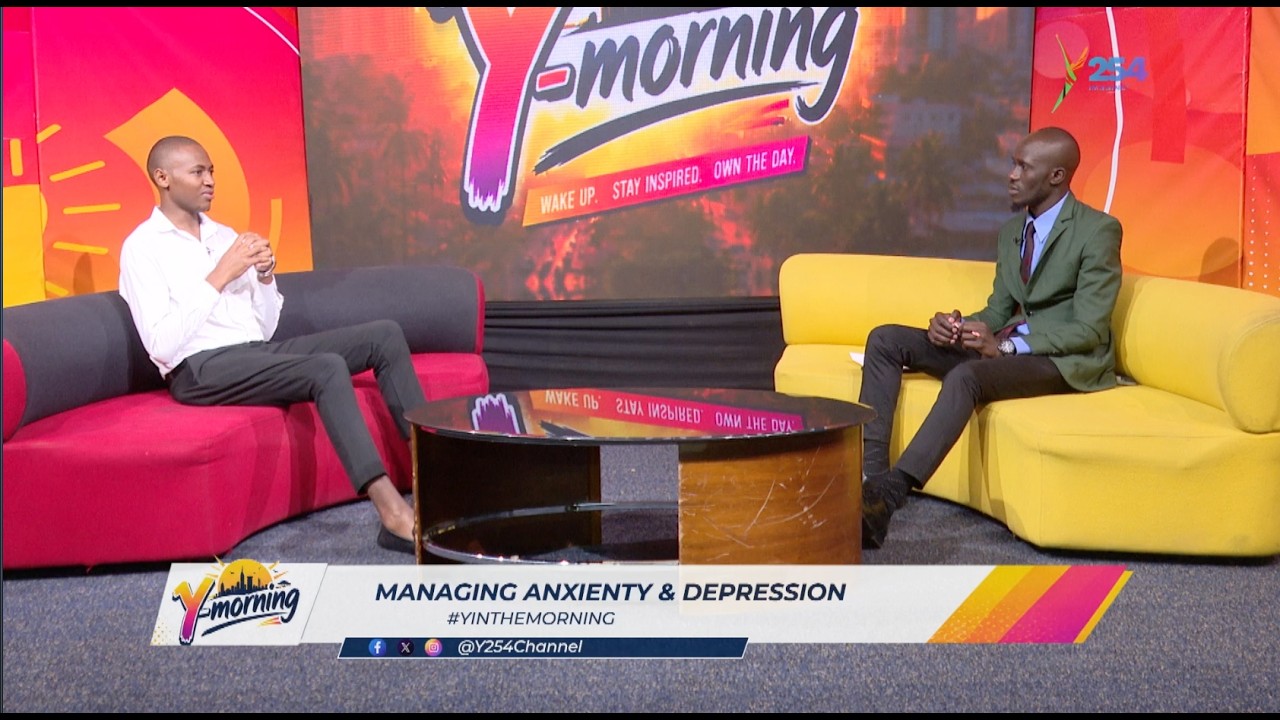
Managing Addiction,Anxiety and stress with Addiction Counsellor Pithon Njuguna.
Watch on YouTubeVideo summary
The video features addiction counselor Pithon Njuguna discussing the complex interplay between mental health issues like depression and anxiety, substance abuse, and societal stigma. He explains that these conditions often stem from unresolved childhood traumas or chronic stress, which eventually dysregulate the brain's prefrontal cortex, impairing emotional control. While normal sadness or occasional anxiety is a part of life, clinical depression is characterized by persistent symptoms such as continuous sadness, loss of interest in activities, fatigue, sleep disturbances, and appetite changes lasting at least two weeks. Similarly, anxiety shifts from a manageable fear to a disorder when it becomes constant and triggers a "fight or flight" response that prevents normal functioning.
Njuguna highlights how these mental health struggles often manifest differently across genders and can lead to destructive coping mechanisms like substance abuse. Men may externalize their pain through aggression or withdrawal from loved ones, while women might internalize feelings as guilt and overwhelming sadness. The counselor emphasizes that self-medication with alcohol or drugs provides only a temporary dopamine rush followed by severe hangovers and regret, creating a cycle where the individual loses the ability to make rational decisions. Furthermore, he notes that social media has become an unhealthy coping mechanism for many, particularly among Gen Z, where excessive scrolling acts as a distraction to avoid unresolved emotional pain until the brain becomes desensitized and unable to find satisfaction even in digital content.
A critical warning issued in the discussion is the deceptive nature of suicide risk, where individuals may appear happy or jovial in the days leading up to a tragic event, masking their deep despair. The counselor advises that seeking help is not a sign of weakness but a necessary step toward recovery, especially when one notices signs like social withdrawal, neglect of personal hygiene, or an inability to fulfill daily responsibilities. He outlines the professional approach to healing, which begins with a thorough assessment to identify underlying triggers and co-occurring disorders like drug-induced psychosis or bipolar disorder. Ultimately, the path to recovery involves addressing these root causes through therapy, medication when necessary, and aftercare programs that help individuals reintegrate into their communities while managing the realities of work and family life.
Read the full video transcript
It's easy as well to self diagnose and
say I'm depressed. But then what are the
telltale signs that you're battling
mental health issues that now extends to
things like coping mechanisms where
drug, alcohol and substance abuse comes
into play. When you look at issues like
anxiety and depression, the most of them
result from maybe each and every daily
encounters or circumstances that you go
through as a human being. How do you
seek help? And our guest who's joining
us live in studio is going to help us
unpack this conversation. I'm being
joined live in studio by Peter Jaguna.
He's an addiction counselor. Great to
have you and good morning.
>> Good morning.
>> Right. So maybe let's get to like
understand in a bigger panoramic picture
when why first of all why is it
conversations around mental health are
usually covered or laced with stigma?
For example, somebody is struggling and
they end up doing the worst like taking
their lives. to think a recent example
stupid boy. He was outgoing. He was an
outgoing personality. He was in the
entertainment music industry. He was
doing a lot in terms of him being
visible on social media. But look how it
ended for him. Why is it lays with a lot
of stigma especially in the current
world we living today.
>> Thank you. Uh it's a very interesting
topic to start with and most of the time
it's very very hard to come out clean on
how you're battling the issues that
you're dealing with with unspoken
battles to be in specific. For instance,
now with depression, it's very very hard
for someone to
like fully understand cuz for instance,
now in the normal days, how we are
living, everyone expects it's okay to be
sad.
>> But now in depression, we always have
that persistent sadness.
Day in day out, people tend to think
he's changing, isn't he? He's trying to
leave us. is trying to adjust
but story by story he or she she's going
down.
>> Yeah.
>> Uh let me ask you before an issue or
let's say you've used the word battle
before what you're going through
escalates to now a coping mechanism
where alcohol and drug abuse comes into
play. What is usually the bigger
underlying problem before now you start
acting out and using substances or
abusing them
>> to cope?
>> Okay. So most of the issues where we
start with we always start with
childhood issues.
>> Mhm.
>> The [clears throat] most unresolved
issues from childhood,
>> right?
>> That's why we start.
>> Uh-huh. Especially now let's say from
uh let's say in childhood maybe one of
the caregivers was calleding you or was
being harsh mean
>> so those moment they keep on playing
>> and now for the instant you get now the
acute stress where now you act the body
activates it fight or flight mode
>> fight or flight mode. Okay. So if the
same action continues and continues
happening day in day out, it continues
now into the chronic stress right and
now the chronic stress itself it
disregulates the part of the brain
especially now the prefrontal cortex
which is
>> now
which is supposed now to regulate the
emotions and feelings.
>> Mhm.
>> And now now if we dive into depression
it's a mood disorder. Oh, so depression
is a mood disorder.
>> Mood disorder.
>> Okay.
>> Mhm.
>> So now after going through all the
stages, you're now at the chronic
stress, you're battling with it. Now the
depression itself, that's why it starts
building up,
>> right? And now the first I would say for
someone to be diagnosed or to be fully
diagnosed with depression, you need at
least five symptoms.
>> Mhm. What are the symptoms?
>> Persistent
sadness
>> for at least uh continuously for 2 weeks
or longer. Loss of interest in
activities that you love,
>> right?
>> For a period of 2 weeks longer, which it
doesn't have to break.
>> Mhm.
>> There is fatigue,
>> right?
>> Poor sleeping patterns.
>> Some tend to sleep more hours.
Some tend to have insomnia.
>> Yeah.
>> And now there is the loss of appetite.
>> Mhm.
>> Yep. So among these issues like loss
loss of passion or loss of interest
started loss of interest. What could
likely trigger that in a person that
you'd say but you've you've you you know
you're a professional. You're an expert
at this. You've said at least for two
for two weeks these signs are consistent
and prominent. then you're likely to be
diagnosed of depression but it's easier
to say bro I feel depressed why we do a
lot of self diagnosis but you've given
these symptoms loss of interest maybe
you're changing passion or you're
changing trajectories to profession can
it be a sign of depression too you
mentioned fatigue I feel like everybody
goes through fatigue after you work for
a very long time without rest they say
work with no play makes jack you know
right Um you said as well uh you
mentioned yes you mentioned stress
stress is also a contributor to
depression too
>> right but everybody goes through uh
stress on a daily life. Yeah. So what
makes this equitable to depression and
then how how what's the next step that
you pick up after you're diagnosed with
all these things cuz they sound like
everybody's going through this on a
daily.
>> Mhm.
>> Yeah.
>> Okay. Let me start by making it now how
it's different especially now start with
fatigue.
>> Okay.
>> The moment now we at a stage of now
chronic stress before start developing
into depression
>> chronic stress. Okay.
>> There is certain uh symptom that happens
in our bodies. Our bodies are like a
smartphone.
>> Mhm.
>> When like you don't have enough storage
it will give you a notification.
At the same time when you're going
through certain emotions unresolved ones
>> stress your body will give you signs and
symptoms and now the point of when you
depression most of the time for us we
take it as normal at the shoulders in
the morning hours you feel you got pain
you always think it's normal
>> but it's our body telling us we are not
okay Right?
>> Whatever you always say is
the brain whispers before it screams.
>> The brain whispers before it screams.
Okay.
>> It will give you signs.
>> Mhm.
>> It will show you. But very indirectly,
it's very very hard to tell,
>> right?
>> Cuz most of us, we don't pay attention
to that.
>> Mhm.
>> What I think is maybe my shoulders has I
feel pain. Maybe it's because uh my
sleeping position post
>> maybe at work
>> we tend to ignore whatever I'm feeling
what I'm going through
>> right
>> and
uh the other part I've heard that you
have mentioned is the loss of interest
maybe because you might try to adjust to
new activities
but when we are doing these things we
move them step by
Yeah.
>> For depression.
>> Mhm.
>> You tend to leave everything.
>> Okay.
>> If I was hanging out with friends, I can
solve the plans.
>> But that could be a rain check.
>> Mhm.
>> Mhm. Could be a rain check for another
day.
>> Mhm.
>> Right. What makes it a sign of mental
health awareness?
>> It happens cuz what if you cancel the
same same event or the plans for more
than five times consecutive,
>> right? Is it the reason you're citing or
why you're counseling or or you're
taking a rain check? That's a sign of
depression.
>> It's because now you don't want someone
who is close. For someone who is close
to you, they tend to give you more
attention.
>> Okay?
Let's say like for a close friends who
we have they tend to tell you
use myself as an example pedon you're
not okay
>> since I know like my friend will be
brutally honest with me
>> I'll try to cut him or her off
>> right
>> and that's why
>> that's avoidance as as a coping
mechanism
>> y
>> okay
>> so most of the time you tend to find for
depression it has now are co-orbidity.
>> Mhm. Combidity meaning underlying other
issues that contribute to it.
>> Yeah. Like you have a disease and now it
results to another one.
>> You have a bed.
>> So it's a novel that develops and builds
up on another. But also let me ask you
for the purposes of clarity. What is the
difference now between depression and
anxiety? How do you decipher a person is
anxious or now it has developed or
combinated to depression?
>> Mhm.
Okay, that's a very very good question.
For depression, I would say it's more of
mood.
So it it's more about the mood.
For anxiety, it's the fear.
For humans, it's very very okay for us
to be anxious.
But if it tends to have normal or okay,
>> it's okay for both.
>> It's okay. I would say
>> okay
>> for better news okay
>> okay
>> mhm
>> it's okay to be anxious
>> but if it keeps on coming on
>> it has some few patterns
>> Mhm.
>> triggers now that's why it
now moves from being okay to now a
mental health condition.
>> Mhm.
>> So you said depression is more of mood.
Yeah.
>> But uh anxiety is more of fear. Are
those like the main major signs of uh
the both of the spectrum,
>> right? You mentioned sadness. What could
because when you lose when you lose a
gig, you're likely to be sad or angry.
Those are like the immediate common
reflex reactions. Uh when you lose
someone, you are definitely going to be
sad and also angry, aggravated, and just
irritable. Um how do you how can you
tell that a person's sadness is
resulting into depression and also might
contribute to anxiety without uh making
it like a normal life event cuz on a
daily you can meet somebody who had
breaks you it was a relationship that
went there's that period in fact we say
you mourn the relationship and then boom
it's common in fact on a dust is
constant it's K yeah
>> so how do you put that into perspective
>> just normal All sadness.
>> Yeah.
>> Okay. So on that I would say
uh the for instance now people let's say
now going the same same thing. Mhm. For
like depression allow me to start with
that and now we go to the anxiety how
cuz I want to bring now connection
between how they are related and
intertwined.
Mhm.
For people now going the same same thing
for depression most of the time you find
them like now the sadness part of it
it's like now a coping itself like
coping mechanism
and we all have different reaction for
us men and ladies we are different when
you're depressed
>> okay
>> for ladies you tend to find guilty the
persistent and sadness
and now being overwhelmed.
>> Oh, so guilt,
>> guilt, sadness and then being
overwhelmed.
>> Yeah. The negative those like so
overwhelming.
>> Mhm.
>> For men now this where now the society
takes it allow me to maybe to put in
this.
>> Yeah, please go ahead.
>> The society brings it now in another
form.
For a man who was known to be calm,
understanding, he starts being
aggressive.
>> Yeah.
>> You see, he's battling something and now
the issue that he's carrying, he's now
projecting them
>> indirectly.
>> Mhm.
>> Maybe to the partner, to the friends or
to the family.
>> Yeah. The kids specifically.
>> Mhm.
>> Mhm. And that's why you find
most of the cases you find them
>> like for instance now here in Kenya you
find for someone who now has dived into
addiction
>> right
>> you find now the kid maybe went to the
shop
>> Mhm.
>> he was [clears throat] to come back with
a balance of like like
>> 50 bob but maybe he or she lost it
>> and you find it cuz the parent is going
through something in the relationship or
in the marriage.
>> Yeah. It has been quite overwhelming.
You find it that
he or she ends up beating the child or
doing something much worse.
>> Yeah. And let me ask you Pam on a daily
an average Kenyan let's use Gen Z what
is the what why are they likely to go
through depression and anxiety what are
the circumstances and and events that if
you were to study as a professional and
also maybe in in your work or in your
line of duty the people that you met uh
what are the circumstances or the events
that always landed them into this
monster of depression and anxiety in a
daily average household of a Kenyan.
>> Well, let me start with the childhood
part before now we get into the
adolescence and now into the adulthood.
>> Yes. For now the childhood part I
remember let me use a very very good
example. There are teachers who used to
be harsh.
>> Yeah.
>> You see there are certain allow me maybe
to use uh the math teacher for an
example.
>> He would enter the class
shorts mob.
>> Yeah.
>> So for instance now the math teacher
walked in you find like almost four five
kids
>> Mhm.
>> they start having anxiety
>> right
>> you see.
>> Mhm.
>> You see now the teacher has inflicted
that fear right the fear itself now it's
constant it start developing. M
>> now if you start having a trigger the
moment that teacher walks in works works
as the trigger for the anxiety
>> right
>> now you find it is very very hard now
for the student
>> to focus
>> now from school you go home
>> mhm
>> here's the parent why you feeling mad
>> you see and let's say he or she has
other siblings
the parent will start being like you
know your sister is passing. She she's
doing well.
>> Why you not doing this?
>> Yeah. But those are right questions to
ask. By the way, I don't see anything
wrong in the questions.
>> Mhm.
>> Uh-huh. Why are they making the child
anxious?
>> Mhm.
>> See, they are the right questions, but I
uh something we always say, it's not the
words that hurt, it's the tone.
>> Oh, it's the tone.
>> Yep.
>> Nice. Okay. Interesting.
>> Cuz I might say something
in a different tone and you take it
positive thing.
>> Right?
>> If I say it in a different tone, it will
hit deeper be like a knife.
>> So more math there's a there's a
possibility most uh math teachers were
brutal or you've used the word harsh.
they were harsh in their format or their
style of teaching and that's why a lot
of young people developed maybe
resentment and fear and now the anxiety
from the math teacher but you know math
teachers always give a target so if you
get below 50%
>> so I I think also the categorizing of it
really maybe messed up people you are
considered a failure right if you're
below the pass mark yeah
>> okay I think I'm beginning to get the
picture now right of where that anxious
or the anxiety comes in. Okay, go ahead.
Now we had now at the point now the
students at home
>> now [clears throat] the child he or him
or her now with the parents
they start now asking the questions you
see the first time it's always okay
what's happening we'll give you the
resources you need this book it's okay
take it but now when the student now in
this class you see now the teacher he or
she is working as a trigger to focus
when now the anxiety
is very very high. It's very very hard
to focus
>> very hard. Now for this student find him
or her
she's there just
she's just physically there but
psychologically she's not paying
attention.
>> Mhm.
>> Cuz now fear is what is controlling. Now
the
body itself it's in fight or flight mode
>> right
>> and it cannot do it cannot multitask
listen to the teacher
>> now who [clears throat] acts as a
trigger
>> right
>> and now be able to do now the maths
>> this is what you're supposed to do to it
down
>> right
>> the brain is focused on there is a
threat
>> m so it's the freeze of light.
>> Mhm.
>> Right. Okay.
>> From now at that point we move now maybe
from let's say the now this this
let me use as an example let me use
myself
pedon is in grade five now you're moving
to grade six with a different teacher.
>> Mhm.
>> Mhm. Now who is more welcoming more
friendly?
You see back then in let's say in grade
five we had this teacher there are some
who used maybe and are used to maybe
saying you know you don't do this you're
not good you can't do this
and that will now bring the self-esteem
low and low and no
>> for the students
>> right
>> and that's how you find when now the
self-esteem is low
>> now the kids start now even seeing him
or herself.
>> Yeah.
>> Being maybe worthless,
feeling like am I really worthy?
And now when he or she starts to
question him or herself
>> is that now bringing doubts
so many doubts and at this stage the
still now the child is still developing.
>> Yeah. And now what happens now when we
have now the chronic strength it changes
now the brain
itself the brain changes.
>> Uhhuh.
>> So the way you process things also now
starts
>> depending on how I think is it called
disregulation or regulation?
>> Disregulation.
>> Disregulation. Yeah. Okay. So it changes
and it starts now focusing now on either
freeze, fight or flight.
>> Yep.
>> All right. So let me ask you what are
the early signs of an adult uh of some
of these uh issues mental health
underlying issues cuz you said there
could be there's it's actually no a
novelty coorbidities uh anxiety maybe
has maybe grown from maybe stress or it
started with stress
anxiety now it's depression now it's
more chronic and now it's an issue maybe
what are the early signs of a daily
average Kenyan that they're going
through a mental health crisis and how
do they start coping up with it? And
also maybe you can loop in when they
start acting out as a coping mechanism
where they're resulting to things like
um drinking too much alcohol cuz they
always warn you in the adverse they say
excessive consumption of these product
is harm to your harmful to your health.
They are smoking weed a lot which I
think it's common. The other day I think
we were looking at a statistic during
Mandam Manu most university students who
are ingesting weed so that they don't
feel the pungent smell of tear gas while
they're protesting. Uh others get even
addicted to social media is also part of
another addiction too. What are the
early signs? When does it escalate to
now acting out and coping up and how do
you manage it? Mhm. Now connecting it
with addiction.
Every person start with a very very
simple stage which is called
experimentation stage.
>> Experimentation. Okay.
>> In addiction
where you start maybe you take the first
sip of alcohol
or the first puff of that cigar or that
marijuana
maybe with friends.
Now for the brain it has its own
processes.
The first time we see
and then we record the data itself.
Yeah.
>> After recording now it's stored and now
we start reproducing itself. Now we will
try to imitate the action. The last
stage itself is now performing the
action itself. And that's why you find
most of the cases
the first time you try add maybe an
addiction or you're trying the first
>> sip
you notice your friends maybe they're
taking
uh the common name
>> now the time you'll be alone you'll do
the same same thing.
>> Mhm. You see the brain has already
already recorded the same same pattern.
>> Yeah.
>> And now maybe coming now to the mental
health now for depression and anxiety
especially. Let me allow me maybe to
start with anxiety. There are people who
don't talk a lot when they are sober.
>> Yeah.
>> Mhm. You see there's something you call
now social anxiety.
>> Mhm. Social anxiety.
>> Mhm.
>> Mhm. where like you don't you fear being
negatively judged by other people.
>> Yeah.
>> But the moment you're intoxicated,
>> right?
>> Alcohol gives you something we call
forced confidence.
>> Yeah.
>> That's when Yeah. like you're involved
in reckless behavior.
>> Yeah.
>> And you don't even
>> rational choices and decisions are made
when people are drunk.
>> Yeah.
>> But they say they tell the truth a lot
when they're drunk compared to when
they're sober.
That's
>> what saying
>> the reason that happens a lot
>> because now alcohol itself acts as a
depressant.
>> Yes.
>> It represents your body and at that
point that's when you find now the when
intoxicated with alcohol most of the
emotions will blow up.
>> That's why you find most of the people
who don't express themsel fully when
they are sober. Mhm.
>> Let them take few sips of alcohol
>> or smoke their
>> Mhm.
>> their weed.
>> They just tell you everything. Whoever
wronged them last year, last month,
>> right?
>> Whoever took his or her money,
>> anything.
>> Mhm.
>> They just tell you it blank blankly like
point,
>> right? Is that a negative trajectory of
life? If you're dealing with life crisis
>> as um as a counselor.
>> Yeah. Because if this person can't even
function, I call them high functioning
people. Yeah. Like they can't really
function normally at their cho at their
chores or the responsibilities while in
the sober mind. They have to adjust and
have some dopamine, you know, in the
mental a little high. Is it a good
thing?
>> Like you are drunk. Mhm.
>> Yeah. Than like you are sober.
>> Mhm.
>> Well, something I would say about that
is we tend to focus on one positive
thing and we ignore the nine negative
things that are coming due to
intoxication of the substance.
>> Mhm.
>> The one thing is you tend to find the
temporary happiness.
You see, but now we come with
the feeling of like the next day you'll
have the hangovers.
>> Yeah. You'll be judging yourself. What
did I do yesterday?
>> How
how do they think of me?
>> Yeah. Like you start questioning
yourself
time by time, second by second.
>> Yeah.
>> Mhm.
And now after
uh there is now we at the part of
anxiety where like you're intoxicated
sometimes you tend to the anxiety tends
to wear off.
>> Mhm. you're confident enough.
>> Yeah. When you're sober or high.
>> Mhm.
>> All right. Okay.
>> Now, at the point where it becomes now a
bit,
I would say, risky, it's when now you
get the panic attacks now in anxiety.
>> M
>> cuz most of us we tend not to understand
on how panic attacks happen.
>> Yeah.
>> Especially for us men.
>> Yeah. I've I once experienced a panic
attack but way back it was at an
audition where you know I didn't know
who were there and when I saw when I
entered the venue I realized it was some
bigger celebrities. It was actually on a
film in TV but my kind of panic attack
was maybe yeah since you're a counselor
was I'm just extremely nervous. I'm
losing my lines. I don't know what I'm
going to say when I when I step in front
of the camera that time because it was a
film audition. It was a script. Yeah.
and you had to bring out that character
and role. So I'm pacing up and down. I'm
punting. I'm sweating. I'm literally
everywhere. I can't settle and I'm so
irritable. So for me, that was my panic
attack. Yeah.
>> But then for a normal person, how do
they how do they show up that contribute
to mental health crisis?
>> We always start with something the heart
palpitations. They're so hard.
>> Your heart beats faster.
>> Very very fast.
>> And you start sweating now.
Uh-huh.
>> And now some the like the muscle
>> shaking.
>> Mhm.
>> Okay.
>> And now the shortness of breath.
>> Yeah. That's why you take a lot of
[gasps]
>> Yeah.
>> Mhm. And now some when it's very very
severe, confusion kicks in.
>> I lost my lines. Just like I said, I
can't remember the lines and I have to
act those lines. Yes.
>> Mhm. And now maybe allow me maybe to go
a bit
>> okay
>> on the current society especially let's
not go too far let's give it an example
at here to go up a CBD
>> let's say for someone who has a panic
attack you'll find someone who is sitted
down
shaking
>> crying let's say if it's a lady and most
of us in society or in the current
situation we' be thinking we are
Yeah,
>> we just assume.
>> We just assume.
>> But at the end of the day, people are
bing so many things outside here,
>> right?
>> Mhm.
>> But my question was, when does it when
do you now start acting out to a point
you're resorting to things? Cuz you
mentioned, you explained a place where
self-confidence, alcohol gives you
self-confidence. But then what triggers
that part where now I can't deal with
the reality of this situation. I have to
find something to hide it. Yeah. Yeah.
You could also call it masking. Yeah.
What triggers a person to go to that
level and how do you help them as a
professional when they're seeking maybe
if they've not even sought help or they
have to seek help or they're seeking
help. How do you work with them in that
journey of seeking help?
>> The first thing uh let me start with how
we do our things. Maybe at an
institution there at sober homes
we always it's always okay to ask for
help. It doesn't mean that you're weak.
Seeking that help doesn't mean that
you're weak
with this.
Uhhuh. And
>> yes, go ahead.
>> Okay. Thank you. So for for someone who
is battling like maybe the depression
itself, there are signs where like maybe
the self harm
Mhm. For someone who tends to have now
the suicidal thoughts,
they tend to come like when they tend to
have those suicidal thoughts on and off
on and off.
>> Mhm.
>> It's high time maybe as a family member
or a friend
cuz when they're intoxicated or they
under the influence of substance, it's
very very hard for them to convince them
you're not going to the right path. they
won't make that decision
cuz that's when we say like alcohol and
substances they make you have they tend
to make you have the impaired judgment.
You can't make the right decision.
At this point, it's very very hard for
an individual to notice that it's going
over boom
cuz one thing is we always tend to even
if you go to the normal locos
the denasi
they tend to say I'm happy at the end of
the day but at what cost?
>> Yeah. So
uh the question was
how do you tell
correct me if I'm wrong the signs the
first signs like how do you tell this is
like completely going in another
direction or it's not supposed to head
for certain point if you feel like if
you see like a family member or a loved
one has started like being withdrawn
was that time cuz currently like for now
as Jenz's most of us we tend to not
attend the family gatherings
most of us you feel like ah next year
going to Shush's place everyone will be
there
two two days maybe to when we are
supposed to meet I won't be available
he or she is trying now to wait maybe
the reason why there is something that
is happening in the family
>> but now the issues
it's very very hard to
reveal them I'm to remove the layers
story by story
>> cuz the moment when you have and so many
unsolved issues from childhood
>> they act like when you have
layers like you put uh Examp
when you have something like a shoe if
you put it here and you put maybe like
12 blankets on top you can't tell where
the shoe is if you start at that point.
>> Mhm.
>> Now that's how unsolved issues look
like.
>> The first thing it's now been withdrawn.
>> The next now
>> you mentioned that as loss of interest
too as well. Right.
>> When you lose interest you withdraw.
>> Yeah. Right. Okay.
>> And now [music] the second thing is now
the selfharming part cuz now in
depression that's very very common.
>> Yeah.
>> Where you tend to find someone
>> that's an extreme end.
>> Mhm.
>> Self harming. Yeah.
>> So what does a person do at this stage?
>> At this stage pain becomes the only
solution.
>> Pain becomes a solution to pain.
>> Mhm.
>> You tend to feel the satisfaction. When
you cut yourself and you feel that pain,
it gives you the satisfaction.
>> Isn't that psychosis?
>> I would to say mentally. Yeah.
>> Uh
well, we will classify it at that point
though in it's common in depression.
Psychosis it's a bit heavy cuz it has
its own
own personalities, its own symptoms. It
has its own direction
>> for depression. Most of the time when
people are now doing practicing self
harm,
they tend to harm themselves on areas
that you can't see.
>> Oh, not maybe on the forearm.
They tend maybe on the inside part
>> on the thighs where it's very very hard
to tell. M
>> and you see now at now at this age it's
very very hard to tell someone like can
I see is it possible maybe you share out
>> yeah so that's a coping mechanism
cutting yourself torturing yourself
exposing yourself to pain
>> but also let me ask you as a an
addiction counselor how do you work with
such a person on a journey to healing
cuz we mentioned all this stress anxiety
depression etc and whatn not how do you
start now as a professional are there
like recovery plans what is the first
step that you start having a
conversation before you now walk them a
journey to recovery
so the moment you walk in maybe it's
impatient or outpatient in the
institution first we do something we
call the assessment
first we have to help you understand
what am I going through where am I cuz
we can't start from maybe You're lost.
Allow me for lack of a better word,
allow me maybe to use lost. You're lost.
We can't start and tell you let's go
west.
We have to help you find
how did I live at this point.
See when I understand how I lived I be
able to understand what are the triggers
>> and that is the first thing we do for
the assessment. And now if someone is
bur maybe the mental health condition
and was into substance substances
we still do several assessments and now
there's the toxicology
cuz there are some who use now we call
them poly substance the subst
>> substance use meaning you are using one
one or more
>> more than one
more than one drug.
>> Yeah.
>> Poly substance.
>> And you find most of the time now people
with battling with depression most of
them you find into they are more into
alcohol
or into marijuana.
>> Yeah.
>> Right. But let me ask you at a larger
scale. There's people who occasionally
drink. Yeah. How do you how do you
differentiate between an occasional
drinker who's drinking for let's say
having a good time like they call it
local to have a good time versus
somebody who is dealing with something
and most of the time uh if you listen to
even mental health conversations they
tell you I didn't even know I was
depressed but also maybe on the other
side too they self diagnosed and they
said oh I think I'm depressed so I'm
going to use I'm going to self-medicate
how do you uh put perspective both sides
of the spectrum.
>> Well, okay, allow me maybe to start with
this point. We don't commend or we don't
advise someone to do the self diagnosis.
That's something we always advise
because there are symptoms or signs we
look for
and maybe to communicate it that
clearly.
Well, on that end
maybe
now about whatever now like assessing
and everything correct me if I'm wrong
but
you're on the right path.
I would say
kind if you don't mind kind allow me to
restructure your question. How do you
put into perspective a person who is on
the extreme end of self diagnosis and
they feel oh I think I'm depressed
do self- medication versus a person
who's just occasionally drinking to have
a good time.
>> Mhm.
>> Like they say thank you. It's very very
easy to tell the difference especially
for us who are in this field. For
someone who is taking it just for fun,
the occasional drinking itself, let's
say the recreational one, the
responsibility part, it's well done.
The moment now addiction becomes chaotic
in your life.
You start neglecting even the small
responsibility that you're supposed to
do.
>> Yeah.
>> And now in addiction, there's something
you always say that the normal becomes
the abnormal and the abnormal becomes
the normal. Mhm.
>> For in now what I mean is when you're
heavy deep into addiction,
you tend not to do now the home chores
that you're supposed to do.
>> Yeah.
>> The personal hygiene.
>> That's supposed to be normal.
>> Yeah. So you stop showering, you stop
eating.
>> Mhm.
>> Right. There's those who overeat now as
well.
>> There are those who overeat in
depression.
>> Okay.
>> Mhm.
for this. Now let's say let's see
combine on how it's very easy to tell.
Now for someone who is now having an
underlying condition for someone who is
intoxicated it's very easy to tell when
they at the end cuz they start giving
you you know I feel a bit tired I don't
see as if I want to enjoy life anymore.
Most of the time when people are
intoxicated to take it as a joke, it's
very light for them to say and we tend
to take it very lightly.
>> When someone comes and tells you,
I feel I'm not going to live anymore
and they're intoxicated. You see all of
us in that table,
>> we are intoxicated and be like,
>> yeah,
>> but this person is hinting of suicide.
He's
>> hinting you suicide.
>> Okay.
And now maybe at this point when you
find someone who had been sad for a very
very long time maybe for 2 weeks and
longer his b is depression
there is only one common thing that
happens before they commit suicide most
of them they tend the last day maybe
before their brain finally decides I
want to do this
>> mh
>> I'm done and done for good
>> you find them there like the previous
nights to be all the moments before they
commit suicide. They always very very
happy.
>> M
>> sometime to be happy when they are
partying.
>> Yeah.
>> And you find friends are like we are
with him or her yesterday. Very okay.
Very jovial.
>> We even spoke on on a phone call.
>> Yeah, we did talk. He was he or she was
very very joy vibrant. M
>> and now they are they've committed
suicide.
>> I think in the morning you get now
different news.
>> Yeah.
>> And you tend to ask yourself as a friend
was I missing any signs of hints
>> from my friend.
>> Yeah. So meaning there's this there
there's a possibility of trails that
this person was leaving
>> but nobody was putting them or being
cognizant that this could be a sign of
an underlying deeper issue.
>> Yeah. But also let me ask you on the
other side how does it affect affect a
person's daily life a general average
Kenyan who is depressed what are some of
the facets of their life or their
livelihood that gets immediately
arrested when they are in this you know
predicament. M. So most of the time we
tend to find now for the people who are
depressed
tend to find like most of them in the
relationship for like allow me to start
for others man. We tend to live for
someone who you love most when you feel
things are a bit overwhelming you tend
to break up with them and you solve your
own things. And that's how it happens
for
for us men.
>> Yeah. In the society we tend to live all
like to cut off people who love us,
people who care for us,
we tend to cut them off.
>> And especially now if you go now into
the depression for us as men, we tend to
find like in families, we tend now to
disown them.
>> Yeah.
A dad who was known coming home joio
playing with kids. The responsibility
has been overwhelming. He's into
alcohol.
Things start to get heavy and heavy.
And now maybe he was coming home 8. He
start coming at 11:00.
>> Yeah.
>> From 11. Maybe next week one day he's
missing. He has gone out with friends.
Not coming back.
>> Yeah. And when you look at especially in
the current world you're living in
today, social media plays a pivotal role
in terms of as well curating or having
these conversations but also maybe as a
contributing factor to I'd say anxiety I
don't know about depression but you can
clarify on it as we're near the end of
this conversation. So uh for person
who's extremely like their drag is
social media they can't do without it.
They're always doom scrolling. And I
think the other day we were talking
about how the impact of AI slope and how
people are now getting sucked into they
just want to it's one click, one share,
one scroll after another and switching
and swapping between different social
media platform.
>> Um how do you categorize that in terms
of a copying mechanism? Is it a good
thing or a bad thing? And what is the
impact on somebody's mental health? Cuz
you realize somebody spent over six
hours just streaming or watching a
stream online. the they're the streaming
for five hours, you're done watching
that, you switch to Instagram. What is
the impact of that as well when it comes
to this conversation around mental
health, depression and anxiety in a
person's life? Thank you.
At this point now, social media has
become a very very common coping
mechanism in our society
where you tend to find most of us tend
to scroll for hours.
It's unhealthy
if it's longer hours, especially when
you're suppressing the emotions. When
you're trying to avoid certain unsolved
issues that you haven't dealt with, if
you tend to block them, the brain tends
to get that overload.
It's like having like those issues, you
tend to keep on adding more pressure,
more pressure on them. At a certain
point the brain
will reach at a point where it cannot
handle the pressure.
>> Yeah.
>> It will now start at I remember the a
point where we discussed the brain
whispers before it screams.
>> Yeah.
>> It reached now to a point where now
scrolling itself doesn't give you the
satisfaction cuz most of the time when
you scroll it gives you a hormone like
the dopamine.
>> Yeah. You feel the satisfaction
>> something is distracting your brain.
>> Yeah. So you use that as a coping filter
or mask.
>> Yeah.
>> Right. So it's a distraction. I think
that's what you had mentioned earlier.
>> So that that helps you to get through
your day or to survive that period of
whatever you're going through.
>> Mhm.
>> Okay.
>> You survive it for that day. But now the
brain itself when it's avoiding
unresolved issues and it's using a
certain distraction, you'll get used to
it.
>> Yeah.
>> And that's why you find someone
scrolling scrolling and you get
>> maybe at a certain point you find like
maybe I'm scrolling on Tik Tok and I
find it it's not it's not giving me the
satisfaction I want.
And I feel ah no I don't feel the
satisfaction.
>> Yeah.
>> And at this point now it comes not to be
a concern a critical one. The moment you
sit down on your couch you take the
remote you switch on the TV.
Maybe you go to YouTube or watch a
movie.
>> You binge watch everything on Netflix.
Yeah.
>> You binge watch. And now the critical
levels are you switch on and you can't
even know what to watch.
Nothing comes in mind.
>> You're blank. The it's used staring into
the TV.
>> Yeah.
>> It's cuz now the unhealthy coping
mechanism the brain has been used to
>> is now asking for another coping
mechanism.
>> Yes. So it keeps on is collecting and
developing. As we close, who are the
common people that come to seek help a
lot in your land of duty? And also in
terms of the common underlying issues,
what is it? Is it anxiety, stress,
depression? Like what do you deal with
on a daily? And how do you usually help
them to heal from that in a nutshell?
>> So most of the time I tend apart from
now addiction, we tend to deal more with
DIP, which is drug induced psychosis.
Mhm.
>> We deal with that. schizophrenia
cuz it's a bit people don't talk about
it a lot. The personality disorders
cuz most time they tend to go over but
then people can tell where the problem
is coming in bipolar.
>> Mhm. We tend them to come up with coping
mechanism
to help them understand how can I live
with this. And now the stization in the
society is you can't take the
medications
cuz most of the time people tend to say
the medications will make you
be worse or you go nuts.
>> Yeah.
>> But at this point it's reversing the
condition.
>> Yeah. And now there's the depression,
anxiety.
Now there's something you always do with
our clients. Immediately we do the
inatient
>> afterwards. There's something we do
called after care program,
>> right? After program
>> where we work with our clients
>> even when they are distant,
>> right?
>> We do sessions
>> with them. We help them to cope up with
the reality now cuz they dealing with
work, family, they are now integrated
back into the community. Okay.
All right. So, we are exiting. Uh
anywhere that you're always active where
they can be in touch with our viewer who
has been watching this conversation and
maybe they would like to take it
further.
>> Mhm. Uh maybe if it's possible I would
like to give an email maybe at like
maybe you can reach us at sober homes.
It's Kenya atgmail.com.
Right. And then we have our line where
maybe you can get to one of the
counselors
>> in the institution. They can help you to
through the journey and to give you more
knowledge and skills on on how to make
the decision.
>> Right. So you mention the email they can
go there.
>> Mhm. And candy along.
>> Yeah. Mention it in 3 seconds. We are
exiting. We are out of time.
>> 079200
2060. That's our hotline number in our
institution. All right, sure. Get in
touch with Peton Dura. He's an addiction
counselor. All right. For anything, if
you missed out, I promise you it will be
available on YouTube in the morning at
24 channel at brand1 at James. We thank
you for watching from 7 to 10:00 a.m.
See you tomorrow.
Heat. Heat. N.