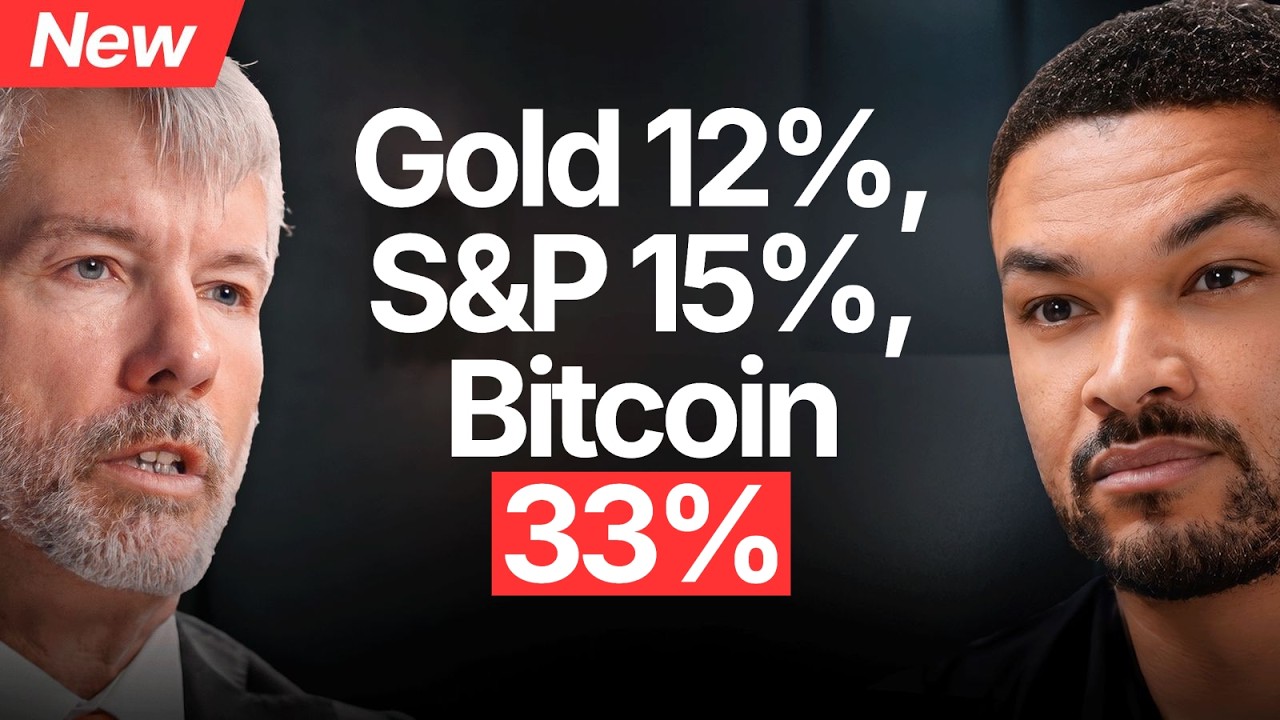
Man Who Owns 4% Of All Bitcoin: His Final WARNING To Everyone Who Doesn't Own It | Michael Saylor
Watch on YouTubeVideo summary
Michael Saylor argues that individuals should not attempt to outwork robots but instead leverage artificial intelligence to identify unique opportunities and create novel solutions, citing his own achievement of generating $15 billion in value last year through such innovation. As the world's largest holder of Bitcoin via MicroStrategy, he champions "digital empowerment," asserting that Bitcoin serves as superior digital capital because it cannot be seized by governments or banks like fiat currency held in traditional institutions. Unlike physical cash or gold, which offer lower returns and lack portability, Bitcoin allows for the instant transfer of millions anywhere without permission, providing a critical hedge against the debasement of currencies; Saylor points to Miami Beach land prices rising one hundred-fold over a century as evidence that the dollar loses about 7% of its value annually, causing other global currencies to collapse even faster.
While acknowledging that real estate and stocks offer some protection through scarcity or growth, Saylor highlights their limitations regarding illiquidity, maintenance costs, and market volatility compared to Bitcoin's stability in unstable economies. He explains that while AI might create an age of abundance where utilitarian goods are plentiful, scarce assets will always retain value because humans are status-oriented animals who aspire to exclusivity beyond basic necessities. Consequently, he warns against studying fields hitting the end of their growth curves and urges young people to focus on emerging technologies like AI that represent new exponential opportunities rather than diminishing returns. MicroStrategy exemplifies this forward-thinking approach by using digital engineering to create a novel financial instrument backed by Bitcoin, allowing them to raise significant capital when traditional markets were exhausted, while remaining over-collateralized even if prices fluctuate significantly.
Addressing recent market fears regarding the sale of $55 billion worth of Bitcoin, Saylor clarifies that such transactions are operational or related to convertible notes rather than profit-taking, and demonstrates that selling a portion of holdings proves liquidity without causing asset failure or bankruptcies. He advises that Bitcoin is an ideal investment only for those with funds they do not need for four to ten years, warning short-term investors against using it as cash due to its volatility over weeks. Instead of pursuing expensive education, he recommends investing in digital capital and affordable AI tools while studying applied statistics and comprehensive history to gain wisdom and avoid the arrogance of assuming one is discovering new truths when historical patterns repeat. Ultimately, Saylor concludes that resilience against short-term market noise is essential for maintaining conviction in long-term technological shifts driven by digital capital, which offers sovereignty against centralization and outperforms traditional indices over time.
Read the full video transcript
I used AI to make 15 billion dollars
last year.
>> You did?
>> I did because the AI gave us a solution
to the problem that no one had ever
encountered before in the history of the
world. And so my advice is don't try to
outwork the robots. What you want to do
is ask the AI to do something that's
never been done before. And if you want
to create these incredible success
things, you want to locate the magic
opportunity. I know this because I'm a
technology entrepreneur and [music]
we're the biggest buyer of Bitcoin in
the world. So, what is my mission? I'm
preaching the gospel of digital
empowerment [music] and Bitcoin is
digital money and it's going to be the
best long-term capital asset and you can
actually own something and someone more
powerful than you can't take it away
from you.
>> What you mean they can't take Bitcoin
from you?
>> So, this is a stack of currency. You
walk through an airport on this, they
ask you if you have cash, they just take
it. So cash in a physical form is a
problem. So what do you do? You put it
in a bank. So the bank then decides
whether you get to keep it and whether
you get it back. But I could move a
million dollars of Bitcoin from here to
anywhere to London to anywhere in
cyerspace in a few seconds. So the last
thing in the world you want to save is
money.
>> So what about this? Why not just put all
of my money into gold?
>> Well, gold is up 12% a year, but Bitcoin
is up 33.
>> What about the S&P 500? you're going to
get double the performance from BTC that
you would get from like the S&P index.
>> So, should I buy a house?
>> I will tell you why you shouldn't buy a
house.
>> And then you sold a bit of Bitcoin
recently after telling a lot of people
sell a kidney if you must but keep the
Bitcoin. So, why did you sell the
Bitcoin instead of your kidney?
>> Because
Michael, beyond just buying [music]
Bitcoin, what is a good strategy to
build and become wealthy in your view?
And then you [music] have 10 rules for
young adults building a strong
foundation for their life and career.
So, let's go through these. So, first
>> this is super interesting to me. My team
given me this report to show me how many
of you that watch this show subscribe.
And some of you have told us according
to this that you are unsubscribe from
the channel randomly. So, favor to ask
all of you, please could you check right
now if you've hit the subscribe button
if you are a regular viewer of the show
and you like what we do here. We're
approaching quite a significant landmark
on this show in terms of a subscriber
number. So, if there was one simple free
thing that you could do to help us, my
team, everyone here, to keep this show
free, to keep it improving year over
year and week over week, it is just to
hit that subscribe button and to double
check if you've hit it. Only thing I'll
ever ask of you, do we have a deal? If
you do it, I'll tell you what I'll do.
I'll make sure every single week, every
single month, we fight harder and harder
and harder and harder to bring you the
guests and conversations that you want
to hear. I've stayed true to that
promise since the very beginning of the
D of Co, and I will not let you down.
Please help us. Really appreciate it.
Let's get on with the show.
[music]
Michael, because of your success as a
technology entrepreneur, you are a
multi-billionaire from my math and
you're heavily focused on digital
currencies at the moment, specifically
Bitcoin. What else do we need to know
about you in terms of what you've built
and accomplished outside of that?
>> I always wanted to make a technical
contribution. So, the the early business
was business intelligence. So how do you
extract intelligence from large raw data
sources and that was what micro strategy
did. We created a global business
intelligence company and [snorts]
I think in 2020 when the co lockdowns
took place and the world turned upside
down that was when I discovered my
greatest idea and it wasn't even my idea
right it it was Satoshi's idea but I I
discovered Bitcoin in 2020 and the
company today is $60 billion but we
peaked about 125 billion so we got
somewhere between 100 and 200 times
bigger since we discovered Bitcoin
>> and when you speak to the general public
now when you do podcasts like this, what
is the the essence of the message that
you're aiming to communicate to them?
>> Bitcoin is uh is digital empowerment,
digital capital. We're living through
the digital transformation of assets and
this is just as profound transformation
as digital intelligence. The real
profound breakthrough of Bitcoin is this
idea
that you can take economic energy,
convert it to digital form and tightly
bind it to the person, the family, the
company, but the country. We can talk
about how we all hate countries, but you
know, the history of the world is all
the weak countries getting smashed by
all the big countries. So if what you're
interested in in is empowerment and
fairness and equity for the small
company, the small family, the small
person, the small country, the weak. How
do you do it? Well, you basically
encrypt the money, put it in cyberspace,
protect it with a private key. It's like
now you can actually own something and
someone more powerful than you can't
take it away from you.
>> There's two types two types of money
there in front of you. There's dollar
bills and then I've got a couple of
Bitcoin on the table. What you mean they
can't take Bitcoin from you?
>> Okay. So, this is a stack of currency.
You walk through an airport on this.
They ask you if you have cash. If you
do, they just take it. Cash in a in a
physical form is a problem. So what do
you do? You put it in a bank. Well, a
bank is uh is a counterparty. So the
bank then decides whether you get to
keep it and whether you get it back. You
go to the bank and you ask for it back.
They might ask you why you ask for it
back. If you ask for that much back,
they file a form with the Treasury
Department. You know, if you ask for too
much money back too soon, right? Someone
comes knocking on your door. So the
challenge with this this is fiat
currency and um you hold this at the
pleasure of the nation state and by not
just your nation state it's like every
country on earth gets to decide whether
you get to spend this stuff right- which
is interesting and if you want to
actually transfer money to someone in
another country you need the permission
of your bank another bank the central
bank of their country the correspondent
bank there might be seven different
banks that have to decide whether the
money gets from here to there. So, this
is permissioned money, you know, that's
uh managed by the state. And with
Bitcoin, I can take a million dollars. I
can actually encrypt it in a chip in a
physical coin, the cusacius coin, and
that's a million dollars. I slide it
across and it's literally a bearer
asset, you know, and so that's one
manifestation of it. But you could also
put it into information form. I could
transfer this to you just in the form of
a private key that I wrote on a piece of
paper that I gave to you.
>> A series of letters you could give me.
>> Yeah. Or I could send you a message. I
could send a text message like, "So,
good luck getting a million dollars of
gold from here to London if people don't
want you to move it. But I could move a
million dollars of Bitcoin from here to
anywhere in a few seconds." The idea was
I don't want to trust Apple or Google or
Morgan Bank or a central bank or a
government, right? And so in the extreme
case, you know, two people can meet in
Africa and I can trade you some Bitcoin
for your truck and I don't need the
permission of seven banks and 16
governments and 32 other bureaucrats in
order to buy that truck. What is it that
most people, the average person doesn't
understand about the nature of money as
it's sat in their bank as it relates to
the debasement of it or the sort of
inflation of it? Because most people
think if they've got, you know, $10,000
in their bank and they keep it there and
maybe getting interest on it at 4% a
year, they're going to be good.
>> So, this is about $10,000, I guess. Um,
one acre of land in Miami Beach on the
water cost $10,000 about a hundred years
ago.
I know this because I have a house on
the water and I have the the deed of
sale and it was about on two acres and
it was $20,000. The entire house cost
$100,000 and uh it's about $20,000 worth
of land. today. Uh, one acre of land on
this the same acre on the water
$10 million
maybe $20 million. So, you know what
happened here, right? It's the same
dollar. It works out to be a,000x
increase in price. So when land goes
from $10,000 to $10 million, that means
that the currency, the dollar, the
money, lost about 7% of its economic
value every year for 100 years running.
If you lose 7% a year, you know, then
you get cut in half, right? 10 times,
right? So what do most people not know
about about money? What they don't
realize is that the best currency money
being a medium exchange unit account
store of value, the dollar, the best in
the 20th century and the 21st century,
the US dollar lost 7% of its value every
year going for 100 years. That's the
best it's ever going to get. It's not
that good for everybody else. If you go
to most other countries, they lose 14%
of their value. And so they collapse in
about 30 years. So what you have is a
situation where if you store your wealth
in currency in in the money of the
society the question really is just are
you going to lose most of your money
within 10 years that's the weak
currencies in Africa for example most
currencies in Africa you couldn't hold
you your wealth even for 10 years maybe
5 years or are you going to lose all
your money in 30 years hyperinflation
happened in Brazil happened in Argentina
you know that's Mexico. That's most
places and that's the status quo. The
average fiat currency, you know,
collapses in about 29 years, I think.
And then the best is if you happen to be
a citizen of the greatest nation in the
world and you win all the wars, you're
just going to lose all your money in,
you know, half life is 35 years, you're
going to lose your money over the course
of a hundred years.
>> So, should I buy a house?
So, you get to the next interesting
point, which is that $100,000 in 19 uh
26 in Miami Beach today would be worth
$100,000. That house $50 to $100
million. So, the house is better, right?
In fact, if you're trying to preserve
your wealth, you have to acquire scarce
desirable property. So, your choice is,
do I buy real estate? Do I residential
real estate? Do I buy commercial real
estate? Do I buy a private company? Do I
buy a public company like stocks? Do I
buy collectibles? So, let me tell you
why you shouldn't buy a house. Because
uh there's a 2% property tax on houses
in in Florida, which means that if you
buy a house, you pay 2% of the value
every year. 2%, you know, means that
every 36 years, you actually pay the
cost of the house in tax to the
government. not a very good store of
value because uh you're taking on a
massive tax load and you're taking on a
maintenance load. But having said it,
it's still a better deal than just
holding cash in a bank or holding cash
in a safe. You know, commercial real
estate looks a bit better, right?
Because with commercial real estate, you
can offset the tax, the insurance, and
the maintenance cost with rents. So,
what really works out with commercial
real estate most of the time is you buy
a million dollars commercial real
estate, you have a bunch of fees, you
charge rent, the rent offsets the
maintenance cost. You don't really make
any money on the rent, but the
underlying million dollars appreciates
7% a year every year. And so, you
actually can build wealth with
commercial real estate if you can just
cover the maintenance expenses. Most
people are are told that the way to
build wealth when they leave university
and they get into the working world is
to buy a house. So most people that's
what most people do. They they get a
job, a 9 to5, they take the money they
get from that, they go and get a
mortgage, they buy a house, and they
move in. That's kind of what we're all
told implicitly. Is that a good strategy
to build and become wealthy? In your
view,
>> the only way that it's a good strategy
is
you're buying the house in a
jurisdiction where the property taxes
are manageable, then yeah, you can you
can generate some wealth. But if I flip
that and you end up taking a 7% mortgage
and you get massive tax and massive
insurance expenses, then that same
investment, you know, works out the
other way and it it crushes you to
death. So, a better idea generally is
commercial real estate if you're if you
actually have the, you know, the
business acumen to to uh get in the
commercial real estate business because
you can pass all the expenses through to
your tenants. These things are all hard,
right? Real estate business is hard.
Starting your own company is hard.
Investing in other companies is hard.
The conventional thing, the safe thing
is I just put all my money in a money
market and I get paid 3% and then after
tax I've got one and a half%. And the
currency is losing 7% of its value a
year and you're just losing five or 6%
of your wealth every year for your life.
So that's why Bitcoin is such a
compelling thing. That's why people that
believe in Bitcoin are passionate about
it because the average person shouldn't
have to be a real estate expert. They
shouldn't have to be a tax expert. They
shouldn't have to be capable of
launching their own restaurant or bar or
bakery. You shouldn't have to be a stock
picker. Why shouldn't the typical person
just be able to take their money, put it
into an asset which appreciates in value
15% a year, and they don't have to worry
about it?
>> What about the S&P 500? they could just
put it into the stock market, right?
>> Yeah. John Bogle's real contribution and
the success of uh the S&P 500 is this
idea that currency is not a store of
value. Real estate is illquid and scary
and difficult and inefficient and high
maintenance. So what is the liquid
capital asset that I can I can buy? And
it turns out to be like SPY. It's just
the S&P 500 in the form of an ETF. So
that has returned 15% over the past 6
years over a 100 years maybe 10%
something like that
>> every year
>> and if the US dollar is losing 7% of its
value in scarce desirable terms over the
course of a 100 years and you're getting
10% you're getting a 2 or 3% boost and
return for accepting the volatility
uh of being invested in the stock market
but it's not a bad idea right it if you
want the conventional
best idea to preserve your wealth
without taking on individual, you know,
corporate risk and individual real
estate risk. I just buy the S&P index
and wait.
>> What about this?
>> This is gold.
>> Yep.
>> Why not just put all of my money into
gold?
>> It's not an awful idea to buy gold. Gold
is up um 12% a year for the past six
years. So whereas the S&P is up 15,
gold's up 12, the NASDAQ's up 18,
Bitcoin is up 33. Okay. So generally if
you look at the world and you say where
do you want to save your money, you want
to buy a capital asset, gold's a winner,
S&P's a winner, diversified tech stocks
are a winner, Bitcoin is a winner. Now
you're going to say to me, well then,
well, why Bitcoin? Well, the answer is
if you're living in Turkey, if you're
living in Argentina, if you're living in
Brazil before the currency collapses or
Mexico or Venezuela or any country in
Africa, you don't get gold, you don't
get the S&P, you don't get QQQ, you
can't buy diversified real estate in the
US. Those options I named are a western
world conventional capital assets. So,
the big mistake, don't invest in non-
capital assets. Don't put all your
family's money in soybeans, you know.
Don't buy barrels of crude oil. Don't
buy cotton. Don't invest in things that
a factory or a robot or an AI can
generate infinite of. You buy things
that the robots and the AIs and the big
factories cannot pump out by the million
gallons. And so what is that? It is
maybe an ounce of gold. It is a share in
the 500 most desirable companies in the
world. It is one out of 21 million
Bitcoin. All of those things are things
that the robots are not going to create
infinite of. Those are capital assets.
Which capital asset is a function of
where you live and what your mindset is.
If you're living in a war zone, my
advice is Bitcoin because you're not
carrying this through a checkpoint,
right? Like, you know, if if you need to
go through an airport, you want
something that you get to keep and take
with you. You talked about the robots
there.
>> Yeah.
>> And uh when we say the robots, I think
we mean both the the surge in robotics
we're saying, but also artificial
intelligence that's going to empower
them to be very very intelligent.
>> Yeah. How has this changed your thesis
and how you view the future? Because
it's it's a profound surprise, I think,
to all of us that artificial
intelligence is accelerating at the rate
we're seeing.
>> Technology fails until it succeeds. When
I was at MIT, people were trying to
make, you know, speech recognition work.
It just didn't work. For a thousand
years, people wanted to fly and it
didn't work. And in 1902, the New York
Times declared that every learned
scientist knows that you'll never be
able to fly. And then in 1903, we fly.
In 2023, you know, the AI started
working. You can see what's happening.
We've affected the digital
transformation of intelligence, cars are
going to drive themselves. It's pretty
clear that anything that takes massive
human labor, you know, whether it's
lawyering, writing a contract, or
composing a poem or composing a script
or composing a book. It's like, you want
a book? Tell the AI what kind of book
you want. Here's my 10. You know, I want
this. I want it to be set in London. I
want these protagonists. Can you make it
like that? Put some more violence in it.
You know, Voltater, right, was
impressive because he created, you know,
this much literature and and when he did
it, it came out of the mind of one man
and that was quite amazing. And, you
know, I think we're always going to
admire the people that did it first,
right? But, you know, the AIS will think
for us. you know, put the AI into the
robot. We're not that far, right? Like
when I when I sit and I talk to my voice
assistant, whether it's Chad or whether
it's Grock, and it's it's like she knows
everything and she keeps getting
smarter, you know, you know, every
single week she gets smarter and it's
like what happens when they go into a
robot? It's like, well, you can you
pretty much can imagine a billion robots
and maybe we'll pay 200 bucks a month
for a robot and the robot will just
pretty much do everything. And so the
question is, do you want someone to do
everything to cook, to clean, you know,
to take out the trash? Would you like a
self-driving car? Of course you do.
We're on the verge of these perfect
products, right? that like we'll get to
the point where we're like I I you used
to actually have an oven that burned
things like what
what it was stupid. Yeah, it was too
stupid to know it was going to burn the
Huh? Why didn't you just put
intelligence into the appliance, right?
Why why would you ever have an
unintelligent impliance right at this
point when it gets exponentially
cheaper? We used to get in traffic
accidents,
right? like like the big reveal, right?
The big the big inversion is when people
realize that the self-driving cars are
safer than the person driven cars,
right? It's like you used to make
mistakes.
You know, the irony of course is now
when you send a message to someone, if
you want to prove that it came from you,
you have to actually put errors in it,
right? It's like if you put errors in
it, I believe you typed it. you know,
the AI can draft a thing as though it
had a PhD in English and it had 20 years
experience as a copy editor. And so
we're reaching this point where lack of
of effectiveness is just laziness,
right? Like if you wrote something which
wasn't perfect,
it's because you're lazy, not because
you're not perfect. I mean, the AI
create perfect documents. They do
perfect research. the robots will do any
amount of work. And I I think Elon makes
this point which is we're about to trip
over an age of abundance.
>> Do you believe that's true?
What does that say about Bitcoin?
Because I'm looking at some of the
quotes here that Elon said about the age
of abundance and he says in a future
where anyone can have anything. You no
longer need money as a database for
labor allocation. If AI and robotics are
big enough to satisfy all human needs,
then the relevance of money declines
rapidly. I'm not sure we will have it.
If you are stranded on a desert island
with a trillion dollars, it will be
pointless because there is no labor to
allocate. In a benign scenario, we will
have universal high income, not just
universal basic income, meaning anyone
can have any products or any services
that they want. Universal high income
via checks issued by federal governments
is the best way to deal with
unemployment caused by AI/rootics
because AI [snorts] and robotics will
produce goods and services far in excess
of the increase in money supply. So,
there will be no inflation. Work will
become optional. Kind of like playing
sports or a video game. You can go to
the store and buy vegetables or you can
go and grow them in your backyard
because you like growing them. That's
what work will be like. AI and robotics
are going to make so much stuff and
provide so many services that they will
actually run out of things to do for the
humans. Money is fundamentally
information. The true constraints of the
future won't be financial. They'll be
energy and mass.
>> He's half right. I agree with with part
of what he says that is consumer goods,
consumables, utilitarian goods uh will
become abundant, but there are always
going to be scarce desirable goods that
will not become abundant. And I I think
he overstates the case. Money will still
be valuable. Wealth will still be
valuable. But I'll give you an example.
Henry VII didn't have clean water. Did
not have heat. Did not have cooling.
these things the king of England did not
have and technology gave all these
things to the middle class and so if you
live in the middle class today you know
you can have your appendix out you know
but Henry VII didn't have dental crowns
he didn't have x-rays so you get modern
medical care you know the infant
mortality rate has plunged life is safer
clean water clean air right clean food
and technology gave them to us We stamp
out infinite Coca-Cola, infinite
Hershey's bars, ice cream, right?
Running water, right? Electricity. So
all of those things have been given to
the middle class, the working class in
the developed world, right? Not
everywhere, but let's say in the
developed world. But everybody doesn't
get a Hampton's house. Everybody doesn't
get their own private jet. They don't
get their own private yacht. So what
happened with the explosion of
affluence?
Massive utilitarian entitlement. lots of
cars, but you know, okay, so everybody
gets a car, but how many people get a
Porsche? What happens with humanity is
we always invent the luxury car? We come
up with the trophy asset. And and again,
uh but most people don't actually want
that. They want to be able to like feed
their family and not have to worry about
the bills. So all of those people, you
saying that those people are going to be
they're going to be good. They're not
going to have to worry. I'm saying that
if if your aspiration is a good life, if
you want infinite food, infinite energy,
infinite education, infinite
entertainment,
right, you're probably going to get it.
My point is in theory, right, why does
money matter today? Because everybody,
you know, has electricity and water
because people want to buy something
more than water. By the way, water is
the proletarian drink.
>> What does that mean?
>> It means that if you go to a restaurant,
you don't and you can't afford anything
else, you ask for a cup of water, right?
[clears throat] And then if you have
some more money, you get yourself a
Coca-Cola or a soft drink and that costs
five bucks. But if you have more money,
you buy yourself a vodka. And then when
you have more money, you want to buy
yourself the specialty high-end tequila.
And eventually people find a way to
spend $38 on a drink. And uh you know in
New York City, you know, you can see
that everywhere. Why do we go to
restaurants and pay $300 to eat at a
restaurant because you can actually feed
yourself on three bucks a day? And the
answer is there's always going to be a
hierarchy of affluence and people are
going to find things to aspire to that
will be more than
the utilitarian mean that everybody
gets. If I give you a universal
healthcare, people want private
healthcare. If I give everybody a house,
someone's going to want a house twice as
big. Everybody's always going to have a
reason to want something more, you know,
>> because we're status orientated animals.
>> That's the cynical way to look at it.
But the other way to look at it is I
wanted to be sitting on a mountain peak
skiing, but not that mountain peak
because the snow's not good on that
mountain peak this week.
>> And it's too busy on this one.
>> Yeah. And that one's too crowded. you
know, it's like there there's always
going to be some exclusivity. You know,
there's going to be a quest. So, I I
think that money's not going away. I
think it's pretty obvious if you look
around you that that uh people still
need money. It is true that the basic
needs in life, basic transportation,
basic energy, basic health care, all of
those things can be manufactured in
quantity and they'll get progressively
cheaper. We'll call them consumer goods.
If this uh knowledge work does become, I
guess, taken by the robots and the AIs,
there's some people say there's going to
be new jobs created and everyone will be
fine. But it's not clear to me that
there will be enough new jobs created in
a period of time um to satisfy the
demand of people to have something to do
professionally. It used to be everybody
was a farmer, right? And then all of a
sudden in America, we have new jobs like
called accountants and lawyers and film
producers. You're a podcaster. Your job
didn't exist 20 years ago. It did. You
know, the job description did not exist.
The business did not exist. There's a
lot of things that exist today. Yeah. I
there are people that make a living
putting on makeup and clothes and
posting on Instagram and that was not a
job that existed 30 years ago. So
there'll be a lot of new jobs. There'll
be dislocation. There's going to be
political unrest. What do I think? I
think this is the best argument in favor
of encouraging a free market and
allowing uh liberal uh unregulated
businesses to prosper because if you
have a progressive society and by the
way the United States is sort of more
progressive
>> define progressive in this context
>> you're allowed to start a business
you're allowed to sell a product it's
not illegal to to create a
But you you can't do what you're doing
in Cuba,
>> right? In North Korea, you couldn't do
it.
>> I read something crazy last night about
driving autonomous cars. It said lawyers
are trying to stop block EVs because
these particular lawyers make a lot of
money from litigating car accidents.
>> We wouldn't want people to not crash.
>> Yeah.
>> Like Yeah. So the point is there are all
sorts of laws and restraint of trade
like you can't have an Airbnb in the
face of modern technology. If you have
modern technology and it's creating
dislocation if your goal is to embrace
the technology
create maximum productivity
and then minimize the disruption and the
inflammation
then the more degrees of freedom you
offer the less pain there'll be. Because
in a more free society, you're going to
have 10,000 new kinds of businesses pop
up or 100,000 new business opportunities
that no one conceptualized. And they'll
be threatening to the status quo, but
they'll be rational and they'll create
value. And then they will create gainful
employment and they'll create wealth for
all the people that are displaced,
right, by by the technology.
>> Steve, what you doing? Uh, just making
myself a delicious coffee
>> from the freezer.
>> From the freezer. Have you not heard
about Contier?
>> No.
>> Oh my gosh. This is going to change your
life. A couple of months ago, the
founder of this business called Matt
sent a big shipment of this coffee to
our office in London. What most people
don't know is that the processing of
coffee takes out a lot of the taste. So,
what they do is they flash freeze it at
the optimal moment when it's most tasty.
And they send you in the post the coffee
in these little frozen ice cubes. Now,
Matt sent a big shipment to my office. I
moved it to the kitchen. I said to the
team, "Knock yourselves out." And then I
saw so many messages in our Slack
channel of people going, "Oh my god,
what the hell is that? It's so
delicious." All I have to do is pop it
out in the morning using the little
button on the back of this thing. I pour
my hot water in and I mix it and that is
done. You can get $30 off your first
order of Cometier coffee if you go to
cometier.com/stephven.
try it and please Instagram DM me,
LinkedIn me and let me know if you love
it as much as I do. One of the things
you've heard me talk about quite a lot
over the last couple of years, and this
is something that's true in business and
content, but also with everything in
life, is that consistency is the thing
that really, really compounds. The same
is true in sales. When your team is
small, consistency happens naturally.
The team knows of every deal, so nothing
gets missed. But as I've experienced,
when you grow, this starts to break
down, and deals start to slip.
Follow-ups don't happen. Leads go cold.
That shouldn't have. And when this
happens, a lot of leaders look at it and
think they have a people problem. When
actually it's a systems problem. The
businesses that I've watched scale well
commercially all have a system their
team uses every single day. And for my
team, that system has been our sponsor,
Pipe Drive. It's an easy to use
intelligent CRM tool for growing sales
teams that gives you visibility of every
deal in your sales pipeline at every
single stage. And it shows you what
needs to happen for that deal to move
forward, all in real time. It's what
keeps our commercial operation
consistent when we were a team of five
or when our commercial team was a team
of 50. Over a 100,000 companies are
already running their sales on it. So,
if you'd like to join them, sign up at
piperive.com/ceo
where you'll get an exclusive 30-day
free trial instead of the usual 14 days
and there's no credit card needed at
all. Head to piperive.com/ceeo.
You know, earlier you were talking about
how you can get AI to write a book. I
was thinking as you were saying it, the
interesting thing is I now ask my AI um
what book I need to read and to make
that book for me versus being
prescriptive to it and because it has
this huge memory on me. It knows what
I'm dealing with. It knows the
businesses I'm building, the problems I
have. And so I just say what what do I
what's the question I should be asking
you? Which book should I be reading? And
then can you make that book for me? Make
it 20 pages. is I like it in this
particular style cuz it's my favorite
style of author and then I want to
download it as an MP3 file and listen to
it on my way to work. I have 43 minutes.
Could you say what should what's the
question I should be asking you? Yeah,
you're you're using you're using that as
an example, but at the end of the day,
you have to govern the state space. For
example, anybody could say what question
should I ask? But the real issue is
what's the what are the input
constraints? If you're a baker in
Nigeria in Logos,
>> okay,
>> right? There's a certain set of
conditions that are different than if
you happen to be a fireman in Los
Angeles.
>> Yeah.
>> Right. And so what's the state space
that you're exploring in order to create
a contribution?
And uh I I'll give you an example like
um I used AI. I used AI to make $15
billion last year.
>> Is that true story?
>> This is true, right?
>> You did?
>> I did. Yeah.
>> And I used an AI to make $15 billion in
a way that no one would ever conceive
that you could make $15 billion.
>> This is a true story.
>> Okay. Yeah. Let's let's go back to me in
2025.
We have a company that has billions of
dollars of Bitcoin, uh, $30 billion of
Bitcoin. We want to actually raise
capital to buy more Bitcoin. We maxed
out the equity markets. Uh, we became
the largest issue of convertible bonds
in the in the world and we maxed out the
convertible bond market and and uh that
was our journey in the first five years
of our Bitcoin.
>> To simplify this for Jenny and Dave, you
borrowed as much money as you could from
traditional means.
>> Yes.
>> Okay. Yeah.
>> To buy Bitcoin.
>> Yeah.
>> Yeah. By the beginning of 2025, we had
issued as many convertible bonds as you
could issue. We were the largest issuer
in the world and it wasn't scalable. So,
we needed to invent a new type of
security, a new type of credit
instrument that we could use to borrow
money to buy more Bitcoin. So, we went
to the AI. I went to the AI and I
started exploring how do I design a
preferred stock? And so, I said, I think
I want to create a security that's not a
common equity and I don't want it to be
a bond. I want it to be some hybrid in
the middle. A preferred stock, you know,
for the layman, it's it's just a
security that could be anything. You can
give it any terms. I can sell you a
preferred stock and give you the right
to put it back to me in 12 months and it
looks like debt. I can give you a
guaranteed coupon on it. I can give you
conversion rights and and make it look
like equity. So, we used AI to design a
a convertible preferred stock called
STRK. when we did it, no one had ever
created a preferred stock uh that was
backed by Bitcoin before and uh and we'd
never issued it. And so it was kind of a
combination of financial engineering and
digital asset engineering and legal work
and securities law. So we built it and
uh and you know when we asked the
lawyers and the bankers, they're like,
"Well, no one's ever done it before."
Okay? And you know their their answer by
the way is no one's ever done it before
and people don't do that. So, we don't
think you should do that. And we're
like, well, everything else that people
have done, we've maxed out. And so,
we're kind of at the point where our
growth is going to stop unless we find a
way out of the box. So, we're going to
have to do something no one's ever done
before using
new technology, right? We're using
digital capital, we're using uh digital
intelligence, and we're using a digital
treasury company. So, three new forms of
something in order to create value. And
uh after we done three of them, we
decided what we wanted to do was create
a short duration credit instrument, one
that would be would trade stably around
$100, around par. And we're trying to
figure out how do you get a preferred
stock to trade at at a stable level.
It's what what you would call
technically short duration credit, but
it's like we're trying to create a money
market type instrument where people can
buy it at 100, sell it at 100, collect
the yield, and not worry about it
trading up and down or being sensitive
to interest rates. Well, if you do that,
you have to ver in order to get it to
trade stable, if you want the price to
be stable, you have to change the
dividend rate. And so, we created an
instrument that where we could tra
change the dividend rate every month.
Now, had anybody ever done it? No. In
the history of the world, no one ever
created a variable dividend rate
preferred stock. Is it illegal? No. Why
has no one ever done it? No one ever had
a reason to do it. They never thought to
do it. The lawyers, the bankers, the
conventional investors, they're like,
"Well, we've never seen it done before.
We're not sure you can do it." We go to
the AI. We said, "Well, can we do it?"
They're like, "Of course you can do it.
Just do this, this, and this, and this,
and that." Well, they said they don't
like that. We'll just do this, this,
this.
>> Which AI?
>> Chat, GPT, Open AI. So, Chbt made you
$15 billion.
>> Yeah. Because the short of it is we
brought that IPO to market. It became a
$2.5 billion IPO, the biggest IPO of the
year to date. And then we put a shelf
registration on it. We sold another $8
billion of it. So, we sold 10.5 billion
of that instrument plus4 billion of the
other instruments. So, we basically sold
$15 billion of credit, which kind of
equates to the company making about $15
billion.
>> I'm thinking about what this means
generally for the average person
listening
>> because everyone's like searching for
business ideas and new ideas. And you're
telling me that you you can use AI now
to come up with novel business ideas and
solutions that are outside of the box
and that would generate value for
people. um you though there is it's
almost like hearing that there's an
arbitrage opportunity with this
intelligence. I was reading something
the other day that said only 2% of
households have a chat GPT or AI
subscription still. So do you think
there is an an arbitrage there for
people who go to AI now and and can
build business ideas from it? If if
you're an entrepreneur, right, if you if
you aspire to create a business or
create something of value, then it's the
no-brainer is you definitely should pick
one or more of these AIs and maybe you
want to become adept using multiple
them. They're they're just different
tools. It's it's kind of like saying you
got to learn how to use a computer and
you got to learn how to read reading,
writing, arithmetic, right? Just basics.
And then once you've done that, you you
do need to have some domain expertise in
something, right? The question is what
are you going to do, right? You either
want to create um a new product or you
want to create a new service or you want
to radically transform an existing
product or service using AI to be much
cheaper, much better. But to my mind,
you know, I would try to create
something magical. Like for example, can
you create something that does
everybody's accounting does, you know,
does the work of a million accountants
and sell it for 10 bucks a month? Right?
>> If you were 18 now, if your kids came to
you and said, "Dad, what should I go and
study at university and what shouldn't I
study at university?" Would your answer
be different now as we stand on the
foothills of this new technology?
>> You want to study the new thing, right?
You want to learn the new thing. And so
if you look at the history of of
science, the real question is what's on
the S-curve.
>> On the S-curve,
>> the whole theory of the S-curve is for a
thousand years we try to fly and
infinite energy makes no progress. You
cannot fly. And then in 1903,
all of a sudden we can sort of fly. And
in 66 years, we go from flying 20 miles
an hour to flying 300 miles an hour.
First a fighter jet, then a passenger
jet. Then we have like rockets that are
unmanned. Then we have man rockets and
then we have rockets that go to orbit
and then we have rockets that go to the
moon. And so that's an example of an
S-curve. But then you know what happens
in the mid70s we designed the 737 the
747
and we hit a wall you know and 737 is
still the primary airplane for the next
50 years. And if you look at the
efficiency of an airplane from 1975
uh to the year 2025 over 50 years the
modern airplanes are 15% more efficient
like so what you got was a diminishing
return and when you're on the scurve
things are doubling every 3 years you're
doubling you're doubling you're doubling
your exponential growth and then you hit
diminishing returns and then you
stagnate and then you stop and then
things are just not getting any better.
So
>> let's show an S-curve on the screen and
also uh the the new S-curve coming in
below it.
>> Like when I was at MIT, you know,
everybody basically flocked to
electrical engineering and computer
science because that was the cool thing.
And so the mistake to make when you go
to school is you get at the end of the
Scurve. You basically start studying
something that has hit diminishing
returns. And once you hit that
diminishing return,
no material progress may take place for
100 years. It might be that you just
can't break through. Propulsion
technology is the limiting factor. Like
why don't we have planes that will fly,
you know, supersonic, you know, on um,
you know, a tank of gas that's this this
much, right? Or fusion drives. Well,
because we don't. Now on the other hand,
semiconductors
uh started exploding and semi and
semiconductor technology has continued
to advance. We haven't hit that limit
yet. And that's that's why so many
profound breakthroughs were made in
computer science over the past 50 years.
This has kind of hit an S-curve, hasn't
it? As a form factor, my iPhone here,
you know that over since the iPhone, as
you said, since iPhone like 6, it hasn't
really gotten thinner, better. the
battery hasn't really taken a leap
forward as such. So, we're now looking
for another form factor to interface
with computers.
>> Yeah. You know, the iPhone 1 didn't have
cut and paste
>> and we didn't get cut and paste till the
version three. And so, there was a rapid
improvement versions 1 through six or 1
through 7, call it. And at that point,
you start hitting diminishing returns.
And if you were do some utility function
and you were to score it on a scale of 1
to 100, you would have gone from like
five to 70 in a hurry and then you would
have gone from 70 to 90 over the next
few iterations and then you're 91 92 you
hit that limit and now if if you are
starting a company right you don't
create another iPhone right
[clears throat] the real question right
now is uh can I create smart glasses
where I have something that's like my
Maui gym sunglasses. I put them on, they
weigh nothing and they have the camera
and they see what I see and they hear
what I hear and they know where I am and
plug that into AI. And in that point, I
can just say, "Hey, Eve, what is that?"
You know, where am I? And tell me about
that. And and it's like, why do I have
to type anymore? When I met um Mark
Zuckerberg, he showed me the the device
that's on the way from Meta. This is not
a secret because I know they've talked
about it publicly,
>> which is just a it was just a plain
wrist strap with no screen on it, but it
linked to the glasses. And in the
glasses, when I looked around, I could
see all of my screens and everything
like that. And I and if I just because
of this wrist strap, if I just click, it
clicks on all the stuff. So, I was just
sat here with this little wrist strap.
The wrist strap again was just like a
cotton bracelet, very thin cotton
bracelet. And as I just looked around, I
could click on everything and open
things and call people insex and go on
YouTube, etc. And it was just up here in
my peripheral. You imagine again,
imagine that on an S-curve. At some
point, it's going to be a some sort of
like almost like contact lens type thing
that's that I can just,
>> by the way, this is why you should study
fantasy, right? Because they have this,
right, in magic worlds, right? This is
like, you know, like I just wear my
talisman, you know? I have a necklace.
What is it different? Oh, it makes me
omnisient, all powerful, immortal,
indestructible. I live forever. Well,
well, what do you have to do to make the
product work? Nothing. I'm wearing the
wristband and I walk and every door
opens to me and stuff happens. And
here's where Elon gets it right. It's
like the number one engineering mistake
is engineers want to optimize a part
that shouldn't exist. Like, make the
parts go away, right? We start on the
topic of what should you study, right?
It's study technologies that allow you
to create magic things that your parents
could never. If your parents would say
that's magic, you're on the right track,
right? So like how about what's better
than the wristband? Just like how about
you just like implant one pellet
>> neural link?
>> Yeah. Maybe it's a neurolink. Maybe it's
uh maybe it's when I'm born there's a
slight implant and now I I hear like I
can talk to the AI in cyerspace
forever.
>> But should you go study that because
conceivably the artificial intelligence
and the robots are going to be the ones
that create that technology if they have
a PhD and everything and that's
accelerating.
>> Yeah. Well, I guess we're back back to
the what should you study? You ought to
study digital intelligence or digital
assets if you can generate
you know, generate proteins, gener uh
generate any kind of uh life form or
enzyme or protein or the like. Maybe
it's interesting, but I think um with
regard to AI,
you don't want to learn how to do things
the AI can do. What you want to do is
learn how to ask the AI to do something
that's never been done before. Like if I
were to go back to school, 95% of what I
learned uh I probably wouldn't want to
study.
>> What about a surgeon? Do you think you
want to be a surgeon?
>> No.
>> What about a lawyer?
>> No.
>> Accountant?
>> No.
>> Driver?
>> No.
At some point, what you have to do is
ask a aren't really answering the
question yet, but you you have to ask
whatever is the marginal question that
hasn't been answered by the
civilization. Maybe I'll take it. I I'll
take that position, which is the way you
create value in the world is you bring
something into the world that wasn't
here before.
>> This is something that I've made for
you. I realize that the dire audience
are strivvers. Whether it's in business
or health, we all have big goals that we
want to accomplish. And one of the
things I've learned is that when you aim
at the big big big goal, it can feel
incredibly psychologically uncomfortable
because it's kind of like being stood at
the foot of Mount Everest and looking
upwards. The way to accomplish your
goals is by breaking them down into tiny
small steps. And we call this in our
team the 1%. And actually this
philosophy is highly responsible for
much of our success here. So, what we've
done so that you at home can accomplish
any big goal that you have is we've made
these 1% diaries and we released these
last year and they all sold out. So, I
asked my team over and over again to
bring the diaries back, but also to
introduce some new colors and to make
some minor tweaks to the diary. So, now
we have a better range for you. So, if
you have a big goal in mind and you need
a framework and a process and some
motivation, then I highly recommend you
get one of these diaries before they all
sell out once again. And you can get
yours at the diary.com.
And if you want the link, the link is in
the description below. There should be a
button just down below here. And if it
says subscribed, you're already
subscribed. If it says subscriber, that
means you're not yet. And if you're not
subscribed, please could you do us a
favor and hit that button? It helps the
show more than you know. And according
to the algorithm, you're someone that
watches our show, but you haven't yet
hit that button. Thank you so much.
>> Beyond just buying Bitcoin, is there any
sort of actionable steps that the
working class should take right now to
prepare for this robot transition that
you're talking about?
>> I mean, the actionable step is is
learn
>> learn about the robots
>> digital
>> like understand digital. For example,
how much content's available on YouTube
right now? like
>> infinite rather now
>> right what can you get for free on
YouTube and what can you create of value
right if you're in the business of
content creation my advice would be
study digital channels as it's like
should I go and become a stage actor on
Broadway
it's it's a it's a a much smaller thing
Mr. beast can get 100 million
subscribers. You can get 20 million
subscribers. You're not getting 20
million subscribers if you do the thing
that your parents' parents did. So, I
think that you want to look at digital
platforms. There's there's digital
communication like X or Instagram.
There's YouTube and and the like, but
there's also
there's also digital intelligence. I
>> Let's just stress test that first point
a bit. I guess a lot of content creators
are thinking at the moment now because
of these frontier models that can
produce video, content, pictures. A kid
in Mumbai or Manhan where we are now can
set up an agent while they're asleep and
say, "Listen, just post 100 videos while
I'm asleep on this every single
platform. Actually, I'll make five
agents and I'll ask all of them to post
100 videos each." So, you're going to
have this you have in terms of supply
and demand, presumably that's a supply
shock. there's this slop tsunami coming
in and then if you look at demand of
attention online it is arguably fixed.
Financial times did a report said that
young young people are actually starting
to come down in terms of time spent
online.
>> Uh slightly older generations are
starting from a lower base. They're
still going up but they're starting from
a lower base. So you got a tsunami slop
of supply and fixed demand.
>> This even this business feels a little
bit insecure. Actually a lot of the
major podcasters are actually down on
YouTube. If I look at the top who I
would consider the sort of top five
podcasters in my niche, um, every single
one of them is down at least 50%. In the
last 20ish, uh, 12 12 24 months.
>> Well, the solution is certainly not to
not pay attention, right? So, for
example, if you're in the business of
creating content right now, you would
ask the question, can I enhance the
content with AI or can I better market
or distribute the content with AI?
>> What is the moat? the moat's going to be
the most talented content, the person
creating the best stuff that everybody
wants to see. There are videos being
created like here's a walkth through of
a 16th century warship and you know I
don't know if you've seen a guy
constructs the entire warship from the
keel and he creates the ribs and he
shows you the lower deck and the ballast
and he takes you through every step and
it's a three-dimensional
uh video animation takes about an hour
and it's absolutely riveting. I have no
reason to care about 16th century
warships, but I can't take my eyes off
it because it's just so fascinating to
see him explain everything.
>> Are you saying creativity is the mo
still or understanding what humans want
and then delivering it which I guess is
creativity?
Let's say the Led Zeppelin example. But
what what you see in human history is
within 10 years of whenever there's a
new technology platform, there's some
geniuses, they push it to the limit and
they do 95% of everything that can be
done and it all happens within 10 years
and they live forever. So
>> why didn't anybody before Beethoven do
stuff with the panel? uh the piano comes
out, some genius does stuff with the
piano, right? And between Beethoven and
Shopan and you know and a few players,
it's like it's not clear to me if humans
try for another 10,000 years, they'll do
much better. So with Led Zeppelin, you
had electric guitars and you had
amplification and everything kind of
clicked late60s
like the sound of the early 60s was not
quite there and then by 197172
you could do some amazing stuff. And if
you think about all the classic rock
between 1970 and 1980 you have human
creativity pushing the edge of the
envelope in so many directions. And then
you hit this diminishing return. And
then along comes sampling, right? And
then you get Swedish House Mafia and
Aviche and that's new technology. And
then they push it to the extreme. And
then along comes YouTube and Justin
Bieber comes out of nowhere, you know,
and Mr. Beast comes out of nowhere and
they push it to the extreme. And what
you see with every generation is I give
you a new thing whether it's a piano or
electric guitar or internet. Think about
Facebook and Mark Zuckerberg and what he
did at just about the point when you
could do that with the web. And then
think about the early mobile apps, you
know, WhatsApp and the like. It's like
what you want to do if you want to
create these incredible success things
is you want to locate the magic
opportunity right at the right point on
the Scurve where it just now became
commercially viable to do it and it's a
zero to one moment and you want to be
there. You want to be the first person
that applies that technology, right? Uh
to this new idea. Like what did our
company do to to go from nothing to $60
billion or from 1 billion to 60 billion?
We were the first company to take
digital capital Bitcoin and put it
together with digital credit and a
digital treasury model. So we created a
credit instrument, a security that you
could never created before. or you
couldn't have made it 10 years ago. You
couldn't build it on top of anything
other than Bitcoin. So we needed to get
to the point where we had 10 or 20
billion dollars of capital and then we
could create this thing that was a
multi-billion dollar thing and that
becomes resonant and that window is like
12 to 24 months and you go through that
window and you create something that
might be a hundred billion dollar thing
because you go through if you went
through 36 months early you smack into a
wall and you fail. And if you wait like
at this point our company is 20 times
bigger than the next biggest one, 50
times bigger than the company doing
something similar. Did we plan it? Not
at all. We found some extraordinary cool
thing. We committed to it with all of
our heart and soul and we declared we
were going to make it work come hell or
high water. And we got punched in the
face a hundred times. And every single
time we ran into a problem, we stopped.
We recalibrated. we went a different
direction and the process of creating
something beautiful like the beautiful
thing like everybody wants a bank
account that pays 10%. So if you can
figure out how to give people this thing
they want with a new technology
that was impossible that did not exist 5
years or 3 years earlier then you
resonate in the society right you'd go
viral like we were just the first ones
to get there it exploded. If you gave me
a billion dollars right now and said run
a marketing campaign it wouldn't be as
effective like you couldn't buy the
success with a billion dollars of
marketing. You just have to the Led Zepp
guys, they didn't spend a billion
dollars marketing. You got to be in the
right place, the right time, and you
have to have the courage to offer people
the new thing. I have been thinking a
lot about this this idea of you said,
you know, if you spent a billion
dollars, you couldn't go as viral as
that. And if someone came along and
spent a ton of money today, they
couldn't go as big as, let's say,
Michael Jackson. When we go back through
history, I was thinking about this this
idea because I watched the Michael
Jackson documentary recently and he was
at a level of fame that is I don't think
we've ever seen since. And I think part
of the reason why was because there was
a constraint on the distribution
channels back then. So in my house there
was 20 albums over there, box set albums
and Michael Jackson was like three of
them. And then the other way that we
could consume was the TV over there and
there was like six channels and MTV was
one of them and it was Michael Jackson
all day. [snorts] In the world we live
in now where there's my phone experience
>> is a completely different phone
experience to yours because of AI. AI is
learning what I like and showing me my
own little version of the world. I
[snorts] wonder if it's possible to be
as big as a Michael Jackson once was for
anybody these days. And actually I I
even with the YouTuber you mentioned
earlier, I wonder now if fame or or
being a content creator or musician once
looked like this, this sort of like high
ceiling and then you're known for a
hundred years like Michael Jackson. And
now with algorithms that are
personalized, does it now look like
this?
Shorter and shallower,
is it possible to get big? You could
say, well, I can't get as big as Michael
Jackson, but on the other hand, Elon
Musk got big, right? Like like there are
things that get big, right? Companies
get big. Open AI went from nothing to
how many users in just a few months. So
I I think what you could say is going
viral is about hitting a resonating
frequency in the civilization whether
it's an artistic frequency or it's a
political frequency or it's a it's a
technical frequency. Yeah, there are
some things where there's going to be a
glut. There's going to be well let's
take Instagram, right? It's like on one
hand a billion people have like bad
photos posted online but on the other
hand there are people that managed to
get you know 8 million followers and
they you know are the Kardashians you
know you have these people that get
massively big and that's the other side
of the equation.
So I don't really know how it all plays
out except for the fact that it seems
clear that there is room for human
creativity and innovation.
And if your goal is to make a
contribution,
right? If you're at if you're in your
working years where you want to upgrade
the world and make a difference and be
remembered for something,
then a a pretty simple principle is
don't keep doing the same thing over and
over, working harder and harder every
year, fighting against the modern
automation,
you know, epidemic, right? Don't try to
outwork the robots. It's like you're
you're lamenting, you know, how
difficult it is for a content creator.
But let me remind you that it used to be
you would go be a college professor and
teach 200 students a year for 20 years
and you would feel that your life
contribution was 4,000 people whose
minds you touched and now you get 4,000
people a second. Okay? So you're judging
yourself against the next thing. But if
you look back in time, technology has
given us the ability to amplify
our intellect and amplify
our creativity
in a way that is uh unprecedented in
human history.
>> Yeah. I think I think in part it's I'm
wondering now if we're kind of we
technology said okay you can reach more
people TV radio all these things and
actually now with intelligence it's
saying oh we can figure out exactly what
Michael wants so we're starting to live
in these smaller echo chambers where
your creative idea or your creative
piece of content reaching lots of people
is going to become harder because the
algorithms are now in the way and
they're deciding who sees what um and
they're optimizing for the the I guess
the platform the the platform's monetary
desire the The thing that I think is
really interesting and I've been mulling
for the last couple of months is that
that which is really really hard and
scarce and actually you could say
something being hard and scarce are are
are the same cuz to create something
scarce is also hard like you did with
that financial instrument. Very few
people on earth could have created that.
We don't run public companies. We don't
have the information etc. or even that
YouTuber you mentioned who walks you
through those uh the 1600s or whatever.
That is very hard to do. I've theorized
that actually pursuing that which is
hard and scarce. Getting you to come
here today is not easy. So that's kind
of my moat. Michelle Obama coming and
sitting down with me here is still kind
of my moat. Um is is is what we should
aim at. What do you think of that as a
theory? I agree. Let's say you have a
business, whatever your business is
right now, the right thing to do is to
spend an intense time with the AI
considering what are all the ways you
can upgrade and improve the product or
the service you create, right? Uh, for
example, like it used to be you do this
in English and the issue is well what if
what about Japanese or Chinese or French
or whatever and you know the hard way is
you learn 20 languages and you know but
then how does your guest or we translate
it or you hire you know we used to spend
money to hire translators but now you
could have the AI translate this into a
100 languages right now the question is
should you or not can I enhance it right
it's interesting when someone describes
something, but you're like, let's just
put up a chart of the S-curve there. And
then the next step is, can I market it
better or distribute it better? And the
next step is,
am I creating something that'll be
valuable in a decade? Well, will it be
valuable in a hundred years?
>> Well, this is probably a good time to
mention this. 24 months ago, we started
exactly that, which was there are
aliens. No, no, no, no, no.
Uh, Arabic
me. Yeah. And ask yourself how many
people that do podcast interviews offer
that level of quality of content. And I
think that you're I think you're
outstripping like I don't know of
anybody else that's done it. Neither do
I.
>> Right.
>> We started almost 3 years ago and for
the first 24 months it was a tragic
failure. So you had the data scientists
in the corner of our office failing for
24 months and then about 12 months ago
for the first time ever we saw that the
translation technology underneath us had
improved and that we could get the view
duration in Spanish to be [snorts]
higher.
>> Yeah.
>> Than English.
>> And how many months do you think Jimmy
Paige spent trying to master the
electric guitar?
>> More than 24 months.
>> Yeah. Yeah. A lot longer.
>> My advice to an entrepreneur is you
focus, you commit. If you're successful
in less than four years, you got lucky.
It's pro, you know, if it takes you 10
years, well, between four and 10 years
is is very very normal.
If you haven't had success by the 10ear
point, you're probably not cut out for
the business. But you know what you're
doing is it's totally logical. It's
like, is AI going to remake this
industry? The first issue is can you
make the product better? And the second
question is, what's it worth? Right.
>> Right. You can do that. Can you get
paid? You know, and by the way, even if
you didn't get paid, I would argue that
your audience have limited attention
span. It's like I don't have time to
listen to every Lex Freriedman, every
Joe Rogan, every Diary of the CEO, and
every one of the next 20. And so, I'm
going to become loyal. I'm going to
become a customer and a fan of whoever
serves me the best content. And
certainly if I'm a native Portuguese
speaker [snorts] or a native Russian
speaker, you all of a sudden just leaped
right to the top.
>> This goes to my point about hard and
scarce because people in in Portugal
maybe have never heard Michael Sailor
before in Portuguese. So in terms of
scarce, it's actually the only interview
now available that is 2 hours long of
Michael Sailor talking in Cantonese with
Steven, you know, and so that we then
are competing. We have that's kind of
the moat then, right? Well, that that
becomes a benefit to all your guests.
You're the distribution channel for me
>> to send the message of digital capital,
digital empowerment to the world and
then your guest become your moat. I
think that with every single business,
it's pretty clear. You have to ask the
question, is technology going to
cannibalize my business or disrupt it?
and am I going to be the one that
embraces it and evolves and grows with
it or am I going to fight it? And then
of course you're in a dialogue with the
market. For example, the great thing
about what you've done is if you've done
it, you can look and see how it runs and
and whether YouTube actually expands
your reach and then you can look at the
engagement and and figure out whether or
not you're able to monetize that,
whether you're able to able to convert
that and then you tweak it, right, and
adjust and you're
6 months or 12 months can be enough that
you have a lasting advantage forever,
right? If you're 12 months ahead of
everybody else
>> and you're compounding in
>> Yeah. it compounds over time and then
maybe they never catch you like that's
you know and but that's the story of
every business right that's that's the
story of Ford Motor Company and Standard
Oil that's the story of Microsoft it's
the story of Facebook it's everybody's
story which is you just have to focus
commit and then if you're good enough
invariably what happens is is your
customers
will make you the winner
The world needs someone to do what you
do. Like someone had to has to win,
right? There needs to be a winner. The
audience out there wants they want what
you do. They want they they want to walk
into the living room and figure out what
Obama was thinking or they want to hear,
you know, what Mark Zuckerberg was
thinking and they want someone to bring
them into that living room. They want
you to host them in. They need someone
to do that job. You don't you don't have
to be what perfect or better than
anybody ever lived. You need to be
better than the people that are
currently doing it now. Or you need to
be one of, you know, a handful of people
that are that are doing it because at
that point, right, the audience comes to
you, the guests come to you. You're
making a market, right? You're the
market maker in that information. It's
just the real key is know what your
value proposition is. Stay in your lane,
you know, don't don't try to compete in
an area where you're not going to be the
best in the world. But on the other
hand, right, the the one thing that's
pretty clear is that anybody can have
the best in the world in like two
seconds at their fingertips. And so you
don't want to be the third best. You
don't want to be mediocre across a bunch
of things. You want to be exceptional in
one area. Figure out what that one area
is. And then maybe you have two million
followers, then 200 million followers,
right? Then eventually, you know, over a
100 years, two billion. You you just you
just have to have this vision.
>> One of the things that comes with the
pursuit of being first is you go over
the hill, you take the arrows, as the
phrase goes. And so even in that
experiment that I just showed you that
we started 3 years ago which was trying
to figure out how we translate the
diversity into lots of different
languages. It sounds simple. Problem is
you discover you go Spanish words
are longer. So the video in Spanish is 3
hours 10 but in English it's 3 hours.
It's just 3 hours and then the video is
going to be up and then Canton how long
is Cantonese words? And then you oh my
god you have to then translate all the
thumbnails and all the titles in 20
languages at the same time. That's why
you end up three years in when you
thought it was just a one hour job. But
also, if you zoom out even further,
there's this graveyard of other things
we tried that never worked. There's this
the other 90% of experiments we ran in
the corner that did nothing. And it's I
always say to the team, there's two
things a year that define us. And of
that, in our failure and experimentation
team, which is literally what it's
called, we tried 60 things.
>> Yeah.
>> But there's this, you know, five of them
are met,
>> two of them gamechanging. So the
attitude of dealing with failure at the
very forefront of trying to be first I
think is something people don't talk
about enough.
>> Focus your energy, guard your time. Just
cuz you can do a thing doesn't mean you
should do the thing. Right? Most of the
time, the reason people fail is they get
successful in their 30s and they're
successful at one thing and it's like
all of a sudden they've decided they're
going to do 10 other things because
they're good at everything and they
dilute their focus in 10 ways.
People always underestimate the
maintenance obligation like always. And
so I yeah, the right the right solution
to growth is
I would like to make whatever I'm doing
twice as good.
And if I do 10 things to make it 10%
better, I'm probably diluting
distracting the uh phenomena that causes
most businesses to fail, it's a dilutive
distractions or it's it's dilutive
expansions. They do one thing, it works,
and then instead of turning their energy
in to make that better and better and
better and better, they start to
bifurcate and tricate and they expand
and they over reach to too many areas.
It's like the dude with the great
restaurant and he's got the second
restaurant and he's got a chain of 37
restaurants and they all suck and he's
like, "Yeah, I remember the guy used to
have there's no one by the way with a
failed restaurant chain that wasn't a
successful restaurant at scale one,
>> right? Like you didn't get to a failure
of 37 or 62 or 437 until you had a good
one." But it's very very common that
people think that they can just cookie
cutter these things out and you can't.
And so the conundrum that you're putting
your finger on is I want to grow and
progress but I want to not dilute and
distract. And that requires this
maturity of saying, "I tried it, had a
moderate success, but it's not enough.
Kill it like and and and move on because
it's just not going to work."
>> There's two things that came to mind
there. The first is a lot of young
people come up to me and they're 9
months into their idea and they're not
rich yet. So they're they look over
there and they see their friend has
started a thing with uh CBD. And so
they're like, I think I need to go into
CBD. And so their careers kind of look
like this sort of like swinging through
the jungle, grabbing onto the next
branch and letting go of the last and
never really making um upward motion
towards any goal. And then the other
thing I thought about as you're speaking
is I've been mulling this um really only
over the last two months this idea that
if you take a long-term approach to
things, you make foundational decisions
today that create huge competitive
advantages. And the simple analogy I
would give, if you gave me 10 seconds to
make the highest possible tower that I
can, what I'm going to do is I'm going
to go like this and I'm going to go like
this and I'm going to try and do
something like this. And just by nature
of the time constraint,
it's unstable. If you gave me 10 years
and infinite blocks again, I would start
like this.
>> I'd do this one here. I'll put this one
here. I'll put this one here. And I'd
build something more stable. And when I
look at some of the great founders and
also when I saw that you'd been at your,
you know, micro strategy for more than
three almost four decades, I think it
was,
>> I thought, oh, you're one of the rare
long-termists in a world where most of
my generation, we think about our career
or what we're working on in like maximum
5year periods, then we're going to quit
and go do something else. Startup
founders, they build so they can sell
and then they they they're sort of
holding it together with tape as the
acquirer comes to buy the thing. And
they're nervous as the contract's being
signed because they know if the the
acquirer looks under the hood, they're
going to see some. But then I look at
Elon and I go, "Oh gosh, he went
and rebuilt a brand new battery and then
built the charging network and SpaceX
took two decades." My question is about
this long-termism and does it create a a
competitive advantage? I think Elon
thinks like a like an engineer and uh if
you if you look at his businesses,
they're all built upon each other. Like
if you figure out how to launch a rocket
and you have the the highest payload
capacity and the the the cheapest cost
to orbit, then you've got an advantage.
Now the question is what do you want to
put in orbit? We put satellites, but
what satellite like Starlink satellite
because that's the thing everybody wants
internet. And so all of a sudden he's
got an advantage, you know, in the sky
and then you build on that advantage and
you know with battery technology, right?
>> But he could have gone to Russia and
bought a rocket and just shot that up
and that would have been the short term.
Even with Tesla, he could have bought
the batteries off Ford or
>> one great natural example is like a
chambered Nautilus. If you look at if
you look at a creature and it's building
a shell and it's spiraling out on itself
and basically it keeps building on its
own structure and it's nature's solution
for growth under pressure. It's the
Fibonacci sequence too. If you look at a
Fibonacci sequence, if I have this and
then the next structure is here and the
next structure is there and the next
structure is there, part of my previous
business is the foundation for my next
business. And so if you're thinking your
growth strategy is to build on a
foundation of something you already had
and extend its functionality in a
natural fashion, that's natural stable
growth. When your second business idea
is unrelated to your first business in
any way other than the fact that you own
both
>> right now, you're not building on a
stable foundation. So most of these
businesses that work and and the the
best idea is that they start with
someone dominating a market. I'm really
good at this.
>> Mark Zuckerberg.
>> Yeah. And now what is the natural thing
that I can add that I can use my
existing business to to maybe I'm
marketing it? Well, you're Coca-Cola.
Well, we deliver a pallet of drinks to
87,000
restaurants in the UK every morning.
What's a natural extension? Well, I can
put one more type of drink on the
pallet, right? You need to use your
distribution strength, your market
strength, your technical strength in
order to lever. I think you look at all
the great businesses in the history of
the world against Standard Oil, Ford
Motor, Boeing, Microsoft, the things
they did that worked were generally
building on top of their foundation,
either loyal customers or distribution
or some financial asset they already
had. Another way to say it is if there's
no one else in the world that has that
is better situated to do this thing than
you,
then you're probably in good shape,
right? If there are 97 other companies
that have more assets than you in that
space, well, you know, you got to bet
that all 97 of them are not going to
react to you when you do it. It's a bit
harder. So, and that's where the
long-termism comes in because to build
that fundamental advantage, it it it by
definition is going to take time.
>> Good example, uh, Amazon Prime, right?
Where Amazon started giving free
shipping, you know, first free shipping
or very cheap shipping and one day
shipping and and everybody said, "Well,
you're losing money. You're losing
money. You're losing money." And they
lost money doing this for like a decade.
And then they got to some point where
like everybody in the country was a
member of Amazon Prime and they're like,
"Okay, well now it's 20 bucks a month
instead of 10 bucks a month." And it's
like an extra $10 a month times like a
hundred million people. And people like,
"Oh my god, they just made 12 billion in
one press release per year in cash flow
and that's worth like $250 billion." And
you're like, "What? What were you
doing?" It's like we were we were
building the moat. That story is not
uncommon with every other thing. It's
like you first believe you build the
biggest distribution channel you can.
People are going to tell you they're
going to tell you, "Well, there's no
future to whatever the podcast. There's
no future to something."
And what'll happen is 99% of the people
will drop out because they don't
believe. And the true believers, the
ones that are not created, won't adapt.
And then there'll be some that'll say,
"I believe, but I also know there's a
threat, but I'm going to channel the
technology threat, and I'm going to
evolve, and I'm going to emerge as
something a thousandx better than
anybody could conceive." And that's a
beautiful story. So, speaking of strong
foundations, you have 10 rules for young
adults building a strong foundation for
their life and career. And you've talked
about two of them here, which is
focusing your energy and not chasing
every good idea. Yeah.
>> The second one was guard your time. The
third one is train your mind.
And with that you've got train your
body.
>> You know the funny story of that is I I
was invited to a cocktail party of a
billionaire on the French Riviera in a
beautiful home. And I showed up and I
walked into the party think I was going
to hang out and another billionaire
showed up and he said, "You know, Mike,
I just had twins, a boy and a girl. And
I'm walking around asking all of all of
my friends for advice for them. And I
want you to like write some advice for
them that I can give to them on their
21st birthday. And he's got this book
where he's actually collecting advice
for his his children to give them on
their 21st birthday as young adults. So
I sit down and I think think think and
I'm like, "Focus your mind, guard your
time, and train your mind. You got to
learn to you got to learn something,
right? You got to learn reading,
writing, arithmetic. You you have to
actually develop a cultured base. So,
it's like get an education and then
train your body like because if if
you're weak, you're not going to make
it, right? You're not you're not going
to survive. And then think for yourself.
Everybody in the world wants to program
you to believe to do something they want
you to do. And you have to have the
presence of mind to think that's not
right. Just because everybody that I
know and famous, rich and beautiful
people tell me it's right doesn't make
it right. You need to decide think for
yourself and then curate your friends
because you you know you become who you
surround yourself with and if you
surround yourself with positive uh
inspirational talented people, you'll be
the best person version of yourself. And
if you surround yourself with negative,
cynical, failing people, they're going
to want you to fail or they're not going
to inspire you to succeed and and
they'll bring you down. And so after
curate your friends, curate your
environment, right? Like make it a happy
place where you can work or you can
live. And you know, the world didn't say
you had to be in the dark in an ugly
situation. And and after that, keep your
promises.
At the end of the day, people remember
if you didn't keep your promise. So you
you tell you tell someone you're going
to do something, do it, right? If if you
keep your promises, you'll find those
are the people that invest in you. They
uplift you. They make you successful.
They may be the difference between life
and death or the difference between
success and failure for you. And and
ultimately, you know, we're all in
relationships with each other, right?
And uh and no one is so powerful that
they can afford to take anybody else for
granted. Uh we all need each other. And
and um finally,
stay cheerful and constructive. It
doesn't matter whether bad things
happen. The point is people want to come
to work with someone that's cheerful and
happy and constructive. They want to,
you know, they want to be in a
relationship with that person. All those
are just basic principles to get through
life. And then the final point is
upgrade the world. If you have a plan,
if you're on a mission to upgrade the
world, you're going to feel better about
yourself. You get up every day, you have
a mission, you have something to do.
Like what is my mission? You know, I'm
preaching the gospel of digital
empowerment, right? Satoshi
created this
economic property, right? He gave
economic empowerment to 8 billion people
for the first time in human history. And
uh we created the world's first perfect
money. We created, you know, digital
energy, digital matter, digital
property, right? We can be a thousandx
more as as humans with technology than
we were. I look through all human
history and I see it's a story of
misery.
You know, why do people die? Lack of
clean water, lack of clean air, lack of
clean food, lack of clean money.
What do we want? We want to live
forever. We want to live happily
forever.
>> Do you want to live forever?
>> I want to live as long as I can live,
you know, constructively and make a
contribution. If if I could be if I can
be engaged and vital, then yeah, at the
point that I can no longer make a
contribution, uh, then I will move on
gracefully.
>> But if there was a button in front of
you now and the button pressing it
guaranteed you immortality, would you
press it?
>> I think so. I suppose so. Why aren't you
then um committing more of your efforts
to longevity? People ask Elon the same
question.
>> I think there's 8 billion people on the
planet and there are many people that I
respect that are much more qualified to
pursue that mission than me.
>> And the thing that you've chosen to
focus your efforts on and become the
leading voice on and I've watched you
for many many many years is I've you
know when Bitcoin comes down in price
and sometimes I need a bit of a
therapist to remind me of why I've
invested in Bitcoin and that person has
been you over the years. Uh, and then
when it's up, you know, you're you're to
your credit, you're consistent about it.
And that is, you know, I I have watched
you and talk, I think this guy must be
he's either like batshit crazy or a
genius. And it's sometimes hard to tell.
And it goes back to what you were saying
earlier when people will say you're
crazy at first and and then you'll be
proven right. Now, historically, you've
been proven right. If you if you zoom
out from when you started advocating for
Bitcoin, um, Bitcoin is down right now.
So, again, we're back into fear. People
are scared again in there. It's funny
what happens because when it was going
up a couple of months ago, everyone
thought, "Oh my god, this is going to be
the future of money and now it's down."
Everyone is like convinced that it's it
was always a Ponzi scheme and it's it's
done. You've got a I guess trying trying
to simplify this for average people.
You've taken a lot of debt out to buy
more and more and more and more and more
Bitcoin. Is that accurate?
>> I guess we've got about $6.5 billion of
convertible debt and $15 billion of
preferred stocks outstanding. and we're
sitting on top of about $ 58 billion of
assets right now. So, we have raised
about $65 billion in capital to buy
Bitcoin, but most of it was in debt.
>> Okay.
>> Of the 65 billion, for the most part,
we've raised capital with equity and
some debt in order to buy Bitcoin. And
we've been doing that because we wanted
to pump $65 billion of capital of money
of energy into the ecosystem. So, we're
we're powering the ecosystem with
capital.
>> Everyone theorizes, I've seen a few
people on my timeline that I follow
theorize how bad it would have to get
for Bitcoin in terms of price for you to
be in trouble because you
>> Bitcoin could fall to $5,000 a coin, we
would still be over collateralized
against the debt.
>> You'd still be fine.
>> Yeah.
>> And the other thing people theorize a
lot, and again, I did a comment analysis
to figure out what people wanted to hear
from you, is you sold a bit of Bitcoin.
>> You've been asked this a few times. I
know you sold a bit of Bitcoin recently
after telling a lot of people maybe to
hold on to their Bitcoin.
>> People want to know why you sold the
Bitcoin.
>> Okay. Well, so let's make the first
point.
The only person that's never sold more
Bitcoin than me,
>> Satoshi,
>> is Satoshi. Satoshi never sold a million
a million one Bitcoin.
Our company has 847,000 Bitcoin. And so
we bought more and we're holding it more
than anybody other than Satoshi. And
Satoshi is not active. So we have a
reasonable chance of of never selling
more Bitcoin than Satoshi if we just
keep at it for the next few years.
>> Um what I've said is um
>> sorry I should probably show this. This
is this is why there's a kidney.
>> You said sell a kidney if you must but
keep the Bitcoin. I I have I have waged
a campaign non-stop every day for six
years to to promote and advocate Bitcoin
as a long-term store of value, right?
And and what I would say is if you have
money that you don't need for the next
four years and your choice is do I
invest it in the S&P or a house or a
private company or soybeans or money
markets or debt instruments,
I think that Bitcoin is the best, right?
I think the Bitcoin is digital capital.
It's going to be the best long-term
capital asset. And uh you know, so why
did you sell the Bitcoin instead of your
kidney?
>> Yeah. Um,
we sold some Bitcoin a few weeks ago
because there was a narrative or a
belief in the market that our company
had become so systemically integrated or
important to Bitcoin that we could never
sell and if we sold, Bitcoin would go to
zero and our stock would go to zero
>> because you own 4% of the total supply
of Bitcoin.
>> Yeah. Because we own 4% because we're
the biggest buyer. We're the biggest
buyer of Bitcoin in the world. So the
first sentiment was well Bitcoin will
never succeed if they don't keep buying.
And the second sentiment or belief uh
misconception was if we sell it'll crash
Bitcoin and it'll crash the company. And
because of that short sellers and and
certain people in the market took the
position that the $55 billion of Bitcoin
we own was worth nothing. And so what we
had was this ignorant uh skeptical
notion that all the company's assets
were worthless. And because the
company's assets were worthless, we
wouldn't pay our dividends. And because
we wouldn't pay our dividends, the
credit would go to zero, the equity
would go to zero, the company would
fail, and Bitcoin would fail.
And we said, well, Bitcoin is trades 20
billion a day or more, and we've got 55
billion of it. And if we were 0.01 01%
of the market, we could still meet all
of our obligations and it's not going to
change the price of Bitcoin. But no one
believed us. So if if you want people to
believe that you can do a thing, you
have to do the thing. If you told me you
could do a backflip right now, but I
said you you can't at some point you
have to do the backflip, right?
Especially if I tell you that I'm going
to throw you in jail if you can't do a
backflip.
>> Who told you that?
>> Well, that's exactly what's going on in
the market. The market's position was
the company is worthless. The stock is
going to zero. Bitcoin is going to zero
because they can't sell. Right?
>> So if we want to defend Bitcoin
like we have to prove that we can sell
it on occasion, right? So what we're
doing is we're commercializing the
market in digital credit. And if you
have a billion dollars of Bitcoin and
they believe it's worth a billion, you
can sell $200 million of credit and then
you can grow the business if they
believe that. If they don't believe that
the Bitcoin is worth anything, you can't
and you sell the 200 million of credit,
the credit's worthless and the company's
worthless. And so we were in a doom loop
or the the market was in this doom loop.
uh this this negative uh short I don't
know like a a psychosis almost like
hyperventilating
saying that the largest buyer of Bitcoin
can't sell it and if they do sell it
Bitcoin will fail and what we needed to
do was demonstrate that if we sold
Bitcoin it wouldn't fail. So when we
sold the Bitcoin it was 60 59,000 and it
traded up. And so we broke that
misconception. We broke that that
narrative. It turns out that the break
even point for us is about 3.2%. So if
Bitcoin appreciates 3.2%, we can pay the
dividends forever by just selling the
Bitcoin. But you can imagine if you're a
short seller, you say, "Well, you can't
sell the Bitcoin." Haha, because Bitcoin
will fail. And so they want to say that
the credit is worthless because you
won't sell the Bitcoin. So the way to
break that cycle is you sell the
Bitcoin. Now you can illustrate that the
credit is actually good credit. We can
pay the dividends forever. And now the
credit investors
>> without having to sell more Bitcoin.
>> Now the whole point of this was we were
selling equity in order to pay the
dividend on the credit.
>> Yeah.
>> And the short sellers took the position
that you're going to sell the equity
until the stock goes to zero because you
can't sell the Bitcoin.
>> Yeah.
>> So how do you actually get how do you
break that? Well, you have to say, well,
we can sell the Bitcoin
>> and you sold enough Bitcoin to pay the
dividend. So we sold enough Bitcoin to
pay the dividends to prove that we could
fund the dividends with Bitcoin which
means we don't have to sell the equity
and if if we don't have to sell the
equity then the equity trades at a
premium to Bitcoin trades rationally and
then the credit trades rationally. So it
was a benefit to the equity investors
and the credit investors to show that
you can power the company with Bitcoin.
>> Do you do you intend to sell more?
>> It's not our primary strategy. So I if
the if the the common stock trades at a
premium uh to the underlying assets then
probably we fund with the common stock
but if the common stock ever sells at a
discount or trades at a discount to the
common to the Bitcoin assets then you
sell Bitcoin in order to protect the
common stock.
>> And where do you think Bitcoin's going
in terms of monetary value in terms of
one Bitcoin currently? What you said
it's what 68,000 or something?
>> I think it appreciates about 30% a year
for the next 20 years.
Right. And then it'll slow down to being
appreciative about 20% a year. So
>> you think it's the best asset to put
your money in really really irrespective
of who you are.
>> Another way to say it is I think it
appre I think it outperforms the S&P
index by a factor of 1.5 to two.
>> Who shouldn't invest in Bitcoin?
>> The right people to invest in Bitcoin
are long-term capital investors. So if
you have a certain amount of money and
you don't need it for the next four
years and ideally 10 years, then you
would take a portion of your capital
investment portfolio and buy Bitcoin.
And if you believe in it, if you're a
Bitcoin maxi, if you spend 100 hours
studying it, you'd buy a lot. And if
you're not sure, you'd probably
diversify that portfolio across, you
know, some real estate, some equity,
some other long-term assets, and some
Bitcoin. The people that shouldn't buy
it are people that need the money back
in 12 weeks. What about like a regular
25year-old? Um, the one of the questions
that I saw emerging from some of the
interviews you've done is if if a normal
young person has a few hundred to invest
today, why should they bother with Wall
Street products like stocks or corporate
stocks instead of just buying a real
Bitcoin and holding it themselves?
>> Yeah, I think if you have money to
invest for the long term, you're going
to get double the performance from BTC
that you would get from like the S&P
index. But for that 25-year-old, would
would it not be smarter for them to
spend it on something that's going to
help them train their mind? Like you
said, if you only have $100,
>> I wouldn't go spend $500,000 on an
expensive, you know, university
education, but I would spend 20 bucks a
month on an AI subscription. So, so
yeah, you should definitely spend money
necessary to get the the super Grock or
the Pro or the professional edition.
Whether it's, you know, $20 a month or
$200, $200 a month is the most I would
spend. $20 a month is probably the least
I would spend. But look, we're talking
about your Netflix subscription at that
point. But a after you've done that,
then you're talking about what you ought
to be invested in. I think that the that
you ought to be invested in digital
capital because you can take it with you
anywhere in the world. If you invest in
an Airbnb or real estate, you know,
you're locked into a certain city, you
can't travel with it. It's high
maintenance. There's a lot of risk. If
you invest in an individual stock, you
have a lot of anxiety because they come
and they go and you got to pick the
right stock. And most stocks will fail,
but some will succeed. But but it it
really is much more challenging.
I I think really it comes down to if you
have a liquid portfolio,
you know, are you going to invest in
like the S&P index if you're a
conventional capital investor? Are you
going to invest in Bitcoin if you're a
digital or, you know, a technology
capital investor?
>> Michael, we have a closing tradition
where the last guest leaves a question
for the next guest not knowing who
they're leaving it for. And the question
left for you is what is one thing you
believe that maybe you haven't talked
about enough that you think likely 99%
of the world don't yet believe.
If I look at my life and I think about
something that's been that's had a real
impact on me, it's after I got a full
education, you know, uh from college, I
I eventually went back and I studied two
topics on my own. one uh like practical
applied statistics all the stuff that
Nicholas TB wrote like fooled by
randomness and skin in the game and the
black swan and uh you know how do you
know the difference between something
that's meaningful and something that's
just misleading random data that was
profoundly valuable to me and I would
say you know anybody that hasn't read
all of those books probably ought to go
read those books and and obsess over
uh applied statist statistics. That's
the one thing the AI will not be able to
do for you when you have to decide
whether to cross the street while you're
typing on your phone. You know, the AI
will not give you a neverending real
time stream of common sense to tell you
should or should not do that thing. And
so I I think that that's really
important. And the second thing that I
did after I left school and and after a
lifetime of experience is like I went
back and I just read uh the story of
civilization by Durant. Every page, 11
volumes, 14,000 pages. Most of the
history that you read in school, it's
the cliffotes.
But if you go through the entire thing,
and I recommend that one just cuz I
think it was a pretty well balanced
history that covered art and culture and
politics and technology and mil, it's
not just military history, not just
political history, but it was, you know,
all a very synthetic history. When you
go back and you read it all as an adult,
then it gives you such a profound
appreciation for humanity and it gives
you so much wisdom. And what you'll find
is all these things you think you're
discovering, they got discovered in like
15th century Russia and then they got
rediscovered, you know, like most of
these things that people tell you or
this is new and profound. Oh, it was new
and profound a hundred times in a row or
a thousand times in a row. It was just
the story was told a different way each
time.
>> Give me an example of a thing that we
think is new, but history tells you
>> maybe the fact that currency started
getting debased when Nixon went off the
gold standard, you know, and what
happened in 1971 or whatever. And the
truth of the matter is that was the
point at which the US dollar started
weakening at a much more rapid rate. But
it turns out that every currency
everywhere in history has been debased.
My point here really is uh I think
people think that they that they learned
stuff in college,
but really it's not too late to go back
and relearn math, especially applied
statistics. And it's not too late to go
back and relearn history. And as an
adult, you always appreciate those
things much better. Yeah. you almost
it's like the education is wasted on the
youth you know because you don't you
don't have the life experiences to
appreciate what you're reading but also
you know they're they're summarizing
editing and censoring a lot of the stuff
you read and and uh if you just go back
and say I'm just going to you know read
the entire thing in its entirety and
there are a lot of other things you
could also read full histories of other
things but as an adult. Uh I think that
that just makes you a better person and
makes you a better business person,
makes you a better leader. And also it
helps you overcome the arrogance of
thinking, oh, I'm the first guy in human
history that ever encountered it. And
and what you'll realize is no, you're
not. And the empowering part is someone
else did, and this is how they worked
their way through the issue. And and
that can be very inspirational for you.
>> Michael, [snorts] thank you. Thank you
for taking the time. Thank you for um
opening all of our eyes and thank you
for uh building a business which has
continued to innovate in such a way that
people never thought was possible. Thank
you for introducing me to Bitcoin. Um I
think you both introduced me to it but
also you enabled me to have a mental
framework for not selling it. Um when I
when I had I would have lost a lot of
money and thankfully now I don't even
know where it is. my brother, my brother
and some of my siblings take care of it
for me and I don't have to uh experience
the angst and also just thank you for
pushing for this idea of sovereignty
because I think um in the world of
increasing censorship and centralization
sovereignty I think is a really winning
idea and I think that's what you're sort
of philosophically aiming at as well and
um yeah [snorts] I hope to speak to you
sometime soon because you're a very
you're an individual capable of speaking
about such a broad range of subjects
that I care so much about.
>> It's a pleasure to be on the journey
together. Thank you, my friend. YouTube
have this new crazy algorithm where they
know exactly what video you would like
to watch next based on AI and all of
your viewing behavior. And the algorithm
says that this video is the perfect
video for you. It's different for
everybody looking right now. Check this
video out and I bet you, you might love
it.