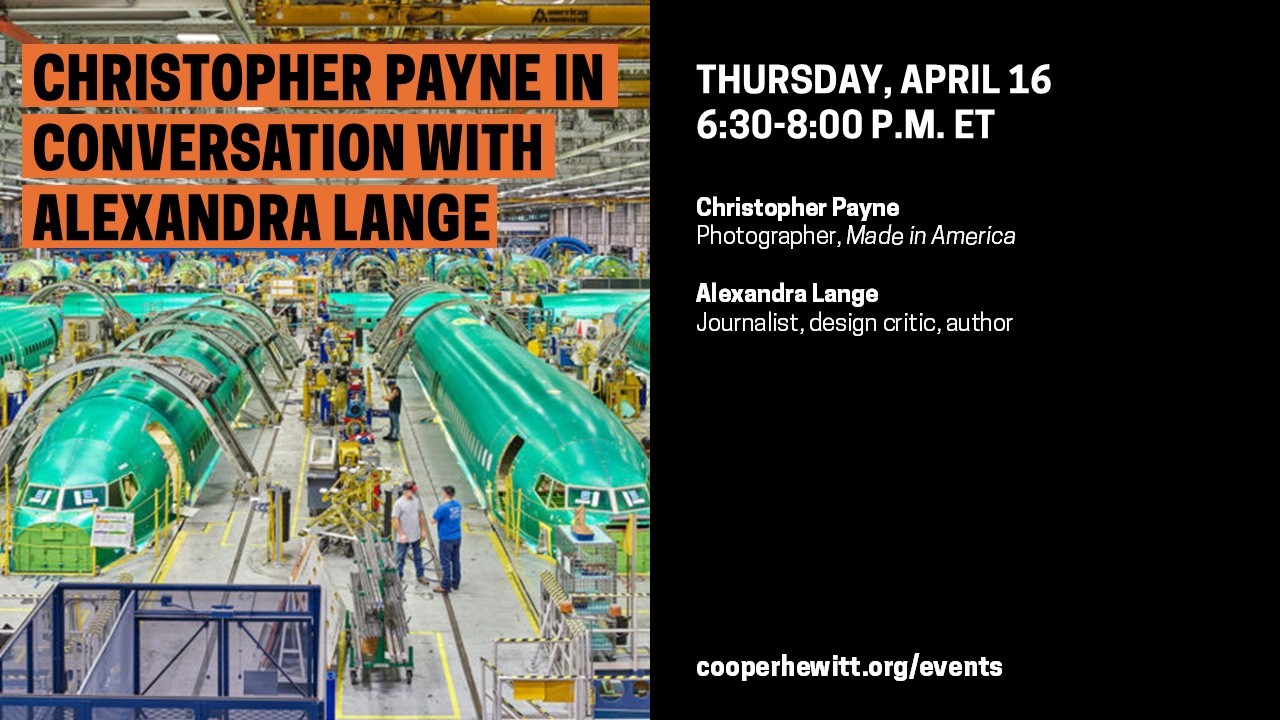
Made in America: Christopher Payne in Conversation with Alexandra Lange
Watch on YouTubeVideo summary
The exhibition "Made in America: The Industrial Photography of Christopher Payne" presents a compelling dialogue between architect-photographer Christopher Payne and design critic Alexandra Lange, exploring the evolution of industrial imagery from mid-20th-century heroic depictions to contemporary challenges. Both speakers, sharing an architectural background, examine how photography has shifted from documenting disused spaces like mental hospitals to capturing active factories that highlight mass production, precision, and the interchangeability of parts. This visual narrative contrasts early government-funded documentation efforts with modern editorial purposes, revealing a transition from blue-collar manufacturing to white-collar corporate utopias where companies like John Deere and Olivetti invested heavily in comprehensive design for their workplaces. These historical images convey a profound sense of purpose, optimism, and unity between product, workplace, and community that is increasingly absent in today's fragmented industrial landscape.
The conversation delves into the aesthetic and technical shifts within industrial photography, noting how early photographers like Lewis Hine used images to expose social injustices while others like Ezra Stoller captured beauty amidst clutter. Payne emphasizes his focus on form, repetition, color, and scale, often translating three-dimensional factory spaces into two-dimensional compositions reminiscent of architectural drawings. However, he observes a phenomenon he terms "downward aesthetic mobility," where modern manufacturing environments have lost their photogenic quality due to automation, plexiglass enclosures, and strict intellectual property restrictions on high-tech machinery. Unlike the chaotic yet vibrant scenes of historic steel mills or tire buffing operations in Georgia, contemporary factories often lack the intentional design and visual interest that once defined industrial sites, making it difficult to capture the transformation of materials and the dedication of craftspeople without facing significant logistical hurdles like union scheduling rules.
Beyond the technical aspects, the dialogue underscores the critical human element in these photographs, where the most compelling images feature workers who embody mastery and community spirit. Payne highlights specific examples, such as a symbol maker at Zildjian, to illustrate how factory work served as a hopeful counterpoint to societal polarization through collaboration rather than division. The discussion also touches on the role of photography during wartime propaganda and the aesthetic appeal of geometric forms like circles and grids, reflecting on the tragedy of losing unique ways of life tied to specific industrial sites. Ultimately, the speakers reflect on how these images preserve a vanishing world of craftsmanship at scale, capturing an era where intentional design unified every aspect of production and community life before economic shifts and labor changes altered the built environment forever.
The significance of this photographic archive is further contextualized by its presentation at the Cooper Hewitt design museum rather than a traditional art or history institution. Payne argues that a design museum provides the necessary framework to appreciate the intentionality behind both the objects and the photographs themselves, interpreting them through layers of meaning centered on good design. In this setting, the images are not merely viewed as historical documents or abstract artifacts but as testaments to a unified vision where architecture, product, and human labor were seamlessly integrated. By preserving these visual records, the exhibition ensures that future generations can understand the precision, optimism, and collective spirit of an industrial past that once defined modern life, offering a poignant contrast to the current state of manufacturing and design.
Read the full video transcript
Hello, good evening. Welcome. I'm Susan
Brown. I'm the associate curator and
acting head of textiles here at the
museum. And I also had the tremendous
pleasure of curating the exhibition Made
in America: The Industrial Photography
of Christopher Payne, which is on view
upstairs on the second floor. I am truly
thrilled to welcome you here for a
conversation between Chris Payne and
design critic Alexander Lang. They share
a deep knowledge of the cultural history
of architecture and they have both spent
considerable time considering the role
of image making in shaping our
understanding of architecture and
design.
Chris Payne trained as an architect
before made in America. He published
several books that focused on disused
spaces, including New York's forgotten
substations, North Brother Island, an
uninhabited island in the East River,
and Asylum inside the closed world of
state mental hospitals. For the past 10
years, he's turned his focus to
factories, spaces that are as chaotic
and full of activity as his previous
subjects were still, and which are in
constant flux due to new technologies
and shifting global markets.
Working in the tradition of
photographers like Alfred T. Palmer and
Gordon Parks who created heroic images
of American workers in the mid- 20th
century, Payne makes photographs that
celebrate manufacturing and
craftsmanship.
Alexandra Lang's essays, reviews, and
profiles have appeared in Architect,
Curbed, Denine, Metropolis, The
Atlantic, The New Yorker, and many
others. Her 2022 book, Meet Me by the
Fountain, an inside history of the mall,
gave a fascinating behindthe-scenes look
at the ambitions and failures of mall
design. In 2025, she was awarded the
Pulitzer Prize in criticism for a series
of articles on the effect of urban
design on children and families,
published by Bloomberg City Lab.
Tonight, for the first hour or so, Chris
and Alexandra will have a conversation
with pictures, uh, exploring the role of
photography, past and present, in
crafting our collective understanding of
American industry and labor. There'll be
time for questions from the audience at
the end. Thank you so much for joining
us, and please welcome Chris and
Alexandra.
Hi.
>> Hi.
>> How you doing? Thanks for coming. Uh we
used to be neighbors.
>> Yes.
>> And um we we share similar interests in
architecture and the built environment.
And it's uh when it when we were
thinking of doing talks and stuff uh the
first person that popped in my mind was
you. So this has been a lifelong uh
desire to to speak with you about the
things that we love. Right.
>> Yeah. And I feel like Sorry. Um, it was
actually very smooth picking all of the
images that we're about to show you
tonight because our taste is very
similar in photography and we're
interested in a lot of the same things,
you know, kind of aesthetically and
qualitatively. Uh, so yeah, it should be
fun. Um, and I think I feel like, you
know, the the theme that we're sort of
operating under is like what are the the
pictures in the backs of our minds that
I see when I look at Chris's work or
Chris is thinking about when he's making
the work because there is this whole,
you know, 20th century history of
industrial photography. Um, and his work
is just merely like carrying it forward,
embracing the new technology both like
as a photographer and as somebody
chronicling industry.
>> So, what we're going to show tonight are
are favorites. And what's nice about it,
it's it's going to be more of a
conversation and uh talking about really
like what you know when a lot of times
when I'm when I'm working, I have all
these historical historic images in my
head, previous photographers, but
you know, you don't really ever stop to
ask yourself like what makes a good
picture. You know, when you've been
doing it long enough, I still make a lot
of mistakes, but you kind of know what
makes a good picture. But tonight, I
think we're going to peel off the the
layers a bit and talk about what makes a
good picture and how did, you know, how
did I get there? Who are the who are the
precedents? Um what is industrial
photography?
>> How does it relate to architecture?
We're both um you know, we both kind of
work in the fields of architecture. We
both think like architects. That's the
way we see the world. And how does that
relate to to this kind of work? Um, but
the first thing I think we want to say
is it's a question that gets that I
always fear people will ask me. You
know, I spend so many hours, hundreds of
hours traveling around the country
photographing factories and I'm always
afraid that someone's going to say why
why are you doing this? Why is this
important? You know, I get it, but um
that's my fear. And
I just want to start by saying I I just
tell them like everything around you is
built in a factory. Your clothes, the
furniture, the rug, the windows, the
curtains, the speakers, everything, you
know, aside from some food. Um, and
that's why I do it. And a lot of people
just don't realize that the world we
live in is based on mass production and
precision and the interchangeability of
parts so that everything is sort of
identical. And uh you know it wasn't
didn't used to be like that but now it's
just such a common thing that we don't
even give it a second thought. We don't
really know where the shirt on our back
is is made.
>> Yeah. But I think one of the things that
is interesting as we start flipping
images and going back through some
earlier industrial photographs is you
can see the level of precision and you
know the level of moving parts and and
the distance from hand work and craft
like get larger and larger over time.
Like some of some of the old early 20th
century factories look pretty homespun
from the point of view of 2026.
Exactly.
>> Yeah.
>> So, let's dive in. And we were I was
thinking about what image to start with.
And it's a it's a recent image. It's not
in the show. It's from the Hyundai
factory in Georgia. And it it kind of
conveys what a lot of factories are like
when I'm in there. They're chaotic.
There's amazing shots beckon everywhere.
There's a lot of movement and there are
a lot of robots. Um and uh they are they
are everywhere. But uh I thought we
thought this was a pretty good way to to
kick off this notion of um you know
industrial photography.
So this is an image that I made in uh
2011. I thought about it for eight years
uh after touring this touring the
Steinway factory in 2002. Uh it's a view
looking through piano rooms at the
Steinway factory in Queens. And we were
thinking about well what makes a good
industrial picture and it's kind of the
same like what makes a good
architectural photograph because this
really is architecture on a smaller
scale. It's the built environment. Um
but we thought you know form is good.
That's you've got to have good form. Um,
and I thought this was a good
representation of that
and
repetition.
And one of the things that being trained
as an architect, you tend to see the
world architecturally. And so it's
always great if you can translate a
three-dimensional
image into something that's
two-dimensional, like a two-dimensional
drawing. You know, when you're in
school, you're learning how to draw
things, how to represent something in a
very clear and concise way and also
beautiful. And so,
um, when you change your point of view
as a photographer, you can often flatten
things out and make them look more like
a drawing and in that way more
understandable.
Any of you know what this is?
The the peeps. Another thing that we
were discussing was uh the importance of
color repetition. Um this kind of checks
all those boxes and also seeing
something that a lot of us know but in a
state where it's a little bit
surprising.
This is before they're covered in yellow
sugar. And believe it or not, I actually
didn't have one of these when I was at
the factory. I was so stressed out
about messing up the shot that I didn't
even think about eating one. And of
course, they don't want you to reach
onto the assembly line and pull one off.
You want to speak about this?
>> Yeah. I mean, I think, you know, I think
in a lot of your photographs, the the
color really, you know, helps us as a
human like find the humanity in the in
these sometimes like very sterile, very
like metallic environments. I mean, I'm
personally very attracted to colors and
then also Chris's photographs that um
deal with things that I, you know, sort
of have in my life, have touched like
the Peeps, um like the pencils, and
here, you know, like yarn and textiles.
I guess I I find those so much more
relatable because again you're making
this leap, you know, from the things
that you know to how those things are
manufactured to then like the beauty of
the the photograph of the artwork as an
artwork. And so I think some of these um
yeah, some of the factories where
they're they're making clothes and sort
of like homely objects um just have an
emotional charge that I personally don't
necessarily get from you know pictures
of them manufacturing planes.
>> Yeah, this is when you take the scale
down it becomes much more humanizing.
Um, a lot of you know this image because
I talk about it every in every lecture.
You'll probably know the story that I'm
going to tell uh about the mill owner
calling me up and and saying, "You
should come up today. We're running
pink." This is when I was living this is
when I was living on Chver Place.
>> Okay.
>> Yeah. Yeah.
>> And uh I already had a picture of this
in a different color, but it was done at
night. It was good, but not great. And
um
my car was parked right outside my
apartment, you know, alternate side
parking. It was it was the perfect spot.
And you know, the kind where you just
sort of when you find a spot like that,
you just sort of look at it and you sit
in your car for a while. And and so I
wavered. I wavered. I didn't want to
drive three and a half hours to to make
a picture that, you know, I didn't know
would would turn out. Um but I made that
decision. And obviously there's the the
result worked out. And uh
I also want to add you know doing this
kind of work um and we didn't we didn't
talk about this but factories are always
changing. You know just like the styles
of clothing things going in and out of
fashion economic trends rise and fall.
Businesses close and factories close.
And a lot of places that I've shot over
the years you know developed close
relationships with these people. They go
out of business. Um, and and not so much
due to foreign competition, but because
there's a no one to take their place,
you know, in these older places that
that you and I love, no one wants to to
learn how to use a, you know, a carding
machine that was built 100 years ago.
Um, so even though I feel like I have
all the time in the world when I'm
there, I'm given a lot of access in some
places. Uh, it's you're racing against
the clock. And so I've always felt a
certain urgency to what I do, knowing
that, you know, in a few years it's just
it's just gone.
This is an image we picked because of
its architectural quality, right?
>> Yeah. It's like they're building a
building.
>> Yeah. Yeah.
the tendency when you go into a car
factory uh or anything where there's
assembly line, you want to show the
assembly line. You want to set get that
scale.
Rarely can you see something kind of
from the side and step back. And uh this
is a electric bus factory in California.
And I remember when I saw this, you
know, buses are kind of made differently
than cars. They're they're really built
up by, you know, it's like it's like
building a house, right?
And um I saw what they were doing and I
think we came back the next day or at at
the end of the day and it was one of
those instances where I could just let
these guys do what they needed to do.
And I've always thought of this is an
example of like the way we think, the
things we love where there's this
architectural underpinning, this grid,
and things are happening on top of that
organically. Yeah.
>> Yeah. I mean, this one the like the the
workers because they're in their blue
seats, it's like they're kind of like
crawling all over the house. Um, and
there's also this really nice repetition
of the two ladders. And the ladder
obviously is something that we all kind
of know in our bodies how big it is, so
it gives it scale.
>> Yeah.
>> Immediately.
>> Yeah. And it's it's because you know
what a bus looks like. If they were
working on something else, it wouldn't
you know it wouldn't resonate. And
that's something I'll touch upon later,
but the kind of familiarity with what
you're looking at and seeing it in a
different way, in a different state of
production, seeing it in a new way, uh,
engages the viewer in a in, you know,
and and when you get more and more into
the future, that kind of cozy
relationship doesn't exist.
So, I wanted to talk a little bit about
um things that have influenced me. And
when I was in architecture school, I
worked for this organization called Haps
Hair, which is part of the National Park
Service. And their job is to at least
the historic American engineering record
part of it, hair is entrusted with
preserving, not preserving, but
documenting the nation's industrial
heritage. And so for several summers
during grad school, I got to live in
small towns around the country that were
the kinds of towns that you would never
go to uh if you didn't have a reason to
go there. And while my friends were
working at fancy architecture firms and
asking me why I was living in Alabama,
um I I grew to love these places
precisely because no one else wanted to
go there. And they instilled in me kind
of a deep appreciation for American
history and ingenuity and technology.
And I had no interest in photography
when I was doing this. I was making
drawings. Um but I got to work with some
amazing photographers. And one of them
was a guy named Joe Elliot who
photographed the Bethlehem uh steel
mill. And he saw it when it was still in
use uh in in Pennsylvania. And an image
like this is one of those things that
that is always in my mind as something
to chase because it doesn't really exist
anymore in this country. Um it's one of
the ones that, you know, that I missed.
Um and it's, you know, it stays with
you. It's like lurking up there. you're
always searching for it. But what we
love about this is that it shows a sense
of um action, you know, not only showing
process, but you get the little person
next to it and the sense of scale.
>> Yeah. Yeah. Yeah. And one of the things
we were talking about earlier in in
relation to this and and some of the
other photos we're going to show is the
fact that like we're talking about this
umbrella category of industrial
photography, but actually the client for
a lot of these photographs is very
different. Like this photograph was made
for a government program. Like the
government wanted to document um
American industry, hired photographers,
sent them out to these places. When you
were working for hair, it was the same
thing.
>> Same thing. Yeah.
>> But now most of the time you're working
for a media company,
>> editorial. Yeah. My myself, you know, or
a commercial commission. But this kind
of work, what's what's beautiful about
this work is that when we were doing
these summer projects, it was a
combination of architectural students
doing drawings, measure drawings on
site, you know, ink on myar, um,
historians, and then the photographers
would come in and elevate these just
benol subjects into art. Um, and this is
one that
hit me that I saw and I just, you know,
he sometimes you see things in glancing
in in passing and and they just kind of
strike a chord and you're like, "Oh,
wow. That's that's cool. I wish I could
do that, you know, even not having an
interest." But these are just
ventilation fans in a tunnel at Yoseite
National Park. And um I love this image
because it's so simple and clear and
it's not trying to be anything more than
than what's there. And that's kind of
the essence of a, you know, good
industrial photography. Um
in relation to mine, which I think is a
little can be a little bit like over
wrought, you know, because I have to I
have to sell myself. But for the
government, they just wanted give us the
facts, show it truthfully, and show it
beautifully. Right. But if you I mean,
yes, it's very dead pan, shall we say?
But if you think about it, you know, an
architect did have to do a drawing of
those fans at some point. An industrial
designer also had to do a drawing of
those fans at some point. So in a way
the photographer is recognizing that all
of those like previous you know design
interventions like did a good job
arranged them so neatly you know put the
circles under another circle you know
like there's artistry to it and that's
what makes this like relatively
simplistic photograph actually like so
beautiful and made it memorable for you
>> right there's an intentionality to the
design and the construction and that the
photographer was able to see that you
know through all the stuff that might
have been there, maybe they did some
cleaning, added some lights, and it just
everything just sort of works out
perfectly and it looks effortless.
Um, and then another thing with
industrial photography, you know, I
always get hung up on process like and
with a lot of these editorial
commissions, I feel this obligation to
show how something's made. You know, if
I'm not catching all the key moments,
then I'm I'm not doing it justice. But,
you know, a lot of viewers don't really
care how something's made. They just
need a beautiful picture or they need to
see the human element. And so one thing,
this is another picture by Joe Elliot
who I consider my mentor and and a dear
friend. But he was always so good at not
only showing the machines and the guys,
you know, with the big blast furnaces,
but he's also showing how they work, the
work conditions, and you don't need to
have people in them, but to show the
spaces where they work, so you get an
idea of what it was like to be there.
And that's such a more interesting story
sometimes. So these are little baskets
that they would raise and they'd put
their belongings in them. And at the end
of the day, they, you know, there's a
lock at the bottom and they would lower
them. And it's the kind of thing you
just don't you don't see anymore, you
know. Um, but it was very common at a
steel mill.
>> Oh, yeah. So, this is one of my choices.
So, this this is an industrial photo
photograph, though you might not think
of this as an industrial photograph
because it's actually showing the
interior of one of the Shaker built
buildings in Hancock, Massachusetts. So
this was taken by a photographer named
William F. Winter Jr. who actually
worked for GE as a photographer. So he
had taken, you know, attractively
arranged pictures of light bulbs and
things like that for GE. and he was
hired by a different government uh
acronym agency, HABs, the Historic
American Building Survey, to survey a
bunch of the Shaker villages in the
1930s because already then the Shakers
were starting to sort of well shrinking
shrinking as a population and um several
of the villages had closed. So they
wanted to document what the villages
were like at that time. But what was
interesting is they hired William F.
Winter, this industrial photographer,
and he took photographs of the Shaker
villages as if they were factories
essentially, right? Like you can see
that the perspective um and the kind of
the the lines, the grid, the
arrangement, the deep space. like these
are the same techniques that were being
used for factories and for then you know
kind of early modern architecture in the
1930s but he's applying it to these
Shaker villages and in fact his
photographs help get modern designers
interested in the Shakers then and
modern designers are still very
interested in the Shakers but I think
it's kind of like an underststudied
aspect of it that actually like his
photographs are interpreting the Shakers
as protoodern designers. Um, and in fact
like this is a workspace. This is the
the laundry and of course the the
sisters the w the female shakers um
would have essentially been doing you
know industrialsized
you know cooking cleaning laundry in
these spaces at the villages.
>> Yeah. And and that's um this is a new
image you showed me and Habs Habs and
Hair have done you can go on the the
website and it's it's unbelievable how
many things they've documented over the
past uh since like 1935 or something.
But what I love about these images and
you know the previous ones of the steel
mill is that they're documenting a way
of life and a way of life which is tied
to the workspace and and and it's like a
whole community. And once these places
close, that way of life, that knowledge,
those spaces, you know, it's gone. And I
think that resonates at least with me
because so few of what's so little of
what's built now is is purpose-built,
you know, for a specific purpose that's
not, you know, flexible. Like you look
at this or you look at that steel mill
with the buckets, you know what it's you
kind of have an idea like, oh, this is
for something very in particular at a
particular time, particular place.
And it's it's a it's a beautiful thing
and you don't notice it until it's gone.
Um, but fortunately they did such a
great job of of documenting this stuff
that at least we have it in in pictures.
One of our favorites.
Yeah. This really
this really shows the vastness. Um, I
think when uh industrial architects like
Alfred Khan began designing, you know,
the buildings around the assembly lines,
um, they just took on this scale that
people really hadn't seen before in
buildings. And so I think sometimes when
the photograph is ostensibly of the
assembly line, it's also kind of
glorifying like just the vast interior
like daylight space that they had to
make in order to have make, you know,
have those factories work.
>> Yeah. This is the the the Louis Olivetti
factory. And the thing we love about
this is we we love Lu Khan obviously,
but that someone a company would hire an
architect to not just design their
headquarters, but their factory and you
just don't you don't really see that
now, you know, and that they'd want to
show that off. And that uh Ezra Stler,
who who made this, you know, you see
kind of both worlds. Usually it's just
what's being made or you know the
building from the outside. Rarely do you
get a vast open space like this where
you can kind of see you know see
everything and uh you know and certainly
you're not going to see typewriters made
anymore.
>> Yeah. And Oliveti um you know was an
important like Italian typewriter
company but a lot of American
industrialists including um Thomas
Watson Jr. um who kind of brought IBM
into the computer age really studied
Oliveti in terms of the way they used
design um both of their products in
their graphic design of their factories
and Oliveti even built worker housing
that was very stylish. Um, so it was
really a company that a lot of American
post-war corporations had their eye on,
>> including people like
>> Sarin. We just picked this. We were
going through the the show this morning
and we said, you know, we need some
Sarinin.
>> Big fans. Big fans.
>> Yeah. Yeah. This is This is the John
Deere headquarters in um uh in Iowa.
What town is it?
>> It's Molen, Illinois. It's one of the
Quad Cities.
>> Quad cities. Yeah.
>> And we both had a chance to tour this uh
and we both realized that that we had
been to the same room in the in this
headquarters, the the the maintenance
shop, and we'd both open the same
drawers. We just sort of when you when
when people who have architectural
backgrounds see flat files, they just
kind of naturally
go over there and and open them up and
in this maintenance shop where the
original drawings from the 60s that you
know stamped Sarin and associates with
the person's name and it's just you know
to be connected to that. Um but maybe
you want to speak a little bit about you
you did your a lot of work on this.
>> Yeah. So my my dissertation was about
the concept of the post-war corporate
utopia. So I focused on four companies
from like the mid-50s to the mid60s that
had really um basically hired the best
designers in the US at every level of
their company, you know, for their
stationery, for their tractors, for
their headquarters, for um for their
landscape, etc. And so one of the ex
exemplary companies was John Deere um
who built this headquarters in Molen um
designed by Aerosin. The landscape
outside was designed by um Hideo Sasaki
a really important modernist landscape
architect. Um they had now I can't
remember somebody redid their logo. They
had Henry Drifus doing their tractors.
It was just like this moment in which
all of like the best people in America,
the best designers in America were
coming to Molen and trying to make this
place like as beautiful as possible. Um,
this shot is of uh a a passageway that
leads from the sort of corporate
headquarters building to this separate
building where they had all of the
latest tractors on display. So, anyone
who came to town could see like the
latest and greatest. Um, and they have a
lot of other historical material about
John Deere there. Um, but you can just
see like kind of the relentless
perfectionism of the grid that was, you
know, so endemic to 1960s architecture
and then it lines up so beautifully with
the aesthetics of architectural and
industrial photography. Like, you know,
everything is kind of radiating off each
other to, you know, like look how
precise everything is lining up.
>> Yeah. And and it speaks to like mass
production and precision. And I remember
when I went on this tour late one night,
uh I remember standing in one of these
bridges because the the landscape is
kind of like this. And so they have
these buildings that are separate and
they have these bridges going across and
it's it's just I mean I didn't see the
land. The guy said you should come back
here at dawn when you can see the
landscape. But the building is amazing.
that if you have that kind of eye, you
you were just drawn to, you know, the
picture in the corridor. I mean, it's so
boring, you know, when you think about
it. But if you're in the space, like you
can't help but you want to just you want
to make that picture.
>> Yeah. You're always trying to line
yourself up like, am I standing on the
seam and the Toronto floor that will
allow me to like look through the window
to the building across the ravine? And
you know, I mean, like the great thing
about these architects is they were so
obsessive. Like, you know, that they
lined everything up. You don't have to
worry that like somebody got lazy, you
know, like out there in the distance.
Like they definitely like did a drawing
so that everything would line up.
>> Yeah. Yeah. But it it's interesting that
that the precision of this style of
architecture and the fact that it
carries over into those in some cases
into these factories. It's just it's a
wonderful like when I think about well
when would I have wanted to have you
know taken pictures uh and and to go
back to this time where you could get
the factory and the headquarters and and
the furniture everything was just this
it was a complete concept you know
>> um so I want to go back a little bit and
we'll talk about
things that have influenced me but what
industrial photography has been used for
uh and during the war when you really
see it coming to its own. It was used
for propaganda uh for raising, you know,
national morale. Um and these were
pictures by Alfred Palmer. The he was
commissioned by I think the office of
war information. You know, it's
essentially a government agency that is
funding the arts. And I was really
influenced by these. I remember when I
when I saw them for the first time and I
I was just starting out in industrial
photography, just trying to figure out
what I wanted to do. when I was still
shooting with a a view camera on film
and I looked at these and I said, "Wait
a minute, he's shooting with a he's
shooting on film, too." And not only
film, he's shooting with like slide
film. So, there's no there's no
tolerance for error. And he's shooting
with strobes because he's overpowering
the existing light. And these people
look great. And he's shooting jet he's
shooting engines. And I I I was like,
"That's that's what I want to do. I got
to teach myself how to do that. Um, so
they were a huge influence on me. And
the thing I really love about these is
that these people, it could have been
made yesterday. And they're obviously,
you know, they're they're propaganda.
They're they're showing these people in
the engines in the best light, but it's
so when you see things in color that are
lit that well, that are framed that
well, um, the people you're young, you
you just feel like it could be
yesterday. and and yet it's 1943, you
know.
>> Yeah. I think it's really easy to be
caught up in the glamour of it. I mean,
like it was very very effective
propaganda.
>> Yeah. Yeah. It's and the other thing
that I noticed having been to a lot of
factories now is that certainly in the
US, you know, people don't they don't
dress up to go to work. Uh and that's
something I always struggle with. And if
I find someone I like to photograph,
I might say, "Wear that shirt again
tomorrow." Or, "Do you have anything
that's not like a black hoodie?" Uh, but
back then they they really dressed up.
It's something I see in in I've seen it
like in South America and Europe and
Asia where people have uniforms. There's
a much there's like a you know, a dress
code. They want everyone kind of looking
the same and it makes it a lot easier to
to photograph.
But these are just these are really I I
just always love looking at these um you
know seeing people making things but at
scale. That's something that I struggle
with a lot is finding that sweet spot
because there's a lot of cool stuff
still being made but a lot of it's artal
and it's more like someone quit their
job in finance and opened up a shop to
make you know whatever and it just
doesn't have the sense of scale that
these places do. And yet this is hand
craftsmanship but at a huge scale. Uh it
also brings up something that we were
going to talk about in the beginning
which is sort of you know form form
right there's form there's light there's
color circles. Uh you can never go wrong
with a circle. Um and just to prove that
point in these next few slides.
I see an image like that and it gets
filed away in my head. And so when I see
something like this of a electric motor,
I'm recalling what I've seen and then I
do it again
in this picture that's upstairs of a of
a a um PET scanner. Um but the idea of
using these strong forms and showing
people working inside something is is
really powerful. uh
you know they're inhabiting the world in
which they work.
>> Yeah. Yeah. I mean the circle for me
just it makes them really feel like they
are you know handmaidadens to the
machine, right? There's something so
powerful about the circular form like
the the human can't help but look a
little bit vulnerable um in in the
center of that circle. Maybe I've
watched too many sci-fi movies, but like
I I just feel like there's an element of
danger in these that is different from
the ones that are more gritted. Like the
grid to me is kind of calming. Like it
feels endless and open, whereas this
it's like, okay, they're like they're
very in the eye.
>> Yeah. They're they're they're inside
this thing.
>> Yeah.
>> And you know, um
something could go wrong.
Not Not usually. Not yet.
>> Right. But this is one of the ones I was
thinking about when I was talking about
how like in the past even the industry
looks more artisal, right? Like these
wheels
look, you know, somebody built them too.
>> Yeah. They're wood they're wood forms.
There's a great I don't know if you all
have seen, but you can look it up. Uh
there's a wonderful group of films
that were made like in the 50s and 60s
of like the making of matchbox cars or
or globes, earth globes or uh dolls, you
know, in England. And it's artistal
work, but it's done at scale. Uh, and
this is um a wonderful photographer uh
Maurice uh Bloomfield
in England and he was you know when I
discovered his work it was another kind
of aha moment because he's working in
color a lot of the times and he's
showing these industries that they're
just gone you know um and they were so
it's not like we don't use these things
anymore it's just they're made probably
in Asia and they're not made artisally
like like this.
I actually forget what that's for. Um
I I have it written down in my notes,
but we were trying to wing it today. You
can you can ask me afterwards. But but
it the beautiful thing is it's not the
object itself, it's the formwork for it.
And
that's another thing that has always
eluded me is to see because the formwork
is often more interesting than, you
know, the machine the machine that makes
it is more interesting than what's being
made. But yeah, you're right. It's it's
it's it's an artal process, but it's
done at scale. And then there's the
color and the circle. I mean, these are
the kind of things that as an industrial
photographer, I I dream about finding
something like this.
This is another one of his shots. Um, we
talked about like propaganda in the war,
but there's like a sense of optimism in
the 50s and the 60s and the 40s where
kind of anything's possible, you know,
and people dress up. They're they're
colorful, but there's a sense of like
abundance post-war like abundance in
these photographs, which is which is um
there's certainly abundance now, but I
think there's more optimism in these
And I had to get in a couple of these.
These are This is the Diego Rivier uh
mural in the Detroit Institute of Fine
Arts, right? This is the Ford. He had
this commission for the the Ford Motor
Company. Um and to me, this is like kind
of like the holy grail of of industrial
imagery. Um it just checks all the
boxes. It shows how things are made. It
shows the worker as heroic. it shows
them as slave, you know, it's it just
it's overwhelming. Um, but we were we
both like
uh these, you know, utopian works of
architecture, but but more importantly
like things that have been funded by
corporations or the government where
they're building like an entire city or
a corporation or a fac, you know,
campus. It's just something you don't
see now, like the idea of the government
funding artwork on a mass scale. Um, and
so this is the epitome of that. And
also, this is a project I'm working on
on uh New Deal murals and post offices.
And a lot of these would show local
industry. So, you know, industrial
photography and imagery is not just not
just photographs. It's also paintings of
that period where everyone was kind of
showing what was going on in the country
and celebrating it or critiquing it.
But, and the great thing about these
post offices is that since they're
local, you often see what was the local
industry. And um so to me, this is just
like, you know, it's a photograph on a a
different kind of photograph.
>> Yeah. Yeah. Yeah. And I'm sure they
often included like portraits of people
that the people in the town would have
recognized. So it's also it's like like
you're famous on the wall of your own
post office. Yeah.
>> In a sense.
>> Yeah. Yeah.
>> Yeah. It it was very personal, you know,
and the post offices at that time were
where the town came to meet where
information was was uh was was passed.
Uh but it gets back to this point that
you know we talk about and it's the
funding it's the investment in beautiful
you know beautiful built things that
will benefit more than just the
corporation or you know the post office.
I mean this is for the public.
>> Yeah.
And then there's sort of like in some of
these images that I dug up, this is an
Ezra Stler image of a Columbia record
factory here in New York City, Long
Island City, probably in the 50s.
But we saw we showed those things that
are more propaganda have a positive
effect. And I mean, I love things like
this because it doesn't exist anymore. I
will never make a picture like this,
right? But you begin to realize like,
oh, this is kind of monotonous work,
right?
>> This is also um this might also be in
New York City or was in New York City in
RCA. Yeah.
>> Yeah. I think so.
>> But there's beauty in it. Like we find
beauty in it. That's the first thing I'm
drawn to. But then you begin to realize
it's oh my god, it's pretty
it can get repetitive.
telephone operators. Another thing that
I'll never I'll never photograph this,
but once again, we romanticize it, but
it's
who knows if it was actually really that
interesting to do. Makes for a great
photograph, but
this is a good one.
>> Yeah. Yeah. because this this has this
is at the Hines um factory in Pittsburgh
which was designed by S Soom um and it's
Ezra Stiller. So you get again like the
grids of the modern architecture with
the like this the ceiling, the lights on
the ceiling, the way the tables are
arranged, but then the ketchup looks
rather sinister, I think.
Um um that hit of like the hit of color
is like, okay, it's heights. We know
it's ketchup, but is it really ketchup?
Well, and and we know they they staged
it, but
>> yeah,
>> when I look at this, it's once again,
it's an image that I will never get the
photograph because this is not how they
would test ketchup now.
>> Yeah.
>> Um Yeah.
>> But it's wonderful. You know, people in
uniforms, this perfect environment,
usually the places when I go to
something, it's not this beautifully
designed
>> and the old stuff doesn't look this
pristine. And so Ezra Stler got in there
just at the right time, you know, and to
have seen it in that condition is
pretty, you know, who knows what he
thought, but um I'm I'm envious.
>> This is the uh this is a a newspaper in
um I think it's is this Columbus or
>> Yeah, Columbus, Indiana.
>> Yeah. Which is a big architectural
mecca. It's a newspaper printing plant.
And when I was growing up in Boston, the
Boston Globe had their printing plant
and headquarters that faced the the road
and you could see the presses. They had
left one of the facades open. It was
just glazing and you could see these
presses running at night. And to a
little kid, it was like, you know,
seeing into Willy Wonka's factory. Um,
but I love this because it it's
everything we've talked about. It's
it's, you know, it's the union of all
these
>> Yeah. And I think I think the I think
it's the Republic is the name of this
newspaper, but they had the printing
plant and then also the um like the
reporter's desks are essentially like on
the other side of this building that is
in the center of town. So it was like
the newspaper um you know the truth
teller was in this glass box located in
the the center of town. Um, so yeah, it
was really like kind of a profound
statement about the importance of the
media in that local economy. Um, and and
as Chris said, the Columbus, Indiana is
a town where Cumins Engine Corporation
is is the largest employer. And the the
Miller family who owns Cumins had this
um program to subsidize like good modern
architecture for their schools, for
their banks, etc., etc. Um, so this
building is part of a whole like set of
buildings um that kind of, you know,
glorified the, you know, ordinary
workings of a Midwestern town.
>> Yeah. And it's just once again, it's
like to see this now, right? First of
all, you wouldn't see a printing press,
but you wouldn't see it showed, you
know, displayed like that. Yeah.
>> Like a jewel in a in a box. And it's,
you know, it's very modern modern
architecture and the synthesis of like
investing in a a a place that has one
purpose. You know, once that printing
press is in there, they're not going to
retrofit it to become a retail complex
in in five years. Like it's this is what
they're building it for.
>> This is your favorite.
>> So, yeah. So, th this is also Ezra
Stler. This is basically the same era as
as the ketchup photo. Um, this is
Connecticut General Life Insurance
Corporation in Bloomfield, Connecticut.
Um, also designed by S Soom with
interiors by Florence Null. So, to me,
this is just like the ultimate Ezra
Stler architectural photo because you
have this suburban gritted campus. like
the the colors are so clean and it's
like the the desks and the employees
extend into infinity
>> and it and it's just an extension of
like you know these factory pictures
where it's a total environment they're
investing in everything from the
landscape to the headquarters to the
factory to the furniture the signage and
when you walk into like when I walked
into John Deere that headquarters
if if you're, you know, unless you're
blind, like it's it is just it's you
kind of go I was freaking out because
it's
>> Yeah. You're just really you're not used
to everything being thought through.
>> Exactly. Yeah. Like vision. You feel the
vision of the architect of this
intention um that it's more it's about a
sense of place and a sense of purpose
and that that it comes across.
>> Yeah. And it's also interesting in this
case because we see a shift from, you
know, kind of like blue collar industry
to white collar industry. Like what is
Connecticut General doing? It's it's
paper pushing, right? It's an insurance
company. And there are other there other
photos in this sequence um of rooms with
like stacks of paper on which they would
have printed their insurance policies.
So even there there's this kind of like
quasi industrial moment with the stacks
of paper but mostly it's it's the labor
of people at their typewriters
>> right and it doesn't you know I guess an
industrial that's sort of saying that
industrial photograph doesn't have to be
about like a machine it's about people
working right and as we know a lot of
things that people do uh those jobs get
phased out things we take for granted
now you know might not exist in 10 years
so like something like this you And
that's like when I was at John Deere, I
went there after the pandemic and the
guy was saying that, you know, half the
building was empty, right? So you've got
this landmark building. It's and it's
cool when it's empty because it's you
just have the run of the place. But at
the same time, you're thinking like,
wouldn't it be great to actually see
people working in here and yet as we
know, you know, once people are not
working in an office, they don't want to
come back. Um, and probably people out
there have long commutes. So
>> yeah.
Oh, yeah. So, this was one of my
choices. I actually forgot that these
same EMS chairs are what you are all
sitting on right now.
But this is from um this 1960 short film
by Charles and Ray Emmes called A
Kaleidoscope of Chairs. Um and this you
can you can watch it online sort of
bootleg. Um, but it's this film is
really interesting to me because I think
what the EMSes were trying to do with it
was to take the industrial photograph
like into motion and into music because
it has like a jazz soundtrack and they
have all of these photos of these, you
know, EMS molded fiberglass chairs like
coming off the production line in these
vast numbers, but then they make them
dance um and they turn them into a
kaleidoscope. scope and you see like
Charles and Ray like sitting on them and
you know it's cut so they seem to be
like boopping around the room. So I feel
like they were trying to take some of
the like glamour and joy of some of
those industrial photographs but you
know make it move because they felt like
that was the next thing for modernity
was to you know like have it be a a
moving film rather than a still
photograph.
And it speaks to like just the ind the
idea of industrial design permeating
everything.
>> Yeah.
>> Yeah. Yeah.
>> Which I guess it's happened but not at
this level of like I mean we're still
loving these kinds of chairs.
>> Yeah. They're made of something
different now though. Uh to be less
polluting.
So, let's sort of talk about the darker
side of this this genre,
>> all of this industrial celebration. But
>> but um now I I look at an image like
this and I go ballistic over the the you
know this giant um press or forge and uh
and then you think like oh wow that you
know what else is it saying and it's
saying as the nation became
industrialized
uh and these factories are huge and you
know people are working crazy hours and
they're kind of like cogs in this
machine and you know just to see how
small he is and it you know you realize
like and I've seen this like I go in
there I'm I'm in these places for like a
day a couple days and I love it but I do
talk to people and you realize like this
is hard work um and it's not necessarily
to be romanticized even though it's
important it's just it's it's tough
work.
This is one we love. It's a textile mill
um in Massachusetts taken by if I get
the pronunciation right Frank Delano who
was one of these government
photographers during the war sent around
the country to document what was
happening and picture like this right
has has sort of two sides right
>> yeah I mean it it's so beautiful first
of all right I had never seen this
before today and I was like oh my god
like what is happening with this photo
like we were already thinking about um
like the twopoint perspective and these
sort of grids extending into infinity.
And here's one of them, but really, you
know, from before the modernist era. Um,
and you're seeing this clash between um
the past and the form of the house and
the modernity of that, you know, like
infinite litup grid, but you know what's
actually happening?
>> Yeah. And they're working through the
night. We think it's,
you know, I think it's like amazing
because I like things that operate
around the clock. It means that I can
photograph there all the time, right?
They don't they don't kick me out when
the the first shift ends at 3:30, but
someone has to get up and and do that
third shift, and that that probably
sucks. Um, and the work, as we know, in
some of these other pictures in the
Lewis Hine shots that really showed
child labor um and
>> yeah,
>> change things.
>> Yeah. So this is a a Louisis Hine photo
um taken for a child labor organization
in the in the 19s.
Um so this is at um a textile mill in
South Carolina and he was sent out
specifically to take pictures of
children working in hopes of you know
changing the child labor laws. So, this
photograph is actually like part of a
political movement and it has again like
all of the hallmarks of these other
photos we've been talking about. It's
very beautiful, but it was, you know,
direct directed at at telling the
terrible story of this, you know, very
small child forced to work in a textile
mill. And I've always been familiar with
these, but you can look them up online
and it's incredible how many mills he
got access to, right? And how many
children are working and they're just
they're all variations of kind of the
same thing. And I've been fortunate to
actually be in some of these older mills
where they still have equipment like
this. And it's very easy to imagine, you
know, the kids working there because
they had little little hands and they
could pick up the bobbins and stuff. Um,
and I've seen carts exactly like that.
Uh,
and I don't know, there's something
about these images that I find much more
powerful than the ones I make. And maybe
that's because they're, you know, Lewis
Hine and they're they're original and
they speak to a way of life, a
community, you know, a community built
around the mill that is gone, you know.
And so when I'm photographing some of
these older mills, I really feel like
I'm I'm photographing a relic which has
been disconnected from from its history.
It's still there, but that sense of
community
uh of the town working around the mill
is it's gone. And so I'm finding little
bits and pieces, but it's not like the
way of life is doesn't exist.
>> Yeah.
This is another Ezra stole image I think
from the the TV factory here in New
York. Um, and also, you know, I just
found it the other day and I thought
it'd be cool to include it because he
took so many pictures. You know, there's
so much out there and and usually people
only see the ones that are famous. But
this just speaks again to repetition.
And the other thing I liked about it,
the reason why I'm really showing it is
because one thing I struggle with when I
go in and make these pictures is the
clutter, right? There's it's noisy. It's
dirty. It's cluttered. The lighting is
crappy. And I look at Ezra's stuff and
usually, like I said, you only see the
good stuff. But if you go poking around
the um the esto inventory,
you see that he had he was grappling
with the same things. These factories
looked pretty much the same, right? I
mean, the stuff was cooler, right? More
photogenic, but there's still boxes in
the background, right? which he I would
have I would have lit it in such a way
that it was dark and you just saw the
people and things.
>> I was actually fascinated that you do
like move things around like I mean I I
think you know it's like
there are some photographers that would
never like touch anything in the
environment. So are you moving things
out of the background or you just like
leaving them in the dark?
>> I would light it so that you wouldn't
really see it so that it would
disappear. I love it because now I see
that it was he was struggling with the
same things I struggle with. Um
but yeah, I will do whatever I can to
make it look um its best or should I say
to remove any what I think are
distractions, visual distractions from
the story that I want to tell, from the
emotions that I want to, you know,
raise. Um and this is another one I
found yesterday and I I couldn't believe
it that he took this. Not only did he
take this picture in black and white, he
took it in color. And I I'm just
struggling. I'm really wondering someone
like Ezra Stler who was just so dialed
into like the architecture.
And yet, you know, you he would get
these I think he would get these
commissions to do the the headquarters
or the main building and then you'd also
have to shoot the factory. And you can
see that that what he was drawn to. And
I'm still wondering what drew him to
this. But it makes me feel better
because he there was as much clutter
back then. It might have been newer
clutter. The factory might have been
newer. It might have been a little more
colorful, but there's still a lot of
stuff. And maybe he just was like, you
know what? I love this because it's such
a mess and I'm going to do it. And the
guy there is, you know, a good model and
it's got that perspective. But yeah, so
>> then there are other photographers. this
guy named Chris Killip who was a UK
photographer and he photographed he was
commissioned to photograph the Pirelli
Tire Factory in England. He'd been like
a fashion photographer, right? and he
went to this factory and he kind of was
by then he was like a street
photographer and he tried to apply his
street photography approach to this dark
and dirty factory
and his he just wasn't getting good
results and so he said I need I need to
do this old school and he went back to
his 4x5 camera he got his strobe light
and he actually moved took an apartment
near the factory so he could embed
himself in this face and get to know
these people. Um, and really this is
where industrial photography is not
about what's being made, it's about it's
about the people. Yeah. And to that end,
here's another one by
Gordon Parks. Um,
Pittsburgh
was it Pittsburgh. Uh,
they make grease.
Pittsburgh. Uh, I forget the name of it,
but it's a grease factory, and they made
grease for,
you know, armament during the war. All
those tanks and trucks and planes need
grease. Pittsburgh. Uh, Pittsburgh. Um,
it's written there.
>> Yeah.
No, this one is really nice because it's
like there's no highlights, right? Like
we're living in kind of like a dark
realm of like, you know, making
something dirty. The workers get dirty,
their sm, you know, the smock is dark.
And yeah, this is where you start to see
the, you know, the the negative side of
industry, like does this really look
like shouldn't he be wearing a mask? You
know, this like most of these photos are
pre- OSHA. Um,
and so yeah, it's like yes,
photographers were used to glorify
industry. photographers were also used
like Lewis Kahine, you know, to create
political change. Um, and then sometimes
they're just, you know, documenting how
hard life is.
>> Yeah. But the crazy thing is he was
commissioned by company.
So this isn't it's a critique,
but he's just showing what's there. So
it's not like and they probably saw it
and they probably thought they were
great pictures. But I think in his head
he was also using it because a lot of
his other work is you know more social
or social that's his that's his interest
and this is a tool kind of to show the
you know the racism and the working
conditions and like you know there
weren't standards to which this could be
compared to but it doesn't take you know
anyone can see that this is like really
messy work like no one wants this kind
of up.
>> Yeah. So, this is a this is a photograph
um by my brother Jeremy Lang, who's a a
documentary photographer um from a
series that he photographed in 2018
called After Golden Leaf, which is about
traces of the tobacco industry in North
Carolina. Because like all the time we
were growing up in North Carolina, you
know, there were still cigarette
factories in Durham. you could smell the
tobacco drying in the spring in these
big industrial buildings. And then in
1999, there was a big lawsuit that
basically closed all of that down. Um,
but tobacco is still being worked and
produced in North Carolina. So, he drove
all around the state looking for it. And
this is just, you know, a photograph.
You know, there are still people out
there picking tobacco with their hands.
Um, so yeah, I think this is a really
good companion to the the one just
before the Gordon Parks photograph.
Yeah. Just talking about um, yeah, the
kind of hand work that is still being
done, you know, who's doing it
>> and you can really see I mean, this is
nice. You you can't see the the guy so
much, but you can see his hands, which
are are dirty and clearly, you know,
like have the marks of somebody who's
working every day, right,
>> in the field. I think so often we forget
that like
most of this stuff even though there's a
lot of automation people tend to these
machines you still have people on
assembly lines even if they're not
actually doing the work and it's like I
said it's extremely repetitive
um a lot of the hard work now is done by
robots for sure but it's you know for
for like you and me we we work in a
creative world every day can be
different and we have a lot of choices
to make u but a lot of people who you
know like work in these uh Asian
factories don't um this is a Bratinsky.
Every everyone knows Bratinsky. But I
love this picture for um a particular
reason because I know that to make this
picture was really he had to really test
the limits of his camera. Um and I just
know it was a it was a tough technical
shot. And I love how it's you know you
see this mirror. So it's this it's like
a two single point perspectives which
you never you never see.
This is something also that doesn't
really exist in the US. So on one level
I'm I'm searching for this kind of
image, you know, because that repetition
and now you're getting repetition of
people, but it just it doesn't really
exist on this scale.
>> Oh yeah, this is another one I chose. Um
this is from so like earlier we showed
you those habs and hairs and WPA
photographs. This is from another
government photography program called
Docu America that was run by the EPA in
the early 1970s. And the charge that was
given to the photographers was to
document the built environment. And this
the sense was at that time the EPA had
just been created. So they would
document the built environment as it was
and hopefully they would come back 5
years later after the Clean Air Act and
the Clean Water Act had um done what
they were supposed to do and they would
document a different environment. Um so
this is um a picture of a neighborhood
called Little Korea in Birmingham,
Alabama. Um and those the smoke stacks
are from US Steel. um in this
neighborhood was a subject. This was
taken in 1972 and basically the same
year um Birmingham sued US Steel to try
to make them clean up their act. Um so
the photographer of this is a guy named
um Leroy Woodson and he has a whole
series taken in Birmingham um of this
neighborhood of people in the hospital
with emphyma um including like x-rays of
their lungs and then of a nent
environmental group that was trying to
clean everything up. So he's really he
he shows like a whole portrait of
everything I would say around the
industry. So everything that happens
like outside the factory.
>> Yeah. That's that's one of the reasons
why I love doing this. I I would be
great to do more of this, but there's so
much to to photograph. You know, if you
go to the like what's being made is just
the touchstone, you know, it's much more
interesting when you can kind of show
the whole the community, you know, and
the effects it has and who's doing the
work. And in in that ca in that in that
way, you could make one place your whole
like you could work on it your whole
life. Um, so
just if you go there when I shoot
things, I'm always aware that the story
extends beyond those walls and that it
could just keep going.
Um, so we wanted to kind of wrap up a
little bit by saying like, well, what do
factories look like now? The factories
of the future. We've seen some old ones.
Um, this is Spirit Aerospace in Witchah,
Kansas. probably the one place I've been
to which was lived up completely to my
expectations and exceeded them. Um they
make planes for Boeing and uh we think
of Boeing as like they make planes.
Boeing is just the company that
assembles the planes and all the parts
that are made by other factories
elsewhere around the world. A lot of
these factories especially at this scale
look like they did you know 80 years
ago. This was used to make uh this
factory is used to make bombers during
the war. And so one of the reasons why
it resonated with me is because when you
walk in there you feel like you are
stepping back in time and you're seeing,
you know, something that you thought was
gone. Um it's very rare, but I find at
the really really big places
if you kind of like close your eyes a
bit and uh just you know not really try
to look at anything particular but you
do feel like you are transported.
This is that Hyundai factory that we
started out with. And it shows like
what's possible if you hire an
architect, a good architect, and you
have a vision not just for the factory
itself, but like for the entire campus,
um, which is what they're building in uh
in Georgia uh outside of uh Savannah.
But it's amazing. It didn't feel like a
factory. A lot of it's automated, so
there's just less people. There's a lot
of kind of uh uh I forget what you call
them, AGVs, automated automatic guided
vehicle or something. You see them
everywhere, but they they shuttle parts
back and forth. Um in addition to
robotic arms on the line, but when I was
here, I was just really struck by the
fact that it was like uh it was a really
nice place to be in. Um and very well
designed, very well laid out. They laid
it all out in Korea and then they built
it here in America. Um, and so
everything feels like it's supposed to
be where it's supposed to be.
Um, a struggle that I have
with the work I do today is that I'm
always searching for things that I've
missed. You know, records,
TVs, things that just aren't made
anymore. Um, and a lot of things that
are made now
are made behind uh they're made in like
plexiglass
cases, assembly lines. You don't know
what you're looking at. And there's this
term that someone an old friend came up
with a while back called downward
aesthetic mobility
where you know not only the things that
they're making are becoming less
designed and intentional but the
machines that make them and the way
they're made are just becoming less
beautiful and photogenic.
Uh and that's why it's so much fun to
photograph an old building because or an
old factory because they might have a
machine in there which is more
interesting than the thing being made.
That's not the case now. And so I have
to work very hard opening things up,
trying to change what's on the line. Um,
this is an agitator for a washer, you
know, and trying to get an agitator
that's big enough that it will fill the
frame of the picture. Um, and getting
the factory people to work with me to
kind of shut a line down and
>> so that you can get in there
>> to get in there, light it, clean it up.
um because things just aren't as
photogenic as they used to be
and a lot of times you don't know what
you're looking at. Um this is the Roman
space telescope that I shot for the
Atlantic and uh it's not like the Apollo
era where you kind of know what it is
right away. here you're just I walked in
there and it's like well what am I
is that what is that you know
>> um and so you have to consider the
environment and there's our grid again
right
>> how do you make this object fit in this
space and give it a sense of order and
like uh when when a lot of it is very
cluttered and and how do you show people
in it and scale and and create a story
out of a very static object
Um, the other challenge I face is that,
you know, there's a familiarity between
with pianos and pencils, things we know.
You talked in the beginning about
clothing, you know, furniture, but
things like microchips, you can't even
see how those are made because it's so
small. And the machines that etch those
patterns are, you know, $400 million a
piece. So
whereas they might stop a line to make
those agitators because they're not
using that machine at that moment,
they're not going to open up a $400
million machine so that I can get my
little picture. Plus, it's full of
intellectual property. So how do you
show industrial making of things? How do
you can what is that really about? you
know, and it can be about the
neighborhood. It can be about, you know,
the ill effects, uh, you know, the human
condition.
It it's also for me a lot about
complexity, you know, and I can't
explain how a microchip is made. I don't
even know how they work really um on a
superficial level. So, how do you show
complexity? A lot of times you just have
to walk all over these vast facilities
in the basement above trying to find a
picture that conveys complexity
so that we can at least appreciate how
much effort it takes to make something
so small.
So we'd like to end with just some we
were thinking what like what makes the
perfect picture? What what's what are
the funnest pictures to make? Um, and
for me it's always been these
environmental portraits, you know,
there aren't many people who get as
excited about a dishwashing
I mean a washing machine agitator as I
would. Uh, and so you need to get people
in these pictures to humanize them. And
a lot of the pictures in the show have
people in them. And having given a lot
of tours now, it's interesting to see
what what people gravitate towards and
it's always the ones that they can
connect with. um that where the the
person is who's been doing this their
whole life perhaps, you know, looks like
they are a master of their craft. And
that's been a lot of fun to connect with
people on that intense level of even for
just an hour or two, they are the most
important people in the world to me when
I'm making that picture. And uh you
know, it's my job to honor what they do.
So, this is a uh a mill that makes
carpets down in um
in Georgia. And
you know, I'm haunted a lot by those
Lewis Hine pictures because they're
things, you know, they weren't
great conditions.
But it's a way of life that I I missed,
you know, the whole textile industry. I
missed that. I saw the remnants of it
when I was growing up in New England.
And you saw it. You probably would have
seen a lot of mills down south, right?
>> Yeah. I mean, in Burlington when I was
young, they were I mean, they still make
some clothes there, but they made a lot
of clothes, but I have to say that it
was mostly like extremely boring clothes
because it's it's like the Hannes
factory. So, it's like tube socks,
though. I mean, it would be fun to see
what you could do with a tube sock
factory. C
>> circular knitting machines are very
beautiful. But the fun thing that that
that because I've seen so much now um
and I have this kind of like to-do list
in my head, but when I see something
like this and a master craftsman and
this sort of scenario, when I I remember
when I saw this, I walked in and I said,
there is a way to kind of bring that
whole textile story full circle, you
know? So, in the show, we've got the
pink that pink Carter thing, the pink
wool, and then we have this. And I don't
need to show all the other stuff in
between. I'd like to Susan and I would
love to show more textile stuff, but
this makes me feel better and that I can
get kind of a Louiswis Hine picture
without the child labor. Um, and bring
that story full circle.
I think you all know what if you live in
New York, you kind of know what this is.
Um, this is from the Coney Island
overhaul shop where uh no up uh the 207
shop where they rebuild subway cars
and um we went through the whole
alphabet
and we settled on the queue
and I told uh Gay, that's the name of
this woman here to wear purple the next
day. So, she had to rewear her shirt.
But these are the things that are
important to me. um
getting it right because if she was
wearing black or gray, you know, it
wouldn't be the same picture. So, it's
colorful but also complimentary colors,
you know, and goes back to the grid and
the circle and all that. And um
you know, it's a fun moment when you
when you know you're you found something
unique and special.
This is Ziljen's symbol. Um, with the
previous picture, I had probably two
years. I could go back and forth to the
overhaul shops. Sometimes I take like a
year off, right? I only had four hours
in this factory where they make the
finest symbols in the world. Um, a
company like Ziljen doesn't need me to
promote them. So they're not going to
give me free run of the place like you
know an old textile mill owner would you
know turn those are the lights turn them
out when you're done. So I have to walk
in um and I have to quickly identify
what to me is the most important moment
in production that aha moment when in
this case a piece of metal is
transformed into a musical instrument.
So really, you know, and I think Ezra
probably thought this too, um, how do
you distill
a whole process down into one picture so
that when you walk away with one image,
that's kind of what stays in your head,
you know, and um, and also the person,
you know, the guy with the ponytail and
the denim, you people just you see you
see these people and you just know that
that's that's the guy.
>> Yeah. Yeah. He's a great body language
like Yeah. kind of like moving into it,
being absorbed by it.
>> Yeah.
>> And it's that, you know, it's the kind
of production moving that that stick,
cutting into the metal, watching him,
setting the camera up, and then letting
them do their work and not even staging
it, you know, because you want that that
sense of uh of, you know, spontaneity,
you know, and and like he's he's he's
he's being true. He there there's
nothing faking it because if he was
faking it, he would ruin that symbol and
then they would be really annoyed with
me. So,
and then um yeah,
>> no, I mean I love this one, but also
this is another circle one. I didn't
realize this when we were talking about
it before, but when you were talking
about the circles and I was talking
about people being sucked into the
circles, this is like this is another
one of the circle ones. This is This is
the ultimate circle one. And this is a a
perfect example. So I have versions of
this without the guy, but I knew,
>> but then it's just a tire
>> and you don't know how big it is.
>> So this tire is over 13 feet in
diameter. It's used for mining trucks.
Um and it was the last shot for that day
in the shoot. And they'd give me one day
to shoot this tire factory in um in
Georgia. And they weren't letting me
shoot the the wonderful kind of waffle
iron that makes that that makes the
tread. It's the IP is like you think it
was like military grade. So they
wouldn't even open that up for me. So
what's frustrating is you will show up
to a place hoping you can get something.
They say no, but you're like, "Oh, when
I get there and I show them what I want
to do, they they'll they'll probably
maybe they'll change their mind."
Nothing. And so I knew that, you know,
I've got 30 minutes to make the hero
shot. And without the guy, it's just
attire. And originally, he was also
wearing a black hoodie.
So, you know,
color is is everything, you know.
>> Did you make him borrow something from a
friend? Like
>> I mean, that's that's a real
Bridgestone.
>> Oh, okay.
>> Yeah. So, he had one. It just he wasn't
wearing it, but he had to get out of the
tire, you know.
Um,
>> how how do you get out of the tires? Now
I'm really thinking about this.
>> They they have little, you know, they
have little ladder in there.
>> Yeah, but he's actually buffing it. Why
they were buffing it when it's going to
be used in a mining open mining pit,
>> but they do they
>> So he was doing a legitimate job.
>> He was just wearing the wrong thing.
>> This is completely because I would have
I wouldn't have seen that picture unless
I had seen someone in it. So yeah, I
knew that was the one that we had to
get.
Um, so we'd like to end with uh the
American flag, um, which is also on
view. And you know, this is a project
I'm continuing to work on. It still
interests me. And one of the things that
interests me is that is that that that
why I'm drawn to it is because every
time I walk into a factory, I still feel
the sense of creative possibility.
Anything can happen. there's always
something I haven't photographed yet, a
picture that I want to, you know, insert
into this bigger story. But the other
thing that I've noticed over the years
is that factory floors, and you
mentioned this, like sports teams or
something that that there are very few
places in America now that are
uh kind of democratic. And the wonderful
thing I've noticed about factories is
that everyone has to work together
as a team towards a common goal. and and
in this era of polarization, I I think
that gives us a lot of hope.
Thank you.
>> All right, we have time for about two
questions. So,
>> hi. Uh well, they handed me a mic, so
>> um
>> Oh, oh, there there you are. Yeah. Yeah.
>> Um how many or do you have a sense of
how many of the shops or factories you
go to are union shops? And how do you
think that compares to some of the older
photos that inspired you? And is that
something you think about as you work?
>> Um
yeah, I do because
I love unions. I love the idea of them,
but it actually they're very hard to to
photograph and because they get
suspicious uh when when I'm there and
and then I I will have to meet the union
rep. Um it's a lot harder to get union
people to stay late. So, you know, just
just because like
what's what's that?
Um
I tend to start my day, you know, I get
going around four, right? and they're
legally they can't stay and and so a lot
of these people don't mind staying but
the the the companies don't want to pay
them you know overtime and and so before
I know it I can cause a lot of problems
on the back end that I'm not even aware
of you know pulling someone off the line
who's more than happy to show me
something and yet you know there are
ramifications in in that there you know
there are all these rules and so uh you
know it all depends it all depends on on
what factor you're at. You You never
know. You never know. But sometimes
having a union there can make it harder
for me to to make pictures. Yeah.
Uh sir. Yep.
>> I'm always
stand
It's that's an easy question. It's just
you got to change your point of view. So
I think anytime I can get higher, I can
get perspective on it and flatten it or
just show it in a different way, in a
clearer way than you would see it. You
know, some things are great at eye
level, but more often than not, you're
going to get something a little more
interesting if you look at it kind of
from above or maybe at an angle. Um,
it's just a it's very easy for me to
just do the things that I'm used to to
be lazy and then I go up on a ladder.
I'm like, what was I like what am I
doing? Like, how long have I been doing
this? And and just taking a little more
time to set something up and to see all
the different options. Yeah. Thank you.
Yes, sir.
and a lot of those pictures a lot of
those pictures this scale and the human
element and obviously I think that you
also touched with the first image of the
robotics and you also touched on that
I'm just wondering from a historical
point of view because so few people get
access to these environments um is there
an urgency that you feel that you need
to capture before you know you mentioned
how things are disappearing how things
are disappearing what is what will
disappear today that is your role um as
as a privileged you know as so few
people get to go into these environments
that you feel is your responsibility to
capture
>> yeah you you never know there's
something in the show that I learned
just last week couple weeks ago is no
longer in use because they just couldn't
perfect it and when I made that picture
I thought oh this is the way of the
future. Whereas I just also read that
you know they're making big investments
now into like uh you know V8 engines and
I thought that wouldn't have happened.
So you never you never know. Um and I
always just try to if I'm there uh I do
my research and I just try to photograph
what I can because there's there's just
no there's no way to predict. Um, if I
did, then I would I would have a list
of, you know, a to-do a better to-do
list, but I I don't. And I'm always
surprised by what opens and closes.
>> Yeah,
>> we have time for one more question.
>> Um, I guess I'm wondering what is the
difference for you?
Well, for the view, what do you think
the difference is that the viewer takes
away uh from seeing this exhibit?
in a national design museum as opposed
to in an art museum, a photography
museum. And I guess for the Cooper
Hewitt, why why this exhibit? Why are
these photographs
I mean, I love the exhibit, but I'm just
saying why for you was it important to
show this collection
uh in a design museum?
>> First of all, I I I want to say that
it's this is you might be able to speak
to this. You're like, I don't want to
speak anymore.
Um, it is such an honor to speak to to
be at a design museum given my
architecture background because because
like we love design and so that's the
way we see the world and so these
photographs are a way to get people not
only appreciated appreciative for the
things that they wear and that are
around us but also the role of right
design.
>> Yeah. I mean like you would not you are
a designer like you would not have made
the pictures this way if you weren't a
designer. Um so even yeah like even if
it's a photograph it's also a design.
>> Um but I do I mean I I think that it's
an interesting question because
now it's like how would people interpret
these photographs differently if they
were being shown in a different kind of
museum? like I don't think we can know,
but I do think that they probably would
be interpreted differently just even the
way that we were kind of like tossing
back different ways that you could
interpret the individual photos. So
yeah, you put this in like you know what
is it the Museum of American History in
Washington DC and maybe they seem a
little more rahrh you put them here it's
like about what is being made like
people that are making things. I mean,
yeah, there are other ways.
>> The great thing about this museum is
that there's there's all these
underlying like levels of interpretation
that are design. It's it's everything.
It's design. It's the intersection of
all these things that I love. Yeah. If
we showed it at at a American history
museum, it would be they'd be
interpreted as historical documents. If
you showed it in a a gallery with a
white wall, they would want the we'd
want to show things that are more
abstract, you know, and to hang as like
objects. But to me, it's it's always
been less about what what you're looking
at and what what am I what's the story
I'm trying to tell. And it's very easy
to see things these days is superficial
because you're just scrolling and it's
just, you know, it's like something to
look at and go, you know, ah, look at
that. And then forget about it. But
there's so much intention to this
subject matter that that's what's great
about this museum is because there's all
these layers of meaning and it's all
sort of centered on on good design.
Yeah.
>> Right. Thank you very much everyone.
>> Thank you.