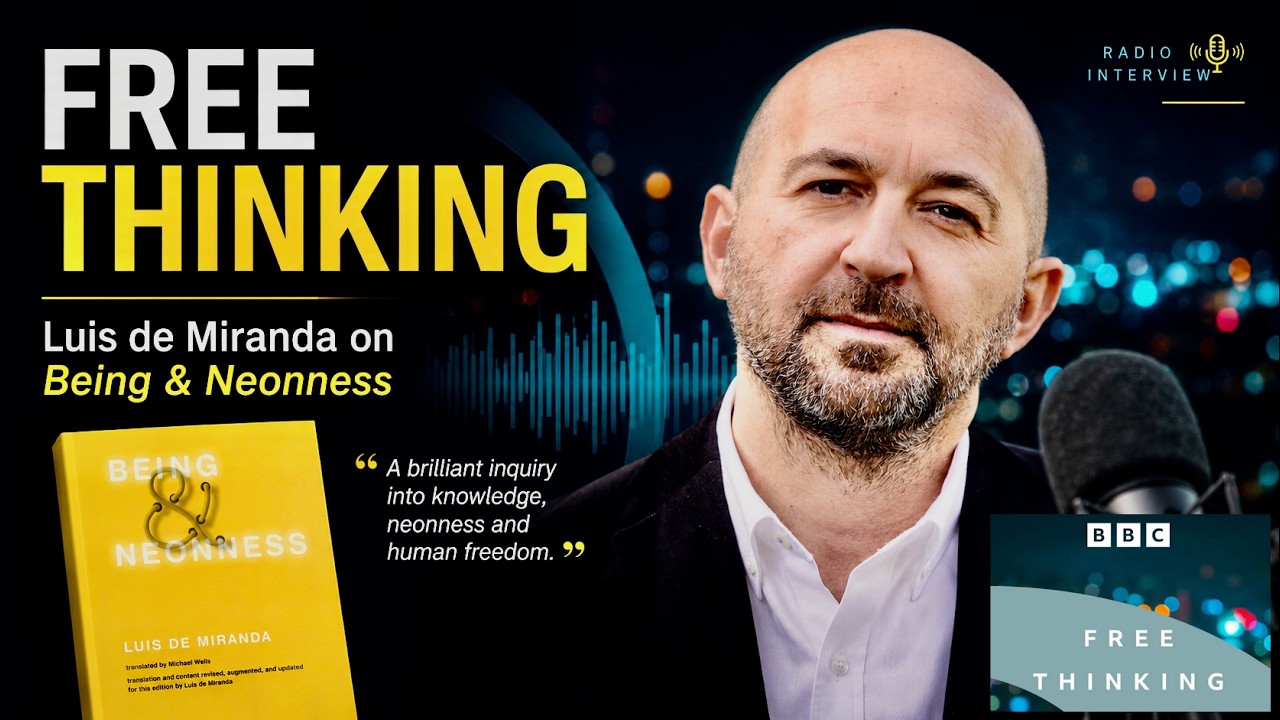
Video summary
In this engaging radio interview, philosopher Luis de Miranda introduces his concept of "neonness," a metaphorical framework that explores the tension between internal chaos and external order through the lens of neon signage. De Miranda traces the origins of this idea to Paris in 1912, suggesting that as individuals felt atomized within massive corporate structures during the early twentieth century, they sought identity by becoming like illuminated signs themselves. He defines a neon sign not merely as an object but as a crafted reality composed of two opposing elements: glass and gas. The solid glass represents the rigid shapes we impose on ourselves to function in society—acting simultaneously as a prison and a means of existence—while the noble gas inside symbolizes the creative, uncontrollable chaos inherent within us that must be constrained to communicate with the world.
The conversation delves into how neon has evolved from a luxury item decorating Parisian operas to a global symbol associated with American capitalism and later adopted by various regimes for their own purposes, such as the Soviet "neonization" program in Poland. De Miranda highlights the inherent contradiction of neon: it is fragile gas trapped within durable glass, mirroring the human struggle between our rich inner plurality and the simplified identities we present to survive socially. He notes that while traditional neon signs have largely been replaced by discrete LED lights which resemble isolated points rather than continuous lines, this shift reflects a changing reality where digital fragmentation dominates. Despite its current status as an object of nostalgia for lost urban poetry, de Miranda argues that neon retains its progressive potential because it can still be "exploded" to liberate the gas and reshape our understanding of identity without imposed constraints.
Ultimately, de Miranda concludes that we should not mourn the disappearance of traditional neon technology but rather appreciate its explosive possibilities as a catalyst for thought about our place in the cosmos. He suggests that while light has always been an obsession driving avant-garde art and thinking from futurists to contemporary designers, future forms of illumination will continue to reflect human desires even if they shift focus toward other senses like touch or sound. The interview ends with a hopeful perspective that neon serves as an aid to stimulate critical reflection rather than just decoration, inviting us to enjoy the transformative potential of freeing ourselves from rigid shapes and embracing a more fluid negotiation between our inner realities and the world around us.
Read the full video transcript
Neon, one of the noble gases harnessed
since the 1910s to burn messages into
the urban night, bringing us the word
Shinszano, Grand Pal, Guinness is good
for you, and in the work of Tracy Emmen,
never again, trust yourself. And is anal
sex legal? Little throwback to our
previous discussion there. The
philosopher Lewis de Miranda is the
inventor of the concept of Creel, a
negotiation between the real and the
created, which he suggests might provide
us with a way of thinking about our
place in the cosmos. He admits it sounds
a bit newagy, but his new book is about
neon and how that technology might also
provide us with a way to look at the
universe. You are going to be gentle
with us, Lewis. I sense that we may get
into quite esoteric territory here and I
want to be sure I can come at least some
of the way with you. I can be gentle if
you promise to be gentle.
>> So, we're in Paris 1912 looking at the
first neon sign. What in the world is
different at this moment?
>> I think we entering a century as we saw
a little bit before where people are
going to try to find a place in this
sort of massive
fight, massive competition, massive
corporate world where people feel like a
little bit like soldiers. they are
atomized. There is much less sense of
community than before. So one of the
solutions to that is to become a neon
sign. What does that mean? Right?
>> What does that mean?
>> This is what I call neoness. And I use
the neon as a metaphor for the 20th
century.
What is a neon is made of glass
and gas. And these two realities very
physical realities they are quite
opposite right. So as you said gas no
neon is a noble gas and that for me
symbolizes the creative chaos and indeed
it is an element that is chaotic itself.
It's very hard to control but then
suddenly you put it in a in a glass and
you give it a a definite shape which is
often a slogan etc. And that is I think
what people have been trying to do all
around the century, right? To sort of
constrain their the plurality that they
feel inside themselves into a function,
a shape that becomes both a prison and a
way of being in the world. And how were
these thoughts triggered in you? Was
there a moment when you were looking at
a a sign and uh and saw that this was a
kind of a metaphor for how we might
conduct ourselves in the world or for
the the experience of the last century?
Yes, it was in 2011
in the winter in Paris. I was feeling
quite lonely walking around the Louv,
the really old part of Paris, right? You
have the Punaf, which is actually uh the
oldest bridge in Paris. And then
suddenly there was this kebab shop with
this neon that sort of symbolized and
summarized globalization in just a few
words. A crepe, kebab, pizza, tea, cake.
And I stopped and I immediately this p
came to my mind in French
which of course refers to Sarter's book,
right?
>> Jean Paul.
>> Yeah. And then of course I didn't think
it would be serious to write a book
about neon. And I went on with my other
projects which one could wonder if they
are more serious than this one. But
slowly I did the research and in fact I
was invaded by this uh image by this
reality by this object a little bit like
when Haidiger observed the Van Go shoes
from all perspectives. This is what I
did with neon and I discovered amazing
uh things. So of course there are
historical things. For example, neon
started as a luxury object. It decorated
the opera in Paris.
But there is also this idea that in fact
it is a crafted object. You cannot
massproduce it. So it occupies this.
>> It has to be blown by an individual.
>> Exactly. and and it's it's it's a very
uh careful craft that is today practiced
only by a few.
So neon occupies this sort of position
between the old world right it its name
it's very mysterious right it means neo
in Greek the novelty and the promise
Budriar called it the promise of this
rivers of plenty that would uh come
forever with uh the expansion of
capitalism. It's always been a trigger
from from its beginning for for
avantguard thinking and avantguard art.
Why did it appeal to those moderns? What
did they see in it? Artists like uh uh
Maholina and uh all sorts of thinkers
have have engaged with neon
>> and the futurists uh we we usually
forget that the futurists a few months
after the first barberh shop was
illuminated by neon in Paris, they
decided to make an exhibition in Paris
where with their names as neon signs. So
I think it fascinates precisely because
it is a it is like us a contradiction
contradiction between a richness that we
feel inside that needs to be expressed
in many ways and the fact that when we
go in the world when we look for a job
when we look for a place in this society
we need to uh minimize
uh who we are and present a certain
identity. We've seen in the previous
section how uh difficult it can be uh
for someone when those norms, those uh
identities are not yet recognized. Does
neon make the world less solid, the city
less solid? Because it represents the
urban. It's part of the materiality of
the city and yet it is a it is a gas and
and it's something very fragile.
I think that's the the paradox today is
that it has become almost an object of
nostalgia,
a reference to uh all sorts of poetic uh
dembulations that represent something
lost already. Right? Today it is
replaced by LED lights which are
themselves much more discrete. If you
look them very close, you realize that
they're points like our reality today. I
was at the airport a few hours ago and I
saw this publicity for a bank and
basically
it said we are preparing a future of
bites and boxes.
And I think that was not ironical.
That's the future we are preparing
today. Even with the way we illuminate
our realities,
>> how does the meaning of neon shift as it
migrates around the world? It begins in
Paris. It's it begins as a kind of
European expression, becomes very
closely associated with America and
American capitalism, but also the uh the
Soviet block um tries to kind of rework
it to its own ends. What happened there?
Yes, there was a program called
neonization
uh where
>> like electrification the great Leninist
plan.
>> Yes. And the problem was that of course
we wanted to have neons for example uh
in in var the the capital of Poland. Uh
but there were not enough shops in the
in the that regime. So they started
putting neons uh as uh to indicate that
there was a public library for example
which in in fact was a return to the
origins uh of neon. Uh today we see a
comeback of neon in for example the
facade of theaters right I saw one uh
one or two years ago the kou frances
right the the the center for uh the
prestige of French theater in the last
500
>> royal court theater in London is still
proudly burning its red neon over slain
square
>> but that was a red neon k frances uh in
the middle of the pale royale and that
brought an ironical sense to it when you
look at French politics today. So can
neon if neon was identified with
progress now it's become a kind of locus
of nostalgia can it regain that uh that
energy can it be progressive again or is
it always now an object of nostalgic
contemplation
>> well no I think that um neon carries uh
a promise with it because we can always
explode the glasses and and free the
gases and perhaps
develop a form of shaping that is not
imposed on us but that we contribute to
together. Uh but in a sense I think that
neon whether it's coming back or whether
it's uh an object of the past
um is replaced by other types of uh
lightning that still reflect our
obsession with light which we had before
neon and which we will have after neon.
and as opposed to perhaps a care for
other senses which is what I develop in
the book listening touching and perhaps
senses that we are not aware of so neon
should be an aid to stimulate thought
then we shouldn't mourn the
disappearance of neon but we should we
should enjoy something about its
explosive possibilities
that's a good way to put it
>> thank you very much Louis de Miranda
whose being and neoness is out now
that's where I turn the lights out here
Let me thank our guests Lewis de Miranda