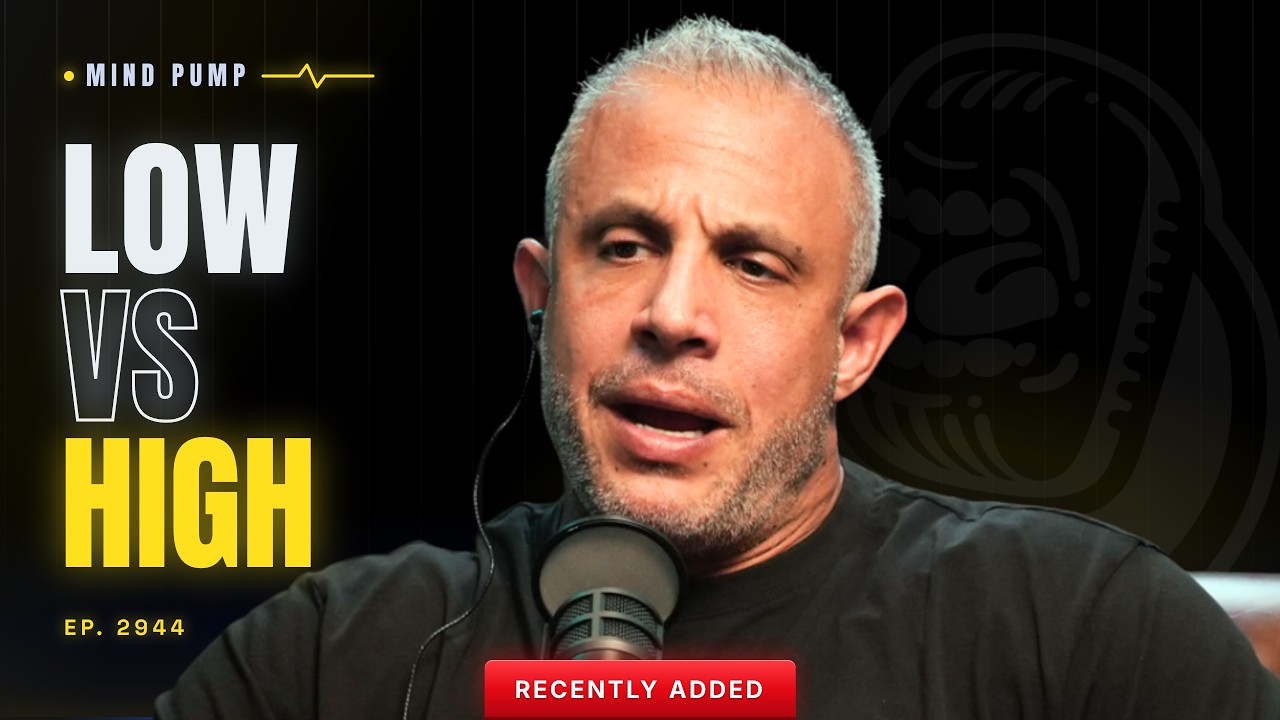
Low Reps vs. High Reps, Which Actually Builds More Muscle? (It Surprised Us) | Mind Pump 2944
Watch on YouTubeVideo summary
The video explores the long-standing debate between low-rep and high-rep training, concluding that both methods are equally effective for building muscle when intensity is controlled by proximity to failure. While low repetitions prioritize maximal strength and result in less systemic fatigue and joint damage, making them easier to recover from, high repetitions build strength endurance but impose greater metabolic stress on the body. The hosts advise against mixing rep ranges within a single workout session, as this hinders technique mastery and makes it difficult to gauge progress; instead, they recommend focusing on one specific range for a phase of three to four weeks before switching. This approach ensures that athletes can fully master the physiological demands of each style without compromising recovery or learning curves.
Beyond the core training debate, the discussion covers various lifestyle topics ranging from marine biology to parenting challenges and current events. The hosts share anecdotes about sea otters, noting the size difference between river and ocean species, while also addressing the complexities of teaching children about privacy and appropriate physical boundaries in public spaces. They further examine a controversial news story involving shop owners in Florida who detained burglars without police assistance, debating the legal and ethical implications of such vigilante actions. Additionally, the conversation touches on immunity stacks used to prevent illness, the nuances of homeschooling versus public education, and the importance of community support for mental well-being, suggesting that joining groups like a church can be crucial for emotional health.
For athletes, particularly young wrestlers, the focus shifts to building foundational strength and resilience during the off-season to manage in-season stress without compromising performance or health. Key exercises include squats, deadlifts, overhead presses, and split-stance movements designed to simulate single-leg takedowns, with a strict emphasis on perfect technique over heavy loads; if form breaks down, the weight must be reduced or the exercise modified rather than forced. The hosts strongly advise against excessive weight cutting for teenage athletes, warning that it can lead to body dysmorphia, amenorrhea, and hindered strength gains, suggesting instead that athletes build muscle in a higher weight class. For older populations or those with injuries, regressions such as using bench pads for sit-to-stand motions or aquatic workouts are recommended to maintain consistency and longevity without risking further damage.
Ultimately, the video emphasizes that exercise and nutrition should serve as tools to improve mental health rather than sources of anxiety, urging listeners to abandon obsessive goals like specific weight loss targets in favor of finding joy in movement and eating whole foods. For individuals struggling with conditions like PTSD or depression, an overly controlling approach to diet and fitness can worsen symptoms, so the hosts recommend short, consistent daily workouts that provide immediate feelings of energy and pride rather than infrequent, grueling sessions. The overarching message is that consistency, community, and a love for the process trump perfection; by focusing on micro-goals for specific movements while maintaining long-term macro goals, athletes can sustain their progress without burning out. This philosophy extends to all aspects of life, where the best strategy often involves doing the opposite of what one thinks is necessary, as illustrated by the example of an athlete who grew significantly after incorporating high-rep training into their routine.
Read the full video transcript
All right, you're strength training.
You're lifting weights because you want
to build muscle. You want to sculpt your
body. You want to boost your metabolism.
But what's better, low reps or high
reps? Are there advantages to one versus
the other? Disadvantages. Which one
should you train in for your goals?
We're going to break it down right now
based on the data and our experience.
Here we go. Low reps, high reps. This is
the challenge.
>> Low reps.
>> Fight.
>> Done. [laughter]
>> That's the end of the episode.
>> High reps. This was a uh this is always
this was a debate for a while.
>> The one you're the one you're not doing.
>> Yeah. Well, we're going to get to that.
We're going to get to that. But um this
they are different. So, here's the deal.
There's two schools of thought. Uh one
school of thought says uh this is a
better rep range versus the other one.
You know, pick your choice. Then there's
another school of thought that says
doesn't really matter just as long as
you mix them up. They're both the same.
Both of them are incorrect. Uh they do
both have value. They do both um provide
results, but they're also both
different. They also do different things
to the body mostly um when it comes to
performance.
>> But I'll even argue and and this is
completely anecdote. Uh I'll even argue
it does create maybe a different look in
the body. This is pure speculation.
Bodybuilders have talked about this for
a long time. I think I've noticed this
as well. Uh but I think the important
thing to start with is uh and the data
shows this clearly they both build
muscle. Like you want to build muscle,
low reps, high reps at the end of the
>> day that's what matters.
>> They both build muscle.
>> So somebody who's contemplating this or
having this discussion, what do you
think is the biggest or the biggest
mistakes that are made?
>> Yeah, good question. I think one of the
big mistakes is people navigate to the
one that they uh like to do better. Thus
>> that's what comes to my mind.
>> Yeah. unless they completely ignore the
potential value of the other one. U I
would say that's probably the biggest
mistake cuz some people are afraid to go
low reps. Uh and other people
>> the focus might be wrong too going into
that rep range. Yeah. Especially I know
when you're kind of jumping into the low
rep range. It really complete different
focusing gear.
>> So I I literally think you fall into one
or two categories. You either um are
married to one because you love it. you
identify more with a powerlifter so you
look like a power lifter all the time or
>> you love the high rep super set low rest
period type of stuff because you you
identify with that or like the circuit
training. These are the two that I feel
like you you either fall into. These
people will gravitate toward those trap.
And then the other person, who was I
thinking of the other person? The other
person is somebody who um is like me
when I first started where I'm like
mixing every workout. Like I had this
idea muscle. Oh yeah. I know the
benefits of [clears throat] all the rep
ranges. So every workout included kind
of all that. One one exercise I'd have
short rest periods. Another exercise I
have long rest periods. high reps, low
reps, superset some stuff. And so I
really feel like you're one of those two
categories that you kind of fall in fall
into. Um very I feel few people unless
you're following somebody's written
program that's mapped this out for you.
>> Ours will have that.
>> Yeah. Follow something like that. I
think if you're doing it yourself, you
tend to gravitate toward
>> Yeah. So, so in the past, um, the
observation among strength athletes was
that low reps built the most muscle. So,
bodybuilders used to say this. They used
to say if you want to build mass, this
was the terminology they used, then you
go really heavy and low reps. Um, and
the data, early data showed this as
well. So, early data actually showed
that heavy weight, low reps was better
uh or built more muscle. Now, what they
didn't necessarily control for was
intensity. So, when you control for
intensity, in other words, if we do a
set of 15 reps, which would be
considered high reps, or a set of five,
which would be considered low reps, so
long as they're within the same reps and
reserve, uh, then they're both going to
build the same muscle. In other words,
uh, you want to pick a weight that you
could do maybe 17 reps with, which is
the most you could do with that weight.
Like, you'll go to failure, you stop at
15, so you leave two reps in the tank.
>> Same thing with the five rep set.
Something you could do seven reps with,
but you stop at five. Here's why
bodybuilders for so long said that low
reps built the most muscle. It's because
higher reps, it's harder to reach that
that point of two reps in in reserve
because sometimes stamina gets in the
way. So, when I'm doing a set of 15 and
I'm trying to get close to failure, two
reps short of it, is it the muscle
strength that's failing or is the fact
that I'm gassed out?
>> Yeah. And so this is what bodybuilders
noticed in the past, especially bigger
bodybuilders who, you know, when they're
moving that much muscle, this was
actually a stronger.
>> Anybody who's anybody who's experienced
uh high rep squats understands this
[laughter]
because that's typically uh you know,
give me an isolation exercise and it's
very easy to take the muscle to failure
regardless of the rep range. Like it's
it doesn't take as much gas and stamina.
But ask me to do, you know, 20 reps of
squats to failure. And I'll tell you
right now, the weight I have to choose
is not the limiting factor on my
muscles. It's my my Yeah. my stamina, my
my cardio
>> to do, you know, 20 reps of any weight
is I'll get gassed. And so typically
what will make me choose a weight, it's
like I have to do a weight that's so
light that I could really easily move
through 20, but my it's not my legs that
have given out by that.
>> Totally.
We also have a new program and it's 40%
off and we're going to throw in some
free maps programs and some free guides.
You ready? Maps, abs, and butt. You want
nice abs, you want a nice butt, this is
the program for you and it's 40% off and
we're going give you another free maps
program. Muscle mommy or muscle mommy
15. Go to mapsabsandbutt.com. Use the
code launch. Get the discount and the
free stuff. All right, real quick. If
you love us like we love you, why not
show it by rocking one of our shirts,
hats, mugs, or training gear over at
mypumpstore.com. I'm talking right now.
Hit pause. Head on over to
mypumpstore.com. That's it. Enjoy the
rest of the show.
Now, there are like actual differences
between them. And the main ones, the big
glaring differences between them is the
strength that you gain in each of those
rep ranges is pretty specific to the way
that you train. In other words, if I'm
focused on low reps, I build maximal
strength better. Okay? So, my strength
is going to reflect the way that I
train. I can lift something really heavy
for a few reps. This is why powerlifters
train this way. It's why powerliffters
don't train high reps. Even though they
build build muscle, powerlifter goes in
competition trying to lift as much
weight as they can for one rep.
>> So, they're going to train in this
particular way. Well, what does higher
reps do then? Well, it builds more
strength endurance. So, still strength,
but you have more strength endurance,
which is still uh in the strength
category. So, we're not talking about
like the cardio endurance necessarily,
but it does build more strength
endurance than maximal strength uh like
the low reps. This is something too like
I and I tend to lean more towards the
low reps that if I get into the higher
reps like especially grip uh so
everybody likes the pump but for me it
was always like a bit of a detriment to
where you know I would hit a certain
point where I would I'm gripping and I'm
doing low reps but fatigue was was
definitely a limiting factor and I would
you know inevitably my grip would fail
and so to to work on that and then
really like work my way through the pump
and work through that endurance of it
really helped a lot.
>> Yeah. Here's another thing, too, that um
a lot of people don't realize until they
start training both in phases. Uh low
reps are easier to recover from. They
just are. It's just not as much damage
on the body. Uh and that's because the
formula for volume is sets times reps
times weight. So, although you're
lifting more weight, the reps you're
doing are so low, the damage isn't as
much. And look, we know this. I could do
a really intense setting of barbell
squats for five reps. So, I can do three
sets of five reps, real intense, three
sets of 20 reps, real intense.
>> The 20 rep sets of squats are going to
fry me.
>> Even if I had the stamina to handle it,
they're just going to fry my body.
>> So, you funny like I agree on from a
muscle standpoint, from a joint and
ligament stand. I'm so glad you won.
>> The opposite is true for me. Totally.
>> So, uh like high reps, uh so much easier
for me to overreach and overtrain my
muscles. Yes.
uh low reps. If I lean in that direction
and you start getting joint problems,
>> then my my joints and ligaments starts.
Yes. That's where the aches and pains
come from. Where when I stay in the high
rep range, I don't tend to have that as
much. I tend to deal with more, but I'm
more likely to feel uh over, you know,
doms, right, kick in way more, right?
That kind of fatigue.
>> Yes.
>> Yeah. And I So, here's where we're going
with this. They're both so valuable uh
that you really should do uh both of
them. But here's what's important. This
is where I want to spend some time uh
communicating this. Earlier Adam said he
used to train in a way where he kind of
mixed everything up all the time. Um and
there's not ne nothing necessarily wrong
with that. But you're better off
focusing on one for a phase and then
moving to the other one for a phase.
Why? It's a totally different feel and
mentality.
>> Difficult to determine improvement too.
Yes. Uh you know it's like you become a
master of none at that point. like we're
not really being able to gauge like,
okay, well, am I, you know, am I gaining
more weight, you know, to this lift? Am
I improving repwise? Like, you don't
know. Well, that's where that I think
matters the most because is there
something wrong with say me training
that way right now? And I would say no,
there's nothing wrong with me training
that way so long as I don't have like
goals that I'm trying to achieve.
Meaning, I'm content with my fitness
level. I'm not really trying to get that
much stronger. I'm not trying to change
aesthetically because that's where the
programming really starts to to matter
and dictate. And so I always whenever
when someone tells me that they train
like that and they like they love that.
Oh, I just, you know, I mix it up and I
do all these things. It's like cool. If
you're happy with
>> stay in shape.
>> Yeah. If you if you're happy with your
fitness level, both aesthetically,
performance, everything like that, and
you enjoy that and you're like, go for
it. But if you tell me you have goals
and you're I'm trying to get stronger, I
want to lean lean down 5% body fat or I
want to build 5 lbs of muscle. Well,
then that's where that's not going to
serve you.
>> Yeah. So, what I So, you know, and I'm
going to speak from a trainer
perspective. Uh when I would train
clients, when we were doing low wraps,
uh the focus was on teaching them and
coaching them on how to feel the
movement or how to master the movement
and the technique and the skill of the
movement. I was not having my clients do
sets of five reps and telling them to
feel their pecs
>> or to feel their lats.
>> Totally different.
>> Uh or to feel their glutes. It was we're
going to have really good
biomechanically advantageous form. We're
going to maximize your technique and
your drive. And I really don't care
where you feel it. So long as we're
having good form, you're not hurting
yourself. Now, when I would go higher
reps, this is when I'd want them to feel
things like going higher reps on the
bench press with a client.
>> Really squeeze the muscles.
>> That's right. I'm like, "Here, this is
the movement in the pecs. Here's how I
want you to bring your elbows. I want
you to focus on feeling it in the pecs."
Or we're doing squats. Like, here's how
you squeeze your quads or let's say
Romanian deadlifts, you're going to feel
your hamstrings. So, it's it's a totally
different feel. Both of which need to be
trained. So, I, you know, I've been
working out long enough to when I know
when I'm going to go do a set of heavy
deadlifts or heavy squats or heavy bench
presses, I know I'm not trying to feel
the muscle. I I've done this long enough
where I know the mentality, the
technique, and the form, and how I'm
lifting the weight. When I'm going with
the higher reps, I also know it's a
completely different mentality. And if
I'm mixing them up all the time, every
week, which uh which a lot of people do,
they never really get good at either
one. Yeah. And from a performance
perspective, like just looking at it
like I would look at building a
developing a skill. I like fatigue is
your enemy. And so that's why too like
the low rep model u you know these are
really demanding like the compound list.
If I'm like focusing on just loading the
weight as much as my ability allows, uh
I don't want to involve fatigue by, you
know, before that I did this exercise
that now I have to carry in this muscle
fatigue that I have to account for. Uh
where, you know, I'm not building these
these perfect patterns u you know, where
I'm my body's responding the way I want
it to. I'm just kind of convoluting
everything. It's hard too to tell what
what's really working well for you,
what's works well for you because
there's there's we're all individuals,
right? And all of us have shared our own
personal attorneys of, you know, certain
rep ranges, certain exercises, certain
rest periods tend to lend themselves
well with that client. Like I've had
certain clients that just respond better
with
>> certain modalities. And if you're doing
what I was doing, which is kind of
throwing the whole kitchen sink at your
body all the time, it's hard to tease
out and be like, you know, what what's
working the best or at all.
>> Yeah. And that why is that important to
know? Well, I'll do more of what's
working the best, less of what's not
doing%.
>> Otherwise, you don't figure that out.
That's right.
>> One of the hacks that I had with
clients, and I'm just going to give it
general, right? This is very different
from person to person, [snorts]
>> but later in my career, I really figured
this out. And it was such a hack because
what it resulted in was clients that
were less fatigued that actually built
more muscle and got results, better
results. And here's what it looked like.
When I would first get a client, barring
any major issue, initially my goal was
to get them to do correctional exercise
so they can move properly. It's always
the initial goal. Then I tried to get
them to be able to perform these basic
compound lifts really well. Once they
felt comfortable with that, which could
take anywhere between a month to six
months or a year, okay, depending on the
person, once I got to that point, low
rep training with my clients almost
always worked better. Now, it doesn't
mean I stayed there all the time. I
would move them out and do different
things, but it just was less damaging
and demanding on their bodies. They
weren't so strong that we were, you
know, risking injury on their joints.
You know, this was like Mrs. Johnson
deadlifting 135. You know, Mr. Smith
who's pulling 225 off the floor. But
man, they would leave not feel fatigued,
build muscle, great. When I would have
them do the higher rep stuff, it was
like, man, you better have good sleep.
Your diet better be good, and it's going
to fatigue the crap out of you. And it
it just the cumulative stress on their
bodies was always harder to manage than
the lower rep stuff. So, a lot of my
clients, I train them like this, and I'd
move out of it to keep them, you know,
their bodies fresh, but this is where
they got the best result. This is why
MAPS anabolic started with phase one.
>> Yeah. And do you think that's because
it's sending a a louder signal with just
less volume or or just less stress
overall stress?
>> Oh yeah. Like you take somebody
>> cuz you're like when you to your point
like Miss Johnson
>> Yeah.
>> Um you know she does three sets of five
you know three sets of five on deadlifts
for 145 lbs 135 lbs whatever
>> versus her doing you know three sets of
15 at like 90s or 60s or something like
that. It's just she's going to get she's
going to get as much her she's telling
her body she needs as much if not more
muscle to move that really really heavy
weight than what she needs to move
>> and it's not it's not a bunch of
fatiguing
>> work when you know Mrs. Johnson, you
know, doesn't get the best sleep. She's
got a job. She's got to take care of her
kids. So, this was like a this was what
I played with quite a bit. In fact,
sometimes when my clients would come in
and they were really fatigued, we would
do sets of singles and doubles at a
moderate intensity. I would just have
them practice the lift. And it was
funny. I'd have to convince them in the
beginning cuz like, am I really doing
anything? Like, I feel like we're not
lifting much. And then they'd come back
the next week and we'd add 10 pounds to
the bar. And I'd say, "Look, you just
>> got stronger." And it just was less
damaging. Now, when my clients started
getting really strong, which I didn't
have a lot of clients that got to that
place, like Doug's a good example, he
started getting really, really strong.
Well, we got to, you know, we're not
going to play with the singles and
doubles all the time. He's pulling 400
lb at 165 lbs.
>> Yeah.
>> Now, we're looking at risk of injury.
So, now we're going to play with some
some other things. But just just
something to to consider. But I think
the important thing to understand with
this is uh do both. Do them in phases.
Stick to one for like three or four
weeks. Have fun with it.
learn how to train that way, then move
into the next one for, you know, 4
weeks. It's one of the best things you
could do to get perpetual progress.
>> Now, when somebody is looking for body
composition change, my favorite thing to
tell that person uh regarding this
conversation is the best thing you could
possibly do is the thing you're not
doing.
>> Of course. Y
>> like one of my go-to favorite moves with
a client who was looking for a aesthetic
change was asking them what do you
typically do?
>> Totally.
>> Then it doesn't matter what the answer
is whether if it's you five by five for
three years.
>> Yeah. Five by five. There's awesome.
We're doing high reps. We're super set.
>> Change will change.
>> Yeah. And then and and that with the
with proper eating uh would send this
awesome novel stimulus to the body that
would would induce muscle.
>> Good example of that is stand efforting.
So Stan Effording, a bodybuilder,
powerlifter, at one point he was known
as the strongest bodybuilder that there
was. Um, and even though the guy could
squat, 700 lb, when you see him on
stage, his legs seemed to be lagging a
little bit. And so he started training
with Flex Wheeler, who would, you know,
was a very a top bodybuilder in the 90s
and Flex Wheeler had him doing high rep
leg exercises, 15, 20 reps. And Stan was
like, man, it was so hard and I never
trained that way. But his legs he gained
like two inches blew up around his quads
from training that why his body was so
used to because he was a powerlifter so
used to training in that way
>> that when he moved the higher reps boom
>> he got more muscle. So that novelty
effect I think is uh an important thing
to communicate. Uh I'm going to uh
switch gears and talk a little bit about
a peptide that I just started using that
I've used in the past. It's um it's a
mitochondria
uh peptide. In other words, it helps the
mitochondria function better. So, I've
talked about MC before, which I always
love.
>> This one Justin loves too right now.
>> Yeah. Anytime I've used Mati, I get more
energy. I feel better. I get a little
leaner from it. Not a lot, but I
definitely notice I get a little leaner.
There's another peptide in this category
that works differently called SS31.
SS31 operates uh differently than Matzi.
So, it's totally different. Started
SS31. I think I love it.
>> Really?
>> Yeah, dude. I think I really like it
>> more than matsi or like a similar effect
>> similar similar with the energy the
clarity the kind of good mood
>> uh you know your mitochondria is
operating well it's like every cell uh
has more energy um so yeah it's a it's a
pretty good one and you can get it for a
second there you weren't able to get it
but now you can
>> what mechanistically are they doing the
same thing they doing something
different
>> different to the mitochondria so um so
SS31 I'm reading off the screen here it
targets the inner mitochondrial membrane
brain to repair cellular energy
production and reduce oxidative stress.
It's uh so it helps the mitochondria
operate better. If you look up MOT C,
>> I feel like you said that's like the
same thing, doesn't it? No, it's
different.
>> So, this targets the inner membrane of
the mitochondria to do what it does. M C
uh it regulates cellular metabolism,
insulin sensitivity, and energy
homeostasis. But how does it work? It
activates
pathway, which acts as a cell's master
energy regulator. Um, here's what a lot
of people do with the mitochondria ones
is they'll go one and then they'll do
the other one.
>> So, they'll do like a cycle of one, a
cycle of another one. And what's cool
about these
>> cycle off and then Yeah.
>> Well, what's cool about them is uh once
it kind of repairs what it needs to do,
it's not like you got to stay on it
>> then you're good. So, it's like one of
those ones you could do like once
>> I mean a year. Again, we don't like to
do this, but I know in combination with
red light therapy like it's like
supercharge it, right? Well, especially
with the mitochondrial peptides. Yeah.
It's It enhances.
>> Yeah. Um, and our partners at np
hormones.com, they they're able to offer
every peptide that is available from a
FDA compounded uh pharmacy. So, it's
like all the good ones.
>> Speaking of that, is BBC uh available,
not available? Okay, it is back, right?
>> Yeah. BPC157 is available again. So, you
can get them uh get it off there. And
you're I want to ask you Adam, you're
micro doing
>> I have been now for um
>> So you're taking like 1/5if of a normal
dose of a starting dose.
>> Yeah. So I started I started off at five
units. Um and then I went to 10 units.
Actually I started off they they started
me off at 1.25 or 15 or I mean excuse me
12.5 or 15 units. I always it's I'm
looking I'm thinking about this the
needle. It's at one right. Um
>> so they started me off a little bit
higher. It was too much. I noticed it it
it suppressed my appetite
>> because you're not trying to take it for
>> no bunch of weight loss.
>> No, I I really wanted to use it. I told
you guys that when uh you know, although
I I went the first time I did all this
the I had all the terrible side effects
of losing tons of muscle and I wanted to
see what that all felt like by, you
know, treating it like a client would
treat it. It was all experimental for
me. Uh not trying to like utilize it to
its, you know, maxing it out counter it
with all your tech.
>> Yeah. Exactly. Now, and but what I did
notice during that process was, man, my
psoriasis was really good. Now, uh was
it good based off of what some of these
uh you know, practitioners are talking
about because they think that there's
some sort of
>> or just that you're a little bit low
calorie
>> or is it just cuz I'm super low calorie?
Um I wasn't sure. So, I wanted to test
that and I was like, "Okay, well, what
if I took a dose that's low enough um
that I get some of the uh inflammation
benefits from it, but not so low that I
can't eat the what I need? so high that
it messes up your
>> Yeah. Yeah. Yeah. Yes. So, I had I I've
been floating around trying to figure
out what that number was. It seems that
it's somewhere between the, you know,
five units to 10 units.
>> Um, which you're is like what you said
like a half or less than a half of a
starting dose
>> and it is like perfect. I can I feel the
inflammation. I can tell it slows down
motility. uh which has this
psychological side of it too for me
which is I because it slows down
motility it has changed a lot of uh
night eating behaviors that I've had for
a long time.
>> Oh, you're going to feel like you have a
brick if you eat too much and then start
sleeping.
>> Yes. And it it's it only took me a
couple times of testing that to go like
I don't like that at all. And so uh
there's been just happened last night
where um I I had a good lifting session.
I could tell that I was still hungry and
my body was wanting to build uh and eat
more. And so, you know, that's normally
what I'd be like, "Oh, I I lifted. I
moved a lot. I'm I'm lean right now. I
could afford
>> some ice cream or I could afford some
high calorie meal." But I know like, oh,
like that late at night and something
that doesn't easily digest. So, what I
go get rice and ground beef.
>> Oh, yeah.
>> You know, just a nor another I had a
reheated one of the meals that I
>> It's like another plus side. It makes
you want to eat better.
>> Yes. So, uh, and so I'm not sure if it
there's something happening with the
GLP1 that is impacting my psoriasis and
inflammation as much or is it curbing
some uh these negative behaviors that
I've had before. All I know is I 100% am
the inflammation is down big time. I can
feel it in my hands and joints. I can
see it in my face and I'm holding weight
like I'm not
>> psoriasis. You can tell.
>> Oh yeah. Oh yeah.
>> Yeah. you know. Uh so these are this is
all so we have friends that um work in
the space that are doctors that
prescribe it uh lead researchers.
Um so that there are studies that are
going on now examining the um the
anti-inflammatory
and autoimmune
uh protecting effects of GLPS. Okay. So,
because there's been so much anecdote
where people are like, "Man, this
autoimmune issue that I have, I mean,
yeah, I'm on a GLP. I'm losing weight,
but this autoimmune issue seems a lot
better or I have these lower
inflammatory markers." And it was hard
to separate like, "Well, is it the
>> Yeah.
>> GLP, or is it because you're you're
eating less cuz eating a lot of garbage
will do that too, right? Will make your
inflammation go up
>> off, but there are a lot of
practitioners who've been using off
label essentially these compounded just
like from our partners at mpormones.com,
right? you get compounded um you know
GLP so it's not a pre-loaded pen which
means you can use a tiny dose you can do
large dose a lot of these practitioners
are I'm talking to and they're like I
use them for clients all the time that
way like they don't need to lose weight
yeah
>> but they have you know this particular
autoimmune issue we micro dose it and
it's a lot better first person I heard
talk about that was Dr. Ina when we
remember when she said that she uses it
a lot like that, you know, [snorts] I I
I have the same skepticism around it.
Like which one is it that's helping me?
>> The thing that I find interesting is
that if it's if it was from low calorie,
I would think I would be losing weight,
>> but I'm holding.
>> So it's not so low that you'd lose.
>> Exactly. So it's not so low of calorie
that for sure was probably a factor. I
feel like when I took it the first time,
it crushed appetite and I was cutting. I
mean, I lost 20 plus pounds like quick.
>> Um, but I'm I'm holding about the same
amount. I I I felt like uh my body
released about 3 to four pounds of
water. The initially the inflammation
that I joke about in my face and in my
joints, I felt like I that went and then
I've just held right there. I mean, I'm
just holding it 216 to 218.
>> You guys should see the studies that are
that are being conducted on them right
now. It's wild. They're studying them
for autoimmune issues. They're studying
them for addiction.
>> Addiction. Yeah. That is going to be
that is crazy because a lot of people
are reporting and we don't have any
studies yet that show
>> that it does this. But this is a lot of
anecdote and the studies are going on
right now as we speak. So, who knows?
The jury's out. But personally, I've
heard again these practitioners report
back that their patients are coming back
and saying, "You know what's weird? I
know I'm taking this for weight loss,
but I don't want to smoke anymore."
>> Yeah.
>> Or I don't want to drink alcohol
anymore, or I don't want to gamble.
>> The impulse is gone,
>> bro. I got a buddy. I got a buddy who
has a friend, a close friend of his who
was who took it for gambling because he
had a gambling issue.
>> Wow.
>> And I'm like, did he notice that he
wants to gamble less? And he goes, yeah,
>> I I don't know. So, it's it's acting
definitely acting on the reward centers
of the brain.
>> Theoretically, could it affect these
things uh in any way? Yeah,
theoretically it could.
>> So, really weird. It
>> is weird.
>> I mean, here's the deal. uh for the
weight loss effects alone, I predict 2/3
or 3/4 of the American population will
be on them at some point. You throw in
addict addiction
uh you know uh positives
addiction and how many people suffer
from autoimmune.
>> A lot.
>> Yeah.
>> A ton.
>> Yeah. So I know. Yeah. No, I I'm I'm
pretty fascinated with it. I'm I'm well
over a month now. I want to say I'm like
I got to I'll look back and see exactly
where I'm at um and when I I start doing
it. But it's been a while now. I'm I'm
at least six plus weeks, I think, into
into it. And uh I got nothing but
positive things.
>> Speaking of medications and stuff, did
you guys see this drug? I don't know if
it got passed yet. I want to see if it
passed um uh the FDA trials, but there's
this drug
uh that uh cuts CPAT. So, it cuts sleep
apnea. So, sleepnapia sucks. If you have
it, you have to wear a CPAT machine.
um 44%
it cuts these sleeping events or these
breathing events I should say by 44%.
It's a pill.
>> Interesting. A pill.
>> It's a pill. So why? Because it treats
the neuromuscular
dysfunction that can that can cause
snoring.
>> Really?
>> Yes. So snoring often times like oh
you're heavy. That's part of it. Your
tongue grows side effects.
>> Okay. Well that's Well, I don't know.
>> We [laughter] don't need to go there
yet.
>> Like oo.
>> Yeah. Yeah. We don't need to go there
yet. But but we do know that there's
some kind of neuromuscular dysfunction
that happens with some people cuz some
people have sleep have um sleep apnea
that are not overweight. They just have
it uh for you're overweight. [laughter]
>> Such a dick.
>> You have your big old neck, dude.
[laughter]
>> Damn. Damn. Shots fired.
>> It's all right. I'm the one that wears a
CPAP in here. Uh but
>> calm down, beak.
>> But did [laughter] you guys
dang, bro? All right. I'm just
>> Did you guys Okay, so let me ask you
guys this. Do you guys notice that uh
like you don't ne you don't have um
sleep apnnea, but do you snore if you
drink?
>> Oh yeah.
>> Yeah.
>> Or I'm really tired if I'm really
exhausted or something like that. So I I
periodically will. Um I always have to
ask Katrina cuz I don't know when I do
and she never complains or something
about it.
>> A lot of people will say they don't
normally snore but if they drink they'll
snore.
>> It's a neuromuscular issue that's
happening. You know what else can can
contribute to snoring? This is a
anecdote. There's a lot of them.
>> Uh gluten for some people. H.
>> So people with gluten intolerances uh
will snore more when they have gluten.
>> That's interesting.
>> So because it affects their CNS,
>> huh?
>> So now side effects of this pill, who
knows?
>> Yeah, that's I mean
>> fixes
anal leakage and [laughter] other things
that come with it like
>> bleeding.
Dude, those those
>> I don't snore anymore, but I
>> those funny commercials, you know, of
all the drugs that may cause
>> you get the micro machine guy at the end
to wrap up all the stuff.
>> Cool. My rash is gone, but I got 10 of
these other things.
>> But I have erectile dysfunction.
[laughter]
>> More women want to talk to me, but I
can't do anything about it.
>> Oh my god. Do you guys know what a mkin
is? I have about this. That sounds so
>> Doesn't that sound like from the movie
Trolls? Is that what that is?
>> No.
>> The bad guys. I've heard this. Okay, so
I What brings this up was because like
>> honest it was like a um Can we guess?
Courtney was talking to one of her
friends is like hair stylist and they're
joking because like they're talking
about wigs and stuff and all this
>> and it comes up. She's like, "Do you
know what a merkin?" I'm like, "No,
>> it's a wig."
>> No.
>> For your pubes.
>> I know that's what it is. That's what it
is. I was like, I know. I've heard this
before.
>> It's not just like a new thing.
>> It's supposed to be It's supposed to be
like stick out of your out of your uh
>> It's like a [laughter]
It goes through there and it's like a
little beard, you know, for it.
>> How do you keep it on? Well, and two
people like so so actors and actresses
like they do this for like sex scenes
too and they put that on to kind of
cover up.
>> Okay. So no normal person is like but
yes
>> why
>> I don't know.
>> I didn't know that was like a desirable
thing.
>> Yeah. I mean guys wear muscle shirts
now. You know
>> why [laughter] would But I don't I I to
my knowledge.
>> I didn't know I have I did not know that
women are like yeah you know he's cool.
>> Come on Doug. Pull it up for my search
for delaying over here. He just doesn't
want to pull it up. I'm like I really
don't want to pull it up. I don't think
that's a thing. Is it? Is that a thing
where you're like you're insecure cuz
you don't have enough?
>> Well, cuz back in the day, again, this
is like the syphilis.
>> Mkin trends.
>> Yeah. Like
>> Yeah. Big experience. Resurgence in
popularity through high fashion pop
culture.
>> High fashion. There you go. You guys are
I thought you were the fashion guy.
Yeah. No, I'm not claiming that.
[laughter]
>> Wait a minute. Public figures like Do
Cat and Julia Fox, I don't know who they
are, but they're famous
>> rappers. Oh, yeah.
>> They bring back the 1970s full bush
aesthetic. So, what I don't understand
is why not grow it themselves.
>> Yeah. Why don't I just grow it?
>> Maybe I don't know.
>> Maybe they maybe they went too hard and
then lasered it at some point. Now
they're like, "Oh, no." Yeah, they
probably lasered it off, dude.
>> Dude, what the
>> Yeah, why not? Why not? Why not?
>> Listen, I'm Listen, I'm I'm
>> back to the
>> I don't think there's a single Sicilian
that needs to wear Mkin. It's like
[laughter]
we're fine. We don't need those bad
boys. I just thought it was fun. It's
like, of course, you know, they make
wigs, but I'm like, I didn't know they
made wigs for that.
>> Ew. Dating back to the 14 and 1500s,
they were originally used historically
by sex workers to mask the physical
effects of SEXUALLY TRANSMITTED
INFECTION.
>> JUST HIDE IT.
>> You got a bunch of crabs.
>> You know, it's funny when you see like
these new people that do it as a trend
right now, they don't know the origin of
it. [laughter]
>> You know what I'm saying?
>> Hey, why you wearing that? What's going
on? So, you must tape it on. It's got to
have like sticky tape on it.
>> Yeah. Or it's
>> or just sitting in the underwear.
>> See, you know, we should probably just
sit It's probably just sitting in
>> You know what we should do? We should
buy them
>> like a Velcro.
>> We should buy them in a different in a
different hair color and see for
whatever. [laughter]
>> I'll wear a red one.
>> I just don't I just don't get why not
just grow it out.
>> Find me an an Irish mkin, please.
[laughter]
>> Does the carpet mash the drapes? You
know, it's kind of a thing.
>> Wow, bro. You could also wear that as a
goatee, though, by the way. So, if you
>> Yeah. Yeah. the murking [laughter]
>> downstairs or upstairs. It's
>> just don't switch them up when it's
versatile.
>> Just don't put the wrong lens in
[laughter] the wrong place.
>> Yeah.
>> Hey, you like my new beard? It's like
that's my
>> itchy. I don't like it.
>> Oh, gross.
>> Oh my goodness. [snorts] I thought that
was interesting.
>> All right. This total good segue because
now I want everything filtered. Uh, did
you guys read the story, the study on
HEPA air filters?
>> Did you guys read this? Have you been
seen this, Doug? I'm surprised you
haven't.
>> What are air filters? So, air filters
that use a HEPA um uh like purifier. So,
this is like one of the best um like air
filters to clean out the air. So, we
have uh the big one in here, the ones we
have in our homes, cuz we all have the
same ones.
>> They are very very good at at purifying
the air. These help
>> micro level. Yeah.
>> Check this out. Trip off this.
>> This was a study. Adults aged 40 and
older performed 12% faster on a test of
executive function after using a HEPA
air filter in their home for one month.
>> Wow.
>> 30 days.
>> Wow. 30 days.
>> Isn't that wild?
>> Jeez.
>> Imagine what could possibly like what we
would need for a year.
>> Dust and
>> Yeah. The particulate matter for the
air. And by the way, microplastics.
>> Microplastics.
>> There's a lot of them we breathe in.
>> Jeez.
>> Isn't that crazy?
>> Wow. Do you know that in some cases
indoor air pollution is worse than
outdoor?
>> Well, yeah, makes that makes sense
because you're locked in. You're closed.
It's like you're in a box.
>> Yeah, dude. Yeah.
>> Isn't that crazy?
>> Trapped in there.
>> So, I wonder if like um how much of our
like degenerative diseases uh like
dementia and stuff might be connected uh
to some of those things. 12% in a month.
There's not a supplement that would do
that.
>> That's crazy, dude.
>> Isn't that amazing?
>> That's interesting.
>> Do you guys have air filters in every
room at home?
>> No, not every room. Two rooms. Yeah. I
want another one. We have them in every
single room.
>> You do.
>> Remember we moved out of that the the
old place cuz the mold
>> Oh, yeah. Yeah.
>> And so I got really paranoid.
>> You were able to not
>> You didn't have to burn anything like it
didn't transfer with you?
>> No, we threw we so many things around.
>> We bought all new stuff. All new stuff,
dude.
>> But I put filters in every bedroom and
um Yeah. So good. I'm glad I did.
>> Wow. That's That's pretty wild,
actually. Makes a big impact.
>> I wonder how like uh the the biggest
offenders. I know those like Glade
plugins are bad, right? Hey, those are
really bad. You don't use those anymore?
>> No, I don't do it anymore. I used to.
>> You used to love them.
>> I used to love those.
>> That's such a thing.
>> Hormone, especially when I had dogs. It
was like my I
>> What was your scent?
>> Vanilla.
>> Yeah.
>> Oh, vanilla. [laughter]
>> I'm a big vanilla guy, you know.
>> Yeah, me too. I like that, too.
>> That takes me back to high school,
though. Remember I told you that? Yeah.
My high school.
>> No, I don't know. Jesus guy.
>> Sorry.
He was in high school,
>> first of all.
You didn't go to strip club in high
school, do that.
>> No.
>> It's like my first kiss, dog. Come on.
Come on. [laughter] It's like
>> Yeah.
>> Where were you in high school?
>> Yeah. What were you doing in high
school, guy?
>> I worked construction, you know?
>> I'm over here coughing a field and
making out. You know what I'm saying?
That's all I'm doing. [laughter]
>> Guys over here drugs and and strippers,
dude. [laughter] Calm down, dude.
>> Calm down at all, dude.
>> The whole reason. Calm down, Aeros.
>> I just assumed you were. That's all.
[laughter] I don't know. just testing
you.
>> Shut up.
>> Right. Right.
>> Shut up. Hey, did you hear about the
otter attack, Justin? You were saying.
Okay. So, no, it's not Santa Cruz, but
you were saying earlier.
>> Yeah, we have a a local like famous
otter that uh it's off of West Cliff and
it because it's like this is this is um
where it lives.
>> I didn't know this about otter.
Territorial. I love otter. They're so
cute. They look like little puppies in
the water. It's my one of my favorite
animals.
>> They are super cute.
>> They're vicious.
>> Yeah. So it it was it would swim up to
surfers and bite them and it was funny.
It was like
>> Otter 841. That's his name. Wow.
>> Wow. Yeah. It became it became like
people wear shirts like [laughter] with
the otter. No way.
>> Yeah. He's he's like a mascot of uh
Santa Cruz. It's funny.
>> I like the name 841. Is that the zip
code or something?
>> No, they tag us. They tag him. So
>> So check this out. A veteran open water
swim instructor from Reno. So, Lynette
Bellene, 38 stitches in intensive
medical treatment.
>> 38 stitches
>> after being aggressively attacked by a
river otter
>> while swimming along the east shore of
Lake Tahoe.
>> Wow.
>> Like, wow, that's vicious.
>> They're not even that big.
>> I didn't think like they could get big.
>> Otter.
>> I thought it was just like little bites.
I didn't think like
>> they get a decent size, I think.
>> Dude, I thought they were the sweetest
animals ever.
>> How heavy can they get, Doug?
>> Yeah. How big can an otter get? Cuz
that's like a It's like a a river dog. I
feel like I feel like they can get
pretty heavy.
>> No.
>> No, dude. They're 35 to 54 in long. 11
to 35. I would have guessed 80 to 90 lbs
at least.
>> Good lord.
>> Yeah. Yeah.
>> 90 lb.
>> Yeah. No, I thought so. They look they
look fat to me.
>> The river ones?
>> Yeah.
>> No, they're the river ones are meaner. I
don't know.
>> Look at those little teeth.
>> Oh, yeah. They look different.
>> Is there a difference between the the
river and ocean ones size-wise?
>> I don't know. But you know what's funny?
It's They're cute cuz they're furry.
I would be very I would not think
they're cute.
>> Totally. How big are the ocean?
>> They call sea otter. Yeah.
>> 35 to
>> 90 lb. Big difference.
>> That's a southern sea.
>> That's like the ocean ones, dude. That's
>> How do we know so much about animals
sometimes? [laughter]
>> Oh, is it the animal shows your son
watches? Is that what it is?
>> No, I just I remember
>> every once in a while you throw out like
a fact about animals and I'm always
like, how did he know?
>> 90 lbs.
>> I mean, I was wrong on the river. I
didn't know. I just assumed that they
were like the same size. cuz I didn't
know that they were they they were that
dramatically different. It's like half
the size.
>> Yeah.
>> Wow. I tell you guys I didn't tell you
guys about Speaking of kids, my
daughter, my three-year-old daughter
>> Mhm.
>> she uh we go to the pool um at at the
gym we go to and she got her a bikini
finally and she she was so excited. She
calls it a boob mask. [laughter]
>> The top. Look, I have a boob mask.
>> Oh my gosh.
>> I look like mom.
>> It works. [laughter]
some of those. You're like, "Yeah,
>> I guess."
>> Speaking of that, we're at we're at this
interesting crossroad or phase, I guess,
with Max. You know, he's at that age now
where he's he's he's getting too old to
like he's been so comfortable with mom
like, you know, grabbing her boobs and
Oh, yeah. Like, you know,
>> he does the same thing. See, my son does
that, too.
>> Yeah. Yeah. And then Katrina's like
trying to like, hey, you can't do that.
Why? I don't, you know, why why can't I
do that? They're so They're so soft.
>> Explaining it to so [laughter] Yeah.
>> He's all dad does it.
>> Yeah. No,
you know, or she'll be getting out of
the hot tub and he'll like stick his his
face between her butt cheeks and like
try and blow
>> Oh my god, bro. Listen, can I tell you
something right now? I feel so much
better now.
>> I thought my son had a problem.
>> I was like part of me was like, man,
>> they don't know you. Oh, my poor kid is
bad like I
>> So, it's it is normal.
>> Yeah, unless our kids are just taking
up.
>> Yeah, I don't know. [laughter] I don't
know. Max is doing and you know and
maybe that's the thing I have to be
careful of like like we've and I've also
started to go like is this is probably
where I need to stop doing this too
where it's just like you know him and I
swim naked in the pool it's our pool you
know what I'm saying that's different
>> I feel like that's different too but
I've told her that but I mean I think
we've just been so comfortable with our
bodies open there's no there's
>> my son does the same thing he grabs my
wife's boobs you know we do the same
thing with the butt and she gets really
she gets really mad and
>> so she's like those are private areas
you can't
giggles and thinks it's funny
>> and It doesn't help that I laugh, you
know, in the background cuz when he
first does it, it makes me laugh, too.
>> We're trying to we're trying to
transition out of that right now. And
like he needs to know and you know, he's
he's rubbing up against Katrina and he
can't control his body yet. So, he
doesn't know he doesn't know what's
going on. And so, and so she's like,
"Okay,
>> we need to we need to learn to have a
little bit of our our
>> This would be great to remind him when
he's a teenager, by the way."
>> Yeah. [laughter]
>> He's all weird.
>> Used to grab your mom's boobs all the
time. Remember that? Remember?
>> But his girlfriend's over.
>> Yeah. I mean, it's it's there's there's
parts I think that are really cute. So,
I'll come in uh because this is like the
new talking point and like he's learning
that. And I told you too, he likes to
sleep naked, right?
>> So, um
>> if I if I come in and uh like there'll
be times where I, you know, I I get in
late or, you know, I was doing
something, I hadn't said good night to
him and so I'll come in after Katrina's
already tucked him in, lights are out
and stuff like that. And also come in
and kiss him good night and stuff like
that. Sometimes I'll lay there for a
little bit. And remember the first time
it happened, I didn't know what was
going on. And so I obviously know what's
going on now, but I would go in and you
know it's pitch black and I'm trying to
find my way into to his bed and I'll
crawl in lay next to him and just kind
of rub his head and kiss him good night
or like that. And uh the like the first
time this happened like all a sudden he
pops up he gets up and he's like in the
cover he's moving around. I'm like what
is he doing? And I realized that he's
he's putting his underwear back on.
>> So he's feeling a little more conscious.
>> Yeah. Yeah. Well he knows that well he's
been told that like hey when you're
laying in bed next to mommy and daddy
like you're okay. you can cuz he's been
told he can sleep naked if he wants to.
I tell Katrina like let him sleep naked
if he wants to sleep naked.
>> But she's like yeah but then he want he
crawls in next to me and he's naked and
his thing gets all hard and she's like
so [laughter] she's like
>> I was like well then just tell him when
he when he's laying
>> the kids are going to listen to these
episodes.
>> Oh my god.
>> No, they won't care by the time by the
time they finally you know when our our
kids are going to care is when they're
30 something they'll be. So but anyway
so she she's coached him on like you
know you can sleep naked when you're by
yourself but when you're with mommy and
daddy you put your underwear on. So, but
I didn't know that what was going on.
I'm like, "What are you doing, buddy?"
He's like, "Oh, I'm putting my underwear
on." Oh, okay. [laughter]
I think it's hilarious.
>> I can never I can never sleep naked
because always the thought in my head is
if I have to jump out of bed
>> to like defend my family, I'm naked.
>> Oh, I feel like that's one of the best
defenses.
>> It's scarier for I feel like if I come
running out ass naked with my gun, you
are more scared than
>> Yeah. I feel like that's way scarier.
This guy's crazy. [laughter]
>> He didn't even put on shorts.
>> I feel like that's it. I feel like it's
>> I just I just don't want to be grabbed.
>> Or Yeah. Yeah. Or you go like you're
going to grab him. You don't even need a
gun.
>> Glad you're here.
>> Jump [laughter] on you, bro.
>> That would be the best.
>> Yeah. You didn't have to knock, dude.
Why'd you break?
>> Wasn't there a guy? Wasn't there a dude?
I think I read this a long time ago,
this article where someone broke into
his house and the dude
>> tied him up and then like abused him the
whole time.
>> No way.
>> Yeah, dude. Like, yes, I think this is
true. It was like Yeah, dude. Remember
that?
>> So, when we we were in high school,
there was a guy we used to terrorize
that we called under underwear Anderson
>> and [laughter] it's cuz he used to we
used to like we used to like toilet
paper the house and do like kids [ __ ]
right? Dumb older guy.
>> Yeah, older guy. And well, old I mean,
he was probably our age, my age. You
know what I'm saying? And he used to
come out and chase us in his underwear.
You know what I'm saying? So, we're all
scared to death.
>> Underwear Anderson. [laughter] Underwear
Anderson.
>> Listen. Oh, here it is. Dude, I told
you. Look at this. A local shop. So,
this is Orange, of course, Orange
County, Florida. A local shopkeeper and
his brother caught two individuals
attempting to burgl burglarize the
commercial property. Rather than
contacting law enforcement, the store
owners took matters in owners's hands,
held them at gunpoint, forced
relocation, so they moved in the back
bathroom. Then, they were ordered strip
naked, and were severely beaten.
>> Wow.
>> Yeah. When the intruders were arrested
for the break-in, the shop owner was
also arrested and faced charges of
assault battery with a deadly weapon
torture and sexual battery.
>> Wow.
>> But you know what? They're never going
to
>> guarantee you don't try an electric
fence.
>> Change their life. They'll never do that
again. You never know. It's like that
scene from uh
>> spread the word.
>> What was that? Pulp fiction.
>> It's just like pulp fiction. Yeah.
>> I feel like I feel like you you know
that's the f around and find out. I feel
like you do something like that that
>> you know I don't know. I feel like that
that should be that's part of the
gamble.
>> Your little heist didn't go as planned.
>> Yeah. I feel like you [laughter] if that
that goes down that way it's like I mean
obviously you can't kill him and like
what does torture mean? Does torture
just mean like they you know they
handcuffed him, stripped him down,
whipped him a little bit like that's you
deserve that bro. You come in you come
in try to [laughter] rob me like you
just getting a little naked ass whooping
is like that's a l you're lucky. You're
lucky I didn't shoot you dead. That's
like a gift.
>> Or you give him an option. Listen,
either call the police or I I whip you
around a little bit. What do you
[laughter] want to do?
>> Or I'm gonna do some things.
>> Let me call my friend.
>> I don't know what kind of things.
>> Let me call my friend. You know, shows
up with a mask or whatever. It's funny.
>> Anyway, so uh I want to talk about um
Manuka Honey, the the company work with
Manukora.
>> A good transition. [laughter]
>> Yeah. So good.
>> Speaking of
love that [laughter]
you should strip him naked, throw some
honey on. You know what I'm saying? Like
>> Okay. Okay. Okay. Leave him out in the
woods. It's a pet bear to [laughter]
finish him off.
>> Actually, I was going to ask you
something about Monaco cuz uh so
yesterday I asked you about uh the stack
for me for the things that
>> it was that
>> it was the one I forgot. I knew it. I
knew it. And I actually all think
>> I got to give Katrina a credit cuz she
actually remembered. So it's funny. So I
So yesterday antiviral.
>> Yeah. So the audience knows because
we're like talking in uh code here.
Yesterday uh so my son got sick. He
didn't go to school. Um, and I was
telling S, I'm like, "Man,
>> you recently talked about one of our
sponsors and it's like benefits for like
not getting sick or something." I
couldn't remember what he had said. And
I'm like, "So," and I said, "Man, I
should really add that to my stack." And
I'm like, so I went through the list of
things like stack the vitamin D, the
zinc,
>> the um echania, yeah, elderberry.
>> No, it was it was uh zinc uh elderberry.
It was um uh what was the other one I
told? Oh, thymus and alpha.
>> Yes, thyus. It's an alpha. So that's a
peptide NAD and glutathione. And then
and then the thing that we couldn't
remember. And so I did I did all the
stuff. I had Katrina. And then what made
me remember it was last night. So we
have we have tea like every night. And
we had she had just had this she had
bought this other um off-brand honey cuz
our guy next door who does the does the
um does his own honey was out. So we
just happened to have this random honey
that I had on the counter. And so I just
used it. And she's like why are you
using that? Why would you use the monor?
are like right now Max is sick and I'm
like
>> that's the thing that sell that's what
we couldn't figure out it was that right
>> yeah cuz it's antiviral antibacterial um
and especially when you're being exposed
right before you get sick use it
>> yes so there's the there's the monster
stack for you right there so NAD
glutathione zinc elderberry thyosin
alpha
>> monor
>> monor you want the ultimate defense to
getting sick
>> well you haven't got sick in a while
>> bro I'm I mean knock on wood right No,
>> but you've been sick inside this room
with us. Uh, Max has been sick.
Katrina's been sick.
>> I That been sick?
>> No,
>> Justin never gets sick.
>> You don't get sick either.
>> Him and Doug don't get sick. You You've
been sick three times the whole time
I've known you.
>> Both my kids have been sick quite a bit,
but
>> which is what's interesting about that
is the two of you are the more cortisol
stress junkies of the out of all of us.
>> Maybe we're too relaxed.
>> Yeah, maybe. Me.
>> I don't know.
>> Maybe we need more stress.
>> Maybe
>> I'm less stressed than I was.
When was the last time you had sick?
>> Uh, last time Cabral did it. But last
time I tested normal. Remember that?
Yeah.
>> Yeah. Wow. What What would What would
you attribute that? Cuz that was
something you
>> Oh, I worked on that so hard.
>> You did? That's
>> like so hard. Meaning I slept more.
>> Yeah. [laughter]
>> I mean, tried to change some lifestyle
things such as uh beating the clock, you
know.
>> Yeah.
>> Uh
>> he's late more often.
>> No. No.
>> No, you're not.
>> I'm not late. I was on time. Was that uh
No, that's a that's a fair assessment. I
think it's been a long time since I've
seen it. There have been many times
before that where like you were
scrambling doing multitasking kind.
>> I haven't scrambled for a long time.
>> Yeah, you haven't.
>> Which is a good sign.
>> No, you're you're right.
>> But my stress is way down. But sleep.
>> It's actually rare that I get here cuz
I'm normally one of the first ones here.
It's rare I get here and you're not
already here,
>> which was not the case before.
>> Yeah, that's true.
>> I've turned a new leaf. [laughter]
>> Okay, good. I wonder has I wonder how
much that is is playing a factor. The
sleep for me is a is a big facuge. I got
a 60 last night.
>> Oh no.
>> Yeah. Just cuz I didn't I didn't go to
sleep on time. I didn't go to bed.
>> Uh well you watching
>> No, I was I was trying to get some for
my wife all night long and and she Yeah.
She was like And normally she's game
always but she was she knows that it
gives her energy and it puts me to
sleep. So that you know that's how
>> like I need to sleep.
>> Yeah. And Yeah. I'm like, I need to
sleep. And she's going like,
>> she turned you down. That never happens.
>> I know. Well, that is cuz you know what?
I miss my window.
>> So, which I don't like that.
>> I don't like putting me in a window.
>> Like, and so she she's like, you know,
hey, let's go. It's like 6:00, you know.
So, it's too early. I want to relax a
little bit. I want to do my thing and
then I will or whatever that. And then
because I miss my window, she's like,
no, it's going to wake me up.
>> And then all night long, I'm trying. And
then I can't sleep because I'm like,
[laughter]
>> yeah, yeah. So, you know, it's I don't
know about you guys, but that's my like,
you know, she says no and then like an
hour later,
>> you know, then it's no again.
>> Keep wandering.
>> Yeah. Yeah. It's like like there's
something subconscious. I don't
[laughter] think I'm I'm not even like
doing it. Like trying just like
subconsciously like let me see if
>> My wife just My wife tells me I'm just
incessant.
>> You're receiving this.
>> She says I'm incessant. Like I'll come
on to her and then like and it's always
at the wrong time. She like just have
told me she has a migraine. 10 minutes
later I'm like, "Hey, you're in the
boo." She's like, "I just told you I
like I told you. Yeah, [laughter] I
totally don't feel good.
>> Feel better.
>> And I'm just kind of like persistent.
It's the sales guy in me. You know what
I mean? What makes me good at sales?
>> I think that's what
>> it's hard for me. You know what I mean?
I'm like, well, there's, you know,
>> circle the wagon.
>> Yeah. That's another objection.
>> There's only been five nos. I got two
more to go. [laughter]
>> I'm getting better.
>> So, so that's what happens is that I go
to I go to bed and there's at, you know,
10:00 at night and all night long I
still think I have a chance until 3:00
in the morning. Oh, [laughter]
I just I realized now you're bad.
>> Yeah, that I'm mad.
>> Say no to her next time. Get her back,
dude.
>> That's a good marriage right there.
>> Hey, I got a study for you guys on
homeschool. Did you guys hear about
this?
>> No.
>> So, this was a peer-reviewed study that
was uh the first nationwide homeschool
achievement study in 15 years. You want
to know what they found
>> from homeschooled kids? What? They score
29 percentile points higher in reading,
25% uh points higher in language, 25%
points higher in math, 26% point higher
in social studies, and 27% points higher
in science. So, generally speaking, they
perform better.
>> Uh, you know, I find so interesting
about that is how how different that is
from what I I felt like the narrative
was.
>> Yes. It's so opposite of what you I
think people thought before and or is it
s
>> has public education just got that bad?
>> Which one? Or is it just a combination
of the two?
>> I think it's like maybe homeschooling
isn't that much better. It's just that
public school so bad.
>> Here's what I know cuz now I know cuz we
homeschool and I know enough parents
that homeschool now because we
homeschool.
>> One thing that always this is consistent
across the board from everybody I've
met. Uh it takes them an hour or two
hours to do all the school work of the
day. That's it.
>> Yeah.
>> So you normally go to school for like
seven hours. These kids are dumb.
>> You don't have to start super early in
the morning. No, dude. Like no kid
[laughter] performs awesome like that
early.
>> No. And nobody has as much of a vested
interest.
>> So I look I look at um I got this great
example in front of me of of my son's
age and three different approaches to
this. Right. So we've got you and
Jessica with homeschool. I've got my
best friend who's public school and
they're teachers
>> and Katrina and I who have max in
private school and I would say all of
our kids are excelling but it
strategically from different for
different reasons, right? Like your
point about homeschooling. Yes. Like so
exactly like you you've pointed out the
benefits and and of homeschooling. for
that. Uh, obviously I've seen with with
Max and his school like I'm so impressed
with a lot like I know that I don't have
the what Jessica has the disciplines you
need if you're going to homeschool.
>> Oh, I could never do it if it was on me.
>> I know. I know. There's just so much so
much more outside of just parenting,
right?
>> Structure that that you're you're you're
teaching them and and it's not as simple
as just you're not teaching them math
and education. Like there's values that
his school is teaching him beyond
education that I love. Right. And I
like, man, I wouldn't even think to do
that. And it's so cool that this school
does that. Then I see my my best friend
who's his kids are going to public
school, but they're teachers. And so
school doesn't end when school ends.
>> Like they spend they're very in and
their kids are wicked [clears throat]
smart.
>> But I also think it's because they don't
just it doesn't end at school. When they
get home, they're they're they're both
teachers, so everything is a lesson. And
I remember my mom my mom's like this. If
you watch my mom when my mom she's a
teacher. So when she she doesn't play
with my son, she teaches when she plays
with my son. So like everything is a
teaching lesson and that's a if you've
ever anybody who's been married to or
knows a teacher in their family that
they have that especially good ones,
right? They have this gift where you
everything they do is it like every
meal, everything. And I feel like
homeschool moms have this trait. They t
they start to learn how to do that to
build a lesson and everything. And the
other thing too is there there's um I
don't I don't know how you would control
for this, but I would imagine that the
kind of parents
>> that want to homeschool are generally
more vested than the general, you know,
group of parents who sends their kids
off to school. In other words,
>> less like disconnected.
>> Yeah. How much of this percent you know
25% better at these you know categories
is it that just just because the parents
are care
>> and they're involved you know big factor
>> because I wonder if you took
>> the parents whose kids go to school
public school and then took the ones
that actually are involved would we see
the difference you know what I'm saying
>> well the other thing you could also ask
yourself you should ask is too is like
you know how important is love right for
a kid right in the the process of
raising and how much of love is
translated as as in time for them.
>> Yeah.
>> So, in other words, you homeschooling
them,
>> you spend more time with them.
>> You spend way more time with them, which
is perceived as more love,
>> right?
>> And so, is the more love playing a
bigger factor in all those those kinds
of
>> There's a there's a downside to it, too.
And people don't want to talk about
this, but I'll say it as a parent,
[snorts]
if if if I had to homeschool my kids and
it was all me. Yeah. You get no breaks.
I mean, I'm not going to lie. Sometimes
you send your kid to school and they're
and it's good. You like the school. You
get a break.
>> Yeah.
>> You get like a three-hour break when
they're little, a six-hour break when
they're older. You get to do other
things.
>> That's rough. My wife gets no breaks
except for the ones I come in and step
in and give her. Otherwise, it's all
it's all shifting and then it's hard for
you to share that break with her. You
know what I'm saying? So, no. 100%. I
couldn't do it. I couldn't do it. I have
so much respect for somebody who does do
that or could chooses to do that. I
think that it's it's incredibly
especially to be good at it, right? I
think it's incredibly challenging. It's
again what I uh I have I'm so grateful
for that we have is that we can send him
to a school that I feel is teaching a
lot of things that one I want and then
two I wouldn't even have thought of that
I think is so valuable.
>> One of our big motivations for it, well
a couple, one is we want to be able to
teach them some of the stuff that we
want to teach them that you that you'd
have to like specifically find a school
that's going to teach a particular way.
>> That's hard. The second thing is there's
things that I don't want them to be
taught
>> that a lot of the especially public
schools around here
>> where I'm like, you know what, you don't
even find out till after.
>> That was my biggest consideration was
was diving out.
>> Yeah. [laughter] No, 100%. And I have
had that talk many times. We I said
>> the the day they teach something that I
don't want my son teaching, I'll I'll
pull him out.
>> I have friends who came who who found
out after
>> after the kid learned the the whatever
they were teaching him. And it's like,
dude.
>> Well, and yeah. And there was this like
idea that they could opt out like like
my kids could just walk out, you know,
not have to like it was like sex
education then. And that was just like
the the teacher was literally like no,
you can't leave and you can't like hold
on. And you know, this became Yeah. It
became And it's like you can't you can't
say that's how the experience is going
to be and then now you're like literally
going against what you're telling me is
going to happen. in the class. So, I was
like, "Dude, we're out of here."
>> Yeah. I mean, Katrina and I, we went
down to the principal and asked all the
questions.
>> Mhm.
>> Do you teach this? Do you teach this? Do
you like I want to know like I want to I
want to know before it happens, not
after the fact, because I didn't ask the
questions cuz I want to I want to find
all that stuff out. So, I I agree with
you. I think it's not [clears throat]
just uh the stuff that you want them to
be taught. It's also stuff you don't you
don't feel there your kid needs to be
taught, especially at a young age. It's
like at one point, you know, he can
learn about
>> some of some of it seems innocuous. Like
I'm not even talking about the
controversial stuff necessarily,
although that's part of it. Some of it's
just like you don't I don't think you
need to be teaching a third grader that
we're destroying the earth and that, you
know, if we don't change directions in
10 years, like
>> what are you teaching my third big kid
who can't has zero control over that to
panic and freak out?
>> Fear, fear, fear.
>> Yeah. All these animals are extinct and
we're killing them all, you know? And
the kids in third grade, they're like,
what?
>> What are we doing? It's like, why do
they need to know that so they can do
what? Nothing. They can't do anything
about it. Yeah,
>> why are we placing this?
[clears throat]
>> And there'll come a time when we when
they will learn and then we can talk
about it. We can discuss that. But at
that age, it's
>> the worst thing you could do is learn
about something extremely stressful that
you have zero ability to influence or
control. It's a very that's a that's a
not a good place to be for a kid. It's
scary.
>> Yeah. I think a lot of that stuff too is
um predicated on how a teacher delivers
it because I think it that can play a
huge role too because you could talk
about an an animal being extinct and you
can do it in a way that makes
>> people you can make the kid feel like
we're killing these things. That's
right. Right. There's there's two
different things.
>> Like I just used to be
>> Exactly. Yeah. There used to be a lot of
them. They've died off is one thing and
being extinct is one thing versus saying
like you know humans are killing it.
Like that how they present that
information has a lot to do with that
information too.
Typical children's vitamins are
basically candy in disguise. Haya is
different. It's made with zero sugar, no
gummy junk, and it fills the most common
gaps in modern children's diet. So, it
provides the full body nourishment your
kids need. It's non GMO, vegan, dairy
free, allergy free, gelatin free,
nutree, and everything else you can
imagine. It's only it's the only
multivitamin that we recommend for kids
on the podcast. Again, it's got the
right nutrients that your children need.
It tastes good. It's not full of a bunch
of sugar and junk. And it's true our
diets are so deficient in key nutrients.
Studies are showing that people who take
multivitamins are healthier because our
diets just lack some of these key
nutrients. And by the way, this is true
for kids as well. Go check them out. Go
to hyaalth.com/mindpump.
That's hi yahhealth.com/mindpump.
That link will get you 50% off your
first order. This segment of the podcast
is brought to you by Mindpump Fitness
Coaching. This is the number one course
that teaches trainers and coaches how to
build sustainable sixf figureure plus
businesses and careers in fitness. Look,
it's roundt based. So you can hear Adam,
Justin, and myself teaching you how to
build a better business, get more leads,
close more deals, close bigger deals,
and be more effective trainers. By the
way, our course is nationally
recognized. In fact, it gives you 1.9
CEUs with or for your NASM
certification. Find out more at
mindpunfitnesscoaching.com.
>> Our first caller is Mark from Wisconsin.
>> Mark, what's up, dude? What's happening?
>> Hey, guys. [clears throat] This is cool.
Thank you.
>> You got it, man. How can I help you?
>> Well, uh, I'll keep the intro short. Uh,
got into fitness a few years ago. been
listening to your show for uh a couple
years now. Want to thank you very much
for your nononsense, you know, just
delivery on fitness, right? Keeping to
your core principles, finding unique
ways to, you know, continue to to just
get those across. But I'm a guy that
focuses on goals and I kind of had a
weight loss goal when I started. I got
there, uh, noticed I was starting to get
a little stronger, which was awesome.
And every couple months, I'd have to go
to the local gym and pick up a couple
more weights, right? Pick up a couple
more weights. And I I I'm an older guy.
I'm in my late 40s, but I feel really
strong. And I and I I want to set a goal
of maybe going like to a a potential
strongman competition. So, I I went
online and started looking at
>> like some of the categories and things
you have to do. Um, but I just don't
know. Like, you know, it seems like
there's not a great separation of age,
weight limit, uh, skill level, and I'm
looking for some advice. Like, if that's
not the right thing to do, tell me like
I I want to get strong and and I want to
have something to look forward to and
see if I can compete with other late 40s
gentlemen.
>> All right, good question. So, let's back
up for a second, Mark, because I'm
reading your email. Uh, and it says, um,
essentially you're talking about needing
a new goal, and it sounds like without a
goal, you kind of feel bored or you lack
direction. Is that is that resonate?
>> 100%. Um, I got my personal trainer
certificate uh about two years ago and I
I put programming together, would go to
the gym all the time, uh, and now I'm,
you know, again, life just gets in the
way. And when I go outside in my garage
and work out, it's I I just don't have
the programming set. I'm always doing
something a little bit different. Not
working on progressive overload, not
focusing. I'm just happy that I'm out
there and doing something, but uh I've
noticed the strength kind of go away a
little bit. So, I I I want to get back.
>> So, the root the root issue uh and and
just correct me if I'm wrong. The root
issue is just kind of you're losing that
spark.
>> You want to kind of reinvigorate that
spark. Okay. So, there's a couple things
here uh that we want to address with
that. Now, one uh and I do want to say
that having goals is great. I mean, we
always encourage people to have goals.
That's a big part of fitness. But there
is a downside uh to goals, which is that
you always need to have a goal in order
to find yourself uh having the
motivation to be consistent or to get
to, you know, like I said earlier, to
have that spark with fitness. And that
can actually be detrimental. It's now
it's not often something that someone
runs into because most people just run
into the problem of not being
consistent. But when somebody's really
consistent,
constantly needing a goal can actually
pose a challenge. And what you sometimes
find with people is I would have clients
that were like this is that they had to
sign up for something all the time.
>> Yeah.
>> This the only way they could be
consistent with the workouts. And what
it what it what it did for many of them
is it just moved them in directions that
wasn't really good for their bodies. Uh
or they would uh overtrain or burn
themselves out because they had to get
the next marathon, the next triathlon,
the next whatever. So keep that kind of
in mind. So there's nothing wrong with
goals, okay?
>> But what we als what we also want to do,
and you've been working out for a while
now, we're in the same age category,
>> is we want to find uh workouts that are
just fun for the sake of the workout
itself.
>> Yeah.
>> And that's a great place to be. Like if
you just enjoy the workout because it's
fun,
>> if you enjoy being active because it's
fun, you'll never run out of that spark.
It'll always be there because the spark
really is just that workout itself. It's
not that I'm necessarily aiming for
something.
>> It's that I just enjoy doing uh what I'm
doing. And that's a that's a really
really good place to be.
>> Well, we we we have to talk a little bit
about why that is too because at at some
point you you reach these goals or you
you hit peak, right? So like one of the
things you've been going through is you
you lost all this great weight. That was
a huge goal. You've accomplished that.
>> You know, now let's say now you're
seeing strength go up. So now we start
we set this strength goal and strong
man. We're probably going to see some
strength go up. But eventually you get
to a point where at for you're you know
late 40s you're strong as you know
you're hitting your 90 percentile
strength you got good cardio like all
these things and so it can get really
discouraging when you don't see progress
and part of yeah like I'm definitely way
weaker than 35year-old Adam I definitely
don't look as good as 32 year like and
so if I'm always drawing back to like if
I have to have this competition I'll
look like I'm failing all the time. So,
if I were to go try and chase something
that I've already peaked at and that's
the driving motivator, then it can also
work against me as like a well [ __ ] I'm
I remember when I was so much stronger
than this and and it's like so that's
part of why that that strategy of always
having this like serious goal going
towards can be a failing strategy
especially as we age and we've been
doing this for decades.
>> Yeah. There's a psychological phenomena
you'll see with people when they
accomplish a massive goal and they'll
have a period after of uh what can feel
like depression.
>> So like I want to be a bestselling
author. I get there la this the year
after that it's like one of the hardest
years of my life type of deal.
>> Um and so those are some of the things
you might run into. Now I will say this
uh you are interested in doing a sport
that does have a small but very uh uh
tight community. M
>> so like powerlifting strongman tends to
have a really great tight community. And
so my recommendation to you if this is
something you're interested in is to
find a local strongman training gym or
group if one exists near you. Uh go to
it and you ask them and say look I've
never done this before.
>> I'd love to try. What does that look
like? Is there something I can sign up
for? Uh or what do you recommend? And
then become a part of that community and
then take it from there. I think that
would be the best strategy moving
forward. And I would recommend that to
you if you were 26
>> instead of 46. I would say the same
thing. I'd say go find a strong man
club. Uh introduce yourself and they
love that. I mean, you go in there, as
long as you're serious and you're not,
you know, and you're like, "Hey, look, I
want to do this. I want to learn this.
Like, what should I do?" Uh they're
typically very welcoming, encouraging,
and then you just go from there.
>> Yeah. I also think too, like I mean,
it's
>> finding another thing to stimulate uh to
to keep the training fresh. There's
nothing wrong with that. I think too
like so if this is more of a long-term
goal, it's like a a macro goal, right?
And then you have all these micro goals
in between. So if strongman is something
that you are really kind of into,
there's a lot of unconventional
movements.
>> Love that idea
>> within that. Okay. So now we have to
break that up. It was like, okay, can I
can I learn, you know, some of these
like really unique lifts and can I just
start there and and you know, how do I
how do I approach that and then get good
at the skill of each one of those
different types of lifts? And I and I
think just like tackling that piece by
piece and then really seeing, you know,
the result of that and the overall
strength that that's going to provide
and then bleed into the rest of your
training, I think would be rad. And then
at that point you're like, "Wow, I've
I've accomplished all these new, you
know, subs skills that now I can apply
and like may maybe I can, you know, be
in this community and I can compete and
I can, you know, you know, move forward
with this." And so for me it would be
like tackling a program of ours like
oldtime strength and really kind of
breaking it down uh you know on a micro
level of like you know can I can I
really sustain and hold this heavy
weight overhead you know with one arm
and can I control that and and can I own
that and uh and then kind of move and
progress from that because it's totally
different than than you know going to
the gym just showing up building muscle
like this is really movement focused
this is really uh you know technical and
I think like each one of those is super
technical. So, if you geek out on that
and that interests you, uh there's a lot
of room for that. I I love I love that
advice that just and probably will serve
you uh for much longer, right? I mean,
you could spend
>> the next five years uh working at strong
man specific lifts, getting good at a
circus press, right? Getting good at
getting good at specific movements. Uh,
and and that's kind of how I would go
after like our strongman or I mean our
um our oldtime strength program is I
would look at it as like here's all
these movements. Several of them will be
very unfamiliar. I'm going to pick one
of them I'm really going to hyper focus
on to get really good at. Now, I'm
obviously you're practicing kind of all
of them, but it's like the goal is I'm
really going to try and get strong and
perfect this movement on this one and
just keep cycling through it and uh
probably interrupt those every two to
three times you're running that program
with either symmetry or our performance
programs to address mobility and joint
health.
>> And uh and then after you've done it a
few times and feel very proficient at
it, then you could also go join a club
or sign up for a strongman competition
and do that. So, okay,
>> that'll probably set that goal out nice
and long so you have something to work
on for a while and probably a safer,
smarter approach towards a goal like
that, too. I love I love Justin's
advice.
>> Yeah.
>> Thank you. That's awesome. You got that.
>> We'll we'll send old timey over to you,
Mark.
>> Oh, well, thank you guys so much. That'd
be great. Thank you.
>> Yeah, you got it, man. Give it a shot.
Let us know how you
>> Yeah, keep us posted. Love to hear how
the journey goes.
>> Yeah, you're going to have a good time.
>> I will. Well, thank you guys so much. I
appreciate your time.
>> All right, brother. Right on.
You [snorts] guys remember we have Mark
when we had Mark Manson on the show a
while ago? Yeah. Yeah. [clears throat]
And his his like life goal was to be a
bestselling author.
>> Yeah. Yeah.
>> Writes the subtle art of not giving an
F. Uh it crushes
>> crushes.
>> And he was depressed for I think a year
>> right afterwards.
>> Afterwards. [laughter]
>> And I've seen that with uh with people
with fitness goals.
>> Yeah. You peak
>> and constantly needing to chase the next
goal. Uh and then it stops serving you
and starts becoming an issue. Um, and
then the people that I know when I would
manage gyms, people that were so
consistent that were in their 60s and
70s even, uh, they're they didn't really
have a specific goal. It was just they
loved it. They loved it. They loved
coming in. They loved the way they felt.
They loved the workout. They look
forward to each one. And they [snorts]
it was never an issue of, you know, I
got to get this next like lose this body
fat, build this muscle. It was just they
just enjoyed the process. And when you
enjoy the process, forget it. Everything
else takes care of itself.
>> Yeah. Our next callers are Leah and
Audrey from Wisconsin.
>> Oh, hey. How you guys doing?
>> Hey,
>> nice to meet you guys. How can we help
you? Thanks for having us.
>> Yeah, you got it.
>> So, we want to ask a little bit of a
mother daughter programming question for
you guys. So, I'm 36. I've been in law
enforcement for 15 years. I've trained
consistently for about 11. Uh but took a
little bit of a break in 2021 after I
had sort of a traumatic injury issue
happen. Um and then kind of restarted
again last year with Audrey. Um she's
big into wrestling and I wanted to
introduce the weight training aspect of
it along with her wrestling training. So
I just kind of want to get your advice
on what we can be doing together to help
um help her the most with her wrestling.
She's going to be a sophomore this year.
Um, last year she did in competed in the
107 category. So
>> awesome.
>> Awesome.
>> That's awesome. Yeah. All right. So So
there's gonna be a bit of a a difference
between So are you looking for a workout
for both of you or something for your
daughter that you could help with?
>> Yeah. No, I think something for both of
us. We've been running with Maps
Anabolic for like the last three months.
We've been doing like we did the intro
portion really nice and slow and steady
to teach her the foundational like the
big three movements.
>> Very nice. we really want to focus on
making sure her body is doing the right
mechanics when we're going into
squatting and deadlifting in particular
just so we're not developing any bad
habits. Um so we've been we're still
phase one of that. Um but yeah, just
kind of looking for something that both
of us can do together. Um
[clears throat] I think since I've got a
relatively decent history of working out
that I can keep up with her to some
extent, she can definitely kick my butt
in the like the cardio aspect of things,
but
>> yeah.
>> That's awesome. Okay. So, it's going to
be very different in season versus
offseason.
>> For your daughter. So, in when she's in
season, it's going to be very little
strength training. So, I'm very familiar
with wrestling training and it's brutal.
>> Low volume.
>> There's a lot. So, in season, uh her
strength training is going to be
minimal. Like very minimal. Like
>> like maybe three exercises once a week.
Like that's it. Okay. Offseason a
traditional strength training program is
totally fine. Um and and what does let
me ask you this. What does offseason
look like uh for her? Is she doing
anything at all for conditioning or what
does that look like?
>> Yeah, so right now we have her meeting
with a wrestling specific coach once a
week and then her and I are either in
the gym resistance training once or
twice a week depending on what our
schedule looks like.
>> That's perfect. Oh yeah. Okay. Off
season it's going to be very basic
strength training uh for her. So, the
most bang for her buck is going to be in
getting good at the super basic compound
lifts. No, it's not spec like wrestling
specific strength training that doesn't
come into play until, you know, 3 or 4
years from now. Right now, what we're
looking at is building foundational
strength. So, things like squats,
>> yeah,
>> deadlifts, overhead presses, rows,
pull-ups, you know, that kind of stuff.
Um, really good wrestling uh exercises.
Are you familiar with the zer like
deadlift, zer squat? Okay. Really,
really good for wrestling because uh
it's, you know, like a zer deadlift for
example, uh the weight is in the crooks
of your elbows and it's like you're
holding somebody. So, it simulates what
it would be like to clinch with somebody
>> uh to do a throw or a takedown. Split
stance lower body exercises are also
excellent for wrestlers because it's uh
strengthening her leg. Now, squats are
great, too, but you also want split
stance exercises because when she's
doing like a takedown, a single leg, a
double leg, she's shooting, and it's
usually one knee that's forward uh when
she's driving through to do the
takedown. And so, uh what you would
essentially do in the off season is you
would pick two, it would be two full
body workouts. It'd be one leg, one
push, one pull, maybe a core exercise,
and then you're done. One of those
workouts should have a split stance. one
of them should have uh like a a
bilateral um and that's offseason. In
season she's doing like two or three
exercises once a week and that's it.
>> So right now I'm doing powerlift 15 with
my son um and we're doing it three times
a week. And to his point about just
doing, [snorts] you know, focusing on
the compound lifts from what you're
talking about, I think like what do you
guys think about like 15 strong but like
split up? So, you'd probably do it like
three times a week, not like the full,
you know, five day cadence. Uh, just
because the volume of it, I think, is
more appropriate. The focus of it is
more specific to those like compound
lifts and then you can get introduction
to, you know,
>> are you take are you taking uh cuz it's
got that's got that's six workouts. So,
are you are you pairing two of the
workouts? So, is it is it four exercises
in her workout or you only doing two
work two lifts?
>> I'm only doing two lifts.
>> Okay. So, I just want to make sure
that's clear so she knows that when we
send it to her. So, it's like we'll send
15 strong to you. In there will be six
workouts. Basically, what Justin's
saying is taking
>> you're doing three of them one week, do
the next three the next week, and so on.
>> Mainly, uh because of the skill of
wrestling, I I want her to stay specific
to that. Uh you know, when conditioning
wise or movement wise, uh the the weight
training itself, if you just like stick
with those two exercise, but you ramp
that intensity up like progressively, I
think that'll serve her a lot better.
>> Yeah. The name of the game uh with a
young athlete, especially in a sport
like wrestling, is injury prevention
uh and building good stability and
strength. And she's especially in
season, she's going to be towing the
line uh constantly between overtraining
and you know what she could tolerate
type of deal. And so we want to build
resilience um in her body in the
offseason um and in in season we're
trying to manage uh stress quite a bit.
So, I'm sure you you already know this
and this is very I have teenage uh kids
myself. Like most important thing is
going to be sleep and nutrition. Uh for
both those things, um those make the
biggest difference, but 15 strong is a
great program for her to follow. Now,
Lee, for you, you're not doing the
wrestling in season. [laughter]
>> So, your volume can be higher
>> uh than hers. You
>> probably do double that. Yeah.
>> Yeah. So, you'd be doing twice as much
essentially than your daughter uh with
the strength training, but you'd be
there, of course, watching her technique
and form and doing all that. Do you have
mass 15 strong by any chance?
>> No, we don't.
>> Okay. Okay. That'll be that'll be the
program we'll send you.
>> I'll send you that.
>> Yeah. And we'll do that.
>> That'll be awesome. And then is there
anything specific that I need to be
looking for with her? Just cues that
she's overtraining because that's really
what I'm worried about come wrestling
season. Right now we're she's right
around 116 115 for body weight but when
she gets stressed out she tends to not
eat enough and then she drops
>> decrease in strength uh you know
stiffness and tightness and achiness.
Yeah those things are
>> Is it okay if I go a little deeper into
that uh while your daughter's here?
Okay. So the big thing to consider uh
with a with a weight class sport like
wrestling and this is just as true for
the guys. Okay. uh the body dysmorphia
is very high in weight controlled
sports. So constantly cutting and trying
to make weight. Uh what you see with
young uh girls is uh and you see this
common with with girls sports anyway,
but especially with a weight class sport
is they don't they lose their period.
That's a big sign right there. You lose
your period. Uh we're not eating enough
and we're overtraining. [snorts] Uh and
it's it tends to be accepted as like oh
that's just what happens. Uh but that
right there is a big sign. Um, and then
also with weight class, and I know
coaches hate it when I say this.
>> Yeah, they hate it.
>> They really don't like it, but when I
would train young wrestlers, uh, I mean,
if they're within 5 lbs, that's fine.
After that, I'm like, you're wrestling
in a higher weight class
>> cuz the constant like
>> try to stay at that weight as much as
possible
>> here. Some of the hardest clients I've
ever trained uh were clients who had who
had been in a sport for high school and
then especially college where they were
always fighting to be in a weight class
and then they get out of those sports.
They're trying to live a regular life
and their relationship with food and
training is so difficult to unwind. It's
very very difficult to unwind. So, and
another way to say this is that she will
do better with uh 5 to 10 lbs more
muscle on her in a higher weight class
than she will do cutting 8 lbs down to
the lower weight class that they might
originally say she's in. And that'll
impede
on our ability to build muscle and build
strength if we're constantly always
trying to cut down to a weight. And so,
you know, these coaches sometimes they
want to put a kid like, "Oh, I need
somebody at this weight, so she's close
to that, so we're just going to put her
there." It's like um I mean if this is
this was my daughter or son, it would be
like no, we're going to we're going to
build muscle and get strong and do all
the things that you're trying to do
right now and kind of where her weight
lands. That's where we're going to
that's what class she's going to be in.
That's kind of the attitude I would have
is in the offseason, you guys build, get
strong, do all the things you were
talking about and what you're already
kind of doing. And then when season
comes in, this is where you're at.
>> Yeah. Wherever she's close to, that's
the weight class we're going to. I'm not
allowing some coach to tell me like,
"Oh, I want her in this weight class
right now." And then all off season
she's trying to keep her weight close to
that and and not build when that's what
she should be doing right now is
building strength and feeding fueling
her body to build strength. Uh then then
we'll then we'll dictate where she's
going to be.
>> And Lee like coaches are very convincing
and so what they'll and that's their
job. Like you're a coach, your job is to
win. So I get it. But what they're going
to say is she's got a lot of talent. if
she's this weight class, she could
totally dominate that. She's got a lot
of potential here. And so, as a parent,
you're like, "Oh, I don't want to take
away from my kids potential success."
And so, it starts to become compromised.
Uh, and um, I'm telling you, uh, later
on this turn, this can turn into some
kind of big issues. And so, the weight
class part I'd be very careful with. And
so, my goal, the goal would be, uh, make
sure my daughter eats, make sure she
eats enough protein, make sure she
sleeps, does she feel good, is she
getting stronger? Your mom, you know
better than anybody. So, you'll be able
to know, oh, you know, she's a little
irritable. I think she's overdoing it or
whatever. Um, and um and and this and
strength is a great uh uh metric. Yeah.
>> Like [clears throat] if she's getting
stronger,
>> she's probably doing a lot of things
right. Uh if her strength's not going up
or it's going backwards, uh sometimes
oftenimes that means we're doing a few
things wrong. And sometimes oftenimes it
means just doing too much.
>> Okay, that sounds great. Yeah.
>> Yeah. And um as far as deadlifting is
concerned, we I started her off on a
straight bar and then we moved over to
trap cuz I noticed that she was
struggling a little bit with just the
positioning of the bar and feeling what
felt right with her body. Good call.
>> And now we're back to a straight bar. Is
there a preference versus one or over
the other?
>> I love what you did. Uh typically with
athletes where trap bar is kind of where
we stay. I think the the skill of
learning how to do a a good deadlift is
is a great skill for her to have.
>> Y
>> So if if and I think what you did is
perfect. If you notice form technique
off, let's go to a trap bar. Let's get
good at it. If she's having good
technique in a conventional deadlift, I
love that.
>> Uh if you but you see it off, then I
absolutely you're not.
>> By by the way, there's a few
>> losing out by going trap.
>> And there's a few ways to measure
strength increases. So I'm glad we're
going here. One is the obvious. There's
weight on the bar that you're adding.
The other one is her technique better.
technique sharper.
>> And I, you know, when I'm training a
kid, like technique is everything. Like
I just want to perfect your skill.
Perfect your skill. That's going to
translate better to the sport anyway
than just adding weight uh to the bar.
So if she's, you know, if you got weight
on the bar, she's doing a straight bar,
you notice her technique a little off,
lighten the load, let's get perfect
technique. Uh that's the most uh that's
going to be the most important thing.
You also want to consider um you know
body coordination isn't uh where it's
going to be eventually. her body's still
changing. So, that's going to change uh
how she moves or how how acclimated she
is uh to, you know, doing certain
exercises. So, technique is going to be
uh paramount. Um and that'll serve her
much better than being like, I think we
can add five pounds to the bar.
Technique's a little off, but okay,
you're not hurt. We'll just keep going.
Like, yeah, don't go in that direction.
>> Right.
Definitely wanting to avoid any injuries
long term.
>> Yes. Yes. But, uh, 15 strongs got a lot
of exercises that I think will
translate.
>> Yeah.
>> Uh, to to her sport. But honestly, it
like here's the thing. You don't need to
overthink a lot with a young athlete.
>> It's like if they get better at certain
basic exercises, the carryover is
massive.
>> Oh, yeah.
>> It gets much more specific when she's,
you know, 18, 19, 20. Now, the strength
training gets very specific. But at 15,
16, it's just like, let's just get you
overall better. If you in the next year,
if you guys just get proficient at the
major lifts, meaning your form looks
flaw flawless, and you add a couple
pounds to the bar on top of that, that's
a huge win.
>> Yep. Yep.
>> Like that's just that that's a good
goal. It's like, let's get the most
beautiful deadlift, the most beautiful
squat, and if we can add five or 10
pounds to the bar along the way, too,
that's an that's
>> complnting her skill. So yeah, you just
doing that uh and building, you know,
overall strength and just add it's going
to translate so well, but really the
skill is the highest important right
now.
>> Yeah, I'm glad you said that, Justin. Uh
nothing. So she wants to be good at
wrestling. Wrestling more is going to do
that better than anything.
>> Y
>> strength training is literally
supplemental. It's very supplemental. So
don't make that the focus.
>> It's not the focus.
>> The focus is not lifting weights. The
focus is wrestling. And then how do we
support that uh in in the most effective
and slight and also gentle way we
possibly can.
>> So if you feel it's starting to kind of
impede on on you know your performance
with wrestling, this is where we kind of
toggle back.
>> If she's like, "Hey, I came back from
wrestling practice and I was sore from
our workout." Yeah.
>> And I it was hard to do wrestling
practice. Okay, we got to back off.
Yeah.
>> On the strength training.
>> Yeah, that's that's good to know. We've
been trying to be very uh listening to
our bodies and be intuitive with what's
going on with if she's having a really
hard time at practice, we back off on
the weight training. Or if training is a
little bit hard, then we take a break
from that, too. I don't overdo it with
her at all.
>> And then I I can't stress the fueling
the body.
>> Fuel that body. Give it what it needs.
Protein is so important. Um,
>> the challenge with teenagers is
>> that is that's why I'm saying that is I
every every young athlete I've ever
trained uh getting them to hit protein
consistently is one of the hardest
things and it is one of the biggest game
changers.
>> Here's the here's the two challenges
with with teenagers always teenage
athletes. Go to bed on time. That's a
very difficult one.
>> Uh and sleeping in doesn't make up for
it. It's better than nothing but doesn't
make up for it. So that's number one. By
the way, teenage girls need about 9 to
10 hours of sleep. uh especially if
you're training hard, not eight, it's
like 9 to 10. So go to bed on time.
Eating breakfast, that's the other
challenge.
>> Eating a protein heavy breakfast is
very, very challenging. But if you do
that, it sets you up.
>> Yep.
>> So I just want to get it on the record
that uh parmesan bagel with cream cheese
is [laughter] not a protein breakfast.
>> No, it is not.
>> No, she would probably You want 30 grams
of protein uh in her breakfast. Yeah. So
some kind of meat, chicken, have to be a
>> protein. or something that's easy like a
a G those Greek yogurts that have 20 30
grams of protein in it. That's a real
easy. That's normally where I got to
start a lot of my young athletes cuz
maybe they don't have a big appetite or
they want something on the go and fast.
And so I love those. What are they?
Oyos. I always say the name wrong. OOS
or however the hell you say it.
>> They have they come in those little
those little thing. They're 20 grams of
protein in one and they're little. And
so they can like shovel those down real
quick before they head off to school or
do granola and some berries.
>> Yeah. And that's a great way and or
double it up if you have enough of an
appetite. Now you got 40 grams of
protein. Starting your day like that is
huge to being successful with and know
that the way protein works is that you
could have a really good day on Monday
and if two, you know, a huge day, you go
over on Monday, Tuesday you're low. That
extra doesn't carry over like
carbohydrates and fat. That means you
missed. That's a not successful day. And
you don't want to have too many of those
not successful days of hitting your
protein because it'll impede your
pursuit of getting strength, getting
stronger, and building muscle. There's
two directions here. Uh I'll I'll I'll
uh highlight for you mom. So one is
restrict which is going to be very
that's like the natural easy direction
with a weight class sport. The other one
which you can start building now is I
got to get my protein. And one of those
will serve her for the rest of her life.
The other one will be a challenge uh for
the rest of her life. So hitting protein
if that's the target uh that's number
one that's going to serve is going to
make you recover faster, stronger.
You're going to get stronger than the
other girls. Yep. you're going to feel
faster. You're going to feel like you
got more gas in the tank. Uh the other
one, you might make your weight class,
but it's not going to feel as good. And
so, it starts in the morning.
>> The way I would I motivated my young
athletes to do this, this is our
competitive edge because this is one of
every athletes, young athletes
challenge.
So, one of the So, we f like athletes
focus so much on their sport. with that.
And it's like, listen, if I can get you
strength training and I can get you
hitting your protein every single day,
that is going to give us a massive
competitive edge against everybody else
because I know that 90% of them won't do
those two things.
>> Oh god. 100%. I guarantee 100% of them
are not eating enough protein.
>> So that those two things are a huge
lever that we can pull that I'm here to
help you support you through that. And
so drill that home. You hit that protein
intake consistently. you you complement
the strength training, get good at the
technique like we're talking about, and
that will give you one of the greatest
competitive edge against your peers.
[snorts]
>> I love that. Love that. And we very much
went into the whole wrestling journey
with the mindset of once we start
restricting calories and really focusing
on what weight class we're supposed to
be in, that's when it's time to pull the
plug on wrestling. Cuz
>> I was a 15-year-old girl once upon a
time and we all think we're fatter than
we are. And I'm like, we don't need to
add any of that to the equation. Just be
strong, be healthy, be happy. That's all
I need to know.
>> Yeah,
>> you're doing it right, Mom.
>> Yeah, good job.
>> Doing it right.
>> Good job.
>> Awesome. Well, thank you guys. I
[clears throat] don't know. Audrey, do
you have anything you want to ask about?
No.
>> I would I would love updates. So, as you
get into the season, please please keep
us informed. We love hearing from our
young athletes that we uh we help out.
So, I would love to hear
>> for sure. Thank you guys so much for
everything that you do. We appreciate
it.
>> All right, guys.
>> Thanks.
>> Weight class sport. So, men, I've
trained a lot of men. We just helped
somebody not that long ago.
>> I trained a lot of guys.
>> Remember they the last caller, not like
the last caller, but one of the last
batches.
>> The guy who struggled and we had a
90-day followup, remember? And he blew
his mind cuz he was one of those ex
aathletes that was
>> forever. I think it was it wrestling? I
don't remember what sport it was or
running or it was some sport that
>> kept him dieting his whole like life and
he was so afraid to bump his calories.
>> Yeah.
>> And then we bumped his calories and he
was just leaner, stronger, felt better,
everything, you know. So, no, it's it's
for sure. I tell you what, though. I
mean, she uh you know, I don't know how
long did she say how long she had been
listening to the show cuz she definitely
uh great approach. Map's anabolic. They
sent sound like they stayed in the
prephase for a very long time.
>> Like she worked on technique. She backed
her off deadlifts. She put her in trap
park. She saw the technique was off.
Went back, you know, like
>> I mean, I mean, I'll add this because
you kind of made this point. Uh and now
this changes as you get to higher
levels, you know, get up to college. But
in in this at this stage, if you want to
have a huge advantage over your peers,
you just eat right and go to bed. Eat
right cuz nobody else is doing that.
Everybody else is staying up late.
>> Eat right, go to bed.
>> You're like way advant.
[snorts]
>> Yeah, you're going to you're you're
you're so much further ahead of your
peers. Our next caller is Liz from Utah.
>> Hi, Liz.
>> How you doing, Liz?
>> Hi.
>> Great to be on. Thanks for having me. I
appreciate it.
>> You got it. How can I help you?
>> Well, I just have a question. Um, I love
helping older populations, senior
citizens get stronger. Um, I help them
with their metabolic health, um, healthy
habits, all of that. Um, often they are
not, um, comfortable with going to the
gym or say they don't have time or they
have a lot of injuries. So, I typically
start them just with like walking and
band workouts from home. But I also
teach Aqua Fitness at our rec center and
we use dumbbells and you know noodles,
different um different forms of exercise
there. And I'm wondering if there is a
program that I could help with building
strength for older people that maybe
have injuries or can't get um into the
weight room.
>> Yeah, good question. So, give me a
little more detail. When you say older,
what is the age range we're looking at?
Oh, typically mid50s to I mean I have a
couple um ladies in my Aqua Fit class in
their 80s. So
>> Awesome. Okay. Big difference. There's a
big difference there. And these are uh
deconditioned kind of beginners.
>> Yes.
>> Okay. So it's going to be very very
basic. We have a program uh that you can
pull from
>> but even some of the exercises in the
program I send you might be
inappropriate for like let's say some of
the 80-year-olds or people who just
aren't unable to perform certain
movements. uh map starter would be the
program that I would send you that you
can pull from. And then really you
really want to scale things back to meet
the person where they're at. So I'll
give you an example. Okay? So a very
basic exercise, I'll give you two
examples. Uh one basic exercise uh is a
squat, right? A standing body weight
squat. Often times when I had somebody
in advanced age come in to hire me, they
could not do a basic body weight squat.
And so what I would do is I would take a
bench and I'd put some uh support pads
on it. So I'd elevate the the bench
essentially and I'd have them sit down
slowly and stand up. And so that was the
regression uh for a squat. And then as
they got better with that, I would
remove a pad so the squat was a bit
lower uh and I'd wait until they could
get like 10 good ones and then I'd lower
it again until they could sit all the
way down on a bench and stand up with
control. Another example is like a very
basic exercise like an overhead press.
oftentimes my advanced age clients
couldn't even fully extend their arm. So
without weight, they just couldn't get a
full extension. Their arm would stay
bent or they'd have to lean back or do
something like that. And so what I would
do is I would have them hold on to my
fingers. I'd have them push up as high
as they could. Then I'd pull their arms
up to the full extension. I'd put them
in good position. And then I'd say, "Try
and hold your arms here." I'd take my
fingers away and have them do an
isometric at the top. And so this is
where your mindset needs to be with
modifying movements for people so they
can uh progress uh in an appropriate
way.
>> I would say teaching a class setting to
advance age has to be the most difficult
thing to do. It's I think class settings
are already tough to try and appeal to
10 or 20 people that are all uniquely
different and have different
capabilities. That's but if I'm dealing
with at least 20 year olds to 40 year
olds that can do a lot of basic
movements you can probably put together
but to S's point right now like you
could have some great exercises I put
together but then they're they're
totally inappropriate to an 80year-old
to possibly do so
yeah
>> I would say that most of the people are
probably like 50 to mid60s there are
there's just a couple older ones but the
nice thing about working out in the
water is I have ladies that come with a
walker, you know, can hardly walk, but
once they get in the water, Yeah. they
do fine. And that's one thing I love
about Aqua is they can go at their own
pace and they can adjust things. And so
I teach pretty intermediate um and we do
lots of weights and reps, but I just
wondered like as far as an Aqua class,
um I teach how to activate muscle
protein synthesis through nutrition
three times a day. So I'm actually
seeing muscle mass or mus skeletal
muscle go up every week just through
nutrition. But I want to accelerate that
with exercise. So as far as like working
out in the water, would you say that
that's doable to increase muscle
strength?
>> Absolutely. So isometrics are great in
the water with uh older populations. And
so what they would do, like an example
would be uh you're standing
>> uh maybe supporting yourself with the
side of the pool. You lift one leg up
straight as high as you can and then
hold it. And so there's a lot of these
isometrics you can do in the pool
because the pool provides buoyancy. they
can get themselves in a position and
then hold for an isometric. And
isometrics are great for building
strength and muscle especially in people
uh who need to regress to that
particular level. So think of that like
what positions can I get this person in
that that they can hold in the in the
pool because the pool allows them to do
it for like 15 to 30 seconds.
>> Okay. And as far as progressing, um, you
know, when I follow your programs, we
typically progress in weight to get
stronger, but in the pool when we don't
have a lot of options of increasing
weight, would you just say more reps?
Um, would that be the best route to go?
>> More reps, more time, uh, increased
tension,
>> velocity. Yeah.
>> Yeah. Um, and then here's the other
thing. Do you offer one-on-one to any of
them if they want it?
>> Um, I haven't. Most of my clients that I
coach are over phone and Zoom, so I'm
not in the gym with them personally
unless I'm teaching a class.
>> Okay. Because that would be another
thing would be to offer one-on-one with
the people that need it.
>> Yeah.
>> Okay. And what about for someone like
myself? I mean, I've been very
consistent in the gym for about four
years. Um really increased muscle
strength, but it seems like over the
past year, like I'm just kind of really
in the thick of pmenopause. All my
joints um hurt. It seems like I'm
nursing a lot of injuries, shoulder, um,
hip, knee, um, and so I don't feel like
I am progressing so well in the gym.
Would something working more in the
water, um, with it being better on
joints. Do you think I would see um,
results in the water? Because right now
I I teach on the side of the pool, but
if I myself got in and really worked on
weights and uh, exercises in the water,
do you feel like someone that's maybe
not a beginner would see results? Yeah.
I don't think that would be your
workout. No. Uh but there's
>> although that wouldn't hurt you to do
that in addition to what you're doing.
>> I think getting in the water the benefit
of that would be it would be make you a
better coach uh because you're in the
water and you are feeling the water and
so it allows you to adjust technique uh
a little bit better. But uh I don't know
what the recommendation would be for you
without knowing what your workout looks
like right now and what your nutrition
looks like right now. And we can go into
that if you want.
>> Oh, if you have time. Um I I typically I
I love to follow like your um anabolic
and um aesthetic. I've been kind of
playing around with the kettle bell
workout. Um and I feel like my biggest
problem um is I probably don't warm up
or um I have an hour in the morning,
hour and a half to get in and get and
some of those are longer and so I I
probably don't prep enough and so I'm
probably trying to lift too heavy
without warming up. Yeah. So, typically
when I'm so if I'm looking at an avatar
that you kind of fit, right? So, you're
you're working fitness, you've probably
been doing it a while. Um, and now
you're starting to notice a lot of aches
and pains. And also, based off of the
program, one of the programs that you
mentioned, which is MAPS aesthetic, I
can pretty much I think I can I can
confidently guess that you're overdoing
it. You're probably doing too much
volume in your training. I don't think
it's an issue of warm-up. I think you're
probably doing too much. And so the
cumulative stress is now turning into
lots of aches and pains. So like maps
aesthetic for sure is too much volume
for probably 99% of people who listen to
our show or just people who work out in
general. Maps anabolic is not bad. Uh
but phase three can get really high with
the volume. So scale the if you're
feeling pain, scale the volume down.
>> Maps 15 performance is what I put her
on.
>> Yeah,
>> max 15 performance would be a great it
would reduce volume. uh address uh you
know unilateral multiplaner type
movements which would benefit joint
health and I think that would be a great
uh a great program for you to follow and
see how you feel from that. We'll send
that to you if you don't have it.
>> Oh, that's awesome. I haven't tried any
of the 15. I I always feel like that
would be too short.
>> Every all of all of our fitness people
think that and then we get them on it
and they go strong. I like that too cuz
we need to Yeah. really focus on
movement in uh different planes of
motion too. Uh the programs you had
mentioned are very you know uh sagittal
plane focused only. So uh to get that
variation is going to help a lot uh to
complement that strength stability there
in the joints.
>> Yeah. I love 15 performance for you be
perfect.
>> Okay.
>> All right. I was thinking maybe I needed
to spend more time like priming or you
know like those kind of things but um
you think just cutting it down
>> that won't hurt. So, so what's great if
we're setting you up with 15 performance
and you're used to running in an
anabolic or aesthetic, it's going to
give you more way more time because you
don't need now you have all this extra
time. So, if you do anything more, apply
that to mobility and priming.
>> So, spend uh spend time doing some 9090s
and do some thread the needles and wall
circle. Like do do some of these
movements to benefit your hips and your
shoulders in in in conjunction with the
two exercises from 15 performance. So
that would be wonderful. So if in a
perfect world, you follow the weight
training from 15 performance and then
absolutely with your more with your free
time that you have uh because the
program is a lot shorter, use that and
apply that to hip and shoulder mobility,
thoracic mobility and do that every day
uh with it would be awesome.
>> Okay, perfect. I spend a lot of time
kind of physical therapy exercises on my
shoulder um on my hip. I have a torn
labum. So that's kind of like prime
probably like just lighter lighter reps.
But um I like that idea of doing that.
>> Yeah, we'll send that we'll send you a
starter and uh 15 performance. You get
two programs.
>> Oh, I would love that. Thank you so
much. And then as far as the older, you
know, older population um are you saying
try to get them out of the water um and
doing doing things or
>> I think what Sal said that is great
advice like you can you can progress
isometrics, right? So if you can coach,
it's uh hard virtually, but if you can
communicate well enough to them how to
intensify the isometric, that's like
progressing an isometric. So first it's
like learning how to just hold your leg
up and that alone will be challenging
and they'll probably be shaking a little
bit. And then it's like, okay, now
you're there. Now intensify it, you
know, activate your glutes, activate,
you know, so learning how, you know,
squee extend your extend your leg, flex
your quad, flex it as hard as you can.
So coaching like that and getting them
to intensify it will actually progress
it and then if they want more and and
then it would be trying to get them to
come out of the pool and let me do some
of these exercises for a map starter.
That's why we're sending that to you is
that you can pull from some of those
movements and then ideally coach
one-on-one with some of them if you can.
>> The pull is a little difficult. It's
mainly cardiovascular. So do you have
any of those actual dumbbells that like
push and give you
>> resistance? We have a a variety of um
different size dumbbells. We have
noodles. We have kickboards. We have
buoy belts for deep water.
>> So, we um we actually, you know, get a
pretty good workout with all of the
dumbbells. I try to do, you know, a
typical um routine that I would do like
in the gym with weights, but move it to
the water. And then I like to teach them
a lot while I'm teaching things that
they could do at home like um calf
raises while they're brushing their
teeth or squats or you know like just
more movement and nutrition to go with
it.
>> Great. So if if your goal is is to help
them improve their longevity and
vitality which is what it sounds like.
Okay. The two most important things that
trump everything else.
>> Number one is consistency
>> and number two is community. Y
>> so if you look at the data on uh older
populations what improves their
longevity and vitality uh when in
regards to fitness it's consistency that
trumps
>> free with their joints
>> that trumps the most perfect workout is
just that they do it and then community
is massive for longevity and health. So
as a as a coach as a teacher number one
for you is to make them want to show up.
I know it sounds crazy but it's like how
do I like I got I want to make this they
love coming. they want to come, they
want to do this kind of thing. They want
to see each other afterwards. You can
even organize things outside of the uh
of the class itself. Those things will
do more for the longevity than going
from a okay workout to a perfect
workout.
>> I agree. Yeah, we have a great
community. We'll get 50 people, you
know, in a class and they love coming.
So, I I think that the community is
there and they're loving like I'm just
really trying to teach them healthy
habits and and [snorts] learn why
they're getting stronger, not just, you
know, not just for strength, but for
blood sugar balance and all of those
things that go with it. So,
>> is this a is this your main business,
Liz, or do you do something on the side
also? Is this your main business?
>> Um, not water fitness. That's just
something I started on on the side just
because I wanted to be able to help um
older people and I I don't see them in
the gym, you know, like I see them in
the water. So, um, I do that more for
fun. I, um, am just I'm a metabolic
health coach for the past 15 years, and
I just help people, um, balance blood
sugar. U,, I teach muscle protein syn
synthesis, activation, like to build
strength and healthy habits, exercise,
sleep, water, hydration. Um, so
>> yeah,
>> just kind of a overall healthy
lifestyle. Yeah, I was just asking
because I think the ideal thing is to to
kind of do all the things we're talking
about in the water and then when people
are wanting more then I would I mean if
you're open to like take them
individually say hey listen Susie you're
doing so great
>> in the water if you want more you want
to do more I would do these one-on-one
sessions with you and so I would just
have an just have an offer
>> uh for that progression because you can
do a lot in there for and like Sal is
saying the big things for longevity are
making sure they show up they love it
but you might have the occasional person
that is maybe in their 50s and they're
like they want more and they're loving
the progress and it's like I would have
an offer if I was you that was like hey
for those of you that want to keep going
and progressing or doing great I have
this uh one-on-one thing that I do.
>> Mhm.
>> Yeah. Well, I have to fit it in with the
five kids and the all my 93y old grandma
like all the things. So, I don't do a
lot of one-on-one in the gym but um
>> Oh, five kids mention that.
>> Yeah, [laughter] a great idea. Um, but I
do recommend um your programs to a lot
of people that are just getting started
just because I I love your programs and
I usually recommend like the bands
program like if they're just starting
wanting to do something from home.
>> Right on.
>> But you mentioned um your map starter.
Would that be better than the bands for
someone that doesn't have a lot of
equipment and doesn't want to start?
>> They're both minimal. They're both min
They're both minimal equipment. The the
starter includes a stability ball and
some dumbbells. So, it it has a little
[clears throat] bit more to it uh than
probably just bands. Bands is probably
the easier like just getting someone
started. They don't have much. Just get
some bands.
>> Suspension trainer would be another good
option.
>> Yep.
>> Okay. Y like a TRX.
>> Yep. Yep. Yep.
>> Okay. Perfect.
>> All right. I love that. Um yeah, I just
cuz I'm trying to build consistency
without them going to buy a bunch of
equipment first. I'm just trying to
build like that consistency first. So,
perfect. You guys are awesome. I
appreciate your help. Thank you. Right
on.
>> Okay.
>> That's my favorite uh my favorite group
to work with. It's so fun.
>> It's so fun working with people like
that.
>> Yeah. Pool stuff. You know what's funny?
Early as a young trainer. This just
shows immaturity, right? As a young
trainer. How
>> stupid you thought.
>> Oh, I just pool workouts. Oh, what a
waste.
>> Looks ridiculous.
>> Like what a like how couldn't have been
more ignorant.
>> Well, I mean, it's what you I mean, it's
funny.
>> Very helpful.
>> We talk about the things that drive us
crazy. Some of them are things we're all
guilty of at one point.
uh you know as a 20 early 20 trainer
everything you viewed was through the
lens of building muscle or burning body
fat
>> and the perfect workout.
>> Yeah. Well, just I mean the ultimate
everything is building muscle and
burning body fat and that's so when you
in the context of that or through that
lens that those do suck but through the
lens of longevity and health and
community and
>> well she said it you get someone in a
walker who can't stand up straight they
can stand up straight in the pool
>> and that is a wonderful way to
strengthen that position. I mean
>> our next caller is Justin from Florida.
>> What's up man?
>> How you doing Justin?
>> Hey guys. How you doing?
>> Good man.
>> Good. How can we help you? Yeah, not a
whole lot, man. I first of all, I just
want to say uh thank you to you guys. I
started uh listening to you guys back in
2022,
and through the years, I mean, on and
off, my fitness has kind of been a up
and down roller coaster uh going through
the Marine Corps and such um to where
they pretty much just slay your body in
one direction and it's not a healthy
direction. And then um getting out. I
mean, I've always struggled with my
weight and whatnot, but
from 2022, I started listening to you
guys and I got connected with the MAPS
anabolic program. And when I started
that program, I was probably weighing
around 245ish.
And within 3 months, I scaled down to
199.
>> Wow. Um,
so the program was very effective. Um, I
loved it. I loved what you guys um
preach on a daily basis about fitness
and not only that about, you know, just
self-care, uh, mental healthwise. Um,
you guys have helped me out a lot when
it comes to my mental health as far as
even, you know, I listen to you guys
about your father figures, you know, how
you guys live your life with your
families and such. Um, I lived my whole
life without even knowing my dad, you
know. So, I uh I commend you guys and I
[clears throat] thank you guys for
everything that you do for the
community. Um,
>> thanks, man. Thank you, dude.
>> So,
with that, um, after anabolic, I did a
little bit of uh I did powerlift
and then my work life changed. I changed
careers. Um, I went into the post
office. I'm a letter carrier with them.
Um, and then I started getting on the
program MAPS transform.
And when I was doing that program, I was
I was in the second phase and I was
doing preacher curls. And when I just
went down, I think I [clears throat]
hyperextended it too far down and uh my
right distal bicep tendon ruptured off
the
>> radius uh forearm bone and they had to
do a complete reconstruction
uh surgery on that. Um, so with that, I
went out of uh work for a little over a
year with that injury and it just uh
mentally wise really, you know, set me
back and even healthwise, it really set
me back. Um, even to the point to where
>> when I wrote my letter, I mean, I don't
have it in front of me to read it. Um,
but you know, I'm I'm one of the
heaviest points of where I've ever been
in my life of being around like 260 or
plus, you know, and uh I've been in all
the way down to, you know, when I was,
it's funny listening to you guys and
everything that I was doing wrong, you
guys called out and I started trying to
slowly change over that time, you know,
as far as even counting my calories. cuz
I was so particular and
everything that went into my body I was
tracking and you know it just got really
too much for me
>> um mentally wise that I didn't want to
do that anymore
>> um to where that's when I really went
into powerlift and [clears throat]
>> I just stopped tracking calories and I
just started feeding protein into me and
then um [clears throat]
so I don't really know why I got the
injury maybe it's because of bad form or
whatnot. Um or just my body. I'm not
sure. But I'm just at a point to where
I'm trying to really figure out
what's the direction of my health and
the best approach to take it, you know,
to uh to go, I guess.
>> Yeah, dude. Yeah. Thanks for calling in,
man. Thanks for the kind words
[clears throat] and uh thank you for
your service.
>> U Thank you.
>> Do you mind if I get more into your
email because there's some stuff you
sent in your email that you didn't
really mention. Do you mind if I bring
some of it up?
>> Oh, yeah. Yeah. No, that's fine.
>> Okay. So, um so some some underlying
things that we want to uh that we need
to place in context to help with how we
approach fitness and nutrition. Um so,
since you got back from Afghanistan,
PTSD, depression, anxiety have kind of
played a little bit of a role uh in in
all of this. Okay.
>> Um exercise uh and nutrition are
phenomenal
uh for helping with things like anxiety
and depression. Uh, and as those get
better, PTSDs tends to get a little
better as well. But it can also make
those things worse. A lot of people
don't talk about how fitness and diet
can make anxiety, depression, and PTSD
worse, but there are ways they can make
it worse. And one of the ways it can
make it worse is by trying to control
everything through diet, exercise, and
lifestyle. like trying to control every
calorie that comes in my mouth, looking
at all my workouts like I need to make
uh progress every time I train or if I'm
not progressing in a specific way that
I'm failing and that can actually make
things a lot worse and I don't know if
that resonates with you Justin uh with
you know
>> yeah it's home alive. Okay. So, what we
need to do number one and and this is
going to help you with a lot with the
other goal that you have which you
mentioned your email which is like, hey,
I want to get in better shape and lose
some weight. What I want to ask you is
forget the goals. Forget weight loss.
Forget getting stronger. Forget all that
stuff. With exercise, what makes you
feel the best? What makes you feel good
when you're done?
>> My energy.
>> Okay. So, you want
>> just uh
>> Go ahead. Go ahead. Go ahead. Sorry.
>> No, I just um one thing like I said in
my energy, but you know, coming home and
just my son seeing, you know, what I've
done and everything, he just his uh
sense of pride that comes over him
really
>> Yeah, I hear
>> does it a lot for me.
>> I hear you, dude. I hear a little
underlying something there, too, which I
think all dads uh struggle with, which
is uh we want uh
>> we want to make our kids proud.
>> Yep. Uh, but I think your kid's probably
pretty proud of his dad, uh, regardless.
So, and I can say that pretty
confidently. So, uh, all right. So, the
energy makes you feel good. So, when
we're doing exercise to improve the way
we feel, there's two ways that exercise
improves how we feel. One is in the
short term. So, when we're active
appropriately, in the short term, um,
all those feel-good chemicals go up and
we feel good. Then in the long term, the
way fitness makes you feel better,
there's two ways. one, it makes you
healthier and a healthier brain and body
tend to be happier. And two, uh, is the
sense of accomplishment and the
consistency. You're doing something
hard, you're staying consistent with it,
and that just makes us feel, uh, really
good. So, what we want is we want
something that allows you to tap into
both of those every day. So, what would
be better probably for you would rather
than rather than doing three longer
workouts or two longer workouts a week
would be to do a short workout almost
every day. So, almost every day you do
this workout that gives you that kind of
like feel-good in the moment. Uh, but
also long-term is going to contribute to
better health.
>> So, the MAPS 15 style program would be
ideal for someone like you. Now,
ideally, I don't know what your schedule
looks like, but ideally, you'd want to
do it uh first thing in the morning
because it does uh when you look at the
data, it does tend to set the stage for
most of the day. Now, if that's not
possible, it's not a big deal,
>> but if your schedule can work around
that, maps 15 in the morning, uh would
be great. The second thing I would do,
now you're a male carrier, so you
probably get tons of steps already.
>> 15,000
steps.
>> 15,000 steps.
>> Okay. So, I heard you say 15 to 20,000
steps a day. Is that correct? Yeah, it's
got he's got it written up there, too.
>> Okay.
>> Yeah.
>> Map 15 is your workout. Now, let's talk
about diet. With diet, I just want one
rule. That's it. We don't need more than
one rule. Eat whole foods. Try to eat
whole foods. Try not to eat anything
that's not whole foods. That alone is
going to help with the weight loss goal,
but it's definitely going to help with
making you feel better. And it's also
not so controlling that we're, you know,
creating this anxiety around everything
that we're putting in our mouth and
counting things. It's just Whole Foods.
Mass 15. Here's the other thing. Once
when you cut out uh the fellas and I
talked for a second, so you lost
connection, but we're going to set you
up with our concierge coaching for free
for two months.
>> Thank you so much.
>> That way you meet once a month with a
coach, a mind pump coach, and then you
report back to them and they'll help
move you through the process,
>> give you some accountability. It'll give
you 60 days of that and they're going to
walk you through
>> uh this process, modify anything you
need or whatever and kind of coach you
for the next 60 days and I'd like to see
if I can hop on one of those calls if
possible so I can talk with you uh
personally on one of those uh coaching
calls.
>> Sure. And I appreciate that so much
really from the bottom of my heart.
Thank you so much.
>> You got it, dude. And then if I can add
one more thing, it's just because I I uh
I have a little bit of knowledge around
um PTSD cuz I have people close to me
who've had some of that. And one of the
most impactful things you could do is be
a part [clears throat] of some type of a
community. Um and so if you're not a
part of a community that helps support
that, it makes a huge difference. Uh the
place that you know I would recommend is
a church. Uh and so this something to
look into to have those people kind of
do life with you makes a big difference.
can make a in the data it shows it makes
a huge difference. So just something on
the you know little extra there.
>> Okay. Yes, sir.
>> All right, dude. All right. We're going
to hook you up with one of our coaches.
>> Got you, Justin. We're going to work
through this whole thing with you, dude.
Got you.
>> That's tough, dude. That is very tough.
But I what I said about exercise and
diet with anxiety and depression is
true. It can make it a lot better. Could
also make it worse.
>> Well, yeah. It's like um you know
somebody who has body dysmorphia or
eating disorder and you know exercise
and working out and eating healthy could
be yeah it could be a good could be a
good thing but can also be a really bad
thing if it becomes this massive
>> uh form of tyranny like you talk about
and that's what it is is he's
tyrannizing himself through it which
will force him eventually to rebel and
swing the other direction and so
>> but we'll help him we'll get him uh get
him on our concier and and have our
coaches to walk him through this get him
going. Look, if you like the show, come
find us on Instagram. It's Mindput
Media. All right, I know you like that
episode. If you did, check this one out.
30% [music]
body fat for men. This is way too high.
This is actually a bit high for women as
well. So, in today's episode, we're
talking about how you can go from 30 to
10. What is 10% body fat? This is when
you have a visible six-pack. Can you go
from 30 to 10%, yes, it's possible, but
not if you guess along the way. So,
we're going to talk about how you can do
that in today's episode. Now, there's a
huge range, [music] right, of like body
types.