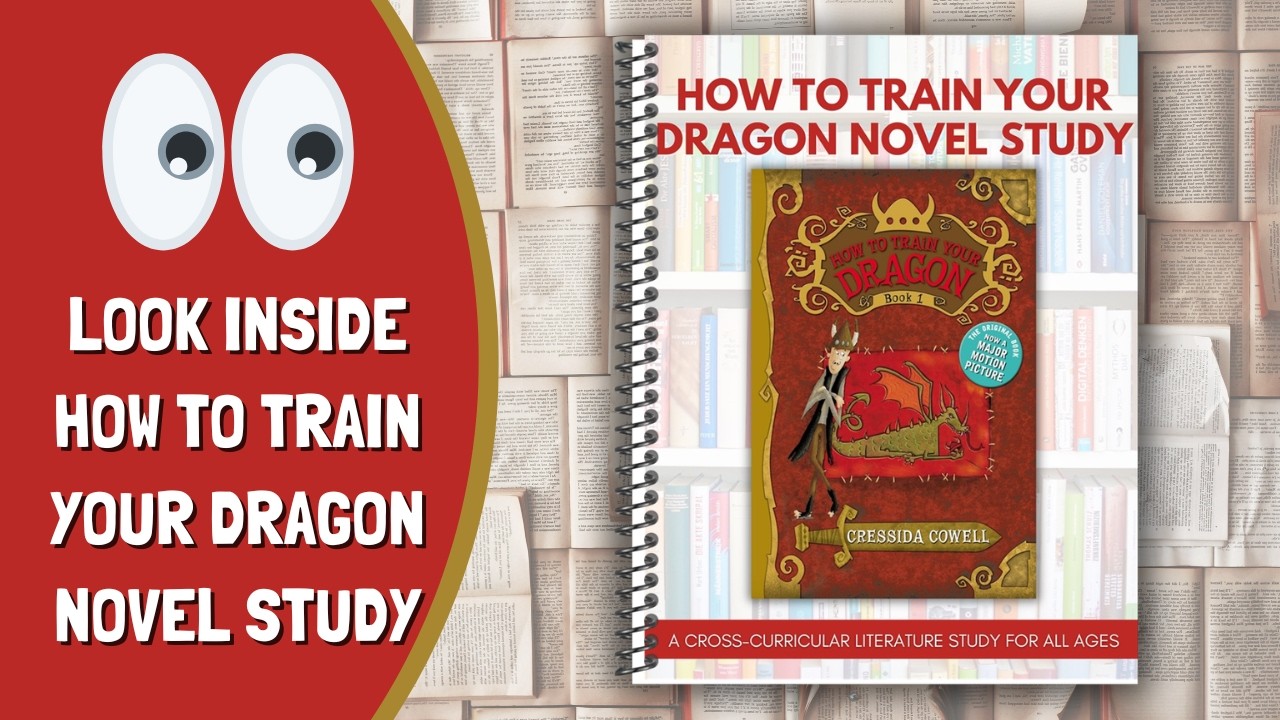
Look Inside: How to Train Your Dragon Novel Study | Cross Curricular Literature Study for ALL Ages
Watch on YouTubeVideo summary
Bu videoda "How to Train Your Dragon" adlı roman için hazırlanmış yeni bir roman çalışması incelenmektedir ve bu çalışma, kitabın herhangi bir formatında (ciltli, ciltli olmayan, elektronik veya sesli kitap) bulunması yeterlidir. Çalışmanın içeriği haftalık okuma planlarını beş günlük günlük aktiviteleri detaylandıran bir ders planı özeti ile başlar. Ardından, okunan kitabı gerçek hayata bağlamak için matematik, yazma, sosyal bilimler, bilim, sanat ve müzik gibi alanları kapsayan en az iki farklı disiplinlerarası bağlantı önerisi sunulur. Ayrıca, öğrencilerin kitap boyunca buldukları favori alıntıları takip edebilecekleri özel bir sayfa da yer almaktadır.
Çalışmanın ana gövdesi haftalardaki okuma ve uygulama süreçlerini detaylandırır; her hafta için okunan bölümler, kopyalanacak çalışma sayfaları, dilbilgisi veya kelime bilgisi becerilerini geliştiren öğretim noktaları, her hafta değişen ancak her zaman içeren kelime çalışmaları, yaratıcı yazma veya çizim etkinlikleri ve bölüm özetlerini içerir. Örneğin, belirli bir haftada Hiccup'un dünyasında yaşamış yeni bir tür ejderha icat edilmesi gibi yaratıcı görevler verilirken, diğer haftalarda ise dişsiz'in bakış açısıyla günlük tutulması veya sözlük tanımları incelenmesi gibi farklı yaklaşımlar benimsenir. Bu yapı, okurların metni derinlemesine anlamalarını ve dil becerilerini geliştirmelerini sağlar.
Kitabı bitiren beşinci haftadan sonra yapılan çalışmalar daha kapsamlı hale gelir ve kelime bulmacası, çapraz bulmaca, yeni kitap kapak tasarımı, tema belirleme, detaylı olay örgüsü haritalandırma, karakter analizi, kitap incelemesi ve film ile kitap karşılaştırması gibi aktiviteler sunulur. Ayrıca, kitaptaki mecazi dil örneklerini sınıflandırmayı içeren bir el işi etkinliği yapılır; bu süreçte öğrenciler metinlerden bulunan yirmi örneği metafor veya abartı gibi farklı kategorilere göre sıralarlar ve bu konuda cevap anahtarı da sağlanır. Çalışmanın sonunda, üç boyutlu karakter oluşturma, kukla gösterisi düzenleme veya alternatif bir son yazma gibi isteğe bağlı final proje önerileri sunularak öğrenme süreci yaratıcı bir zirveye taşınır.
Read the full video transcript
Hey everybody, welcome to The Waldock
Way. I'm Jessica. Today's video is going
to be a look inside one of our brand new
novel studies, and this one is for How
to Train Your Dragon. Now, the only
thing that you need in addition to the
novel study is the book in some form,
paperback, hardback, ebook, or
audiobook, whatever your preference is,
you just need to be able to read it.
Inside the novel study, you're going to
find lesson plan overview. This tells
you what chapters to read each week and
what activity you're going to do each of
the five days.
After that, you have cross-curricular
connections. This is one of my personal
favorite parts about the novel studies,
because it really helps bring the book
and what you're reading to life. So,
there are at least two different ideas
for what you can do to bring the book to
life, covering math, writing, social
studies, science, art, as well as music.
There's also a page where your child can
keep track of their favorite quotes
while reading this book.
And then we get into weeks 1 through 5,
which is really just um the work that
we're going to be doing while reading
the book. So, for each week, you're
going to be covering the chapters that
you've read, and you will have copy work
that your child will copy, and then this
is like a teaching point, so it's going
to tell you what to notice, what to pick
out, or teach some sort of grammar,
spelling, or figure of language skill.
Then there's going to be vocabulary.
Now, the activities are going to vary,
but there will still be vocabulary each
and every week.
There's going to be some kind of
creative writing or drawing. Again, the
activities will change, but it will
still be writing. So, this week we're
going to be inventing a new species of
dragon that would live in Hiccup's
world.
There will be comprehension questions
that cover the chapters read. This week
it's short answer.
And then a summary of the chapters that
you read that week.
So, let's go ahead and look at week two.
Again, we have that copy work with a
teaching point.
Vocabulary, this week we're going to be
looking at the definitions in the
dictionary.
Writing, we're going to be writing a
diary entry from the point of view of
Toothless.
Comprehension, this week it's true and
false.
And then our week two summary.
And that kind of repeats for weeks three
and four, just with varying activities.
And then when you get to week six, after
you complete a three, four, and five,
you will start doing kind of a full book
type of activities cuz you will have
finished reading the book in week five.
So, you have things like a word search,
a crossword puzzle,
designing a new book cover,
drawing a picture and describing the
setting of the story,
identifying the theme of the book and
finding examples that support the theme,
plotting the story in detail,
choosing your favorite character and
doing an in-depth character analysis,
writing a book review whether you
recommend or don't recommend it,
doing an in-depth book and movie
comparison,
as well as having some really great book
and movie discussions.
Then there is a figurative language
activity, so you're going to learn the
different styles of figurative language,
find some of your own examples in the
book, and then do a hands-on activity.
So, for the hands-on activity, there are
these principal cards that have all the
different types of figurative language
on them, and you're just going to lay
them out for your child, and then use
the 20 examples that we found from the
book. And you will have them sort them.
So, for example, if that one was a
metaphor,
if that one was a hyperbole, they would
just sort them with the correct cards.
Then I've also included an answer key
for that.
There are final project suggestions. So,
once you have completely finished, you
can have your child do one of these.
These are optional, but if you just want
to go one step further, they can do
something like create 3D characters, do
a puppet show, write a newspaper, create
an alternate ending. Just a few
examples.
And then we also have answer key for all
of those activities that you did weeks 1
through 5.
>> [music]