Video summary
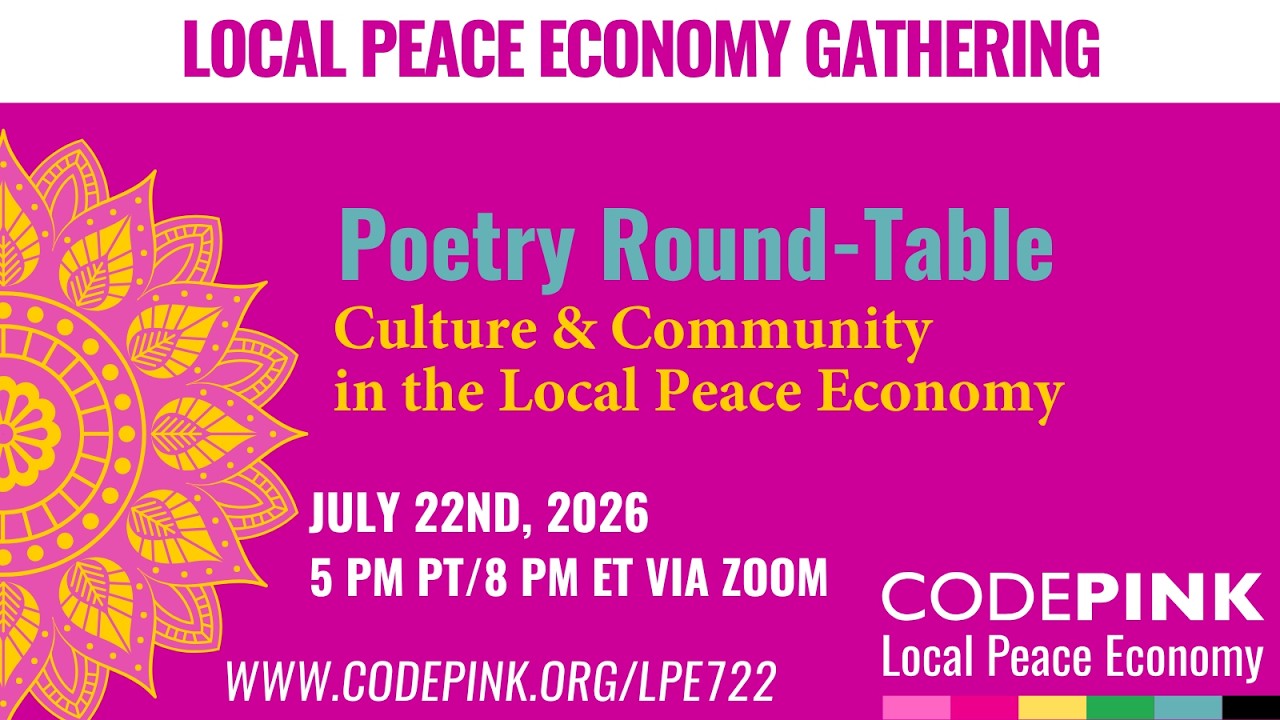
The gathering centered on a poetry circle led by poet Joy Johnson, who shared her creative process inspired by the "global peace economy pivots." Johnson explained that her work often explores the deep resistance people feel when attempting to pivot toward peace, emphasizing that individuals are not meant to solve every global problem but rather to engage creatively within their specific spheres of influence. The session encouraged participants to move beyond intellectual analysis and instead focus on their visceral emotional responses to the poems, creating a vulnerable space where feelings of manipulation, disconnection, and hope could be openly acknowledged. This approach transformed the reading into an intimate exploration of how poetry can validate personal emotions and foster a sense of shared human experience among strangers.
Several participants read original works that addressed themes of systemic control, environmental loss, and religious imagery. Joy Johnson presented a poem critiquing American media manipulation and commercialism, which resonated deeply with attendees who felt their agency was being eroded by external forces. Another piece, titled "2026," used sonnet form to mourn the destruction of nature and the prioritization of human greed over the lives of birds and trees. Additionally, Danny read a rhythmic poem exposing the hypocrisy inherent in opposing political narratives, while Moji shared a heartbreaking dialogue between an Iranian mother grieving her daughter killed by missiles and an American mother reflecting on her soldier's actions. These readings highlighted how language can either divide or unite, depending on whether it reveals underlying truths or perpetuates propaganda.
The group engaged in profound discussions about the intersection of faith, trauma, and authenticity, particularly regarding the use of religious vocabulary in poetry. Moji spoke passionately about distinguishing between the essence of religion and its abuse by powerful forces, defending the right of poets to express their authentic voices even if it involves imagery that might alienate some listeners. The conversation extended to the importance of visualization and imagining alternative futures where humans co-create peace with the biosphere, as suggested by Josh's poem about unity. Participants noted that without the ability to imagine these positive possibilities in their art and daily lives, society loses the capacity to build them, reinforcing the idea that poetry serves as a vital tool for envisioning a world beyond current constraints.
The event concluded with a strong sense of community and connection, underscored by the willingness of attendees to remain in breakout discussions long after the formal session ended. The shared vulnerability allowed people from diverse backgrounds, including those facing Islamophobia or living under different cultural traditions, to find common ground through their artistic expressions. By focusing on feelings rather than just facts, the gathering demonstrated how poetry can bridge gaps created by political polarization and historical trauma. Ultimately, the meeting reinforced the belief that small, creative acts of engagement and honest reflection are powerful steps toward healing and building a more compassionate world.
Read the full video transcript
All right, welcome everybody. It's uh
July 22nd. Um this is the local peace
economy meeting uh that's focused on a
poetry circle where we're going to talk
um to a poet in our midst, uh Joy
Johnson, and and listen to some poems of
hers and talk to her about her process.
And then we're going to read poems
together and reflect on each other's
poems. And uh we'd really like I'm going
to um I'm going to preface the meeting
that we want to hold the space a little
differently than just reading poems. We
would read the poems and take a short
moment of silence after each poem. And
then we want people w as they're
reflecting
and they're thinking about the poetry
and then wanting to speak about it with
the larger group that they think about
how the poem made them feel and what the
poem inspired in them and uh how uh what
vulnerabilities it brought up in them in
themselves instead of necessar not
necessarily what you're thinking but
what you're feeling because of that
poem. And we want to encourage people to
be just a little vulnerable with each
other tonight. All right. So, uh, let me
welcome Joy Joy Johnson. Uh, she is a
regular at the local peace economy
gatherings. You may have seen her, uh,
talk and and share, um, at several
meetings before. And, um, she has been
writing beautiful poems based upon the
global peace economy pivots. enjoy. Um,
and we've been sharing them on the local
peace economy substack. And so if you
are not uh familiar or not following the
Substack, I'll put the link in the
comments, but um I wanted to give Joy a
little bit of time to talk about her
project.
>> Oh yeah. Okay. Hi everybody.
Um, you know, I was just reading uh
something from I think it was writer's
digest, something dorky like that today
about one of the things to uh uh to good
habits of a writer is to look for
inspiration everywhere, which is like
second nature to me. So when I got the
workbook
and there was a list of 23 pivots, I was
like, "Oh, look, this is a 23 poems."
You know, I was good to go. It and uh so
I I did finally finish. It took me over
a year to write all of those. But I did
finally finish those and uh um and I'm
very and and of course and I shared them
with Jod and Marie and and and then they
want to do something with them. So, I'm
very flattered uh to have them including
me on the Substack. It it's really
really nice. And I want to add that in
in the Substack, it's not just a post of
a poem that I wrote, but Marie uh writes
some words about the pivot and about the
poem and stuff like that. And I think
it's very um it's very thoughtful and
and I really appreciate it. I really do.
>> Thanks. Yeah, we're trying to make the
pivots as accessible to uh people's
relationship with being in these times
right now about how it's I think it's
really easy for people to go like you
know to hear like oh you should pivot
from one thing to another but what does
that actually mean like what is the
creative process in your mind when
you're thinking about pivoting your life
towards peace and I think that the
workbook and the way that the pivots are
structured is uh very thoughtful that
way and the creative
>> the creative outpouring of your poetry
is like a perfect expression of that.
Um,
>> I think and you picked up on on one of
them that you already posted that I
wound up writing a lot about problems
you might have if you try to do this
pivot and and and and so I you know a
lot of times it's it's more like the the
the the things that might be difficult
about the pivot in my poetry.
>> Yeah. you know,
>> and and really exploring and and sitting
with the resistance that we have to like
every day we encounter multiple ways to
pivot in a whole bunch of different
areas, but there is this like deep
resistance to pivoting in specific ways.
is like today I'm writing um I'm
preparing another one for Substack and
it's about pivoting from plastics to
planet
>> and and
the the history of plastics and the
relationship that we all have with
plastic in everything we do everything
we consume like you know everything that
comes into our house and in our yards
and plastic is everywhere and how
feeling like we and potentially pivot
from plastic to planet like feels like
sometimes like an overwhelming uh step.
And so I think uh that these poems
really take the problem and look at it
in this like bite-size emotional way and
it helps us to understand that we're not
meant as creators, as people to cure the
problem for the world. We're here to
engage in what narrow circle of
influence we are here to engage with and
to do the very best creative work that
we can and that we're not here to solve
every problem in the world. And that
understanding that in the context of the
pivots is um is an important part of
that process. And I think that your
poetry is really beautiful for that
because it looks and it goes what is my
contribution and what small step can I
take to be better?
>> Well, sometimes I hope it that's good.
I'm I'm glad that that you know you're
reminding me of one of my favorite Nuda
quot which I I won't be able to remember
exactly, but it's about it's it's
something along the lines of the the um
poetry is not for the poet, it's for the
reader.
Yeah.
>> So, um,
yeah, whatever you get out of it, that's
and you're talking about stopping and
reflecting and letting yourself feel it.
And I think that is very important in
the in because
uh, you know, poetry is a special kind
of writing
that invites that kind of of of
engagement. You hope you know that it's
not it's not it's not reading a novel.
It's not it's not reading a a history
book. It's not that. It's something
that's touching,
you know, something I think that's kind
of a unique way to reach down into the
human experience
hopefully, you know.
>> Yeah. It it it re it allows people to
experience in their feelings an
ephemeral
>> leading relationship
to uh what I kind of term as the
numinous like there's this that it we
are that what's outside of us that is a
collective
>> and and you get when you read a really
good poem
>> you feel that ephemeral quality of
something more than words.
Does that make sense?
>> It does make sense to me. I don't know.
What about you guys? You getting it?
[laughter]
>> Um uh and and you're talking about then
maybe to me one of the things that
poetry did for me was in causing me to
have feelings.
Um first of all, it validated that I
have feelings. And nobody was even in
the room. I was just there reading a
poem and it was like it's okay to have
feelings, you know, and and then but
then it made me feel connected
to other people who maybe read this and
had feelings, you know, right?
>> Is that nuts? I don't know.
>> No, it's not. And speaking of connecting
to other people who are having these
same feelings, can you talk, you're a
really good uh um person to uh talk a
little bit about the writing workshop
that's ongoing, has been going on for
the year. And I've been with Code Pink
for almost two years now, year and a
half, a little more than that. And the
writing workshop predates me. And so
there has been a a group of people. I
don't think it's like uh an exclusive
group of people. People come and go, but
a group of people that meet once a month
to share. And so can you talk to
everybody about what that looks like?
>> Yeah, it's I I find it uh to be one of
the the [clears throat] most
um meaningful exchanges I have about my
writing that I've ever experienced
because uh yeah, and and it's different
people every time. Um but uh Michelle
Humphre leads it usually, you know, and
uh and um and and she follows this uh uh
template for how to do the discussion of
the reading. And it's not just poetry.
We uh people bring all kinds of writing
there, but a lot of us are bringing
poetry. Um and and uh and we do this
really interesting thing where the
author reads the poem and we share them
or or reads the work whatever it is and
we share them uh with links you know you
so that everybody can open it up and
look at it and then somebody else reads
the piece of work
and and so first of all that's really
illuminating to hear somebody else read
my words. That just doesn't happen every
day, you know. And then uh and then the
author has to leave the room. In other
words, you mute yourself, right? And
then and then the other people in the
group discuss what they've just read and
but you get to eaves drop on them
because you are you know you may have
left the room but you're just outside
the door with your ear to the door you
know and uh and then after they feel
like they've exhausted uh their
discussion the author is welcomed back
in to to the conversation at which point
I always have like questions or or like
what did you mean by or what did you
think of or you know that kind of
wonderful stuff. It's just I think it's
a really genius way to uh to to do it.
And so you know we have usually maybe as
many as a half a dozen people come and
uh I don't I don't know. It's great. You
guys ought to come.
>> And you know you can also come if you
don't have anything to share by the way
and just be part of the discussion.
just allow yourself to be touched by
what somebody else has written, you
know.
>> And do you feel like have you um taken
the notes that people gave you and then
changed what you've written and like
incorporated it and is that something
that um that that people do or do and
then they come back with the changes or
is it like a workshopppy kind of thing
or is it or do you
>> It's not It's not that much like a
workshopppy thing. It certainly is that
is a a a thing that could happen for
sure. But um I think uh meeting only
once a month, we kind of uh are much
more interested in bringing something
new every time and not not revisiting
that with our limited amount of time,
you know.
>> Yeah, that
>> I certainly do take notes from what
people are saying. Absolutely. You know,
I I do that. Uh and and and I might
change a little bit. Uh but I'm not I'm
not I'm not I'm not the right person to
ask about that process. I'll just say
that. [laughter]
>> Well, do you want to um read a poem uh
that you've written that you you know
that you want to share with the group
and and maybe talk about what the
inspiration like where it came from?
Like did it come out of, you know, a
creative bolt of lightning or was it a
process or like how did you um how did
you create it and and what was the
inspiration other than the pivot and uh
yeah just
>> tell us. Okay. So, do you want me to
read one of the pivots or do you want me
to read something else?
>> It's completely up to you.
>> Um I So I Let me see. I I know I open
Yeah.
Uh, so I have one open that is a pivot.
So I I think maybe that's the one that
I'll start with. And this one um in
another writing group in person writing
group that I'm in, I got some good
feedback about this. So, I thought you
guys might enjoy it and you can tell me
what you think or but most importantly,
you got to remember that after I finish
reading it, we're just going to be
silent for a while and you're going to
experience
what it ever is that it wants you to
experience. Right, good.
Okay, this one was for the reactionary
to investigative.
Uh, story untelling.
Freedom is the thing. From morning
pledgings to founding fathers warnings
about taxing without representing to
heck with central planning, no wonder
pre-term us was confederation. to
anthems a rung from sporting events.
We're inundated with infinite tales
unsung throughout a youth fence ignorant
of what's owed to slaves, natives, the
earth above and below and how freedom is
the wrong poem. We are one.
Then comes the imposition onto all we
see and partake of commercialism. How
our worth is beholden to our purse. What
power it can muster to coersse respect
from whom? Non-existent jury.
Nonetheless, we're pistoned back into
work. Chasing what we told we we're told
we want. Reassess courtesy American
Express constant makes it hard to see
codenisens of earth as joys unbounded
and congress priceless.
Then all grown up, we settle right in to
watch the news. A story bespoke not for
you, for the oligarch. I don't want new
wars to watch, read, listen to. The
Germaine asks, "Who's paying for the
tuning to? Who is distracting us with
half-truths, untruths?
We're being used. It's no conspiracy.
It's just concentrating wealth elsewhere
unfairly, monumentally unso. Since
baptism against fascism needs
compassion,
every contrived separation arose.
Every moment on earth, blind love,
our duty to the story, the truth.
All right. Does anybody have a
reflection or
uh a sense or a feeling that they want
to express
or an inspiration, a feeling of
inspiration?
I feel like it just kind of captures our
our day-to-day
existence in America. Now,
I think if he'd written it in a
different country, it would have come
out a little different
differently,
but sort of the way that it feel it sort
of has a feel for what it's like here.
I think the sense of um
not feeling powerful.
Uh feeling like a lot of
uh what we how we spend our time and
what we listen to on the news and uh
what we're told is important has kind of
been set in stone for us.
And hopefully we feel like questioning
that.
>> Right.
>> Yeah. For me, I it I felt uh a strong um
urge
as you were listing listing all the ways
that we that that we are being
manipulated.
Um are that our reactionary self
um I wouldn't say I felt shame around it
because I could see myself in those
reactions.
I would I think that I I recognized
more deeply I felt more deeply the
manipulation of of the war economy's
hold and grasp on sort of all of these
different parts of our life. And um
>> yeah, you don't have to wait with me
here.
>> Okay.
>> Yeah. And so I that that's how that's
how how I related to it. Does anybody
else want to speak up?
Yes. I wanted to um see the line you
said from baptism
and then until fascism. if you could
repeat that section or maybe put in the
chat if you have a text version. But
were what were you what was your
intention when you were writing that
line or what were you thinking about?
We're thinking about religious
manipulation or something else.
H
um well the line uh that sentence is
since baptism
comma against fascism
colon
italicized needs compassion.
Um,
and you know, what I was thinking about
is not nearly as important to me as what
it does to my reader, but
um,
uh,
what
You know, I think this is a poem again
that in the pivot from reactionary to
investigative
um that I am doing talking a lot more
about the difficulty of that pivot you
know and uh and personally the
difficulty I you know that I might be
having with how do you get there you
know and uh so
I think that that little line there is
maybe tied up with that uh
how do how does this happen that you're
born and I I admit that instead of
saying since birth I said said since
baptism probably because I needed more
syllables. Okay.
Um and and uh up until you know now when
we have this in this country in
particular I think we have a rising
fascist element going on and and and
clearly uh
if you're trying to untell that story
you know which is the subtitle of the
poem for me that um
that maybe compassion might be a better
response
uh a little bit more mature and a little
bit more investigative rather than
reaction. You know what I mean?
I don't know. Was that an adequate sort
of pointing the way to what I was
saying?
>> I understand like mechanically needing
more I think syllables, but I think
birth is a better
from your intent way of saying it
because it's talking about how one is
conditioned.
>> Yeah.
>> And then can lead to changes throughout
life um according to you know um
experiences and learning and growing as
a human. So yeah, I think that would be
a better word because like for me
baptism means rebirth. So it kind of
doesn't really flow in in the way that
uh maybe you intended it.
>> Yeah. And I and I worry about too when I
can't help my upbringing. I I have
certain vocabulary words. Um even though
I don't consider myself particular to be
a Christian anymore. I've been I've
taken Buddhist vows and all that kind of
good stuff. Um, but it it v the
vocabulary of Christianity just comes
out of me and I worry about that
sometimes. And one time in the reading
group, the the there was a a decent
amount of Christian vocabulary in the
poem that I shared that day and it
turned off some people. They immediately
dismissed it. But a but as we read it
together and they discussed it and then
I came in and we discussed it. It was
actually a poem against religion, you
know.
So, but I get I get what you're saying
and I worry about those words creeping
in uh to to my stuff.
>> It wasn't so much that I would be
cautioning against religious vocabulary.
I just I was from my perspective it's
almost making it sound like you know the
idea of baptism and then fascism
I probably misunderstood you. Um that's
why I think it's important to ask a
offer what they mean but I interpreted
it as saying that religion inherently
has shaped and formed fascism or a
conscience of fascism. But I would
strongly disagree with that perspective
as I think often Christianity is about
really seeing and aligning with the
other or the scapegoat or the one who is
powerless.
Ideally,
>> ideally,
>> but then, you know, you could that would
o could open up a whole conversation
about the the misinterpretation of
baptism and Christianity and stuff like
that.
>> And maybe it's maybe it's even a
conversation that is not even between
two people, but between you and the
poem,
>> which is that could happen. Yes. So I
think poetry like you can imagine that
you're when you're reading something
you're having a conversation with the
ideas in the poetry the words but also
with the offer even if you don't know
the offer.
>> Hey so Moji has his hand raised and I
thought we Moji would you like to uh
reflect on how the poem made you feel?
>> Sure. Uh well
I the poem made me
made me feel
sad for one thing and then
uh but what the reason I raised my hand
uh is because of
what I find often. I am from Iran. I am
a Sufi Muslim
and so I am subjected to
Islamophobia,
to being uh being called a sleeping cell
of terrorism and all other nonsense that
is being pushed by the
military-industrial complex and Israel
in particular.
And I want to say in my own poetry,
whether in Persian or English, I don't I
don't focus on
how it's going to impact
whoever.
it just comes out a lot of times in a
dream or I wake up and I the the fo the
poem either in Persian or in English is
flowing and I'm just writing it and but
I believe there is a profound
distinction that needs to be made
between religion and its abuse
by the force forces of as we say in
Persian by the forces of gold
power and deception.
And so a lot of times I feel sad that
people
um especially poets may feel compelled
to hide what is flowing out of them. And
in case of joy, it may it may have
Christian uh vocabulary or Christian
imagery.
And then they say, "Oh, it pisses people
off. Therefore, I should not be
authentic to what is flowing out of me
as a poem."
And my only answer is, and I've been, as
a Sufi, by the way, I've been
persecuted.
Um, and so there is a difference between
the essence of religion, whichever
religion we are talking about, and the
fact that it has been quote unquote
fucked up by people who are,
you know, who have agendas
of various sorts. So I thought to share
that.
Um, that's all. Thank you. Thank you,
Moji. That's a really powerful
reflection both you and Rosalyn um
sharing about this the religious imagery
and how what it elicits from people as
they and the feelings it brings forward.
Even it's very subtle like I didn't even
mark it as religious and but it it is
obviously but I didn't even mark it as a
religious uh word and and it's it's it's
a really important aspect of our
relationship with words as to what it
makes us uh feel when we're relating to
the very specific aspect of the word
chosen. Joy, do you want to share
another poem with us? I I totally could
if you want me to.
>> Sure. [laughter]
>> We'll do one more and then we'll open it
up to people.
>> Okay.
>> Others who want to share. And if you
want to share a poem, um raise your
emoji hand. I can't see your actual hand
because uh when you're Zoom controlling,
you only see like three people of an
assembled group. So raise your hand uh
your emoji hand. And in the order that
that people raise their hands, I will I
will pick them uh after Joy reads her
poem and we reflect on it.
>> So go ahead, Joy. So, this one is not
one of the pivots and it's a more recent
poem and it's called 2026.
Uh, but I wrote it in uh Roman numerals
and it is a um a a series of four it's a
four sonnet series
and uh I recently wrote one that's a
seven sonnet series. So, you can be
grateful that I'm not going to read that
one. Okay.
Okay.
How meaningless will be my end compared
to inapt or not the life of one tree who
in my yard has bloomed prolifically
whose green soul made home for many a
bird to fill the world with a morning
song heard by just everything needing a
boosting a new day meeting readying to
sing some better beginnings into being.
Please swear you've never cursed the
bird song of a morning. Whether in
leisure or spooked by the day's coming
demands workforce have claimed so many
would be expansive moods. I only care
you have whooped at bird's chorus into
new day exude
contemplation of a world come undone
amidst my concern for online gift guard.
Everything comes to not for the rear
guard of these generations. So many ton
of trees and birds transmuted into man.
So much blissful ignorance, oh my god,
of how to make a world go. The lifeguard
we need instead of admitting this one is
worth changing everything for bird song
in place of rockets drone and chainsaws
smoke. Unconscious we breathe like
advent for gone like nothing's wrong.
Like Jerusalem oak stands for
eventuality unchanged. No matter how
blindly deaf we're estranged,
soon enough my end will be upon me,
except I shant even be there for its
consequence. So why in my bones upsets
this thought of birds and trees lively
army of births output of earth's output
reduced to memory today's mood certainly
nei find me a motivation please acostic
insufficient quantity to remedy this oni
this miscanton
everything will change doubtless but
ruthless need it be So all to have been
taken for no other end than a
grandisement of few human wallets. Such
judices with no dream beyond a
microclimate.
Let no feather, no leaf fall unhallowed,
unseen for its essential part in time in
this grand endeavor. life so sublime, so
unique in the known verse, a ballad to
chaos and the laws of physics, and an
imagination grander than mine or any
part could ever have dreamed. Shine, I
declare, a monument foreshadowed at Big
Bang, ephemeral in its print of energy
throughout all existence. Life, life,
life, never fade, genius imprint. Sing,
sing ye birds. Tell us this morning's
instance. Nothing tree limb will be more
important than how you support us all
with your graces.
Thank you.
Well, I I could I could relate to that
as an as a um a conservationist
who works to try to protect
birds, among other things.
Um,
and
I think we may
the poem is like saying what why should
I care? I mean it's it's implying that
my short little life doesn't isn't why
am I worried about that? You know what's
happens to the birds songs?
But, you know,
um
I'm I was just thinking about that. I
was thinking about a lot of the things
that you're that that are going on. And
right now,
uh the whole story of the Emperor's
Nightingale, for example, I if you
remember that from childhood where they
were where he gets a fancy mechanical
bird to sing to him. Well, it seems like
that's kind of what they're trying to do
now for us is is get us to buy into that
that we can sort of have that and that
will satisfy our needs
even if we don't still have a
functioning planet.
So that's my thought.
>> Thank you, William.
If anybody else would like to respond
about their feelings or their
relationship to the poem, but just
unmute.
>> What were you saying, Marie?
>> I was saying that if you have a response
to the poem that was just read, uh
Joyy's poem, um if you would, uh just
unmute and you can respond to how it
feels and your relationship to the poem
if you have an observation.
It was deep.
It was deep and profound.
So, thank you. And I'm sorry that I'm
late. No, it's it's finally
I wanted I just my relationship to the
poem I felt um
over and over again the the pull between
uh ideas of the sacred and the numminous
and the relationship to the more than
human world. And that is a place where I
feel like I sit very deeply in my
everyday. That's how I experience the
sacred. So I I very much appreciated
that in the poem um and how it was
brought forward. Just wanted to say
that.
All right. Well, um Josh Middorf has a
poem that he would like to share and um
Josh, if you would like to read your
poem and then again we will have uh 15
20 seconds of silence afterward and then
have a response period. So go ahead
Josh.
>> I I have a request for this community
too. I woke up yesterday morning with
this idea that Jews in America are just
so divided. There's the community of the
traditional community which is support
Israel no matter what and then there's
the Jews within code pink that are
setting another example and many others
of us and I I would like help organizing
a gathering or a conference of Jews to
express both sides to connect with each
other. um the those who support the
genocide and those who support peace. So
if anybody please reach out to me if you
think you might be able to help with
organizing that. Thank you. My poems.
If all life is a dream, is it your dream
or mine? And why should our two dreams
agree?
An answer avails if we're both the
divine. At our source, I am you and
you're me. Though it seems that we're
separate, I trust you'll concur. It's a
stretch to conceive one great soul.
Still, we sense there are times when our
boundaries blur and designs coales as
one whole.
If together we've dreamed up this life
with its flaws and its numberless
wonders untold, might we re back our
species to mind nature's laws? Who can
say what new worlds may unfold? We might
harness the power of resonant thought.
We might dream exploitation to cease
once we own all the battles that air man
has fought. Are we ready to co-create
peace?
Wow.
If anybody has a
a sense of uh feelings or relationship
to this poem or something they'd like to
observe,
go just unmute yourself and comment
>> to the point.
For me, the poem really spoke to
if we can't dream and imagine
a future
where we are co-creating with the more
than human and the biosphere and
uh in a positive
way with a relationship to natural law
and biological systems. If we can't
imagine that in our poetry, in our life
and in our world, then we have almost no
ability to create it. Like if our
imaginations are are so hemmed in by the
systems we participate in that we can't
imagine these beautiful worlds that Josh
described. Um it's really important to
imagine them. And so the poem, this poem
to me imagined these worlds and I
appreciated that very much.
Oh, thank you, Marie.
>> Well, don't you think don't you think
like that what you're saying, Marie, is
part of visualization?
Like in my meditations,
I will take a few seconds to just
visualize the world the way I want it.
Even though I know there's chaos going
on, but it's like I wonder if we all
just did that every because we get so
caught up in the the horror of it all
that we forget that there still is
beauty. There's still so much around us
that we can visualize and we can
appreciate. I just a thought.
>> I agree and I think uh I feel like the
poem is a kind of meditation that that's
Yeah.
Anybody else have an observation on the
on Josh's poem?
>> I I just want to say that here's sort of
where
All right. I think um it's the reader's
personal experience, right? is what
happens because there at the end
I don't even remember the line exactly
um but it totally made me think of uh a
need for uh better education
which is a place that my brain goes all
the time because I'm an educator okay or
possibly because I'm human but I always
claim it's because I'm an educator um
and and so there you go that immediate
mediately that I was like, "Oh, yeah. I
know what he's talking about now." You
[laughter] know?
Thank you.
>> Yes. Thank you, Josh. Barbara, you're up
next. Would you like to read your poem?
>> Um, yeah. I I um this poem, although I
wrote it when I was about 11 years old,
um it kind of speaks to Joyy's last
poem.
Um,
it's it's entitled Smog
and it goes soft and muted misty gray.
The enveloping clouds will come to stay.
But they are right. It it must go. It
surely will look different though.
And that's it.
>> Any good for a 11year-old?
Anybody
else want to relate?
I I want to say that because she put it
in the context of having written it when
she was a child that [clears throat] it
made me think of just really how
different things are than they were when
I was a child, you know. Um and uh and
so
sort of a bound up wistfulness with
Yeah. Don't we need to change and wasn't
you know can we find our way back to
some good stuff or something like that
that that uh um about undo some stuff
you know.
All right, Barbara, thank you. That was
that's really special that you have a
poem from when you were a child. Like I
uh I I don't I I I think I must have
written poems when I was 11, but I have
long since um not had them in my
possession. So, I think it's pretty
amazing that you uh that you uh have
preserved that bit of your childhood for
your your grown um adult self to reflect
on and to to keep with you. Um that's
really beautiful.
All right, Danny, you're next.
>> Yeah. Hi. Yeah, I've got a different
style. Maybe it's a different branch
because um and I'm in a rare or unique
branch because everyone does this
subjective descriptive
kind of stream of consciousness which
[snorts] is fine but I do the objective
didactic
more intellectual than the emotional
stream of consciousness
although mine is full of emotion.
[snorts] So, um, it's rhythm and rhyme
with meter and message
and, uh, rant and remedy because you
can't do rant unless you have remedy.
So, I'll just do my disclaimer and then
I'll start. Um, [snorts]
so any comprehension of what I'm going
to say in this poem will cause emotional
enlightenment
and spiritual emancipation.
And um, I don't want to forget to say
hello to my friend Emoji. Salam
alalayikum. [snorts] And um if anybody's
going to understand this, I think Moji
will. So um here we go. It's called Who
Am I? [snorts]
You say that your God is gracious and my
God is ghoulish.
You say that your religion is a godsend
and my religion is a godamned.
You say that your paradise is perfect
and my paradise is perverse.
You say that
your doctrine is divine and my doctrine
is deranged.
You say your zealousness is fantastic
and my zealousness is fanatic.
You say that your unwillingness to
compromise is a virtue and my
unwillingness to compromise is a vice.
You say that your nationalism
is patriotism
and my nationalism is fascism.
You say your aggression creates peace
and my aggression creates war.
You call your soldiers courageous
and my soldiers courage.
Why is your hate justified and my hate
vilified?
Why? Why is your violence heroism
and my violence terrorism?
Why? Why? Why is your revenge revered
and my revenge renounced?
Our motives and methods are the same.
Our rhetoric, our rationale, and our
remedies are identical. Yet you say that
your cause is righteous and my cause is
wrong.
Who am I?
Who are you?
I haunt hypocrisy.
I ravage ruthlessness.
I empower empathy.
And I inspire integrity.
You see how it works?
Do you see how it works? I boomerang
belligerance
and I magnify magnificence.
Yes, we are explicitly many,
but never forget we are implicitly one.
Diversity is not a problem to be solved.
It is the colorful tapestry in which we
are inextricably
involved.
The reflection that you see
is actually we.
Your actions create me.
Kill me.
Kill me and you kill humanity.
The reflections have started in the
comments which um have been really
positive and supportive. Uh would
anybody like to
react and uh share what has brought up
for them?
I just want to say I really like Denny's
poem [clears throat] and I uh I kind of
connected to uh
um the poem that um Josh um read earlier
as well as uh the first poem that Joy um
read for us. Um, I kind of see Danny's
poem um as a critique of of uh the way
of how people are um you know separated
and pulled apart.
And I see Josh's poem as a reflection on
how you could actually bring people
together. And they kind of both reflect
on the same theme of uh we are all
really just one and the only reason that
we do not see each other as one is
because [clears throat]
we are being manipulated
and that was the theme of Joyy's first
poem
um about the u mostly on the atrocious
American propaganda system but it's it's
common in all the world And it kind of
is what uh separates people and makes
them see as not one.
>> Thank you. That's a great reflection. I
love the the fact that you could tie
them together and see the the common
thread. Beth, would you want to come on
and talk about your what you just put in
the chat?
>> Well, it's interesting. I've been in
several small groups with Danny
after the local peace economy
and he inspires me a great deal.
He talks about the language we use and
talks about pivoting
to different language so that we
so that we talk to each other and to
those we wish to
bring into the conversation. in a way
that they can they can enter.
And one of the other poems talked about
the unity at the at the heart of things
was Josh's ball which also moved me
greatly.
And that's something that's been a theme
that Danny's been talking about pretty
much every time we get together.
And this poem spoke so deeply about
about how we can
allow words
and thoughts and ideas divide us.
I I I really
really appreciate it a lot.
Thank you, Beth.
Yeah, I felt the poem really spoke to uh
the um moral constancy that we
so often miss um in our lives because of
propaganda or othering or for whatever
reason that I I highly value moral
constancy in my friends, in my
relationships.
And um and this really spoke to the fact
that there is a lot of um moral
inconsistency
in the world and um and that once you
see it it's hard to unsee it. So thank
you Danny that was really lovely. So we
have two more hands raised and it's one
minute
um to breakouts. I thought that we could
have two more poems
and we will read them without commentary
at the end and then you could go to your
breakouts and discuss these two poems.
Uh MoJi and Rosalyn will read. Discuss
these two poems. If they're in your
group, you can discuss with them. Um if
they're not in your group, you can
discuss among each other. And if there
are other poems that want to be read in
your breakouts, then to read those, too.
And for people who are new to the local
peace economy gathering, we do not time
our breakouts. Uh we send you off to
breakouts allow you to talk until the
talking is done until the conversation
is over. And when everyone leaves um the
breakout groups um and returns back to
their lives, then I close the room down
sometimes hours later. Um and I love the
fact that um people stay so long and
connect and deeply connect with people
um our allies around the world u with
each other. So Moji, if you would like
to read your poem.
>> Sure. First of all, thank you and thank
you brother Danny for mentioning my
name.
I
I want to read a
poem that when I woke up from sleep, I
began writing on May 13.
Uh and I as I was writing it, both the
Persian
beginning of it and the and the English
section of it, I was weeping
as I was writing the poem.
And it's a conversation between
a Minab mother. Minab was the the school
in Minab was destroyed by American
Tomahawk missiles.
And this is a conversation between one
of the mothers of Minab who is singing a
lullaby to to perhaps a doll that her
daughter was playing with. the daughter
that was killed at school and then then
an American mother, the mother of
soldier America.
It's a conversation between the two and
it is being it has been turned thanks to
a very talented musician and and uh
singer friend of mine into a song called
Minab Lullabi.
And the Minab laai is an awakening
lullaby as you will see rather than one
that lulls
pe you know you know humanity into into
sleep.
So I'll transl I mean I'll read the
translation of the of the Persian laabi
and then the English ninab laai. By the
way, this was
third 10 days after the idea that
occurred to me on May 3rd
to build a Minab school memorial
monument for peace which is now a
project that is developing.
Minab la.
Oh, Minab's daughter.
Lullaby. Oh, fresh blossom
flower.
Where did you go? Where did you go?
Why did you go? Why did you go? You were
my cute, sweet daughter.
You were the bird of my flight.
Why were your pedals pulled? Oh,
why you my bird flew out of the nest?
Oh, my flower.
And now the American mother. Salam. Oh
mother of m
like you I am a mother.
I need your help. Oh me knob. Oh me
knob. mother. M mother.
I am the mother of soldier America.
But but oh mother of mab,
my son is proud is proud
that
the ugly tomahawk birds that he flew
into the school bird nest of your flower
daughter of Mino. He is proud.
Why?
Why my baby boy soldier America doesn't
understand and doesn't care
that the axe of his tomahawk by the way
tomahawk means axe the word means axe
why doesn't so my soldier America
my son doesn't care that the axe of his
tomahawk has crushed your school bird to
sleep. Oh, mother of mop, help me. Oh,
mother of m, not long ago, my soldier
son used to be my dear baby boy.
He is my baby in my heart still. But now
the bird of his soul has gone to sleep,
to deep sleep. And I weep and I weep and
I weep. I plead with you, oh mother of
m,
help me, please.
Can the bird soul of your school flower?
Can the bird soul of your school flower,
our daughter of Mino and of America?
Can her weeping soul sing the lullaby of
conscience?
Lullabi of conscience.
168 weeping times. That's the number of
children that were killed.
Sing
can her weeping soul sing the lullaby of
conscience.
168
weeping times to awaken to awaken
to awaken the soul of my soldier baby.
Thank you.
Thank you, Moji.
You guys are going to have a lot to talk
about in breakout groups. Um, that was
beautiful.
Rosalyn, would you like to read your
poem and then we will break for
breakouts.
>> Yes. Uh thank you Marie. So I will open
up. It's an old collection but uh it was
inspired
um recently by a testimony by Benjamin
Champagne song. remind me of the murder
of Manuel Tran or Turkey if anyone is
familiar with the stop cop city movement
and the Fred between police brutality
and militarization.
So it's a series of four very short
poems that you read together. One call
of the Atlantif forest. Creation groans
beneath the weights of bullets. Sniper
fire burning beauty. Who will fight for
Ze? Yahweh who crafts heaven and earth.
Mountains above and a valleys below.
Atlant forest rise. Forest defenders
creating world holding many worlds
sitting a top a canopy. Echoing cry
caught by the leaves below. Call of the
Atlanta forest.
Two.
We birdmen like birds flying on instinct
with a clearer view. Emotions evolving
into rational thought. Call to action or
dues. A forest landscape lays in waste.
Barren dune of bullet haze. Unless we
birdmen take flight. So take flight we
do.
Three.
When you are called a terrorist, is it
the terror of empathy? Yet the world
cannot see. They do not perceive the
real terrorists.
The 40ies who kill and slaughter without
impunity the innocent of blood pools
around them.
Four.
Choose life. Even when all the world is
burning, fire of hate. Choose life, says
Yahweh. Lean not on your own
understanding, but the wisdom carried on
a prayer flying from the great white
north to the Atlanta forest.
Oh, that's great.
All right, so we're a little bit after
the hour and I want to respect
everybody's time. Um, thank you
everybody who read a poem. Thank you so
much. Joy, thank you for bringing your
work and your um your pieces not only to
this space but also to the Substack and
allowing us to learn about the pivots
through your eyes. Thank you to
everybody who participated and commented
and and shared uh and was vulnerable
about what these poems did for you. Um
I'm going to send you I'm going to stop
the recording. Um uh thank you again.
I'm going to stop the recording and then
I'll send everybody to breakouts.