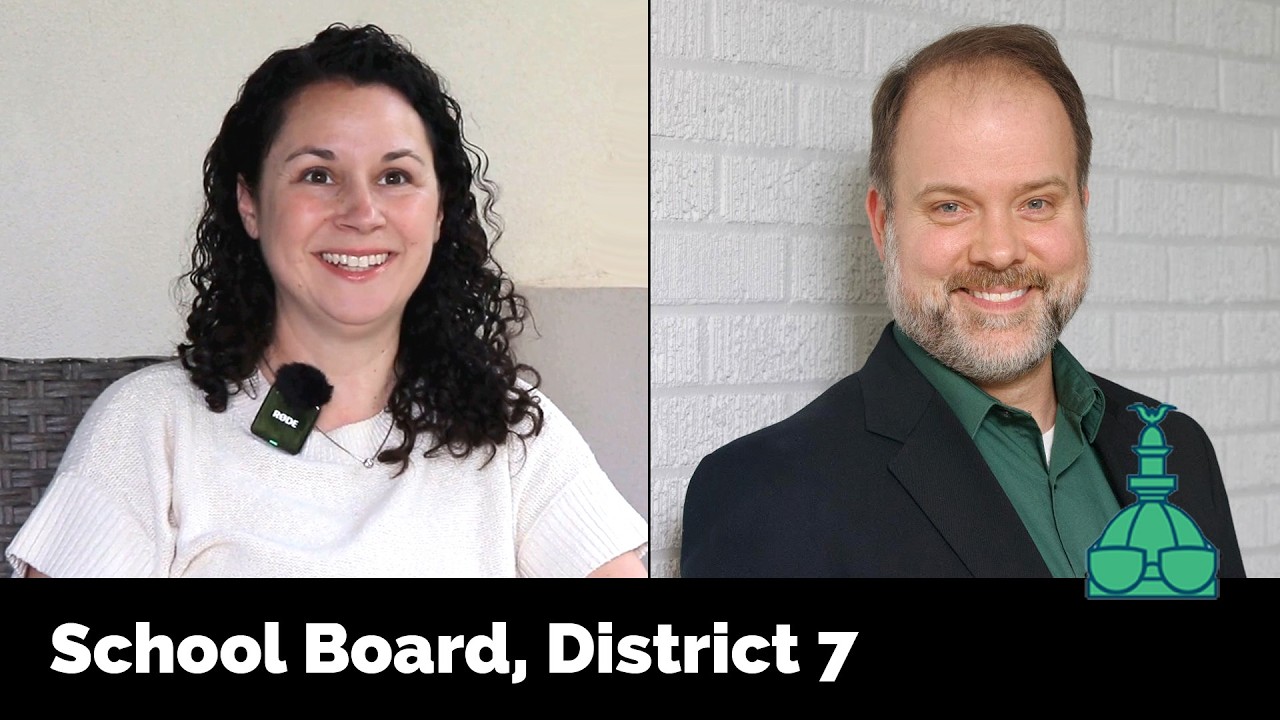
Lillie Brooks and Adam Shirley are running for ACC School Board in District 7
Watch on YouTubeVideo summary
Lily Brooks and Adam Shirley are both running for a seat on the Clark County Board of Education in District 7, bringing distinct backgrounds to the race that shape their perspectives on education. Lily Brooks is a former second-grade teacher and paraprofessional who has lived in Athens for several years with her family, having moved back after a stint elsewhere due to her husband's job at the university. Her qualifications are deeply rooted in her dual experience within both public and private schooling systems, as well as her active role as a parent and community volunteer. She has served on the Board of Trustees for the Foundation for Excellence, where she helped manage grants for teachers and honor educators. Adam Shirley, on the other hand, is an eighth-grade science teacher with nearly two decades of classroom experience, including time spent teaching in Japan and working as a substitute and paraprofessional. Notably, he cannot legally run for the school board while still employed by the district due to state laws prohibiting conflicts of interest, a fact he acknowledges but argues does not diminish his understanding of the system's needs.
Both candidates emphasize their passion for education and their desire to support teachers, who they believe deserve the best possible environment to serve students. They agree that the school board's primary role is not to micromanage daily operations but to set broad policy, establish budgets, hire a superintendent, and define the district's mission and vision. Adam Shirley draws on his experience with the Board of Elections to highlight the importance of consensus-building and slow, deliberate decision-making processes that ensure no one is left behind. He argues against "scorched earth" approaches that might divert resources from reading programs to other areas without addressing underlying issues, noting that much of the district's funding comes from state and federal sources beyond local control. Lily Brooks similarly stresses the need for a balanced approach that acknowledges both successes and failures within the system, advocating for targeted support rather than sweeping changes that could harm effective programs.
A central theme in their discussions is the critical issue of literacy and reading proficiency among students, which they identify as a top priority for improvement. Both candidates express concern over statistics showing that some schools are classified as failing and many students arriving at classrooms unable to read at grade level. They attribute these challenges to a complex mix of factors, including absenteeism, lack of support at home, and systemic issues rather than blaming individual teachers or parents. Lily Brooks points to Mississippi's third-grade reading gate as a potential model for holding students accountable until they master basic skills, while also emphasizing the need for tutoring, after-school programs, and community involvement like Boys & Girls Clubs to fill gaps when families lack resources. Adam Shirley adds that retaining failing students is a logistical nightmare due to staffing and scheduling constraints, though he acknowledges it might be necessary in some cases if consensus can be reached around such measures.
Beyond literacy, both candidates highlight the importance of parent engagement and community collaboration in solving educational challenges. They believe that parents must stay involved in their children's education by monitoring progress, attending conferences, and supporting learning at home, while the school board should act as a bridge between the district and the broader community to secure additional funding from state and federal levels. Lily Brooks also promotes the Athens Career and Community Academy (ACCA), a high school program offering certificates in fields like cosmetology, biotechnology, and culinary arts, which she considers an underappreciated asset that can help students gain practical skills and career pathways. Ultimately, both candidates present themselves as pragmatic leaders who understand the nuances of running a school district, balancing idealism with realism, and committed to building solutions through dialogue, consensus, and careful stewardship of public resources.
Read the full video transcript
Hello, you're listening to the Athens
Politics Nerd podcast. Today, we're
taking a look at the Clark County Board
of Education.
I'm going to interview the candidates
running in District 7, former second
grade teacher and parapro Lily Brooks,
and former member of the Board of
Elections and current science teacher
Adam Shirley.
District 7 runs along Timothy Road, and
it also includes West Lake Drive and
part of Milledge.
Now, let's meet Lily Brooks.
Thanks for coming on my show, Lily.
>> Yeah, thanks for having me.
>> So, why don't you tell us a little bit
about yourself? Um, so where are you
from?
>> I am from Louisiana. I grew up in South
Louisiana.
I grew up as a product of both public
and private education, and so that plays
a lot into some things I'll talk about
later. We moved here because of Josh's
job. Um, football operations with the
university. We lived here for uh 6
years, I think it was, and we had all of
our kids were born here. And we uh moved
away for 2 and 1/2 years.
Josh took some other jobs, but then
ultimately we made our way back to
Athens. And then, yeah, I have an
undergrad in speech pathology, but I did
not get my master's degree in speech
pathology. I worked on a master's degree
in education, which allowed me to teach
second grade. And so, yeah, so I moved
to Athens and I took a job as a parapro
at Cedar Shoals.
>> Okay, cool. And why do you want to be on
the school board?
>> Um, I would like to be on the school
board because I
first of all, um
through all of this time that we've been
in Athens, I have been a parent of CCSD
students. I've taught in CCSD at Cedar
Shoals for just a short period of time,
and then uh Barrow for a little bit
longer period of time in pre-K. And I um
and then I've also become come to be a
pretty busy community volunteer. And all
of those things combined
led me to this decision to to run for
school board. The things that I saw as a
teacher and and the things again the
things like I said that I experienced
coming from both a private and public
education background of my myself. Uh I
went to uh some public schools up until
fourth grade and then I went to private
school Catholic school all the way from
fourth grade all the way through 12th
grade. And so um just taking these
experiences together and knowing where
the need is and knowing the
the dynamic of our community and what it
looks like as a teacher not only as a
teacher but as a parent volunteer when
I'm doing things with the parent with
the parent organizations the PTOs the
PTAs when I'm working with my booster
club um
providing meals for the track team uh
uh volunteering in the media center at
the middle school and seeing that
side of the um school spectrum it's just
been it's been a really interesting just
to see all the different facets and how
they make up the school system and how
running for a position like school board
you can affect change or
help things be better in all of these
different ways. All these different
areas.
>> Yeah I did want to ask about your
qualifications. So so you do have
experience both in the school system and
then also you have children going
through the system as well.
>> Yes. Yes I do. I have yes I like I said
I I've taught I taught at at Barrow um
for two and a half-ish years it kind of
got muddled by COVID and so I was a
pre-K para in the pre-K program there
and then
I taught second grade in a full-time
classroom in Louisiana in North
Louisiana before we moved to Athens. And
then yes as a parent I like I said you
name it I've done it. PTOs PTAs
fundraising chair I have um
put on a 5K the Owl Flight here in town
that the middle school does.
>> Now to Adam Shirley.
>> Thanks for coming to my show, Adam.
>> Hey, thank you for having me.
>> So, let's start by um telling us about
yourself. Um so, where are you from
originally?
>> Oh, originally I was born in South
Carolina, uh lived there for about 2
months, and then grew up basically 10
years in Florida, 10 years in Missouri,
came to UGA, and then with the exception
of 2 years I spent in Japan, I've been
in Athens since 2001.
>> Okay, and what do you do?
>> I teach eighth grade science.
>> What's that like?
>> Oh, it's awesome. It's uh baby physics
and baby chemistry. We uh light stuff on
fire and blow stuff up for for science
though, so it's okay.
>> Cool. So, how long have you been doing
that for?
>> I've been teaching eighth grade science
for 10 years.
And then I taught seventh grade for a
couple years in there. Uh I've been a
substitute teacher before that, a
paraprofessional. So, 18 years
altogether in classrooms, 14 years as
the lead teacher.
>> Wow, so 18 years in at
>> in any capacity.
>> Clark County schools?
>> No. Uh so, in in Commerce and in Clark
County. So, 18 years total, 2 years in
Japan, and in Clark County a year and a
half as a substitute, about a year as a
paraprofessional, 2 years in seventh
grade there, and then 13 years now in
Commerce. So.
>> Okay.
Or in Athens.
>> No, no. I I live here, but I teach in
Commerce.
>> Oh, you teach in Commerce?
>> Yeah, yeah. You can't be on the school
board and teach in the same school
system.
>> Oh.
>> There's a state law against that. Um and
I tell my neighbors that I've been
meeting, as much as I love running for
school board, I would not give up my day
job for this. I love teaching too much
to have to pick between
>> Oh, I didn't realize that.
>> So, there's there's nobody who teaches
in Clark County who is even able to
legally run for school board.
>> Okay, I I guess that would be a weird
conflict of interest, wouldn't it?
>> I can see it both ways, right? Like it's
a conflict for sure, but then like I can
run for Congress and have conflicts in
Congress, and that's okay. Cuz then
we're kind of robbing ourselves of the
chance to have kindergarten teachers,
10th grade algebra teachers, you know,
principals running for school board who
really really know how this stuff works.
But, I can see it both ways.
>> So, uh why do you want to be on the
school board? So, the main reason is
there's two three main reasons I want to
run. First is a passion for education.
Like I just from 18 years in the
classroom, I know that our students
deserve the very best we can give them.
I know that the these teachers that are
with our kids for let's face it a third
of their lives, right? 8 hours a day
from ages 5 until 18, our kids are spend
time with teachers. And so, we need to
make sure the teachers have the best
possible support they can have. I just I
know that from an educator's
perspective.
And so, I want to be on the school board
to help. The second main reason I want
to run is because I understand what the
job is for the school board and what the
job is not. And that second part
wouldn't have meant anything to me
before I got involved in like local
government with the Board of Elections
and the SPLOST committees that I've
worked with, but I've learned from
speaking to neighbors and observing the
school board and frankly watching other
people that work in different parts of
the government that we have ideas of
what we ought to do if we're in that
position that sometimes don't quite
match with what the actual scope of the
job is. And that job is to say, this is
the goal, the mission and vision for the
school system. We're going over there.
That's where we're going, y'all.
Second thing, hire superintendent who
will take us there and say,
"Superintendent, go. Take us there."
Third, set a budget.
Consult with the superintendent and find
get their recommendations, but
ultimately the school board sets,
"Here's how much money we're going to
get for you. We know how much is coming
from the state, how much the federal
government gives us.
We're going to set the millage rate that
sets how much the local share will be,
but here's the money, superintendent.
Go." And beyond that, there's not much
else that the school board does.
They they can set the broad contours
like board policies that set some
general constraints on what it's going
to look like getting over there like
code of conduct, dress code, hiring and
firing, review of disciplinary things,
but that's as close as the board gets to
actual day-to-day operational stuff. The
bulk of that like 99% of the day-to-day
operations, is the superintendent's job.
And so, understanding that apparently
puts me in the minority. So, I
understand what the job is and what it's
not, and that makes me qualified. I
learned from working on the Board of
Elections for 5 years that if you come
in with these ideas and think I can
change it, let me flip over the tables
and burn the place down, that's not what
the job is. The job is to be part of a
group who builds consensus cuz a lot is
riding on this. And just like for
elections with 80,000 some odd voters
wanting us to get it right, with 13,000
kids helping we get it right, we have to
make sure that we know what the job is
so we can do the best by them cuz we
don't get a second chance with the kids.
So, the second main reason I want to run
is that. And then third, I just I know
that I have the right skill set for this
because of my work with the Board of
Elections and with the SPLOST
committees, this idea that sometimes the
wheels have to move slowly to get
something right. Um and this can
infuriate people, it can bore people, it
can make people so exasperated and I've
known this from talking to friends and
family about the Board of Elections.
They just say, "Can't you just make it
move faster?" And really I've learned
that it's not supposed to. With so much
riding on something being done
correctly, the wheels have to move very
slowly to be sure that everybody, as
much as we can, is on board with it and
we're leaving nobody behind. And so,
whereas I've spoken to some people who
want to just go in there and knock stuff
over and and change everything around, I
know we can't do that. We can't afford
to do that. And so, like my temperament,
my understanding of what the job is, and
my passion for education are really what
led me to want to run for the school
board.
>> Yeah, I want to talk about the knocking
stuff over a little later. Um
Um but I did want to ask about your
qualifications. I I think you think you
touched on that, but uh so you do have
experience in the school system. And and
and you have a child who is not maybe
not quite yet in the school system. Is
that right?
>> Uh our son is going to begin at Holston
in August. Uh pre-K.
>> That's exciting.
>> yeah, we're just beginning. I've spoken
to many neighbors who have graduates
that have gone on and I tell them we're
at different ends of the journey, right?
Like yes, we have a student who'll will
there for pre-K in August. So.
>> Yeah, so about the knocking stuff over,
I attended the last candidate forum put
on by the Family Advisory Board and I
was just kind of struck by the dire
assessment that some of the candidates
had of the school system, like where
we're at, like they're saying that our
kids can't read.
The district isn't doing anything to
help them and like some of the comments
I thought they were saying like maybe
this intentional they're not doing
anything to help them.
Um
At least that's that's what they made it
sound like. Um but like I know there are
some great teachers there, like my
sister is a teacher. I know how hard she
works. Right. So what's going on here?
Like are our schools that bad? You know,
like
>> What's the deal?
>> I I won't pretend to know, of course,
what is happening in every single
classroom across the school system,
right? I won't That's not a fair thing
for anyone to try and say. I will say
that from my assessment when I worked in
at Coyle Middle School, from speaking to
the neighbors that I've spoken to,
there's not one simple answer, right?
It's all these things at once. It is a
school system that is working great for
some people. It's a school system that
is failing miserably for some people.
It's a school system that's just kind of
there for some people. It's all these
things at once and so
for example, it is it is true that the
numbers show that our reading scores are
not where they should be at all. It was
true that people that were pointing out
and characterizing the system as failing
the students in terms of getting them to
read. Absolutely. And I share the
concern about we must make sure our
students can read. Absolutely. But what
I worry about is the devil's in the
details. If we tried to go scorched
earth, it's all about reading, okay, but
there's it's a zero-sum game, right?
There's not more money coming from
anywhere. So whatever money we want to
route to or divert to reading with the
best of intentions, great, but it must
come from somewhere. And so my
understanding is to help with these
things, we can help better our student
outcomes by getting the superintendent
in there that we understand is qualified
for the job, making sure they are
supported, and making sure that they are
doing right by our kids based on what
we're hearing from the community, what
we're hearing from principals, what
we're hearing from teachers, and be able
to then use our voice to speak to other
groups outside of the county. This is a
key part that I'm not hearing from many,
many other candidates. There's a role
that the school board has to play
because only 40%, maybe 50% of our
budget comes from local sources. We We
have control over that. The millage
rate, we can control that. But, the 50%,
if not more, of the budget comes from
federal and state sources. And so, we
can be inward facing as much as we want,
but the school board really has a role
to play to talk to our legislative
delegation, to talk to the governor's
office, to talk to our federal our
senators and congressmen about what they
can do to help us also. So, to answer
your question, what's going on in Clark
County? We have people trying their very
best to do right by our children with
limited resources. I think that is the
simplest, tidiest package I can put it
in. There's exceptions. I'm sure there
are some teachers who are not as good as
they should be. There might be some
administrative bloat, some positions
that might not should be there. I don't
know that for sure, but I accept that's
possible. But, I think it's a much more
complicated answer to go any further
than we have some things that are
working, some things that are not
working at all, and to try and fix that
is a very delicate balancing act because
you don't want to, to use a kind of
gross uh figure of speech, lose the baby
with the bathwater, right? We don't want
the good things that we're doing to get
sacrificed in the name of helping shore
up some of the bad things. Cuz there's a
lot of good happening, and we There's a
lot of bad happening. And to try and fix
that, we have to be very careful how we
proceed. So, to wrap up my answer then,
um I don't despair that I don't have the
answer
because I'm not running for
superintendent. If I were running for
superintendent, I would be genuinely
deeply concerned about what am I going
to do with the numbers here on this end
of the thing. I take comfort in the fact
that I will be one of nine people
who come together and share the
perspectives of our neighbors, and put
our heads together, and try to make the
best possible solution.
>> Um one thing you said is that we have
limited resources, which of course is
true.
The flip side of that is um
the people who don't like our schools or
whatever, they'll say um
you know, they actually spend a lot of a
lot per student here like more than in
some other places that maybe have better
scores.
>> For sure.
>> So yeah, how how how do we square that?
Like how is more resources the answer?
Is that what we need or is it really
something else?
>> So it's it's a great question and a lot
of neighbors have shared that sentiment.
Like what is my money going toward? Is
what I've heard from a lot of people
whose doors that I've knocked. And it's
it's it's a valid question. Like
ultimately, if we can have all the
research-based, evidence-based best
practices, but if the people that pay
the taxes don't feel like it's helping,
they're going to make a lot of noise
about understandably why the taxes
should be lower because why am I going
to I can burn money in a pit in the
backyard and get the same test scores,
right? Is is the kind of sentiment that
I've heard from some neighbors, right?
Um so my answer is not shovel more money
at the problem. My answer is not what we
ought to do is just blank. My answer to
how we go about with the funding
shortfalls, I think the way we solve
this is one, to address the concerns
that people have about the local taxes
being so high. Like one of the most
common concerns, especially from our
neighbors that don't have kids in the
school system, they just now see the the
the school M&O tax line on their
property tax bill. They don't see their
kids' report cards. They don't go to
graduation anymore. My approach to
helping those concerns is to help bridge
the gap and help them understand where
their money is going to.
This money is not getting them to where
we want them to be, but this these
resources that you are paying in taxes
are helping us get them further along
than they would be otherwise. It's hard
to prove that, right? Think of how bad
it would be if we weren't paying for
this. It's kind of a difficult thing to
convey, but that's the job of a school
board as far as I understand. We our our
school administration, they're busy
running the schools and helping our
students. I see the school board having
a role to play knocking on doors, having
town halls, uh fielding emails and phone
calls, helping to have this conversation
and say, "You might not agree with what
we're spending it on, but I assure you
this is what it would look like if we
didn't do this. These are the gains
we've made since this program began.
We're not where we should be, but we're
much better off than we were before. And
so, I think the core issue there with
the money is helping people understand
I, and as far as I can tell the rest of
our colleagues on the school board, do
not view it as a pot of money in the
sky. That's just somebody else's money.
It's your money and my money, and I'm
treating it like as if it were our piggy
bank and our bunch of our budget. If I
see a $3,000 property tax bill like ours
was for schools. That was the share we
went to schools. Just to schools. I'm
not taking it lightly the responsibility
of spending the money for our children.
And then, the last piece of this is
looking outside of the local level. The
state money coming in is generous, for
sure. There is lots and lots and lots of
money, as any legislator will tell you,
the largest single item on the state
budget is education, and they love
talking about that. And it's it's it's
worth being being mentioned. But, it
seems disingenuous to me that we have so
many legislators who are allowed to get
away with saying things like, "We gave X
billion dollars for state school state
school funding. It should be enough." It
seems to me like numbers that are that
big don't mean anything to us. It's
like, I don't know anything about roofs.
I didn't know about roofs at all till
our roof came time to be repaired and
replaced. And the if you had told me,
"Well, we gave you $8,000 for a roof.
That's plenty." If I don't know about
roofs, I'll think, "That seems You know
what? You're right. Maybe someone did
rip me off." But, if roofs really cost
$21,000,
unless you know how much a roof costs,
you might be fooled into thinking, "Man,
$8,000 generous. That was plenty of
money." I'm kind of making those numbers
up, but the point is
we it's we're all so busy. It's hard to
really understand it costs a lot of
money to teach kids, especially kids who
come from really struggling backgrounds.
And we happen to have,
for reasons that could be a whole
different conversation, a high
concentration of those students in this
area. And so, I would point out that it
seems to me that the fact that we have a
lot more money per student being paid
per pu- per pupil
and much less achievement rate to show
for it is more a function of the other
circumstances outside of the school
walls. I think the better we do at
organizing and communicating with
people, the better that our neighbors
will have our backs and say, "Yes,
Senator. Yes, Governor. Y'all need to
send more money to these schools. It's
not just that you gave them enough. They
need more for these reasons."
>> Back to Lily Brooks.
First, she'll talk about her volunteer
work with the Foundation for Excellence.
Then, we'll get into her opinion about
Clark County schools.
>> Uh I was on the Board of Trustees for
the Foundation for Excellence in public
schools for Clark County.
We offer grants to teachers for
different projects. They have to apply
for the grants, classroom grants, and
then also we
honor teachers. We recognize teachers
for certain things. So, that was a
really fun experience to be a part of
that. And we also do a lot with the
Teacher of the Year celebration. We kind
of support the celebration every year,
the the dinner that they have. So, yeah.
>> And so, so we do have good teachers in
the school system.
>> Absolutely. We have some phenomenal
teachers in this district.
The teachers that have
been in my kids' lives
these last 5 years of middle school
teachers have just been I mean, we've
experienced some of the most phenomenal
teachers. It has It has excited my kids
in ways that I would have never
imagined. Their interest in social
studies and foreign languages and things
like that has just really piqued through
in their experiences with those
teachers. And then the high school, the
same thing. They They're truly teachers
who truly care about these kids and and
their success and all of this They also
are teaching them like young adults.
They are treating them like they are
going to be in college very soon, and
they they do expect them to be
independent and and take care of their
assignments and all those sorts of
things. So, it is just a really It's
been a really fun experience to watch my
kids go through the system and
experience the the dynamic teachers and
the the
I can't say enough about the teachers in
Clark County.
>> But, there was a candidate forum that
you were at and I was also there. That
was the only one I've been to, so maybe
the other ones have been different, but
I was kind of struck by the dire
assessment that some of the candidates
had of the school district. Like they're
saying like our kids can't read.
>> So, I I would I mean, if you look at the
statistics, there are some statistics
that point to some of our schools are in
what's called a failing they were put
into a failing category a few years ago.
They have been giving given state by the
support by the state and even the
federal government to help come out of
that. And hopefully this this testing
cycle that they did the test the
milestones they just took a few weeks
ago
are supposed to be the test that pull
them out, hopefully, of of this failing
status. But, yes, we have a lot of
students who
are passed along cuz I don't know if the
at the forum this was also said and I
might have been the one to say it, but
we have a no fail policy. We do not fail
our students. We pass them along even if
they are not I think there are some
summer school opportunities and some
remediation opportunities, but it is not
the same thing as them having to change
repeat the grade and truly making sure
that they understand what
they need to know their basic knowledge
to move on to the next grade. I have a
teacher Sorry, I have a friend who is a
teacher and she is a third-grade teacher
and she says they are getting to her
classroom without the ability to read
and that should shock everyone.
>> It It shocked me. I'll I'll I'll tell
you. I mean, I I went through the Clark
County school system myself.
I think I turned out okay.
>> Yeah, and I know many, many people who
did and I and then that's the thing, and
then that's what it boils down to is
that we want these these students to
have the the all the tools and all the
things that they need to succeed in life
and to make it out of okay, I mean for
lack of a better term and just be able
to take what they are given as part of
their education and
and be successful community members.
They I don't I don't mean they all have
to go to college. I don't mean they all
have to go to any sort of post graduate,
you know, post high school education,
but just being productive members of
society and being able the
the the everything we do is based on our
literacy of reading and writing and
math. And those if those things are not
there, we're not setting them up for
success.
>> I mean,
are those things there though for I
maybe not for every student, but like as
a whole, do you think
like our how bad are our schools? I
guess is what I'm asking. Like
>> Well,
>> should we be so concerned as what
they're kind of making it out to be?
>> I wouldn't say that {quote} {unquote}
our schools are bad. I would say we have
students in our system that are not
meeting the the standards. And so
because of that, it looks like we are
because there are schools, like I said,
that are failing.
We do have pockets that are
not meeting the standards. And I but
that is that is honestly I no to no
fault of the teachers. It's to no fault
of the students. It's to no fault of the
parents, but it's it's a system it's
it's a it's a it's a village type thing.
It's something that we all kind of need
to help out with and work on and make
sure that these kids are getting what
they need and if they're not if they're
not getting the support at home, then
maybe we piece in the help that they
need and the the support that they need
if they're not getting the support from
home or if they're
you know, if they need some extra work
extra time for tutoring or something to
make sure that they are reading on
level, provide that for them and those
sorts of things. So I would never I
would I do not say that we are a bad
school district. I don't cuz I don't
believe that. I believe that we are a
great school district that people just
haven't seen
all of.
>> But but we do have some problems. So, I
don't want to put this all on on your
own the school board because I agree I
think I agree with you. It is a village
kind of situation. Um but but how can we
start to solve this? And how can you
start to solve this
as a school board member?
>> So, I think one of the biggest hot
topics that we now we've spoken about
and all those sorts of things is just
the the literacy piece. The the
literally making sure that they can read
on grade level. And whatever grade level
that I mean in Mississippi they have a
third grade reading gate. They had that
we that Mississippi is actually one of
the states that we lived in for a short
period of time while we were gone from
Athens. And um
third grade reading gate. So, if they
can't read at third grade, you you don't
pass them along until they are up to
speed. So, but you also have to follow
them and you have to make sure that they
are on you get they make it to third
grade, great. And then what what happens
at fourth grade? Like do they continue?
And hopefully once they get past a
certain threshold. I don't know the
statistics on this or any of the data or
anything, but hopefully once they get
past that threshold of being fluent in
reading, hopefully
and understanding, they they they can
take that and and move along with that.
But again, it's important that the
teachers are
putting forward curriculum and it's and
the district is putting forward
curriculum that that is meaningful
enough to create that to to continue to
sustain itself. But also parent
involvement as in they're going home at
night and they're saying, "Okay,
how how was school today? What you know,
what did you learn today?" Or and not
and not even like that specific, but how
how are you progressing and make and
staying as as much on top of it as
teachers are, parents should be doing
kind of the same thing and checking in
and making sure. So, then then you get
to the end of the year or the middle of
the year or whatever when you have these
parent-teacher conferences and you don't
say, "Oh, I'm sorry. They They can't
read or they they are they are
deficient in these areas or whatever."
So, I think the the biggest piece right
now is the literacy piece. And I do know
that we have they have changed some of
the curriculum as far as phonics.
They've
They've gone back to a more basic
phonics phonics instruction these last
few years. The The wheels are turning.
It's and hoping we'll we will see some
of the fruits of all of that in the next
few years as
as that is
brought back to light. So, I would say
the number one thing, the hot topic, is
literacy. So, and then of course there
was other things. There's there's
absenteeism. There that that that that
plays a part, too. And but then that
also goes back into the parental
involvement I'm talking about. Parental
involvement means the parents, the
family members, the community members
making sure that those kids get to
school not just to school but to school
on time. Cuz if they're missing the
first thing of the day and it's math
lesson, then they've just missed an
entire lesson on And if they do it every
morning, that's a whole you know, that's
weeks or weeks. So, it's um
that's that's another
item that can play into the literacy
piece and just the the the whole
building the students up
in a way that is giving them the the
basis, like I say, the
the ability to take this education that
we are giving them and be successful
community members.
>> And but if they don't get to school on
on time, if they can't read, um I guess
I'm hearing you say that they maybe
should be should be held back.
>> Yeah. I I think so. I think
I I absolutely think that they should be
held back because I think that they they
deserve the chance to
truly learn what it is. And if they are
not truly learning, then there's another
there's another step in there that we
need to take. I don't know if it's a
like I say, extra time with tutors and
after school program or
there's a lot of family involvement
needed there to to support these
children in a way that they can be
successful. And so that is that is also
a huge layer of it. And if and and I
understand that that families do not
have the structure that that support kit
their their students
in the most efficient way. But there
that's why we lean on community members
and we lean on things like the boys and
girls club or or some a tutoring program
or an after school program or something
like that so that then if the parents
are working until 5:00 and then they
have to pick their child up from school,
they have sat and at school, yes,
they're sitting at school a little bit
longer, but at least maybe they've taken
that time to get a little bit of support
in whatever subject they are
um
not doing well in or that they just need
a little bit of extra time in.
>> Back to Adam Shirley.
What is the main way that you feel that
you can help solve some of these
problems you know, as a school board
member? Like what are you bringing to
the table?
>> What I bring to the table is the
understanding that it's not about me,
it's about we. And as trite as that
sounds, it really needs to be the mantra
of everyone on the school board. I
learned from the Board of Elections. I
was one of five people. Not a single one
of us could walk in and kick the door in
and say, "This is how we're doing it,
y'all. It's my way or the highway." It
it doesn't work that way. Even if that
person's idea was perfect, it's not
about that. It's about getting
everyone's insight,
having each of us at the board at the
school board table go talk to our
neighbors, run it by them, and come
together and organically build this
idea, this initiative, this solution,
whatever, and move forward from there. I
think that understanding that I have
sets me apart from a lot of folks who
haven't had the experience. Six years
ago, I would not have appreciated the
nuance involved in that because I I I
still sometimes catch myself thinking,
well, this idea is just the factually
best idea for something. We just need to
simply say it loud enough and say it
long enough and folks will just have to
get in line. That's not right. There's
the interpersonal component of this.
There's the fact that we need to have
human conversations with each other,
disagree about stuff, agree, let it sit,
come back next month and talk about it
some more, and let it marinate more and
just organically let let a consensus
kind of coalesce around things. I think
that's the one core understanding that I
feel like I bring to the table as a
school board member. And then also right
behind that is better than anybody else
on the school board, I would say I
understand the frontline teacher
perspective better than anybody else.
Not that I have all the answers. Not
that my perspective trumps anybody
else's, but if it comes down to how will
this new initiative look 8:00 in the
morning when the kids come down the
hallway at the middle school? I will
have a better sense of that than any of
the other colleagues on the school
board, though they have expertise also,
their expertise is not in the school
classroom like mine is.
>> Also at the forum, a lot of the
candidates said that they wanted to if
if there was like a failing student to
hold them back a year.
And then you gave kind of uh
sort of a hesitant answer on that.
Do you mind like repeating that answer
for for the podcast audience here?
>> Yes, I would be happy to and I'm
thankful you brought this up.
I understand the sentiment. I absolutely
understand the sentiment. Um the
the the question is do we do we retain
students who are failing? If so, when? I
believe was how they kind of posed it.
And my response at the time was, I get
it. I get the reason why you would,
but the devil's in the details because
let's say I teach eighth grade right
now. Let's say the eighth grade class at
Clark Middle or at Coile or BHL or
Hilsman, if we had out of let's say 250
students in the eighth grade, if 100 of
them are failing, I'm making these up. I
don't know if these are the real
numbers, but if 100 of them are failing,
if we said, "You're back here next
year." Or maybe go down to third grade.
Someone was saying third grade as the as
the sweet spot. If we bring them back
next year, you suddenly have the same
wing of classrooms with the same number
of teachers with 100 new students that
just showed up, functionally.
Which is a logistical nightmare. I'm not
saying we couldn't get there, but that
to to know this in April when you have
kids coming back in August, you have 4
months to find teachers, find room for
them. And and maybe you could say,
"Well, there's like you just slide them
down because the fourth grade or the the
next grade level will be have 100 fewer
kids. We'll just slide some people
around." Okay. Okay. Sure. But it kind
of becomes chaotic and it kind of gets
unorganized in a hurry. And maybe it's
worthwhile. Maybe. I'm not saying no,
never. I'm just saying, "Woo!" Again,
the teacher perspective on the hallway.
If you have those kids coming back the
next year, is it good for the kids?
Maybe. I believe the results The
research is mixed on whether it actually
helps to retain a kid. I totally get the
message it sends because if I have that
person come back next year, they will
they will probably be a little more
a little more likely to, you know,
hunker down and get to work because they
know that we're not playing around. And
also the kids around them will know.
They'll know that kid, they brought him
back or they brought her back. We better
be careful. They're not playing around.
I get the value of that. But then is it
really best for that student that got
retained? Is there not something else we
could do instead of retaining them? So
again, maybe the answer after all this
is, "Yep, retention is the least worst
option." And I I would be fine with that
if if the consensus could coalesce
around that. I'm not the best for like,
"Yes, this. No, this." because I just
know that we're dealing with people.
Right? There's just humans in the
classroom and their parents and their
home life. And if the teachers have been
the right fit for them, and there's just
so much going on for this picture to
simply bring like an artificially simple
answer is is just not fair to the the
humans that we're dealing with.
>> So.
>> Yeah, I know I think there is there is a
lot to it. Anyway, um is is there
anything else that any other like really
important issues in this race that we
haven't talked about yet or anything
else that you think voters should know
before they cast their votes?
>> I think that you've given me a chance to
cover most of what I wanted to say. I
think that what sets me apart is there
is no other candidate that I've met
going for this school board seat who has
the combination of first-hand experience
in the classroom. I was in the classroom
today. I'll be there tomorrow. I plan to
be there for the next 12 years.
And somebody who also has experience
with managing a local government. Like
being being in some branch of the local
government and having that sense of
things are riding on you. Staff is
depending on you setting the right
policy and not micromanaging them. Uh I
think that I have a foot in both of
those worlds and I don't believe any
other candidate in this contest does.
>> All right. Well, thanks for coming on my
show.
>> Thank you so much. I really appreciate
it, Chris.
>> Back to Lilly Brooks to close it out.
What's the main way that you feel that
you can help solve some of the problems
we do have and make our schools even
better as a member of the school board?
Like what do you bring to the table?
>> Um the main way that I think I can help
is just that I I bring so many different
background. I've come from every angle
of a parent, a teacher, and a community
member. I've I The quote is I've seen it
all. So, I've I've I've seen
every angle of the school district and
knowing all of these angles and knowing
what it looks like for some of the kids
that could that come to our school
district
who maybe didn't eat
food all weekend or things like that. I
I know that side of it cuz of cuz of my
teacher side of it. The parent side of
it, I know what my kids have
experienced. So, I take what my kids
have experienced. I've also and then my
my volunteering and my community time, I
take the what the experience that I have
with the kids that I've worked with in
those and and the district employees and
the teachers and and staff members of
all the schools that I've worked with. I
know their experiences. I mean, I don't
know their experiences cuz I'm not in
their shoes, but I I know enough. I've
been around enough to know I mean I mean
I've been a part of Clark County School
District for almost 10 years now as a
parent and teacher and a volunteer. So,
I I just feel like I've I've been doing
this
a long time in different roles and now
I'm putting it all together and that's
what I bring to the table.
>> Okay. Um is there anything else that you
think voters should know about you or
about this election or just about in
general any other topics that like
important issues that you that we
haven't discussed yet?
>> Um one of my one of my platform pieces
that I love to give a plug for is the
Athens Career and Community Academy um
ACCA and it is well, most people don't
know that it exists. It is a program in
high school that students can go to in
10th through 12th grade and there are
pathways where they can get some sort of
pre-college
certificate really for some of them to
have some base knowledge of
any I mean, there are it's like teaching
as a profession,
cosmetology, biotechnology,
entertainment, sports, and event
management, firefighting. There are
numerous, welding. I think they do
welding at Cedar.
But anyway, it is a phenomenal program
that is available to students at Clark
Central and Cedar Shoals and I just I
think it is one of the best the most
unknown secrets of the Clark County
School District and I think that it it
should be given all the support and all
of the things that it deserves because
it it it changes kids' lives. I think it
gives them the opportunity to see what
could lie ahead for them or even if it
doesn't. There's also a culinary
program. They don't necessarily have to
be interested in going and
cooking at a restaurant eventually, but
just knowing those skills like learning
how to cook a meal or and giving you the
kind of the basic skills of what it
might look like to work at a restaurant.
So, it I'm just fast I've ever since I
learned about it, I've been fascinated
by it and I'm actually on the advisory
board for the entertainment, sports, and
event management. I always get I have to
think about it. ESEM is the acronym.
But, I I'm I'm I'm a huge proponent of
it and I'm I just I think it needs to be
supported and and spoken about so that
more people can know about it. So,
anyway, that is one of my huge passions
of CCSD. So, thank you for letting me
speak about it.
>> Yeah, absolutely. And thanks for coming
on my show.
>> Yeah, thank you so much.
>> Thanks for listening, y'all. This is the
last podcast I'm going to be able to do
before May 19th.
I wish I could do more, but I am just
one person over here and there were so
many candidates this time.
I really needed another week or two, but
it is what it is. So, my job is over at
least until the runoff.
Happy voting. APN out.