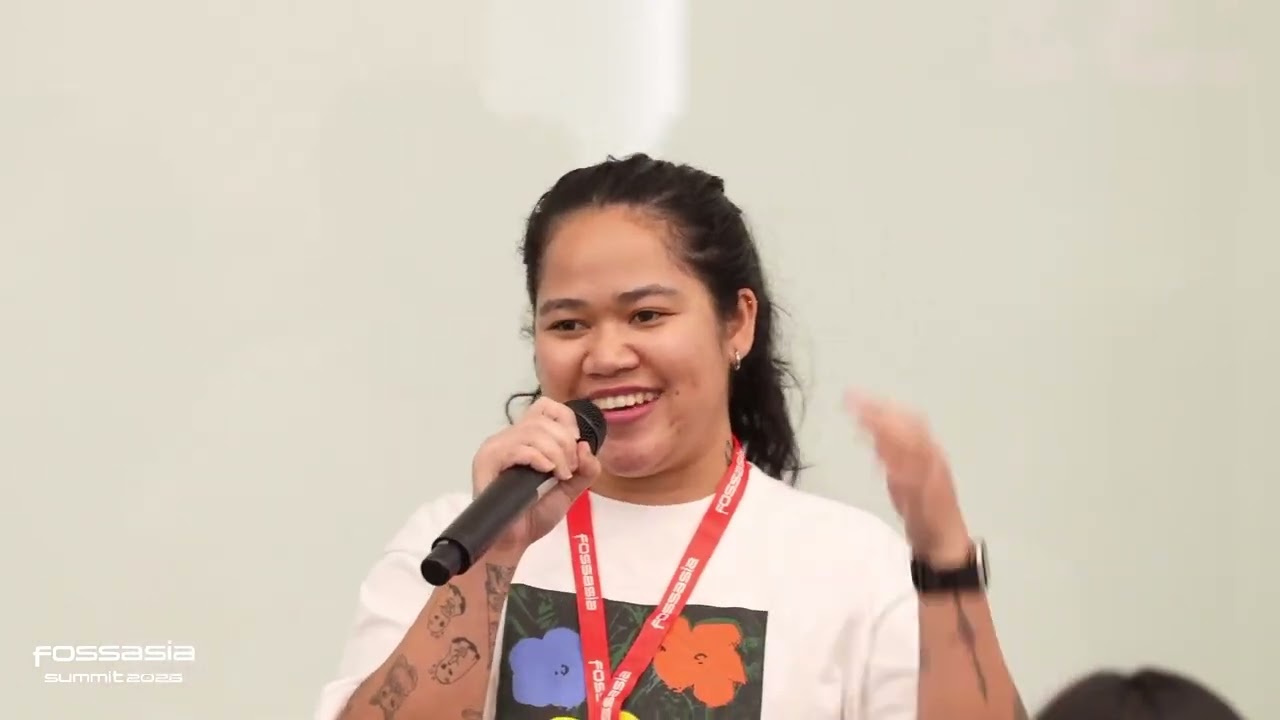
Lightning Talk Series: Voices Across Borders: Building Inclusive Tech Communities, #FOSSASIA 2026
Watch on YouTubeVideo summary
The video features a series of lightning talks from the FOSSASIA 2026 event, where speakers share their personal journeys within the open source and technology communities. Shins, a business administration student from Thailand originally from Burma, recounts how he transitioned from having no knowledge of open source to becoming an active volunteer. He emphasizes that while many people use technology daily without understanding its underlying functions, joining supportive communities allows individuals to learn these skills with the help of mentors and friends. His experience highlights the importance of inclusivity, showing that anyone can start something new regardless of their background or prior experience by leveraging the kindness and guidance of others in the community.
Estela from the Philippines discusses how community building fundamentally reshaped her career trajectory after she initially felt out of place in the tech industry due to a lack of confidence in coding. Through her involvement with groups like Google Developers Group and Women Techmakers, she gained the support needed to transition from a fresh graduate into roles as a web developer and eventually a senior product designer. She stresses that international summits provide more than just technical skills; they expand one's knowledge base, connect people across borders, and offer vital networking opportunities that are essential for career growth, especially for those who might feel marginalized in traditional industry settings.
Tari, a computer science graduate specializing in machine learning and AI, presents his final project, AIGP Doctor, which serves as a multimodal AI orchestration system for medical diagnosis. He explains that as artificial intelligence automates routine coding tasks like writing scripts and creating boilerplates, new graduates must shift their focus toward understanding system-level architecture and integrating various AI models. His project demonstrates this by using an interface that accepts text, images, and voice inputs, which are then routed through different specialized models for analysis before being aggregated to provide a diagnosis with a high confidence level, illustrating the practical application of orchestrating existing powerful models into cohesive systems.
Finally, Velia from Vietnam introduces Event Yay, the next generation platform designed to streamline conference organization for FOSSASIA and similar events. She details how the new system simplifies critical processes such as calls for speakers, review workflows, and schedule management through a user-friendly interface that supports multilingual submissions, conflict detection, and automated email communications. The platform allows organizers to customize submission forms, manage speaker drafts, and instantly publish schedules while ensuring fairness by assigning team members to score sessions and check for conflicts of interest, ultimately making it easier to coordinate complex events efficiently.
Read the full video transcript
Hello everyone. [music]
Nice to see you everyone tonight. I'm
sorry.
Okay.
Where do I start?
In this session I'm particularly invited
for my journey with open source.
So starting with
I have to start with my name of course.
Mina already introduced me but you guys
can call me Shins.
I am a second year bachelor student
learning business administration in DCC
Thailand Chamber of Commerce and I am
volunteering in this event since last 6
month
2025 October.
When I first tried this
volunteering opportunity, I didn't have
any idea about this open source
community. That was my first time and
everything was so new to me.
And at that time I met with really good
mentor like Hong and Valia who had
helped me along the journey. And also in
my team our recent lead,
I have a partner who called Amos and he
was very helpful along the journey. So
it was really good to get into a place
that where people are helpful and kind
to each other. And right now I am here
standing here to share my journey and
then to inspire more people to join this
community.
The reason is that we use technology
every day. Everybody uses phone and
MacBook everything
but we don't actually know the feature
and the function and I think that maybe
if we pay more attention and if we have
friends who understand about these
stuff, they will easily explain it to
you. For me
I am really weak with technology but as
a business major student I have to use
every day. So
after being here for a long time I've
learned how to use AI properly and I
know that which website can help me
write this
proper thesis and proper assignments and
it was really a good thing and I can see
that my academy have been
uh significant improvement. I can see
that. So, uh to end this session, I what
I want to say is I'm originally from
Burma. I'm here in Thailand and now I'm
participating in the even where people
all across the border are
communicating, networking, and
networking with each other. It has
really been a long journey. So, if
anybody want to learn anything from me
today is that you can always try to
start something new that you have no
experience in it and you can learn by
the help of your friends and co-worker.
That's will be all. Thank you.
>> So, hello everyone. I hope you still
have the energy to listen to us here
women talking in front of you. You may
saw me running around in there in front.
>> [gasps]
>> Um yeah, so I'm Estela. I'm from the
Philippines. So, I travel here just to
join the first Asia
Summit. Um this is actually my first
time
volunteering in the in an international
summit. Um mostly I just joined, so
um I think I'm just going to share to
you how community building helped me
also kick off my
uh community, I mean my
tech career.
So, it's just that because like 10 years
ago, I thought actually like I didn't
have a place in the industry. Um I know
that a lot of you here is
uh coders, like developers, but I think
when I graduated from college, I thought
that I'm not really good with it and I
didn't enjoy. So, I thought that oh
maybe uh
tech industry is not for me. And then
because I've been in the Google
Developers Group and leading our
community chapters there called GDG
Cagayan de Oro and
also community leading Women Techmakers
Ambassador in our chapter. And I've been
with the GDG community for over 12 years
now. And because of that I put it in the
resume and when I
am a fresh graduate
I applied and the first thing the
interviewer asked me is that hey, I saw
that you're a GDG
community leader like a member.
Would you be able to um
organize a Android study jam? And then I
told them, yes, of course. And he was
like, okay, you're hired. And I think
that was a kick off for me. I was like,
oh, so so what would be the
the position because I applied for a
project manager and I'm a fresh
graduate. And he said like, oh, you're
going to be a web developer here. I
believe you can do it. I was like, oh,
okay. And I was what? 20 years old
around that time. And I was like, okay,
then it's a 8-hour drive from where I
live and it's my first time going there.
So my mom just drove me there. But the
thing is that I came from a
very strong
family support. So I grew up with a
privilege also. My mom taught me how to
be kind and how to
you know, like love unconditionally. But
my dad, I'm a daddy's girl. So my dad uh
uh taught me how to be tough. So
[snorts]
I think it's because of that background.
I just went there in a very unfamiliar
city and told him, I can do this. And I
went there be a web developer and I was
like, I didn't enjoy this. I want to do
something else and I love like
strategizing, you know, like doing some
tactics. So I went to um another company
where I have a really great mentor in
there and not just in the company, but I
also met a lot of uh women who inspired
me to continue in the industry and
that's how I became a product designer
and now I'm a senior. So, I would really
encourage everyone to join community uh
summits like this because it because
it's not just teach us something, you
know, like a a skill, but it also teach
us and widen our space and knowledge and
meet other people and I think it's
something that I enjoy the most. So, I
think that's it.
>> Okay. So, my name is Tari. I'm from
Indonesia
uh based in Singapore. Well, I recently
just moved to Hong Kong and I just
finished my computer science study uh
specialization in machine learning and
AI
in University of London and I've been
contributing for sessions since
I think before COVID slightly and then
COVID then I start contributing to First
Asia again.
So,
Okay.
Thank you.
Oh, no.
Okay, so this is me and today I will
briefly talk about my final project.
Um I want you to build something that is
applies to AI because of my
specialization on it and has real social
value on it and also to practice my
future job
and because I just graduated, so I'm
actively looking. If you guys and you
have opening job, let me know.
Okay.
So, here's AIGP doctor. It's a
multimodal AI orchestration for medical
diagnosis.
And why I built this is because as you
guys know, the computer science is
changing rapidly because of AI. And
traditional paradigms are shifting,
especially for the junior developers.
Many small tasks are automated. Like
they can write your
your script, making your task a
boilerplate.
So, I was thinking like new graduates
will need to think more at the system
level or architecture level.
And I think that this final project for
me is uh helping me for to practice
this.
>> [snorts]
>> And the good news is
uh in the first ecosystem today, there
is many powerful models that already
exist. There's a huge research effort
that makes them great. You can find
models that do text, speech recognition,
vision, and there is many more.
And there is also still huge value to
provide it today by orchestrating this
model into a system, by building
interfaces or AI agents, and there's
also more.
So, here is like over high-level
overview of my project design. As you
can see, there is
uh
input web This is web interface input
with user with multiple input. You can
add like voice,
uh text, images. So, when the user give
a voice, it will use Whisper model to
transcribe it into text to like uh
minimize uh the complexity to send it to
the router. So, the router act as a the
orchestrations.
And they will like send this input to
the AI layer, which the AI layer has
multiple AI models, and
they will analysis the input and have
the results
based on what input you put. Like, for
example, there is image,
then they will uh tell the visions to
analysis, or if you add text also, they
will trigger the like bio bird or
clinical bird.
Then, once the input is there, they will
send it to the aggregator,
and
do like the weightings, the weights.
Like, the output will be weighted.
And based on the output, it will send to
the confidence level threshold.
And if the confidence level is high
enough, then we'll then we'll it give to
output uh diagnosis output. Like, for
example, oh, you have a cold.
And if not, then it will send it to the
secondary analysis AI, which there is 25
and 10 llama models. It's basically this
model handling Q&A.
And so, the user can add like follow-up
questions about
the symptom already started 2 days ago.
And with this adding context, it will
trigger the system to rerun the first
AI, and then doing the loop until it
reach the level confidence that is high
enough, then you will get
into the final output diagnosis.
So, this is my final project, and I have
been a small thought about myself, or
like to new graduates or junior
uh developers. So, life for recent
graduate in junior developers are is
changing a lot and fast. Many
traditional tasks already automated by
AI. As like what I say
uh in the first few slide, writing small
script or
creating better codes is easily
automated now, so we cannot rely on
those tasks as our main skill anymore, I
guess.
Uh so, instead we need to focus on the
understanding on the architectures
level.
And that's it. Thank you. And if you can
reach me out if you have a more
question. Thank you.
>> Good afternoon, everyone. Good to see
all of you here. So, um my name is
Velia. I'm an event coordinator from uh
FOSSASIA, and I'm from Vietnam. So, um
today I will like introduce like have a
quick introduce for you about Event Yay,
the next version of the event Yay we
knew now. So, if you are organizing
conference, meet up, or workshop, I
think this very useful for you. So,
today I will mainly talk about call for
speaker, review, and schedule. So, here
is a organizer user interface. So, on
the left on the right, I think uh we
have a list a menu with uh
many functions like setting, call for
sponsors, speaker, manage speaker,
manage session, and then we have a
dashboard and show you like how many
session do we have, and uh we need how
many session do we need to review. Yes.
So, here is a uh user interface. Um you
can submit your session and uh save a
draft or edit.
Yes. So, the good thing about call for
proposal, so you can customizable
submission form. Also, you can file
upload and multiple multilingual option.
And you can choose whether submission
are public or invite only. I mean, that
is kind like you close the call for
speaker form and you still want to give
or sponsor or another speaker to
submit their sessions, so you can create
a set code and give it to them. So, also
speaker can submit draft or final and
they can receive automatic confirmation
email.
Yes. So, also the next thing is review.
After the speaker submit their session,
we have a review process. So, we will
assign our
team member to score session, leave
comment tag, and then we can detect
conflict of interest
to make for sure like it's equal for
everyone. So, the decision process is
simple, just accept or reject or wish
list button. So, for other system, we
need to like download the speaker list
and then we work on Google exercise, but
now what for Event X, we do all in
So, for the final one is schedule
management. You can drag and drop
schedule editor and also the system can
check like speaker room conflict or when
everything look good, the schedule is
published it instantly as a public
program page.
Yes. So, you also can export or import
your data your data like attendee list
or speaker list from different like type
file.
And also there one another feature is
email and communication. So, after the
speaker submit their session, they can
automatically receive an email. So, also
you can We have a lot of built-in email
template you can use or you also can
create your own template and then just
one click, it can send for all all the
people. Yes.
Yes, so that a really quick introduce
about the next Event X. So, if you want
to sharing about even day or the journey
to fast Asia, you can contact me via
LinkedIn or the email. Yeah? So, thank
you everyone.
>> [music]