Video summary
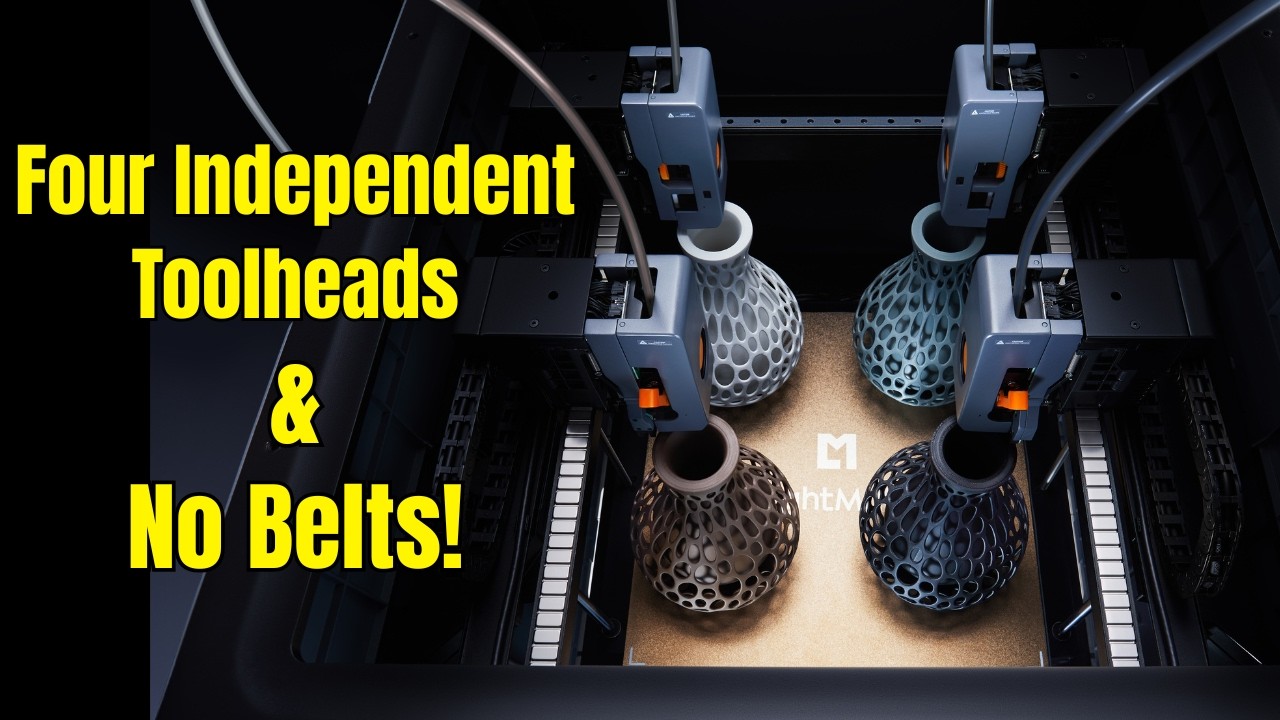
The LightMake L4 is presented as a revolutionary 3D printer that fundamentally differs from traditional desktop FDM machines through its unique architecture of four independent print heads operating simultaneously within a single unit. Unlike systems that merely feed multiple filaments into one nozzle, each of these heads can hold and dispense different types of filament independently, enabling simultaneous batch production where the build plate is divided into four sections to print multiple objects at once. This capability offers significant productivity advantages for print farms or users needing to produce multiples of the same part, though the ultimate test will be whether these heads can maintain consistent quality and reliability over repeated cycles rather than just functioning in isolation.
A major focus of the video is the printer's approach to multicolor and multimaterial printing, which aims to eliminate the substantial waste and time loss associated with traditional color switching. By allowing the machine to instantly switch between pre-loaded tool heads, the L4 claims to achieve a "zero purge waste" workflow where filament unloading and nozzle flushing are largely removed from the process, with head-to-head switching occurring in approximately one second. While this system supports up to 16 colors when paired with an autofilament expansion system, the presenter notes that the real value lies in multimaterial capabilities and the drastic reduction of purge material, often referred to as "poop," which is a common inefficiency in current multi-color systems.
Beyond its print heads, the LightMake L4 features a distinct motion system that replaces traditional belts with industrial-grade direct drive linear motors utilizing non-controlled magnetic propulsion. This design choice is intended to provide superior maintenance-free operation, potentially lasting over 50,000 hours without belt stretching or tension adjustments, while also offering high precision in positioning the print heads within plus or minus one micron. The machine incorporates a monolithic diecast frame and vibration cancellation algorithms to manage the challenges posed by four rapidly moving independent heads, alongside advanced software features like AI smart monitoring and an open-source slicer designed for fleet management and automatic model arrangement.
Despite the impressive specifications and ambitious engineering claims, the video concludes with a cautious optimism that will only be validated once the presenter receives the machine for hands-on testing. The review will focus on practical metrics such as actual filament savings, time efficiency during color switching, motion consistency at higher speeds, and the long-term reliability of the tool heads after thousands of changes. While the spec sheet suggests a powerful new tool for 3D printing, the true measure of the L4's success will depend on how well it performs in daily use, whether it lives up to its promises regarding waste reduction and precision, and if the ambitious hardware can overcome the inherent engineering challenges of managing four independent print systems.
Read the full video transcript
Take a look at what's happening here.
Those are four print heads and they're
all printing at the same time. This
isn't four printers. It's only one. And
those same print heads can switch in
approximately 1 second. They're designed
to dramatically reduce the purge waste
that comes from normal multicolor
printing. And the motion system moving
all of this doesn't even use traditional
belts. Now, there are pretty big claims
being made about this printer, and I
haven't tested any of them yet, but
that's all going to change soon. This is
the LightMake L4, and I'm going to be
getting my hands on it soon to put it
through all of its paces. But before
that happens, I wanted to take a closer
look at what LightMake is actually
building here because on paper, at
least, there's a lot that makes the L4
different. Let's talk about the obvious
feature. There are four independent
controlled print heads inside of the
LightMake L4. And that's an important
distinction because we're not just
talking about four filaments feeding
into one nozzle. Each of the four print
heads can hold its own filament or
different types of filament at a single
time. And the light make can use those
heads in a few different ways. The first
is simultaneous batch production. The L4
can divide its build plate into four
different sections and print four models
at the same time. for production work
that immediately gets my attention. If
you're running a print farm or producing
multiples of the same part, being able
to print four objects simultaneously
could offer a pretty significant
productivity advantage. But that's
actually something I want to test
because having four tool heads moving
simultaneously is one thing. Having four
tool heads produce consistent parts with
consistent quality over and over and
over again, that's the part that matters
to us. And that's the first thing I'll
be looking at as soon as I get my hands
on this machine. The second big
advantage of having four independent
print heads is multicolor and
multimaterial printing. Each tool head
can stay loaded with a different
filament or a different type of
filament. So instead of constantly
pulling one filament out and loading
another one in and then purging the
nozzle and repeating that process, the
L4 can actually simply just move to
another tool head that's already loaded
and ready to go. And lightmake says that
switch can happen in approximately 1
second. If that works reliably, that's a
huge deal because one of the downsides
of many current multicolor systems out
there isn't necessarily the color
capability. It's everything that happens
between those colors. Filament has to
unload. Another filament has to load.
The old material has to be flushed out
from the nozzle. And all of that takes
time and creates waste or or poop as we
like to call it. With dedicated tool
heads, you're eliminating much of that
process. Lightmaker calls this zero
purge waste. Now, I do want to put a
small asterk next to that, though. It
doesn't literally mean nothing besides
your model is being printed. The L4
still uses a minimal prime tower, but
that's very different from repeatedly
flushing large amounts of filament
through a single nozzle. So, rather than
the marketing term, what I'm really
interested in testing is how much
filament does it actually save? And just
as important as that, how much time does
it actually save? Because if the
difference is a significant, this could
be one of the L4's biggest advantages.
Now, we all know there are a ton of
different tool head changers coming out
right now, and I have a couple of them,
but I'm really curious to see how the
Lightmake L4 stacks up to them using
those four individual heads. When paired
with LightMake's autofilament expansion
and dry system, it's kind of
long-worded. They say that the L4 can
support up to 16 colors. Personally, I'm
more interested in the potential for
multimaterials than I am for 16 colors.
I just don't use 16 colors or even four
or eight very often to be honest. But
really, the four tool head system isn't
the only reason I'm interested in
testing the L4 because there's another
major difference hiding inside of this
machine. There are no traditional motion
belts, no belts that run the drive
system at all. Light is using
industrial-grade direct drive linear
motors with non-controlled magnetic
propulsion. And that's a very different
approach from the belt and pulley
systems we're used to seeing in the
desktop FDM printers. Now, there are
some potential advantages here. One is
maintenance. Belts eventually wear. They
stretch. They require tension
adjustments. And ultimately, they need
replacement. Light is claiming that
their linear motor architecture is
actually designed for more than 50,000
hours of stable operation without belt
tensioning or replacement. That's an
impressive claim. But let's be clear,
I'm obviously not going to run this
thing for 50,000 hours before I make a
review on it. It's just not possible.
But I can test things like motion
consistency, print quality, noise,
vibrations, and how the system behaves
at higher speeds. And precision is a
really big part of their pitch. The L4
uses a closed loop motion system that
continually monitors positioning and
makes adjustments in real time. Light
specifies plus or minus one micron of
closed loop motion precision. That
number sounds incredible, but there's an
important distinction here. That does
not mean your finished 3D print suddenly
has plus or minus one micron of
dimensional accuracy. Those are two very
different things. You've still got
extrusion and material shrinkage and
layer height and temperature and all the
other variables that are involved in FDM
printing. The claim specifically relates
to the motion systems positioning. So,
where the print heads are actually at on
the print bed, because ultimately that's
really all we care about, uh, how the
prints come out off of the machine when
it's done printing, not just how
impressive the number looks on a
specific spec sheet. Now, let's talk
about the size of the build plate,
because it's actually a pretty big
factor here on the L4. The build area in
single color mode is 354x 370x 386. In
multiolor mode, it is 354x 350x 386. And
in fourpart batch production mode, each
of those four sections measures 177x
195x 386. Lightm also claims that they
included quite a bit of technology
around the core hardware. There's a 6
and 1/2 in color touchcreen. AI smart
monitoring, RFID smart material sync,
one tap fleet deployment and cluster
management, which is part of their
slicer. I believe you can see all of the
printers you have and be able to deploy
like to all of them if you want to,
which is going to be really cool. The
lightmake slicer is free and open-
source with features being developed
around automatic model arrangement,
centralized farm management, and smart
task allocations. Now, these are all
things that they said in their
marketing. Um, and I'm really curious to
see how it goes. And yes, it's built off
of another slicer as far as, you know,
where it started. Tell me in the
comments if you recognize that slicer.
There's also a 5 mm independent tool
head lifting mechanism that allows the
actual tool heads to go up or down 5 mm,
which is kind of cool to see. That
combined with micron level compensation
is designed to improve first layer
adhesion and reduce warping. Again,
something we're definitely going to have
to test, but it is cool that each
individual tool head can move up and
down. And we all know that four rapidly
moving independent tool heads will
introduce some interesting vibration
challenges. Lightmaker is using uh what
they call a monolithic diecast frame
along with the vibration cancellation
algorithm to try to beat this. Now there
are a lot of claims here by LightMake.
Some are going to be easy to test and
demonstrate and others I'm just not sure
how I'm going to be able to show. But
that's really why this printer has my
attention because there's going to be a
lot of new stuff to actually check out.
On paper, there is a lot to like. But a
spec sheet can't tell us how reliable
those tool heads are going to be. It
can't tell us that 1 second switching
remains consistent after hundreds or
thousands of changes. It can't tell us
how much filament we're actually going
to save. And it definitely can't tell us
what it's going to be like to live with
this printer every single day. And those
are the questions that I want to answer.
And if you're interested in the L4 and
want to check it out, LightMake
currently has a VIP offer available
ahead of the campaign that they're going
to be launching. For a limited time, you
can put $50 down as a VIP deposit and
get up to $1,300 off the LightMake L4.
And if you pledge within the first uh 48
hours of launch, I believe they're
actually going to include four spools of
PLA filament. So, there's another four
spools you don't have to buy. I'll have
the official campaign link down in the
description and probably in the pinned
comments where you can go and check out
the details for yourself. If it's
something you're interested, definitely
do your research on this. And keep in
mind, this campaign is for a new
product. Make sure you understand what
the terms, the timeline, and the pricing
are, and all of the normal risks
involved before deciding whether it's
right for you. For now, I'm cautiously
optimistic about this one. There are
some legitimately interesting
engineering ideas here, but ambitious
hardware also creates ambitious
engineering challenges. Once I have the
machine in my hands, we're going to test
the claims and find out if this machine
can actually do what they say it can do.
So, if you want to see that, make sure
you're subscribed. And in the meantime,
let me know in the comments what's the
first thing you want me to test on the
L4. the forehead batch printing, uh,
multicolor, tool switching, the the
linear motors, or something entirely
different. Again, I'll have the link in
the description below for the campaign
if you want to check it out for yourself
and learn more. If you like today's
video, hit that like button. If you
haven't subscribed yet, do that so you
can see the video that's coming up when
I do the review. And if you want to see
more 3D printing, laser, and CNC videos
that I have coming up very, very soon.
to make it easy [music] for you. Click
the logo right here to subscribe. And if
you haven't checked out this one, you
definitely want to check out that one
next.