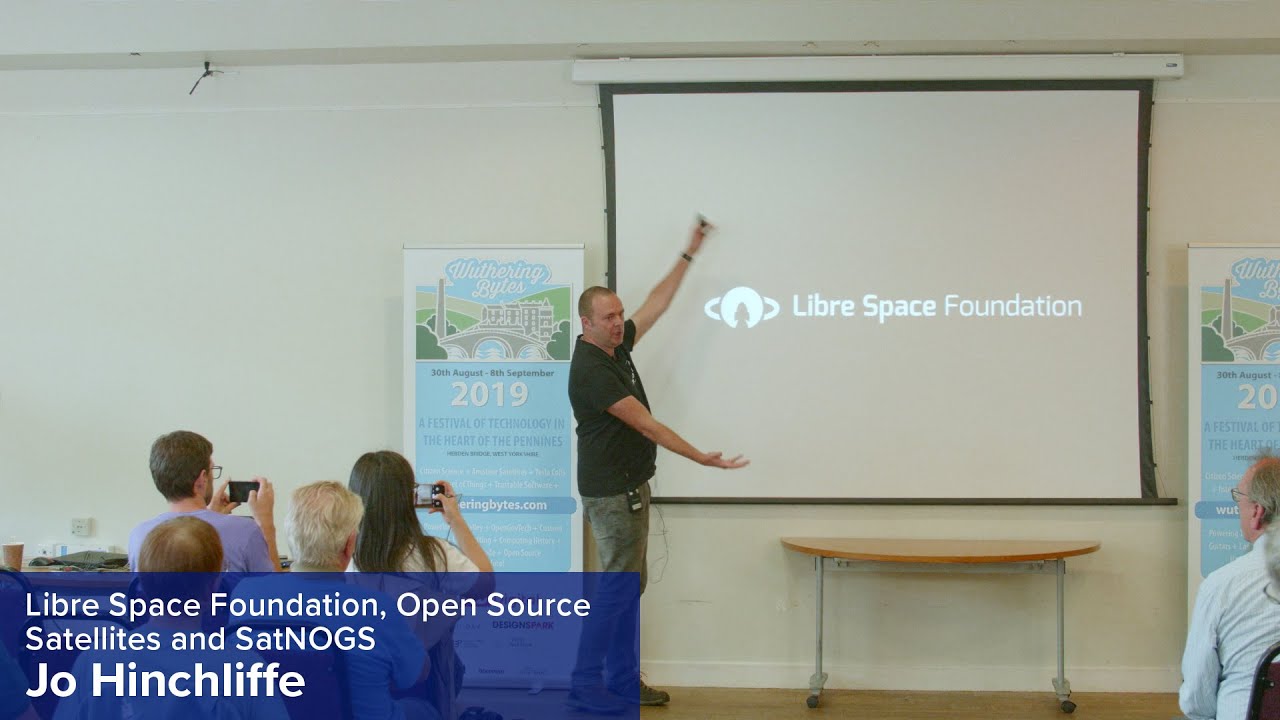
Libre Space Foundation, Open Source Satellites and SatNOGS, Jo Hinchliffe (Wuthering Bytes 2019)
Watch on YouTubeVideo summary
The Libre Space Foundation aims to democratize access to space by making it feel closer and more accessible to everyone, moving away from the exclusive image of massive government facilities like NASA or ESA. A core principle of their work is operating in an open-source manner while deliberately avoiding traditional defense and warfare methodologies often associated with aerospace development. The foundation's journey began with a specific project called SatNOGS, which originated during the 2014 NASA Space Apps Challenge when a team from Hackspace Greece developed a low-cost ground station design to network together listening equipment globally. This initiative successfully won the Hackaday Prize in late 2014, providing the group with significant funding that allowed them to expand their operations and formally establish the Libre Space Foundation as an entity dedicated to these open-source space endeavors.
Building on this foundation, the organization leveraged its growing network of ground stations across the globe to collect vast amounts of data from academic satellite missions that transmit openly into orbit. This collected information is stored in a publicly accessible database, providing researchers with significantly more data than they could gather independently. The community's growth was further catalyzed by their involvement in building and launching their own CubeSat named UPSAT as part of the QB50 mission. Although the project faced delays due to integration issues on the International Space Station, it ultimately succeeded thanks to a collaborative effort involving mechanical engineers, electronics experts, and global volunteers who contributed code and resources via open-source platforms like GitLab.
Beyond satellite tracking, the Libre Space Foundation actively promotes amateur rocketry through scratch-built designs using entirely open-source tools for simulation and circuit design. Their influence expanded significantly after partnering with ESA at an Open Source CubeSat Workshop held in Darmstadt, which brought together a diverse international group ranging from hobbyists to high-level academics. This partnership established them as trusted collaborators within the European Space Agency's ecosystem, leading to further funding opportunities for agile teams working on software-defined radio applications and other space-related challenges that large industries might overlook. Additionally, they are currently exploring partnerships with institutions like Harvard and the Smithsonian to improve metadata standards for satellite data, ensuring better organization and accessibility of information from various sources.
For individuals interested in joining this movement, setting up a ground station is presented as an achievable task rather than a complex engineering feat requiring specialized knowledge or expensive equipment. The process involves creating an account on their website, inputting location details obtained from Google Maps, selecting antenna types compatible with specific frequencies, and submitting the information to receive a dot on their global map. Once operational, these stations utilize open-source software like Gpredict to predict satellite passes, allowing users to schedule observations that automatically record audio or data packets when satellites fly overhead. The resulting data is stored in the public database where community members can build custom dashboards using tools like Grafana to visualize information, decode signals, and even share creative elements such as quotes from video games embedded within the data streams received from space.
Read the full video transcript
so i'm here to talk about a thing called
libra space foundation and tell you the
uh story of the libra space foundation
and i'm gonna kind of tell you the story
by talking about the projects that the
libra space foundation delivers so just
for now the libra space foundation the
the kind of main aim of the libra space
foundation is to make space uh seem a
bit closer to everybody because we often
think like spaces as ben sort of alluded
to in his great talk this thing that
happens at nasa esa in these massive
buildings that we don't have access to
and stuff like that and libra space
really want to kind of democratize space
and bring it closer to us
and also critically they want to work in
an open source way which i'm pretty sure
most of the people in this room will
have a mere inkling of what that might
mean uh and also um
they um sort of a bit political i guess
in that they want to kind of develop
space stuff but outside of the kind of
war and defense kind of methodologies
that that is the kind of classic way
that the stuff seems to get developed in
space so let's just do oh i should have
said some stuff about me uh yes i'm joe
i'm uh aaron's concrete dog i'm a
freelancer um i have never ever grown up
or made my mind up what i want to do in
my life so currently at the moment i
write for hackspace magazine i do a bit
of work for these uh this lot and i uh i
tinker with things i like machining
things i make stuff i'm yeah one one of
them and yeah there we go right so
who's heard of satnags
oh that's pretty good i've been i've
been in rooms where that's just been
like the tumbleweed comes across and
stuff so satnogs is the first uh project
of the libra space foundation
and in fact it existed before the libra
space foundation was even a thing and it
came out of this thing called the nasa
spacex challenge apologies to any
american people in the room for that
terrible accent um has anybody heard of
nasa space apps
no so nasa's oh yeah a couple of people
so nasa space apps is like um nasa run
this thing where they set up um
uh
hackathons and they all happen
concurrently around the world on the
same weekend so um they're there and in
local individuals like so somebody in
hebdon bridge from bridge rectifier
could go we're going to run a space up
challenge in hebdon bridge and they get
in touch with the team and they get sent
resources and materials and branding
stuff and they can run their own kind of
hackathon
in line with all the others happening
around the world on the same weekend and
they pick themes so they sort of set
some challenges for these these these
hackathons and way back in their 20 the
beginning of 2014 they had um a nasa
space out challenger one of the themes
was satellite communication
so
cut to greece and a hackspace called
hackspace greece uh in athens they went
really imaginative with the name i think
and uh a bunch of people got together
and uh formed the team as part of this
nasa space app challenge and they
basically came up with this and what it
was was it was this idea of so you've
got a satellite you've got a cubesat or
you've got a pocket cube there's an
amazing uh pocket cube builder in this
very room in front of me so you've got
these these these satellites these small
satellites and they're zipping around
the around the earth in low earth orbit
maybe once every 90 minutes so they're
traveling ridiculously quickly and you
know you've a team has invested a load
of time and money and has tried to make
this thing that does something and
returns some data from orbit and they
want to be able to hear it so the thing
you built to hear it is basically like a
radio but we call it a ground station
and um so lots of universities might
build a mission and they build a ground
station to try and hear their mission
the trouble is is that these things are
zipping past and
they may only get like a couple of
minutes whilst their their satellite is
overhead and that might only happen a
couple of times a week there may be
great sways of time where there because
of the position of the satellite and the
position of the earth they can't listen
to the satellite so the idea that
we came up with
all those years ago was well what if
there was a sort of cheaper way to make
ground stations but we could network
them
so as something went over a ground
station in america it could kind of get
picked up there but then when it dropped
out of that one maybe somebody else's
could kind of pick it up and take over
and we could if we have a network that
are all connected we can massively
increase our coverage
so um i love that photo this is this is
uh my friend pierros and um this is one
of the first ones that was built and
this is on a rooftop in athens um which
is sort of more romantic than set up a
mountain in wales somehow but you know
where i live but there we go and so this
is pierros uh and and this is uh
so one of the first iterations of the
design so there's two antennas there's a
box of goblins with some motors in it
and basically you can you can tell it
when a satellite and a satellite is
going past that you're interested in and
it will turn on a radio start recording
but it will also track over um the sky
and follow it so you get a really nice
signal to your antennas as it passes
over
so that that's kind of uh and this was
of course all open source and they were
trying to reduce the cost and the
complexity so that other people could do
this as well because we wanted to build
this network
and then a brilliant thing happened we
published it on hackaday and at the end
of 2014 uh it won the hackaday prize
and it was the best year ever to win the
hackaday prize because it they gave an
amazing prize which was one you had a
choice actually we didn't take long to
think about it you could either claim as
winners
one ticket for one person to go to space
on a private launch whenever that in the
future became available
or
you could take what they had worked out
to be the cash equivalent of what that
was worth at the time
so being a load of space pirates we took
the cash
and it was a considerable amount of cash
it was it was over if it was in uh great
response it would be over i can't quite
recall but it was something in the order
of like 140 000 pounds or something like
that so it was a it was a good lump of
cash so we all had a mad crazy party we
all know we didn't we didn't um so this
th this happened and suddenly satnags
this project that was just kind of
largely confined to a few people around
the world and and uh centered around
this hackspace in greece kind of had a
load of resources at its disposal
so
it was then that they kind of thought
well there's loads of other things we
could do to try and democratize space
and to make it seem closer for people
and we've got some cash now so we need
to set something up so we became the
libra space foundation of which satnoggs
is a um
is one of the projects
we cut to a couple of years later this
is i love this image that somebody made
somebody in our community made this is a
just a montage a collage of of lots and
lots of our ground stations around the
world it's not all of them by any means
it's just a a collection that was
stacked you can see people have done all
kinds of designs and we have ones for
different frequencies and some of them
have ones that move and some of them
have simpler ones that don't move and
then it's really started to grow and
grow and grow we have this this enormous
network around the world and this is a
little bit out of date now but this just
shows this is if you went to our
satnog's website uh this is the sort of
landing page and it shows you this map
sometimes takes a bit of time to load
and that causes us more problems than
some of the really clever space stuff if
we're honest um but yeah you'll you'll
see there's uh lots and lots and lots of
ground stations um or all over the
planet and but we do have some areas so
if anybody knows anybody in sort of up
here in northern canada
africa as well we haven't made we have
actually just off this picture we've got
a couple down here but yeah any any
contacted areas that have no uh no
coverage there we'd love to talk to you
so um
locally this is where i live it's a bit
of a weird website let you publish
exactly where your house is on it if you
have a ground station in your garden so
i was very proud to be the first person
in north wales uh to have a little
ground station in my garden and um it's
interesting that
you you only need to sort of be the seed
sometimes with with things like this in
our communities that if you're the first
one in the loo area and you're hoisting
up a great thing or you've actually i'll
show you later sent your your 12 year
old daughter up a ladder to fix a big
antenna onto a pole um your neighbors
what's happening what are you doing
there and then they glaze over slightly
to say oh it's a space ground station
thing that i just do as a hobby and oh
okay
um but it it it is true that uh once you
start doing stuff um you can usually
locally other people will follow
so back to the libra space foundation
so what other projects do we do we'll
come back to the satnox thing in a bit
because i'd like to show you a little
bit more under the hood of how a few
little bits work um so the libra space
foundation we have this money we have
this network of satellite ground
stations that listen to all manner of
satellites that are up there lots of
academic missions transmit their data
openly and they love us because they get
back so all the data that we collect
goes off into a publicly accessible open
source database so the academics alike
you return
100 times more data than we could get
have got on our own so we we solve a lot
of problems for people and um
yeah so and we've got this ground
station network you can listen to all
this stuff
what's next so an opportunity arose it
fell into our lap actually um that we
got the opportunity to build and fly our
own cubesat so our own satellite so it
kind of makes sense doesn't it we've got
all this listening gear at our disposal
let's build a satellite and put it up
there so um
we can we can you know we can sort of
complete the loop almost so this is a
satellite that um that was built and
flew and it's called upsat or upsat or
if you're one of my colleagues from
greece they pronounce it oopsat which i
think is just the oops it's just
brilliant um so it's a sort of two and a
half unit cubesat so it's about this big
and yeah it was it was interesting
because it was part of this bigger
mission called qb50 which this
organization basically wanted 50 of this
certain type of radiation sensor to be
flown in low earth orbit and what they
did instead of just building 50 of their
own cubesats and chucking them up they
sort of put it out to tender and said
anybody can build one of the ships so
long as it interfaces this sensor sends
the data back in this way and you know
we welcome applications so i won't
mention who it is but an organization
applied and were accepted to build one
and they had um
they had around uh i think it was just
short of three years to realize this
project
six months from the end of this when
you're supposed to be sort of putting it
in a box and and very carefully and
posting it to the people and they got in
touch with us at libra space and said
we haven't built it
it's all gone wrong
it's been a bit difficult really we sort
of bit off more than we can chew
um can you help us so we said okay well
we've got some mechanical engineers
involved in our group and we've got a
lot of electronics engineers let's look
at what what you've got
this sort of small
sort of sketchbook of not not very
complete ideas came across and so um it
was quickly apparent that they they
didn't have very much and so we actually
said to look we'd love to be involved in
this and but i don't think we can we can
do it together i think the the only way
we could kind of do this is if we took
the project
and kind of chucked our hacker ethic at
it yeah so we had six months we got this
this gig to build and launch a satellite
and we we started from nothing so we
literally
opened a well it was a github then it's
on gitlab now we opened the repo with
nothing in it you know readme
um build bill's hotelite
submits commits
so yeah so six months have been said but
we did have some money because we had
this cash from the hackaday prize so we
paid some of our kind of real key
contributors who were available to give
some time so we started paying some of
them to work on it and also we leveraged
the community there were loads of people
around the world just chucking little
bits of work into this a couple of hours
here a couple of hours there but there
was a core sort of in in in greece and
around europe that were
living this there are people who still
twitch when you talk about the upsat
development but six months later well
four months later away it went and it
was deployed and we we delivered on time
and um the way that this one got
launched was through a company that i
think ben mentioned in his it was called
it's called nano racks and it you know
it's really i mean it is quite technical
but it is essentially a jack in the box
on the international space station on a
robot arm and so um it goes up on a
rocket they unpack it they stick it in
the international space station you go
on a jobs list and eventually they get
down the jobs list they unpack your
thing check all the things you've said
remember to plug that in and pull that
out and do this they put it in this jack
in a box and then at a very precise time
and precise direction they they push it
out and um yeah so that's kind of the
story so it went up on this rocket so
this is uh an atlas v with a
cygnus um resupply mission so i like to
tell my kids that it went up and it was
wrapped up in like the astronauts pants
and clean clothes and all that kind of
stuff just you know because
that's what children are for just to
make nonsense up and let them believe it
um so yeah and so uh but unfortunately
it was delayed massively delayed
massively it was integrated packed in
all put in position and then it took
about another
i think it was supposed to launch in
like three months time but it took six
months which that you know we've all
stopped this crazy period of work and
we're like oh my god did i did i plug
that battery in did
when i soldered that when i was drunk
was that a good idea like
i don't know so it's a nerve-wracking
time and then it got to the
international space station and then it
sat there for
ages and that was utterly heartbreaking
and depressing and very difficult but
i've got a tip for you okay so if you
ever end up with a satellite on the
international space station that you're
waiting to get deployed by the
astronauts on the international space
station the best thing you can do with
your time is get on twitter
and talk to the astronauts on the
international space station and blag
them and say when it launches please
please please would you take some
photographs of our satellite being
launched and they get eventually go oh
if you just shut up we'll do it
so the next slide and i really hope it
works because sometimes it doesn't but
it should work cause it's on my computer
is it is a little uh animation made up
of about um 12 frames so what you're
about to see is our little tiny
satellite up sat at the back of three
satellites getting chucked out into
space off the international space
station
we're at the back
and that is literally we annoyed an
astronaut on the international space
station oh god it's that day i'd better
go in the coupler with my camera and
take some photographs
yeah so there we go so yeah so we built
that what else do we do we do loads of
other things we've got a whole set of
repos that are um so i'm really
interested in amateur hyper rocketry i
think it's a great stem activity and
it's i mean it you know rockets we saw
in ben's thing rockets just evoke a
great sort of feeling of excitement i
feel and uh so we have a lot of stuff
we've got some repros around uh open
source avionics stuff to measure
you know pressure height and to deploy
different aspects of
explosive charges that you use to break
high power rocketry stuff apart and so
we've got all that's an ongoing project
that we've we've got and uh one of my
next speaking engagements after this is
i'm going out to a thing called the open
source cubesat workshop which is travels
around each year and this year it's
actually out in greece and i'm going to
be hosting a roundtable discussion with
people from all over the world hopefully
if they come because it's an optional
roundtable um about how how can we
develop like a global open source um
rocketry road map i don't even know if
it's worth doing i don't i don't know
the answers at all but i want to have
that discussion because we see things
like i don't know if you've heard of
copenhagen suborbitals who are trying to
build an amateur crude and not crude as
in uh it will have crew on it not crude
as in like war crude um they've they've
got a crude um uh suborbital uh mission
that they're trying to build as an
amateur group and we've and you know
we've got all these interesting things
but what we haven't got is a is a truly
open source kind of um approach to to
rocketry so i do a lot of open source
orchestra this is a picture of one of my
rockets it's not quite as impressive now
after ben's talk is it but you know in
real life that's about this big um and
uh the thing i love is um i love um
completely scratch building rockets so
everything on this is scratch built
apart from the motor because as a member
of the uk rocketry council i have to
inform you it's actually illegal to make
solid rocket propellants in the uk as an
amateur and but everything else so the
parachutes that it kicks out every
everything i make because i'm that kind
of um
well some would say idiot really i'm
that kind of idiot because it's you know
what better use of my time than to stay
up to three in the morning sewing a
small cross-form parachute on a on a
sewing machine that i've laboriously
done all the maths on well i could just
buy one for 17.99 but you know um
yeah and and i love talking about
rockets i love kind of publishing stuff
so again um if you find me concrete dog
or your fan of libra space uh stuff
there's open repositories with with
rocket designs in and and also not just
uh it's not just an open design
we tend to use
open source toolpaths for everything so
like if you're looking at one of my
rocket repros
the design simulation and flight
simulations and stuff are all done in
open rocket which is a free open source
little application for for designing
rockets um you know
all our all our electronic stuff is done
in a uh key cad which of course we send
to uh osh park the finest uh pcb
fabricator is on the front row i've got
to say that
you'll get me um so yeah so uh it's all
up there and then what else does libra
space do so and this was a really
pivotal move for us at libra space this
is a picture at the end of the first
open source cubesat workshop which i uh
mentioned earlier this was held out at
um oh where was it held darmstadt so
they have um
what's the damage that one esoc
yeah so it's the sort of um they do all
the
command and control stuff of stuff
that's actually in space and orbiting
mars and all that kind of stuff there
and that's where all the data comes back
to for the european space agency and
they've got a big kind of conference
suite there and so we we partnered with
esa
and to deliver this open source cubesat
workshop um and it brought people from
from all over the world we had people
from like uh
these two gentlemen from jaxa from the
japanese space agency
people from uh i remember this young
lady was from canada you know like it
was a truly sort of global meetup and it
was interesting because it was one of
the first things that east has done that
wasn't just industry it had
people like me there going hello i build
rockets in my shed in north wales
through to you know like like sort of
high-end academics and all kinds of
different people
and the really interesting thing about
it was oh well there's two two uh things
that i found interesting one is that i
got to talk and that is just terrifying
sadly i mean it's terrifying speaking in
front of anybody but going on a stage at
issa and just feeling like the least
eminent person ever in front of this
room and then somebody just before i
went on this guy who's a french guy who
works for ezra called red red one came
up to anyone
you know they they stream this to uh the
issa um television channel i've just
checked we have uh we have like
seventeen thousand people watching
and then he handed me the microphone
hello
yeah terrifying um so uh yeah but the
the brilliant thing for uh the
interesting thing for libra space was
that um we became uh a sort of known um
a known partner who could work with issa
so from this very simple thing of a
workshop partnering on a workshop that
we wanted to deliver together it just
meant that we were on their radar on
their systems as a partner that can be
involved financially with the european
space agency
so
since then we've we've built on that uh
relationship and we've we've actually um
started to receive quite a bit of
funding for different projects from the
european space agency which is just mad
when you think you know it's a group of
hackers uh in
a greek basement and now it's like oh
yeah they've given us some money from
the european space agency so this for
example is one of the projects that that
we're uh
involved in and we're delivering so esa
gave us a chunk of money to basically
address a load of things that they want
developing to do with space applications
for software defined radios
and they realized that perhaps some of
these little problems that they had
weren't ever going to get solved in like
big industry and it actually perhaps
needed kind of small little kind of
agile kind of groups to go oh yeah we're
really good at that and we'd love to do
it we've got the passion for that
we'll take that on and this funding that
the libra space have allows us to give a
little bit of funding it's
geographically uh sort of um boxed into
europe so
what happens in a couple of months don't
know but there we go but it means and
that we can we can give groups little
bits of funding from us and sort of
subcontract
stuff from esa by us to allow people to
to deliver these workloads that we we
manage and and when the repos are full
of all the stuff that solves it to esa
to our satisfaction we can send them
into to esa and fulfill our kind of
obligations with them so it's a
fantastic opportunity there's lots of
little businesses and teams all around
europe working on some of this stuff
um oh actually i thought i had another
slide there outrageous
and we've also so i'll do it off cough
we've got um we've just done a bit of
partnership was just starting a really
innovative bit of partnership work with
um
the center center for astrophysics
harvard and smithsonian
which is a libra the library of the of
the astrophysics department and they've
got this thing that they want to do
about um how metadata of all this data
that comes from satellites kind of gets
um logged and what the sort of schema
that what the metadata looks like and so
things like that we're starting to sort
of broaden our kind of wings into into
other things and it's largely because we
have this big resource of data we've got
so much data from from satnags that it's
a really useful tool for other academic
sort of people to to throw work out and
develop
so back to satnags um how am i doing on
time i'm all right i think yeah yeah i i
wanted to just give you because loads of
people hear me waffle on at great length
and you're doing very well none of you
have fallen asleep yet i don't think but
and lots of people think oh it must be
incredibly complex having a ground
station in your garden and blah blah and
if there's one thing i want to leave you
with today is that it's dead simple if
people like me can do it anybody can so
it's all on a website so if you've liked
logged in you know if you've signed up
for facebook or something you're you can
pretty much do the website stuff because
it's dead easy so basically you log in
and you create an account so this is me
that's my amateur radio call sign you
don't need one of those there are there
are stations on there that have like
lovely names of le where they are there
are other ones that people have just put
jeff's station you know you can call
them whatever you like and and basically
you set up an account and then you can
set up a station and you put in some
details that you get off google maps
about your your location you work out
how high you are and you work out kind
of um what's the minimum horizon so that
means if you're between two buildings
your horizon is going to be a higher
number because you can't see as much of
the sky if you live halfway up a
mountain you don't know what to put so
you just put in 10 because on one side i
get nothing
but on the other side i get everything
so that's all that is you put in some
details about the type of uh aerial that
you have which um
means which frequencies you're you're
available to listen to and you kind of
click submit and you get a little dot on
the map
and on the website once your station's
up and running and um the if i scroll
down from from where we were before this
is what i would see so it automatically
uses loads and loads of open source
software it uses things like g predicts
and loads of new radio modules and all
this kind of stuff and it pulls together
um a three day long list that
continually updates so you can get three
days worth of these into the future and
what these are are these are past
predictions of things that are going to
go over your station so wherever your
station is is sort of represented in the
middle here and each one of these is a
satellite that's going over
here it's making this journey between
these times on on that particular date
and
nobody we track thousands and thousands
and thousands of of satellites so nobody
remembers what what all of these are i
know what that one is because it says
iss so there's a good chance that's the
international space station i i've maybe
been into it long enough that i know
what a few others are but i i totally
don't know so we've made it that if you
click on one of these
you get a nice pop-up and that tells you
a little bit about um the satellite and
that's going past so this is a an
amateur radio satellite and called fox
1b and it gives you some sort of the
success rate of people hearing it when
they've made an observation and and some
of the details about it so it's you know
it's all pretty kind of usable so if you
think oh yes that's good it's going in
my house i'm interested in that you
would then click the schedule button and
you simply get a little
check check box really gives you the
same information it shows you sort of on
a timeline where it's going to be some
of the satellites have different
transmitters that transmit on different
frequencies or do different bands or do
different data on different transmitters
so you might get a drop down selection
here that you select what you want to
listen to when you're all ready you
click schedule
click schedule the observation was
successfully scheduled you'll get this
page that should unless you click the
big delete button in the corner this
should just exist forever and and
basically it's got some details about
your station and what the uh what the
observation is of and then it's empty
because it's not done the observation
yet it's going to happen in the future
so you've got a waterfall tab an audio
tab and a data tab
so when you come back
after the allotted time if everything's
gone well the the the doohickey in the
box in your garden has turned on it's
recorded some audio it sent it to the
web the web it's been stored and it
produces a an image of the the audio
of course then you can click the audio
tab and you may get um you'll get an
audio wave of the um the the recording
with the data in it if that's uh some
sort of data when you click play it may
sound like a you know a zx spectrum uh
loading a game
[Music]
and for the bpsk fans that was a secret
message for you all um
so um but but also we do have some
observations that are um audio so for
example we i'm gonna play in a little
bit i've got some clips of audio uh
listening to the astronauts on the
international space station so it could
be audio and then uh you might click the
data one so the data might just be you
know
frames of data that don't really really
do much but it might be
what's my next slide actually before i
give the game away i know um so there
might be frames of data and then all
those frames of data get stored on the
satnox database which is again this open
public database that anybody can go into
and use
um
[Music]
sometimes data might be images and it
might be decoded here but the other
thing that lots of our members of our
community are really into at the moment
is we um
we we send all this stuff into our
database and then members of the
community pick a satellite that they're
interested in and they build a um they
build a dashboard usually using a tool
called grafana if any of you are
interested in that kind of stuff it's
quite a popular tool at the moment and
they'll build a dashboard that nicely
displays the stuff that's in the data it
will decode it if they've shared those
details from the mission of how to
decode it and they'll decode it and
stuff so the next one i'm going to show
you is a nice one this is the university
of texas launched a cubesat that they
called armadillo
apparently you have to say it like that
they told us on twitter um so uh the the
this is sort of
there's other stuff on the dashboard
that's maybe more sexy but it's got some
stuff about times and frames and it's
got some uh stuff about the frame count
and stuff but the thing that they did
you can't really see this but the thing
that they did which has kind of really
excited some some amateur radio people
is at the end of every data package
they've put um a quote from the game
portal 2 in
so
so this this this dashboard we've built
just comes up with quotes from portal 2
which which just continually populate
these random silly lies like there's one
that just goes
whatever
it's like brilliant uh what is this one
the situation is hopeless oh there's one
that yeah just repeats don't like space
don't like space and they're all quotes
from portal 2. but the interesting thing
about that is that it really energizes
the community because they're like it's
not just a load of dry data coming back
they're like oh i've got to schedule
that observation because what's in it
tonight or this week or whatever
um
the other thing that we get is we do um
a lot of the weather satellite images
are open and available for anybody to
have and there's this beautiful thing
this beautiful thing that you can do
right so you can work out when there's
going to be a really nice um weather
image over your area of the world so
like for me it would be whales in the uk
and you know some of europe and i and
you can work out that sometimes that
everything aligns sounds like i'm going
to be a bit cosmic now but everything
aligns that you've got an observation
coming over just as the sun is rising
and you're going to be able to get like
a dawn image of above where you live and
it'll show all the mountains in shadow
and stuff so i this happened once for me
and i was like oh this is going to be
amazing
i'm going to get like you know all like
we have to see the pyrenees maybe in the
alps and there'll be shadows and then
there'll be the uk and there'll be
whales and of course it was cloudy
totally cloudy but there we go so yeah
but we get lots and lots and lots of
different types of data including
there's this brilliant program run by
amateur radio enthusiasts around the
world called aris
which enables school children to talk
via amateur radio to the international
space station and we um
regularly record
the side that comes back from the
international space station and then we
we link it back to aries so that they
have a record of the conversations so
these are all taken the next two clips
are two short audio clips you've got to
remember this audio has come from space
and been picked up by an antenna in my
welsh garden so it's not the best of
audio quality but it's not too bad and
uh the first one i believe is a
gentleman on the international space
station called scott tingle that's a
name isn't it and and he's talking about
his ride up
uh
um
[Laughter]
[Music]
can you imagine being a like a 12 year
old 13 year old at high school and you
know people turning up setting up all
these aerials and then like chatting to
elections like yeah and then we're after
the races i just think that's that's a
really cool project the next one
is dehydrated chili so that's great also
we have food from different countries so
we can share uh between the russian food
the american food canadian italian
european french
japanese so that's great that's for the
kind what we live on a gmt the time of
london that's an obituary decision it's
halfway between houston time and muscle
time so we eat our meals
on that time so now here on board it's
about 9am i've had breakfast a couple
hours ago and i'll have lunch uh
it sounds rather pleasant doesn't it
cuisine of the world yeah
so there we go we're getting to the end
there but i just wanted to chuck a
couple of slides in there i showed this
picture earlier of this big moving
tracking one and lots and lots of people
in our community do build these but a
more common entry point is for people to
build a static one so i wanted to just
show you that what i have in my garden
there we go um it's a rare day oh my all
the greek team didn't believe that this
was my ground station because there was
blue sky in it the greeks the greeks in
our team just think it's gray here
continually so yeah and this is my
ground station wells it's on a
scaffolding pole or what quite a long
scaffolding pole that i've cemented into
the garden i know my partner loves me um
and it has a small waterproof box and
then this is actually a commercial
antenna but you can lots of people make
it even cheaper by building um antennas
themselves and this uh as i told you my
my daughter i think it's essential that
uh young women have ladder skills i
don't know where that's quite come from
but i just felt it was very important
and saren my daughter loves it she loves
girly up and tinkering and she loves
listening to the stuff that's uh that's
coming back from it and looking at the
data so it's um it's nice that it's
become a family thing even though my
partner again is like why is she up a
big ladder um
but
in the box there's nothing too too
exciting um it's uh this is sort of uh
the the equivalent kit but on the desk
so there's a waterproof box there's a
raspberry pi which needs an sd card with
a special image that we've got on our on
our um uh satmos website there's a
couple of clamps to put it on the pole
some cables we do a thing called power
over ethernet which means that it gets
its power and its internet connection
through one cable so you only have to
drill one hole in your gable end and uh
yeah as i say this is a commercial uh
antenna that um we use usually when well
either if you've got the bully or if
you're building one to install in
somewhere else it's just a quicker way
to do it but lots of people build these
with like home built antennas built out
of all kinds of cheap and findable
materials and so yeah that's that's just
that's kind of it you need an internet
connection and some some stuff that i i
would guess quite a few of you probably
have in your homes or layers already so
uh yeah that's me um i write for
hackspace magazine and there's a massive
um feature on libra space foundation
that you can get in issue 18 of
hackspace magazine which you can
download for free or all the hackspace
magazines uh come out this uh download
every article there's only 22 issues so
far and i hope they continue um but
they're all worth reading but issue 18
has got a load of stuff about space and
the libra space that's my email find me
on twitter somebody else has got
concrete dog with an o so you have to
put a zero in that's me thank you very
much
[Applause]
[Music]
you