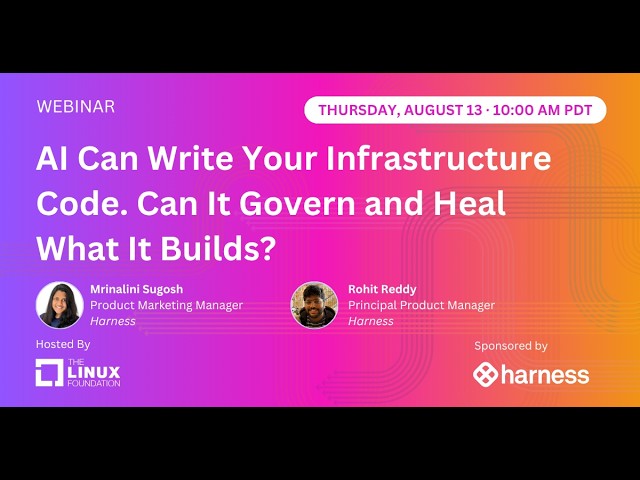
LF Live Webinar: AI Can Write Your Infrastructure Code. Can It Govern and Heal What It Builds?
Watch on YouTubeVideo summary
While AI has revolutionized the speed of generating infrastructure code like Terraform, it simultaneously exposes a critical governance gap between defined platform standards and what actually runs in production due to console changes or tool fragmentation. To bridge this disconnect, Harness introduces a unified control plane where governance travels with every change from provisioning through retirement, embedding policies, security checks, cost analysis, and approvals directly into workflows rather than leaving them in parallel silos. This approach allows the system to maintain safety by ensuring continuous enforcement across the entire lifecycle, preventing infrastructure breakage that occurs when different stages of responsibility operate independently without holistic oversight.
The platform leverages specialized AI agents equipped with rich enterprise context via MCP servers to enhance human judgment at critical approval gates and automate complex tasks. These include a DevOps Agent that personalizes pipelines and OPA policies based on organizational templates, a Security/AppSec Agent that prioritizes vulnerabilities by risk level rather than detection volume while proposing fixes directly in pull requests, and Remediation agents that analyze the blast radius of changes before deployment to autonomously fix drift or compliance issues. By utilizing a knowledge graph that correlates infrastructure chain changes with downstream services like Kafka streams, these agents can detect passive interfaces reacting to updates without direct API connections, providing a holistic risk score through resiliency testing rather than relying on isolated detection metrics.
As the ecosystem becomes increasingly machine-readable through open tools and emerging agentic capabilities, manual reviews are no longer sufficient for managing AI's growing autonomy in infrastructure management. Organizations must intentionally define boundaries where agents act independently versus where humans remain in the loop to ensure safety, positioning Harness as the essential control plane needed to manage these actions across both infrastructure and software development lifecycles. The ultimate vision is to enable "healing" infrastructure that moves beyond simple detection to automatically closing loops on problems while maintaining rigorous governance throughout every stage of existence.
The webinar concludes by emphasizing that although AI simplifies creation, it requires a deliberate strategy for managing autonomous action within an interconnected environment where risks can propagate through complex service dependencies. Harness invites viewers to explore these capabilities further through demos available via their website or connections on social media platforms like LinkedIn, with the full recording set to be published later on the Linux Foundation's YouTube channel. This shift represents a fundamental evolution from reactive monitoring to proactive, intelligent management that ensures infrastructure remains compliant and resilient even as AI agents take on more significant responsibilities in maintaining system health.
Read the full video transcript
All right. Hi everyone. Thank you so
much for joining today. Um, as Candace
mentioned, I'm Maos. I'm a product
marketing manager at Harness and I'm
joined today by with my colleague Rohit
uh who's a principal product manager at
Harness. Uh, I would love for him to
give an introduction to himself.
>> Hey. Hey everyone. I'm Rohit and I lead
uh product for infrastructures code
management here at Harness. Nice to meet
you all.
>> Yeah, nice to meet you. Um so the
premise of today is pretty simple. Uh AI
has gotten really good at helping us
create infrastructure as code and
generating code and we can basically
generate Terraform open tofu policies
configurations a lot faster than we did
before. Right? But creating more
infrastructure faster creates a second
question. Who is governing all of that
infrastructure once it exists? And when
something changes, drifts, uh, becomes
risky and gets too expensive, can the
system actually do something about it?
And that's what we're going to dig in
today.
So, let's get started. So, you know, for
years, I think we've progressively
gotten at what we would like to call
like day one operations, right?
um Terraform and open tou has like given
us a declarative infrastructure and then
CI/CD and githops gave us repeatability
and automation but the reality today is
like much messier right we have so many
tools multiple states console changes
configuration changes and a gap between
what our code says should exist and what
is actually running and that's really
the theme of today um and what we're
talking about right the failure usually
isn't just in provisioning
infrastructure. It it's what happens
next or what happens after. So Rohit,
you you typically like deal with a lot
of teams um and customers, right? Where
do you typically see the gap start? Is
it is it console changes? Is it drift?
Is it disconnected tooling or something
else?
>> Yeah, I think it's I I I I think it's
it's all of the above. But I think the
single biggest gap that I see today is
the disconnect between like what
platform engineers put out there and
what is being consumed. Um and again
like that might also like have multiple
tooling involved and multiple types of
actual uh technologies involved. So
there's like certain certain degree of
disconnect and drift there.
>> Yeah. uh when you say it's it's between
what platform engineering could you
could you dig a little deeper into that
like give us an example from a customer
>> absolutely so you know one of our
customers they wanted to sort of set up
paved paths and enforce uh the usage of
these paved paths so now you have uh you
some users consuming these paved paths
and some who do not but you you now want
to um take an inventory of what are the
resources which are in fact in adurance
to these pave parts and what are the
resources which are not. So you know it
is uh this is a very important sort of
problem to solve uh which again like a
control plane plays a very important
role in in solving that problem.
>> So kind of [snorts] in almost alluding
to our next slide like infrastructure
really does start to break when control
is assumed right. Um and when we zoom
out we I think I completely agree with
you. You can see why that sort of
happens because every part of this life
cycle may be strong independently and
the tooling may be strong independently.
Um like your IC tool may know its
declared state. Anible knows the
configuration it needs to apply. CI/CD
knows um what what it was asked to
execute, right? And um security and
governance tools know the policies
they're responsible for, but none of
these things inherently means the system
as a whole is correct, right? That's
that's kind of what ends up happening.
Um, and then you may end up with like
multiple sources of truth because the
Terraform state that you have might not
actually equal what the actual
infrastructure is. Um, you know, and
configurations can change without
infrastructure context and CI/CD can
execute what it receives. So, and
policies might exist but only at like
individual checkpoints, right? Um, so
the issue isn't like necessarily that we
need a better point tool. the issue
seems like that the state is defined but
it's not continuously enforced across
the whole system. Is is that seem like
an accurate description?
>> Yeah. Yeah. Absolutely. And I think it
just alludes to the point that sometimes
like all of these handoffs happen across
teams and across you know different um
levels of the organization and it
becomes very important to bring all of
these together in in one unified
platform. Actually just this week or
last week, GitHub actually described
this broader shift right of developers
becoming sort of moving from being like
primarily coders to becoming
orchestrators and how AI you know
designing how AI generated work is
proposed, validated, reviewed and
ultimately shipped. Um so do you see
that shift in terms of infrastructure as
code as well?
Yeah, absolutely right. Like the code
generation is just one aspect and part
of it and you know like frontier models
have sort of really accelerated that
part of the story but again like how
like the developers responsibilities are
sort of blurring and they're taking on
more and more responsibilities in terms
of uh you know managing a lot more
aspects of this life cycle and and it
totally uh translates to the
infrastructure side of things as well.
But in this case, personas are slightly
different, but it's it's the same
fundamental philosophy.
>> Absolutely. And one more thing that
we've been seeing, you know, whether
it's Terraform or whether it's open Tofu
or honestly any sort of code that's
being generated and tooling out there
like Open Tofu 1.12 that released
recently in May. Um they're starting to
add capabilities like simultaneous like
human readable and machine readable,
right? agent readable output which is
just another sign that infrastructure
tooling is increasingly expected to sort
of participate in this sort of large
movement towards automated systems
towards a single control pane and not
just operate by itself. Um and that's
something that's really just you know
something that's important to highlight.
And so the problem here that you know we
want to take a step back is that it
isn't that we need another point
solution to provision or make automate
these individual tooling and silos. It's
that um if state gets defined but it
isn't continuously enforced across this
entire system and these different steps
um you know we can see a huge disconnect
in the system itself. So what do we do
about it? Right? Uh the solution really
is that the control that we've been
talking must travel with this system and
it leads to the entire shift we've been
talking about. So today in a lot of
organizations we already talked about
the fact that control is assumed. So um
with a control plane what changes is
that desired state is like continuously
reconciled. So the context, ownership,
all of those things like travel with the
change, right? Policies are enforced
throughout the infrastructure life cycle
from the time you provision it to the
time that infrastructure retires. And
interestingly, we're seeing this concept
actually emerge across the industry.
We've talked about GitHub, we've talked
about Open Tofu, but even recently as
last month, um you know, Hashi added
like a beta HCL Terraform policy
framework to HCP Terraform specifically
aimed at enforcing policies across
different stages of the infrastructure
life cycle including initialization and
that's something you know we are also
doing at harness. So this is the idea of
moving governance earlier and making it
part of the life cycle itself um is
becoming increasingly important and for
me the most important outcome here is
that um the the is that the only
compliant systems should deploy right so
when you show customers ro the
transition from like showing them how
control is assumed in systems to control
is enforced um which of these changes is
sort of get the biggest
reaction from customers. Is it
visibility? Is it enforcement?
>> Yeah, I think like as again like uh
going back to my earlier point like it
is giving end users the ability to
operate within like compliant
frameworks. So it is like giving them
the ability to operate within paved
paths um and making that self-service
very straightforward and also like
having that governance layer across all
of these components um in terms of the
platform engineers being able to control
what those frameworks look like if there
is deviation from the pave paths and
also like complete visibility and audit
of any such occurrence of you know
non-compliance And how do you prevent it
proactively? And also if if there is
certain incident where it was prevented
uh how do you how do you have a complete
audit so that you can then use that data
to coach people uh to have like better
uh developer self-service as an
overarching you know outcome.
>> Absolutely. So what would this like look
like in practice? Like we've we've
talked about in harness, you know, uh
Rohit talked about these paved paths.
There's golden paths that you can
enforce for infrastructure, but this is
an sort of example of things you can
keep in mind while, you know, getting to
your step one. Not everyone today is
already at a point where, you know,
they're in implementing golden paths and
self-service for infrastructures code
that has checks and balances, that has
security checks in it, that has approval
workflows. Um so this is sort of like
your starting point and here as you can
see instead of having governance sit
beside or in parallel to the
infrastructure workflow we actually make
it part of the workflow. Here we
initialize it. We can run something like
check off TF Lint TFAG um and then we
generate the plan we can run with scans
post plan. We can understand policy and
cost at this point. um we can introduce
an approval when one is actually
warranted and then we finally like apply
the infrastructure changes. And the
point of these is not uh not necessarily
like the logos on the screen, right? Or
to say that you this scan is better um
or this is the ideal workflow. Your
tooling may be different. The point here
is um policy, security, cost, approval
and deployment can all become part of a
single governed workflow or pipeline as
we call it at harness right and that's
the difference between saying we have
policies and saying our infrastructure
cannot change or cannot bypass our
policy cannot change without bypassing
our policies and things like that.
So let's take a look at something that
we have here at harness which is sort of
at the approval point cost context right
um one of the big things as we're
deploying more infrastructure and as
we're creating more of these changes um
for a human to you know approve changes
or to understand what changes we're not
asking someone to look at the Terraform
output and make a judgment call right
because um telling me that something
changed from like an EC2 small to EC2
medium just tells me what changed um and
what resources are affected. But the
bigger thing that is probably more
impactful for a human who's approving
this is what is the cost impact? Did the
policy checks pass? Is there drift
involved? Right? Is this going to change
from the actual state? Is this fixing a
previous drift? Um so the human should
really review this full decision and not
be reconstructing the context
themselves. So a lot of things that we
do is provide context for them at the
time of apply. Um and Rohit I I want to
sort of pause here because there's a lot
of discussion right now in the industry
about agents taking more autonomous
actions, right? Um, so how do you think
about the boundary between like
automatically enforce and what should
still require human judgment? Do you see
approvals like these still requiring a
human judgment?
>> Yeah, I think like there are there are a
couple of um aspects to this. The first
aspect is how do we enrich this approval
to an extent that you know at some point
like we can pass this off to the agents
right like like we discussed like open
tofu has been making changes to you know
have them be human readable and machine
readable so we're working towards like
you know having these contextual
approvals have more data more context um
which eventually can be presented and
pulled in a machine readable format as
uh but at this point uh we are also
leveraging agents to enhance the actual
data a user gets at the point of
approval. So you mentioned like cost
aspects, security aspects u and there
are a lot of other like semantics which
potentially um can be inferred with
agentic tasks like how can you look at
the overall plan and like how uh these
plans correlate with other resources in
the ecosystem and how do you actually
contextually you know bring that as a
deployment risk analysis and enhance
this approval. So there's two layers to
this like one actually enhancing the
approval itself with you know with
agents and then like making this
approval like both machine readable
going forward u to you know have certain
um you know levers to consume that data
and automate the entire process. But at
this point like we do see a lot of um
our own customers like still have the
human in the loop element. You know
infrastructure changes are extremely
important. You know they are they can
they can cause significant outages as we
all know here. So again like the intent
is to enhance this metadata with agents
today but also like move towards a world
where this content is machine readable
and you know eventually we get we get uh
to a degree of confidence where it can
be fully automated.
>> Absolutely. And I think that's
especially important with AI, right? Uh
because automation shouldn't really mean
removing humans everywhere. It should
mean involving them where their judgment
actually adds value. And I think that
view is actually increasingly um mirrors
agentic flow designs almost like um
everywhere I've seen workflows being
created. Um I saw like GitHub actually
launch like their security architecture
for agentic workflows a few months ago.
Um and that that really emphasized this
concept as well from like a thought
leadership standpoint where it's like um
isolation for agents running um
constrained outputs, comprehensive
logging and those are principles we
carry into all parts of agent workflows
that we create at harness because rather
than simply giving an agent unrestricted
execution privileges especially when it
comes to something like infrastructure.
So another thing I know Rohit mentioned
earlier was uh self-service
infrastructure with controls right
because once you have all of these
controls and checks and balances in
place governance can actually become an
enabler of faster self-service for
developers rather than a blocker because
um a developer today shouldn't really
have to file a juro ticket and wait like
one day or even two days to get
infrastructure that the platform team
has provisioned a 100 times before,
Right? If the platform team can define
an approved pattern with the right
template, the right security controls,
the right cost constraints and policies,
then developers should be able to
consume that pattern themselves and even
agents should be able to consume that
pattern themselves, right? Um so
developers and agents alike get speed
and platform teams get standardizations.
Um and of course the finance and
security teams don't have to discover
what happened after the fact. Um so
that's really like the paved uh road
model or the paved path uh because that
makes the safe path almost like the
easiest path to use and that's that's
really why having this sort of like
templatized workflows is essential for
infrastructure at scale.
Now one thing I did want to talk about
is um we we talked about this idea of
multiple tools right and the concept of
one platform a single uh control plane
because infrastructure doesn't stop when
terraform says apply complete right you
can provision your infrastructure with
terraform open tofu teragrron cdk and
then maybe you have to configure it with
anible after that right and ultimately
the infrastructure is supporting some
sort of application deployment So
historically those can easily become
three separate workflows but as we've
seen as you go towards a more automated
workflows for developers or for agents
um and sort of the the context
disappears when you have three different
tools. We tend to see a better path
forward with sort of one platform for
all of these separate toolings. Um,
Rohit, I'm curious from your end, what
tends to break when provision,
configuration, and deployment are
treated as sort of three separate
independent systems instead of one life
cycle?
>> Yeah. Again, like the handoffs are now
across multiple teams, multiple
potentially multiple tools and different
role-based access controls, different
ways to audit your u end toend workflow
and also just the governance layer,
right? like you you cannot just have
policies in place across multiple like
handoffs if if they are in fragmented
tools. So that's typically like one of
the biggest um you know sort of concerns
that a lot of uh users that work with us
bring up and are able to alleviate with
this one unified um pipeline story.
Um, so is the answer here and and I'm
asking this as a person who knows the
answer that you're going to give me, but
is the answer here are we suggesting
replace terraform or replace anible with
a single control plane?
>> No, absolutely not. Like you sort of
like keep your tooling, but the
orchestration happens in one single
control plane.
>> Yeah. And I and I think that was an
important clarification because the
answer isn't to replace Terraform or
replace Anible. is to give give these
tools that shared orchestration,
governance and context um when you're
going into sort of the world of AI and
agents and with that um let's talk about
sort of AI and how it comes into the
picture especially for us at harness um
the interesting thing um that I've seen
is that the industry is moving very
quickly beyond just code completion
right or code generation um uh GitHub
harness there's so many companies that
have agentic workflows running inside um
their CI and CD and you know almost
every other company has some sort of MCP
servers that lets AI systems access uh
current registry information maybe even
perform workspace operations right um
open open AI actually describes MCP as
an open protocol that is becoming an
industry standard for connecting models
with additional context or tools or and
knowledge right So the question really
is no longer um will AI agents interact
with our SDLC in infrastructure. They
probably already are, right? The more
interesting question is what context and
what controls surround these agents when
they act. And that's how you you can
start thinking about the architecture
here that we've defined. um a query
comes in to the unified harness agent
and we can route it to our specific
agents like our delivery agent or
security agent um some infrastructure
specific agents that we have that I've
highlighted like the remediation and
blast radius agent right but underneath
them like what really makes all of these
agents work is the context the knowledge
graph understands the environment um
enterprise rules and policies understand
uh what's allowed um memory ies add
context and relevant organizational and
user context and because an agent
without context um like may be powerful
um an agent with the right context I
would say is like useful right and that
that's really the fundamentals of like
what's uh what's behind harness AI
so
you know we've talked about MCP and um
the reason MCP is really important is
because we don't want to tell developers
here's AI and it completely changes how
you work right um developers today
should still be able to stay in their
environment like cursor like visual
studio and ask for what they want and
the request can inherit the enterprise
context the governance behind it before
an action ever even touches the
infrastructure and this is becoming more
and more as an established model um
because we've like for example even in
harness you can you know explicitly
request information and context about in
and around the infrastructure and that's
exactly why context um matters more uh
once once an AI agent like remediation
or blast radius is capable of actually
taking infrastructure actions u rather
than just like maybe answering questions
um like how does like you know blast
radius and remediation become like the
concept become more important do Do you
want to help define that here?
>> Yeah, I mean uh like one of the
foundational aspects is the context. So
what what is this infrastructure
backing? Is it backing a production
service? Is it backing you know a dev
instance? like how do you bring that and
layer that on top of like what your
infrastructure is defining and that's
where again like the unified platform
becomes very important where you're able
to like bring in the context of what is
actually being deployed on these uh
infrastructure components. How are these
infrastructure components related to
other infrastructure components that
exist and um you know today potentially
are treated in isolation. How do you um
then like layer that and sort of set the
stage for defining risk of an
infrastructure change? So whenever
you're making an infrastructure change,
you sort of give agent this context, the
actual context of the change and then
are able to predict like is you know
what is the blast radius of this and is
it a risky change um and if it's a risky
change you know what are my mitigation
strategies like how do I go and make
this less risky or do I need to add in
more approvals
um and then there's the other
operational aspect of you know there are
things that needs to be done from an
infrastructure um chain standpoint to
bring them into a compliant uh you know
control plane, right? So how how do you
like make make sure your infrastructure
is cost compliant is compliant to
security vulnerabilities and you know
these things are constantly evolving and
how do you how do you make sure the
operational overhead of keeping up with
these is minimal. So that's where like
the remediation aspect is also very
important where worker agents can sort
of go and do that work for you but then
give you a pull request to say hey like
this is the work that I did based on
this insight um that came in from the
cost side or the security side uh do you
agree and if you agree let's go ahead
and merge this change which again kicks
in a blast radius analysis to see if the
change the second layer of you know u
checking if the change is actually
not risky or risky and then like
completes that whole loop.
>> Awesome. And and that's that's where the
more capable the agent becomes, it
sounds like the more important the
governance layer and even governing
agents become, right? Because we don't
want to almost choose between powerful
AI and safe infrastructure. The
architecture has to kind of give us
both.
>> Yeah.
>> Awesome. So, one thing we wanted to talk
about is just a few of the agents that
we have here at harness to um show you
what u you know an autonomous uh a
future towards an autonomous SDLC could
look like. Um the DevOps agent here for
example, it can create and edit
workflows or pipelines um analyze and
fix those errors. It can create OPA
policies uh because if anyone of you
have written OPA policies, they're not
fun to write. And so having an agent do
that is great. But again, the key word
here is that it's all personalized to
your organization and environment
because if you remember a few slides
ago, we talked about this agent acting
on the context of your organization and
your user. Um, so you know, you just
don't need AI to know how to create a
pipeline. Um, that of course TR GPT and
Claude can probably spin up any YAML
that does that, but you needed to
understand how the organization you work
in creates pipelines, right? What
templates do we use? what approvals are
required, what policies do you need to
run, what environments are allowed and
that transition from sort of a generic
generation to almost context automation
is extremely important.
The second piece over here that we have
is the security or appsec agent. Right?
The same kind of constructs apply to
security. Most organizations
um I would say don't have a shortage of
finding vulnerabilities. Right? the like
we have a lot of scanners and a lot lot
of ways to find problems but the real
problem is going from detection to
prioritization to remediation so without
creating another massive manual backlog
or queue. So the security agent here can
actually understand the security
contacts prioritize risk generated fixes
and PRs and almost enforce policies um
and monitor your security posture. um
real like this is talking about
application but like what really changes
when AI moves from saying like here's a
problem to actually being able to
propose the fix especially from a
security context.
>> Yeah. again like we spoke about the
operational aspect of it right like that
today like in in many organizations like
including uh to some extent harness
right like pre the AI era like there's a
lot of these sitting in backlog right
like you have these vulnerabilities
which have certain ETAs you have like
cost optimization opportunities you have
like performance optimization
opportunities but u they not they do not
always get prioritized because Again,
there's like all other operational
aspects which take precedence. But when
the conversation moves from, hey, this
needs to get prioritized to, hey, this
needs to get approved. Here's already a
change that I made for you, the the
throughput like starts to starts to
improve. And that whole feedback loop
becomes uh you know like a close
feedback loop which which has like a lot
of room for uh a a larger throughput.
>> Yeah, absolutely. And I think that's
much more like useful when you think
about model for like enterprise AI which
is accelerate the remediation, preserve
the control point and really get through
your black lock and don't add to what
already exists. Um and finally like
let's talk about what we're here to talk
about which is infrastructure automation
agents right um we get to the two agents
that are very relevant to today's
conversation. We've been talking about
this uh blast radius is fundamentally
about uh before we make changes right
before I make this specific
infrastructure change what could it
affect what uh depends on this resource
what is the actual risk of applying it
um is there a risk score and the
remediation agent is fundamentally about
after so after we've detected drift a
cost issue or security or compliance
problem instead of leaving just another
alert or another backlog item in the
queue. Can we determine can the agent
determine the appropriate remediation
and create the PR um so that I can
approve the fix and my backlog is
reviewing fixes rather than reviewing uh
problems to solve right um so it really
like goes from um like should I do this
to something changed how do I safely get
it back to uh where I should be and
that's where the word heal uh starts
becoming real right because we're moving
beyond detection ing infrastructure
problems to really closing uh the loop
on that. Um and so rather than me just
keep on describing this, I think it's
the point where we've come to like show
this off. So Rohit, can you just walk us
through what this looks like end to end
from a govern infrastructure change
through understanding blast radius and
into how an agent can actually like
remediate drift and let's see autonomous
infrastructure in action.
>> Yeah, absolutely.
Thanks. sharing my screen.
Awesome. So, yeah, like I think like
before we get into the actual meat of
the agents, like I just want to set some
context for, you know, where we are um
from a harness perspective. So, this is
a harness platform. Uh infrastructures,
code management is one of the many
components that harness offers and as
you can see here, there's like a lot of
other problems that we solve as a as a
as an organization. Uh so right now
we're looking at a specific you know a
specific project. Everything in harness
is organized into accounts and accounts
have organizations and organizations
have projects. This is to ensure that
you know users have access to just the
entities and uh pipelines that they need
access to. So what you see here is a
workspace uh a list of workspaces and
again like a workspace is essentially a
collection of resources. This can be
backed by the technology of your choice.
It can be open tofu, it can be
terraform, it can be CDK. You know, we
we offer like a wide range of um you
know, tooling to actually back this
infrastructure with the ISC of your
choice. Um and again like uh if if you
get into this specifics of a workspace,
it manages a bunch of resources.
Um and like like I said, like this is
just managing a three- tier web app. In
this case, uh there is opportunity to
manage and maintain variables and
there's governance built in whenever
like certain entities change here and
also when the actual uh infrastructure
is changing in in the context of a
pipeline. We also support configuration
management and we natively integrate
with anible. You can define your
inventories and playbooks right within
the platform. And then we have a native
host explorer where you're able to see
all the different hosts that are
managing. Um, and these can also
essentially come from the workspaces.
And we have a native uh bridge between
your provision resources within ISCN.
And then how you configure them
immediately after provisioning or
whenever there's a change. And then you
can get into a specific host and look at
like the health of it, exactly what
playbooks ran against it. Um the actual
changes and down to the specifics of a
given task. Uh and again how all of this
sort of comes together is is is in this
one unified pipeline. You can provision
and configure and deploy uh in one
pipeline. Again just to set context, our
pipelines are our orchestration layer.
uh the pipeline engine and harness spans
across all the components that uh I just
showed you here. And in this case like
I'm surfacing a pipeline which is spread
across infrastructure provisioning
configuration and also the deployment
aspect. So it's provisioning your
infrastructure. It's using terraform and
it's using open tofu in this case. We
have an approval gate built in. This is
again something that Reena alluded to
and we show a lot of contextual
information when a user is actually
making this approval right from your
cost your security u your uh you know
the chain set uh and so on and then you
you can then pipe that into your
configuration layer where you can
leverage anible to actually prep uh
these machines for deployment and then
you can actually deploy on these
machines. So this is just to set the
context of like what infrastructure as
code management is and again we can get
into the depths of this and this might
you know uh take its own uh time but we
want to focus on the AI aspects today.
Now getting into the agent foundations
right. So um as we discussed in the
presentation there are two types of
fundamental agents that we are looking
at. There are expert agents that harness
um offers. And again you see this little
aski icon here. You know you can you can
sort of like use this as your interface
to uh you know construct your own
pipelines to ask questions. And again
this is exposed with via an MCP. So you
don't necessarily have to come in here
and do this in the platform. You can do
this from the tool of your choice. And
then we have this concept of worker
agents which essentially give you the
ability to create your own custom
agents. Right? So specialized agents
with a specific set of rules which can
do a hyperfocused task. And as you can
see there's a variety of agents here
with you know very different um nuances
and what they are tailored to do. So
let's get into like what this uh expert
agents can do. Like I've just run a few
examples here in terms of like okay I
just asked this hey what are the
workspaces that need my attention. It's
a non-contextual question and I just
want to know what needs my attention.
It's going and looping at looking at all
of the different workspaces that exist
and it tells me that hey like there are
a few workspaces where an apply is
needed which means a code change has
been merged but we've not applied the
change and there's a workspace where you
know it's actually in a drifted
condition. So we also offer like native
drift detection it runs periodically
flags drift down to the specific
resource which is drifted and down to
the specific attribute in the resource
which is drifted. So now that I I I
figured out that this workspace is
drifted like I then asked it a follow-up
question of like you know what are the
percent what is the percentage of
resources which are drifted and it it
went into the next layer of detail got
all the resources and then gave me a
drift percentage. So again like this is
this can be used for all sorts of
operations to create entities and also
like gather information in terms of like
what needs attention, what needs to
change and then I can follow this up
with a prompt saying hey can we actually
like you know rerun um a plan here which
will then trigger a pipeline to actually
remediate this drift. Now again drift
remediation comes in two flavors. We
either like sort of say you know the
drifted resources that exist uh the
drift that was introduced is invalid and
we just like reset it to the state of
truth which is the codebase or we say
hey like the the drifted the drift is
actually valid like you know users just
leverage click ops to do this uh but the
drift is valid. Now how do we take that
into account and how do we then
remediate that drift and in this case a
remediation means to accept that drift
and make certain code changes. Right? So
let's look at that example. Uh so again
as you see here we are back in the
workspaces screen. We have these
different insights. Um the insights are
pulling in different actions of how we
can improve the workspace. So it can be
cost insight where you can optimize your
cost. It can be a drift insight where
you can actually remediate your drift
and we have a worker agent which is
dedicated to remediation. So as you see
here like this I ran a pipeline ahead of
time which essentially was triggered
from a drifted uh a drifted uh drifted
detection that ran on a specific
resource. It then went ahead and
triggered this remediation agent task.
I'm going to show you the logs. It then
went and like triggered off an agent
which is a worker agent which is spec
which is specialized in remediating
infrastructure as code related uh issues
and incidents. It can be cost related,
security related, drift related in this
case and then it went and did its thing
and identified what was actually uh
drifted and then it fixed three
attributes and then raised a pull
request.
So I'm going to go in here, click on the
pull request, and as you can see here,
it just automatically tells me like what
uh what was actually changed, the
changes that were made. And if I go into
the files changed, u it actually
accepted the drift which occurred uh by
clickops. So it was able to go into the
actual context, look at what's in the
cloud, what's in the code base, what is
the delta, make this change, and now
it's waiting for review. And if if this
looks good to me, I'm just going to go
ahead and merge it. It will trigger
another pipeline which can actually go
ahead and do a init plan, have an
approval gate, and then apply, which is
closed that entire loop of hey, I
introduced drift and then like you know
an agentic loop kicked in. It identified
that there's drift. It triggered a
remediation action. It gave me a pull
request. And the moment I approve this
pull request, it again triggers a closed
loop of applying that change and uh
going through the entire motions of
grid.
Uh and the second key thing that we we
wanted to talk about is the blast
radius, right? Like it is very important
for us to understand like what
is this change going to do? like and a
lot of the times we look at the plan and
the plans can be large. It can be across
like hundreds of resources. How do we
identify if a change is risky? So here's
here's another uh of our agent which
sits in line with your pipeline and it
runs after your plan. It analyzes the
change. It it then like uh runs an
agentic loop on what is the risk of this
specific change. And if I go into the
resources section here,
so in this case, it's telling me it's a
low-risk change. It it gives me a score
of how risky the change is. It
classifies the risk between low, medium,
high, and critical. And then it also
tells me like it gives me a synopsis of,
you know, what's h what's actually
happening in this entire section. And
this goes back to our conversation on
how do we enhance the approval with more
context to give the users the confidence
and then eventually how do we make this
machine readable for you know for us to
create downstream closed loops uh with
other agents. We not just have like a
highle view but we also have a graphical
view of this change and again in this
case it was just four new resources that
were created. So the change is less
risky. Now let's go to another uh
example here where the change is
actually risky. So in this case it's
telling me that it's a it's a 10 out of
10. It's a very risky change. It's
telling me that uh this change is
actually disabling public access blocks
and deleting serverside encryption which
is obviously something we do not want.
So it's flagging that proactively as a
high-risk change. And if we actually go
into the graph view you see here that
there are different treatments for
different types of resources. So a
resource which is deleted is in red. It
gives the user a very clear uh picture
of like what's getting deleted, what's
unchanged, what's actually changed and
also assessing risk at every node level.
So it's going to give you risk at an
indiv individual node level. In this
case, this specific node is deleted. So
it contributes to an overall risk factor
of 10. We take into account how dense a
specific node is, what type of a node it
is and what type of a contextual change
it is to sort of like overall assess the
risk and come up with a broad um scoring
for the entire pipeline. So that's on a
very high level you know how we are
leveraging both um worker type of agents
and expert agents and sort of like
giving users the flexibility to create
their own worker agents operate within
the the ecosystem that they are used to
via IMCP and obviously there's a UI to
sort of consume this for uh users who
actually want to come into the platform
but all of this data is sort of
available where you are we meet you
where you are We give you the ability to
create your own agents. We have certain
expert agents which specialize in
certain uh nuance capabilities and are
natively embedded into the workflows.
Yeah, that's w that wraps up a quick
demo um of these capabilities.
>> Yeah, awesome. And I've shared some
links about harness AI or infrastructure
automation um and the platform itself.
So, if anyone is, you know, wants a more
in-depth demo, um, sort of like a better
pro like end to-end product, uh, demo,
feel free to, uh, hit us up, uh, book a
demo, and we're happy to sort of walk
you through a longer demo as well. Um,
and I think we have a few minutes for
questions.
So, what I will do is
switch it up here. Um and then let me
open up our questions.
So um there was a question here which is
regarding improved developer experience
with harness which I think was a slide
um when we talked about uh
uh cursor plus uh agents and harness AI.
So how do you control drift once the
application goes into production?
um organic inter in integrations will
evolve slowly over a long time and can
create convolted architecture that no
one really understands. That's why
systems created in 1970s and 1980s are
so difficult to work with today.
Yeah, I I can I can address this right
like again like I think we spoke spoken
spoke in depth about like drift like
we've seen like couple of approaches to
you know maintaining and managing drift
obviously like uh one is to just uh say
that okay like we just block all click
ops access and you know in a perfect
world like everybody has to do
everything through ISC which is
obviously aspirational but u not we
cannot completely prevent that. So drift
is bound to happen. Now we can create
systems and downstream actions to sort
of uh take that into account and how do
we create a closed loop around it.
Right? So first aspect is actual
detection and surfacing that data to the
users in an audit auditable fashion like
can I actually tell you how many
resources are drifted in my entire
estate like we saw an example of that
with you know where harness I sort of
answered that uh briefly right like in
this pro context of this project 42% of
the resources are drifted and then we
take that to how do we how do we take
action on this right we either remediate
that drift by accepting it which is
where the remediation agent comes in and
it's able to like contextually look at
like what has been drifted. uh does that
make it does it make sense to accept
that drift actually makes that change
and surfaces the PR or we say hey like
click ops is not allowed and you know we
just have to uh reset it to the state
and and IA that exists as a source of
truth which which again like you can
choose to do either either directions
but again like as we discussed earlier
we do not sort of force users with the
tooling of choice and similarly we we
offer tools and pathways. Uh we we we
have like our own set of like best
practices, but it's really up to you to
handle how you want to handle certain
scenarios, but we we offer like a wide
range of u drift remediation techniques
which which we discuss as part of this
presentation.
>> Awesome. And yeah, if you ever want to
learn a little bit more, see see a
thing, just sign up for a demo. We're
always happy to show it. um you know um
and the next question is sort of does
the blast radius agent detect passive
interfaces where downstream system
reacts to change data but doesn't have a
direct API connection to the source of
the change uh we've seen this in cafka
pub streams pub sub streams
>> again so this is where uh like what Nina
was mentioning about the knowledge graph
becomes very very important so we are we
are able to like correlate an
infrastructure chain change back to the
services that consume it. We also have a
capability around resiliency testing
which which then like uh folds into the
same thing of hey like we are able to
sort of create these u nodes and edges
of not just like your infrastructure but
build that in context of the knowledge
graph which gives us a more enriched
like you know blast blast detection
capability and comes up with a more
holistic score of uh how risk is
analyzed and perceived. Awesome.
[snorts]
I think that's the, you know, scope of
all of our questions. Um, just to bring
this back to where we started, um, I
would like to wrap it up, but, um, I
think AI is making, um, it dramatically
easier to create infrastructure. That's
a given. The ecosystem is also becoming
in increasingly machine readable with
open tofu, terraform
um the all of them releasing like MCP
work and the broader sort of agentic
workflows all are pointing in that
direction which means the answer just
can't be simply like you know manual
review downstream or manual controls and
automations. So as we're uh giving AI
more like more ability to act, we need
to be very intentional about where it
can act autonomously and where humans
stays in the loop. And that's kind of
fundamentally where harness steps in to
act as that control plane for your
agents, for your infrastructure, and for
your SDLC. Um with that, I really hope
you guys had a wonderful afternoon.
Thank you so much for spending your
afternoon watching our webinar. And um
if you have any follow-up questions,
don't hesitate to reach out to Roadai on
LinkedIn. Uh book a demo on the harness
website and uh reach out to us on
harness socials as well. Thank you so
much.
Thank you so much to our speakers and
for everyone joining us today. As a
reminder, this recording will be on the
Linux Foundation's YouTube page later
today. We hope you join us for future
webinars. Have a wonderful day.