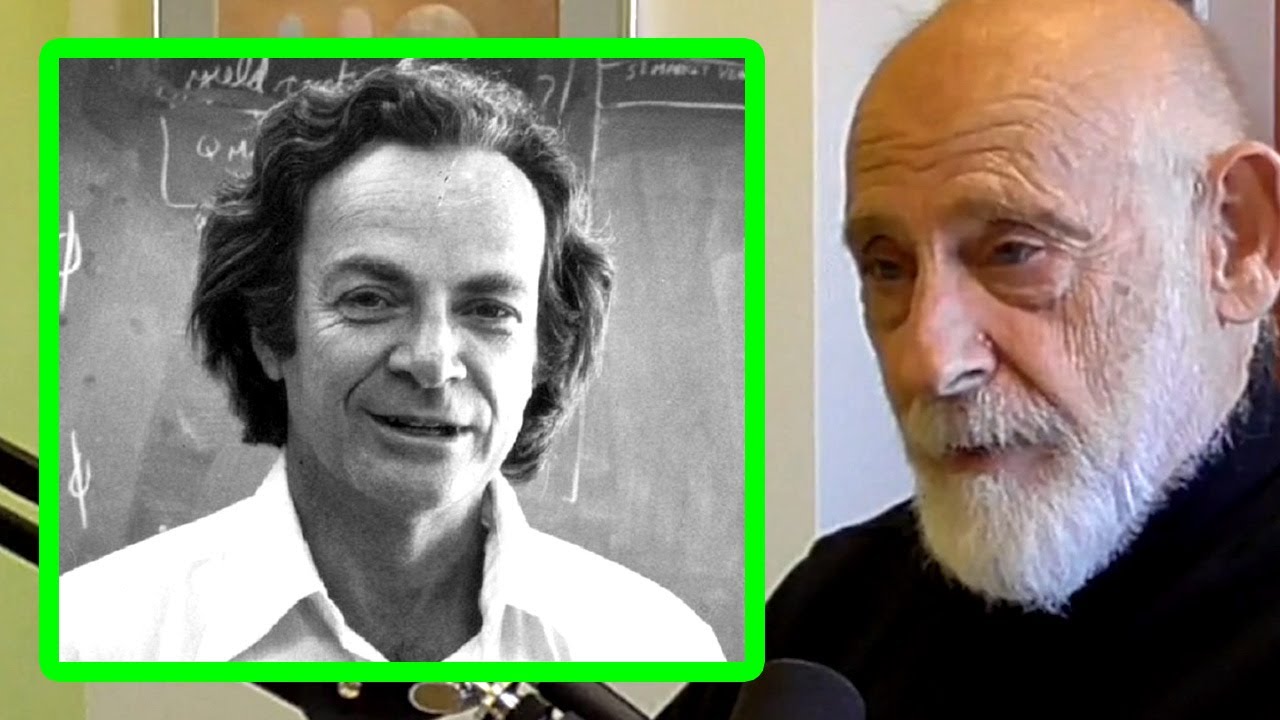
Leonard Susskind: Richard Feynman and Intuitive Visualization vs Rigorous Mathematics
Watch on YouTubeVideo summary
In this discussion, Leonard Susskind reflects on his relationship with Richard Feynman and how Feynman's unique approach to physics influenced him. Susskind describes Feynman as a physicist who operated through deep intuition rather than relying solely on complex mathematical formalism; he could close his eyes and visualize phenomena directly, allowing these mental images to guide highly sophisticated technical arguments. While this style did not fundamentally alter Susskind's own way of thinking, it validated an intuitive approach that Susskind already possessed but perhaps had undervalued. Feynman demonstrated that one could successfully navigate advanced physics by prioritizing simplicity and directness over immediate mathematical rigor, a method that made the field feel more accessible to Susskind. Susskind applies this same philosophy to his own work in quantum mechanics, black holes, and string theory, emphasizing visualization as the primary step before engaging with equations. He admits that while he is competent at mathematics, he considers himself first an intuitive thinker who attempts to convert physical insights into mathematical language only after gaining clarity through mental imagery. For Susskind, physics begins with visualizing the phenomena themselves rather than manipulating symbols; if a conceptual insight feels valid intuitively, it serves as the foundation for subsequent mathematical derivation. This process acknowledges that while some individuals are naturally better at translating intuition into rigorous math, the initial spark of discovery often comes from pure visualization and physical understanding. The conversation then addresses the inherent unintuitiveness of modern physics compared to classical mechanics rooted in everyday experiences like throwing stones or splashing water. Susskind argues that quantum mechanics, general relativity, and quantum field theory are deeply counterintuitive because they defy our evolutionary adaptations for perceiving rocks, water, and three-dimensional space. However, he notes that through prolonged exposure and study, physicists rewire their brains to develop new intuitions specific to these abstract domains. Over time, many of his friends have become so accustomed to quantum-mechanical thinking that it feels more natural to them than classical physics, illustrating how neural pathways can be reshaped by intellectual effort even if the concepts remain alien to our biological instincts. Despite this rewiring capability, Susskind questions whether humans will ever fully adapt their cognition to understand higher-dimensional spaces naturally or think like subatomic particles such as electrons. He asserts that human brains are fundamentally wired for three dimensions and struggle to visualize one, two, four, five, or six dimensions in an abstract way without embedding them within a 3D framework; even imagining a line requires visualizing it on a piece of paper existing in space. While humans can learn mathematical tricks and equations to navigate these higher dimensions, the experience remains distinct from natural perception. Susskind doubts that we will ever completely rewire ourselves to find four or five-dimensional concepts as instinctive as three-dimensional reality, suggesting there may be inherent biological limits to our spatial cognition. Ultimately, the dialogue explores the tension between intuitive visualization and mathematical abstraction in theoretical physics. While creatures living in two dimensions might imagine a third dimension using mathematics similar to how we attempt to grasp higher spaces, Susskind warns against romanticizing these ideas as fully natural human experiences. The consensus is that while education allows us to function comfortably within unintuitive frameworks like quantum mechanics or string theory, our neural architecture retains a strong preference for the three-dimensional world we evolved in. Consequently, physicists must constantly toggle between intuitive visualization and rigorous mathematical tools, accepting that some concepts will always require conscious intellectual effort rather than becoming second nature through mere familiarity.
Read the full video transcript
[Music]
you work to more friends with richard
fineman house ii influence you it
changed you as a physicist and thinker
what I saw I think what I saw was
somebody who could do physics in this
deeply intuitive way his style was
almost a closed his eyes and visualize
the phenomenon that he was thinking
about and through visualization
I'll flank the mathematical highly
mathematical and very very sophisticated
technical arguments that people would
use I think that was also natural for me
but I saw somebody who was actually
successful at it
who could do physics in a way that that
I regarded as simpler more direct more
intuitive and while I don't think he
changed my way of thinking I do think he
validated it he made me look at it and
say yeah that's something you can do and
get away with practically you can get
away with it so do you find yourself
whether you're thinking about quantum
mechanics or black holes or string
theory using intuition as a first step
or step throughout using visualization
yeah very much so very much so I tend
not to think about the equations I tend
not to think about the symbols I tend to
try to visualize the phenomena
themselves and then when I get an
insight that I think is valid I might
try to convert it to mathematics but I'm
not a math another natural mathematician
I'm good enough at it I'm good enough at
it but I'm not a great mathematician so
for me the way of thinking about physics
is first intuitive first visualization
scribble a few equations maybe but then
try to convert it to mathematics
experiences that other people are better
at converting it to mathematics and I am
and yet you've worked very
counterintuitive ideas so how that's
true that's not Eve is something Connor
into every they're rewiring your brain
in new ways yeah quantum mechanics is
not intuitive very little of modern
physics is intuitive intuitive or what
is intuitive mean it means the ability
to think about it with basic classical
physics the physics that that we evolved
with
throwing stones splashing water or
whatever it happens to be quantum
physics general relativity quantum field
theory are deeply unintuitive in that
way but you know after time and getting
familiar with these things you develop
new intuitions
I always said you rewire and it's to the
point where me and many of my friends
are inventing my friends
can think more easily
quantum-mechanically than we can
classically we've gotten so used to it I
mean yes our neural wiring in our brain
is such that we understand rocks and
stones and water and so I'm sort of
evolved evolved for yeah do you think
it's possible to create a wiring of
neuron like state devices that more
naturally understand quantum mechanics
understand wave function understand
these weird things well I'm not sure I
think many of us have evolved the
ability to think quantum mechanically to
some extent but that doesn't mean you
can think like an electron
that doesn't mean an another example
forget for a minute quantum mechanics
just visualizing four dimensional space
or five dimensional space or six
dimensional space I think we're
fundamentally wired to visualize three
dimensions
I can't even visualize two dimensions or
one dimension without thinking about it
as embedded in three dimensions right if
I want to visualize a line I think of
the line as being aligned in three
dimensions right well I think of the
line as being aligned on a piece of
paper with a piece of paper being in
three dimensions I never seem to be able
to in some abstract and pure way
visualize in my head the one dimension
the two dimension the four dimensions
the five dimensions and I don't think
that's ever gonna happen the reason is I
think on neural wiring is just set up
for that
on the other hand we do learn ways to
think about five six seven dimensions
fan we learn ways relents mathematical
ways and we learn ways to visualize them
but they're different and so yeah I
think I think we do rewire ourselves
whether we can ever completely rewire
ourselves to be completely comfortable
with these concepts I doubt so that it's
completely natural there was a tour it's
completely natural so I'm sure there's
some what you could argue creatures that
live in it two-dimensional space yeah
and um well it's romanticizing the
notion of course we're all living as far
as we know in three-dimensional space
but how do you how do those creatures
imagine 3d space well probably the way
we imagine 4d by using some mathematics
and some equations and some some tricks
you