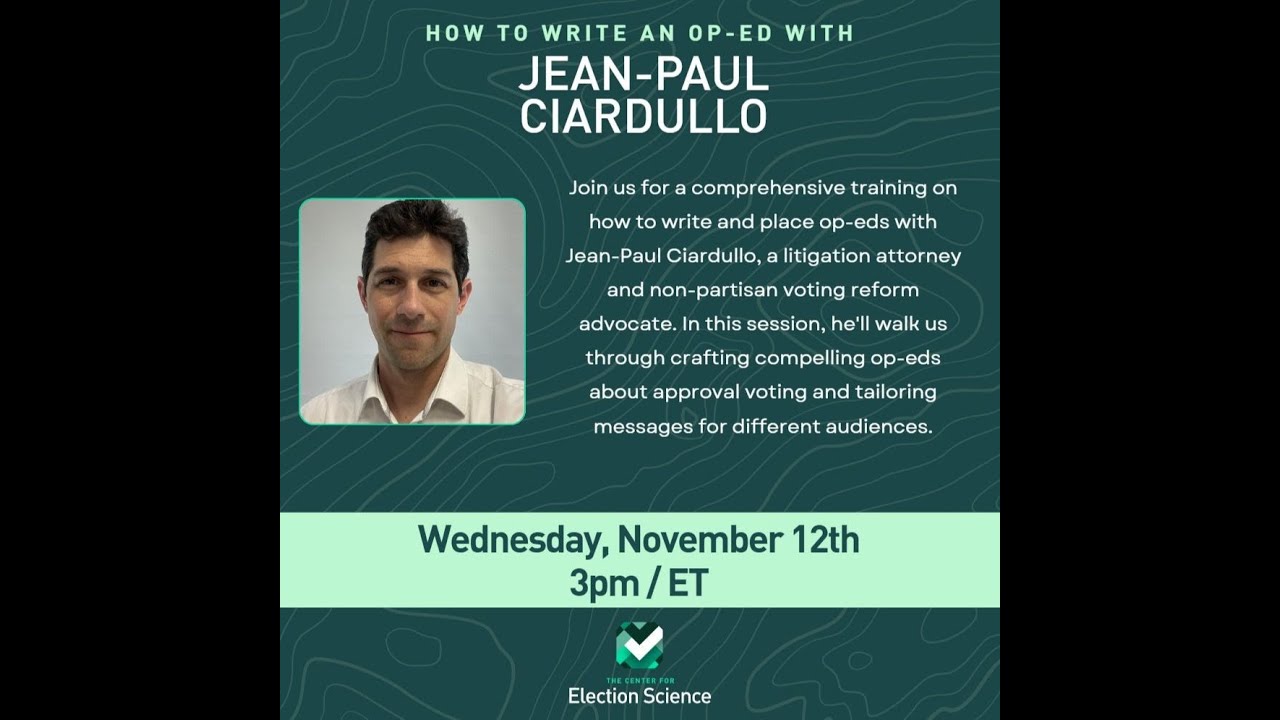
Learning Hour Writing & Placing Op-eds with Jean Paul Ciardullo
Watch on YouTubeVideo summary
Jean Paul Ciardullo from the Center for Election Sciences delivered a comprehensive training on crafting op-eds to effectively amplify messages within today's digital media landscape, where social platforms often overshadow traditional television as primary news sources. Drawing on his practical experience with both major outlets like *The New York Times* and local publications such as the Salt Lake Tribune, Ciardullo outlined essential guidelines for writers aiming to reach editors who typically lack deep knowledge of niche topics like voting reform. He emphasized that successful articles must be concise, generally between 600 and 700 words, focusing on a single subtopic rather than attempting to cover every aspect of an issue. Furthermore, submissions should maintain a positive tone by offering concrete solutions instead of engaging in partisan bickering or negativity, while clearly identifying the author to establish credibility without relying on anonymous claims that editors reject.
The core message of these op-eds must immediately capture attention with a strong opening sentence and a compelling title that conveys the central concept quickly, avoiding technical jargon and rant-like structures that alienate readers. Authors are advised to assume their audience starts from a "blank slate," requiring them to explain complex concepts like approval voting from first principles using familiar analogies rather than assuming prior knowledge or getting bogged down in misconceptions about one-person-one-vote mandates. To build trust, writers without specific credentials must support their claims with hyperlinks to objective data and reputable sources, ensuring that the narrative frames issues as nonpartisan opportunities for unity. This approach is particularly vital when discussing approval voting, where explaining how votes are counted equally without ranking helps demystify the system and contrasts it favorably against ranked-choice methods that often force polarization or eliminate centrist candidates through runoffs.
Ciardullo illustrated these concepts using an apple pie analogy to show how approval voting naturally unites voters around common choices, creating a mutually beneficial equilibrium similar to John Nash's game theory where coordination on shared interests yields better results than competing for individual maximums. He highlighted that the system fundamentally rewrites political incentives by allowing candidates with broad consensus support to succeed even if they do not capture an initial plurality, thereby encouraging politicians to seek supermajority appeal across the spectrum rather than relying solely on party constraints or simple majorities. While acknowledging hurdles such as voter confusion regarding complex ranked-choice mechanics and establishment resistance, he argued that these are temporary issues overcome once people understand how approval voting simplifies decision-making compared to computerized instant runoff calculations that often discard second-place options unfairly.
In terms of strategy for publication, Ciardullo noted that while viral blog posts can work if they gain traction, established newspapers carry significantly more authority due to their rigorous editorial review processes and the prestige associated with being published there. He recommended targeting local or ideologically aligned outlets whose boards already advocate for unity, noting his own success in placing an article in a publication outside his immediate residence by leveraging unique professional perspectives, such as framing arguments through software engineering expertise when discussing policy directly. The session concluded by emphasizing that despite initial challenges like the need to define approval voting early on without confusing it with ranked-choice systems, the long-term benefits of presenting nonpartisan solutions and achieving supermajority consensus make this approach a powerful tool for modern advocacy in an era dominated by digital media fragmentation.
Read the full video transcript
Well, we're just going to get started
here. We know that some folks are going
to continue to sort of trickle in. Um
it's still pretty early. Um but we just
wanted to say hi, welcome to the center
for election sciences and as we call him
JP um our training on um how to write
and place opeds because writing is just
one part of um the process here. We want
to welcome everyone and please feel
encouraged to um write your write an
introduction in the chat. Um, we will
have some time at the end of the
training to have a little bit of a Q&A,
but we will also be reading questions
from the chat. So, for example, if you
do have to drop early, let's say you
find yourself like 10 minutes like, oh,
I can't I'm not going to be able to make
that, you can drop your question in the
chat and I'll read it. Um, and then we
make it a habit of sending around the
recording um and the notes after each of
these trainings. So you will see it
answered in the chat or rather in the uh
in the video that we'll send around
after. So if you do have that burning
question or just a any comment, we can
um address it in the chat and um make
sure yes, I'm very happy to see some
folks already chiming in saying hello.
Don't worry, we're a friendly community.
Um and we are very happy that you are
here. Uh I will pass it over to Nina
Taylor.
Hey everybody, I'm Nina Taylor. If we've
not met, I serve as the chief executive
officer for the Center for Election
Science and I just very briefly would
like to bring greetings and welcome to
you all uh for our learning hour today
on how to write a compelling op-ed. Um
just thank you for taking the time out
of your day to join us and um this is so
important to us because as you all know
how information um is consumed has
radically transformed. So according to
Pew Research, 86% of Americans get their
news from their digital devices with
social media and video platforms
overtaking traditional TV as primary
news sources for many demographics. This
means our messaging has to be everywhere
everywhere that the conversations are
happening. Um the good thing about this
new media landscape um is that how SEO
uh has changed and how it works now is
very different than how it worked
before. And so now it's about
highlighting the voices of the many um
and driving a wider network of credible
perspectives that add strength and
legitimacy to a movement. And so um when
when 10 different thoughtful people or
in this case 15 different thoughtful
people um write articles about approval
voting that creates a powerful signal um
that the movement is real and gaining
momentum. And so today, while the
examples will focus on approval voting
because let's be honest, that is just
our jam, um JP will remind you that the
the tips and strategies um could be
really adapted to anything that you're
interested in, whether it's
redistricting or uh voting reform or
even what's happening in your
communities. Um, as I always say with
our virtual events, be curious, ask
questions. Um, and let's just dive in
and learn how we can amplify our
messages to make sure that our
collective voices are heard. Over to
you, JP.
>> Yeah, thanks Nita and Allison and
everyone else who at the Center for
Election Science. Um, my name is John
Paul Trulo. Um, JP is easier. U very
happy to be here today. I I I was
honored to get the the invite. Um and in
my my day job is I'm I'm an attorney.
I'm a partner at a large law firm called
Foley and Lardner. I do litigation in
court arguing cases about breach of
contract and patent infringement and
that kind of thing. Um but about 15
years ago outside of work I became very
interested in voting reform issues. Um
my own angle on it was uh and this
dovetailed a little bit with my
litigation work. Um, is there some sort
of almost game theory way of arriving at
a best result in an election uh that
makes the most people happy? Um, it
seemed to me that uh the things in
nature, this was also partly my training
undergrad. I was an engineer before I
went into law and it's sort of a merger
of these concepts. So I was thinking,
you know, most things in the natural
world fall on a bell curve. And how do
you maximize the ability to have the
most people on that center of that bell
curve represented in politics instead of
it being polarized? And I sort of set on
my own came into approval voting doing
the spreadsheet simulations of different
elections and then sort of reverse
engineered it and looked it up and found
it was hey that's a real thing people
know about and have been advocating for
for a long time. Um and I got hooked up
with the center for election science
some years ago and done some work work
with them. Um and I also had started
more recently to try to get into writing
some op-eds. I have several different
ones right now that are sort of in the
works that kind of keep editing them and
uh uh trying to improve them. Um I had
one uh published on an online journal uh
called the Fulcrum that maybe some of
you know of uh and then uh after that
one with the Salt Lake Tribune. Um and
I'm working on getting another one out
now. But in the course of looking into
this, I feel like I kind of picked up a
lot of sort of information and pointers,
maybe some stuff people already know
about, but I thought it kind of put it
all in one place. Um, now, as Nina said,
you know, I kind of have my own thing is
approval voting. I put that that sort of
angle on this. However, if you're just
interested in voting reform issues
generally, or frankly, almost anything,
a lot of what I was going to say here, I
think, is kind of generally applicable.
if you're particularly interested in
pool of voting, maybe I have some new
ideas to share. Uh, and that kind of
comes in more towards the end of the
presentation. Um, so again, very happy
to be here and why don't we start right
now. I'll have to ask Nina or Allison to
advance the slides if we can go to the
first one.
All right. So, just starting with the
basics. Um, you know, I found that in in
I've looked at placing opeds in a
variety of different national and local
publications um all around the country,
different states, different places I
thought might be kind of uh interesting
to put an op-ed because maybe it's a
state where I think that the, you know,
the nature of the demographics there,
people might be interested in that kind
of thing. Um, and what I found across
the board is that almost all the places
that that would take an op-ed, they want
it to be about 600 to 700 words. Um, I
think you could get away with maybe more
than that. If it's like an online
publication that it's not like one of
the major news outlets and you know
they're more flexible with what they'll
publish, they don't care as much. But if
you're trying to go with what would
otherwise be considered a traditional
newspaper, even if most of their content
at this point is online, you're going to
have about a 600 to 700 word limit. I've
actually found that quite tricky to stay
with it because there's so much I want
to say. Uh but it it actually is good
for forcing you to focus. Um, and as
I'll mention maybe in a few slides, it
kind of is helpful rather than trying to
sell the kitchen sink in in a single
oped to maybe pick a certain subtopic
that you're going to make the theme and
focus on. Um, I I found it's hard to get
published in the big national
newspapers. I I've tried and failed with
the New York Times and for a while I had
a a dialogue with the editor at the New
York Post. I was trying to get something
published there, but he's like, "Well,
you know, this isn't really the kind of
thing that we we publish." Um, and my
sense is that un I mean I think if I
were a professor of politics or someone
who just obviously, you know, was like
an expert in the area as opposed to a
litigator who for some reason is doing
this as a high interest that might have
had more panache that I might have had
more luck. If any of you are able to,
you know, pitch yourselves that way as a
clear expert in the field who's
credentialed, you know, you may have
more luck. So, uh, by all means, I think
you should try in the first instance to
go with the biggest outlet you can go
with, but just to be, you know, mindful
going into this that you may ultimately
have more luck with the local newspapers
or um, uh, some of the online uh,
journals that exist. Um, another thing
that I run into as a practical issue is
that uh, many of the uh, newspapers or
traditional outlets will have a payw
wall. So, if you want to then share your
article after you've published it,
people might say, "Hey, that's great you
published something, but I can't access
it unless I buy a subscription." Some of
them, they'll let people view an article
or two before they block them. Uh, so
you may want to check to see if that's
the kind of uh sort, you know, outlet
that you're publishing through. Um, but
it's just something to keep in mind
whether you care about that. Um, as I
note here, most of these places insist
that whatever you're sending them be new
and exclusive to them initially. Um, now
most of them I think would then say
after they've run it for some number of
weeks or whatever, you can then
republish it elsewhere. So that'll get
around the payw wall problem eventually.
Uh, you can, you know, put it out on on
some uh other website or some other
platform that doesn't have a payw wall
afterwards. Um, and also again, make
note here, no no anonymous submissions.
They want to see who you are. They want
to understand who's sending them an
article. We can go to the next slide.
Um, so what are they looking for? Uh,
you know, I think probably for me the
most important thing I took away from
from this is the second bullet point.
They want to make sure that whatever
they're getting is something from a
reputable source and uh they don't want
to publish something that's going to
come back to bite them that somebody's
going to say, "Hey, wait a minute. You
know, you put out this article, you let
somebody put out this article, but it
it's all wrong and you know, it sort of
demonstrabably contains false
information." Um, so, you know, here
again, if you are an expert in the field
and you're credentialed, they'll
probably that'll maybe be enough for
them. and they'll think, okay, this is
somebody who, you know, clearly knows
what they're talking about. If you don't
have that credentiing, uh, then you got
to make sure that you provide a lot of
information to support what you're
saying. Usually the way I've tried to do
that is with hyperlinks, which is
frankly what most of these places ask
for. They want you to pepper your
article with hyperlinks to what's the
source information for that. Um, and
actually something that that occurred to
me, uh, maybe I can follow around with a
supplement that could get distributed is
I found a lot of nice places online that
have interesting polling data and that
kind of thing that is sort of objective
factual information that's useful. Um,
and I'll get to this a little bit later
in more detail, but for example, there's
an organization
that does a lot of very uh high quality
polling on trying to find uh what are
the sort of uh common ground positions
that you could get a supermajority
support for across the electorate. So,
issues that might otherwise seem to be
contentious, you know, is there a uh
sort of middle ground position that you
would actually get most people to sign
on to? and they found indeed there is.
So, you know, for most issues like
whether it's gun control or abortion or
whatever, you can get a large
supermajority uh approval on certain
policy positions and it's just a matter
of being able to articulate what those
policy positions are and you get lot lot
of support for them and there's polling
around it which is quite useful and
something in general I think that anyone
interested in in voting reform and
particularly approval voting uh that
needs to be the kind of data that uh we
ultimely ely get more of because one of
the gating things I think in these sort
of um presentations or discussions you
have with somebody you're trying to
explain what the value is you know how
can you depolarize people is to show
that in fact if you dig in on the data
there is a supermajority consensus
across most the electorate on a lot of
issues and it's just that those that
those formulations of what those policy
positions are are not being made and we
need people to be able to make them and
to be able to get elected ed on them.
Um, so say here also the the article
should be written in a way that most
people could understand it. Uh, not no
technical jargon. Um, and it should have
a a rational tone to it. You know, I
think maybe goes goes without saying,
but nobody wants to publish something
that sounds like a rant or uses a lot of
adjectives unnecessarily. Uh, this is a
lesson I've learned from litigation.
when uh you know we submit briefing and
make arguments to a judge, the judges
are a little bit like parents that have
squabbling kids and you know they kind
of don't want to hear all the nonsense.
They want to just cut to the chase, just
the facts. You know, they can make their
own decision based on the facts and I
think that's a generally a good policy
for op-eds as well. Um if we to go to
the next slide. Uh so each of these
different outlets, you know, they'll
have some website usually you can find
and look up that has their policies or
protocols for what they want.
Please make sure you follow that, you
know, they there's a very quick way that
they could just reject you if you're
over their word limit or you didn't
include hyperlinks they wanted or
whatever. Um you know, so you have to
follow that the letter just to kind of
get get in the door. Um, now usually
what they want is for you to send them
an email or they may have a submission
app where you have to paste something
in, but typically they just want to have
uh the text pasted in. Um, and uh, so
it's, you know, it's within an email as
opposed to attaching a copy. Uh, part of
that may be a cyber security issue. I
don't think they want to be downloading
or opening attachments, but you know,
make sure that you're pasting it into
the body of the email. Uh, what I've
done is usually have a short leadin,
just a few sentences that says, you
know, well, who am I and why should they
bother reading what I'm about to send
them? Um and uh so I' I'd recommend that
you have that uh as well because
certainly you know I they get so many
submissions
um and probably a lot of them from
people that you know right out of the
gate they'll start reading something and
if they sense that they don't think you
know what you're talking about or you
know why should they even bother
listening to what you have to say
they'll probably just put it aside
before even reading it. So, if there's
something you can do to capture their
attention, to make them realize just in
the first sentences of an introduction
to an email that there's some reason why
they should listen to you, um, and you
you have something interesting to say,
you know what you're talking about. Um,
all right, let's go to the next slide.
All right. So, what other things could
you do that would attract attention? And
this in the first instance is really as
much just for the editors to get them to
be interested in wanting to even
publish. Uh and then after that it's to
get people to read it. So it works on
both levels. Um the title I think is
tremendously important. And um this is
something I've gone back and forth many
times on and particularly in some of the
drafts I'm working on as to what title
to use. Uh you know, how do you convey
in just a few words this concept? Um,
and uh, it's it's tricky. I mean, it's
definitely uh, something that requires a
lot of thought and you know, honestly, I
think I've probably spent as much time
thinking about what to title the article
as writing the article itself. Um,
something that I'm trying to put myself
in the mind of a myriad different
potential readers and what they might
take away from it. Does it sound too
uh, too bold or too loud? uh or does it
sound not compelling enough, you know?
So, there's some middle ground you want
to hit in there. You don't want to make
it sound too uh like like it's
exaggerated because that's maybe
off-putting. Um but on the other hand,
you don't want to s make it sound too
subdued and it sounds uninteresting. So,
there's some sweet spot where you're
able to quickly explain the gist of what
you're about to say. I've seen this
trend, you probably have too, in a lot
of op-eds these days where um the the
sort of the credentiing is in the title
where the person will say, "I'm a
doctor. This is what you should do." You
know, something like that. Or, you know,
I'm I'm a I'm a uh an ex- congressman.
This is what I think of something. And
it it has that sort of bio in the first
two words. Um, if you have some
compelling bio or whatever your position
is, you may want to consider doing that
and having that be right in the in the
in the title since that seems to be a
common type of styling of titles these
days. Um, and then also the opening
sentence, you know, something that very
quickly explains where you're going. And
this is another thing I've learned from
litigation and brief writing. And you
have to just get right to the point.
like, you know, you sit down and write
something and you think, well, I'll kind
of get the I have to lay some foundation
or exposition and and then I'll get to
my point later.
For something that's 600, 700 words that
people are just scrolling on a screen
and, you know, they're looking at it
between lunch and responding to some
other email, it needs to be something
that immediately grabs the attention,
quickly explains
what the reason is for existence of
this, whatever you're writing. Um, so
don't save it for later. You're going to
have a big revelation. Um, or at least
hint at what the revelation is in the
first sentence. Maybe that's the hook.
So, you know, um, but, uh, something
that's catchy, grabbing, uh, you know,
right out of the gate. Um and uh you
know I think what one of the articles
that I had done I uh I think it it it
started with something like you know
what if there were a way that uh we
could a we could make a simple change to
the voting system that could uh you know
uh help eliminate polarization or you
know start start with a question
something like that. I forget exactly
how I worded it. Um, but you know that I
think is kind of attention grabbing. You
know, it's it's it's it's explains where
you're going and then it kind of makes
them want to stick around to hear the
answer. Um,
so, uh, let's go to the next slide.
All right. And then in terms of this is
the the concept of having a main point.
You know, as I said, I I I started out
when I thought about putting together
op-eds with an idea of trying to
explain, in my instance, all of approval
voting kind of in one shot. Um, and it's
taken me a while to realize that that's
very hard to do. Um, there's just so
many different angles. There's so many
different sort of preemptive responses
to the usual lines of questioning or
critique that could be done. And I came
around to the conclusion that it's sort
of a disservice to try to do too much in
one article. You you may whatever point
you're trying to make may get lost in
the shuffle and it may not be as
compelling as if maybe you just focus on
a particular angle. So uh you know it's
going to approval voting. Let's say that
you know it has multiple benefits. Maybe
you pick one of those and that is the
the what you're choosing to write about,
you know. Um and uh and then I if you
can pick a topic, a specific thing, then
that can focus like a lens
the rest and that kind of flows. Then
what's the title going to be? All right.
Well, now the title should
address this particular topic you've
chosen. Um
and uh you know and then the first
sentence whatever it is that you've
picked as your particular topic that you
want to emphasize or uh so forth. Um you
know that should be exactly what you say
in your first sentence or or at least
hint at or you know lead in on. Um and
then the article can be organized around
that theme or or concept. Um there's a a
draft for example of a article I'm
working on now that I was trying to sort
of uh marry up my background with
litigation with approval voting and and
sort of analogizing
the solution that it offers to a
settlement than a litigation which to me
it felt sort of you know there was a
certain um uh similar in spirit concept
there. Uh, and uh, so I was titling the
article, you know, uh, a litigator's
proposal for harmonizing politics or,
you know, I think I had a couple
different working titles, but I, you
know, sort of once I picked that concept
and theme, that then goes to the title,
it's the first sentence and then and
then usually I try to tie it back in and
then in the end you conclude on the same
note. Um and that sort of bundles it
together in a way that is coherent and
and and more compelling I think. Um
we can go to the uh the next slide.
All right. So um
what are some typical hurdles you know
for any this is you know uh maybe
applies more generally to any sort of
voting reform topic that people might be
interested in not just approval voting
but you know for anybody I mean I'm
assuming that folks who are on this call
have some interest in voting reform to
the extent that you you're you're into
this you've been into this for a while
you know the issues you're familiar with
people that work in the space and you
kind of you
you're just in it in a way that the
average citizen is not and that the
average, more to the point, editor of
one of these newspapers is not. Um, and
so you have to be able to pull back and
know your audience of, you know, who are
you presenting this to? What's their
level of knowledge going to be? What
prejudices are they unknowingly bringing
to the topic before you've even opened
your mouth and told them anything? And
the first thing to realize is I feel
like I've learned this lesson is that
the vast majority of people just don't
know a thing about voting reform. That's
just not something that's on the radar.
You know, maybe in certain places
they've like implemented rank choice and
now they've heard of that. Um but even
those people I think don't understand
exactly what it is, frankly, most of
them. Uh, and so
my assumption going in, and you know, I
might be wrong, but the assumption I
start with is that who, whatever editor
I am submitting this to is not going to
really know what this is about. Um, and
I think that's a safer place to start.
And it also, I think, helps with the
writing. Um, we have the same problem
with brief writing and litigation. So
we, let's say we have a case that
concerns an area of law that is kind of
specialized. So let's say we have a you
know like a copyright case um and uh or
a trade secret case or something. The
first thing that we do as the litigators
is look up once we get assigned the
judge we look up the judge but who is
this person what experience they have
and if we see that they've had no prior
experience with intellectual property
cases or whatever it is that we're
dealing with or I got a case now it's
about gaming law dealing with like
casinos and things like that. And if the
judge doesn't have experience in that
area, then it dramatically changes how
we write the briefing and how we submit
the argument because now we're in the
role of like an educator where we have
to explain from first principles what
this topic even is. Um so uh certainly
you want to this goes back to you know
not using jargon etc. Assume you're
you're starting with a blank slate.
someone who their their notion of voting
is that, you know, they get a ballot and
they check a box and they that's it, you
know, and so assume that that's the
level of knowledge of whoever you're
submitting to and write to that and with
a with an eye towards being an educator
and explaining. Um, those who are
familiar with rank choice, I found
that's that's the only other voting
option they're aware of. They're not
aware there's anything else. they just
assume that it's either, you know, sort
of first pass to post plurality voting
or rank choice and that's it. And like
what else would there be? So the fact
that there even is anything else is
something that is like a new concept
that needs to not just be assumed. Um,
and then many I think just are kind of,
you know,
there's so much that's out there in the
media that's been there for so long that
has just insisted that the country is
polarized, half the country hates the
other half of the country, hand ringing
about how there's no solution that many
people just assume that well that must
be true. You know, why would I read that
everywhere if that weren't true? And
they're going to start with that
assumption. And so you you need to sort
of write in a way that you're
acknowledging that that may be the
position they're starting from and you
know explaining why you're offering
something that actually really is a
solution as opposed to just more hand
ringing. Um and uh also I you know
there's some I'm I've often encountered
people who invoke the one person one
vote as something that they think is
proclusive of other voting systems and
something that that may need to be
addressed or explained in an oped to
kind of preemptively address that issue.
Um if we go to the next slide.
Um, as much as I, you know, given what I
said before about trying to reach
people, the reality is you're not going
to be able to reach everybody. And
there's some people that be so ingrained
on whatever their view is or, you know,
whatever the preconceived notions of
thing is that you're never going to be
able to convince them. And so you you as
much as you want to try to write to
educate, write to try to persuade,
you know, realize you're only going to
be able to do so much. And um you know,
you don't have to go so overboard
because you know if if there's someone
who's going to read it, who's going to
be inclined to think, hey, there's
something interesting about this. I want
to learn more about it.
You know, hopefully whatever you can put
in there will capture their attention on
its own merits without you having to try
to jazz it up. Um and you know, I think
maybe I make this point somewhere on
another slide, too, about you know, not
using too many adjectives and so forth.
You know, again, this is something we do
in litigation. I I tell all the jun
junior associates, I handle training at
the law firm for our junior associates,
and I say, you know, if you have to use
adjectives or bold and underline and all
that, you know,
it's you're doing yourself a disservice.
Um, it's a little bit like uh I don't
know if anyone's seen the movie
Inception, but this was a famous
Christopher Nolan movie. And and there's
a premise in the movie that they're
trying to persuade someone to do
something that if they try to just tell
him to do it, he'd never do it. They had
to convince him that was his own idea.
And so we do this with litigation
briefing where we just present the facts
and we present it in such a way that the
reader should be compelled to say well I
I know what the conclusion should be
based on this you know without you
having to bold underline and use
adjectives too much. I usually go
through briefs now and I cross out all
the adjectives. Um
and then uh in going back to this slide
here, um you know, I my belief just from
having existed in the United States and
traveled around a lot for a long time
and spoken to a lot of people is that
there's a lot of people that want
concrete solutions. There's a lot of
people that do not want to feel that
they have to be at war with people over
politics. um that these things might
generate clicks in mass media and I
think in that sense we're sort of
evolutionarily driven to the top of news
feeds because they just people are sort
of interested in in the same way they're
interested to look at the cover of a
tabloid interested in hearing about
people fighting but they themselves I
don't know are fighters or they not
inclined to be at war with their
neighbor and if you can present a
message that is providing a concrete
solution. And it I my hope is that
people would read your articles and they
think finally somebody else who actually
wants to find an answer, get people to
work together and this is what I've been
waiting to hear, you know, kind of like
an aha moment, a revelation, you know,
um as opposed to just hearing all the
usual banter about people are they can't
get along and we're intractably
in a two-party stalemate in the in the
politics or worse that you know some of
you may have seen this now trickle into
media is is references to civil war
which I I find to be a remarkably
offensive angle to take in any news
publication and very disrespectful of
the past and what it took to get the
country where it is. Um, so hopefully
your message can be one of positivity
and things that I my own belief is most
people actually do want to hear. Uh, and
they'll appreciate your article for it.
We can go to the next slide. Um, okay.
So, this now starts to get a little bit
more into approval voting specifically,
but you know, hopefully there's concepts
in here that no matter what your uh
interest is, uh, and maybe we've got
some folks in the call that are rank
choice people. That's fine, too. you
know, some of this I think translates um
so I'm doing it from the perspective I'm
familiar with, but hopefully this is
something that people may feel is, you
know, generally applicable or they can
take some um value out of this. Um so I
mean I think that it's necessary going
back to sort of educating you have to it
has to say somewhere in the article what
approval voting is. Um, I don't know
that that should be probably not the
first sentence because again, I think
you want to organize around some kind of
theme of, you know, what is the benefit
of approval voting that you're
advocating in the article and that's the
first sentence. But shortly after that
in the article, you'd want to get to
what the hell are you even talking about
because most people are not going to
know what approval voting is. Um the uh
this formulation here uh that I have on
the slide I I've used before something
succinct quick. I I always throw in that
the votes accounted equally and not
ranked because I find that the vast
majority of people if they're not
familiar with it will assume you're
talking about ranking. Um which is just
you know obviously this is this
different than that. Um, and I in in the
articles I've worked on so far, I've
also then tied it back to something that
people are familiar with. So, I think
there's like a line in one of the
articles that I have now is, you know,
you you may not have heard of approval
voting, but you already know how it
works because, you know, and then I go
into how this is in fact if you were
with a group of friends, you're going to
pick a restaurant together, you're going
to pick a day of the week that was best
to hold a meeting. This is what you do
naturally without thinking about it.
people volunteer a group of options that
they find to be acceptable regardless of
which one they think is their favorite
and you find what's the one that has the
most overlap in the group like a ven
diagram and that's how groups of people
from time and memorial have made
decisions and so tying it back to
something that look this isn't some
strange foreign concept that we're
introducing here we're just putting a
name on something you've already done
your whole life and just didn't realize
it um and why not apply that to politics
you know why not apply apply that to a
system where people otherwise forced
into this intractable two-party
stalemate because they're only given one
option to pick. Um, so, uh,
you know, I think, you know, the the
nonpartisan aspect again, you know,
going back to people's preconceived
notions,
most people, you just mentioned
something about politics, something
clicks in the head and they go into sort
of a fight orflight mode where they're
trying to analyze, are you Republican,
are you Democrat? What's your angle? Who
you trying to, you know, who are you
trying to help here? Which to the blue
team or the red team? You know, and if
there's something you can do to unring
that bell and say, look, this is this is
a nonpartisan thing. This is not about
red team, blue team. This is about how
to achieve supermajority consensus. Um
this is something everyone from all well
anybody who's in the 80% of people who
are in the middle of the bell curve
should be interested in. If you're one
of the the people that are extreme on
the far ends of the bell curve, then
you're going to hate this because this
is going to disenfranchise you. So those
people can leave the room, you know,
like that's that you know, you want to
be able to convey that uh you know um
you're not you don't have any angle on
this. It's not a political party thing.
Uh this is just a neutral way of trying
to achieve supermajority consensus. And
then I give some concrete examples
because that's the next thing people
always say is, "Well, who's ever done
this before?" And in addition to St.
Louis and Fargo, which I, you know,
usually work in reference to, and you
can include a hyperlink there, by the
way, to, you know, information about
that, I know that we just had some
success in Utah. Uh, so there there's
some new news there to to maybe uh
report on. And in fact, for anybody
who's got time to do something quickly
while the iron is hot, you know, talk
about something to kind of focus and
organize an article around, there's
something that was just a development in
Utah like, you know, last week. So, you
know, there could be an article on that
and then tie into, you know, the past
success in St. Louis and Fargo and so
forth. Um, and then with rank choice,
you know, I I don't always necessarily
address it specifically in detail, but
uh something that um I think implicitly
if someone who's only familiar with rank
choice read your article, they should
come away at least understanding what's
different about approval voting, even if
you don't specifically compare and
contrast in detail. Um, let's go to the
next uh slide.
positivity. Um, yeah, I think you know
so much out there is negative. To me,
the whole underlying thematic of
approval voting and voting reform
generally is something as a positive
message is people who believe that there
is a way of bringing people together.
Um, and that I think should should come
out in the tone of any article. um you
know having it be uh you know what I
found is that a lot of times a given
sentence you write could be framed in
the negative or the positive. It could
be something that is
critiquing something or being critical
of something and saying oh you know this
system doesn't work and it's never
worked so we have to change it. Well you
know maybe that's true but maybe there's
a positive way to say that. say, "What
if there was a way to actually bring
people together?" You know, well, now
you're saying the same thing
conceptually, but you've put a positive
spin on it instead of a negative
critical thing. And and I think that
this is a little bit like, you know,
people say, you know, they may not
always um remember everything about a
person, but they'll remember the way
that person made them feel. I think it
may work a little bit with like that
with articles that you know they might
not remember ultimately a lot of the
detail of what you wrote but they'll
remember hey that was that really
positive upbeat thing that I read that
was you know presenting a solution to
this problem and it sticks with me
because of that and now I want to go
back and learn more about it. So I I
think it ultimately has greater staying
power and it's you know it's a
difference between a positive
reinforcement and negative
reinforcement. Um,
and I made the point here again about
the uh minimizing the adjectives, the
the inception point. Um, you know, so
hopefully the uh the
the reader will be able to come to their
own conclusion of this being a a
positive hopeful uh concept. Um, we go
to the next slide.
So uh what I tried to do here was give
some examples. Now in the next few
slides as to you know I was saying
before about maybe pick an angle you
know pick a particular topic you know
some perspective on it. Um and uh you
know so angle one here is the concept of
uniting people again something positive.
Um, and uh, so, um, like I one of the
op-eds that I did in the fulcrum, I I
tried to put the word unite in the title
and and I I think I titled it a one-word
ballot change to unite our democracy,
you know, and I was trying to cram some
different concepts there into into one
succinct title, but using that word
unite was, which is a positive word. Um
and it it kind of you know you can
organize an article around that concept
of uniting people. So what are some of
the concepts that you know flow from a
con the angle of uniting? Um the polling
on supermajority and I saw somebody I
noticed somebody put something in the in
the comments about maybe having some um
uh nice polling uh information which is
fantastic. I think we got to everybody's
got to kind of get together and put that
all together somewhere because I think
it's just gold to have the polling on
that. You know, I I found that a polling
that that tries to prove the opposite
that tries to prove that people are
polarized. Usually the polling is
prejudiced in the way it is done because
it'll frame it in terms of you know x%
of Democrats say this or x% of
Republicans say that. they already from
the inception of the the poll already
segregated it. Um and it wasn't or it
was done in a way where it was polling
people in a way they didn't have much
like mirroring the voting system itself.
It didn't give them options like they
could either pick that they liked one
extreme or the other extreme and there
wasn't any middle ground presented as to
well would you would you support a
middle ground position? Um, so, uh, that
kind of polling is very important and I
think is necessary for an article like
this to back it up with a with with
real, uh, information. I I I saw
somebody, it was on a t-shirt or
something somewhere and it said, um, a
person without data is just a person,
another person who has an opinion, you
know, and so you really need data to
back this up. I think to me it went
without saying from my own experience
you know and I I had this picture of a
bell curve here which is another concept
about uniting
to me everything in nature falls in a
bell curve the same thing with political
views and you know so there's not two
humps like a camel
there's there's clearly a large hump in
the middle and the question becomes well
how do you get the 80% of the people
that are clustered around the the hump
of the bell curve to be able to form a
united voting block instead of getting
artificially split off into two camps um
so that they could unite and really you
know there's a concept of a you know a
common enemy in a way that I think is
powerful that always brings people
together is a notion of a common enemy
to me and I haven't quite been able to
figure out a way to articulate this yet
in the form of an article but it's
something that I'd like to work on is
the common enemy in a way has been the
very concept that we're divided like
that that this messaging that's put out
there of, you know, you should be at war
with your neighbor. You know, we can't
get along and the best you could hope
for is half the country hating the other
half of the country. To me, that's the
common enemy. That's that messaging is
preventing us from being able to move
forward together and do things and
accomplish things. It presents to me a
national security risk. I mean, if we're
so disorganized that, you know, half of
Congress can't agree with the other half
of Congress, then we're not going to be
able to rise to the challenges we need
to for the future. So that the very
division itself, uh, I find to be a sort
of a common enemy for the 80% of
reasonable people that would like to be
able to find a way to work together. Um,
the um, uh, this this I make a mention
here of this apple pie analogy. This was
something that that that I'd come up
with. I think other people have used
similar formulations. I think somebody
used something about pizza. um but to to
explain where approval voting had an
advantage in terms of bringing people
together that you know instead of sort
of forcing people to polarize around two
first choice picks which often would
happen I think in in in many rank choice
elections where you kind of you know
most of the votes end up going to the
people that are on you know one side or
the other and the people in the middle
there's their purpose is often it's like
a center squeeze effect it's called
where they they get split off to support
one of the other two people on the other
side. Um, rather than the people in the
middle being the ones that get the most
votes. And the analogy I was using was
uh, and feel free anybody wants to use
this analogy that you know if there were
pe two people going into a pie store to
buy pie, let's say they're shopping for
the family for Thanksgiving and they
have to pick a pie and the first person
says, "Well, my favorite pie is
blueberry. I want blueberry pie." The
second person says, "Well, my favorite
pie is cherry pie. I want cherry pie.
Now, you know, in our existing voting
system, first pass the post, there's
going to be election between blueberry
and cherry, and somebody's going to come
out unhappy, you know, let's say with
more more than two people. Um, but what
do most people do in that situation?
They say, "Hey, what's your second
favorite pie?" And the first person
might say, "Well, I like apple. Apple's
pretty good. I like that." And the other
person, "Oh, I like apple, too. That's
my second favorite." So, what pie are
they going to buy? They buy apple pie.
Now, in a rank choice election, apple
pie would have got ranked out because it
was everybody's second choice, and you
would have had a runoff between
blueberry and cherry, and somebody's
gonna be unhappy. Um, so I've used that
analogy to kind of get across the power
of approval voting to unite people
around the common choice that would the
way they would naturally do in most
settings and group decision-m. Um, I
mentioned here this Nash equilibrium. If
anybody's tied into finance, I'm I'd be
fascinated to do a deep dive with
anybody in economics on this. Some
people may know uh professor Nash uh he
was famous uh for coming up with this
Nash equilibrium concept in economics.
There was a movie made out of about him
called the beautiful mind. He'd suffered
from some mental disturbances. Um but
the the it's this concept of the Nash
equilibrium in economics was that it's a
it's a game theory concept that you know
if everybody was trying to get their
maximum
benefit from a certain game or
circumstance they may end up canceling
each other out. But if they coordinate
around
a a certain sort of uh you know um uh
mutually beneficial option, they
actually end up maximizing the result
they'll get out of the system. And it's
directly analogous to approval voting in
my view and something I'd love to see an
econ economist talk about as like a game
theory concept. We can go to the next
slide and I know that we're maybe
running up on time here because I wanted
to leave some room for discussion or
questions as I'll try to run through
these. Another angle uh might focus on
the simplicity of approval voting. Um
you know our current election system can
get a little complicated. Um and uh a
lot of the other voting systems that are
that are advocated can you know also
themselves be a little complicated. rank
choice, you know, requires most
instances having a computer program that
runs the the instant runoffs and
calculates, you know, what the results
are. My own belief, I think, is most
people don't really understand how that
works. They think they know how it
works. Most people I've spoken to that
have some threshold knowledge of rank
choice voting assume it's a scoring
system where all the votes are counted,
which is not true. That's not accurate.
a lot of so and I think the data show is
most rank choice elections the two
people that got the most first choice
votes one of those is going to be the
winner for the people who voted for
those as their first choice whoever they
picked as a second and third choice is
just discarded and never counted so it
like going back to my apple pie analogy
the fact that those two pie shoppers
both would have liked getting apple pie
is never appreciated because that vote
is rejected from the system it's not
counted
Um and uh so that's something I think is
not quite understood. Um and uh this
played out in um a similar scenario as
this played out in the Alaska election
between it was Pilah and um Sarah Palin
and Nick Begich. And the um if you
actually look at the data, Nick Begich,
who was kind of like a centrist
Republican, if you put him head-to-head
with either uh either of the other two,
he would have won. But under the ranking
system, it was it ended up being a
little bit like my pie analogy where
because he was kind of, you know, more
of the second choice for everybody, he
got kicked out. Um so there's a certain
simplicity to approval voting of just uh
you just add up the votes whoever gets
the most vote wins. Uh and this concept
of aams razor which is you know if
that's a philosophical principle maybe
people have heard that the simplest
answer is often the right one. Um some
people ask me about what I think about
um you know having an actual scoring
system like a star voting and um my own
view on it I I I appreciate it. I I like
it maybe second best to approval voting,
but I think it's not accomplishing the
robust compromise that approval voting
does and it adds another layer of some
complexity. Whereas there's a certain
sort of simplicity of just, you know, we
don't even have to change the ballot
system. I mean, think about that how
much money is saved. We can just use our
existing ballot counting machines and
all we have to do is just change the
criteria so they can accept more than
one vote on the same uh form. Um, and a
lot of, you know, we I looked into the
legal side of a lot of this. A lot of
the the the state and local regulation
around voting and so forth is already
set up to accommodate the concept of
approval voting. In fact, a lot of
places don't really have anything that
mandates that it has to be first best to
post. Although there there's um I think
you know more laws that would have to
change to allow something other than
that or approval voting. uh is so just
there's some extra you know baggage that
needs to be uh dealt with uh on some
other voting methods whereas approval
voting is very simple to implement very
simple to understand everyone will get
it at the end the person got the most
votes they won okay next topic um
incentives this actually if I were to
leave you guys with nothing else
substantively
is to me the heart of the value of
approval voting and a concept that I've
now shifted towards in terms of what I
lead with as the most important thing.
And it took me a while to articulate it.
It was it was something that was staring
me in the face in the beginning. In
other voting systems, all you need is
51% to win. So the incentive for any
including rank choice, you just need
51%. In fact, if you get 51% in round
one, you don't even have to do the rest
of the instant runoff. Whoever got 51%
will win. In any district where you know
you're shoe in with 51%
no incentive to reach to the other side
of the spectrum. You know maybe you
might care about putting a little extra
effort to capture just enough extra
votes you make sure you get 51%. But why
do you not want to go further than that?
Because if you go too much further into
the other camp then your base or whoever
you have as you think is your locked in
support for your half is going to start
feeling alienated. Hey, why are you
talking to the people on the other side
of the aisle? you know, um, so the
incentive structure for the politicians
in a game theory sense is to try to get
to 51% and really no more than that so
you don't alienate any of the people
that are on your camp. The power of
approval voting to me is that because it
counts all the votes in the same round
of voting instead of all these runoffs.
If you have 51%, you can lose to
somebody who got 61%. who in turn could
lose to somebody who got 71%.
And it creates a race for the
politicians. They say, "Wait, wait a
minute. I can't just, you know, try to
only get 51% because if somebody else
can appeal to more of that bell curve
than me, then they're going to capture a
larger number of votes and I'm going to
lose. I'll get 51% and I'll lose." Um,
so it just fundamentally rewrites the
incentive structure in a way that the
our existing voting systems and rank
choice do not do. Um, and this is
something that I don't think has been
emphasized enough. I think that this is
one of the most powerful messages if you
get people to understand it. It it it
kind of self-organizes the incentives of
the politicians around wanting to
capture that 80% of the bell curve just
organically. They have to otherwise
they'll lose. And and uh as soon as they
realize that, they're going to start
figuring out, well, what are the things
that I could get a supermaajority of
people across the political spectrum to
come together on? And I have to make
that my platform, otherwise I'm going to
lose to somebody else who does a better
job of that. Go to the next slide. Um
this I think I've kind of already
covered here, so we can we can move
ahead. Um
and here, you know, I think these slides
will get circulated. I don't want to
take too much more time. We're we're
kind of right towards the end. I I put
in these last two slides here some
thoughts on preemptive responses to the
usual critiques. Uh you know, oh, people
only vote for the first choice.
I I don't think so. I think if people
understand the system, then as if they
realize that if they don't vote a
certain way that they're gonna somebody
they dislike is going to win, uh then
they're going to be incentivized to to
vote for more than one. So they they're
not putting all the eggs in a losing
basket. And also once the politicians
change their stance and you bring in
more political parties and people to you
know get more other parties in the
system trying to achieve this 80% or
more consensus uh I think you just
change the landscape and so this sort of
concern uh doesn't apply. Um I I'll skip
some of the rest here. We'll go to the
next slide there. I think this is the
last slide actually. Um the
establishment won't allow it. That's
maybe a common sort of concern and
certainly we've seen that happen where
you know this got voted down in North
Dakota and so forth which I think is
remarkably shortsighted on the part of
the politicians. My own belief is that
most of the politicians
wish they had this system of approval
voting because they feel constrained
that they have to go with the party even
on some position they think is
ridiculous. um and they would love it if
they had a platform to appeal to a
supermajority of the public on some
rational policy position. Um so my own
belief is that as soon as this was
something that people got it, it would
catch on and a lot of the Republicans
and Democrats who are more
reasonable-minded would say, "Hey, wait
a minute. Now we have a way of actually
coming together." And I think if you
could if there's an article that could
kind of make that apparent and and maybe
even an article directed to politicians,
there's an idea. Say, "Hey politicians,
are you tired of being at odds with each
other? Here's a way you could come
together." You know, and then finally,
this concept of, "Oh, we haven't tested
approval voting enough." This is sort of
a chicken and egg problem. I mean, as I
say here, approval voting could be the
miracle solution we've all been waiting
for, but if you applied this logic, it
would never be adopted. Um, I think in
any kind of uh healthy democracy, you
got to be able to try different things.
Um, and uh it's I think it's bad policy
to try to put all your eggs in only one
basket. There's more than enough
different forms and um uh jurisdictions
in our very large country in which uh we
could uh try this out and see how it
works. Um and uh my own belief is that I
think most people are looking for a
solution like this. I think that's the
last of the slides. I'll try to stop
there. I know we're kind of coming up on
time, but I don't if you know Alison,
should we open it up for questions or
>> Yeah. So, if we have um any questions
um we can open it up. Um and also if you
think of questions, you can email me as
well. Oh, but we have Alan. You can go
ahead Alan.
>> Uh thank you. Uh thanks JP. This was a
great presentation. Uh, I really feel
like I learned a lot and it helps me
organize my thinking in in writing an
op-ed a lot. So, I appreciate it very
very much. Um, one of the things you
brought up was that you think most
people
uh think they understand or at least who
have even heard of RCV think they
understand it but maybe don't. I I think
I agree with that, but I haven't
actually seen any hard data that uh
points to that. I'm curious if if
anybody here uh has that kind of data
because I would love to have that in my
pocket.
>> Well, I'll just say my sort of uh the
first thing I think of with that was
that Alaska election because I think
that um a lot of people, you know, it's
interesting because the data on it that
was released was not complete. Like if
you went to like the Alaska elections
website, what was actually published, it
didn't show all of the rankings that
people did. it just kind of cut to the
end. And I think a lot of people looked
at especially if you were someone who
wanted a Democrat to win, you wanted
PTOA to win, it was just immediately
hailed as, oh, this system's great
because it got Democrat to win.
>> Yeah.
>> It it made sure that that Sarah Palin
didn't win. And there there wasn't
enough of peeking behind the curtain and
looking at the actual numbers to
realize, wait a minute, if you'd put
Begage up against Pollah in a one-on-one
election, he according to the data on on
how people ranked, he would have won.
Uh, and the fact that that was not
publicized and that the media hadn't
picked it up, I did see there was one
Harvard politics professor who' picked
up on it and wrote an article and said,
"Yeah, this didn't really quite come out
right." and and he kind of explained why
and he was proposing some very
convoluted solution to it. And as I was
reading it, it was like he was sort of
trying to reinvent approval voting in
like a weird way. Uh and I I was
thinking, gee, I got to talk to this guy
and tell him there's already a system
that does this very efficiently and
would in an AAMS razor way quite simply.
Um but that that's an example that I
have where I thought that that you know
it was just not understood really what
those results really were.
>> Great. Thank you.
Do we have any other questions? And um
Alan, we dropped some other stuff in the
chat. I can also email you some of those
resources and top ones that we have as
well. Um any other questions, folks? And
if you do have questions that you think
about uh after, you can feel free to
email me. I'll drop my email in the
chat. Um
that's actually a really good question.
Um I think that's Adam. Um that is what
is the value of opeds as opposed to blog
posts or other written works? It's a
good question.
>> It's it's excellent question. I was
actually going to put a bit of
disclaimer in this that you know I I'm
I'm not really addressing ways of you
know going viral and social media and so
forth. My own sense of it is that if you
can get a um a nice opeted out there
that especially if it's something where
you're kind of in forced into the
succinctness of something that's you
know 600 words or less um that it could
be something that then gets circulated
that maybe enough people would find that
and say hey you know this is this
interesting article it's a quick read
and then that can get forwarded around
another social media as like a blog post
and it has I think maybe perhaps some
more authority to it because you've had
to go through the ringer of, you know,
uh, making it get get past an editorial
board. And so it has a certain aura of
authority to it that just a random post
might not. Um, that that's what I think
perhaps a benefit could be. But I would
say that if you have a way of getting
yourself to go viral from just a a blog
posting, um, then by all means, you
know, I think whatever gets the message
out there, uh, it's not it's something
that I would claim to be as much of an
expert in. And not that I'm an expert in
anything. I'm just sharing my own
personal experience and advice.
>> And Allan, I think we'll just if he has
another followup, we could take that and
then kind of wrap it up.
>> Do you have another question?
>> I I I do have um a couple more hopefully
quick ones. Um,
uh, one is, uh, sort of related to this
last one of like could we have another
similar meeting to this where we talk
about like emailing or contacting your
representatives? Um because I feel like
that a lot of the information is the
same of what you want to get across, but
there might be subtly different things
that maybe some people who have more
experience in reaching out to their
representatives and have had success,
I'm thinking like Nate Allen or someone
like that, um could share with us about
what works, how long do you make it, who
do you reach out to, how do you find the
people to reach out to? Oh, okay. And
there's probably a thing I should
already have watched. Um, and then the
other question I had is
um, yeah, in terms of finding the
newspaper or the the outlet to reach out
to, do you have any more advice in that
direction of do you kind of like do a
broad search of what are all the outlets
in my area and then and then rate them
in terms of how how far their reach is
and how much I
like how how do you do that search to
begin with to get started?
>> I I'll speak to to that one. Your first
question, I might pass that to to Nina
or Allison, but on that question, I've
looked at a lot of different news
outlets across the country over the past
few years. Um, and while I do think that
you may have more luck with something
that's local to the extent that they see
that you may be a reader or you're
someone from the community, um, I don't
think you need to be constrained to
that. Um, you know, you know, like I got
something published in the Salt Lake
Tribune and I don't I live in Los
Angeles, not Salt Lake City. Um, and
that that wasn't an impediment. Um, but
uh, you know, Alan, you know, somebody
like you, I mean, you're kind of in this
your whole job description seems to be
around, you know, voting reform. I my
guess is that you'd have a bit more luck
maybe with um, uh, almost any
publication because, you know, you you
present as an expert in the field. uh
for someone like me who you know my job
title is litigator and it's not im
immediately apparent what I have to do
with voting reform um you know what I've
tried to do is pick jurisdictions that I
thought might have some interest in this
like maybe it's a place that might be
kind of a purple city and you know that
that they might have a leaning towards
wanting to hear about a solution that
brings people together. I also looked
for where the editorial boards for
certain newspapers had already released
their own op-eds that were advocating in
favor of uh not necessarily even voting
reform but you know trying to bring
people together. Uh there was I think it
was like the one of the newspapers in
Dallas or something. They'd had a very
compelling article about this whole
notion of uniting people around
supermajority consensus positions and
they had included a lot of nice polling
and pie charts and it was from the
editorial board. They took the time to
put it together and I thought okay well
here's some people that already have
prepackaged interest in this. Now I
haven't reached out to them yet but that
they're kind of on my list. I kind of
you know made note of that. Um, so you
may look to see if they, you know, uh,
sometimes editorial boards will have
some mission statement or mission
purpose and they may say explicitly in
that that they're looking for, uh, they
like to advance, uh, you know,
nonpartisan, fact-driven positions or,
you know, something that signals that
they might be receptive to, um, you
know, this this kind of thing.
>> Cool. Okay, great. So that actually
gives me one more follow-up question if
I can. Sorry everyone. Uh and it it gets
back to this idea of kind of the
biography in the title and and my
experience because I I have had two
careers. one as a software engineer um
where I was a senior software engineer
at Google and I can kind of attack
things from that perspective and in fact
that's where like the majority of my
training is or I can come out as the
person who's leading this organization
that's advocating for approval reform at
the risk which makes me maybe seem like
more of an expert in the area but also
maybe seems more like I'm just uh like
pandering or or trying to to
um push my own agenda rather than like
propose an honest solution. And I'm I'm
curious what your take on that is.
>> I I would say that if you had a way of
framing your article as something that
was building off of your experience as a
software engineer, like you know, like I
was giving that example of I've got a
draft article I'm working on where it's
like a litigator's perspective. Like
that's literally yeah that angle on the
article then I think that there's value
to presenting yourself that way and
saying you know I'm looking at this from
the perspective of a software engineer
maybe trying to optimize a system or you
know if you had to write code to you
know optimize a complex system you know
how would you do it and analogizing that
to sort of the organizing principles
around approval voting then that's it's
valuable to come at it from that
perspective I would think that if it was
more of a straightup discussion of
policy politics ethics and uh you know,
voting reform, you're better served
highlighting the fact that you're in the
field. Um because I I think that that
most editorial boards would be inclined
to accept that as threshold evidence
that you know, you have some idea what
you're talking about. Um
>> yeah, that's my that's my own, you know,
my own sense of it from from my own
experience.
>> Thank you.
And like I said, Alan, if you have more
questions or you just kind of like want
to chat further, I'm sure we can
facilitate that as well. Um because
there's just a lot that's going on
recently. So, uh we're more than happy
to facilitate this conversations. Um but
I just wanted to wrap up here. Thanks
everyone for who has stayed a little
later. Thank you so much JP. This was
really helpful. We will be sending out
the slides, the um it's not a
transcript. There's like a little notes
app that ends up um getting some notes
from the meeting. And then we also send
out the video as well. So you should
have all of um the uh all of the things
here that you need. And hopefully if you
have any more questions, don't feel free
to um email us. We like to have um
continuous conversations with folks. Uh
we also have a discord community that
you can go and ask lots of questions. We
have lots of expertise in the discord if
you have any questions whatsoever. Uh we
know that you can get uh an answer
there. And um yeah, thank you so much
for joining and we um hope to see you in
future trainings because we continue to
have these conversations uh in this sort
of political climate so that you all
have the tools that you need to advocate
for the things that you care about. Uh
thank you so much and I hope you all
have a nice what is this Wednesday? Have
a nice Wednesday evening afternoon.
>> I just want to also take thanks
everybody for attending and you know I
I'll ask Allison Nina to include my
contact information whatever gets
circulated and anybody who might want to
reach out. I you know unfortunately I
don't know most of you but I'd love to
meet you talk to you um regardless of
whatever you want to talk about I I it
would be nice to to to meet you. I
appreciate you attending and hopefully
there was something interesting about
it. Um, and uh, have a great day. Thank
you so much.