Learn All 72 Piano Chord Inversions With ONE Exercise (Pivot Note Drill)
Watch on YouTubeVideo summary
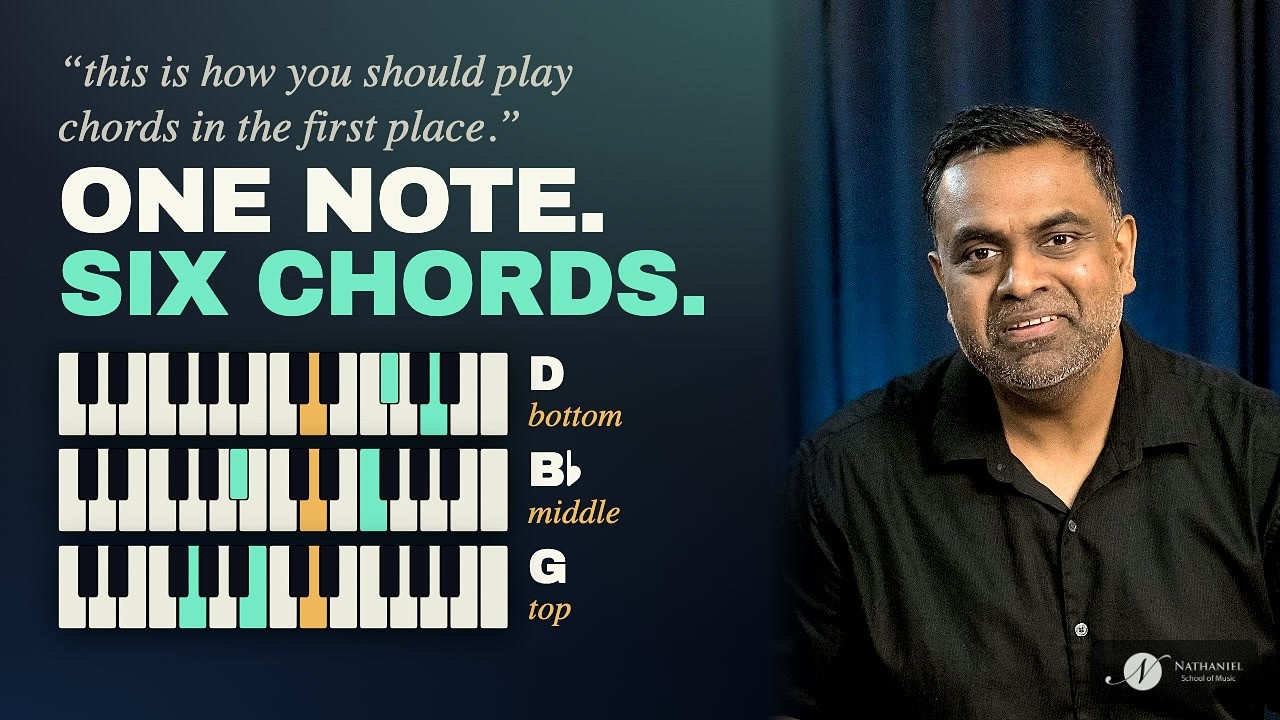
This lesson introduces a comprehensive exercise designed to help pianists master all 72 possible inversions for major and minor triads using a single "pivot note" drill. The core concept involves selecting one specific note, such as D, and identifying every major and minor chord where that note functions as the root, third, or fifth. By anchoring this pivot note in different octaves—specifically at the bottom, top, and middle of the keyboard—the player systematically works through six unique chords for each position. This method ensures that all inversions are practiced within a cohesive musical ecosystem rather than in isolation, allowing the musician to understand how these chords relate functionally while maintaining a consistent hand position or pattern.
The practice routine progresses by shifting the anchor note's location to explore different voicings and inversions for the same set of six chords. When the pivot note is placed at the bottom, the player performs root positions and first inversions; moving the anchor to the top requires utilizing second inversions, while placing it in the middle covers the remaining possibilities. The instructor suggests various techniques to enhance this drill, such as playing identical patterns in both hands simultaneously, singing the chord roots to train the ear, or alternating between major and minor chords to maintain engagement. This tactical approach not only builds muscle memory for specific shapes but also reinforces theoretical knowledge about chord construction and intervallic relationships, preparing the player to apply these connections in actual songwriting and improvisation.
To reach the full goal of covering all 72 shapes, the exercise expands by introducing a second anchor note that is the tritone away from the first, such as moving from D to A-flat. This strategic choice generates a new set of six chords for each octave position, effectively doubling the unique combinations without requiring the player to learn entirely unrelated material. Once the initial 36 shapes are mastered through this mirrored process, the remaining chords become significantly easier to grasp because they follow the same logical patterns and functional relationships already established. The lesson concludes by encouraging learners to utilize digital tools like the Chord Trees app for further exploration of complex chord types, such as suspended chords and sevenths, while inviting viewers to support the channel through Patreon memberships or live workshops at the Nathaniel School of Music.
Read the full video transcript
[music]
>> Hi everyone. This is Jason Zac from
Nathaniel School of Music. In this
lesson, it's going to be an exercise to
practice every single major chord, every
single minor chord, in every single
inversion. So, that's
12 into two, 24, and 24 into three.
Yeah, that's a lot, I guess. Whatever
that number is. What is 24 into three?
72, I guess, right? Yeah. So, 72 shapes
for major [clears throat] and minor
chords are going to be done in a tiny
YouTube lesson. I have no idea how we
are going to get this done, but let's
try. The first step would be to take a a
single note, let's say D, and ask
yourself how many triads have the note D
in them, which are major and minor?
Because this lesson we are learning
major and minor chords. So, that will be
the namesake chords, D major,
D minor,
>> [music]
>> and then D, you ask yourself the
question, D is the fifth of I am the
fifth of what? So, D is the fifth of the
G, which is G major. D is also the fifth
of the
G [music] minor.
Then you can ask yourself the question
because a chord is a has a root, a
third, and a fifth interval. D is the
root of the D major, D is the root of
the D minor, D is [music] the fifth of
the G, D is the fifth of the G minor.
So, now you go D is the major third of
which major chord, and D is the minor
third of which minor chord? D is the
third of the B flat major chord, D is
the third of the
B minor chord, isn't it? D is the third
of the B flat. [music] D is the third of
the B B flat, B minor, B flat, B minor.
So, you basically have these six chords.
Now, you need to work on the inversions.
So, good way to work out your inversions
for these six chords is to pivot or
anchor one note at a specific position.
And that note is the note you started
with itself, which is D. So, D will
start off with in the left position or
maybe in the top position. Let's start
with the left. So, that's the bottom
position. D is here
in the left side and you play all the
six chords in no particular order. In
fact, I don't encourage you to go D
major and D minor immediately because
that'll be a kind of an easy one, right?
So, go major chords maybe, then do
minor, and then come back to the root
tonic minor. So,
D major,
G major,
>> [music]
>> B flat major,
B minor,
>> [music]
>> G minor,
D minor. That's a good order. So, tonic
major,
then
>> [music]
>> D is the fifth of the G major. Now, D is
the third of the B [music] flat major.
D is the minor third of the B minor.
D is the
perfect fifth [music] of the G minor.
Finally, D is the root of the
D minor. [music]
And where is D along this whole journey?
In the left side. So, automatically
you've practiced six chords, unique
chords, together in a very musical
ecosystem with inversions. So, that's a
good start, I guess.
It's kind of tricky, but it's also kind
of easy because this is how you should
play chords in the first place. Okay?
I'm going to go on now with D in the
upper register.
In the top, we've covered it in the
bottom, right? And before we move
forward, get your keyboards out and play
along with me. Why not? You can pause
the video and get it. And you'll also
get a study material which covers each
and every chord, each and every
inversion. It's very easy. It will stay
with you for life. All you have to do is
become a Patreon member, and we'll also
give you a an app which helps you to do
all this pretty much as a composer, not
just to practice this in an in a you
know, just in a a pianist exercise kind
of way. We have this app which is out
called Chord Trees. You can go to the
link in the description, and what's
really cool about the app is you can
choose to be full-on chromatic and get
every single chord out of a note, or you
can even go diatonic and go into kind of
pop and rock mode. Or you can why you
know, why why only do triads? What about
a suspended chord that has D in it,
right? That'll be maybe [music] a G
sus4, or D is the sus4
of an A, or D is the major seventh of
the
>> [music]
>> E flat, or D is the minor seventh of
maybe the
E minor seven flat five, or
D is the
what do you call it? The tritone of the
maybe G sharp diminished chord.
>> [music]
>> All of that has D. So, if you need
access to the entire gamut of stuff,
it's available on the Chord Trees app,
and you'll find all this in the
description, and we we're building a lot
of apps, so you can consider checking it
out. Not only there, but be part of the
Nathaniel ecosystem. Subscribe. Don't
forget to do that. Then you'll get
regular updates on our community.
If you'd like to learn these apps in
actual classes, do consider workshops
and courses at our school where live
lessons occur. And [snorts] don't forget
to hit that subscribe and turn on the
bell for regular notifications. Before
we get started, that's pretty much the
only way to get these videos out to you
folks. And to basically provide fuel for
these videos to live on on YouTube for a
longer time. But hopefully a really long
time. And yeah, that's about it. Let's
continue to get cracking. So, you have
the D which we finished off at the
bottom.
D major.
G major.
B flat major. And I encourage you to
either do one of the things in the left
hand. Do a ditto, carbon copy, parrot,
whatever you want to call it in the left
hand with respect to the right hand.
>> [music]
>> The same thing. D major, G major,
>> [music]
>> B flat major, B minor, G major,
D minor. [music] Repeat.
You can try different patterns for both
hands.
B flat.
B minor.
G minor.
And finally,
>> [music]
>> D minor.
You should also practice
playing the roots of the chord in your
left hand.
So, I'll start with D major.
>> [music]
>> B flat.
>> [music]
>> B minor.
G minor.
D minor.
You can go in the reverse. D minor,
[music]
G minor,
B minor,
B flat major, G major,
D major. [music]
You can also sing the roots to train
your ear a bit more, I guess. Now, let's
push D at the top
and practice the same old six chords. D
major,
G major, [music]
B flat major. You see, D is on the top.
That means I have to use the right
inversion.
D major [music] would be played as F
sharp A D.
B flat major will be played as F B flat
D. So, in other words,
>> [music]
>> the root position of D major, the
inversion of B flat,
the second inversion of B minor,
and then [music]
the root position of G major,
root position of G minor, and so on. So,
get used to that shape. So, that's six
plus six. You know, we've got ourselves
12.
>> [music]
>> B minor,
G minor,
D major, [music]
yeah, it goes on.
D is kind of stuck as a wall or a anchor
up there. You should also practice D in
the middle. So, again, D major,
G major,
B flat major, [music]
B minor,
and then what's left? G minor.
D [music] minor. So, you have this D in
the in the center. So, with this
ecosystem, you're basically getting six
chords played in all the inversion
possibilities. So, you mastered six
chords in all their inversions. So, how
you move forward is first of just
understand the process.
The target note or the anchor note was
initially at the bottom
and you played all the chords.
>> [music]
>> Then the target note was at the top and
you played all the six chords.
>> [music]
>> Target note was in the middle and then
you played again all the six chords.
Hopefully the root in the left hand.
>> [music]
>> That's the majors and then minor.
>> [music]
>> Or you can carbon copy it.
>> [music]
>> Exactly in the left hand. So that'll
[music] be D G B flat B minor G minor D
minor.
Now all this on D and you've kind of
covered six chords all their three
inversions. So six threes are 18 and
you've got not only that you're also
playing in a very tactical way. You're
going to use these kinds of connections
in actual songs. So what do you do now
to take this number to the full number
our target number which was
24 chords in total into three inversions
72 right? Yeah. So what [snorts] you can
do then to generate another anchor note
would be take the polar opposite of D at
least in terms of the function and the
circle of fifths. That would be its
tritone. So that'll be A flat.
So now you get all the options for A
flat and go along the way.
>> [music]
>> A flat major
A flat minor or A flat [music] is the
fifth of the D or A flat is the fifth of
the D flat or C sharp and A flat [music]
is the third of the
E or A flat is the minor third of the F.
So like that you'll have six options. A
flat major
D flat [music] major
and then
E major
E minor [singing]
and then [music] A flat minor
and then
C sharp minor. Okay, I started in the
wrong order. Let's do that again. A flat
major [music] and A flat is all on the
top or G sharp if you want to call it
that. You'll have to call it both words
because the major chord E, we call that
note G sharp while the major chord A
flat, we just call that note as A flat,
right? So, let's roll that again with A
flat at the E bottom. A flat [music]
major
D flat major
E major major third
>> [music]
>> F [singing] minor minor third and then C
sharp minor perfect fifth [music]
and back to the minor tonic. Okay, so
all of these chords I reckon we have not
done at all for the D key, right? So, it
automatically gives us six brand new
chords major and minor in a nice combo
of three major three minor and another
six threes are 18. So, that will give
you 36 now. 36 out of 72 is half of the
way. So, basically now if you want to
get unique possibilities, you're doing D
it's tritone which is A flat. So, let's
consider putting F at the top. F major
B flat major
>> [music]
>> D flat major. So, you see now I have
that D flat major which has repeated and
then [music] D flat minor [singing]
D minor which has repeated. So, it
starts getting easier once you do the
first tritone
you will get 36 unique options. You can
take any tritone. It could even be C and
F sharp or
A and E flat or
G and D flat and F and B so on and so
forth. Once you get that you've got 36
and then the it's going to get
exponentially easier. So the first 36
you have to work. That's six into three,
that's 18 shapes. Major and minor into
two, 36. Then the remaining 30, you have
no idea how much more easier it'll get.
It'll If it took you about, you know, a
week to do 36 chords, it'll take you two
days to do the remaining 36 or maybe
less. So, that's about the exercise,
everyone. Hope you found it useful. And
do consider using our chord theory app
to actually apply these concepts
musically to help you improvise and
compose and also practice the piano. The
notes are available on our Patreon as a
study guide. Do consider getting
yourselves a copy and the app is also
there. Do consider heading over there
and you can also support our channel by
going [clears throat] to the app pages
and,
you know, considering to support it or
you can become a Patreon member or
whatever works for you. And if you'd
like to learn any of this live, do
consider a course at Nathaniel School of
Music. Okay? I will catch you in the
next one.
Don't forget to like, share, and
subscribe. Cheers.