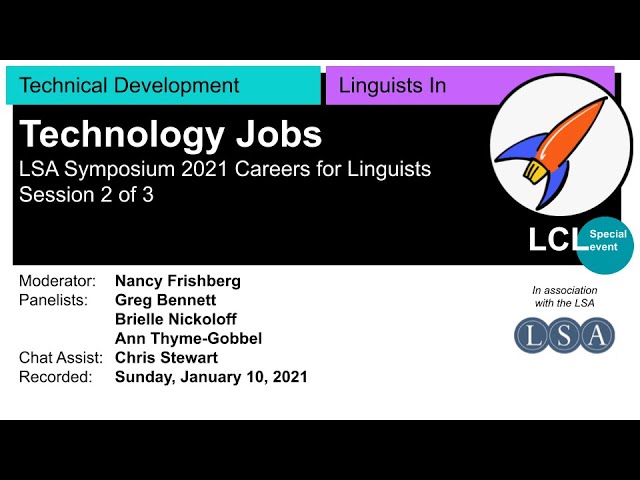
LCL Technical: TECHNOLOGY JOBS - LSA Symposium 2021 session 2 of 3
Watch on YouTubeVideo summary
The LSA Symposium 2021 session featured a panel discussion with three industry professionals—Briel, Nancy Fishberg, and Greg Bennett—who shared their unique career trajectories from academia to the technology sector, specifically within voice user interfaces and conversation design. Briel transitioned from pre-med and neuroscience to linguistics and eventually UX design, leveraging her background to help clients name Alexa skills and define use cases while working as a nanny before launching her own startup. Nancy Fishberg, holding a PhD in sign languages, highlighted the importance of personal connections for entering major companies like Nuance Communications in the mid-1980s, while Greg Bennett utilized a DARPA research assistantship to enter Microsoft, later helping establish Salesforce's first conversation design department and advocating for ethical considerations such as preventing gender bias in voice analysis.
A central theme of the discussion was the comparison between working at startups versus large tech corporations, with panelists noting that a "yo-yo" career pattern often allows professionals to gain diverse experiences by balancing the broad impact of big companies with the detail-oriented nature of small teams. The group addressed whether advanced degrees are strictly necessary for entry into the field, concluding that while PhDs provide depth, practical experience, networking, and self-driven learning are often more critical; Briel specifically advised against paying for graduate school unless one has a clear professional goal. Furthermore, the speakers emphasized that linguistic skills like phonetics and discourse analysis are directly applied to product naming, grammar writing, and ensuring system fairness, stressing the need to anchor technical arguments in business value and user experience outcomes to secure stakeholder buy-in.
Practical career advice was also offered regarding branding and logistics, with speakers arguing that strictly adhering to formal spelling rules can make a brand appear stuffy; instead, companies should align their language with user habits to positively impact marketing perception and the bottom line. For non-US citizens targeting American startups, the recommendation is to seek large corporations with dedicated HR infrastructure to support visa processes, as small startups often lack this capacity, though starting at a smaller company can provide the flexibility needed to build a foothold before moving elsewhere. Internships were clarified as opportunities open to high school and college students who act as generalists across team functions, contrasting with corporate environments that may doubt candidates claiming diverse skills, while the session concluded with strong encouragement for linguists to network actively to combat self-doubt and own their expertise by framing answers around business impact before diving into technical details.
Read the full video transcript
[Music]
So we've got three panelists today who
are going to talk about uh uh their jobs
in voice user interfaces, conversation
design, conver discourse and so on.
uh my let me introduce myself and then
we can uh Chris will say something about
himself and then I'll go through some of
the same points that Alex was um making
in the first part of this panel where we
were talking to people from the
government sector and this time we're
talking to people in industry and so on.
So hi Bril I can see you is that am I
saying your name correctly?
You are nice to nice to meet you. So let
let's let you go first and give us a one
or two minute summary introduction to
you what are you doing now and you know
job title where did you go to school
very brief and then we'll come back and
circle on some of these then then let me
just say the other two panel I was going
to introduce myself too right um I'm
Nancy
Fishberg I am an independent uh
contractor and I'm interested in
qualitative
uh experiences uh human experiences
while using digital products or physical
products. And so I do I call myself a
user experience researcher and
strategist. But I came to I've been in
uh industry side of things for since
1985. I think that's a long time. It's
longer than some of you have been alive.
Oh well. Uh and but it was a hard
transition to make because there weren't
people ahead of me that I could talk to
about how did you make the transition?
So that's what you know I have a PhD
from University of California, San
Diego. I was the first PhD in sign
languages. And let me not let that uh
hijack the rest of the conversation. I
think in a in a group of linguists, we
can all accept that it's a a real thing.
Um and let me say for Chris. Chris, do
you want to get on and say a quick hello
and introduce yourself? Sure. My name is
Chris Stewart. I work at Google as an
analytical linguist in a team that does
human computation.
um doing mostly automated analysis of
large data sets that are annotated by
humans, raiders across the world. Um I
previously worked as a senior data
scientist and a voice engineer at um at
Nuance Communications. Um and yeah, PhD
in French linguistics from the
University of Illinois in
2009 and had a tenure track job, left
the tenure track and I've been in
industry ever since. And I should
mention that even though neither Chris
nor I mentioned it earlier, both of us
do coaching privately outside of our
regular jobs for people who are trying
to make career transitions, especially
out of academia. So that's that's the
commercial. That's over. All right. Now
to our panelists. Briel, please talk to
us about you.
Sure. So I am um a I'm head of product
at Botmach. I'll get get into that a
little bit more later. Um, I got my I
got two undergrad degrees from the
University of Colorado at Boulder. One
was in linguistics, which was really
kind of an afterthought, and one was in
neuroscience. Um, really with the
intention of going to medical school
after I grew up in a family that was
very STEM oriented.
Um, and I I really wasn't able to
visualize a path towards success other
than medicine based on kind of the
environment I grew up in, even though I
realized in high school I loved
linguistics. So, I started I I added a
ling minor as a sophomore in college um
here and there convincing my parents
like don't worry, this is just like a
fun thing on the side, like don't stress
out. And then by senior year, I had
taken so many lane courses
that, you know, all I needed was like a
two classes in another language to get
um, you know, to make it a major and get
a degree. So that's where I found
myself.
Um, and long story short, I was so
unaware of this world when I did
graduate. Um, the only thing I had ever
really heard about the world of like
tech or industry or a a linguistics
linguistics opportunities
um that weren't in academia were my best
friend who had always been kind of an
artist. Um, my parents saw her kind of
path through high school and college and
they were like, you know, she's great,
she's like doing her own thing, but you
need to stay focused. and she ended up
getting an amazing internship at Spotify
as a designer um during college and and
then you know worked at um startups and
now she's at Snapchat as a designer and
so it finally opened my eyes to this
idea that creatives can you know forge
their own path in this world and um she
had been like sneakily sending me
linguistics uh like analytical linguist
job descriptions from Google over the
course of my senior year and trying to
say like, "Hey, this is a thing. Like,
you can do this." And I was like, "Cool,
sounds good, but now I'm going to stay
focused." So, anyway, long story short,
um I I realized as a senior like this
isn't working for me. And luckily, I had
been a living nanny at that time, so I
didn't have to move home after I
graduated. and I kind of just threw
myself into learning everything I could
about UX, UX design, what this new space
of voy design was and um started working
at a very small startup and that was my
kind of um foot in the door and okay so
we're hold on to that one we're going to
talk about how you got to that first job
but so say so you're now working on voy
design expand that because I'm not sure
everybody knows the pronunciation voy
design voice user interface design. Um,
my and sorry, I wanted to cut myself
short in case I'm taking too much time
with this intro, but um, yes, I started
as a a voice user interface designer at
a very small startup. And, um, there's
two people. It was really me and my
boss. So that was my first realization
that you know this world of startups
exists and um you know really starting
to finally reach out and I actually had
reached out to an uh during that summer
asking her like hey what do you do? I'm
really just trying to find people that
are in this world and because I don't
really know what it means to be an
analytical linguist at Google. I don't I
don't really know what it means to be
like this in the real world. So I was um
Okay, that's a great segue where we can
get a quick introduction to Ann and come
back to you. How about that? Thank you
so much. So I want to introduce you all
to Ann Gobble and and you're going to
correct me on pronunciations also. And
this is by linguists. Yes, that's the
only time I would do that.
And so uh you were in this before was in
it. I was.
And so tell us the quicky introduction
and then we'll go deeper. Sure. The
quicky introduction is that I also came
out of UC San Diego grad school. Um and
like me, not like like you. Exactly. Um
um but we did not overlap. But because
I'm so old. Yeah. I'm not spring chicken
either.
[Laughter]
But any case um yeah so I um had my
degree was in linguistics and cognitive
science because of the UCSD
um cogsai program which is you know
people are in all these different
departments and which is a fantastic
place to get into this kind of work that
we're all uh interested in. Um and the
thing is while I was in grad school um I
was a foreign student because I was born
and raised in Sweden. So it was I was
kind of limited on kind of work I could
be doing for money while I was a
student. But my adviser who was a
phonetician said, "Hey, um ITT um
they're they're doing all this work on
phonetics. They're doing this phone
marking on because they're developing a
speech recognizer and you want to do
that?" I'm like absolutely it sounds
great. So that's kind of how I sort of
went started down this path and um then
I did a similar job for another u
startup before I finished and then it
was kind of the natural easy choice then
to just kind of go that way. So and you
liked it. I mean and I don't know if you
were here to listen to the first part of
the the government part of the panel but
one of the things that people advised
the panelists advised was do something
you like. Yes. And that uses your
skills. So it's not just that you did
you found that job and poof, there was a
path for you, but you really liked it.
Anyway, that's exactly it. Like like you
mentioned earlier, Nancy, it was the um
I had found out about uh linguistics
from from somebody went to UCLA when I
was, you know, in in college and what is
this linguistics thing, you know? Yeah,
I need to find out because I came from a
family that was very much into language
and so on. So it's kind of a natural
like, well, this is cool. I wonder what
I can do with it, but I'll worry about
that later. So, so that's how I got
started. And then I've, you know, just a
briefy one is that I've kind of been at
various kinds of companies, big and
small, new ones like many people. Um,
Amazon, uh, now I'm at a small startup.
And I like both of them, both types of
jobs for different reasons. We can go
into that more. Yeah. Yeah. I think
that's a nice theme that we can pursue
in a few minutes after we meet our third
panelist who is Greg Bennett and I think
I know how to pronounce his name because
it's pretty pretty regular in the
greater Anglo-Saxon area. So, Greg, tell
us about you. And you came out of the G
a Georgetown program. I'm not sure if it
was the same one.
Let's see. Kyle, go ahead. There you go.
Um, so I, yes, I attended Georgetown for
undergrad and grad and, uh, focused in
applied linguistics and social
linguistics because at the time I
couldn't really sort of make up my mind
between language teaching and, uh,
discourse analysis, interactional social
linguistics. Um, so I did a bit of a
fuse of the two. Um, and technically my
degree is in applied linguistics because
the applied linguistics concentration at
Georgetown allowed for a lot more of
flexibility um to you know spend time in
the social linguistics area as opposed
to had I done the socio concentration I
wouldn't have been able to do quite as
much of the language uh pedagogy course
work. So I I did that work actually my
first exposure to industry was while I
was at Georgetown in graduate school. We
had a research assistantship for a
project through DARPA, the Defense
Advanced Research Projects Agency. Um,
and that was really sort of my first
exposure to doing research for a
product. So what does it mean to
understand a particular interaction or
users for a given uh you know at the
time it was a video game that we could
potentially develop into an experience
and at that time I didn't even know what
user experience was um I I was just like
okay well these people tend to do these
things and so we should make the product
do you know X in order to accommodate
that. Um I took a year off after grad
school to kind of do the whole find
myself California yoga granola hummus um
journey as it were which was hugely
valuable. Um spent some time teaching um
ESL because I didn't really do any
teaching as part of my graduate work. I
only did research assistantships. And
then u you know of course our
um guardian angel as it were Anna Marie
Truster reached out to me and was like
hey I heard you're in the Bay Area.
Microsoft is looking for a researcher
who knows something
about conversation and ethnography. And
I was like Microsoft knows what those
things are and cares to hire somebody
who like specializes in that. So I was
like sure why not? And at the time I
didn't even have a resume. I just had my
CV and I the email actually had come
from you Nancy um that you had said the
email to Anna and at the time we didn't
know each other. I was just like okay
well maybe the hiring managers will
think I'm legit if I attach this entire
email thread to my response. Oh did you?
So I did I forwarded the whole thing. I
was just like maybe they're going to
know somebody here because I don't know
any of these people. And then I attached
my CV because I didn't know any better
and was like, "Hey, I don't know if you
know, you certainly don't know me, but
you might know one of these people. I'm
interested in the job." And that's
actually what got my foot in the door.
They were like, "Oh, I know Nancy." Um,
Lisa Peasson was actually the person
hiring. So, um, and like they all they
did was read maybe like the first page
of my CV. So, of course, like they
didn't know anything about what I did
because the first page of your CV is
just like where you went to school,
right? Um, and so when I got in the
interview room, that's when I found out
it was the project they were working on
was Cortana. Um, they did offer me the
role after I explained to them the kind
of work that I did at DARPA. And, um,
once I got in the role, that's when I
had the great fortune of working with
Lisa Peasson, who took me under her wing
and taught me what UX was. And once I
figured out what user experience was,
that's when I realized, okay, actually
the jump from social linguistic research
to user experience research actually is
not that far. It's just a matter of
figuring out what user experience calls
these research methods instead of social
linguistics. And at that point, that's
when Nancy, I sought you out and had a
right, we had lunch, we had lunch at
Yahoo. Um, at the time, I ended up
moving to Yahoo from Microsoft. And I
was like, "How do you talk about tokens
when you're talking to non-llinguists
because I don't know what I'm going to
do about this?" And it was great. You
facilitated me like a user researcher
and it was wonderful. Um, and then at
once I so I I ended up at Yahoo because
I wanted to see, okay, am I really
interested in user experience or am I
really just interested in tech? Um,
found out that I preferred user
experience research to search relevance,
which was what I was doing at Yahoo. Um,
I got connected to someone at Salesforce
through a Google group um called uh
design user research, which is pretty
popular. Everybody, I think uh is is on
there um for a contract role um that had
been filled, but then they were saying,
"Hey, if you're interested in a
full-time role, um that might be opening
up in a couple of months." So, I stayed
in touch with the hiring manager,
reached back out to them once I saw the
full-time role for a user experience
research role, um, and then said, "Hey,
would you be willing to refer me?" Um,
and that she was, uh, very luckily, and
that's what got me into the interview
room. As soon as they submitted the
referral, um, the following day, I got a
call from the head of research for an
interview. Um, three days later, I was
interviewing and then another couple
days later, I had an offer.
um started out I've been at Salesforce
for five years. Um Wow, that's great.
Yeah, it's been a I can't I did not
expect to be here this long if I'm being
honest. Um I started out as a user
experience researcher working on the
flagship salescloud product. Um and the
entire time I was working on research
for their AI products which at the time
were more fledgling. Um, and then I
moved over to the ServiceCloud product,
which is for their customer service
industry to work on the Einstein bot
builder because that's when I found out
that we were going to produce a chatbot
builder. And as soon as I heard that, I
was like, "Everybody out of my way. I
want to research that." All right. I'm
here to help. Yes. And that's I'm not
from the government. I'm from
Salesforce. Yes. Exactly. Um, and that's
when I started moonlighting as a
conversation designer, offering uh
because everyone on that team really
wanted advice like how long should the
pause between turns be or uh how do like
how do we organize the intents or you
know how do we frame the conversation?
And I'm like a I can't believe you're
using these words, b I can absolutely
help and c let's go. Um so, uh I did
that for I think two and a half years
until the demand for conversation design
resources like actual design assets
really hit a fever pitch and I sort of
seized that moment to um essentially
found Salesforce's first official
conversation design department and so
now I run that. That's very fun. and how
many conversation do you have anybody
reporting to you or do are you a loose
matrix of people? I'm sorry I'm going on
beyond this intro thing and uh so let's
hold that question for just a minute
because I want to draw attention to a
couple of themes and Kyle if we can have
all three people on with me at the same
time. Can you highlight all three and
then we can go back and forth and have
more like a real conversation and Kyle
doesn't have to do so much work. I don't
know if he's even listening but we can
hope. Um, I'm hearing two themes that I
know we want to come back to besides the
content of your actual day-to-day work.
And I'm talking to all three, Bel and an
and Greg. And that is this business
about startups versus big companies. And
I think there's a very interesting
interplay with some questions that are
coming in the Q&A uh which is about
visas for people who are not US citizens
getting jobs with US companies in US
locations and how do you negotiate that,
right? And so I hope that we will all uh
be able to talk about some of those
things as well.
Uh, so if you haven't already told us
about your first job after graduation
and so Greg, you're holding, you've got
one marker in the parking lot, right,
that you're going to tell us about this.
Uh, do you report to people? Is there a
conversation design group, an
affiliation group, you know, uh, and
there's lots of ways that organizations
can handle it, and I'm curious about how
so Salesforce is doing it now. But let's
we're almost there. I see two of us and
we're going to have two more coming in.
One. Okay, good. Then two. Good. Okay.
If you haven't told us about your first
job after grad school. Oh, sorry. I
don't mean after grad school. I mean
your first job outside of academia and
that transition. I'd like to hear from
any of you that hasn't. I think we sort
of heard from Bil if you have something
more about that one.
And uh Ann, I don't know if you kind of
you you sort of jumped into it, but you
didn't really give that that detail
about how you made those connections.
Sure. Was Peter Benson involved? Not at
that point. Uhhuh. Okay. There's a name
I haven't heard in a long time.
No, you're right. Actually, he was
there. That's right. He was there.
That's right. Yeah. Um Yeah. Yeah. Yeah.
Yeah. No, so I mean, I kind of hinted at
that that it was sort of a a slide into
it. Um even though I think still I am
kind of at heart more of a sort of
researcher like I mean academic on some
level but sort of practical academic
right because I don't want to just sit
and do theory I want to sort of apply it
but I also really want to get at the
underlying like really how how does this
stuff work you know and all that kind of
stuff right so it has to it's always
this balance of finding you know how do
I do the stuff that's actually real data
and reality that can be applied and you
know that kind of
But yeah, so that's how it started. I I
um started just doing this phonetic the
phone marking. Um and then as I was
finishing up getting closer and closer
to finishing grad school and being there
on a student visa, I'm thinking what am
I going to do next? Yeah. And uh don't
want to go down the path of of uh of
academia or not. And I got this other
similar job for another startup in San
Diego that um started as all also
started out as doing phonetic marking of
stuff but then kind of went into other
things. Um and it was a small R&D
company very language and speech focused
and uh they kind of survived by um
getting small business grants mainly
from different sources NSF you NIH DoD
you know take what you can get. So I was
doing that for quite a while and that
turned into a real job. Then after I
finished I'm like okay you're doing my
stuff I'm sticking with you you know
there comes your visa tie in you know um
and uh then I worked there for quite a
few years until it kind of folded for
various reasons and that's when I went
to nuance because a friend again it's
the connection stuff a friend who knew
somebody else who like hey why don't you
talk to so and so she's at nuance why
don't you talk to her she does your kind
of stuff and then that then that's how
it it's absolutely So you cannot
underestimate those personal contacts
and I feel also like that taking that
step of actually saying yeah sure I'll
do that phonetic marking stuff the
during grad school if I hadn't done that
I have no idea where I would have gone I
guess that was the first step into that
path
thank you okay does anybody else want to
say more about their their initiation
into the world of nonacademic work
you're okay trying to initiation stuff I
actually want to hear more about uh the
the advertisement for this group which
is about technology and phonetics. But I
think you know Greg, you're the furthest
from phonetics in some way except for
that stuff about how long should the
pauses be between uh between the
question and waiting for the answer. Are
you still there? Should I wait for you?
You know that one, right? But uh Brill,
I think you and Ann both can talk to
that more. and Ann, I hope you give an
advertisement for the upcoming book.
So, Bri, so yeah, um I I think Ann
really is the expert on this one. Um I
don't have any advanced degrees, so
everything I know about linguistics, I
was trying to pack in in college between
premed coursework and neuroscience.
Um, I wish I could have gone a lot
deeper because I I and and I think
that's one of the reasons I consider
going back to school in the future
because I kind of feel like my
linguistics education was rushed. All I
knew is that I had like this weird
inexplicable passion for learning about
it and like trying to teach my friends
about it, but I just I wish I could have
gone much much deeper. So um I do know
that when I w when I did start as a as a
voice user interface designer
um sometimes uh I would get to draw on
that uh that knowledge when for example
helping a client pick a name for their
like Alexa skill. So
um in my last startup we were a product
company but also kind of trying to get
off the ground by doing a bit more
agency type stuff. So um our promise was
that you come to us we will help you
think up a good use case to bring your
brand or your company to a voice uh user
experience probably accessed via Google
Assistant or Alexa at that time. And
then um and we would basically bring
them through the uh we would really take
on a lot of that process. So it wouldn't
be like a normal, you know, graphic
design agency situation where the client
already kind of probably has an idea of
what it should look like and feel like
because these experiences on the smart
speakers are so new. So, we would really
take um we would really kind of drive
the whole thing and help and I remember
helping a client pick um the name that
he was going to launch on Alexa with and
explain explaining to him like what
makes a good name and what doesn't
because it has to be easy to say. Um the
phonot tactics have to be just so um you
it has to be memorable because it's not
right there in front of your eyes like
uh a visual interface is. Um it you
obviously want it to somehow reflect
your brand. Um, but yeah, I remember
being able to explain a little bit about
like why this name wouldn't be such a
great idea because of this reason um the
phenology of this versus this. and he
responded like he was interested but I
was like okay I'm actually maybe in the
future I'll still because I gave him
like two paragraphs like of hardcore
linguistic reasoning and he was like
okay just tell me what I should do. So
from then on I was like I'll just think
about it on my own and then I'll sort of
give like the two sentence reasoning
from now on.
But you know you can back it up with all
kinds of other stuff if anybody tries to
tries to Right. Yeah. Right. If they
push back, we've got the we've got the
the rationale. Right.
Right. Great answer. Thank you. I
appreciate it. And tell us more about H
about your stuff and about the content
of your work in the past few years.
Sure.
Um, so of course what you see and and
you probably if you're around people
doing this stuff at all, you see a lot
of people who come through the the
nuance doors because there's a we like
to refer to as the nuance mafia. We kind
of tend to stay in touch and we show up
all over the place, right? Because the
thing is nuance um u was and is a place
that of course does um work for call
center phone stuff. the things that
people love to hate, right? Which is far
from the press or say one that people
like to point to, which is just if you
do that, you just have other problems,
right? That is not what good voy design
is about for those things or anything
else, right? But the thing is about
working in that space is
that we were kind of limited in many
ways. And I'm I'm very glad that I went
through that because um when I started
it was a small company and um which
means everybody kind of had their
fingers in a lot of things. So I got a
lot broader experience than people even
who started there a few years after I
did got a chance to do like writing
grammarss and things like that which is
really cool because as somebody who's
interested in linguistics right you see
exactly what happens you know it makes
you understand you know you have to
think about both what the user does
what's easy and hard for the user and
what's easy and hard for the computer
and how do you get these to talk to each
other right in ways that work for
everybody
and uh and in a way it was actually
easier back then than it is now when
some of the technology is further ahead.
I mean in terms of recognition and
things like that but most people don't
get the opportunity to get that close to
actually messing with the with the
details right so um and um then so I
went from there uh after many years I
went to uh Amazon lab 126 before Alexa
came out um as I was working on things
related to that and then I got lured
away to another startup like went to
small to big to small Um because I
really do like I call that my yo-yo
career. I do that too. Right. Tiny
little company. Big company. Yes.
Exactly. And and they're good. You know,
like we mentioned, pros and cons of
both. Um I kind of like the smaller
companies because of the chance the
opportunity if you if you're working
with the right people, you have a chance
to make more of an impact sometimes and
again you get closer to the details of
the you know where you can mess with
stuff. Uh but that's not always true,
right? I mean it all depends on the
details but uh I went to a place where
we were doing a um a multimodal app for
helping people prepare for um medical
procedures and u but it had you know a
speech component to it you know and
brought up some really interesting
questions linguistically in terms of
what do you do especially in a field
like health right I mean now you can't
just say oh oops I gave you the wrong
song right oops I gave you the wrong
medical advice oh darn right? I mean,
that's just isn't going to fly. So, it's
a whole different level of of tricky to
do it then. And how do you confirm that
you actually heard the right thing and
you're still being helpful? And
sometimes you might have, you know,
other forces in play that, you know,
like well, you know, business rules,
blah, blah, blah. You know, that's
always a fun one. But,
um, so, but that was a really really
interesting job. And what we did there
also in terms of fanatics and and so on.
And to piggyback on what B said, we
actually had, we were trying to come up
with names for our own products and we
actually did some tests with, you know,
naive listeners where we had a whole
little thing set up or playing bunch of
names and see what people remembered and
why and figured it out that way how to
how to name stuff. So that was that's
another place where just suddenly the
whole background of you know linguistics
and phonetics popped up. Right. Um.
Right. And and you didn't choose to hire
in Laurel or her company which
specializes in naming. Well, small poor
company, right? Exactly. So sometimes
you got to use these skills in other
ways, right? Exactly. You probably
didn't follow the process she would have
followed, but you got there and you felt
confident that the linguistic knowledge
you were bringing to the problem of the
brand name would be sufficient. It it
helped in that context. Exactly. So,
right. And then I went to there from
there to Denon which is audio equipment
company that makes very nice speakers
and so on. And I was there with a group
of people some of them were from the
ones and we were working on doing speech
stuff there. Um that was pretty cool
until they decided not to do
that. And now I'm for a startup doing a
little um radio thing, little speech
radio thing. I've been there for since
the beginning of the strange year that
we just left. Um and um yeah, and then
my said my spare time I'm trying to
finally finish this book that I've been
working on with another ex nuance person
on uh mastering voice interfaces which
is talking about a lot of these things
like how do you get people to work
together to get a good product? You know
your linguists, your developers, your
marketing business people.
So good. Okay.
Um, and so Greg, now tell us a
story except you got to come off mute.
Any story at all? No. Well, either you
tell us tell us one of these stories
about, you know, your day-to-day life.
What are you really doing? Or or pull
the placeholder out of the parking lot.
Sure. Probably address the two of them
together. Uh yeah. Uh so I think my my
day-to-day really is sort of zipping
about the company and chasing down any
experience that involves conversation.
Um and making sure that anyone who's
working on it can understand the
linguistic stipulations around making a
a choice about language. So that can
range from anything to are we going to,
you know, like put a period at the end
of our sentence or an exclamation mark
for the conversation design that we're
putting in for this textbased chatbot.
Or it could be um we want to uh
interpret salespeople's sales calls and
figure out if they're going well or if
they're not going well. Um okay, that's
great. But, you know, if you're doing
this based on to keep it in within the
realm of phonetics, um, you know, if
you're doing this based on pitch and we
know that certain conversational styles
have a higher pitch or a greater um,
intensity perhaps than the data set that
you're training on, then now all of a
sudden you've introduced a bias into the
system and any salesperson who talks
loudly um, is now all of a sudden
negative um, and that impacts their job.
So, you know, making sure that teams are
aware of this. Um, I'm not a
phonetician. Um, but I do know just
enough phonetics to be dangerous and to
be a real pain in the you know what for
our uh engineers and data scientists
whereby I've gotten in lengthy arguments
in front of executives. Um, where I will
Yes. um where I will go to bat for the
sake
of you know phonetics where I'm like I'm
sorry but just because and and really I
think from the angle of socioetics again
I'm not a socioonatician and I do think
sociopathicians are a real value ad to
this space so if you are a
socioonatician I highly encourage you to
think through um moving into this space
or the intersection of voice or
conversation design and ethics ethics is
the hot word they like to use in the
industry. I hate it. Um but because I
don't think
it's accurate, but that's what they like
to um use for uh you know, equity and
equality. Um and so for that sake, I
will go to bat and say something like,
well, hey, just because you can predict
the v the length of a vocal of given
vocal tract given the pitch value for a
sound does not make that person male or
female.
Um, and that's like one of the proudest
things I've ever done at Salesforce
where I'm like, "Uhuh, no, honey. We're
not doing that." Um, good. Thank you.
So, let's let's all join in and do that
together. Yes. Yes. Um, and then in
terms of my uh like team and whatnot.
So, I'm not hiring at the moment. I
don't have any direct reports. It's more
of this like dotted line matrix. And by
dotted line I mean that person the other
people who work in in relation to
conversation design with me now have
direct managers who are not me but that
they their work very much is in line
with my space. Um so I'm hoping to kind
of grow that um over the next year in
hopes to actually like hire direct
reports and grow that team.
Cool. That sounds
great. Let's see. We've got I think a
representative of each. So I think that
we I don't know whether we have to talk
about this at all. That is we have one
person who got two bachelors, one person
who got a master's and one person with a
PhD. And that was one of the questions
that had come up earlier is do I need a
PhD? Do I need an advanced degree? And
part of what I always say to people is
if you want to go to grad school, go
because you want to learn something and
if you know what you want to learn, even
better. uh but don't go to grad school
and especially don't pay your own money
uh unless you really want to do it. And
I think Briel can speak to this that
you've gotten lots of uh influence in
the field not because of your degree but
because of your actions and your ability
to draw a group together. So talk about
your women in voice uh group that people
may want to hear about. Oh okay, sure.
Um, so yeah, funny story actually. When
I was a junior or in the middle of my
kind of like senior year crisis about
like am I going to med school? Am I
going to like not go to med school? Like
what am I what the heck? This is what
I've been planning my whole life. Um, I
very hurdly got in my application for a
um kind of like it was a program that
could help me get a master's uh in
linguistics with one more year of
school. Okay. And I really, really,
really wanted this and I felt like it
was the right thing to do because it
kind of would give me that um one more
year to really figure out um if there
was a world out there that I could apply
my skills in and like a possible career
so I wouldn't have to just start
studying for the MCAT right afterwards.
So, um, I got rejected from that and I'm
so glad I did because it still it it
just forced me to have this reckoning a
little bit earlier. And now I now when I
like with a couple years under my belt
uh from working um I know so much more
clearly what I would want to like go
back to school for because I really w
there's all these things that I just
wish I knew so much more about and that
would help me with my job. Um, and
honestly I'm learning more every day
about other stuff too. Like
um over over the last month I
uh my co-founder asked me to join our
company as a late co-founder which blew
my mind and I'm so honored to be you
know in this position and it made me
realize that I really do love this kind
of startup world that I'm in as well.
like it's a whole other side to things
that I had never even anticipated. So, I
love this entrepreneurship thing and I
love, you know, business and it's also
interesting and I'm still doing, you
know, I'm still working with language on
a day-to-day basis, but it just opened
my eyes to this whole other world as
well. So, um, in terms of like the
degree, I know now if I go back to
school in a few years, what I'd want to
do. And when I graduated, um, like I
said, I I was living as a, uh, I had my
living situation figured out. I was
working part-time as a live-in nanny.
And then that freed up my other time to
really like go all in on finding some
kind of um internship or a job where I
could just get a bit more experience in
this field. And like Greg said, I had
also never even heard of what user
experience was. So I just for those
first couple of months, I like read
every Medium article I could get my
hands on. I I reached out to people. I
probably talked to like pro I probably
talked to 50 to 60 people in that summer
just to ask them like what they do um
and how they started to do it and
without asking them for a job right no
you were doing informational
interviewing which says I'm not asking
you for a job I want to hear about how
did you navigate this path that I'm
having I'm stumbling on exactly because
I knew I wasn't qualified for a job yet
um I wanted to learn how to become
qualified and really I took this tip
from um the book design your life and I
really recommend that book to anyone um
looking to start their career make a
change or literally anyone actually just
in general it's a great book but um but
yeah just reaching out and um trying to
create stuff so that's one thing that I
realized was so different about this
world versus academia was um in acade
academia, you really need a lot of
experience. You need the credentials.
You need like I had worked in a
neuroscience lab and I saw the latter
like I was like, "Okay, we've got this
the head of the lab. She's like the
queen bee. Nobody can question her.
She's got all this experience and she's
like the final word on everything." And
then there was the grad student that I
was under. And the grad student was
like, you know, like we would look up to
her and because she was, you know, like
she was finishing up and and it was just
this whole like you you had no basis to
really contribute unless you had already
put in the work, put in the time, put in
the hours, written um all kinds of
papers. And when I started my first job,
my boss
um he was like, "No, you need to start
writing because you have interesting
ideas and you just need to put them on
Twitter. You need to put them on
LinkedIn. You need to you need to get a
Twitter first off because I didn't I
wasn't really a social media person. Uh
and and I was really just using LinkedIn
um to find people, not like put anything
onto LinkedIn, right? I didn't want to
like I I don't like that whole I didn't
like the idea of any of that. But he was
the one really pushing me and he said
you need to use this time to write and
read but really put your work out and
then um and from there I I was just so
grateful to have this opportunity to um
learn speak at conferences. Um he he
pushed me to to apply to speak at a lot
of conferences even though I was like
who am I to be speaking at conferences
and he was like no you you there are no
true experts in the discipline of smart
speaker voice design at this moment in
time because it's so new and you already
have a background in thinking about it.
So whatever you submit will be of value
to someone. And it just blew my mind
that like people would actually listen
to me without me having put in the time
or the work necessarily, but basically
me just demonstrating I want to be a
part of this. I'm willing to put in work
right now and I have some good ideas
that I would like to share with you. So,
and I want to underscore what you just
said is that you you did put in the
time. You're denying that you put in the
time, but I believe you put in the time
and you did the thinking work to pull
these this stuff out of what you had
learned from linguistics and attach it
to the product world in a way that was
that you could talk about. You were
self-reflective. So, whatever you're
self-reflective about is useful because
that's the basis for an interesting
conversation with somebody else. So,
thank you, Bri. That was great. I like
hearing about that. No worries.
Next, who who wants to ask one of ask
you ask each other some questions and
then we're going to get to more of these
questions from the audience. And I know
that a lot of people are on some of very
mechanical things about how do I find an
in I say mechanical how do you find an
internship and my first thought is be on
the right lists. So we mentioned one
list but there are many many of ways to
find the discussion groups and again
LinkedIn is one place where there almost
any topic you want to learn about there
is a discussion group or a six uh on
that topic and so you know being a
lurker briefly until you see whether
this is what I'm interested in may be
the way to go but you may have other um
secret sources of postings about
interesting internships that I know
nothing about maybe you want to name a
couple of those.
I have a question for Greg which is how
much push back do you get? You mentioned
you stand up and you know have to say
okay fine this is how it works you know
you know but how much how much do you
feel like the people that you were
working with are sort of receptive and
you know I think it's a mix um and it
depends on what it is that I'm sort of
advocating for. Um I think like u you
know given what we've been talking about
in the chat um that you always have to
anchor it in what does it mean for the
business? What does it mean for the
product? So when it came to for example
um the pu you know the the push that I
was making regarding gender and um pitch
um I essentially said look if we if we
do this and overly sub ascribe a gender
to a given pitch then we run the risk of
misgendering the user and here's what it
means for the user experience it means
that potentially the voice assistant
back when we were working on voice
Salesforce is not working on voice at
the moment
But um back when we were I I said like
this could potentially make it a huge
usability issue. Um also what does it
get us? Why do we need to know their
gender? What are we going to do with
that information? Also, if we misgender
somebody, hey, guess what? Marketing PR,
I don't want to be you because you're
gonna investor relations. Let's talk
about investor relations. Exactly. this
could hit us in a really bad way for the
optics of the business and we could
potentially not just lose business but
hurt our overall brand. And I know that
at Salesforce brand is extremely
important. Um, so making sure to kind of
anchor it in those values for the
business so that way they can go, "Oh,
shoot." And I'm like, "Yeah, so you
might want to listen to what I want to
say." as opposed to something like for
chat where it's like, okay,
um I think probably the biggest argument
I got into over chat was whether or not
our conversation design should spell all
right with two words or one word.
And I'm like, first of all, people,
spelling is a farce. Second of all, um
if you're going to impose your fascist
spelling ideas upon me, then you better
think twice about how I'm going to
respond. because I was like I basically
was saying like look we're you know I
get that all right as two words make
sense that's how I spell it too but
that's not conversational not how our
users do it and if we want to
essentially evoke a particular
experience or strike this type of tone
with the experience then we should make
it one word. Um so again trying to sort
of anchor it in what does this mean for
the experience? What does it mean for
the product? What does it mean for the
business? Whether that is, you know,
this is what users could potentially
react to. They might think that
Salesforce is stuffy. Do we want that?
No. Um or this might be a brand issue.
Like is it going to potentially impact
our bottom line? Like the money that we
could make? Um is it going to bring bad
marketing or bad press to the company?
All of those I think are great levers to
pull um to anchor your recommendations.
Great.
So, uh, I see in the chat there's a
really, uh, active conversation about
internships and there's also some
several questions in the Q&A about
visas. So, I think we should definitely
address both of those things. Um,
anybody want to start with I'll I'll
give a a quicky thing opinion about
visas and that is in the in the book
What Color Is Your Parachute and the
website which is a if you don't know
about it already because you've been in
academia with blinders on. I suggest you
look at the website and potentially pick
up the book. It's been in print for 40
years and is revised every year. So,
it's not old news. It's just the
principles keep getting updated with the
new technology and they bring in the
technology in but informational
interview. What's a resume look like?
How do you write a cover letter? How do
you how do you create a what they call
some places call it a success group or
an accountability group? That's a useful
thing. But the reason I mention it here
is because they say go to a small
company first as you're making a
transition. That's who's going to have
the flexibility. And I think Bel has
talked about this where you're going to
get to try on a whole bunch of different
roles. You'll see which ones you're
really good at, which ones you like, and
how those things come together. And that
will help you to decide what you want to
do next. And but at least it gives you a
foot in the door. However, if you are
not a US citizen and you're trying to
get a job at a US startup, they will not
have anybody to help you with visa
stuff. They don't have that kind of
infrastructure yet. And so you're going
to need to find people in a visa
situation for US employment are going to
need to find a company that's large
enough that they've got people in the
support staff, HR staff who specialize
in that and will help guide you and
defend your visa status with regard to
employment. So that's my quick answer to
the visa situation, but I I welcome
other points of view and elaborations
and talk about internships. And no, not
all internships require that you have a
PhD. Have you hired interns? Any of you
here? Yes. Yes. Okay. Well, so what
kinds of interns did you hire? Um well I
mentioned this in the chat briefly but
um we at my current startup we've hired
interns that are in high school uh in
college and beyond. So um
we as a startup a very small startup
we're five people now now six people
actually um we don't have the ability to
be super picky. Uh we and in fact we
really really want people that are
generalists versus specialists because
in a team of five or six, you have to be
able to have every teammate thinking
about the whole company as uh you know
how how does my role interact with
yours? How do I affect their role? And
um so yeah, I would say like I've always
really been a generalist because I love
doing a lot of different things and
learning about a lot of different
things. And that I think um when I did
inter or when I did interview at more
corporate companies, I could tell that
that's a skill I really needed to um
well, I could tell that creating a
better narrative about myself was a
skill I really had to develop because I
was like, I can do product marketing. I
can do product management. I can I'm a
linguist, too. Here I am. And they were
like, who the heck? Like, who are you?
Like, what? we don't believe you can do
any of this because you're saying you
can do everything. And I totally get why
they would think that. So, um, for me
personally, that's a big takeaway I got
from interviewing at corporate places.
But at a startup, we really look for
people that are like that because we
want them to be so interested and
passionate about everything really and
be able to do a lot of different stuff,
right? Cool. Okay, we're getting close
to the end of our time. Excuse me. And
I'm going to ask if uh you have any last
minute things that I didn't ask you
about or hasn't been brought up in the
chat yet that you definitely want to
communicate with the the audience. We've
got like 70 people in our audience.
We're so excited that everybody's been
finding out about the um activities of
the linguists linguistics beyond
academia sig. So happy to have your
closing comments folks. I I would really
uh piggyback on encouraging people to
reach out to other linguists in that
have jobs that are similar to what you
might be interested in because like
Belle sort of hinted at you know like
she reached out to me and you know
anytime I think I don't know about other
you know subjects and backgrounds but
certainly I've never seen a linguist in
this field who says oh some linguist I
never heard of tried to talk to me and I
don't want to not at all like yes come
talk to me, right? Absolutely. So, do
that because that is so it's invaluable.
Definitely should do that. And that's
how you find out about what's going on
and who knows who and who can recommend
what you look at next, right? I
completely agree with that. Um I think
yes definitely reach out network but
also I think like the biggest thing for
me that I noticed when I talk to
linguists who are currently in academia
is I get a sense of
um I don't know
like unsuredness or maybe I'm not
qualified or this isn't for me or I'm
not like a 100% a fit or whatever. And I
would say um I think it's easy I think
within the academy to get a sense of if
you aren't if you haven't established
maybe a you know uh a strong um you know
reputation for a certain thing already
or you haven't uncovered absolutely
every single rock like we're trained to
do when we write a research paper um and
acknowledge every little uh thing that
maybe is outside of the scope of
whatever we've researched. um that I
think lends itself to thinking, "Oh,
well then I'm not qualified to speak on
this thing." And I would say like
definitely set that aside. Um you are
absolutely an expert in whatever it is
that you do. And there's always going to
be someone who knows maybe more than you
or more than you know uh your peers or
whatever. But that might not be the case
when you go into an interview room. You
know what I mean? Like when I sit in a
room full of of other
technologists, I'm not a phonetician.
No, but I am the person in the room who
knows the most about the intersection of
phonetics, society, and technology in
that room. I may not be the most expert
person out there. There are certainly
sociopathicians where I'm like, well,
shoot, I don't know anything about, you
know, uh, pick your particular variant
that you want to talk about and have
written a dissertation about. No, I
don't know any about those things, but I
do know enough to be able to guide the
product in the direction of our users.
Um, so think about yourself as an
expert. Um, and if you're not
comfortable with that, then just put it
on a shelf for a moment and just talk to
the people. Um, and it will come out to
them that you're an expert. Um, but like
yeah, own it. You you know what you're
talking about. You certainly know more
than the people who you're interviewing
with. Um, and I think if you lead with
what does this mean for your business?
What does this mean for your product?
And then you can sort of sneak in little
explanations about how you know, you
know, that this could potentially result
in a positive or negative thing for
those those aspects, then yes, that
makes you an expert.
Fabulous. Thank you. And I'm seeing a
lot of plus ones on the chat with with
regard to many of your comments here,
not just Greg, but the whole group. So I
want to thank you all for coming
together. And I want to remind the
audience that we picked a very narrow
segment of technology and linguistics uh
to be able to focus on one theme among
people who have similar but not
identical jobs and domains. We could
have picked uh psycho linguistics. We
could have picked uh 16 other uh
specializations within linguistics and
found you three or four people who could
talk to how a linguist plays well with
game development or with u learning
applications
or designing video uh systems like like
Zoom and you know so we could get a lot
of different ways to uh figure out how
technology and linguistics goes together
and we just told chose is one small
segment for today and I appreciate
everybody's willingness to jump in here
and share your experiences and to be
open to contacts from uh the
participants in this group the 70 and
more people who are here. So, thank you
all for showing up and Chris thanks for
adding to the chat there and being my
backup. I appreciate it.
[Music]