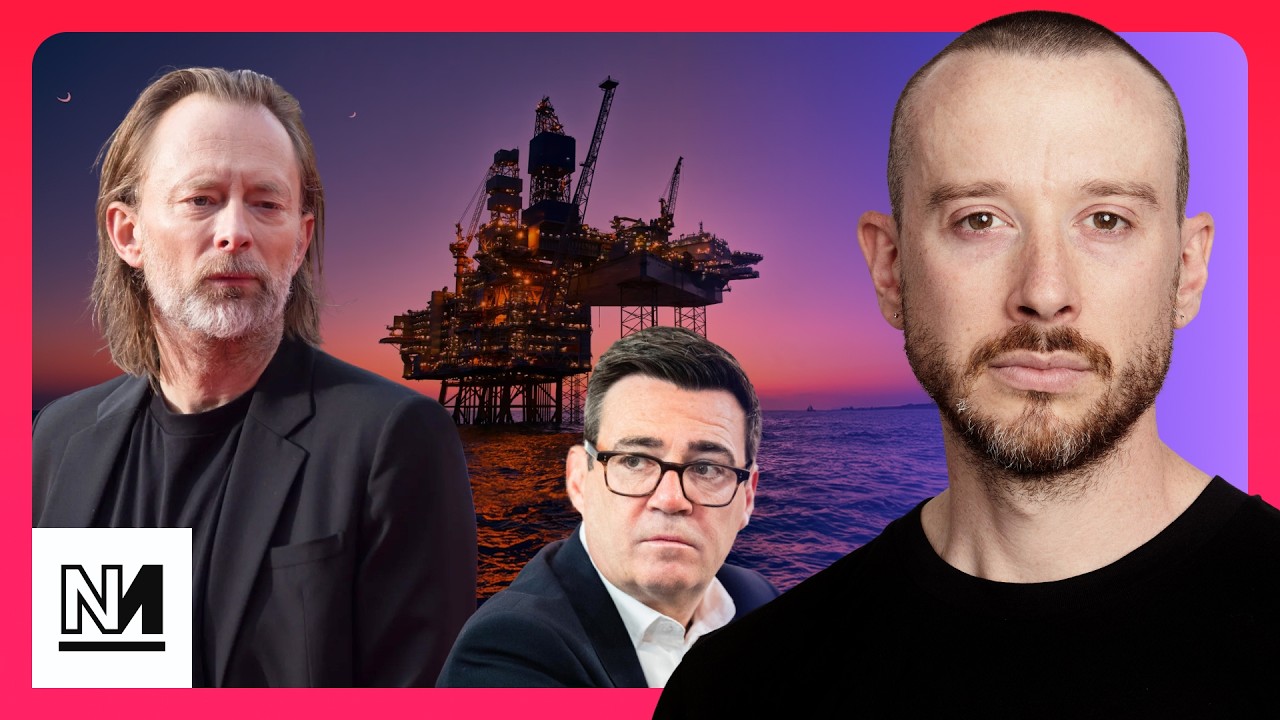
Video summary
Andy Burnham is poised to approve new gas field developments in the North Sea, specifically the Jack Door and Rosebank projects, a decision that has sparked intense debate regarding climate goals and economic strategy. While critics argue that approving these sites contradicts environmental objectives due to cumulative emissions, Dale Vince, a prominent Labour donor and founder of E.ON Energy, has shifted his position to support drilling under specific conditions. Vince advocates for the implementation of price controls on North Sea oil and gas using a "contract for difference" mechanism similar to those used in green energy schemes, arguing that this approach would save billions in household bills, protect jobs, and allow Britain to utilize existing reserves without relying on expensive imports. This proposal comes amidst a record-breaking summer of heatwaves, highlighting the tension between immediate economic pressures and long-term climate commitments.
The political ramifications of such decisions are significant, with the Green Party citing internal analysis suggesting that Labour could lose approximately 50 seats if new drilling is approved, noting that over half of the public desires faster climate action. Beyond the energy sector, recent legal proceedings have also drawn attention to complex issues surrounding jury instructions and terrorism connections in cases involving direct actionists. In one instance where a jury returned no verdict on charges against seven defendants involved in an Elbit Systems break-in, the jurors notably asked if they could be sentenced as terrorists upon conviction, underscoring deep concerns about trust between juries and the judiciary following previous cases where judges later identified terror connections that were not disclosed during sentencing.
These legal complexities extend to other high-profile cases, including those involving Palestine action and criminal damage to property such as Barclays bank branches, where judges have raised terrorism connections unprompted by the prosecution. There are growing fears that including acts of property damage under terrorism laws may undermine prosecutions, as juries might hesitate to convict if it implies a terrorist status for such actions. Meanwhile, in a separate but equally significant development regarding public trust and accountability, Steven Seidman issued a profound apology for his "cultado" piece published before the tragic death of Jason Arday. He acknowledged failures in his judgment, including treating allegations glibly and attributing media pressure to the "silly season" rather than racist animus, and he expressed deep regret for failing to respect Arday's humanity while vowing to rebuild trust through improved work and self-reflection.
The overarching theme connecting these diverse events is the struggle to balance economic necessity, environmental responsibility, legal integrity, and social accountability in a polarized climate. Whether it involves the potential loss of parliamentary seats due to energy policy shifts, the erosion of jury confidence in the justice system due to undisclosed terror links, or the personal admission of fault by a media figure following a tragedy, each story reflects broader societal challenges. The situation suggests that while political and legal institutions attempt to navigate these difficult waters through mechanisms like price controls or retrial considerations, public sentiment remains sharply divided between the desire for rapid climate action and the need for economic stability, all while demanding greater transparency and empathy from those in positions of power and influence.
Read the full video transcript
Welcome to Navara Live. Coming up
tonight as Burnham proicates um Dale
Vince comes on the show um to give his
case um for new drilling in the North
Sea with some caveats. Um very
interesting interview, not one I was
sort of expecting to be making. Dale
Vince on why uh Rosebank and Jack Door
might make sense. Um also Ulles is
proving its worth in the lungs of the
capital's children. Some good news for
you there. Um, a jury returns no verdict
on all charges against um, seven
defendants in the Elbert Systems
break-in. Um, this one really, really
interesting because the jury had an
interesting question to the judge. I'll
be speaking to Steven Mefen about that
in the second part of the show. So,
after a record-breaking summer of heat
waves, Andy Burnham appears set to
approve a new gas field in the North
Sea. Um, the Telegraph on Monday
reported that sources close to Burnham
say he was minded to approve a new Jacko
gas field and the report said no
decision had yet been made about the
Rosebank oil field. Um, Andy Bernham was
asked about Rosebank and Jack Door
today.
>> I think we just need to get this in
obviously in some perspective. The
country cannot stop using oil and gas
anytime soon. there's a a transition uh
that um has to be gone through. Uh so
that's just the reality of it. Um the
question is you know how do we go about
that uh transition? And there is a
legitimate question to say could um
could we speed up that transition uh to
clean energy via using uh what reserves
we've got?
>> There's a curious argument. He's saying
we can use the reserves. So I suppose
sort of implicit there is get more oil
from Rosebank and get more gas from Jack
Door. Um but by getting the fossil fuels
and presumably burning them. I mean what
else you going to do with them? We will
speed up the transition to net zero.
Slightly confusing argument. Remember
also emissions are cumulative. So if we
emit them now um but still get to zero
by 2050, the carbon still stays in the
air, right? Which is why sort of people
make the strong argument keep it in the
ground. But it's not like let's just go
gung-ho for now and then we'll get it
down, you know, by 2035 or whatever.
Everything that goes into the atmosphere
now will stay there for a bloody long
time, especially the carbon methane. Um,
not quite so long. Um, I think this
sounds a little bit like he wants to
have his cake and eat it. Now, I think
we we might have mentioned on the show
before that there are some similarities,
I think, between Andy Burnham and Boris
Johnson. So both city mayors that became
prime minister, both people who really
like to be liked, both people not
particularly associated with committing
to particular policy positions. Um so
somewhat fluid um both personable, both
sort of, you know, happy enough to talk
to people. Now hopefully um the
comparisons end there. Obviously I'm not
saying Andy Burnham is the new Boris
Johnson, but there are some
similarities. I think um someone who or
a group who have sensed an opportunity
are the Green Party. So they've released
new analysis which they say shows Labour
could lose 50 seats if they approve new
oil and gas. Now this is internal
analysis um shared by the Greens with
the Guardian um based on Friends of the
Earth research which showed 55% of the
public wanted climate action to quote
unquote go faster. Um and then they
mapped this onto Labor Green marginal
seats. Now from my reading of the
Guardian piece I'm not sure how
scientific this sounds. Um they do
though have a point that Labour
approving new fossil fuel extraction
after a summer of heat heat waves um
will will definitely piss a lot of
people off understandably I think. Um
and that includes a bunch of musicians.
So 200 musicians including Tom York,
Romy and Brianino have urged Andy
Bernham to reject North Sea drilling. Um
someone who has come around to the idea
of approving new new oil and gas in the
North Sea though is Dale Vince. Now, Del
Vince is the founder of the green energy
firm EOTricity and he's been a donor to
just stop oil, the direct action group
and the Green Party since 2023, he's
been a significant donor to the Labor
Party. Now, back in April, Vince told
the Times that allowing new North Sea
drilling would be a betrayal. But on
Monday, um he surprised Fisel Islam when
he said this.
>> I have a different position perhaps than
the one you expect me to have. Um
there's a way that we can make sense of
this North Sea puzzle. we can actually
bring our bills down which we we can't
at the moment unless we do this one
thing which is price control the North
Sea. At the moment the global market
sets the price and it doesn't matter how
much we make here. We pay the global
price if we price control it like we
have our retail energy sector. We can
actually save money and that makes more
sense of the North Sea and it would make
more sense of Jack Door and Rose Bank.
>> Oh right. So, I mean, have you changed
your position? Because it did appear
that you were against it fairly recently
entirely on the the reopening of oil and
gas from your social media.
>> The way things are and the way things
have been, it doesn't make sense. The
argument that we can save money by
drilling is nonsense. And what President
Trump just said on your show, by the
way, is just the height of stupidity.
The North Sea is not one of the biggest
finds. It might have been 60 years ago.
Now, it's got barely anything left. But
that's a slight digression. If we price
control wholesale energy across the
board like we have retail, we have to do
this to reform our energy system. If we
do that, we pave the way to make sense
of of Rosebank and Jack Door new
drilling sites that are already licensed
because we can save money. And then this
secondary argument that's being made for
new drilling that if we're going to use
fossil fuels, we might as well make them
here as to bring them from from abroad.
That makes more sense and comes to the
four. We will use fossil fuels for a
number of years to come and it makes
sense to make them here. If we can also
save money here and create some jobs,
I'm up for it.
>> So Fisam looked very surprised at us
because I don't think Dale Vince had
sort of publicly expressed that he'd had
a change of heart before that interview.
So Fisam thought he was going to
interview someone who was against oil
and gas exploration and then sort of got
this sudden surprise. Um so what the
hell has gone on? Um, well, I caught up
with Delvin Vince earlier today. Um, and
begun by asking him why he'd U-turned on
North Sea oil and gas drilling.
>> Uh, well, I haven't. That's a very
simple, easy question and answer.
>> Just to clarify that. So, I've I've been
looking at this today. Obviously, I
can't remember off the top of my head
everything you've ever said, but I
looked up today this quote from the
Times in April, which you said um, of
the Labour's pledge to stop oil and gas
licenses. You said it attracted an awful
lot of support. I argued for it amongst
green voters and just stop oil
supporters. The way to stop oil is to
vote Labor because they've got a
manifesto pledge. So is that
>> if if you were saying before that you
don't support it and now you do. Is that
>> I'm not saying I do. I'm not saying that
I do. That's and that's the key to this.
It's been misrepresented, misreported in
the media. What I said back then, uh I
stand by those are the circumstances. If
you recall perhaps uh we were coming off
the back of a Tory administration that
had issued hundreds of new licenses and
were threatening to issue hundreds more
uh and had turned oil and gas drilling
into a kind of um a cultural war weapon
uh ready for the impending election and
it was simply the case that the only way
to stop that was to vote Labor. Very
simple. Yeah. I was against new drilling
absolutely didn't think we need it.
Didn't think it made any sense. couldn't
help us bring our bills down. And that
was the most important part for me apart
from the, you know, the carbon bits and
the need to, you know, make a move to
get off of fossil fuels and the kind of
global need to at some point draw a line
under new drilling and that kind of
stuff, right? Then the circumstances of
the day. Um,
what I said on News Night, which kicked
this all off, was that government should
take control of North Sea oil and gas
prices. that we should no longer allow
global markets to set the price that we
pay for our own oil and gas. We've done
some modeling that shows we could save
10 billion pounds a year if we did that.
We'd also be able to protect the jobs
that we have there and the investments
that have been made. We could maximize
extraction of the reserves that we have
left, excuse me, which are dwindling
really quite fast now. Maybe there's 10
years left according to the oil and gas
authority. Uh but we can basically put
an arm around the North Sea uh protect
them from uh global price shocks because
as our fields decline in production they
become less economic and increasingly
vulnerable to price shocks in the global
pricing system. So there's a lot of good
things could come from this and
optically it's about putting an arm
around the North Sea using the same
mechanism we use for green energy for
let's call it brown energy uh and
putting them on an equal footing but we
get to save 10 billion pounds. we get to
end windfall profits in the North Sea
and have some really major economic
boosts from it because energy bills
drive inflation and bank lending rates.
>> So, you made two arguments as far as I
understood it on News Now, which is that
you wanted the government to introduce
price controls on North's oil and gas so
that it wouldn't be sold um or or it
wouldn't be priced according to
international markets. Basically,
whatever Britain wanted to buy, it could
do so at a set price, which would maybe
give the oil and gas extractors 2%
profit or whatever. some a bit like how
we sort of manage the distributors um
within the country,
>> the retail suppliers, not the
distributors.
>> Sorry, the retail suppliers.
>> The distributors are making 40%. That's
another story,
>> right? Um but your second argument is
that if this were all to happen, you
would be okay with licenses being
granted at Rosebank and and Jackor.
That's correct. Um am I right?
>> Not not completely. Rosebank and Jacko
have licenses. What they don't have is
planning permission. So they sit in a
kind of no man's land between Labour's
election pledge of no new licensing uh
and you know this place where a lot of
people are where we should have no new
drilling they are licensed they could go
ahead they lost the planning permission
on appeal uh due to ironically I suppose
in some ways them not having taken into
account the impact of the burning of the
product the oil and gas they were going
to produce I think the government are
able to give them planning consent uh
and I think they might be minded to. So
what I was saying was that if we have
this price control in the North Sea, our
existing operations, the benefits of
that, they're huge in fact to our
country and to the top cause of the cost
of living crisis, energy bills, that's
that's something very valuable. They
would at the same time, this would at
the same time, sorry, this situation
would change the view of Rose Bank and
Jack uh unavoidably because the argument
put forward by the proponents at the
moment, the first argument is that we
can save money if we make oil and gas
here, we can get cheaper oil and gas.
Now, that's false unless we price the
oil and gas ourselves. So, if we have a
system whereby we do that, that argument
um it makes sense. We could save money
by allowing Jackor or Rosebank and the
secondary argument which is that we're
going to use fossil fuels for a decade
or two to come. Why don't we make them
here? That comes to the four. That's
what I was saying. It could make sense.
It could be a way for the government
through this minefield really pulled uh
by left and right on this issue of these
two really rather small projects that
aren't really going to move the dial on
much uh but have become kind of toemic
and are having attention way beyond
their merits in terms of their their
scale.
>> There's two things I'm a bit confused
about. One is it seems to me the
opposition has somewhat changed unless
the reporting sort of back in April was
really incorrect because this this Times
article is all framed on you pushing
back against Jack Door and Rosebank
specifically saying it would be a
mistake but maybe you feel
misrepresented by them back then. All I
think all you're missing is the fact
that the circumstances have changed and
I'm saying if we do this big thing if we
change how we price oil and gas in the
North Sea fundamentally and it's not a
small thing and most people have missed
that and have just focused instead on am
I doing a U-turn but I'll take that
because if we if we impose price control
on the North Sea I mean it's it's
massive and it actually actually is and
um Rosebank and Jack I'm less I'm less
worried about them in that context
because we've got price control on the
North Sea less worried.
>> So, so how would the price control work?
It sort of explain what the mechanism
would be.
>> Yeah. So, it's um something we're using
green energy called a contract for
difference and essentially
using a system like this we set the
price that a generator call it wind farm
maybe could be now an oil or gas
producer we get we set the price that
they receive. Now, they go about their
business selling their electricity or
oil and gas to whomever they want to.
And this is the key to this. People say,
"Oh, but a lot of that stuff gets
exported." It doesn't matter. The CFD
will do the job for us. They're allowed,
let's call it, £50 a barrel in the in
the North Sea. Um, they may sell it on
the international markets for 100 during
a crisis, but the 50 excess comes back
to the country. So, in effect, we've
only paid 50. D, sorry, you know, at
risk of asking you to repeat yourself,
just could you clarify exactly what a
contract for difference is because I
know this is quite a confusing concept.
>> Basically, it's a mechanism whereby we
bring new projects into the world by by
guaranteeing the price for every unit of
electricity currently, but we could use
it for oil and gas. And if the market
goes above that price, uh the generator
pays that to the center. If it goes
below that price, the center tops up the
generator. So it fixes price, minimizes
risk and lowers cost.
>> This this is basically um sort of in
advance we say we will guarantee to buy
x number of barrels of oil um or quarts
of gas at this price. Um and you have to
sell it to us at this price or if you
sell it to someone else you have to give
us the difference.
>> Uh yeah there's no us in this in terms
of being a buyer. um we just limit the
uh the price that the generator or the
oil and gas producer can receive or can
keep. Um and so I mean the way it works
is there's a market price for
electricity in our country that's also
driven by the price of gas. That's a
different issue which we also need to
tackle. But let's say um an onshore wind
farm might have a CFD I don't know for 5
p a unit of electricity. if the market's
at seven or eight or you know I think
we're we're at 10 plus quite often at
the moment um they might be receiving
that that enhanced income which would
turn into a windfall profit if the CFD
wasn't in place and the excess money
returns to the center uh something
called the lowcarbon company or
something like that that runs the CFDs.
Now in a different circumstance when the
market price falls below the 5p the
center the low carbon company whatever
it's called gives money to that wind
generator to top them up to the 5p these
guys have a business plan to spend in
the case of offshore wind you know
billions of pounds on uh on hardware
and in their business plan they have a
set price that's guaranteed by this
mechanism which allows them to reduce
the the profit margin considerably
because they haven't got to build in
risk for bad years. They never have a
bad year through the pricing of energy
in the market and that's how that works.
So you're topped up when the market is
below you and you give back when the
market is above you.
>> I mean to me it seems like a good idea.
I suppose the cynic and we would suggest
that Andy Burnham might be thinking
brilliant Del is going out onto the
media giving me cover for approving new
licenses or planning permission um in
the North Sea. However, down the line
I'm going to say, "Oh well, you know
what? The price caps it was a bit too
difficult. We're just going to let them
sell on the open market and we'll get a
bit of tax revenue from, you know, if we
introduce a new wful wful tax or
whatever." Are you are you worried about
that? that he says, "Okay, I'll take the
cover, but I'm not going to go for this
um, you know, relatively radical policy
that Dale Vince is proposing."
>> Well, no, I'm not worried. Um, the
cover, to the extent I'm offering it, is
predicated on uh price controlling the
North Sea. Without it, everything I've
said about Rose Bank and Jack Door falls
away. They only make more sense if we
have reform of the oil and gas sector in
terms of price control. So, I'm not
worried, but I'm also not worried
because I think Andy Bernham's that kind
of person and he's very interested in
this idea. He is looking to be bold and
intervene in energy bills, the biggest
driver of the cost of living crisis,
which I think is, you know, one of his
top priorities as prime minister and
rightly so. Um, I'm not worried
>> and sort of the legal mechanism here
because contracts for difference for
renewable companies as far as I
understand is voluntary, right? They can
say we'll either sign the contract for
difference or we'll take the risk and
just sort of sell it to the open market
every time we as we produce it. But most
of them go for the contracts for
difference because as you say they've
got this very high upfront fixed cost
and they want to reduce their risk. What
happens if the oil and gas companies
just say we don't want to sign these
contracts for for difference? You're
impinging on our property rights.
>> Well, it's not their property. It's our
property. The oil and gas is Britain's
and we license them to extract in our
North Sea. So, we change the rules of
the game. It's as simple as that. Now,
let me tell you a couple of things that
will help you see this in a different
light.
Um
the Tories introduced the price cap into
our retail energy sector for suppliers.
Um they introduced it over the heads of
all of the people in the game at the
time and there's about 60 energy
companies. Most of them were
foreignowned either privately or by the
state. Um and they had imposed upon them
a 2% profit margin which is you know
pretty keen in in any industry.
And they just got on with the job. They
didn't have a choice though. They didn't
have a choice. Government changed the
law, made it so. Second thing I'll tell
you is that um Liz Truss in her one
month of uh brief power, she did one
thing, one incredible thing. The tries
saw this problem. Um we flagged to them
the link between the price of gas and
the price of green energy. Um, and they
could see something called legacy green,
which are green projects, green energy
projects that are not in the CFD because
they came out of earlier rounds of
support like renewables obligation, that
kind of stuff. She passed a bill called
the Energy Prices Act, which enabled the
government to do two things. One was
break the link between the price of gas
and the price of all other electricity
in our country, which is, I say, a
different topic, but it has profound
impacts on our energy bills. And the
second thing was she the the bill uh
allowed the government to impose a CFD
on legacy green generation which makes
up about 20% of the power on our grid
today. Um so it's not something that a
government can't conceive of and it's
it's something that a conservative
government did conceive of uh but didn't
implement. So I don't think really
there's any problem morally, legally,
politically with Andy Bernham doing
this. And finally, I mean, obviously
given the heat wave, we've been doing
lots of interviews with climate
scientists over the summer. Um, a recent
interview I did with Simon Lewis, who's
been at sort of lots of the cops, very
involved in in climate negotiations
really. Um, his big argument was to say
that Britain actually does have some
claim to be a climate leader and that
job is going to be made much harder if
we renew licenses or give out new
licenses for oil and gas extraction in
the North Sea. And my understanding you
know as as you've said sort of in toto
sort of this is going to be fairly
marginal concretely in terms of how much
emissions will be released from these
particular sort of extra bits of fossil
fuels but is there not the argument that
politically symbolically this could be
really significant and it's just
therefore not worth it
>> yeah I think they have become uh
powerful symbols they have for both
sides of this argument for people that
say we need to get real about net zero,
realistic about net zero. You know, we
can't afford it, it's pushing up the
cost of living, that kind of stuff.
There's a lot of fallacy in those
arguments. You know, green energy, for
example, is not driving up our bills.
But that's different issue. There's a
there's a strong lobby on one side
saying we have to get real about net
zero and and and care more about
people's cost of living problems and
therefore we should drill in the North
Sea because we can save money. As I said
before, that's not true, but it would be
under this new regime. And on the other
side, you've got people, yeah, making
the case, look, you know, leadership is
important. There's no doubt about that
because there are also people in our
country, as you'll know, that say we
only make 1% of global emissions. Why
are we bothering? We can't make a
difference to net zero. Reform is saying
that just this week, actually, uh,
Richard Ty, I think probably. Um, and so
it's a it's a divided and divisive
issue. I see that materially these two
projects if they both went ahead and I
have a feeling that it might only be one
of them but it's just a gut feeling
because uh Jack door is is primarily a
gas producing project that's a tieback
which um is another nuance uh in the
industry whereby it's not a new site
being drilled from above at least but
from below it's drilling horizontally
from an existing gas field to one that's
very nearby. Uh, I got a feeling that
one might go ahead. The infrastructure
is all built. It could produce gas
sometime this winter. And there's a good
argument for it. If we can also make gas
that's cheaper than the global market.
The um global emissions won't go up
because of this because it'll displace
gas that we're currently bringing in.
And you know, there's there's truth in
the argument that the carbon footprint
of LNG that we're bringing in rather
than produce gas from our own North Sea,
that's higher. So global emissions are
higher because we don't use the gas on
our doorstep. There's there's truth in
that argument as well. So it's a right
old kind of um puzzle of pieces and I
think that price capping the North Sea
will bring huge cost of living benefits
to our country and enable Labor to
perhaps pick their way through this
minefield, let's say, uh of uh new
licenses versus new drilling versus
tiebacks in the North Sea. And these two
projects that sit in no man's land but
have become so important despite their
relative tiny size. Jack door will make
enough gas in its entire life for
Britain for one year. That's how big it
is.
>> Uh Dale Vins, thank you so much for
coming on the show. Always appreciate
your perspective. I like it because I
can never quite predict what you're
going to say, which I like in a guest.
So um thank you for coming on.
>> That was great fun. Thank you.
London's ultra- low emission zone or
ULES has been a political lightning rod
since its introduction in 2019. Um the
policy which charges polluting cars to
drive in London was always dismissed as
a war on motorists by its detractors and
the tries have long used it as a stick
with which to beat London Mayor Sadi
Khn. When he was prime minister, Rishi
Sunnak found the time to attack Khn for
his plans to expand Ules. And in the
2024 mayoral election, the Tory
candidate Susan Hall had opposition to
Ules as a key plank of her campaign. Um,
in the end, thankfully, the war on
motorist framing was not enough to save
the careers of either Sunnak or Hall.
Um, and I say thankfully because a new
published study um, shows just how
important Ulles has been. The BBC report
that scientists have been stunned by
children's lung recovery in ultra low
emissions zones. Um they write this in
the study researchers recruited 6 to
9year-olds attending primary schools in
London's ultra low emission zone and
followed the same children for 5 years
comparing them to similar children in
terms of socioeconomic background
physical activity and ethnicity in
Luton. Children in the study had annual
lung function and capacity tests in the
year before ULES came in and for four
years after. Initial results showed
children's lungs in London was smaller
in capacity than those in Luton, which
is less polluted than London but has a
similar mix of pollutants. At the end of
the study, the children's lung capacity
reached near identical levels in both
groups. Um the effects also seem pretty
substantial. So in London, the
proportion of children whose lung
capacity was deemed clinically impaired
fell from 14% to 9% after the ULES was
introduced. So that's massive. Um in
Luton they also fell but from 9%. So
it's already lower there because they
have less traffic I suppose and it went
down to 7%. So that fall they said might
be because Luton also introduced some
measures to tackle air pollution but
just not policies which were as dramatic
as the ULES scheme in London. Um to
discuss these findings and whether the
lung the lungs sorry of young Londoners
are on the mend I spoke to Dr. Laura
Jane Smith a consultant respiratory
physician at King's College Hospital.
>> So today is a really exciting day for uh
air quality research. Um the publication
of the chills study is a a huge landmark
really in moving forward our
understanding of the impact of public
health interventions and particularly
around clean air. Obviously this is sort
of a scientific study where they've
compared young people in London and
young people in Luton and it's sort of a
bit of a natural experiment because
obviously there's Ules in one place and
not the other. I suppose anecdotally
have you seen children's lung health
improve since Ules was introduced. You
are a you know a respiratory physician
in London. So you might expect some sort
of feed through to to be there in your
profession.
>> Yep. So I'm a respiratory doctor. I see
clinics every day. I see patients every
day in my clinic um who are fighting for
breath. I look after adults rather than
children. Um but they experience the
same thing. They'd give anything for a
few more mills of lung capacity. And
although they can't recover their lung
capacity like the children in this
study, which was what was so amazing
about the results, um that ul is still
helping them breathe better and reducing
the risk of a major flare up that could
land them in hospital. And certainly
they tell me that, you know, things are
not as bad as they were a few years ago.
That doesn't mean there's not more work
to do and particularly with the um heat
waves recently that makes air pollution
worse. So they've been suffering. But
this is a huge step forward um in
committing to improve our air and
improve our health.
>> I didn't realize that actually. So it's
the case that if a child if the air gets
better while they're still in
development, their lungs can actually
repair. Whereas if you're an adult, your
lungs won't sort of repair, but your
condition will just be triggered less
often.
>> Exactly that. So human lungs actually
keep growing until the age of about 20
25. So longer than most people expect
and after that we all very gradually
lose some lung function and there are
several things that can speed that up.
Smoking being an obvious one but air
pollution exposure being the biggest one
um that we're also can change. Um and we
knew from earlier research that polluted
air was linked to smaller lungs.
Previous studies had shown that children
in London had lower lung capacity than
comparator groups. And we also know that
smaller lungs increase your risk of uh
poor respiratory health as adults. But
what this has shown is that not only did
the children's lungs continue to grow at
a normal rate after ULES was introduced,
but that they actually caught up, which
was really unexpected certainly by me
and by many of the researchers. So
actually at the end of the study, the
children in London who'd had less lung
capacity um had caught up with the
children in Luton. So it's a huge win.
>> Forgive my ignorance. Um but sort of
just to explain sort of how asthma for
example which is I suppose is the
condition which most of our audience
will will have heard of how it comes
about. Is it the case that if we didn't
have any pollution and no one smoked
there would be no asthma? Is it is that
something that would be possible?
>> Sadly not. Um asthma is a complex
condition. There are a number of
different things that contribute. Some
of that is in our genes. Some of that is
what we're exposed to both before we're
born and then after we're born. It's
essentially an overreaction of the
immune system to certain things that
trigger it. So, if no one smoked and
there was no air pollution, we'd have
much less asthma. Um, we'd have much
less severe asthma. We'd have many fewer
deaths from asthma, but we would still
have some asthma
>> in general because I know air pollution
sort of in most of the country, most of
the world is sort of been improving.
Obviously, it can always improve more,
but is this one of the sort of areas of
healthcare where it's seeming like sort
of the line is going in the right
direction or are there still lots of
sort of challenges we need to be aware
of?
>> Obviously, this study shows that things
have been going in the right direction
in London and that's really because of
quite bold action. I mean you will
probably remember back in 2019 when ul
was being introduced there was huge huge
push back and we have to give all credit
to Sadi Khan and the mayor's office for
really pushing through and acting on the
evidence and not being swayed by the
loudest voices. Um this shows that
public health interventions on clean air
work but that we have to be bold because
actually this study showed uh in the
time frame of this study which was four
years the uh Luton also brought in some
um interventions to try and reduce air
pollution but they didn't bring in you
know a huge intervention like the like
the clean air zone and so there was some
improvement in Luton but it was much
much less and what we know is that when
we if we want to see big um improvements
in health then we have to make big
policy changes. We have to make big
changes in the environment in which we
live.
>> And is is your message that the whole of
the UK should become an ultra- low
emission zone or I suppose just a
builtup areas or what would you sort of
propose where should we go from here?
Let's say
>> I think uh there's lots of places we
could go and we should go. You know,
this should really spur us on to say not
only did we know this was the right
thing, but we now have evidence to show
that we can materially improve
children's lives. a whole generation of
children will instead of growing up with
stunted lung growth and storing up
health problems for years into
adulthood. We've now given them the
opportunity to really start life well.
There are lots of things that we still
need to work on in London. That would
particularly be phasing out domestic
wood burning which is still a big
contributor to air pollution in our
cities and then we need to act on lots
of things. So other aspects of road
pollution, uh diesel cars are still all
over the place. um having cheaper and
accessible public transport and really
just getting off fossil fuels which is
what we need to do for the climate
crisis as well and that will improve our
health really very quickly as we've seen
in this study just four years made a
dramatic difference and we need to take
that further.
>> Dr. Smith, thank you so much for for
joining me. Really really really um
interesting stuff. I've learned a lot.
>> Okay, I'm glad I'm glad to be of help.
Now, I knew there would be a comment
saying, "Stupid question, Michael, when
I asked the one about asthma." But, I
mean, I would like to say I was just
sort of asking a stupid question in case
anyone in the audience didn't know, but
I also actually didn't know, so maybe it
was a fair enough comment. In late June,
eight defendants alleged to have been
involved in a Palestine action break-in
at an Elbit weapon site near Bristol
stood trial at the Old Bailey in London.
Um Ian Sanders, William Plasto,
Alexandra Herbik, Toto Hocha, Hannah
Davidson, Ulia Brigadova, and Maline
Norman were all charged with violent
disorder and criminal damage in relation
to that action. Um despite none having
been present at the Elbert site when it
happened. Um William Plau was acquitted
of the violent disorder charge during
the trial. Um today though the jury has
returned no verdict on all the remaining
charges against the seven meaning it was
unable to find them guilty of of
anything of any of the charges. Um the
prosecutor in the case had alleged that
the seven so sort of part of what's
known as a filter 25 helped plan the
action. So, they weren't there, but
they're saying they were the allegation
was that they were involved. Um, and
that they compiled an equipment list,
undertook undertook, sorry,
reconnaissance, um, purchased items used
by others, and coordinated the break-in
and its filming. Um, all seven had
previously been charged with aggravated
burglary as well, but were formally
acquitted of that charge in February
this year after a jury cleared the six
activists who actually broke into
Elbert, or who were actually alleged to
have broken into Elbit, I should say,
um, of that charge during their first
trial. Now, in this latest court case,
um all defendants denied any wrongdoing
and after 37 hours of deliberation, the
jury was unable to find the seven of
them guilty of anything. It means that
the case found it collapsed. There might
be a retrial. We don't know. Now,
according to the Filton Defense
Committee, during that deliberation,
this is the key bit, the jury also asked
the court whether the defendants would
be sentenced as terrorists if they
returned a guilty verdict. Now, the
judge, we understand, replied that it
was a matter for him to consider and not
for the jury to worry about. But the
fact the jury thought that was a
relevant question really is notable. So,
back in June, a judge sentenced four
Palestine action activists who had been
found guilty of criminal damage at the
Filton site as terrorists. Now, that was
after he found a terror connection in
their offenses. So, the judge found
that, but during that trial, the jury
had not been informed that that could be
a possibility. and reporting
restrictions at the time meant it could
not become public knowledge that
defendants might be sentenced as
terrorists if they returned a guilty
verdict. Now, we speculated at the time
that the jury might have felt more than
a little deceived by that, right? So,
they thought they were finding um these
defendants guilty of criminal damage or
whatever it was, but it turns out that
what they had condemned those people to
ultimately was terrorism, even though
they didn't know at the time. Um, so
could it be that members of this
particular jury read about that prior
case and are now refusing to play ball?
Um, Steven, you are our resident expert
on Palestine action and actually all
things legal. You're much better at this
than me. You're more sort of you're
better at the details. Um,
what's happened here? Is this the case
that the jury have fought? We've seen in
the past that you asked a jury to find
if this person was guilty of criminal
damage and then afterwards, unbeknownst
to us, you slapped on a terrorism
element to it and they went to prison
for much longer than we could have
imagined.
>> I mean, I think that's that's
potentially really really likely. I
mean, it was very widely reported um
after the the guilty verdicts had been
handed down in the original um Filton
case of the to the four of them of
criminal damage that the judge was going
to consider a terror connection. And at
that same time, reporting restrictions
were lifted, which meant that um it
could be revealed that, you know, that
had been known about throughout the
trial by the defendants, for example,
but not by the jury. In fact, people
were not allowed to talk about it um
either in public or in or or in the
court. Um, and obviously there's a
connection between that case and this
case. Um, you know, so that could that's
plausible. But I think what the jury
what I actually find interesting about
the jury asking this question is that I
think it indicates something very
crucial to justice in this country,
which is a breakdown of trust between
juries and the judiciary. You know, it's
now the case that a jury understands
that it's possible that in some cases
they could be asked to find someone
guilty of a particular ordinary criminal
charge only to find that what they've
done is through their decision sentence
them to much longer and much harsher
terms in prison because independently of
that decision, the judge find it finds a
terror connection. And you know, it's
not it this is not something that nobody
ever thought about. I mean, lots of
times on this show, I've talked about a
House of Lords debate that happened um
at the time that the law that involves
terror connections um of for for for you
know, lesser crimes came in, which was
around 2020. um where this liberal
democrat lord was saying, you know,
we're going to have this situation if we
apply this in this country where juries
will just be deceived about what it is
that they're doing when they think they
are earnestly hearing a case which has a
particular limited charge with a
particular sentence attached to it.
>> Um and so that's one consequence of um
what what might happen here. There's
another interesting consequence I think
um which is to do with something that I
don't know if you've ever heard of this
before. It's called Hoffman's Bargain.
>> Oh god, I've never heard of that before.
>> Okay, so in 2003 um five people broke
into the Fairford air force base ahead
of um you know shock and in the
beginning of the Iraq war where there
were American B-52 jets. Um, two of them
broke in at one on one occasion and they
managed to slash fuel uh, you know,
pipes on fuel on fuel supply uh, lines.
They managed to u break equipment and
and um, you know, meters and dashboards
and things like that. On another
occasion, two people tried to get in and
and they were caught. And then a third
person, a fifth person rather, tried to
get in and he was carrying petroleum
mixed with with uh very washing liquid
and a box of matches cuz he planned to
set the wheels of the of the B-52s on
fire. Um now that case uh was a case of
direct action where you know at that
point there was a lot of uh suspicion uh
not unfounded suspicion that the war
that Britain was go about to undertake
with the US was illegal and so they
tried to use as a defense that uh they
were actually trying to stop an illegal
war before they even got into the
criminal courts. that was heard by
appeals courts and eventually even got
to the house of the house of lords where
one K star um represented one of those
Fairford activists um in trying to push
through the idea that stopping an
illegal war was a legitimate legal
defense for the the criminal damage. Now
the House of Lords decided it wasn't.
There was a lot of political pressure at
the time as well because the attorney
general certainly did not want to
release the legal advice he'd received
over u the Iraq war. Um, so the House of
Lords found that they they they couldn't
use this defense.
>> Sorry to interrupt. This is so if
anyone's Why was this going to the House
of Lords? That's because the Supreme
Court didn't yet exist and that used to
be the highest court used to be the
House of Lords.
>> Quite right. Exactly. I should have I
should have said that.
>> So anyway, in the House of Lords, they
decid they they they
declined to allow them to use this this
offense of um the illegality of the Iraq
war. And in in the ruling that came out
from the lords who were involved, one of
them, Lord Hoffman, sort of described
what he took to be a kind of pact
between direct actionists and um the the
state, which was that, you know, direct
actionists, you know, could display um
through, you know, criminal damage or
crimes their conscience um on on the one
hand, but on the other hand, uh the
courts would be lenient on the condition
that those
were admitted what they'd done. They
were open to the fact that that what
they they had done it for these reasons
of conscience and they didn't you know
they weren't afraid of declaring that
and that is a kind of bargain that has
sort of more or less stood although it's
been diminished of late but it's now
totally diminished. So in the Filton 4
trial, one of the things that the judges
said, the judge said there in his
sentencing once he'd found the terror
connection was that he held it against
them that they hadn't admitted to what
they'd done, that they hadn't just said,
you know, I admit to criminal damage. I
mean, they admitted to all sorts of
things, but they didn't admit to the
charges. But of course, if you know that
there's a terror connection hanging over
your head,
>> why would you admit to anything? Because
you're not just admitting to the charge.
Just as the jury is not just finding you
guilty of the charge, you're admitting
to something much greater that you are
in some way not guilty of a terrorist
crime but connected to terrorism which
carries aggravating factors. And you
know why would anyone admit that? What?
So that bargain is completely out of out
of thrown completely out of the window
in that case. Um so yes two broken
bargains I think. one indicated by this
question between jurors and the
judiciary and the other a much more
fundamental bargain around what the
proper way to treat direct actionist is
in this country.
>> And so this case ended with sort of no
verdict. Um which presumably means the
Crown Prosecution Service might try and
have a retrial.
>> Yeah. Um, and I suppose is there a way
that they can sort of try and have a
jewelry that doesn't know about all this
terrorist connection stuff or is it is
this because this is a widely known news
story. I don't think they can block
someone because they've, you know, read
the guardian or whatever. Um, so this
this could potentially make it very
difficult to charge Palestine action or
or at least get them convicted because
there'll be someone on the jury who
says, "I'm not quite sure about what's
going on here."
>> We just don't know. And it's true, but
you know, they just don't know. Um and I
think that that yeah will will make it
um more more more difficult. Um I mean
it seems like without without a doubt.
>> The other the other thing that keeps um
sort of shocking me whenever I read it
is these people they they haven't been
found not guilty or at least of all the
charges. So they there's been no
verdict. So they're not cleared yet. Um
but they they might be and they've
already spent a really long time in
prison. So some of these people which so
they're char they weren't there. They're
charged with maybe having some
involvement in the planning of this
action and they've been in prison for
over 12 months many of them although
they're out now aren't they? But they've
spent a lot of time in prison.
>> Yeah they were so many many of them were
were bailed when the first Filton 6 um
trial collapsed uh when the aggravated
burglary charge was was um when when
they were all formally acquitted of it.
Um but yes they spent the ones the seven
who the juries have had has found no
verdicts on today spent between I think
15 and 18 months on remand in prison. Um
and not just you know and they were also
all um you know arrested during dawn
raids by counterterrorist police and you
know like if you read some of the
reporting on the trial like you know the
charges put to some of them are that
they they cooked a meal for one of the
people who who broke into into the the
Elbert site or that they gave one of
them who was acquitted a lift somewhere.
You know really the the you know
obviously I'm you know the whole the
whole I haven't been following the whole
case. have just been reading reading
bits of the reporting today. Um it it's
you know it's there are other reasons
why the jury it seems might have been
doubtful about about um these charges.
>> Um let's look at another well it's not a
court this is a decision coming up isn't
it? Because on Friday
um we will see a judge considering
whether there is a terror connection in
another Palestine action case. So, five
activists here were found guilty of
criminal damage in July. And that was
after causing an alleged £200,000 worth
of damage to a Barclay's bank branch in
Burnley in August 2024 when they sprayed
the storefront with red paint and
splintered some windows. Now, I know
lots of people looking at the damage,
was that really £220,000? But anyway,
they've been found guilty of the
criminal damage. Um, however, in that
case, the question of whether there was
a terrorism connection was raised by the
judge himself. interestingly unprompted
by the prosecution. So sort of the the
the defendants were found guilty. The
prosecution hadn't even mentioned it and
then the judge thinks maybe there was
also some terrorism going on here. Um
that was again after the convictions
were secured. Um so what's going on
here? I mean how big a difference would
it make if presumably these I mean I
imagine they're already in custody. Are
they these ones if they've been found
guilty or
>> No, I think I I I'm not sure. I think
they're on they're on they're on bail
pending sentence.
>> And how big a difference would it make
here if the judge does decide there was
a terrorist connection?
>> You know, it's like it's actually really
impossible to say because there are so
many factors that go into sentencing and
then go into the level of aggravation
caused by a terror connection if one is
found. But there are some things that
you know certainly are true that you
know if you're if terror connection is
found in your in in in your offense then
you're subject to uh monitoring for a
really long time once you've finished
your sentence. You're also having to
report things like new relationships,
new phone numbers, moving home for a
serious period of time. um if you're in
custody um you're treated within the the
prison complex or prison system as
someone who has a terror conviction
which means that you're treated very
differently from the general population
in lots of ways you know it's a very
significant thing to find and I think
one of the really interesting things
about this is that you know the terror
act when it talks about criminal damage
um in relation to when it's defining
terrorism it's serious criminal it's
serious criminal damage and the question
here is whether you know in the Filton
for case I think it was estimated around
a million pounds or something like that.
In this case, we're talking about, you
know, a fifth of that. Um, what counts
as serious is
>> I think we've talked about this before
on the show where there was a there was
a debate in the House of Commons when
the terrorism act was first being passed
where there were MPs who had sort of
objected to criminal damage being
included as possible terrorism. And then
I think whoever was speaking for the
government said look we clearly can
think of sort of um scenarios where
attacking property could be terrorism.
Think about if they attacked the
electricity infrastructure for example
or you know poison the water supply.
that they were making the argument like
no there there it is possible that you
could have property damage that looks
like terrorism and that is true but now
they are
>> a shop front
>> a shop front that that's not terrorism
>> shop with spray paint and and and
splintered windows you know that's um
nobody imagines that that is an could
could possibly be an act of terrorism
>> yeah and maybe now that is undermining
these cases because juries are thinking
well I don't want to find them guilty of
criminal damage if I think that they
could end up then being called a
terrorist because it doesn't make any
sense
>> yeah Um, brilliant. Thank you for that
update. I'm always so enlightened when
you come and tell me about the latest in
these court cases. Do my best.
>> I learn about Palestine action. I learn
about how the legal system works. I love
it.
>> Our final, it's not really a story sort
of before we go. Um, as you'll know sort
of from watching our coverage over the
past week. Um, there's been lots of sort
of consideration, reflection going on um
about the the tragic um passing of of
Jason Arday um and how Navara did or
didn't report on that um in the runup to
it. and also people's social media
behavior and obviously you heard from
Aaron Bastani yesterday. Um I know
Steven you've been going through some
emails that have been sent to us um
which you've said lots of them are sort
of very thoughtful and interesting and
you wanted to talk about them a little
bit now.
>> Yeah I do. Um yeah, so I've been going
through complaints that we've received
um about our courage, our coverage
through um the inbox. Um and these are
some of the most sort of beautiful
considered, careful, but also really
critical emails um that I think I've
ever read. Um I'm taking um significant
time to compose equally um thoughtful
and careful um responses to them. Um if
you have emailed uh you will get a
reply. It is just taking me some time to
to to go to go through them all and and
really put put together answers that I
think are uh going to be satisfying to
to the issues that you raise. And I'm
also not going to be deflecting some of
the issues that you raise either. Um,
and I think through like reading these
emails, you know, a couple of themes
have arisen and you know, I think
probably maybe not, but probably we're
coming to the end now of this kind of on
air uh reflection, this practice of
reflection over what what our coverage
was like. Um, but that doesn't mean that
it's going to be the end of it because
um where there were going to be many
discussions through our editorial
processes amongst you know the the team
here at Navara. Uh there's also going to
be I'm sure discussions in our chapel
which is the union here at Navara
because there are many many workers here
who you don't see on screen um of all
kinds who also have views about what has
happened um and that will be a space
where where that will be discussed as
well and some of the issues that you
know just to draw out some themes that
have have come up in the mailbox you
know there are questions about you know
whether our coverage really adheres to
um our editorial code um where we
describe our three core values as a
commitment to emancipatory politics,
honesty, and integrity with
self-reflection. Uh there have also been
uh questions raised around um our claim
to do fact-based journalism. not not
necessarily um attacks on you know
saying that stuff that we did was
non-factual but rather the question of
you know there are lots of facts and
what which ones you give prominence to
and which ones you don't is also part of
telling a journalistic story and there
are questions about how these two things
intersect together as well I think
that's all uh really really wonderful
emails and I I really really thank you
for sending them in and I think what I
found in them is a kind of like critical
grace um which I think is really in
short reply and and I thank you for it.
But another thing that has come up is of
course um some of you may know a piece
that that I wrote um a cult and um I
would like to say something about that.
Now I've I've uh written it down. I
don't want to get it wrong. Um,
so I want to start by offering, you
know, my really very serious sincerest
apologies to Professor Jason Aldiday's
family, his friends and supporters for
this piece that I wrote. I also want to
apologize to you, our audience. Um, and
I wish I could apologize to Jason, but
but that sadly is is is not possible.
In the week before Jason Arde tragically
died, um, I wrote a cortado. That piece
contained many failures of judgment. and
I I want to list them in in some detail
here. The first is that I was led by the
tone of the cortado which is supposed to
be ironic and spiky rather than by the
topic which really required um sincerity
and care. And this showed I think a
failure on my part to respect Jason's
humanity as a vulnerable man at the
center of um a media onslaught.
The point of the piece that I wrote
ultimately was to try to argue that even
if the allegations around elements of of
Dr. to our day's personal biography were
true. The unending coverage just wasn't
in any way warranted in the light of
other currently urgent stories as well
as previous stories about much more
serious and actual deception of the
British public. I also in that piece
pointed out the terrible consequences
that the story would have inevitably for
other black scholars who who remained
seriously underrepresented in academia.
But my my second failure and a real one
real failure was that in trying to make
those points I really gave far far too
much weight to the allegations being
made around Jason and as a result I I
treated them and I treated him glibly,
frivolously and and callously.
My third failure was that I attributed
the cause of the media onslaught to it
being the so-called August silly season.
I think that was lazy and it was benal
and it meant I dodged the harder topic
of discussing the racist animous behind
much of the obsessive reporting uh which
was at that point I think obvious
damning is is that the week before I'd
written about the farright exploiting
events in Seut to spin racist conspiracy
theories to their audiences. So somehow
I was able to recognize when this was
happening abroad but not at home when
the target was someone who was in in
more than one way nearby to me.
So as I said we at Navar are currently
having conversations um excuse me both
internally and in public about our
coverage of this story. I believe that
my contribution in the cultardo was of
no value at all indeed of negative
value. On Monday, Ash published a
reflective piece on the racism that
fueled the campaign against Arday. And
she ends it by saying this. If, as Andy
Bernham says, Jason Arde's death is a
moment for reflection, I can't say say
I'm wholly comfortable with what I found
in the mirror, a journalist who's just
as capable of callousness as anybody
else.
Now, an image in the mirror is a
fleeting image. The image of me also as
a journalist capable of great
callousness is now permanently on the
page. It's one that I can't escape. And
I think that's right. I think that's a
necessity to ensure that I never make
such grave and irresponsible errors of
judgment again. And I hope one I hope
that it will allow me to help others
also to avoid them in the future. And I
want you to know that I really value
little higher than my genderistic
reputation and the trust of our
audience. I know that it's now very
damaged and all I can do is my best to
rebuild is it.
So this is only the beginning of a
personal apology. The rest will come, I
hope, in the quality of my work as we go
forward.
>> Thank you for that, Steven. And I mean
as I mean as it's very very clear to all
of our audience, this is something
you've been thinking like incredibly,
you know, seriously about and that you
feel very deeply and, you know, thank
you for being so so open there. Um, we
we're going to wrap up tonight's show.
Um, we'll be back tomorrow, of course.
Thank you so much for for watching. For
now, you've been watching Nvar Media.
Good night.