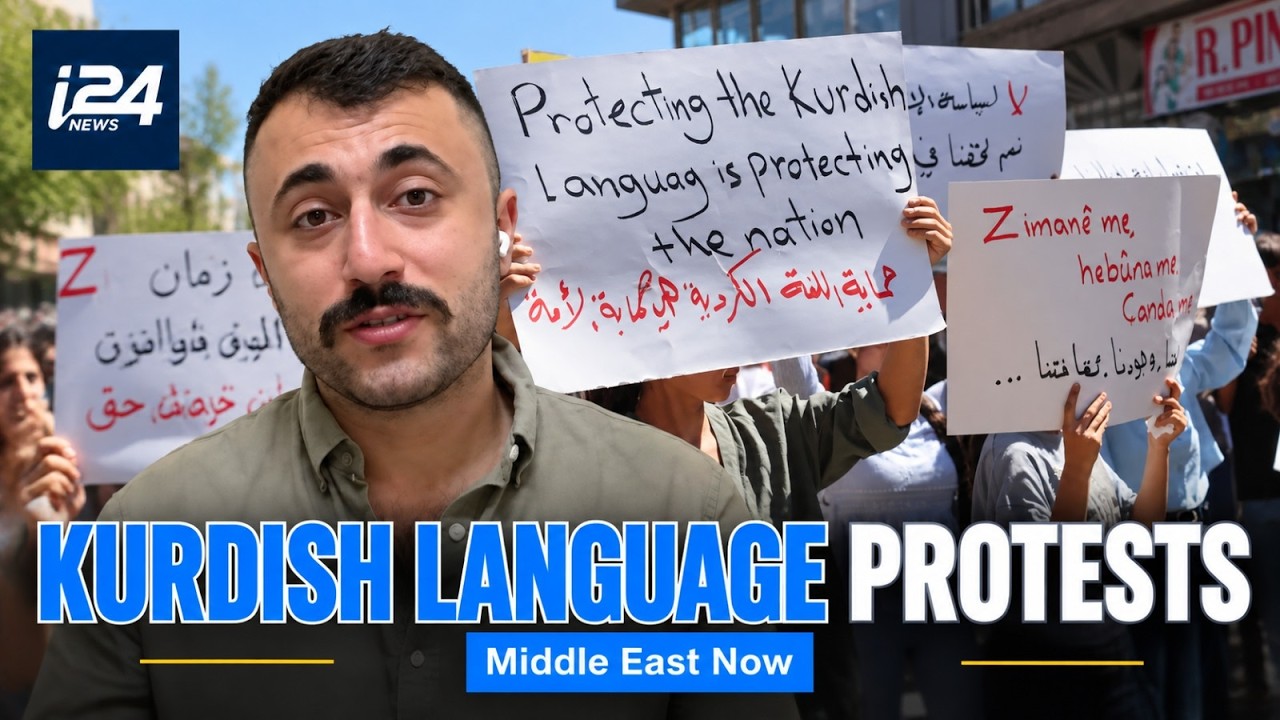
Kurds in northeast Syria say Damascus has failed to honor Kurdish language commitments
Watch on YouTubeVideo summary
Kurdish students in northeastern Syria have launched a boycott of the new school year following a severe crackdown by the Damascus government on Kurdish language instruction. Under the newly imposed regulations, classes in Kurdish are limited to just three hours per week and are designated as optional rather than a formal subject. Students and educators in cities like Kamishi have organized protests to reject these measures, insisting that they will not return to classrooms until the decision is reversed. The unrest reflects a broader dissatisfaction with the Syrian government's education ministry, which has been criticized for undermining the linguistic rights of the Kurdish population in the region.
The situation represents a significant regression from the previous decade under the Rojava administration, where Kurdish was used as a primary language of instruction and a vehicle for national identity. The current generation of students views the Kurdish language not merely as a tool for communication but as a fundamental component of their history, culture, and future existence. They aspire to use the language in all aspects of life, including government employment, private sector work, and social interaction, rather than restricting its use only to academic settings or after certification. By reducing instructional time and making the subject optional, the new government is perceived as actively eroding this identity and denying the people their right to preserve their heritage.
Experts and political analysts suggest that these restrictions are driven by external pressures, specifically interference from Turkey, which opposes a strong Kurdish linguistic presence in Syria due to fears of spillover effects on its own large Kurdish population. Despite previous attempts by the Assad regime to limit language rights, such as reducing instruction time to two hours in 2019, the current reduction to three hours is seen as an escalation that will likely lead to further difficulties for Kurdish authorities and communities. The core argument remains that where the language thrives, the people thrive; therefore, suppressing the language is viewed as a direct threat to the survival and autonomy of the Kurdish society in northeastern Syria.
Read the full video transcript
Now, Kurdish students in the northeast
of Syria are boycotting the start of the
new school year after Damascus sharply
restricted classes in their Kurdish
language. Under the new rules, Kurdish
will be taught for just three hours a
week. Students say they will not go back
to class unless that decision is
reversed. Here's Vadakan Ahmed reporting
from Kamishi in Syria.
Gamishi and the Kurdish territories
generally in the northeast are
witnessing uh protest in different
cities. Like today there was a protest
by students in one of the schools in
Kimishi and also yesterday and tomorrow
we are expecting more uh protesters and
people refusing uh specifically the
decision that made by the education the
ministry of education of the new
government in Syria. Uh well the Kurdish
people um the situation is completely
different right now like uh the
experience is different, the awareness
is different. Um the Kurdish society is
not the same like how it was um like 15
years ago. the people um specifically
after the experience with um the safe
administration in northern and Syria,
they used to study and learn and educate
and teach in their mother language uh
for for almost more than one decade um
here in in northeastern Syria in
Rojavaha which is called in Kurdish way.
Um so we're speaking about a generation
that it's they are learning um in their
mother language um and they are learning
in their the the society language and
they want to make this language as a
national language beside the Arabic one
and to be recognized uh by the
government. Um so the decision that made
by the ministry of education they want
to give only 3 hours each week. Um and
it's it's also uh optional that it's
it's like it's not a formal language
that you are free for study or not. um
this is affecting actually the future
and the identity of the people here. As
I've spoken like recently to um some
teachers, to some students um the
Kurdish people um they have concerns
really about specifically um this point
because they are looking to the Kurdish
language um as an identity um as a
presence in this region as a history as
a future. they want to learn totally
everything in in Kurdish and not only
learning in Kurdish like let's say after
the certification
um the Kurdish society um and the
Kurdish people they want to work in
Kurdish like let's say uh working in the
government uh working in the private
section um working in the society uh
could be trading and other things they
want to also uh work and practice that
in Kurdish language
Um so so now the problem that the
government they want they they are
ignoring actually um um the the
importance of the the Kurdish language.
Um actually I had a a chance to speak
with one of the uh experts about this
and uh some politics. They are saying
that the reason that the Syrian
government cannot give the fully rights
of the language of the culture to the
Kurdish people because uh there is like
the Turkish uh uh let's say interfac
inter intervention in in the government
and presents and Turkey doesn't want for
the Kurdish people to fully speak and
learn and study in in in their mother
language which is Kurdish because they
are afraid for this experience has been
transferred to the Kurdish people in
Turkey which is the Kurdish population
which is the biggest population in in
Turkey. So this is also one of the
reasons that uh government is not giving
those rights. Um so that's why we are
expecting really uh protesters and not
accepting what has been decided by the
government. Um so um even like some
people say that uh this decision it's
really nothing new even Assad regime
they they make a decision something like
that in 2019
and at that time was only two hours so
the difference now it's 3 hours um and I
think we are about to expect like more
um um let's say difficulties and
problems uh because for the politics
here for the Kurdish authorities here
and and and the people one of the main
points which is Kurdish language because
they think where where is the languages
exist the Kurdish people is exist as
well
>> Ahmed there reporting from Kamishi