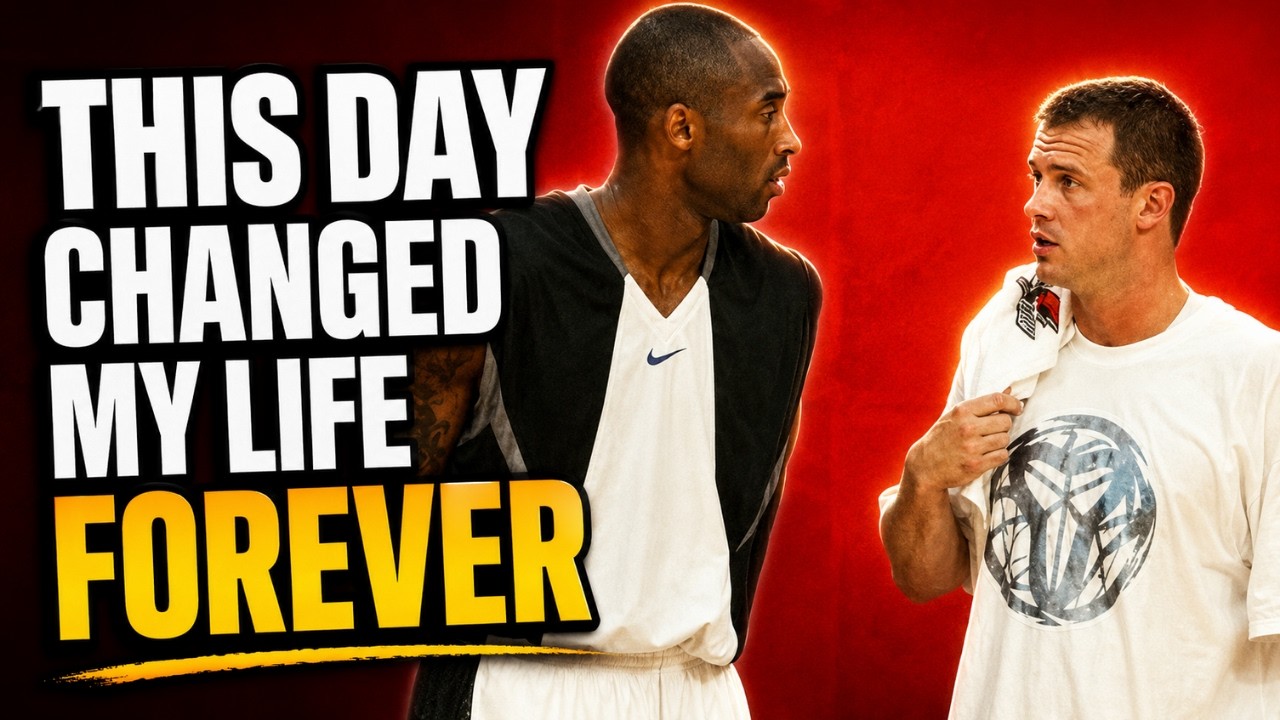
Kobe Bryant Told Me Why He Was the Best in the World It's Not Talent
Watch on YouTubeVideo summary
The central theme of the discussion revolves around Kobe Bryant's philosophy that true greatness stems from a relentless dedication to mastering basic fundamentals rather than relying solely on natural talent. The speaker recounts meeting Kobe in 2007, where he was surprised by how deeply Kobe drilled into simple movements like pivoting and ball handling during early morning workouts. When asked about this focus, Kobe explained that his status as the best player came from never getting bored with these basics and continuously working toward mastery of them. This insight became a foundational belief for the speaker, who realized that excellence in any field requires identifying what winning looks like and then consistently improving upon the core building blocks necessary to achieve it.
This principle is applied universally across various domains such as public speaking, writing, physical fitness, and parenting by first defining specific standards of success and then isolating a few key fundamentals to improve daily. The transcript illustrates this with the example of Queen's men's basketball program, which identified four critical statistics that determined game outcomes; by focusing exclusively on perfecting these areas in every practice and workout, they achieved an 98% winning rate. However, it is emphasized that while one can always make improvements through hard work on controllable inputs like effort, attitude, preparation, and decision-making, becoming world-class also depends on external factors such as genetic predisposition or raw talent. Therefore, the goal should be to simplify success by focusing entirely on the process rather than obsessing over outcomes, understanding that if one does not succeed despite maximum effort in areas within their control, it is simply a matter of circumstances beyond influence.
Ultimately, adopting this mindset provides a sense of liberation and places an individual firmly in the driver's seat of their own destiny. By accepting that success is never guaranteed because life involves elements outside our control, such as how well opponents execute or whether certain cards are dealt by fate, one can find peace knowing they did everything possible within their power. This approach shifts the focus from worrying about results to perfecting inputs like nutrition, training intensity, sleep quality, and hydration in fitness contexts, which naturally skews the odds in favor of success over time. The speaker concludes that whether it is sports or personal life, if you try your hardest and do not let anything within your control be a reason for failure, you can navigate an amazing life without regret, knowing that any lack of success was never due to insufficient effort but rather factors beyond one's reach.
Read the full video transcript
He said, "The reason I'm the best player
in the world is cuz I never get bored
with the basics. I continue to work
towards mastery of the basic building
blocks."
It all stems back to 2007 when I met
Kobe Bryant for the first time and and
he said something that fundamentally
changed my life. It was my assertion
that at that time he was the best player
in the world and I watched one of his
really early morning workouts and I
noticed that he was just drilling down
on a series of very basic fundamental
movements. Pivoting drills, ball
handling drills, finishing drills, but
but basic stuff that I had done with
middle school and high school age
players. And and as a young coach that
really surprised me. So when I asked him
about it, he said this line that still
to this day is the foundation of
everything I believe. He said, "The
reason I'm the best player in the world
is cuz I never get bored with the
basics. I continue to work towards
mastery of the basic building blocks."
And I've extrapolated that out and and
applied that to every area of my life.
So I pick a domain that I'm aiming for
excellence in. It could be keynote
speaking, it could be writing, it could
be my own physical fitness, it could be
being a father. But I figure out what's
an area that I want to improve in and I
want to aim for excellence. And the very
first thing I do is I define, "Well,
what does winning look like in this?
What does being an excellent father look
like? What does being in excellent shape
as a 50-year-old man look like? What
does being an excellent keynote speaker
look like?" And I I decide what winning
looks like and that is completely up to
me. That's not up to anybody else. So I
decide what winning looks like or what
success looks like. And then the very
next question I ask is, "What are the
basic building blocks or the
fundamentals that if I stick to these
and work on these relentlessly and
consistently and improve in, it will
lead me to the path of excellence or
winning in this area?" So in other
words, what are the four or five basic
fundamentals that I need to do to be the
best father I'm capable of, to be the
best keynote speaker I can be, to be as
fit as I can be as a 50-year-old man?
And I figure out what those building
blocks are, those fundamentals, and then
I go heads down and consistently work on
those things every single day. During
the unseen hours, during the seen hours,
but I focus on those basic building
blocks cuz I believe if I can make
drastic improvement in those fundamental
building blocks, then the only byproduct
possible
is going to be what I've considered
winning or excellence or success in that
area. And And you would asked about the
the Queen's men's basketball program.
That's basically what they did. They
figured out that there were four key
statistics that would determine whether
or not they would win the game. And then
they just made sure that everything they
did came down to improving those four
areas of the game. Make sure every
workout, every practice, every film
session always focused on those four
things because as you said, if they did
those four things at a high level and
executed those four things with
excellence, in their case they won 98%
of their games, which is a pretty good
winning percentage. But but but that
means if they don't do those four things
or don't execute,
then the chance of winning goes down
significantly. So for me, it's all about
simplifying success, focusing on the
basics and the fundamentals, and working
towards mastery of those, and and you
can be good at at anything. Now, whether
or not you can be world class in it
is not completely up to you because that
also there's some determining factors
and
whether or not you have talent in that
area, do you have some, you know,
genetic predispositions. So if I enjoy
singing and I I decide that I'm going to
work on the four or five things that
would lead to being a better singer,
there is no doubt that I'll make
improvement. Now, whether I'll be good
enough to win American Idol or to get a
record deal, a lot of that has to do
with whether or not I have the the
talent to do that. So I'm not implying
that
you can be world class in anything that
you say you're going to commit to the
basics, but you can absolutely make
improvement.
>> Hm. Alex Hormozi says, "Do you so much
volume that it be that it's unreasonable
that you will not succeed." And I love
that term, the make it unreasonable that
you won't succeed. And I wrote some
lyrics from one of my favorite songs by
by J. Cole. Um you know J. Cole?
>> Of course, dude. He's my
>> favorite. And he said um
this the line that is on the sentiment
that's one of my favorites. He said,
"Like the second time I got caught from
the junior varsity, fighting back tears,
I promised to switch gears and said to
myself, whatever you do, you won't do it
partially. From this day forward, I knew
I move with a new ferocity for IQ
velocity, a fail-proof philosophy.
Success is in the effort. So, if a
brother tried his hardest, I'm at peace
knowing God ain't deal it in this group
of cards for me." And I love that line.
If I try my hardest, I'm at peace
because I know that God didn't deal it
in this group of cards for me. And
whether you're religious or not,
>> Yeah.
>> that can
that idea that try so hard that you
can't be
mad at the world that there's no regret,
there's no what if because that question
of what if it eats at you.
Try so hard, do the right thing so much
that it becomes pretty much unreasonable
that you won't succeed. And if you don't
succeed, just wasn't it wasn't meant to
be.
>> Yes.
Well first of all, I'm a big J. Cole
fan, so that his lyrics are off the
charts.
He's also a really good basketball
player, by the way.
In celebrity circles, he's one of the
best basketball players that's a
non-professional player. So, I can see
that he he put in the work. Um the way
that I've always framed that for myself
and I framed that for my kids is
if there's ever going to be a reason
that you don't reach a goal or there's a
reason that you are not successful, do
not let it be because of something
within your control.
So, effort is absolutely within our
control. Our attitude is within our
control. Our enthusiasm is within our
control. Our preparedness, how well we
prepare and preparation is within our
control. The decisions we make or the
responses we have, those things are in
our control. So, don't ever let those be
the reasons that you fall short of a
goal or that that that you're not
successful. If it's because of something
else, if it's because of something
that's outside of your control, you'll
still be disappointed that you fell
short or that you missed your goal or
that you weren't successful. But, I know
from first-hand experience, you'll
eventually find peace in knowing that
you did everything you were capable of
and in control of to give yourself the
chance to be successful and it just
didn't work out. And that's because as
we've said before, but it is worth
repeating, success is never guaranteed.
If it was guaranteed, it wouldn't be as
joyous when you actually are successful
in something. So, you know, you can do
everything right and sometimes the chips
just don't fall in your favor. And
that's, you know, to a T, that's
sports. Yeah. That's the game of
basketball. You you can play hard, you
can play smart, you can play together,
you can execute, and some nights the
ball just doesn't go in the basket. Some
nights your opponent's a little bit
better and and they executed a little
bit better than you and you'll learn to
be at peace with that. What you will not
be at peace with is if the other team
outworked you or if the other team was
more unselfish than you were or if the
other team had a better attitude and
played hard. Those would be unacceptable
reasons to lose, but yeah, to me
and I find this
type of approach and this mindset to be
very liberating because it puts me in
the driver's seat and it basically says,
"I'm in control of my destiny." Now, I'm
not in control of what outcomes I get
and I'm not in control of whether or not
I'm going to actually hit ring that bell
of success, but I'm in control of my
attitude, my effort, my enthusiasm, my
preparation, my decisions, my responses.
And I tell you what, that's that's
plenty of things to be in control to
navigate an unbelievably amazing life.
>> Yeah, it reminds me a lot of Jim Murphy
who wrote Inner Excellence. I had him on
the podcast and he talked about how he
will never use the words winning. The
word winning is never brought up with
him and his clients and he works with
some of the greatest athletes in the
world right now as you have
and winning is never brought up because
the outcome is not the focus, the focus
is the input.
>> Yes.
>> And what you're focusing on you will do
well. And so if you do the inputs well,
you are skewing the odds in your favor
to win.
>> Absolutely.
>> We're not focused on winning, we're
focused on improving and winning should
be a byproduct of that.
>> Yes. And and anything that you'd want to
substitute the word winning for, we
could in this case it sounds very
synonymous to say success.
Same thing. You don't have to focus on
whether or not you're reaching a level
of success, you got to focus on the
process, focus on the inputs, focus on
the things you have control over and
then success by any measure will just be
the natural byproduct of that. And this
is true in every area of our life. It's
true financially, it's true for our
fitness and our wellness, it's true for
everything. Like the chips are going to
fall where the chips are going to fall.
We don't control that. But but say for
our physical fitness, you have control
over over what you eat and when you eat
it. You have control over how often you
move your body or if you choose to
progressively strength train, whether
you do some mobility and flexibility
stuff. You have control to a degree over
how much sleep you're getting and the
quality of sleep. You have control over
how hydrated you are. So you have
control over all of that stuff. Now the
exact finish product of of all of your
your measurements and your metrics and
your exact body composition and your
exact physique, you don't necessarily
have complete control over that. That's
outcome based, but you have control over
all of those inputs. And if you focus
relentlessly on maximizing those inputs,
then generally speaking [music]
the outputs will tend to lean in your
favor more times than not.
>> Mhm.