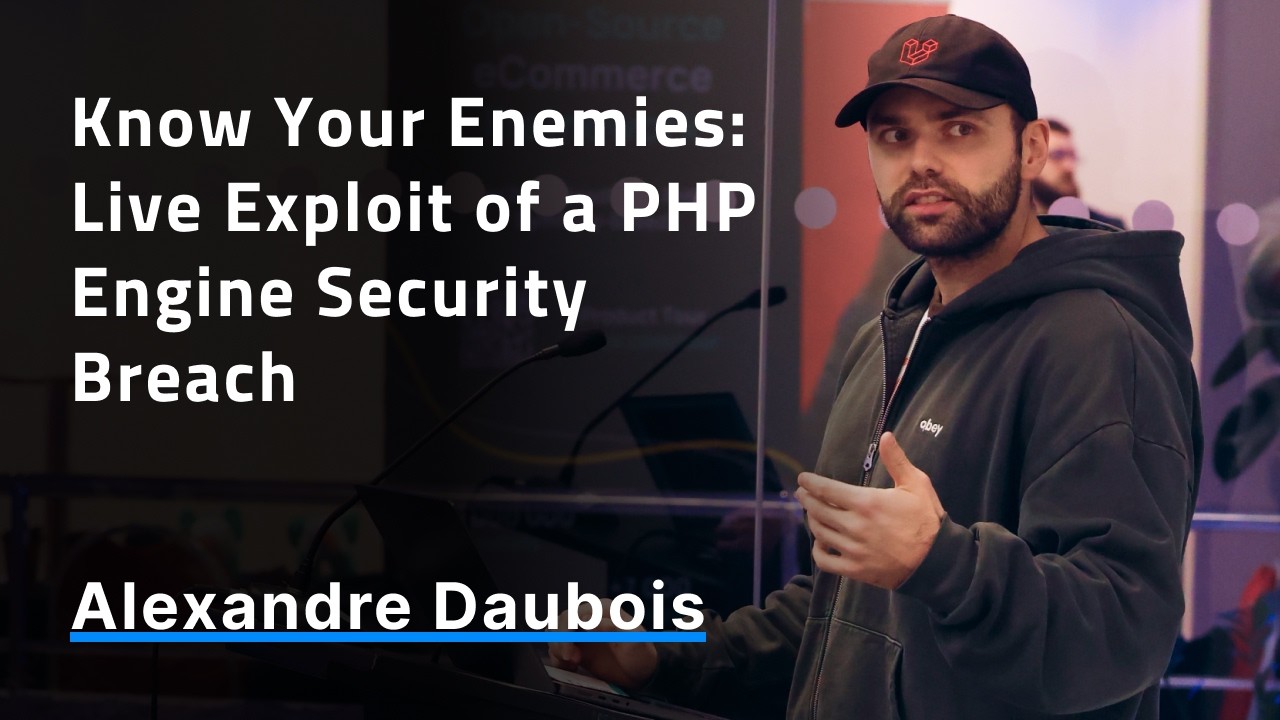
Know Your Enemies: Live Exploit of a PHP Engine Security Breach - Alexandre Daubois
Watch on YouTubeVideo summary
The video presents a detailed examination of security breaches within the PHP engine, emphasizing that despite its 30-year history and continuous evolution into modern versions like PHP 8.5 and upcoming releases, it remains an active target for vulnerabilities. The speaker explains how these issues often arise from the boundary between memory-safe languages like PHP and their underlying C implementations. A primary example discussed is a null-byte termination vulnerability in socket functions, where input validation checks pass because they operate on high-level PHP strings that allow null bytes, but fail when passed to low-level C code which treats them as string terminators. This discrepancy allows attackers to bypass domain restrictions by injecting hidden characters into URLs, effectively enabling Server-Side Request Forgery (SSRF) attacks against internal services within the same container environment without requiring complex logic or administrative privileges.
A second critical case study involves a malicious backdoor that nearly made it into an official PHP release candidate in 2021. This vulnerability was introduced via a commit by the creator of PHP, who inadvertently added code to execute arbitrary scripts if a specific HTTP header named "User-Agent: Zerodium" was present. Although this change was quickly reverted by another core contributor and then re-reverted by an attacker attempting further sabotage, it highlights that trust in reputable authors or infrastructure is not a security mechanism itself. The incident underscores the importance of treating version control systems (VCS) and continuous integration pipelines as part of the threat model, demonstrating how open-source projects can be resilient due to community scrutiny but are certainly not immune to sophisticated attacks on their development processes.
The presentation concludes with practical lessons for developers and maintainers regarding input validation, runtime auditing, and infrastructure security. The speaker argues that security audits must extend beyond user-level frameworks to include the engine itself and its dependencies, as implicit assumptions about data structures across language boundaries can create exploitable gaps. While acknowledging that open-source is not immune to breaches, the talk reinforces its resilience through transparency; unlike proprietary code where vulnerabilities might remain hidden for years, public repositories allow global communities to detect, report, and fix issues rapidly. The session ends by addressing common questions about vulnerability discovery methods like fuzzing versus responsible disclosure via dedicated security emails, as well as the financial challenges facing open-source foundations in implementing bug bounty programs compared to direct government or corporate sponsorship models.
Read the full video transcript
Please welcome Alex Dborah.
>> Thanks. Um, does this work? Maybe. Oh,
yeah. I need to w I think I'm going to
talk very loud. So, all right. So, thank
you very much uh for attending this
talk. You made the right choice. Um so
we are going to talk about security
breaches and how those kind of things
can be exploited and what they are
actually really concretely what those
security bres are in the PHP code. So uh
first let me introduce myself. I'm
Alexando. I'm the CTO of lett.com a
French company creating many uh web
applications and so on and also maintain
a few oss project I'm going to talk
about uh just after that I'm part of the
symfony core team uh also part of the
front end PHP core team and recently I
joined the team of maintainer of PHP. So
yeah pushing a few pull request here and
there and having also so some RFC
accepted. So pretty happy of this year.
So as I told you I'm working at latial.
And we maintain opensource projects uh
such as Symfony API platform uh front
end PHP the PHP interpreter. Uh so here
who is using Symfony
daily okay and API platform maybe. Okay
a few. and funk and PHP.
All right, you should use it. Uh I'm not
going to ask about the PHP interpreter
of course. Um but we have a few um
people at Latiel that are maintaining
this. So myself of course, but also Kev
Nlas that you may know. Uh and we have
yeah that is maintaining API platform
and so on. So
OSS projects are really our core um yeah
business actually and PHP is our
expertise. So of course we maintain also
a few other projects but clearly our
expertise is PHP and that's why I want
to talk about PHP today. Uh so a little
throwback about PHP. So it was first
released in 1994 released for the first
time and uh in the year 2000 the Zen
gine 1.0 0 was released with some huge P
improvements.
Then four years later, Zenjen 2.0 was
released and then uh that was the first
time that we were able to do some
object-oriented programming in PHP which
wasn't the case before. You had to just
do some functional programming and so
on. But then in 20 uh in 2004, you can
finally use classes, objects, methods
and so on. In 2020, we have the just in
time compiler that is introduced uh
which allows to bring amazing
performances to uh application that are
CPU intensive, heavy math and so on. And
in 2025, we have PHP 8.5 that is
released and PHP 8.6 is scheduled to be
released in November 2026. Why am I
showing you this? it's that um PHP is 30
years old and counting and it's still
being uh developed and it's still
evolving in um thanks to the PHP
foundation in a few for the few years uh
past few year there are now core
developer that are paid to fully work uh
on the PHP interpreter which is a big uh
relief for the PHP engine and yeah the
the language is evolving super quickly.
And that's uh really great news. So PHP
is not dead, of course. Um so yeah,
maybe you already saw this page. This is
the source code of the PHP interpreter.
And uh yeah, there are more than
145,000 commits for the last 30 years.
So it's huge. of course uh since the
beginning is that it's like uh 4,800
uh commits per year. So it's pretty
huge. Um it's also 13 commits per day or
an average time between two commits of
two hours. So it's evolving quickly and
uh yeah it's not definites,
bring new features, uh fix bugs and so
on. So, the project is more alive than
ever. And this is thanks to more than
1,000 unique contributors
and it also has like nearly 40,000 stars
on GitHub. So, yeah, these are just
numbers, but it shows you that this
project still has a lot of interest. I'm
sure that you are all agreeing with this
of course in this room but for the times
I show this uh this presentation to some
conferences that were not PHP focused
that's good to remind and of course PHP
is pouring like between 75 to 80% of the
web thanks to WordPress of course uh but
yeah really this is huge and of course
whenever someone wants to create a new
um he shop or personal blog or things
like that they are going to use
WordPress. This is the solution by
default and this is why PHP powers that
much of the web and as you can imagine
with a surface of attack of this large
security is the main focus and this is
the most important yet most complicated
um topic in tech projects of course. So
yeah this is really a big deal.
So this is the page of the security
advisories of the PHP source. So as you
can see there are many uh security
advisories that were published. So these
are not the advisories of the 30 uh
years uh of PHP, but we can see that we
have some security advisories with some
that are pretty recent like uh the very
last one July 3rd of 2025. So people are
still uh discovering security breaches
in PHP and people are still fixing them.
So this is great. And as you can see in
the at the right of the screen uh we can
we have like a score. So here we have
moderate and low. And this is calculated
thanks to the CVSS the common
vulnerability scoring system.
So this is a scoring system that gives
you like how bad is the security breach
that you are dealing with and there are
a few factors that are determining the
score that you are going to have uh for
um for a breach. So we have eight of
them. First one is attack vector. Does
this um this bridge can be exploited uh
through the network or do you have to to
have access to some physical device or
so on? Attack complexity. Is it complex
to exploit this or is it super easy and
nobody with no prior knowledge can use
this security vulnerability. Third one
is privilege required. Of course, if um
bridge is
uh requires you to be like logged as an
admin, it would be uh a bit less worse
than if uh anybody can use it when being
anonymous or things like that. user
interaction. Uh this means that um does
your bridge needs someone to do
something uh on your on their behalf and
or the bridge can be just used uh
without anyone doing anything on their
computer for example. The scope does the
bridge um affect everything in your
project or just a little part.
confidentiality. Does the bridge is
already well known by everybody or is it
um yeah not known at all for for now and
yeah of course if nobody knows about it
it's less worse integrity does this um
break or compromise some of your data
because remember that this scoring
system is about all type of tools and
projects it's not just about PHP so PHP
is a language so for the integrity it's
not really relevant
But for any other tool or library or
things like that that can be really
relevant.
And finally the availability. So if your
security breach um is available
available
uh in every version of PHP for example
this is really bad. But if it's only on
the latest versions or an old version
that is nearly not maintained etc this
is as bad of course. And thanks to those
factors you can determine a score. And
uh so this is a unique ID that is
generated when you have uh like answered
every u factor that I just show you. Uh
really okay it's a it looks like a bit
complicated but really it just all the
answers um compacted in just one string.
So you the first one you have so CVS 3.1
this is so this is a version of the
scoring system and then AVN. So AV is
attack vector N network for example in
this case and then you repeat the same
thing for each factor and then you have
a unique not a unique but a string that
is uh compact and uh have all the
information that you need for the
scoring system and once once you have
this you can determine the scale. So if
it is zero there is no vulnerability of
course zero to 3.9 slow then moderates
then high then critical or exceptional
the most of the time you are going to
see moderate and low uh security
advisories of course if it's critical or
exceptional
well it is exceptional so we never so
see them literally uh sometimes it
happened like the the time where we
where there were some breach in the XZ
uh library or tool that we saw like two
or three years ago, something like that.
This is critical and exceptional because
it's widely available and um yeah, it
can be a back door and super easy to to
use. So yeah, that was critical or
exceptional, but we saw in the security
advisory page of the PHP interpreter
that it's often low or moderate, but
that doesn't mean that this is not bad
and we are going to see this. So for
this uh I want to yeah show you how do
they really look like the security
witnesses because we all hear about
security witnesses and so on and
vulnerabilities and back doors and so on
but we don't always know uh what they
look like really and how they can be
exploited why the code is vulnerable
what makes a code vulnerable
so for the first example I'm going to
talk about CVE 2035 uh uh 1220. So null
bite termination host name. So this is a
real um security advisory of the PHP
interpreter that was uh disclosed um
last year in July I think or June anyway
it was last year so pretty recent
and it was about opening a socket in PHP
with built-in function focus
vulnerability. So what you have to know
is that uh in the PHP interpreter
sometimes PHP is just a C wrapper. So
for many low-level functions
um yeah or system functions or things
like that the BFP interpreter actually
just wrap a C function just registering
it as a PHP function telling okay this
is available in the language but
actually it nearly what it does is just
yeah okay call the underlying C function
and that's it. So you have the PHP
function fog open in this case wrapper
in the PHP interpreter that just
register this function and then calls in
C function and it makes of course a few
uh verification about the arguments that
you are going to to provide if it's a a
string if it's an integer and things
like that and in this precise case of
CVE the problems lies in the underlying
C function well not exactly it's not the
C function that is vulnerable but we are
going to see what's um what I'm talking
about. So for that I just want to remind
how strings are managed in C. So string
management in C um you really deal with
pointers. I mean that you are when you
are dealing with strings in C you are
telling the C language okay I have a
pointer to this memory address. And when
you want to store for example hello in
C, it requires six memory blocks. So one
for each letter and then one final
memory block to tell uh to put the null
by string. And this is what is going to
tell the C language that this is the end
of the string because you are not
dealing with just an abstract string
like in PHP for example. It's really you
are dealing with memory blocks. And when
you have just memory blocks, you you
have to determine something that say
that says okay this is the end of the
string. And the convention is that we
use the null bytes.
So you have something something like
that. You have the whole memory. So like
one one GB of memory and then you have
your string pointer at the first line at
the first letter and if you want to read
the second letter you are just going to
increment the string pointer because
memory addresses are just integers. So
you have the string pointer plus one
it's a e plus one lu uh and when to stop
whenever we encounter this the null by
termination we note that this is the end
of string and this is a convention that
all C developers and C++ and so on uh
know and adapt and every functions uh in
the C language are using this
convention. The null bite is what uh
yeah tells you this is the end of the
string and you should not read after
that because if you try to read some
memory that you are not allowed to read
them because it's after the null bite
then um you are going to have like a sec
fault or just your program is going to
crash or this is an undefined behavior.
So you don't want to do this. Of course,
you don't want your program to crash.
And in the case of this CVE, that was a
huge problem because in PHP, you're
like, okay, I'm currently manipulating a
string, just a string. I don't have to
care about memory blocks and so on. But
in C, it's I'm currently manipulating a
pointer. So there is a slight difference
between those two
that makes the vulnerability
because actually you have the wrapper in
the PHP interpreter that deals with
strings and it called the underlying C
function that relies on null bytes but
in PHP you are allowed to have the null
bite in the string that's completely
allowed you can do whatever you want but
in C you can't. And this is a slight
difference that makes um this
vulnerability exist.
So this looks like this. We have fs sock
open. We want to open a socket
to an address and write something in uh
in this and then close a socket. But you
can see that we have a null bite just
after local host and this is allowed in
PHP. You are allowed to have null bytes
in PHP strings but not in C. So what
really happens here and this is what I
want to show you uh live. So, I'm going
to change just the setting.
Okay. It doesn't crash. So, it's maybe a
bit Uhhuh.
bit um
small like this. Is okay? Yeah. Fine.
All right. So, um let's say you have a
Docker file with a basic setup. So, I
chose 8.3.22 22 because this is the
latest version of PHP that is affected
by this bridge of course. So we have
this docker file that we are going to
run right now.
Uh yeah like this. Okay.
Um so we have a docker with PHP that is
running inside. And what I want to do as
well in the setup is create a secret
services secret service inside the
docker like this. So we are going to
have another service which is a PHP
server that listen on this port with a
few files but that's it. But it's just
an internal service of the container. So
you are not able to access it from the
outside.
Okay. Like this.
Right. The setup is complete. We have
PHP that is accessible from the outside
and a secret service in the container
which is not accessible from the
outside.
And then we are going to have a look at
this. So I'm going to run the first
query. So oh no just want of course to
show you the PHP file first. So in the
PHP file what we are going to do is okay
we have a nost and a file in the query
parameters for example and we want to
ensure that the file and the host that
we are going to fetch thanks with this
script uh the host ends with secured
partner.com. So we are sure that we are
gathering the file from our secured
partner
and if we can't then unauthorize domain
and we stop here. If the host in the
query param hands with secured partner
then we can continue and we we are going
to try to read the file on the server.
So here we are going to open the socket.
So fs open with the hosts the ports uh
yeah and some setup etc. If error
management as usual and whenever the
socket is open then we can craft our
HTTP request to gather the file that we
are we want to fetch. So we have the
HTTP request. We want to get the file uh
and we write it to the sockets and
whenever we have a response here we are
going to get the response from our
secured partner.
Close the socket and then return the
response. Okay. So this is just a simple
script that says I want um yeah my
application I wanted to get some file
from our secured partner and yeah just
like man in the middle actually but yeah
with some some checks like this. Okay.
So, of course, if I'm going to execute
this query like this unauthorized
domain, of course, because we have the
host here, which is just our local host
and the file, but the domain doesn't end
with secured partner.com. So, of course,
it doesn't work. Now, let's try the seon
query here. So, the difference here is
that okay, the file is the same, but the
host is the local host
some null bytes uh null bytes um encoded
in the URL because this is also allowed
of course and then we end with
secured.com
and then we get a file and if we try to
uh yeah just run this
well we have something special here this
is actually something that was inside
the secret service that I created did
earlier. This is the API keys.json file
and it worked. But why? Because I have
this it ends with secured partner. So
what happens here exactly is okay we get
the host. We check that it ends with
secured partner.com. So it works of
course because once again null bytes are
allowed um in PHP strings. So yeah this
check pass and then we try to read the
file and then we have the culpit here
which is focopen. As I told you focus
just was just a wrapper around uh the C
function which has the same name but
because the C function relies on the
null bytes. What happens here is that it
receives this but the C function see the
new bite here. So it says okay this is
the end of the string because this is a
convention. So the whole part is
discarded and what focop is going to see
is just that
the local host
and because uh this is inside the
container uh of course I can access a
secret service that I created earlier.
Okay.
So yeah, this is the whole security
breach here that you can see. It is
because the focop just discarded this
because it's just a wrapper around the C
function. And in C the convention is
that the null bytes is the end of the
string.
All right. So let's um change this
again.
Nice.
Okay. So what we just did here is server
side request for joy. We created some
query some requests on the server that
wasn't supposed to be.
Um as an example for this CVE the score
was 5.9 out of 10. So it is it's a
moderate security advisory
but it's not actually that moderate
because it's bad. It allows to create
some request that you're not supposed to
do and so on. So the first thing that I
want to tell you is that maybe it's
moderates but that's maybe the problem
because uh it's maybe not the right
word. It's not critical but it is
impactful. So don't underestimate when
you see a security advisory with some
moderate or low uh severity.
It may be impactful for you actually.
So language boundaries are attack
surfaces and PHP is memory safe but C is
not. And the boundary is where the bug
uh that the bug was born actually. And
that was not necessarily old code that
was not uh protected enough or something
that it was just that it was a dangerous
interface actually.
Uh PHP strings are not C strings and
implicit assumption uh makes
vulnerabilities. Uh so yeah, as I said,
bugs not um vulnerabilities not always
come from complex code, but sometimes
from obvious code because that was not
that complex and that was pretty um easy
to fix actually. Uh but yeah, because
that was maybe too obvious then a
vulnerability was born
and yeah um security audit should
sometime also includes runtime. So not
just userland, not just frameworks, but
also the engine itself. And auditing a
PHP framework without understanding the
the engine it runs on might might be
incomplete in some cases. So yeah, it's
important to understand how things work
deeply and internally to really
understand what you are looking at and
what vulnerabilities can be uh
discovered.
All right. So that was the first
vulnerability that I wanted to show you
and that was an example of a concrete
vulnerability how it looks and how you
can protect a gam this against this.
Well, you can maybe just uh do better uh
input sanitization and things like that.
Better input validation of course never
trust something that the user is sending
always. So harden your validation rules
and everything is going to be fine.
All right. So the second uh bridge I'm
going to talk about is a pretty
different and I'm going to talk about
the zerod back door. So maybe some of
you already know the story behind this
but I know that a lot of people ignore
what happened actually in PHP a few
years ago when the back door nearly made
it to a P PHP final release because it
made it to the final to the release
candidates of a PHP version. And yeah, I
wanted to talk about this one because
it's about back door and back doors are
frightening and we always hear about uh
it's super bad or we have a back door
and so on but what actually is a back
door, how it looks like and how you can
how people can actually exploit them.
So everything begins with a commit in
March 2021
which is skip CI. So this is a special
tag in the for the PHP interpreter to
just keep the CI when you just want to
fix the typo and so on and you don't
want to run the the full CI of course.
So this is the typo.
>> Yeah.
So
this is not a typo of course. Uh and we
are going to have a deeper look at this.
Uh I just want you to notice the file
where it is um added. So zib C. And that
was pretty strategic because
in every default installation of PHP you
have um Z zedlib which is uh enabled by
default. PHP relies on on a full
extension mechanism and zlib is actually
one of those extensions that is enabled
by default in PHP because it allows to
compress all the responses you are going
to send back to the client and so on. So
it is enabled in every installation by
default but this can be disabled but
distribution Linux distribution like DBN
Ubuntu and so on uh distributes PHP with
this enabled by default. So everybody is
u yeah concerned by this and
the thing that we showed that is
obviously not a typo
uh actually added some mechanism
to um have a look at this HTTP user
agent with 2T.
So, PHP when it receives the requests
automatically uh parses the HTTP request
and all the headers and is going to
store all the headers into uh um headers
globals a global variable in the PHP
interpreter that has uh everything all
the HTTP headers and so on. So, this is
actually how PHP normalizes uh HTTP
headers http underscore and then the
name of uh the header. So here user
agent which is um HTTP to tell okay I'm
sending your request from Safari,
Firefox, Chrome and so on user agents as
usual but there is a a typo and we are
going to see why. So this is u actually
the typo that was uh introduced in the
commit earlier and we are going to have
a look at it. So the first line is uh
you can see that we have HTTP globals on
the first line. So this is the global
array where all HTTP errors are stored
by the PHP interpreter when it receives
request
and then we have Z ash str which is okay
in this hashmap find uh find the the
element that that has this key. All
right. So in the HTTP globals variable
array, we are going to have a look at a
precise key which is HTTP user agent
with 2T. Which means that we are going
to check if there is an HTTP header
called user dash agent with double t.
This is what the first line is doing.
And then in the second line uh we have
we are going to check that the zerodm
string is actually in the http header
and this is important and whenever we
find this value in the header then we
can call the zen evil string function.
Basically this function is like okay I'm
going to give you uh this PHP script
just execute it whatever it is we
evaluate the string just like the eval
function in PHP of course. So if we can
resume uh we have a look at HTTP globals
we find some special header and if it
contains a special value then we can
execute any PHP script that is given
after this value.
So I'm talking about zerodm uh for a few
minutes now but actually uh they are not
related to this. It was just some troll
or things like that uh from the aer uh
just to make things a bit uh things a
bit more complicated uh to understand
from where it comes but zerodium which
is a zero day vulnerability marketplace
has nothing to do with this
vulnerability and we don't really have
any more exp explanations about this.
So this comet
how such commits can make it to the PHP
source tree. This is the biggest
question of course. Well
the distant discovery is that the commit
was created and pushed by which is no
one than other than the creator of PHP.
So the creator of PHP pushed this and it
was reverted by Nikita Tapopov a few
minutes or hours later. Nikapov which is
a big contributor of PHP. Uh he for
example he contributed the generators or
this kind of uh features big features.
So that was one of the biggest
contributor of the PHP engine. So it was
so the uh fixed typo was reverted by
Nikita before being reverted again by
Nikita Tapopov.
So we have the creator of PHP
introducing a back door. Then one of the
biggest contributor reverting it before
reverting the revert and then finally
Ley Morrison reverted uh the revert that
reverted. Yeah, you got it. Yeah. So you
are like just what just happened and
also that just um happened in a few
hours. It was it was not like in a in
days or months or that just it was just
in a few hours and before I give you the
answer of this mess. Um I want to show
you the actual back door uh running.
So let's change
like this. All right. So in this second
example, I have here an executable
compromised. So if you ever receive some
executable from me,
okay, know that it's compromised. So
don't push it to production, of course.
So this is um the actually the the
version that was affected by this commit
uh wasn't computable anymore on my
computer at least. So I took um the
latest PHP 8.6 six uh Dave branch and I
cherrypicked the commit and built um
another compromised PHP executable. So
this is compromised
um and okay so we have a MC file. So
yeah just let's run it like this. Okay
so we have our compromised server that
is running with the back door.
So the index is just this okay hello
from index.php
and that's it.
And now we have our uh request. So I'm
just going to send a get request to our
uh server. And I have a special HTTP
header here, a user agent with 2T with
zerodm just like we saw earlier and then
some PHP scripts and it can be really
whatever you want. So here, of course, a
call to system to have a few insights on
what's happening on my own computer.
Super useful, but you get it. You can
put everything you want here. And of
course, because this is compromised, if
I run this,
okay, so that's nice. I have hello from
alex.php, but also I have everything in
my computer. So system I went to go on
projects pwd prints this and then ls
everything and I have everything. So I
can literally yeah just execute anything
and this is a real back door. Okay. So
this is how it looks like and anybody
can actually use this if the PHP execut
executable is compromised and as you can
see I don't need to be logged in. I
don't need any user interaction. Attack
vector is super simple. So as you can
imagine such vulnerability would be
critical exceptional of course
uh but it's also yeah a bit hidden
because you have to know that you have
to put a second T to user agent which is
uh yeah super hidden and you also have
to put this prefix
for it to work. So it's hidden in the
PHP source code and nobody is going to
discover it by accident by doing some
request to the PHP interpreter.
All right. So that was No, that's not
it.
Uh
okay.
So that was the demo of the back door.
All right. So
as you can see it was super easy to use.
And I want to remind you that PHP is
powering 80% of the web. So imagine if
this made it to some release and nobody
saw it. It wouldn't be just a
catastrophic.
So how did this happen? Why the creator
of PHP and one of the biggest
contributor would push something like
this? Actually it was not them. It was
that the VCS server of PHP was
compromised as this time. And as you can
as you know uh g doesn't do any
verification about your identity. You
can put everything you want in user
email or user name configuration of gits
and there is no verification that it is
your real name or things like so likely
the the made it to the g server of PHP
and just use the name of Mustikita. So
yeah, sorry, but it was not a huge story
where the creator of PHP wanted to sabot
sabotage his tool, but what you have to
know is that it made it to the PHP 8.1
release candidate one. So it was not a
dev branch or it was not yeah some
alphabet or things like that. It was a
release candidate. So it was nearly
ready to be distributed to the to the
world and be packaged in all the
repositories of Linux distribution such
as DBN, Ubuntu and so on. So
you can imagine that it would it would
have been uh pretty bad if it made it to
the final release. Um because of this
incident um PHP uh maintainers uh and
people that uh yeah manage the whole PHP
organization decided to switch to GitHub
at the official repository host for PHP.
Um before that it was just a mirror of
g.php.net
But they were like okay it's too much of
a burden to maintain our own uh VCS
server so let's just switch to GitHub
and then it won't be compromised as it
was for our own server.
So a few things to understand from that
is that trust is not a security
mechanism. It was made by reputable
authors even if it's were it was not
them but reputable authors on reputable
project and it was still compromised.
It's not because okay it's a it's a big
name that created a commit just to fix a
typo that it's a trust mechan a security
mechanism. All right. So now we have GPG
key and so on. But yeah in this case
nothing was signed and uh yeah someone
could have say okay this is big
contributor so I don't have to check
anything but actually it's not a
security mechanism. Your infrastructure
is part of your threat model. So VCS CI
release process these are things that
you must absolutely take into account
when you are doing some security audits.
uh it's not just okay we have a VCS we
have our CI that do yeah unit testing
and so on and you have to yeah think
about it also as uh of part of your
treat model of course always
open open source is not immune but it is
resilient and it was detected reverted
and publicly documented and it would
have not been possible if it was some
pre proprietary code so thanks to the
open source some people went through the
commits and saw this and and they
alerted uh yeah the maintainers that
something suspicious was uh being done.
So we don't know exactly how they um
managed to enter the VCS uh the version
control system of PHP at the time or
it's not publicly documented um for this
part but yeah we know that uh thanks
this is exclusively because of open
source and this is why open source has
such a huge reputation in security and
why it is more resilient uh than
proprietary code because of this kind of
thing that can happen. So yeah, language
bundaries are attack surfaces. Data
structures are not the same everywhere.
So think of it sometimes it can be
really useful. Security audits should
include the runtime. Trust is not a
security mechanism. Infra is part of
your threat model and open open source
is not immune but it is resilient. Um
well that's it. Um, I hope that you
learned a few things about uh what are
concretely um security vulnerabilities
because we always hear about them and oh
it's bad, they've been hacked and so on,
but we don't know exactly what it looks
like. So maybe those are not super
complicated, but it allows you to really
understand from where it can come and
how to protect yourself against them. So
more input valid, more input sanitation
uh validations and things like that. And
of course, open source is super uh super
resilient and okay, not immune once
again. But yeah, this is why open source
is so known for being super um yeah,
super secure because people from all
over the world can just go through the
commits and do some security audits on
their own and yeah, that's what uh makes
it reputation. Thank you very much. uh
if you want to follow me um on I have a
blog and also some socials or where I uh
where I share a few things like that. Uh
so if you want to follow this is where
you can find all my links and I'm really
glad that you were here and I hope that
you learned things. Thank you.
Thank you Alex.
All right so complete failure on my
part. forgot to mention that we have a
Slack. We have a channel for each room
where you can ask the speaker questions.
Um, so if you do have any questions for
Alex,
you're right to laugh at me. Yeah. Um,
if you do have any questions for Alex,
please join the Slack channel now. Join
the Woolbrook uh channel and then ask
them away and I'll try and get to them
as quickly as I can. In the meantime,
Alex, I do have a couple of questions
>> um for myself.
>> How are these vulnerabilities typically
discovered? Well, it really depends. Um,
but most most of the all the open source
projects have an email address where you
can send security uh vulnerability
reports. Of course, if you have
discovered something, don't create an
issue on GitHub to tell everyone that
you discovered the back door, of course.
But uh yeah uh there is an email where
people from the security team so there
are a few people in the foundation that
are part of the security team of PHP uh
that reads the the emails and yeah they
acknowledge um the report and then do
some investigation and create the fix
and then warn everybody once the fix is
uh is found. So yeah, it would deserve a
whole talk about it, but typically
that's people that are sending email to
uh yeah specific email address. So
Symfony also has such address. So
security.com
PHP it's like security php.net I guess
everything is on the repo. So yeah,
typically that's like this and fuzzing
um also happens but fuzzing it's more
for like it detects segmentation faults
or edge cases and so on but fuzzing is
not really the best way to discover
security vulnerabilities. It can but
it's pretty random. So yeah
>> sense. Um Paul wants to know should the
foundation have a bug bounty program
considering the significance of PHP?
>> Maybe. Uh I don't know
>> your opinion. Yeah,
>> saw the eyebrows go.
>> I would love to say yes, but the
foundation is already uh always looking
for funding and sponsors just to pay
people to work on the PHP interpreter
full-time or part-time. So, yeah, it
would be great, but I think that for
now, this is not maybe the pri priority.
uh we all know the financial situation
of the whole world actually and um yeah
the foundation is also part of this
organization that leaves thanks to
sponsors and uh yeah so vulkar and it um
the foundation also allowed the German
government to like spend 150 grand on
the security audit. This is why we had
so many vulnerabilities in 2025 because
like money was given to people to report
and find these and then paying
maintainers to fix them. So like that is
an alternative to a back bounty program
is like taking money from organizations
and like doing security research with
them.
>> Nice. Um I guess final question. Ollie
wants to know what happened with the
revert of the revert. Was it a mistake?
It
>> was not a mistake. It was actually the
hacker that tried a second time to
reintroduce the back door uh but under
another name but it didn't work. But no,
it was not a mistake. was actually a
second tative to yeah sabotage the
thing.
>> It's pretty gnarly, isn't it?
>> Yeah.
>> Um
>> so Nikita reverted found the
vulnerability and reverted it and then
they reversed it back.
>> Yeah. So the hacker introduced it and
the Nikita reverted it and then the
hacker
>> took the name of Nikita and pushed the
reverse of the reverse.
>> Attention please. And uh
>> attention please. The fire alarm is
about to be tested
>> just in time.
>> All right. Well, with that said, please
give Alex another round of applause.
Thank you very much.