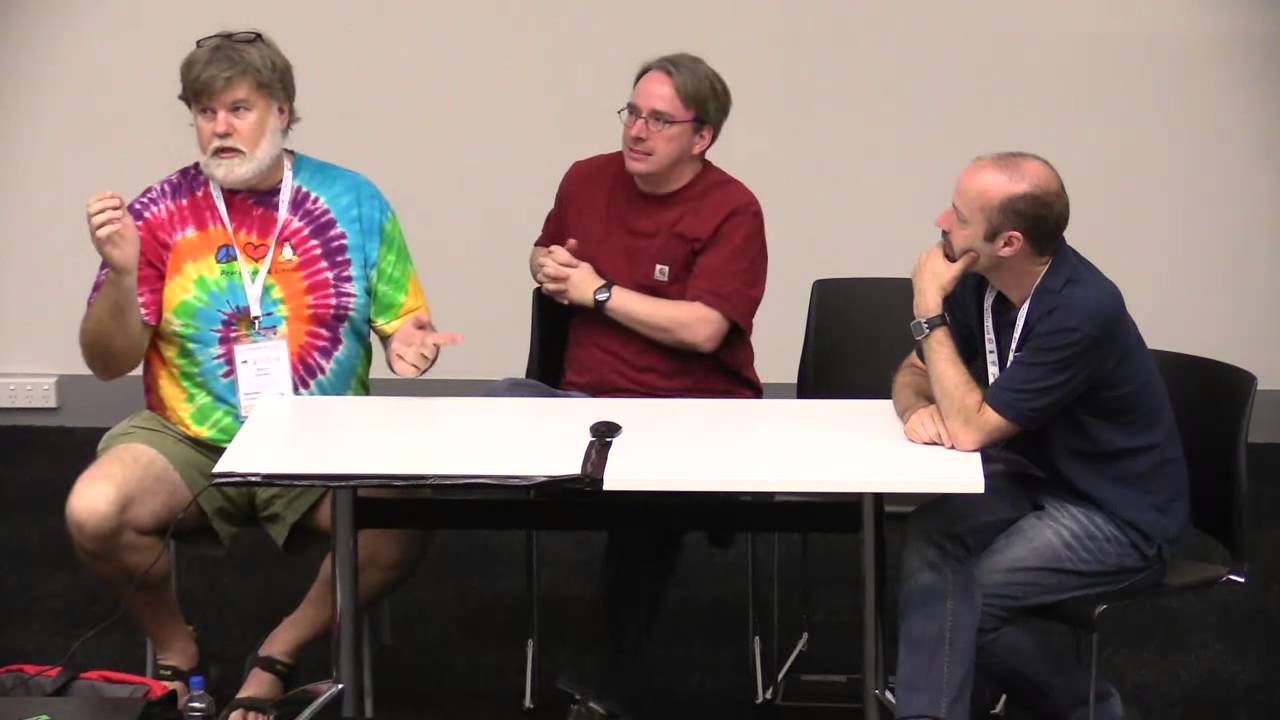
Video summary
At LCA 2015, Linus Torvalds reflected on his decades-long involvement in the conference since its founding in 2002 while addressing several key technical topics from previous years. He clarified that FreedomBox v3 was not solely his project, noting that Sean Mohan and Nick Daly were primary contributors alongside himself, and confirmed that kernel version 2.5 remains unready due to a shifted development model following the initial release's difficulties. Torvalds also updated his perspective on trusted computing and signed kernels, acknowledging their internal use for security despite earlier skepticism regarding vendor applications, while predicting that public IPv4 will likely remain necessary for another decade because of overdesign issues inherent in IPv6.
Beyond technical specifics, Torvalds addressed the community dynamics surrounding Linux development, explaining that his abrasive personality stems from a strict focus on technical merit and a belief that diversity encompasses different working styles rather than just demographics. He distinguished between the vocal minority causing noise during controversies like the systemd debate and the healthy majority of developers who have recovered well, suggesting that engaging younger generations should focus on microcontrollers where programming has immediate real-world effects. Furthermore, he dismissed fears about Linux losing dominance due to hardware changes or persistent memory architectures, arguing that file systems will still be essential for organization even in fully RAM-based environments.
Torvalds also articulated his philosophy on code correctness and legacy, rejecting the notion of making software "provably correct" through complex formal methods in favor of an evolutionary approach where humans make mistakes but collectively find better solutions over time, much like biological processes. He admitted that extensive documentation often fails because developers must read source code directly when documents are inaccurate or incomplete, yet he expressed pride in Linux's ability to thrive alongside commercial and closed-source entities without vilifying them. This evolution from an "us against the world" stance to a model open even to those who do not share its core values was crucial for his success, leading him to believe that Git might be remembered more widely than Linux itself as it spreads beyond Colel's original scope.
The session concluded with Torvalds emphasizing the long-term historical importance of both projects in demonstrating that collaborative human effort yields superior results compared to isolated competition and conflict. His final thoughts highlighted a shift toward acceptance and integration, suggesting that the future of open source lies not in isolation but in proving its value across diverse environments and mindsets. The event ended with applause thanking the organizers and panelists for facilitating this insightful discussion on the past, present, and potential future directions of free software development.
Read the full video transcript
test one two everybody hear me everybody
not hear me yeah right um I've been a
speaker at every LCA since first frisman
in 2002 and so in a lot of ways um this
has kind of become you know sort of a
regular and fairly important uh part of
my calendar of year and uh in fact it's
far from the first time that my birthday
has overlapped in fact uh a year that uh
I will probably never forget in 2003 for
Lots reasons and Perth um we actually
had the banquet and the keynote that I
gave was on my birthday so LCA and my
birthday all get tangled up and uh thank
you very much for recognizing that this
morning um before we jump into the Q&A
though um this week as I've talked to
people I've realized that there are a
couple of you know Loops that I should
try to close um first of all uh for
those of you who were uh at LCA last
year how many of you sat in on the talk
that I gave or watched the video since
um I'm really pleased to report that a
year makes a heck of a difference
and we're able to move into the new
house built on our property at the end
of September and uh the dust is
literally starting to settle as is snow
it's that time of year in
Colorado Also earlier this week my good
friend Evan mogin uh was asked about the
status of Freedom box and had this to
say um I'm pleased pleased to report
that uh trading a little sleep for other
things last night um I can tell you
that and to just be abundantly clear
about this the only contribution I've
made to the freedom Vox o.3 release
other than talking about it this morning
is one package upload to Debian a couple
of days ago since I arrived at LCA uh
there folks like seal Mohan and Nick
Daly and pet Rin holson who've been
carrying the torch over the last year or
so and uh I'm really appreciative of
that um you know go take a look at this
there's still lots of things to do if
this is a project that you're interested
in and would like to help with I'm sure
they'd still love to have your help so
enough about those sorts of things and
me and all of that well maybe not quite
um this is not the first time that I
have shared the stage at LCA with these
folks um
given the little you know ticket selling
thing this morning um if my beard is
worth on the order of $440,000
Australian a 3D printer's got to be
worth something more than
that but in fact if we go all the way
back to 2003 part of the reason that
year is so significant to me is that at
that LCA um Lena and tridge and I were
asked to do something that hadn't been
done until then at an LCA which was to
just take questions from the audience
for a while
and I have said to the organizer several
times since that that's one of my
personal favorite sessions at an LCA
ever and part of the reason for that is
that I actually like taking questions
from people and I like having some sense
of what other people want to hear about
as opposed to just standing and talking
for a really long time the other part
was I think that was actually the first
time that lenus and I or tridge and I or
indeed the three of us alt together had
actually shared a stage and uh that has
sort of set the stage if you will for
lots of things that have happened since
of course um there's some people who
just couldn't leave well enough
[Laughter]
alone and I think within two questions
yeah so that's my my cue there so um I
was reviewing the audio from 2003 which
um how many of you here were at the 2003
Q&A oh fantastic great so um Can anyone
remember um you know who interjected in
the first two questions
Rusty right so the first two he
interjected and then we realized that it
was inevitable and uh we called him down
to the front uh to join the panel and we
thought we might as well just short
circuit that now
because
rust thank you R you notice we already
set up the fourth chair ready for you
and uh so the other thing we had at the
2003 event was we had um choer chops and
so there will be again choer chop
rewards uh for questions so if you uh
want a chop a chop you have to ask a
question and
um that also happened in
2003 although it was lenus that tried to
grab one at the beginning and we told
him that he had to earn it first so
you'll get one at the end ladies uh
right so um shall we start off then any
more photos beo no that was all for the
photos but um we did also have an audio
recording of the session from 2003 and
TR I think you thought there were a
couple of questions from that that might
be worth revisiting yes indeed so we had
a we had a few questions so how how many
of you actually listen to the link that
I sent out to the chat list uh the audio
right so there was a there was a few
pertinent questions I think that deserve
an update answer uh from you know 12
years later to see um how it's going so
um the first question uh that was asked
um was uh when is 2.6 going to be
released so do you remember when 2.6 was
released I have no idea this is why I
have Source control these days
[Applause]
right so and there was a a follow-up
question which um you know is 2.5 ready
for users to try yet and I think we need
an update on that do you think 2.5 is
ready for users uh that was such a huge
disaster that we changed the whole
development model so yeah I think the
answer that is no that's a no right okay
so there was a couple of other questions
that I I thought were worth um worth
revisiting um one was about uh trusted
Computing and signed code and so M of
the audience asked about what Lena
thought about trusted Computing and
signed codee and so just just to you
know uh give you certainly what you
answered at the time you said that you
asked a vendor if there is an actual use
case for a signed kernel and the answer
was no and you thought it was just
marketing um so would you like to update
that
answer uh so these days we obviously do
it even without vendors asking for it um
we use it internally and I use it
internally for example for signing all
my modules and uh I think it's a great
use especially the way I do it which is
to Generate random keys that you throw
away after you've generated the modules
which means that nobody can ever try to
insert anything in your kernel so it's a
great security measure it can obviously
and I think that's something I've said
for a long time although I have no idea
what I said 12 years ago is that uh a
lot of
these security measures that are
vilified in this community are actually
can be very useful and uh sometimes they
have really good reasons for being used
even if some people tend to hate them
intensely but but things have clearly
changed we we do use it ourselves and I
use it personally all the
time
right so the final question that I think
is worth reprising from the 2003 um
event was about
IPv6 um
and at the time if you recall your
answer was that ipv4 is good enough for
most people because you don't want to
give your shoe an IP address and uh
so you also said that IPv6 is a decade
away uh now 12 years
later it's probably less than a decade
away and most people here probably use
it on your cell phones I don't actually
you know how the New Zealand Telos work
it turns out a I mean ipv4 clearly is
still majorly useful and uh and while
IPv6 now works I'd give it at least a
decade
before ipv4 is actually gone if ever
we'll see it's uh I always thought that
IPv6 was way overdesigned and uh it made
it more complicated and more painful
than it needed to be um
and uh private networks and things like
that means that not everybody needs to
use a public IP address anyway and a lot
of people do for no good reason so your
shoes if they do want an IP address
maybe they could use one of your private
Network IP addresses and you could still
use your shoes with
ipv4 so I think they're the the key
relevant questions from 2003 so so um
you may have noticed I sent out an email
to the chat list yesterday asking for
people to think up good questions for
today's session and so how many people
have got questions for today's session a
few people right so we'd like you to
come down and uh stand in front of the
microphone down here uh to ask the
question and um uh if there's any
Applause at all you know at the end of
answering your question you get a choer
chop uh so um first person come please
come down to the front and uh ask a
question
yep so sort of come down you can go
either around the back or up the front
if you want to just and queue up in
front of the microphone
here morning so Len nice easy question
to start with
uh over the years various people
including myself have either reduced
their involvement in the colel community
or stepped away from it entirely due to
the tone on LK
and especially your contribution to that
why do you continue to argue that being
really unpleasant to people's a good
leadership
strategy um part of it
a fair question that's not actually my
real argument
um my real argument is that people are
different and I'm a really unpleasant
person I that's what it really boils
down to is that and some people think
I'm nice and uh and some people are then
shocked when they learn
differently uh and I'm not a nice person
and I don't care about you really
seriously um I I care about I care about
the technology and I care about the
colonel and uh
I really think that a lot of projects in
the open source Community sometimes care
about non-technical things too much and
and the reason I say that is that the
only thing we can actually agree on ever
tend to be technical
issues and if
we start making a big deal about
non-technical
issues that are important don't get me
wrong I'm not saying they're not
important I'm saying that whenever we
start making non-technical issues the
primary issues that just guarantees
will'll never agree
right um and um
I'm not trying to really make excuses
I'm more trying to explain that this is
where I come from and and I appreciate
the diversity in open source but to me
that diversity is not
about gender it's not about skin color
it's about people are different and
people are different in what they are
interested in people are different in
what they're good at
uh skin coloring gender and all these
issues that get brought up as really
important things those are
details uh what is great about open
source is that some people are
unpleasant but they're technically
really good right some people are
Pleasant and like bringing other people
in and uh and I think that's one of
maybe the most important part about open
source is that you can do what you're
good at so when you look at bringing
in minorities bringing in females
bringing in people who don't speak
English my argument has been and is that
we should look for people who are good
at being the people who can be between
other people right um there are lots of
good Colonel developers who are great at
working with people people and they may
not even be great
technically and that doesn't matter
because we all have strengths right and
this is my argument and I refuse to
change well no that sounds
bad it's it's not that I refuse to
change it's that I don't
think I want to try to bow down to what
other people think my personal
personality is pretty abrasive I love
arguing uh at Beering at the Museum of
Technology I was I spent the whole time
just arguing with people right I mean
and and if you're that kind of
personality when you are on lkml you
will
argue and I know there are other Colonel
developers that are like me and I know
there are other Colonel developers who
not like me and that's all wonderful and
that was a really long answer to a
really simple question but the fact is
um that's how I
feel so and please introduce yourself at
the start of the question thank you good
morning my name is Tommy Richards and uh
Matthew kind of stole my
[Laughter]
question well maybe I can
uh I don't work in kernel development
I'm not subscribed to the CH mailing
list but I am in the community and I've
noticed a worrying Trend which is that
over the last year there's been more
hate there's been more abuse more
vitriol in ic and mailing lists on
Google+ and speaking as a professional
this really concerns me because I love
my job I want to love it in 20 years
time but if this trend continues I will
not be in the industry in 20 years time
so I'd like to know Lenn has already
answered but maybe the the other if you
could maybe tell us you all have a lot
of influence in this room and in The
Wider Community do you have any plans to
try and improve the community for the
theater for the rest of
[Applause]
us so I I think we have other people who
want to answer that I'll keep this quick
I think basically what you're saying is
not actually true um I think the uh tone
on lkml I don't know about IRC maybe
people in IRC other bastards and really
it's nasty LK M I think has been getting
better what has happened is that there's
a lot of system
D there's a there's a lot more talk and
it's become a thing that is a newsworthy
so um I actually think lkml has in many
ways Cal down and then people try to
make a big deal out of it and and and
make news out of behavior that is not
different but disagreement so you know
um Rusty mentioned system D um those of
you who have been paying attention will
realize that um I don't know my life and
that of Keith and various other folks
who are here got really Tangled Up in
this whole uh init system debate and it
really came to a head in the Debian
Community uh in the last year in case
you hadn't noticed um the interesting
thing about that Community is that yes
we ended up in a situation where we had
a question that was partially techn
Technical and partially not so Technical
and emotions ended up running immensely
hot particularly for some of the the
core participants in that debate SL
discussion process and you know um
emotions got hot to the borderline
nuclear level for a little while and it
was immensely
uncomfortable um as you know one of the
folks on the wrong end of some of the
vitri all around that um uncomfortable I
I'm being polite um because you are sort
of all my extended family here and I
won't say things to you that I might say
to other folks but um the really
intriguing thing is all of that vitriol
represents what I have described before
as the vocal
minority and we do have a problem in the
entire free software world where
sometimes we are too willing to let the
vocal minority represent us and to sort
of set the tone or the agenda for some
of the discussions I'm here to tell you
that in the Debian community in
particular the community is strong the
community is healthy the community is
recovering brilliantly from that whole
Ruckus around the init system debate um
work is progressing the next stable
release is coming along pretty much on
schedule uh if you got a little extra
time go help us chase down the remaining
set of releasee critical bugs and at the
end of the day um part of what I think
lenus might be trying to sort of get at
around the edge a little bit is it's
okay for us to have uh times where we
all let our passions overflow and get in
trouble with each other on sort of a
personal interaction and Communications
spasis as long as at the end of the day
we somehow figure out how to make things
right uh with all the folks that matter
in the communities that we're working in
and I really hope that if nothing else
all of us here today can go forward into
2015 conscious of the fact that a lot of
what we read and a lot of what gets
Amplified in the press and on blog posts
and all of that sort of stuff is the
opinion of the vocal minority and many
of us would like to be in the silent
majority are still just fine
everything's good we're going to do what
we can tend to support the friends and
diverse friends around us um and let's
not get so distracted by all of this if
we can help it um that's the thing that
would help me to feel better about some
of the stuff we've had to deal with over
the last while and I have to agree with
lenus I think we have to be very very
careful not to assume that the amount of
noise we see in the press and elsewhere
is truly indicative of what it's like to
be part of most of the open source
development communities that we know
of yeah so um as someone completely
outside system de debate I haven't seen
any escalation in verbal but you know
the trend has been pretty much downhill
I think for the last at least five years
right and by downhill he means better
better so yes and I I do think we ought
to give a shout out there've been there
have been uh important folks in our
community who've been doing really great
things uh because it's what they're good
at to try and help improve uh our
openness to diversity candidates I'm
really pleased by the diversity
sponsorship at this and other recent
lcas and the fact that that's brought
some interesting uh people into the LCA
Community a shout out to Karen Sandler
and the other folks involved uh in the
outreach program for women that has
generated some really interesting uh uh
new folks in the community who've done
really useful technical work and are
getting jobs on the basis of that and
all those sorts of things we've seen the
same thing you know we've seen a number
of projects making concrete efforts to
try and increase their uh openness to
contributions from different and diverse
folks it's not that there isn't a
problem out there somewhere I think we
just have to be careful about focusing
on what the problem actually is and
recognize and reward when things move in
the right direction instead of spending
so much time pointing fingers when
somebody gets
emotional
now Cher
chop there you
go next question hi I'm yaku uh so is it
the year of the Linux desktop
yet so I should interject there we did
have that question in 2003 and Rusty you
actually answered that um and your
answer was that by the end of 2004 it
would be 50% Linux desktop in the world
so how's that worked out for you
Rusty you know it's still so difficult
to measure it's so hard to
tell over 50% of my desktops are
running so extrapolating that it's all
good
and in in Who Running l
on your desktop or laptop or than
excellent and on smartphones we are 80%
right
y right answer here you
go okay something slightly different
from the previous ones uh those of us
have a certain age um got into Computing
mostly I think from the old 8B computers
and I remember like there were picture
books for kids that taught Advanced
basic even machine language now the the
world's a different place now and there
doesn't seem to be anything like that
some people are trying like you know
with raspberry par anything but I'm just
wondering what your thoughts are on
getting the younger Generations into our
community because it's all about
learning software literacy and
understanding how um our computers work
and it doesn't seem to be there's much
encouragement for uh the younger ones to
join our community and basically fill
with the ranks as we sort of age so by
younger ones you mean under 30
somewhat
yes I wish I had the answer to that
because I've got three kids and none of
them seem to be interested in technology
except as users well that's not true but
at least in computers in the sense I'm
interested in computers and uh I think
part of the problem is
there's the technology of today is so
complicated that for somebody like me
who is interested in Kels it used to be
easy to get in at at the Hardware level
and that's simply not true in computers
anymore uh and the world has moved on
and we're old farts for a reason um that
said it's much easier to get involved in
many other ways right maybe you're not
into computers and you into the whole 3D
printing thing uh and maybe you're into
doing these Us application things and
they're way easier to do than they used
to be so I I I don't have an answer I at
the same time I don't really worry it's
not the same thing anymore there's no
point in teaching everybody machine
language or basic or something like that
I uh I'm looking at most young people
tend to be pretty techsavvy right so I
wouldn't really worry they may not be
Colonel techsavvy but we don't need
everybody to do that yeah I think
there's also this immense Trend that um
we've been aware of and in fact there
have been some talks around edges of
this uh here at this conference and
that's towards
um accessibility of microcontroller
platforms and other places where um kids
are are really enthusiastic because they
see a direct connection between little
bits of programming and action that
affects the real world um I discovered a
really long time ago well before I had
kids of my own and and it's something
that I've enjoyed playing with them with
that um you know on some level computers
are kind of boring I mean there's all
sorts of things you can do with them and
my kids are certainly far more literate
and quick to go you know grab a computer
to do something than even I am sometimes
but um there's this immense uh sort of
feedback loop thing that works well if
you even get to the point where they're
turning an LED on or off or uh getting a
Servo to move or so my strong suggestion
if you've got kids or or you're trying
to figure out how to get younger people
enthusiastic is look for places where
there's an intersection between simple
Computing devices and real world effects
and feedback loops and you know if they
figure out how to you know write a
little bit of code in an uino thing or
something then they might end up
thinking trying to do colal development
is interesting Someday I'm not sure
whether would
but hi I'm Simon uh my question is where
do you see system D being in the next
five years is it just the new is it just
the new UD or maybe
devs go
yes I I I don't know why the systemd
question comes up because I don't even
care I I I'm a systemd user and I have
not been involved in any of those
arguments at all that I know of uh apart
from not liking one particular person um
and I'm pretty sure Bale doesn't want to
take that question so I'm I use system D
most of you probably do use system D
it's all good I I didn't care either
until yesterday apparently they've got
masquerading support and um I looked at
the code that the patch that I actually
put that in um they don't Fork out to IP
tables because that would be slow so
they use it directly and actually the
code look fairly same so you know as
long as the code's pretty good it's I
don't really understand what all the
fuss is
about you try to
so just to be clear the real reason I
don't want to take that question is I
don't try to predict five years in the
future about much of anything um and uh
you know the events in my life in the
last couple of years have made it clear
that trying to predict too far into the
future is is you know that way lies
Madness um part of the reason that I
ended up taking the decision that I made
in the whole Debian system D thing is
that it seemed to be the place where
there was the most enthusiasm activity
and good stuff being worked on for the
future um and one of the reasons that we
worked hard to constrain the actual
decision that we made in the Debian
project to the next stable release cycle
is we have no idea what will be the hot
shiny right thing to be using another
release cycle later um my anticipation
is that people will continue to poke at
it and do good things and and hopefully
it ends up being you know code that
we're all okay
[Applause]
with okay my question is for Lunes um
lunus when you didn't like the current
version control you wrote good and you
didn't like your you didn't find a good
dive log so you wrote your own Drive
lock what are you working on now that is
not on the Kernel are you hacking on
something now
um I'm not uh
honestly I'm a lazy person which is like
why I like open source I get all these
people to do all my job work for me so I
don't I don't really want to have other
projects what I want to do is just sit
sit on a beach and sip a fofy drink and
just let you guys do the work and and
the fact that then occasionally I've had
to say okay in order to be lazy for the
next five years I have to do something
uh that's F right now um the thing I've
always cared about has been the colonel
and
uh right now knockwood or something uh
the the kernel development process seems
to be working really well and we don't
have any huge looming concerns and I
hope I'm not wrong about that uh so so
we seem to have found a model that is
working is getting us where we want to
go and uh and we're I'm coasting well
right now I'm coasting then the merge
window comes along and it gets crazy for
a few weeks again but um so I don't have
any projects I'm working on um I'm hope
to next week work on my dive log thing
that I started but I gave way but that's
even that hope is more like I hope
things work so well that I don't need
to thank
[Applause]
you uh we a heretical question here I
was just reading it other day about this
new machine the
machine that will have maybe petabytes
of Mista so you don't have
files um because everything permanent
and memory the same thing uh therefore
uh Linux can't handle it you need a much
better offering system that doesn't deal
with files but deals with many
structures wonder what you have to say
about
that call me when it you
want so um well-known member of our
communities just rejoined HP in order to
work on the Linux port to the
machine uh the one thing that might be
worth I mean if Keith wants to come up
and speak but I don't think he does uh
one thing that might be worth mentioning
is even when you have persistent memory
and you can imagine a world where
everything is in Ram and it never goes
away that won't necessarily really
change things as much as some people say
because you will still want to have a
file system just to organize this thing
persistence also means that I mean one
of the advantage of RAM and it goes away
is that you do something and then you
throw it away
and that means you don't have to manage
it as much because it it the fact that
it's ephemeral means that it it's also
something you don't need to care about
long term um if you have persistent Ram
or Ram memers or any other kind of model
you will still need to have a file
system just to have a way to organize
these things that stay around for years
and years so it won't change that it
will change the details in the file
system when you have bite addressability
you can do things that you can't do with
diss but we already see that with ssds
that just the
performance uh differences mean that you
do different things in file systems than
you used to do 20 years ago or 50 years
ago so on some level one of the things I
would suggest is that what's really
interesting about the machine is that
the intersection of a couple of parallel
long-term technology development trends
that are going to hit the market at
about the same time are going to give us
the opportunity sort of all at once to
throw more existing assumptions up in
the air possibly bat them completely out
the window than normally happens when
we're watching sort of the steady
evolution of Technologies Lyn is
absolutely right the introduction of
ssds changed the way we think about
performance in a storage subsystem right
I mean you know gone are the days when
you know elevator algorithms for
managing you know block transfer uh
sequencing are fundamental to being able
to get any kind of useful performance
out of a storage system at all but the
the the the the the needs that concerns
the pinch points just move it'll be
different but it won't be it's not like
the whole world magically gets
simpler suspend and resume is going to
be really fast
[Applause]
there's been so many technical questions
I want to ask a meta question instead so
you can be purely opinion istic
um given that Australia and New Zealand
technically share the same airspace do
you think that they should come together
and form a combined space agency given
that we're the only D20 Nation without
R you should take that one yeah I mean
we technically all share the same
airspace right
so um and and it's expensive and I think
we all need to get together to really go
into space I'm really the wrong person
to ask all the people in this room I'm
probably pretty low down on the list to
really answer that
question right um
okay so we already had a question about
the machine and Linux Plus+ and things
like that do you think there'll be any
innovation in Hardware in the next few
years where the Linux Colonel possibly
couldn't make the transition very
quickly and what do you think the
implications would be for all of us and
all of our work as a whole if Linux
loses the dominance it's achieved over
the past
decades I wouldn't lose sleepover it um
yeah and I really don't lose sleepover
it in fact I think in the computer
industry in general the big question is
not what happens to software in the next
few years but what happens to hardware
and when SC stops and it's not happening
in a few years but it's happening in 10
and it's getting much more gradual and
maybe somebody will come up with
something really radically new and there
are people who argue that hey we've been
saying that scaling will stop for the
last 50 years and it hasn't stopped for
the last 50 years it will stop people
who believe in quantum computers are
before or after the
year is it going to stop before or after
the year of the Linux
desktop you know what I really think
what happened is this the Linux desktop
scaled down and now we have it in our
pockets so that but but we're really at
the point where in 10
years uh five nanometers that's not a
lot of atoms and the whole computer
industry I mean software 2 don't get me
wrong but the whole computer industry
has for a long time time lived on the
notion that the computer 5 years from
now will be fundamentally different and
faster what happens when that's not true
on a chip level anymore you can still
improve right you can do clever things
and you can improve but it's not going
to be the same kind of improvement and
we've seen some of it already but it's
going to get much worse and that will
impact software too but I think it will
impact the hardware people much much
more
and that's going to be interesting in 10
to 15 years what
happens I
might I might mention there was a
similar question actually in 2003 to
that which I I think uh was worth
mentioning at this point there was a
question about um uh somebody in the
audience said that in uh that 20 years
before uh so 1983 they had a computer on
their desk that could uh write letters
uh to their mom and print and now you
know 20 years later 2003 they had a
computer on their desk that could write
letters to their mom and print you know
what's changed that 20 years now the
answer at the time from Bal actually was
that it's got
slower um and that's what's
changed but um I asked a couple of
people about that before this and they I
said well what's changed in the last you
know 12 years and uh the answer from
several people was it's got faster again
and you can't
print uh couple of weeks is it two or
three weeks ago there was this big
surprise uh that it turned out that many
uh Colonel developers don't know how
memory allocation Works um I think
lwn.net uh wrote uh too small to fail
that problem uh
so I thought to myself then well 10 15
years ago go the answer to that problem
would probably be have
rdsm the question today I would ask
which fine manual we should have read do
you think that documentation of the
kernel is
appropriate uh do you have any idea how
to improve
that well I clearly have no idea how to
improve documentation in the kernel this
is where uh um others sometimes step up
and do a great job of explaining small
details at the same
time there was a talk yesterday about
how uh programming should be provably
correct and it's it would be a great
thing if we could prove correctness and
that we all suck at it and and and I
don't take that approach I'm more of
a touchy Fey
guy I actually I believe in biological
processes and I believe in evolution and
I believe in all these making mistakes
and trying and uh we don't have
documentation for how humans work but
humans work really really well except
when they break down uh and uh I
actually think we're at the stage and we
have been at the stage in kernel
development and in a lot of Technology
where nobody really understands
everything that's going on the VM is
complicated deal with it and just
realize that the answer to that is not
to make the VM simpler because the VM is
complicated for a reason it's doing all
these crazy things and a lot of them are
heuristics they don't have hard reasons
for it there often is know this is what
you need to do this is the correct
answer a lot of the time it's like we
want to go in roughly that direction and
uh we don't even know how to get there
but if we do this most of the time it
works that's how a lot of real problems
in real life are and uh that is hard to
document when there is no real answer
and uh we should continue to document
the big rules we should continue to
document the details like um how memory
ordering Works which was another subject
that came up to yesterday but that's
still we'll never be in the situation
where we can give a spe for the colonel
and I don't think we should even try we
should we should just realize that okay
life is complex and we do the best we
can and we need to have smart people but
we also need to have a lot of people who
test a lot of people who are willing to
accept that I don't know what the
solution is but I know what is better
than what we do today in this area and
if you continue to do
that this is how
biological systems work and it's a
provably working process it doesn't get
you to the perfect end result but it
gets you to something that works better
than anything else we've ever
[Applause]
seen hang on got your choer
chop so just to follow did anyone else
want to chime in on that yeah so um when
I wrote uh wrote net filter the first
time I actually wrote a hacking howto
that had all this details on how it all
worked and how you could extend it and
everything else and the first time I
received a major patch I was really
excited the patch was great and I said
what did you think of the hacking how-to
and of course he said what
howto and so the lack of documentation
does provide a filter for contributions
um that's
terrible it's terrible but it's true
because they have to read the code
anyway because the documentation will
lie so why not skip the first point and
make them read the code immediately
because they'll have to deal with it so
in practice I found that effort put into
documentation in the kernel uh was not
paid back uh so I actually disagree I
mean we have areas where we document uh
small details like locking rules and and
these kinds of very specific and very
targeted areas we do need to have
documentation because they are they are
things that people people can't keep in
mind and they're kind of big enough
picture that you can't look at one piece
of code and see what you should do so we
do need documentation but I I think the
argument is documentation is not a
Panacea it doesn't solve everything it
it's not always the answer
um um I I noticed TRD has not been
answering a lot of questions you've been
doing a lot of moderating and throwing
out Cher chup so I'll crack out an Old
Chestnut that everyone can can answer um
current desktops going 2 three KDE
emac what do we run yeah all right okay
that's checked from time to time and
changes from time to time okay anyone
want to start start uh so you know um
this on my badge you know emac get I run
auntu trustee um and I've switched
between a number of different uh you
know window managers um but uh and
actually you know a lot of my work is on
embedded systems these days so uh most
of the time my desktop is actually G
screen um and running G screen on a
system that often the systems are on
another continent and so really the
closest thing to a desktop I have at the
moment is go
screen uh debban unstable xfce4 and a
lot of terminal
Windows um I'm on Fedora one right now
um I'm actually known for being a gnome
hater I don't like some of the
development models they have but I I'm a
gnome 3 user with a couple of extensions
to fix what I thought were big failures
and I don't believe in emac or VI
so I used this one editor that nobody
saying would ever use but it's what I
grew up with so I just fixed that a bug
where it would crash if you had a big
screen and more than 128 lines on the
screen that that's the kind of crap I
run I run stock auntu on my desktop uh
but my build machine is Arch and um uh
and the only window manag that has is
when I ssh in
s-x otherwise it's all text
[Applause]
uh I'm Dave Lane um just have a question
this probably applies to all of you but
um I guess primarily for for lus in this
case um do you all see uh yourselves
being at some point in your leadership
roles usurped by a computer uh and if so
what what kernel will it be
[Laughter]
running a question are you in your
leadership role going to have that Ro
sered by a computer and if so which
Colonel will it be
running I don't
know will it be
heard I yeah I think my mind will be
going before that happens but the
argument there is when that happens and
I don't know
I I think there is actually a partly
serious answer I can give to that that
question and it harks back a little bit
to some of the social interactions
something I've noticed in recent times
is processes for doing software
development are becoming more mechanized
and um so the uh so often these days you
know you're on um you know GitHub or you
know gorus or whatever and it's like
it's a pull request and it's just a
patch and you respond there there's less
social interaction
you you you might as well be you know
talking to a computer because it is
getting more and more mechanized that
process and I think that feeds into you
know I've never seen um any you know
really heated discussions in a pull
request chat um and uh so it is sort of
moving to be a more mechanized process
and you know being more computerized in
a way so I if I end up being replaced by
a computer I don't actually sort of Care
on some level as long as it's running
free software yeah
um hey um my name is Laura Bell it's
actually my first time at LCA
cool I'm a security specialist um while
uh security bugs have always
historically been found in Linux and
open source products in the last 12
months the way they have reached the
world through mainstream media has
changed dramatically um and and you know
our bash bugs of the last 12 months have
kind of changed the way most people who
don't think about security interact um
what are your predictions for security
in the open source Linux space for the
next 12 months and which areas of code
if you were going to go and look at one
right now for vulnerability research
which would you start
with Bitcoin make money
I mean if you knew which piece of code
to look at for security issues we
wouldn't have security
issues it's going to be something very
obscure and stupid and it's going to be
obvious in hindsight and people will say
how did we ever miss that and that's
what it's always going to be uh
the security is just a a hard problem
well well well I think you're absolutely
right and and This falls into another
one of those I'm certainly not going to
try and be very predictive categories
I'm really pleased that at least part of
the response to this sort of escalation
or change in the way things are being
reported and talked about over the last
year or so is that there are some
activities attempting to sort of shine
more light on put more resources on some
of the core elements of technology that
we all depend on um referring of course
to things like the Linux Foundation core
infrastructure initiative and so on uh I
don't actually immediately know sort of
how that's going but the idea that we're
at least trying to figure out how to get
more eyeballs on some of the things that
we all agree are some of the most
important elements of code in our
infrastructure and that we found the
corporate members of our extended
Community willing to anti up to help
make that happen is is pretty cool and I
hope that's a good step there's another
thing that's been going on which I find
personally very satisfying which is that
people are less willing sometimes to
kind of brush the problem under the mat
and leave it up to vendors and have
disclosure like infinitely long
disclosure times I'm a huge believer in
in just
disclosing still somewhat responsibly
but security problems need to be made
public and uh there are people who argue
and have argued for decades that you
never want to talk about security
problems because that only helps
the uh black hats and the fact is that I
I think you absolutely need to report
them and you need to report them in a
reasonable time frame or reasonable for
the caral security list is admittedly
five working days which some people
think is a bit extreme uh and and in
other projects it might be a month or a
couple of months but that's still much
better than the years and years of
Silence which we used to have
thank you very much thank you very much
so we're going to need to to wrap it up
there um so I'm going to get the last
question which is a real privilege as as
one of the organizing
team as of now as of today and perhaps
looking forward a little bit what do you
feel is your biggest Legacy to the open
source movement that posting about the
first release of Linux or the momentum
that caused you to release
git or something
else
um me personally
um quite yeah I I actually think one of
the things that I Linux has been really
good at and
I'm and this is going to raise a few
hackles right I I like open source and I
like
this whole working to that together with
commercial companies and this whole
notion that you don't need to vilify
people who also do closed
source so for me personally one of the
big things I'm happy about is that I was
part of the group I mean and Linux was a
big example for the group who who tried
to take and now this is when fridge will
stand up and give the other answer who
try to take this
very uh you
or us against the world approach of free
software and made it more open not just
in name but also in being acceptable to
people who don't necessarily believe in
our values but believe that our model is
better and uh and that's to me something
that that
Linux was really in mentally at the same
time I'm really happy about git too
because I think git has spread more than
than the colel in some respects and and
maybe I'll be remembered more for gift
than Linux we'll see if I if I would
answer that on his behalf I think that
the thing I think the long lens of
History might find the most important is
how both of those projects have
positively impacted this notion that uh
all of us as humankind working together
collaboratively leads to better results
than when we're all sort of hiding in
separate corners and fighting and
competing so we need to wrap up there
but it's been a a fantastic session and
uh do you think that uh our panel has
earned a choa
chop we
go thank you also to the the organizers
for organizing this session and for an
absolutely brilliant conference so
[Applause]
um thank you
[Applause]
if had War you would have made nearly as
much okay
[Music]
everybody
please help