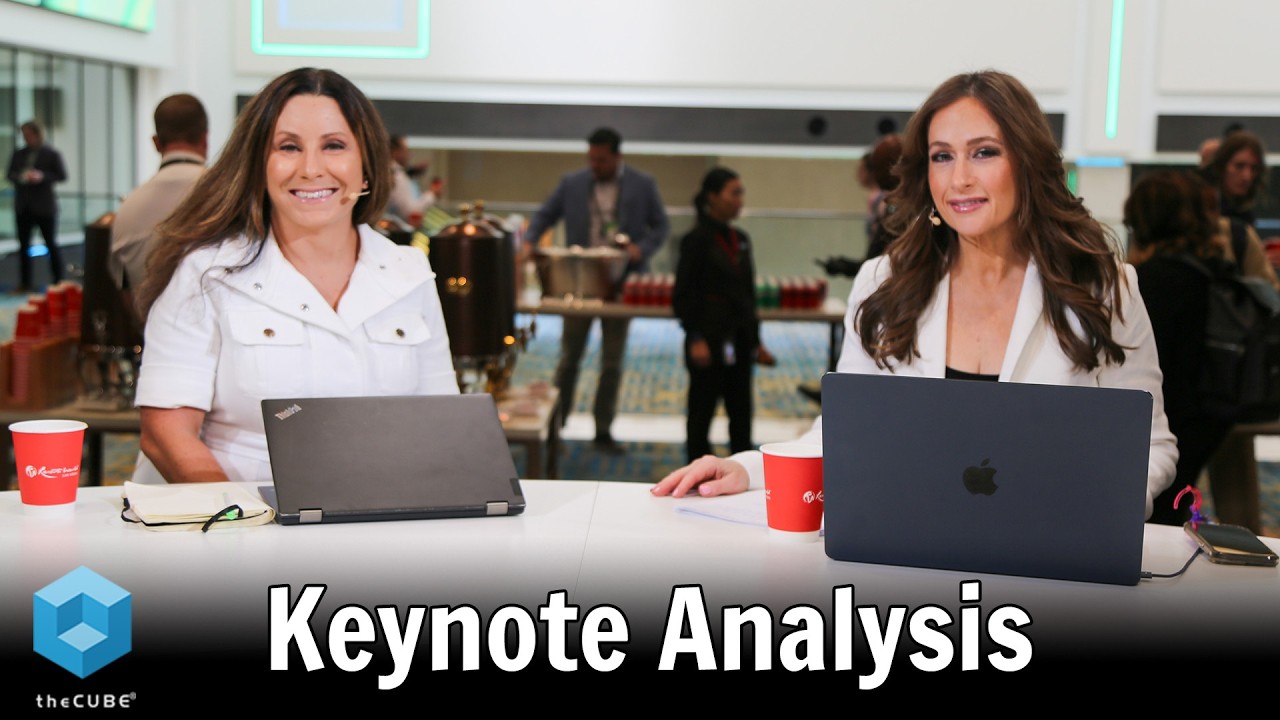
Video summary
The keynote analysis from Workiva Amplify 2026 highlights a pivotal shift in the relationship between humans and software as artificial intelligence evolves into an agentic era. Central to this discussion is the critical need for trust, a theme emphasized by Workiva's CEO Julie Iskow and reinforced throughout the event with signage urging attendees to "go further with AI built for trust." While C-suite executives grapple with the ethical implications of relying on AI, the technical focus has turned toward ensuring that AI outputs are not only plausible but also deterministic, traceable, and defensible. This is particularly vital in regulated industries where compliance requires more than just answers that sound correct; they must be grounded in verifiable logic and transparent processes.
A major argument presented by Workiva's Chief Product Officer Deepak Bharadwaj is the necessity of providing AI with rich context to execute complex functions reliably. The analysis illustrates that raw data points, such as a revenue figure, are insufficient without understanding their underlying meaning, responsibility, and historical trends. Workiva aims to act as a connective tissue across disparate systems like ERPs, CRMs, and even tribal knowledge held by human workers, thereby bridging information silos. By integrating this broader context, AI agents can perform high-stakes tasks like filing 10-K reports or managing sustainability risks with the necessary industry-specific understanding, ensuring that their actions are auditable and aligned with evolving legislation.
Furthermore, the conversation explores Workiva's strategic expansion beyond its traditional stronghold in financial reporting and compliance into new areas such as sustainability and broader risk management. The goal is to help customers navigate these complex landscapes by leveraging AI that has been trained on extensive historical data and regulatory changes. This approach allows organizations to expand their share of wallet while maintaining rigorous standards of accuracy and accountability. Ultimately, the path forward involves a two-step verification process: first, ensuring the legitimacy of the underlying raw data, and second, trusting the decision-making capabilities of the AI agent itself, which requires deep contextual awareness to generate value safely.
In conclusion, the event underscores that the future of work depends on building an ecosystem where AI agents operate with full transparency and accountability. As businesses increasingly delegate functions to AI, the ability to trace every step of the process becomes paramount for maintaining trust and regulatory adherence. Workiva's vision positions itself not just as a software provider but as an essential infrastructure that connects fragmented data sources into a coherent, trustworthy narrative. This integration ensures that as AI takes on a larger role in executing critical business functions, organizations can confidently navigate financial reporting, risk compliance, and sustainability challenges without compromising on the integrity of their operations.
Read the full video transcript
Welcome to Workiva Amplify 2026. We're
coming to you live from Las Vegas. I'm
Allison Kozak alongside Kristie Case,
and we are excited to start the day.
We've got a full list of interviews and
conversations with individuals who are
going to talk about, you know, putting
connected data to work in the in an age
when we're seeing AI rewrite the rules.
>> Absolutely, Allison, and I think those
themes really resonated, you know, in
the keynote
>> you know, at this morning, as you can
see the uh the behind us the the floor
the uh
show floor is kind of filling a little
bit or kind of the um coffee table here
behind us. This place is filling out.
>> Filling out.
Yeah,
exactly.
>> Yeah, so, you know, I think um this
morning um we heard from um Workiva's
CEO um Julie Iskow, and she was talking
to your point, Allison, a lot about how
the relationship between humans and
software is changing in this kind of
agentic AI era, and sort of kind of what
that means for not only, you know, kind
of the roles and responsibilities of the
human in that process, but also, as
you're mentioning, kind of the connected
data and kind of that connective tissue
underneath it.
>> Yeah.
>> Yeah, and then just looking around here,
as I'm sitting here, I'm looking at the
signage um that Workiva has in the event
hall here. One of one piece says, "Go
further with AI built for trust." That
seems to be an ongoing theme. I know I
sat in on um one of the discussions
yesterday uh the C-suite's perspectives
um session. Um
which which is interesting, there was a
lot of talk about trust and and and sort
of what keeps them up at night is how
much to rely on AI, um and that that
really is an ongoing question, isn't it?
>> Yeah, absolutely, Allison, and what I
think is really interesting is, to your
point, that's sort of a C-level
discussion, but this morning's keynote
was a little bit more kind of
technically oriented, and we kind of we
saw a demo of the product, um and we
heard from Workiva's um Chief Product
Officer um
Deep Deepak Bharadwaj who was going to
be on the cube this afternoon. And when
we think about trust, you know, I think
he really talked through some of what
that means in terms of the Workiva
product and kind of what customers
really should be looking for. So, you
know, we can talk a little bit about
that now that I know we'll be hearing
more from him on that this afternoon as
well.
>> Yes, he will be coming up in our lineup.
I'm curious because you you sat down
inside the keynote and learned about
their product unveils. Maybe walk us
through what what you learned what they
unveiled today.
>> Yeah, absolutely. So, at a high level
Deepak was talking about, you know, AI
is sort of very probabilistic. But we're
asking it increasingly, especially when
you think about, you know, compliance,
we're asking it to execute very
deterministic functions, right? So, how
do we think about building that trust
when the answer, the work product, can't
just look or sound right? It needs to be
very trusted, right? And part of that is
making sure that it's very traceable and
defensible.
So, that's definitely something that I'm
looking forward to digging into with him
more this afternoon when we speak.
>> I know there's also been discussion of
Workiva kind of being a bridge to other
systems, right? Is that something that
you're seeing
in in your analysis?
>> Yeah, absolutely. So, when we think
about kind of where where Workiva sits
in the market, and we saw we heard some
of this in the keynote this morning, you
know, we might have kind of these point
solutions, maybe an ERP system for
example. We also might have customers
that are, you know, even keeping things
in a spreadsheet or maybe there's tribal
knowledge that exists just in the brain
of the human worker. So, what we're what
what I'm looking at as Workiva's bigger
opportunity is, as you mentioned, kind
of creating that that context and being
that connective tissue across those
disparate platforms and kind of bringing
in that again that more tribal knowledge
to be able to you know again make sure
that as we are starting to ask AI to
actually execute functions that it can
be trusted because it does increasingly
have that context behind it.
>> Yeah and and you're seeing Workiva being
able to extend into other use cases.
>> Yeah so you know they are historically
very strong in you know things like
compliance
and reporting and very regulated and
audit and workflows that are very
regulated and they are beginning to make
some steps into areas like
sustainability. I know that they're
certainly looking at kind of risk and
compliance as well.
You know we're hearing that they're kind
of expanding some share of wallet in
their existing accounts. So I think
that's definitely one thing that I'm
going to be looking for is how do they
look at you know kind of again AI
starting to execute functions for us
take on a bigger role and really help
customers to navigate like I mentioned
not just financial reporting but you
know broader risk and compliance
sustainability and some of these other
use cases as well.
>> And and also another theme is that
business
business data is it just can't live in
silos anymore right? And that's an
important thing to remember.
>> Exactly exactly. So you know
like we were talking about earlier there
might be a CRM and ERP system that has
different pieces of information but we
need to understand the context behind
it. So you know Julie Alsko on the stage
this morning she threw out an example of
okay 5.5.3 billion I think was the
number that she kind of used as an
example. We see that but we don't know
what it means. Does it mean revenue?
Does it mean profit? Is it going up? Is
it going down? Who's responsible for it
at the end of the day? So that was sort
of her demonstration of especially for a
company like Workiva very rooted in kind
of that financial reporting. We need to
go beyond just the number and we need to
understand its context and who's
responsible for it, um, at the end of
the day.
>> And the underlying data has to be
has to be legit. Has to has to be
something that can be trusted because
that's what leads to action, which leads
to to value and and and overall what,
you know, leads to that trust that
overall has to be the theme, right?
>> Absolutely, Allison. And so, thinking on
that, so certainly
there's kind of two steps, in my
opinion. So, first, we need to make sure
that we can trust the underlying data,
right? So, about the raw data that we're
actually pulling from these systems, but
we also need to make sure that we are
trusting the decision-making
capabilities of an AI agent as we're
asking it to do things like, for
example, you know, again, the example
this morning was creating and filing a
10-K, for example, for the company. So,
it needs there's many steps in that
process. And so, we need to make sure
that and if we are using AI, that it has
that understanding of, you know, our
industry, it has, you know, the previous
years of, um, you know, context as well.
And also, if we're thinking about even
going a step beyond that, if we're
thinking about risk and compliance, um,
you know, the AI agent needs to have the
understanding of our industry. What is
changing with certain, you know,
legislation that we need to comply with
and what does it mean for our business
specifically? And so, that's when we
start to say, "Okay, we need to have the
context, we need to be able to trust."
Because then the trust piece of it
becomes making sure that the actions
that the AI
agent is taking are, again, auditable
and traceable.
>> Wonderful. The great analysis, Krista.
Fantastic talking with you. I'm excited
to get the day started. Um, for now,
that's going to be it for the keynote
analysis, but we're going to be right
back after this starting our day of
interviews and conversations. You're
watching The Cube, the leader in live
tech coverage and in-depth tech
analysis. And we'll be right back with
those conversations.