Video summary
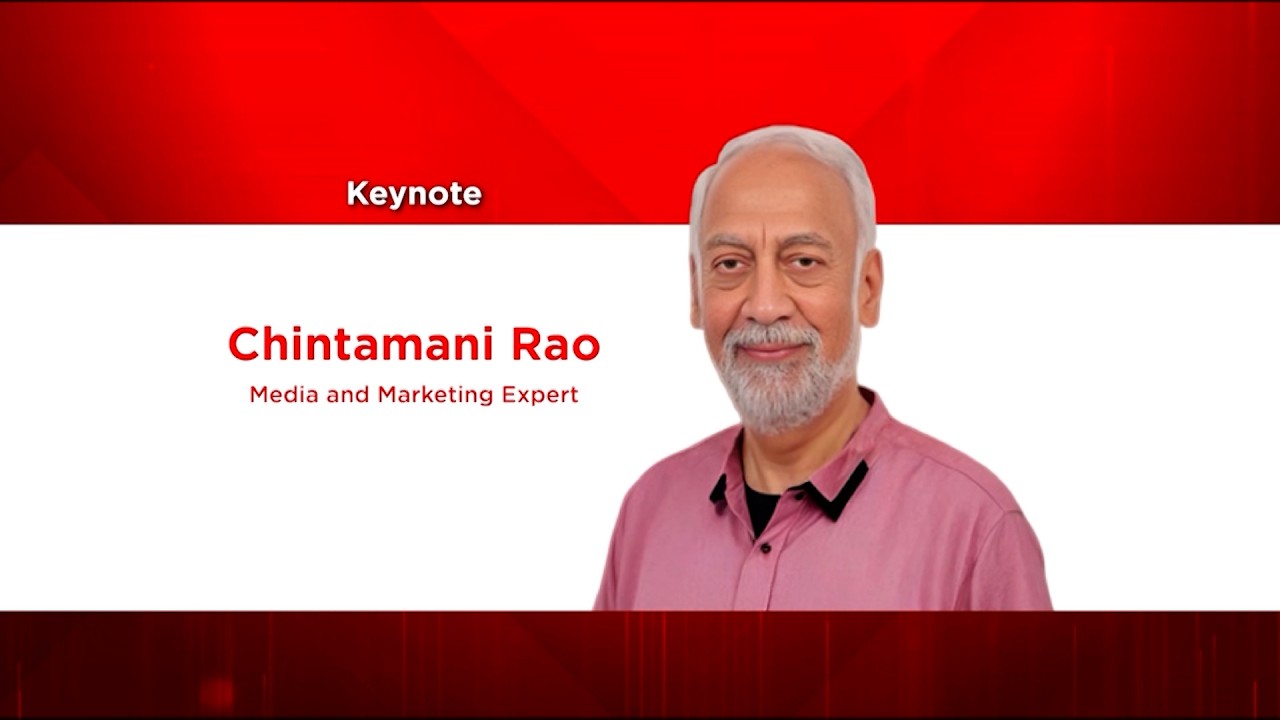
Chintamani Rao opens his keynote address by reflecting on the dramatic transformation of the news media landscape over his career, contrasting the limited information sources of the past with today's digital abundance. He recalls a time when news was confined to a handful of newspapers, radio broadcasts that ended at 10 PM, and government-controlled films, noting how shocking it was that in 1991 there were no immediate news outlets following major events like the assassination of Rajiv Gandhi. The advent of satellite television and the subsequent explosion of nearly 400 Indian news channels have since created a 24/7 environment where TV and print distinctions have blurred, yet this proliferation has not solved the fundamental crisis facing the industry: a severe loss of public trust.
The speaker highlights that while traditional media outlets struggle with declining ad revenue to tech giants like Meta, Amazon, and Google, the biggest shift is in how news is consumed. Recent data indicates that social media and video networks have surpassed all other sources as the primary way people get news globally, leading to a significant decline in traffic for even major news organization websites and apps. This fragmentation has exacerbated societal polarization, where trust in institutions and leaders is plummeting worldwide, and the term "mainstream media" has become pejorative due to widespread skepticism fueled by unverified content on platforms like WhatsApp. Despite this global anxiety and cynicism, Rao points out a crucial silver lining: trust in specific, well-established news brands remains relatively strong compared to the overall decline in faith in institutions, suggesting that audiences have not entirely lost their belief in quality journalism.
To rebuild this essential commodity of trust, Rao argues that the industry must rediscover core journalistic values such as accuracy before speed, verification before amplification, and fairness before partisanship. He critiques the current state of television news for lacking immediacy, where viewers often see "talking heads" debating without seeing reporters on the ground or hearing directly from people affected by events, a stark contrast to the revolutionary live coverage of the Gulf War that once defined CNN's rise. While technology, AI, and new business models can be acquired or adapted, credibility cannot be manufactured; it must be earned story by story through integrity and editorial judgment. Ultimately, the future of news belongs not to those who shout the loudest or rely on algorithms, but to organizations that consistently convince their audiences daily that they deserve to be believed, offering an extraordinary opportunity for those willing to nurture this trust to emerge stronger from the current disruption.
Read the full video transcript
right here in Delhi
have brought into focus the role and
responsibilities of the news media.
I'm not going to go into what happened
these day in these few days in these few
weeks but it does make a relevant
topical backdrop
>> for discussions like can happen today.
By the time you get to be my age, you
see a lot of change.
When I began my career,
the news media were newspapers
or handful of news magazines
and all India radio.
When you went to see a movie which was
once maybe twice in a month you saw per
force the news re made by the films
division of the government of India.
That is it.
Duration was a single channel that went
on air in the evening.
It was a general content channel uh with
news bulletans.
cori came to India 1982
with games.
In fact
to give you a pretty good idea of what
it was like many of you many people here
present today wouldn't uh have lived
that time
have experienced that time
in 1991
at some around 10:00 in the night after
10:00 in the night
Rajiv Gandhi was shot right
uh I was traveling. I was in Madras.
My wife was at her home in Bangalore.
I got a call from her.
She used to write for the Hindu
and somebody called her from the Hindu
to tell her this had happened
at that time 10:00 in the night. There
was no news medium available in this
country.
Can you believe that?
Dudan close at 10:00.
If he if he got shot at 10:10, Dud will
come back tomorrow morning.
That's how news was.
As well, to me, as recently as 1991,
sometime in the late 1980s,
we heard of a crazy plan by a Hong Kong
businessman.
He was going to broadcast TV via
satellite
>> with simultaneous telegraph across all
of Asia
so that at one time you could see the
same thing in Karachi or in Kolumpur in
Hyderabad in Hong Kong you see the exact
same thing
how crazy is that sounded like science
fiction
and that of the birth of star TV
I don't know if people even anybody even
recalls the star is actually an acronym
Star was satellite television Asian
region. S E A R.
The whole idea of satellite television
was something so totally new.
And here we are today with 24/7 TV news
and nearly 400 Indian news channels
across all languages
and access to my international channels
in a variety of languages.
Online, the distinction between TV and
print has blurred
with all news outlets putting our
content in both video and text.
And of course, all of us have 24/7
access to it all right here in our
pockets.
At the same time, the mainstream media,
traditional print and broadcast models
are losing ad revenue to the to the
digital space.
But
it is not that digital platforms are
making money.
The so-called Sang companies now called
now the NANG companies Meta, Amazon,
Apple, Netflix and Google
earn 70% of all
digital ad revenue worldwide
leaving 30%
for tens of thousands hundreds I don't
know how many hundred tens or hundreds
of thousands of other uh uh digital
companies and platforms
And when it comes to news, which
platforms are those? Well,
Institute of Media Studies publishes an
annual report called the digital news
report. It's now in its 10th year.
The latest report published earlier this
year says
2026 represents a significant milestone.
For the first time, social media and
video network consumption is now ahead
of other news sources as the most widely
used source of news globally.
Social media and video consumption
is the most is the most widely used
source of news.
The use of both TV news and news organiz
organizations websites and apps has
followed
not only on the TV but even on the web
news organizations apps and websites are
coming down.
The relative decline of television as a
source of news is better recognized
across industry.
What is perhaps less well acknowledged
is that people's use of news websites
and apps has declined at a similar rate
in recent years.
So it is not broadcasters websites,
broadcasters apps, it is social media
that is the biggest purveyor of news in
the world today.
That is a change quite incredible change
if you stop to think of it that is in
the dissemination and availability of
news in my own professional lifetime.
Today the biggest issue in the news
space is trust. Trust. Simple as that.
Back in the day, if you saw or heard it
on the news or read it in the newspaper,
you believed it.
Even the government owned media,
Dur Dashan and Polar Radio
may have over reported some things or
ignored or underreported some things.
You could accuse them of that. Of
course, you could. The government own
media, right?
But they did not misreport, did not
knowingly mislead.
Now, we have hundreds of news sources
that are committed 24 hours a day, but
we're not sure which ones we can trust.
The term mainstream media has become
almost a porative, hasn't it?
Don't all of us get WhatsApp forwards
telling us something that mainstream
media will not tell you.
Don't we all every
what do you expect of the bloody
mainstream media? Right? That's that's
test that's the attitude towards
mainstream media today.
I'm sure all of us feel the insecurity
around us. The social polarization lack
of trust.
What we feel is apparently true not only
of India that's universal.
I turn to the edman trust barometer.
Anybody familiar with that edman trust
barometer?
It's a annual publication, annual
report.
Uh it is
now in its 25th or 26th year. This year
it was done among 34,000 respondents in
28 countries.
And here is what the 2026 report says.
70% [clears throat]
70% of respondents across 28 nations
now are hesitant or unwilling to trust
someone who has different values,
information sources, approach to
societal problems or backgrounds than
them
70%.
This majority holds like this majority
holds across income levels, genders, age
groups and developing or developed
markets.
So across age, gender, income, developed
or developing countries.
Essentially everyone says the world is
becoming increasingly insular.
Quiet as writers and losers.
Trust in news is at a low. Some of the
worldwide drop in trust reflects wider
anxieties beyond the news industry.
Trust in institutions and leaders is
widely declining and journalism is also
often under direct attack from
high-profile politicians.
But
all is not gloom and doom.
Here's the good news.
You may wondering all this, how can
there be good news? But there is. If you
look, you know where to look for it.
Despite these pressures, despite these
pressures, trust in the most widely used
individual news brands is holding up
better than trust in news overall.
Right? Trust in the most widely used
individual news brands is holding up
better than trust in news overall.
We see a range of responses, anxiety,
disengagement, and cynicism, but also
openness to new sources and formats and
continued belief in what news at its
best can offer.
Against the backdrop of disruptive
political, economic and social change,
core news values remain relevant.
While opinions are fragmenting in many
countries, support for principles such
as impartiality ex persists even if
audiences express dissatisfaction with
other aspects of their current news
experience.
So [clears throat]
for all the anxiety and insecurity,
despite the overall decline in trust
in institutions in general, despite the
doubt and dissatisfaction with the news
experience, people have not entirely
lost their faith in individual news
brands or they believe in what news at
best can be.
That surely is a good starting point as
we look at the future and consider where
to go from here.
Let's go back to the insight
Reuters offers us
that people have not entirely lost their
faith in individual news brands or the
belief in what news at best can be to
build maintain and strengthen that
faith.
It is and must be the mission of those
who manage news brands.
It would be presumptuous of me to stand
here and tell you who are steeped in the
world of news media today every day as I
was at one time but I'm not anymore what
you should do. What I will do is share
some thoughts.
To my mind, at the heart of news TV is
immediiacy.
Powerful news TV takes me to where the
action is. I get to see for myself what
is happening and to hear directly from
people on the spot. It's like being
there.
I don't know how many are here are old
enough to remember the Gulf War of 1991.
I'm back in 1991.
That was in effect the coming out party
of a littleknown news channel called
CNN.
CNN's live coverage of the war changed
TV news forever.
Realtime reporting by Bernard Shaw, John
Halman, and Peter Arnet
turned CNN from a minor news channel to
a world news leader.
Where is that immediacy
in our TV channels today?
In our TV news channels,
when I watch the news, I wonder where
are the reporters?
Where are the reporters?
All I see most of the time is a bunch of
talking heads
most of the time shouting at each other.
If there's no immediacy,
why do we need 24 hours of stands?
To be clear, I don't mean news shows
must only be reporters in the field.
What I am saying is please, please give
me the news before you debate it.
I don't even know what you're debating.
Beyond that, what differentiates one
channel from another,
one news outlet from another is the
people who make it what it is.
The quality of journalism,
the integrity of editorial judgment
and the trust earns over time.
Technology can be bought,
studios can be built.
graphics and redesign.
AI will make many things faster and
cheaper.
But credibility
cannot be manufactured.
It has to be earned one story at a time
and protected and nurtured every single
day.
The challenge of news media therefore is
not merely to adapt to new technology or
new business models.
It has to rediscover the values that
define journalistic integrity.
Accuracy before speed,
verification before application, before
amplification.
Reporting before opinion,
and fairness before partisanship.
The audience has changed and the
platforms have changed, but human nature
has not.
People still want to know
and need to know all the more in these
short times what is happening, why it
matters,
how it affects them and whom they can
believe.
In an age of limitless information,
trust has become the scarcest commodity
of all.
The future of news will be decided not
by algorithms, not by who starts the
loudest.
It will be decided by those
organizations that convince their
audiences day after day that they
deserve to be believed.
That is a demanding standard,
but it is also an extraordinary
opportunity
for those who can build and maintain
trust
will not merely survive this period of
disruption. We will emerge stronger and
more valuable than ever before. Thank
you.