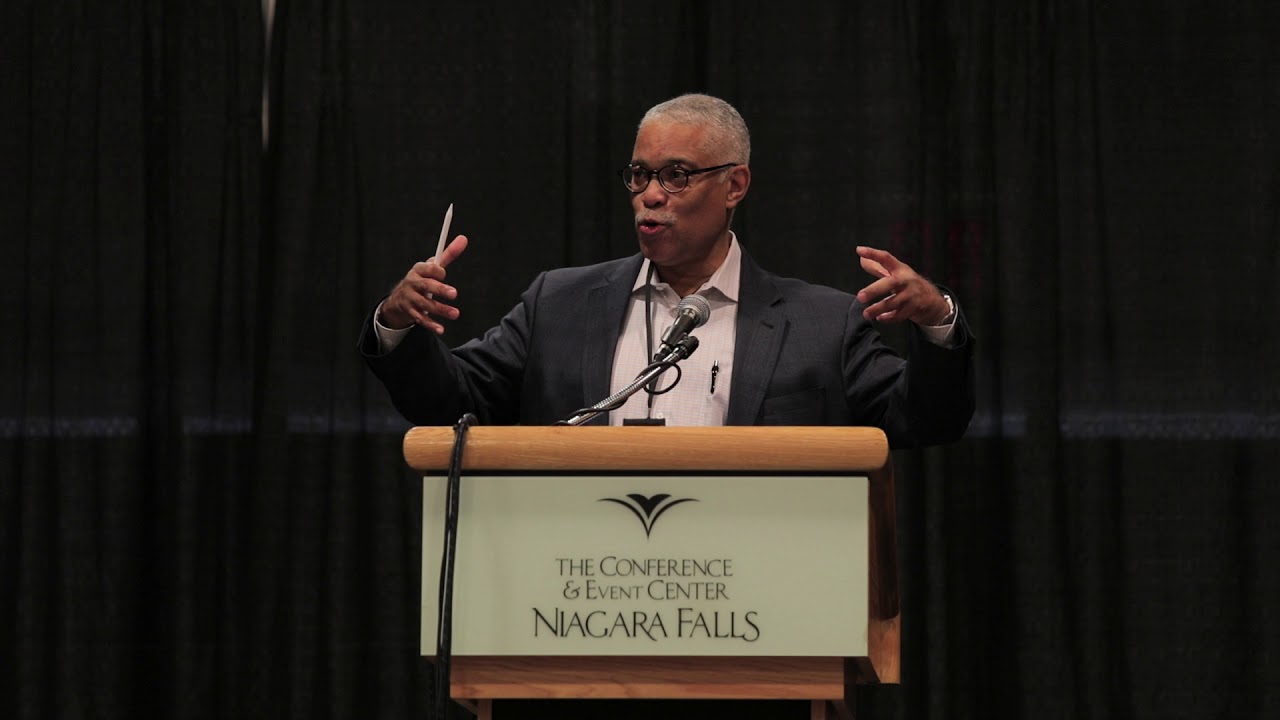
Video summary
Kent McGuire opens his keynote address by humorously acknowledging the late hour of the conference, joking that he needs a backup plan in case he collapses from exhaustion before the scheduled end time. He candidly shares that he initially hesitated to speak at this event, arguing with colleagues and experts about whether he was the right person for the stage, but ultimately decided to proceed after seeking counsel. Rather than relying on polished slides or visual aids, which his communications team had suggested, he chose to deliver a conversational talk focused on storytelling. He expresses deep gratitude to the program committee for selecting topics that address critical issues such as ethics, equity, sustainability, and accommodations for special populations, noting that these are essential areas for interrogation within the open educational resources (OER) community.
McGuire then shares three core stories to illustrate the current challenges and opportunities in education. His first story involves his work on a committee aimed at increasing STEM participation among underrepresented groups, where he discovered that low-income institutions often struggle with basic affordability issues like textbook costs. He argues that simply lowering material costs is insufficient; instead, the community must embrace "open pedagogy" that connects content to students' lived experiences, such as environmental justice or criminal justice issues, thereby fostering a sense of identity and engagement. His second story details Hewlett Foundation's strategic shift toward outcomes-based philanthropy, moving away from unfettered grant-making to building infrastructure, trust, and capacity for licensing and governance within the open community. He emphasizes that while data availability has improved due to technology, there is still a significant gap in evidence regarding effective interventions to close achievement gaps, particularly as students move beyond standard reading and math curricula in K-12 education.
In his final story, McGuire reflects on his own background growing up in Lansing, Michigan, with parents deeply involved in labor unions and education, which shaped his argumentative nature and early experiences as a student leader and school board representative. He recounts a specific instance at Temple University where he had to confront systemic barriers preventing female students from passing math requirements, leading the university to create its own open content tailored to those students' needs. He asserts that higher education and K-12 systems are currently operating in isolation, like ships passing in the night, and must collaborate to change these stubborn patterns of stratification. Concluding his talk, he urges the audience to move beyond petty public arguments about small details and instead focus on opening the community to diverse voices and culturally relevant content. He believes that by doing so, the open education community can generate unlimited effects to transform learning outcomes, improve civic discourse, and sustain efforts to engage young people across the entire educational system.
Read the full video transcript
well good morning it's 534 right a.m.
right I think that's I think that's
about I think that's about right all
right listen I want to move away from
this podium but I don't think I can I
need you to do me a favor
all right yes
I need you to watch me it looks like I'm
tipping over my eyes about their clothes
you know you pound on the on the table
right and at about 905 if I'm still
talking I'm still talking in 905 I want
you to stand up and do like you with me
can you do that I need a backup person
let me see I need a backup person I need
somebody just in case she drops the ball
on me you got me all right cool all
right that's good that's good to know
all right um thank you for having me
here I really appreciate it I had a
conversation with David about this I
don't know when it was but it was in the
spring and I argued with him profusely
because I should not be here
that's my my view of it I can think of a
dozen people better suited to start this
conference for you I lost the argument I
think I was on the right side of the
argument but I still lost it right so I
did what people do when they lose
arguments I sought advice and counsel
about what I should actually come here
do or or say I started with experts
because you know I am on my own learning
curve or a journey where Oh
our is concerned it is true I've worked
for the guy a couple of different times
who had hewlett 16 17 18 years ago
really
at least launched the foundation's
exploration into this Mike Smith and
Mike is the kind of guy who if he thinks
you're slacking off or you sort of lost
your way he will call you over to the
Starbucks in Menlo Park you know and sit
you down and sort of go back over things
with you until he thinks you've got a
clear mind so I talked to him about this
talk to my colleagues about this and I
started thinking about well I'll come
with slides and I'll impress you with
how much I have learned and I let that
go then I talked to my comms person glad
she's not here
glad she's not here well wait a minute
you know I have a communications officer
but they refer to themselves this is
important as comms people right that
should make you nervous right right
they're right they think about they want
to analyze your audience okay Kent who's
who's going to be here right let's think
about what your core messages are and
maybe we can put images running in the
background something like that Oh My
gods I said so you're getting no images
for me and get those from Jess you've
got a lot of sessions there'll be plenty
of slides at the end of the day I am
more of a conversationalist that's why I
gave you that assignment right and so
you'll get a story or two out of me but
no pictures and and and I actually have
about three that I and I will sort of
back into the OER things that are
my mind in the process of telling these
these quick stories but let me pause and
give kudos to the program committee the
only mistake you made was me but beyond
that I think the program and the kinds
of topics as I perused through it you
know ethics efficacy attention to
underrepresented groups of
accommodations for special populations
sustainability I could keep going these
seem like very much the things we need
to interrogate and so I'm really happy
about about that let me just say as I've
gone on my own arc into the oer work you
know I have lived in higher ed I was a
Dean for eight years I am still
recovering from that it's about three or
four years of recovery for every year in
service I've been on a school board for
eight years I'm still recovering from
that and actually I had just spent what
four years in DC working in the
government another four years working in
New York City running a research company
and my wife called me she's gonna show
up more than once in this talk my wife
called me and said Kent it would be
really great if you could figure out how
to do a job where you actually lived
right we lived in Philly I was working
in DC and then New York I got away with
that because my
in-laws moved around the country with us
but they were getting to a point when
they needed our care more than providing
the support that they had been but my
wife called it chance seven year
adventure that's what she called it she
said could you please come home and
that's when I became a Dean but no
sooner than I got there someone asked me
to run for the school board and I lost
that argument too I decided to do it and
my wife was the person outside Roberts
elementary school with the sign do not
vote for him he knows not what he's
doing right but I was the chair of the
curriculum committee and we were trying
to figure out where good content would
come from and how we could engage our
teacher workforce in using stuff other
than the Basel readers and this stuff
that team sort of canned with the sort
of you know very little opportunity for
adult learning you know that that you
know that came with it that was really
my first introduction into the oer world
just trying to work through that and i
think the values of the community of
transparency access inclusion innovation
collaboration these are all things that
i don't know if you can appreciate just
how in demand
they are so let me tell you story number
one i have a hard time saying no to
people
although given the work I now do I am
learning how to say no got got no choice
i when person I can't say I'm hardest
person have time saying no to is Angela
because she shows up with a smile on her
face
very warm you know this about her if
you've met it's hard to say no to her
I'm gonna try harder but I sit on a
committee at the Academy of Sciences I
actually chair it that's looking into
how to fill the pipeline of stem majors
and graduates from underrepresented
groups we've been working at it for more
than a year in fact if I don't run out
of here after I talk to go write the
preface for the report I'm in real
trouble but as we got into this issue we
decided to go take a look at the schools
that were really getting it right what
am I talking about I'm talking about
tribal colleges hispanic-serving
institutions HBCUs both four-year and
two-year and a large number of community
colleges around the country we went to
see them we went to talk to the students
in these programs we visited with the
faculty and administrators and a couple
of things surface right away number one
these under-resourced institutions are
the very ones where the students can
hardly afford to spend two three hundred
bucks for a text if a car breaks down
or a sibling or a relative has a problem
that margin is razor thin and they get
off to a remarkably and they're
borrowing money in the first place right
they're borrowing money in the first
place the second thing we learned was
they know about open they know about
open but there are a set of underlying
questions I'm sure some of you are aware
of them around levels of engagement in
motivation and the difference these
institutions make there's an
intentionality about the work that they
do is they bring this or the cultural
lens with them to much of the content
they can't find their their their own
identity themselves in that content it
would be easier to engage them if some
of the problems they got to work on or
issues that surfaced in their own lives
environmental justice criminal justice
the interplay between transportation and
housing policy and opportunity health
care and wellness I could keep going all
things by the way that we need a monster
ibly more diverse workforce in the
sciences if this country is going to
thrive we our strategy up to now has
been to try to import that diverse
talent from around the world that'll
only get us so far and it turns out
there were real issues in being able to
sustain that and so there's a challenge
that is crying out for the open
community
to really go after and him embrace it
has not as much to do with getting the
cost of materials down we're headed that
way for sure it has a lot to do with
what I think of as open practice or open
pedagogy and really fostering more
innovation in the use of the materials
that are available to us Story number
two I am in the middle of what at
Hewlett we call a strategy refresh I
don't know anybody else in the real
world uses that that term but look I'm
not in the real world who would move the
Menlo Park if they were in the real
world just wouldn't do it
and but that's what we do we have a we
we have a very deliberate to organize
process by which we try to look back and
take stock of what we've been up to
where we've been makes sense of the
moment that we are currently in and then
try to think about where to go in our
grant-making and the like we're about to
do that you know we are almost as soon
well actually we're already getting
started with it before we're really done
with the work and what we have called
deeper learning right one of the things
I've been on record literally walking in
the door at Hewlett was to say look we
you've got to think about our agenda
around learning and our agenda around
open as moving toward each other so I
went back in chat with Mike and said am
I missing anything here and he said no
it's always been about learning that's
where we started but of course as we got
into this we didn't know exactly where
we were headed with this mic by the way
was the last person at Hewlett I would
argue he referred to me as a sort of a
gunslinger he could just throw money
wherever he wanted to and just kind of
see what happens right new president
shows up and sitting doing any more of
that we got to have our outcomes and our
goals and our strategies and Hewlett
became known for something called
outcomes-based philanthropy and that's
when we really zero it in okay what
exactly is that we're trying to do how
exactly are we going to go about it what
will be the strategies we pursue to
achieve those things and how will we
know if we have and that's what these
strategy refreshes are built to create
this kind of profound logic around
around the work Mike said it was
important to get at these questions of
build infrastructure it mattered to try
to build the capacity to license and
govern you know what it means to be open
we have to work on building a community
and establish trust and relationships
and all of that Hewlett has kind of
worked diligently on over over 16 years
or so there's more work there for us to
do we're not going to drop the ball on
infrastructure or field building or any
of that you know don't worry but I do
want us to return to this question of to
what end for what purpose
and how do we use what I think this
community in many ways is uniquely built
to work on kind of really find out how
to make a difference on the learning
frontier the demographics in this
country have changed markedly which
takes me to my third story I'm on
another committee on another panel this
one is working on trying to build a set
of equity indicators for the nation
remarkable how much harder that is to do
then the committee thought when we got
together we thought all this will be a
piece of cake there are all these big
longitudinal national data sets out
their technology and digitalization has
actually made it easier to store
manipulate and report the facts boy were
we wrong well I mean all of those things
are true all of those things are true
but the conclusion we reached midway
through our deliberations was that if we
couldn't come up with an indicator
system that people could actually do
something with what would be the point
let me say that one more time very
frustrating to come up with lots of
indicators of things for which there's
no evidence about how you would
intervene once we place that burden on
our process thinking about indicators
got way hardly
because there's a lot of noise there's a
lot of debate there's a competition of
ideas about how to get better learning
outcomes for young people we're swimming
in data that shows glaring
stratification by race and income to
some degree by gender immigration status
and the rest language but the knowledge
base around how to close those gaps and
break the links between circumstance and
outcomes is lumpy and pretty thin and
again we found ourselves in a
conversation about teaching and learning
and then a conversation about what we
know about the effects for instance of
curriculum and it points to this gap we
need to close in the open community
around even more evidence on efficacy
we're going to try on my watch in a
little bit of a way that we can to close
that gap but the further we get away
from the norm further we get away in
k-12 at least from reading and math in
the early grades unless we know not zero
but the less we know and so we've just
got to really dedicate our
self to bringing more evidence to bear
and I think the thing we know for sure
is that Stand and Deliver sort of like
I'm doing now how much time do I am yes
I've got to get through with this right
thank you am i that's way too much time
I can do this further we get away from
from the kind of standard pedagogy the
less we know
and yet standard pedagogy is the very
thing that's not getting us where we
need to get it's the very end so I think
this is a moment where the folks in this
room and the community of which you are
a part need to lean in on really
experimenting and demonstrating how open
practice and pedagogy and it can make a
big difference for kids so yes I'm gonna
do what David didn't do I'm from Lansing
Michigan Hey must be some mission let me
find out who's here but my comms person
says do big mistake she's not here
who's in higher ed I just want to see
who who lives in higher ed here Wow most
of you who works in the k-12 world
a small but vocal presence it's good to
see this is good to see so I grew up in
Lansing Michigan
my dad was a Union guy he was a shop to
many men in at the O's mobile plant and
ultimately he became the education
director of region 1c right my mother
was an elementary school principal well
actually she was a teacher right for
many years and then she became a
principal now parenthetically that's
when the labor-management argument
started to surface at the kitchen table
right boy but and I was the oldest of
three kids and I developed early on a
reputation I don't know why for being
argumentative I was the guy who would
sort of debate the facts when the facts
didn't seem to be going my way you know
weren't in my favor right I didn't just
do this at home I had a way of doing it
at school and there were some context in
which that helped me but most of them
know not not so much and I thought that
if I could take the facts that have been
presented put a rival argument on the
table question people if is there more
than one way to think about this I
didn't have the term handy at the time
this was a long time ago I'm not going
to say how long ago
it was but it was sort of like deeper
learning all right I was trying to use
the information available sort of think
my way around the problems recruit of
their people to my point of view some
people called me a politician I did win
the race for homecoming king in high
school
twice I was the representative the
student representative on the Board of
Education twice right so there was
something going on here but often it was
not received well it was
underappreciated and my style did not
comport with the kind of order an
organization in the typical classroom
and so oddly my GPA was lumpy you know
there were I was good in civics but man
the further away you got from civics and
social studies the rockier things got
for me
because I just wasn't sort of toeing the
line I yeah I actually flunked gym you
know I wit I met the problem I went I
went and this question of how can you do
that was the question that my dad asked
me he said and the problem was I had a
lot to say to the gym teacher I think
was the problem right you know like I
don't want to do those push-ups how
about sit-ups right you know that that
kind of thing but I think we're at a
moment with this new diverse majority in
this country where if we can
move off of the standard design to
dramatically different ways of engaging
young people dramatically different ways
of bringing the information and content
to them ways of engaging them more
fundamentally in the experience in use
of these big gaps these stubborn and
unrelenting patterns so correlated with
circumstance they just won't move it is
not just a k-12 issue this is
fundamentally about the connections
between higher education and k12 I
remember at Temple the achievement gap I
had there was substantially with women
in man
we couldn't get or we didn't want to get
a set of young women who we had failed
for the first time in their secondary
school experience past praxis one
practices one it was about an eighth
grade achievement level in mathematics
it was a explanation for why the
enrolment in elementary education in my
college was full of women they were
avoiding the math requirements I went
over to the math department asked the
chair of the math department to take the
tests paid him to take me because I
wanted him to come back and tell me
whether or not the test was worth and if
it was what changes in the experience he
would recommend then I tried hard this
is the life of the Dean to get my own
faculty to take the test don't ask the
faculty to take tests oh my god that's
the worst thing but you know I was this
was early in my DJ right and I said hey
the test isn't going to go away and the
president of the university is not going
to blame the math department if our
students can't pass this test and we
have an obligation to our students to
help pull that off guess what we had to
do we had to open things up we had to
create our own content that met our
students where they were and work out
from there with the kind of
laughing and support so we could change
the distribution of achievement in of
our own graduates if we couldn't do that
we were going to be sending teachers
into Philadelphia
not well prepared to work with a
population of kids there who had very
little going for them you think about
the zip codes around temples campus it
would have been like the blind leading
the blind so we're at a moment quite
frankly in this country we're thinking
about these two systems as ships passing
in the night
that we haven't we've just got to change
that and so all of us who are working on
the post-secondary side got to engage
the folks this this there's a small
group of them they feel like right in
here on the k-12 side to see if together
we can't change this distribution I have
one asked I meant to tell you that at
the beginning because I think in my 10
minutes is just about up right I'm very
optimistic about things being open we're
already there it's going to go that way
there's some things to worry about along
the way we should got to figure out how
to work with EdTech people and the
publishers we can't you know because
they just got too much money they're not
going away right got to figure that out
the other thing we got to do is we have
to worry a little bit about the
intramural sport in our community you
know we are words matter
positions and stances matter I'll
probably take some that you guys should
rough me up about overtime but my point
is the more we argue in public big
arguments in public about small things
that's not help that's not healthy but
the big ask I have for you
well let me pause you know I should
pause there because there's no reason
you should clap for anything else I've
had to say but but that's but big
arguments about small things is
confusing and it doesn't help us see the
larger prize right that's a really
important thing happens in the academy
all the time but here's the ass I think
at the end of the day the thing that's
going to make the biggest difference for
us is if we could open up the community
a bit more and we could get then B pause
on that yeah pause on that if we could
open the community up a bit more the
potential for us to generate effects
that would really change the state of
affairs is unlimited if I had more time
I tell you about this self-study I'm
working on now around issues of civic
learning and participation we're at a
moment where young people I worry a lot
about whether we can even argue the
facts whether we can discern fact from
fiction and whether unless we're using
our devices we can even get in a room
together to talk about stuff right if we
could just open this community up and
bring more diverse players and voices
and actors into it
bring more cultural relevance and
diversity into the content that's going
to have a multiplier effect on our
ability to engage young people up and
down the system it's going to have a
multiplier effect on our ability to
sustain what we're up to it will extend
our reach in ways that are irreversible
and so I just ask you to work with us on
coming up with strategies that would
give rise to that I'm over my time well
maybe not this clock says I'm good I'm
gonna yield the balance of my time
will ye the balance of my time - jab so
she can use slides you know in visuals
bring you some facts but I appreciate
you're hearing me out I look forward to
spending time with you as much as I can
while I am here but then I have got to
return to Menlo Park because after a
year kind of convinced my wife that she
could actually join me out in California
she did like two weeks ago she did
someone needs to applaud that I mean
somebody come out somebody somebody got
that but she told me she said Kent you
know the last time you moved me it was
to Atlanta a strange pattern developed
you next thing I know we moved from
Philadelphia to Atlanta and suddenly
every two weeks I was in DC
in New York City and Philadelphia other
places she said why in the world did you
move me down here if you're just gonna
spend all your time back up on the East
Coast so I said well I just who knew
but it will not happen again she has a
memory been married 35 years so you're
somebody should applaud that too for
crying out loud
so she says all right I'm all separate
from my pediatric practice i'ma put
distance between me and my grandson
Alexander and I'm gonna come to Menlo
Park and we're gonna move into a little
box you know that's like a you know
Atlanta Menlo Park
I got moving this little box but you
better not start traveling on me again
like you did when we move to Atlanta and
I looked at my calendar and I said that
darn David why did I agree to this every
week between now and Thanksgiving I got
somewhere to be so I got to go back to
Menlo Park tomorrow afternoon because my
poll numbers are low yeah they pulled up
with a dropper right and so I got to
work on that but I'm gonna I'm gonna
here I'ma be here my learned as much as
I can from you while I'm here and thank
you all very much it is 9:15 which was
when I was supposed to be done pretty
appreciated
[Applause]