Video summary
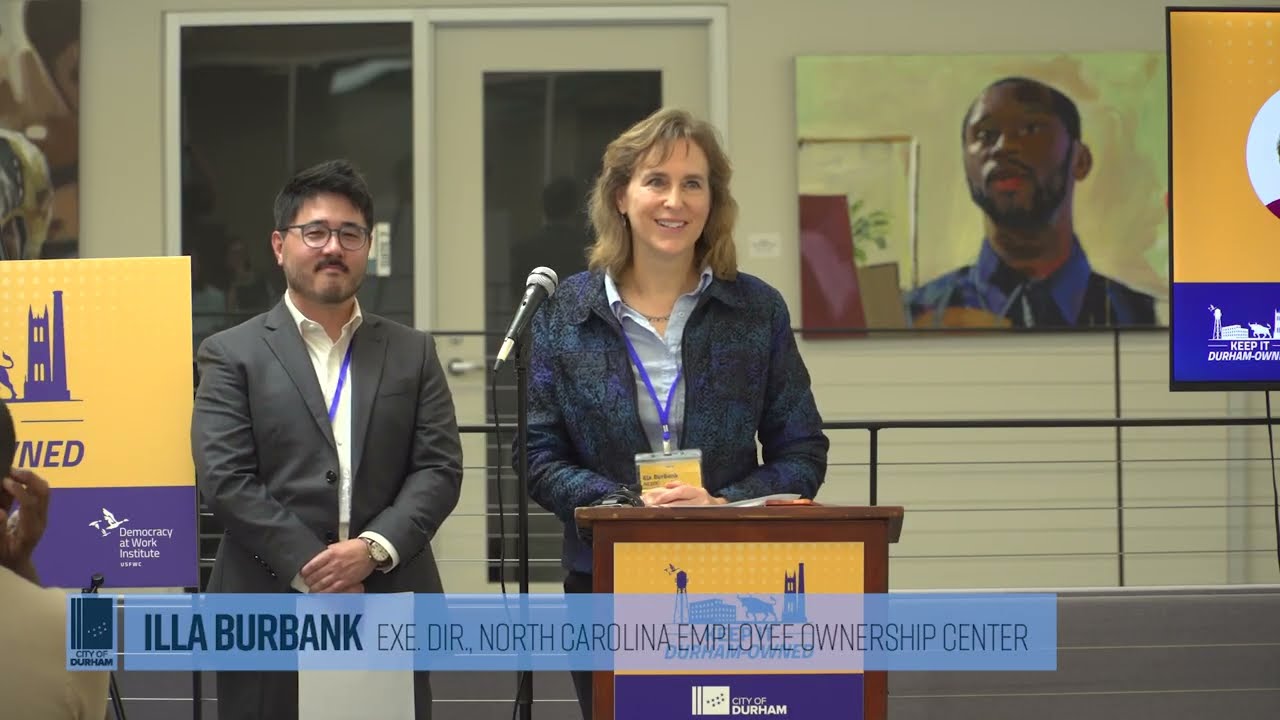
The "Keep It Durham-Owned" campaign is a strategic city-led initiative launched to support local businesses through succession planning and employee ownership models, aiming to counteract the risks posed by an aging workforce often referred to as the "silver tsunami." Held at the historic headquarters of North Carolina Mutual Life Insurance, formerly the world's largest Black-owned company, the event gathered key figures including Director Joshua Gun, co-founders Carl Webb and Peter Sevelich, Mayor Leonardo Williams, and partners from the Democracy at Work Institute and the North Carolina Employee Ownership Center. The primary goal is to prevent local enterprises from being sold to out-of-state entities or private equity firms that might jeopardize job stability, thereby ensuring that wealth, employment, and community legacy remain within Durham rather than leaving the region.
To achieve this, the initiative promotes three distinct forms of employee ownership: Employee Stock Ownership Plans (ESOPs), Employee Ownership Trusts (EOTs) for profit sharing, and worker cooperatives, all designed so that employees do not need personal funds to participate as financing is arranged through loans or seller notes. Success stories were highlighted by Jim Pullen of the Link Group, which converted to an ESOP to preserve its culture, and Susie Sneeringer of Electric Violin, a retailer that became a worker cooperative to maintain local ownership and flexibility for musician employees. Council member Carl Wrist emphasized Durham's unique position in the South for promoting this inclusive economic model, noting that the city provides free education, one-on-one advising, and networking opportunities to help business owners successfully transition to these sustainable structures.
The event concluded with a strong affirmation of wealth building, legacy business sustainability, and job creation as central pillars for the community's future, while attendees expressed deep gratitude to various council members and the mayor for their steadfast support of the local business ecosystem. A poignant moment occurred when a speaker shared a personal story about missing Diller's Barbecue sauce, using it to illustrate the importance of preserving historic businesses so that future generations can celebrate them rather than mourn their loss. This celebration of positive news during challenging times was further bolstered by thanks extended to media partners and sponsors like Zen from Dowi, Provident, and Ela, reinforcing a collective commitment to keeping Durham's economic heartland vibrant and locally controlled.
As the event drew to a close, the group confirmed a quorum to signal that elected officials are actively caring for local businesses, fostering an environment where community members can network and enjoy the "Pride in 1898" festivities with available refreshments. The overarching message was one of hope and proactive stewardship, demonstrating that through collaboration between city leadership, business owners, and employee ownership centers, Durham can navigate economic transitions while maintaining its distinct cultural identity. By empowering workers to own their workplaces, the campaign ensures that the city's historic institutions continue to thrive, creating a resilient economy where local families benefit directly from the success of their neighbors' enterprises for years to come.
Read the full video transcript
Uh, it's a beautiful Monday morning in
the Bull City. How we feeling today?
Everybody feeling all right?
>> All right, we can do better than that.
We live in the greatest city in the
world. Make some noise if you're happy
to be here.
>> Uh, my name is Joshua Gun. I am the
director of the office of economic and
workforce development with the city of
Durham. Uh, I'm a proud Dermite and I'm
proud to be in this space uh, which is
hollowed ground here in the Bull City.
Uh for those of you who are not familiar
with the space that you are sitting in,
this is the historic headquarters of
North Carolina Mutual Life Insurance, uh
which at its height was the largest
blackowned company in the world. Uh
headquartered right here in Durham,
North Carolina since 1898.
In 1898, uh there were some interesting
things going on in our country which I
think our host might tell us about. But
this particular space, Pride in 1898,
was designed to pay homage uh to the
history, but also build a future of
entrepreneurship here in Durham. So,
please join me in welcoming our host for
this this morning's event, uh Carl Webb,
co-founder of Provident 1898. Let's hear
for Carl.
>> Good morning. You know, going behind
Joshua Gun with that energy this early
in the morning is incredible. All of the
great things that he just mentioned
about Providence in 1898 is helpful. Uh
we are on hollowed ground. We're in a
place where entrepreneurs and business
people not only built a business, but
they built communities, they built
universities, they built health centers.
And it's no more fitting place for this
announcement to happen. and looking at
ways that we can keep Durham businesses
in Durham that we can create
opportunities for the next generation
like the Joshua Guns to take these
businesses and to scale. One of the
things that we found out here at
Provident 1898, we are placed in an
ecosystem for creatives, entrepreneurs,
and small business owners. But what
we're also realizing is that not
everyone is going to scale from a seed
into a a thriving business. The way that
we're going to really close the gap is
through acquisition entrepreneurship.
We've been fortunate in aligning
ourselves with national partners that
are helping us in that important work.
Less than 5% of blackowned businesses
even have employees. So to have the kind
of catalytic impact that we need in our
communities, we have to buy and acquire
businesses that we can employ Durham
people. And so that's the next
generation of what we're going to do.
This is a location that has everything
that you need. Office space, meetings
for events, conference rooms, all of
that. But we also have access to
capital. Resilient Ventures being one of
our members here. The North Carolina
Idea Fund that provides a significant
amount of resources. And I tell you, you
know, members of this organization have
been here at Provident from the very
beginning almost. It seems car risk even
from the city was here in the very very
early days. So we are here to provide
services, opportunities, be it space,
technical assistance, money, uh, and
also training necessary to grow. And
we're looking forward to partnering with
Duke University and the work that we're
doing because what we're realizing as a
community between the city, county, and
Duke is that we spend a tremendous
amount of opportunities for businesses.
So, we want to align Durham based
businesses with those opportunities that
the city and the county and Duke
currently have. No new programs, no new
money. Just be intentional about
supporting these businesses. And if you
do that, I just had a birthday and maybe
somebody will take over my business.
Thank you.
Thank you, Carl. And thank you. Uh Peter
Sevelich is also here as a co-founder of
Pride 1898. Thank you'all for hosting us
uh in this beautiful space. Uh we are
here to talk about keep it Durham Owned
uh which is our new campaign to support
employee ownership. Uh but before we get
into the details of how this works and
what this means for businesses in
Durham, we are honored to have our
mayor, Mr. Leonardo Williams, here to
address the crowd. Let's give a big
Durham round of applause for Leo
Williams.
Good morning everybody.
>> Morning.
>> I uh first want to recognize my
colleagues uh because uh I serve as
mayor but I don't do this job alone. I
have mayor prom here. Um she tried to
sit in the back of the room. Uh Javier
Caviierto I have council member wrist
call wrist. I have council member Matt
Copac here. uh these folks get it and
and we are going to do everything we can
and I just assure other colleagues to
try and lead this city forward. Uh what
you're going to hear today is something
we uh we vastly support and um I I I
don't want to sound doom and gloom, but
if you're really paying attention, uh
we're losing black owned businesses at
an alarming rate right now. Um but what
stands firm is we're still a majority
locallyowned city.
We got to connect those dots.
Something's happening. We have our
infrastructure where small businesses
have thrived and it's built the
character of this city. It's why so many
people want to come here for their
conferences. It's why so many people
come to Durham. And I know I only have
two minutes, but I'm going to brag for a
second.
>> Durham is the number two most people
centered, automation ready, future ready
city in America
>> next to New York. Not Raleigh Durham,
Durham. I am a regionalist. I believe in
cooperation.
Durham is also the number two city in
America where young families can raise a
child or raise their children. We're
also the number two most educated
populace in America next to in Arbor. We
also have about 83% of our college
graduates staying local.
When you have all of we also have the
like the the number one performing arts
center, midsize performing arts center
in the country. So when you have all of
those things that are happening, it
makes Durham a pretty cool place. But
you come downtown and you're only going
to find two chains in the restaurant
world. Mela Mushroom and Mo Southwest
Grill. Everything else, you walk in and
you see owners working in their spaces.
And that is what we want to continue to
build. We recently went to Minneapolis
and they were celebrating 15 Fortune 500
companies born right here in Durham. But
David, I don't need a Fortune 500
company. I need you. I need our
entrepreneurs that are building dreams
to come true. And that's what Durham is
doing. And that's what I want to
continue to support. That's what I I
want to continue to build. And if we can
keep a Durham on, we can keep a dirty
Durham. Let's just keep a Durham and
let's continue to build what we have.
But let's be intentional about it. You
can choose to go to some chain or you
can choose to go right here. But I will
say these numbers are still accurate.
When you shop local, 41 cents on the
dollar stays local versus shopping at a
national chain and 14 cents on the
dollar stays local. And I'm not saying
don't shop at chains. I'm just simply
saying there needs to be a balance. So
let's make sure that we're building it
to be intentional. Let's make sure we're
uh supporting our local owned
businesses. But let's make sure that we
create more risk takers, more
opportunity makers. That's what Durm is
all all about. It's home of Black Wall
Street. Let's be about it. Thank you.
One more time for our mayor, Leo
Williams. Uh
Leo's an entrepreneur. He knows exactly
what he's talking about uh when it comes
to taking risks, creating jobs, uh and
supporting the economy here in Durham.
We have uh a major opportunity in front
of us and that is the keep it Durham Own
campaign. Uh the city of Durham is proud
to partner with two entities uh to
launch this campaign and support
businesses in our community. Uh one of
those is the Democracy at Work Institute
and we have some friends here from the
West Coast uh who flew in on Saturday
just to get extra time in Durham. I
don't know if he went to Aggie Eagle or
not but uh spent enough time to
appreciate this great city. Uh the other
is here locally that is the North
Carolina Employee Ownership Center. So
please join me in welcoming Ela Burbank
and Zen Trin uh to talk to us about what
all this means. Let's give them a round
of applause, y'all.
Hi, I'm Ela Burbank. I'm the executive
director of the North Carolina Employee
Ownership Center, which is a mouthful.
So NCEOC is great and together with Luke
Hoffman in the back, we make up um
NCEOC. We are a nonprofit organization
and our mission is to expand employee
ownership in North Carolina. We do this
through education, free education, and
free one-on-one advising and counseling
for those business owners who are trying
to decide what path they should take.
As Mayor Williams had said that the
small and medium-sized businesses are
the lifeblood of Durham, but if we look
at the statistics, and you'll see the
map there is that there's 82,000
businesses in North Carolina and more
than 50% of those are aged 55 and older.
So that means that in the next 5 to 10
years, more than half of the business
owners in North Carolina will be
wondering who's going to own my business
next.
Unfortunately, many of those don't have
a succession plan. And we look at
business owners overall, only about 30%
of business owners have thought that far
ahead to see what their succession plan
is going to to be. It's a difficult
topic. It's one that not most people
want to think about.
So, what has changed from the previous
years? Uh in the past many times
business owners would pass their
businesses on to the children but more
and more children are deciding to take
their own path in life and so they're
not taking over the business of from
their parents.
You could also sell to an outofstate uh
business or to a PE firm, but as you and
I all we all know, that could mean the
loss of jobs um as they pull out HR and
accounting, change the name of the
businesses and such.
You could also list with a broker. Um
but statistics show now there are
exceptions that on average if you list
with a broker only 20% of the businesses
sell. It's a low number.
So employee ownership is a solution that
is often overlooked. So we're here to
talk about employee ownership. It is a
way to sell your business to the people
who know and honor your business the
most, your employees.
So the keep keep it dured initiative is
a support network for business owners
and adviserss. We're here to educate
these business owners, the community,
the adviserss about employee ownership
and provide that free one-on-one
counseling for those business owners.
So, we're talking about employee
ownership. What does that mean? So,
there's three main forms of employee
ownership. The first one is called an
employee stock ownership plan or an
ESOP. And in this plan, you create a
trust that becomes the owner of those
shares
that can hold them forever, right? the
ownership stays potentially forever.
These shares are allocated to the
employees annually. So we have some
employee owned businesses, ESOPs here.
They will get a statement every year
saying you have been allocated a certain
number of shares. Here's the price per
share. And that is held for the employee
until they leave or retire. At that
point, the business buys back those
shares and they have a lovely retirement
that they can enjoy their life. Bobbit
who lives in Kerry has looked at their
they've been a 40-year ESOP. They're
looking to have at least one person to
have $1 million in the retirement
account when they are retiring. Pretty
significant numbers.
My own personal experience was I worked
for a manufacturing company for 21 years
and we became a partial ESOP and I saw
also the culture that changes within
that change, right? as the new employee
owners realize that everything that they
do within that company ends up having a
direct and positive benefit to their own
selves. So I saw a lot more engagement,
employee engagement, employee retention
and innovation. One of our machine tool
workers came up with a brilliant idea
that saved time and money and assisted
our our customers.
So many people advisors especially know
about ESOPS but that tends to be for
slightly larger companies because it is
a retirement vehicle and there's a lot
more regulation around people's
retirement accounts. So we have two
other options here. We have an employee
ownership trust, also known as an EOT,
and that is similar to the ESOP in that
you create a trust that becomes the
owner of these shares that could be held
in perpetuity, but rather than being a
retirement vehicle, it is current year
profit sharing. So, at the end of the
year, the employees receive or it could
be quarterly or or monthly, but the
employees receive a check in profit
sharing.
better for smaller companies because you
don't have the oversight of retirement.
The other one is a worker cooperative.
So worker cooperative is not your
electric cooperative. Most people know
about electric cooperatives or maybe
your consumer cooperative that you go
and you have the right to um at your
grocery cooperative for example. This is
a worker cooperative that is owned by
its employees. There's a a direct joint
ownership with the employees of this
company.
It's not always about an exit. So
employee ownership can also be about
employee recruiting and retention.
Construction has had a lot of
conversions to employee ownership
because it is hard to keep those
construction workers. And so many of
them have converted even though they're
not ready to exit, but they're using as
recruiting and retention tool. So it's a
workforce development tool also.
And it's also a way to re reward engage
all of your employees. Now, we already
have some great employee owned
businesses here in Durham. So, Shopbot
Tools, the founder, Ted Hall, he started
it as Shopbot was a side business, but
as he the business grew, he wanted to
continue to thrive and he wanted to the
employees and the customers to be
rewarded. So, he converted over to an
employee ownership trust. We have Cactus
Group which is a worker cooperative. Uh
Colin and Tobias are still working in
the business. Uh but they wanted to look
ahead and have a succession planning
place even though they're still in the
business. So they became a worker
cooperative.
And then Rustin Paving. Uh you've
probably seen the blue trucks around. If
you pay attention, you will not unsee
that now. The signature blue trucks. Um
started in 1943 by Mike Rustin. his son
Larry joined the business and now
grandson Mark Rustin has joined the
business. They converted last year to
100% employee ownership ESOP.
So, a couple real quick myths about
employee ownership. We're going to do
employee ownership myth busting. Number
one is that employees have to come up
with the money themselves that out of
pocket. That's not true. When these
transactions happen, the trust is formed
and they buy those shares from the
founder. It is done through financing
through loans and oftentimes the selling
founder will also take back a note. So
these are all happening without
employees having to pony up the money
themselves yet they get the benefit of
this business. Myth number one. Myth
number two that owners give up something
when they convert to employee ownership.
When these transactions happen, you get
an outside valuation, an independent
valuation, and the share price is
usually based on that market price.
You're not giving up anything by be
converting over to your employees.
And myth number three, if you have
employee ownership, every employee has a
decision in every decision that has to
be made. That's not true. So employee
ownership, you still have a traditional
ownership structure where you might have
CEO, president, you know, the normal
structure. However, you now have better
engagement and you do have, if you're
doing it right, you're doing getting
better uh involvement by your employees.
So raise your hand if you would if you
are an existing employee owner. We have
quite a few in the room right now.
>> That's great. Thank you.
So, employee ownership warps and you'll
be hearing from two of them um soon
after.
>> Good morning, everyone.
>> Good morning. I'm from Portland, Oregon,
and I just wasn't built for the the heat
that's here. Uh
>> but uh yeah, but boy, what a lovely
city, though. This is uh my third time
visiting. Every time I come here, I just
I really do understand just what makes
Durham so special. It's a beautiful
place, a lot to be a proud of, and
really excited to be here with you all
today. So, I'm Zen Trenholm. I'm the
senior director of employee ownership
cities and policy at the Democracy at
Work Institute.
Uh we are uh a national organization
that makes employee ownership more
accessible to communities that are
locked out of good jobs and business
ownership.
Before I get started on what this is all
about, I want you all to join me on a
little bit of a of a walk down memory
lane.
I know each of us right now can remember
a business we wish was still around.
Maybe it was your favorite restaurant.
Maybe it was your family's business.
For me, it was a cafe that served for
decades as our community's living room.
You know, it's where people met up to
study new language,
uh, you know, catch up on on their
friends and just decompress from a hard
day. And when that business closed, we
lost something unique that was more than
just the coffee they were serving.
That kind of space, right, doesn't just
happen overnight. When a business like
that closes, it leaves a void.
Employee ownership helps solve this. It
roots businesses in the community,
ensuring that they have many more years
ahead of them. It gives workers the most
powerful tool, wealth building tool,
ownership in a thriving business. And
when businesses and their employees
thrive, so do our communities.
I have the privilege of working with
city and community partners all around
the country that use employee ownership
as a tool to meet their needs. From New
York City to the San Francisco Bay area,
we work with local governments to
address a challenge that is becoming
more urgent, right? The silver tsunami
crisis. It's what we're here to talk
about today. They tell us about an owner
of a story business that closed for good
because she couldn't find a buyer. Too
often the owner was not aware that they
could transfer ownership of their
company to their employees because they
never saw an example close to home. They
never met another business owner who
took the same route.
This is why we're excited to partner
with the city and with the North
Carolina employee ownership center to
make it easier for owners to learn about
employee ownership as one option uh to
continue their company's legacy.
Through this initiative, the city of
Durham joins our national uh employee
ownership cities program alongside the
cities of Raleigh and Cincinnati. It's a
national network of local governments
that are working to deploy employee
ownership to build resilient local
economies, quality jobs, and wealth for
workers. And together, we are making it
easier for people to learn about and
benefit from employee ownership.
This will mean that more owners can
retire safely with a knowledge that
their legacy will continue through their
dedicated employees. And that means more
workers build wealth that's anchored in
their communities, ensuring that as the
city prospers, that prosperity is shared
by the people driving that success.
So again, we are extremely proud to
partner with the city and North Carolina
employee ownership center for the
long-term success of Durham's treasured
small businesses. You know, those
entities that really make the city
prosper and thrive. Thank you so much.
>> Thank you, Zen. Thank you, Ela. Uh thank
you to all of our partners. Um Zen also
informed me that he has made a discovery
of Durham hiphop on his time here. So,
um, I'm glad you got to see the other
side of me and enjoyed it. Appreciate
you, uh, supporting Durham in many
different ways. Um, we want to hear from
some employee owned business businesses
in our community. Now, um, you know,
this is an opportunity to preserve those
brands that we love. I want to invite
you also while you're in Provident 1898
today to take in some of the art, take
in some of the the installations or
exhibits here. Uh, and I encourage you
to ask Carl or Peter questions about
them because those are stories about
some Durham businesses and Durham people
who made a really significant impact.
So, invite you to take advantage of
being in this space. Um, speaking of uh
taking advantage of being in the space,
we have an incredible business here
who's going to talk to us about their
employee ownership journey. Please join
me in welcoming Jim Pullen, managing
partner of the Link Group. LET'S HEAR
FOR JIM.
APPRECIATE IT.
SO, I'm Jim Poland and I'm one of the
managing partners and CFO of the Link
Group. We're a market research agency
based in Durham. We've been around since
1994.
And about two years ago, the owner
founders of the company decided it was
time to retire. Part of that silver
tsunami that you mentioned, although I
don't think they'd appreciate me saying
that,
they could have sold the company to
private equity. they could have sold the
company to another larger company or an
industry. In both cases, we probably
wouldn't be in Durham anymore. We
probably wouldn't have the HR team, the
accounting team, the IT team that we
have. They chose wisely, in my opinion,
to go down the employee ownership route.
So, through an ESOP transaction that
Neil described, they sold the company to
the owners, sorry, to the employees, we
became employee owners. um their vision
was to preserve the culture that they
had worked so hard to create over those
32 years and to entrust the future
ownership to us. So as a result, every
employee owner in our company now has a
stake in the outcome. We all gain wealth
by the the growth of the company. It is
a retirement benefit. You've heard all
kinds of news about the US retirement
crisis. You've heard news about wealth
disparity in our country. At the Link
Group, we're trying to address both of
those concerns for our employee owners.
Uh, so far it's working really, really
well. This shows up in how we engage
with each other. It shows up in how we
treat our clients and service our
clients. It shows up in how we give back
to our communities. We've committed to
our our time, talent, financial
resources to give back to Durham. We're
also in Atlanta who are helping out
there as well. Um, but I I will tell you
that becoming an ESOP takes a lot of
work. My colleague Lynn could attest to
that. It is absolutely worth it. It's
not the easiest path. In my opinion,
it's the best path and we look forward
to welcoming some more employee owned
companies as part of the the Durham keep
it own keep it Durham owned initiative.
So, thank you.
>> Thank you, Jim. Uh certainly a success
story that we want to continue to
amplify and brag about in our community.
So, thank you for what you're doing. Uh
we have another great business owner
story to tell. Please join me in
welcoming Susie Sneeringer, store
manager at Electric Violin. Let's hear
it for Susie.
>> Are you going to play? Are you playing
violin today, too?
>> All right. Next time.
>> Susie, do you want me to be your man?
>> Yeah. No.
>> Thank you so much.
>> One more. That was good.
>> Okay.
My name is Susie Smeneinger and I'm the
store manager at Electric Violin Shop in
South Durham. Here are a few of the
instruments we sell. This kind of
explains it a little better than I can.
Um, we've got one maker in the High
Point, Dan EMTT. We've got an instrument
from Brazil that has LED lights. Um, and
then there's also this amazing six
string made by a manufacturer in
Charlotte.
>> It's called the Pumba.
So, we're a retailer. We love what we
do. Um, and while these instruments may
look different, they actually sound and
feel a lot like an acoustic violin. And
we operate like a fullervice violin
shop. So, they're going to play well,
and that's very important to us. Um, and
one of the reasons we insist is that
those of you who do a lot of public
speaking might know a little bit about
feedback. Feedback is a big problem when
you're playing an acoustic instrument.
So, this opens a lot of doors for the
violinist or the chist because they can
come in and plug in and actually be
heard along with the rest of the band.
So, that means you can have hip-hop
violin, you can have rock violin. We
actually get a lot of folks coming
through that are playing at DPAC and
they're looking for an equipment
upgrade. Um, so we're able to show them
kind of what the world offers as far as
electric violins.
Let's see.
>> You can take it off. Might
>> have to go a little higher. Sorry about
that.
>> I can.
>> So, Bla1 Blae Keeler was our former
owner and he had a shop in Carro called
Music Explorium a few decades ago. It
was a wonderful little shop. You could
go in there and play instruments from
all over the world. Um, and what he
noticed was that he kept selling he
would get an electric violin in and he
kept selling them. So, we had to restock
electric violins. So, evidently there is
a need out there. Um, so about 15 years
later, we're selling to 95 countries all
over the world, but we've also got a
really good local base. We've got
schools and professional musicians in
the area buying from us. So, Bla1 was
about ready to retire. He wanted to play
music. Uh, plays in Fulltown Strutters
and a couple of other local bands. and
he really wanted to keep the shop open
and running in the area. All of us
wanted to keep doing what we're doing.
So we we looked into it. We realized we
couldn't get individual financing to buy
the business. Um so what we ended up
doing while Blaze was at a party and
spoke with Anlair Brotten and found out
that one option would be um cooperative
financing for our business.
So, we had no idea there was such a
thing as a cooperative lender. We didn't
know what that was, but we looked into
it and we instantly knew that this was
going to be the right solution for our
business. We all get to stay where we
are. We're all doing what we love and
we're not going to get bought out by
someone that's going to really change
who we are. Um, so that was very
exciting. It definitely took some work.
We got a lot of help along the way from
uh Duke Law Community Enterprise Clinic
uh Carolina Common Enterprise. We ended
up working with a cooperative lender,
Shared Capital, and there were some
interesting things about that. We had
actually members from the lender come
and visit our shop, make sure that the
health of the business was good, kind of
find out more about what we do.
Um, so we spent about six months
drafting bylaws and articles of
organization and really just deciding
how we were going to run our business as
a cooperative. Um, figuring out things
like consensus and would we have yearly
dividends and what would those be? And
the great thing about it is that anyone
who wants to join our shop and work for
us has the option to become a member. So
they don't have to, but if they want to,
they can have a share in those yearly
dividends. Um, another thing that I love
about it, so this is 10 years in. You
know, we're still a pretty small team,
but we have a structure that tells us
how we're going to make decisions as a
group. So, you know, it's a democratic
workplace, but we have to get together
and figure out how we're going to decide
on hires or what we're going to carry.
Um, and that's very helpful for me. And
a lot of us also play music. So we can
have a flexible time situation for our
employees if they need to leave at 4
because they got a show. So that's very
attractive to our local employees who
also play music. So it's been great. It
gives each member a share in the
company's success um by converting some
of that profit to member dividends each
year and it helps us all feel invested
in the shop's future. So, we ship
instruments everywhere, but we love
being in Durham and being a part of our
community.
No violin show today, but soon we'll get
one. Uh, thank you Susie for uh
everything that you do. Um, we have a
champion in our community for so many
things uh, business and entrepreneurship
related, but also for employee ownership
who I'd like to bring to the stage.
She's a key partner to the city. She's a
key partner uh, to many of us in the
room and a trusted messenger uh, for all
things employee ownership. Please join
me in welcoming Latasha Bessi, chief
strategist at Infinity Bridges and a
board member of the North Carolina
Employee Ownership Center. LET'S HEAR
FROM LATASHA.
THANK YOU, JOSHUA, and to everyone
that's here. So, we're here to really
celebrate how we keep it Durham own.
Earlier, Zen kind of asked you to take
it down memory lane. So, for those that
are in Durham and have been here for a
while, I wanted to also just take you
down memory lane. How many of you
remember Dillard's barbecue?
Today is BB Gas Station.
How many of you remember Mutual
Community Savings and Loan Bank?
Today it is closed or merged with M&F.
And we're going to go to M&F in a
minute. How many of you really remember
all of the businesses that was along
what we have is our durm black wall
street that now is no longer existing.
And as we stand here today in the mutual
tower that was the home of North
Carolina Mutual Life Insurance Company,
which was the largest, the oldest
AfricanAmerican life insurance company
globally, not just in the US. How many
people remember when it was in operation
or had a grandparent, a parent, a
sibling, a auntie, uncle, someone that
had a policy with North Carolina Mutual
Life Insurance Company? Raise your hand.
Now, there are others and the last one
that just happened is our
African-American
bank, Mechanics and Farmers, or MNF,
that just merged or consolidated with
another bank. How many people have a
history or know or have even had
relationships with M&F? Raise your hand.
So the reason why we say keep it derm
owned is for all of those things. Now I
can tell you there's plenty plenty more
memories and as a foodie I'm going to
even give you a little bit more memories
of what exists today. How many people
are familiar with Chicken Hut that
currently is on Fairville?
What about LSD Jones funeral services?
What about Scarboro and Target Funeral
Services?
What about um uh oh, lost the place.
Sorry.
What about other restaurants that may be
your favorite uh that are here and
operated of all the places that you can
go? This is why we want to keep it durm
owned because when we don't, Durm loses
its economic aspect and an asset within
our community.
So, who will own the businesses that
already exist? The secession planning
and employee ownership is extremely
essential. And so that is why we want to
really make sure that not only as an
ecosystem of entrepreneurs but also as
service providers that we really focus
on how we do it. So, how do we keep it
dermone? And sometimes you've got to
just keep what Derm is already built on.
Let's keep the jobs. Let's keep the
wealth. Let's keep the legacy. And most
importantly, let's keep all of those
memories, those things that we probably
would want to tell your grandchildren
about, that place that you went, your
favorite spot that you remember. So, as
I conclude, I just want you to say keep
it Durham owned, but also make sure that
you visit them so that we can keep the
economics going around our country and
specifically in Durham today. Thank you.
Thank you, Latasha. Thanks for
everything that you do. Um, when we were
thinking about a name for this campaign,
I just wanted to lift up one thing. Um,
Ela, Zen, uh, Chris Dicki on my team,
Grace Gino on my team, uh, were kind of
the working group for this. And, uh, I
told them that Durham is not just a
noun. Durham is an adjective. And so I
suggested keep it Durham because if
you're in Durham and you're from Durham
or of Durham, you know what that means.
You know what something is when it feels
like Durham. Uh, and then Zen so uh,
geniusly reminded me that we have to put
own in so people know what the hell
we're talking about, right? Um, but, uh,
keep it Durham is what we want to do
here. And when you keep Durham
businesses in Durham, you preserve not
only the economic benefit, but that
cultural, that feel, that, uh, grit that
makes Durham Durham, right? Um, and so,
uh, that's what excites me most about
this campaign. Uh please join me in
welcoming back to the stage a champion
for this work across the state and our
key partner Ela Burbank of North
Carolina Employee Ownership Center.
All right. Yes, I'm back. Um so
hopefully by now you've heard the
importance of the initiative and the
importance of keeping the business o
owners local. So what is this initiative
that we're talking about? you know where
it's succession planning as I mentioned
before is a really sensitive topic. So
you want to make sure that those
business owners have that trusted
advisor someone that they can believe in
that they know has the right answers
there to talk to them about their
future. So this initiative has a three
parts to it really. Um it's about
education. It's about those trusted
partnerships with those trusted advisors
and our free one-on-one advising for the
businesses.
So during this this initiative and
beyond uh NCEC together with the city of
Durham will be holding educational
workshops about employee ownership for
business owners and advisers to learn
more about what employee ownership is.
We'll have lunch and learns. We'll be
joining meetings and spreading the word
about employer ownership.
Then we are going to partner with some
of those organizations as they can host
us to have some of these events and
introduce you know have that network
expand and introduce people to employee
ownership through their own events and
their own outreach.
Making sure that the business owners
that they advise get the support that
they need.
And then finally, we'll be reaching out
to business owners and meeting with
business owners again free um every time
we meet with them. We are not 501c3
nonprofit. So um we will give
independent advice to our business
owners. So one-on-one guidance will meet
with business owners to talk about your
short-term goals. What are your
long-term goals? What is the size of
your company? What's the best fit for
you? And even if it's not immediately
employee ownership, we're taking this no
wrongdoors approach. We can still put
you in touch the right people. If you're
not ready to convert, we'll have the
right network, support network for those
business owners.
We have educational videos. We can put
you in touch with these wonderful people
who have already converted. So you can
ask those questions. We've been through
it. How does this work? It's an
important part of seeing yourselves in
other people's shoes to make sure that
you you're feeling comfortable with it.
We can also help with financial
assistance and other sort of resources
once you make that commitment that
you're going to become employee owned.
So fundamentally, keep it employeeowned
is about celebrating those legacy
businesses. It is connecting them to the
right experts and it's making for the
easier for the business owners to get
the support that they need with a plan
that keeps the jobs, the businesses and
the services they provide anchored
within this community.
So ownership, employee ownership changes
what we've talked about with uh PE firms
and others that have taken over and
changed the culture. Employee ownership
changes that it keeps the values and the
culture built by the founders. It
provides a way for long-term ownership
plans for the company and for the
employees. It keeps the jobs local and
the employees engaged. And then those
profits, as we mentioned, those profits
that previously might have gone outside
are now awarded to the employees who
spend it locally within their own
community. It keeps our communities
vibrant. So my call to action to
everyone is if you're an advisor, please
reach out to us. Let us come to your
events. Help us meet those business
owners who you've heard start talking
about their succession planning options.
If you're a business owner,
please reach out to me and I'm love to
speak to you. Here's a QR code. You can
come to our website and reach out to me.
would love to meet with you and help you
on your goals to your future.
>> Thank you.
>> Thanks, Ela. Um and u thank you to all
of our partners on this work. Uh I want
to also lift up that our office office
of economic and workforce development uh
speaking of no wrong doors is a great
door to enter into if you know a
business that is interested in uh
exploring employee ownership. We want to
be a key resource for you here at the
city as well. Uh, one of our key
champions on the city council for this
effort from the very beginning, uh, is
council member Carl Wrist. Please join
me in welcoming Carl Wrist to the stage.
Wow. Good morning. Good to see everyone
here. This feels like a lot of talk
about memory lane and first full circle
moments. This feels like a lot of that.
So, I first want to thank Carl Webb,
Pierce Sevelich for for hosting us here
today. I did have an office space here,
like a what would you call it? Flexible
space when I first started my consulting
work before I did this crazy thing about
running for council. So, it's good to be
back in your space here. I want to thank
my colleagues, Mayor Williams, Mayor
Pert Cavier, Council Copek, and also
Council Baker, who was a big part of
this could not be here, so have all been
critical in this work. There's so many
folks here that and I want to thank the
business owners, Jim and Susie for being
here, business owners. Um, and Joshua
for your leadership here. This is really
important work. And I also see a couple
folks here in the audience and Claire,
where's Latasha? Where'd you go?
Latasha. So, if you all know me or some
during the campaign, you know that for
many, many years, I worked in the space
of economic opportunity, creating ways
to make economic development more
broadly shared. And so, Ann Claire was
my go-to for everything regarding
employee owns. I'm so glad to have you
here. I'm so glad that you've done this
work. North Carolina Latasha Basgati is
another like one of those people that I
just always went to for local economic
development, small business stuff and
minority development. So, thank you so
much for being here, folks. Um, this
could not have come at a better time in
the city of Durham. Um, as the mayor
said, and you can you can go on the
Discover Durham website, all the
accolades we get in Durham. There's so
many things people are saying about us.
What did you say? We're this one of the
smartest cities in America, one of the
best places to start a small business.
There's all kinds of accolades we're
getting. At the same time, we all feel
the stress here, right? We know that
more than a quarter of our residents are
low income, right? If you look at data
from the North Carolina uh budget tax
center, the top 5% of earners, wage
earners in Durham earn 25 times more
than folks in the bottom 20%. So, we've
got a challenge of this economy
splitting apart, right? And we've done a
our council is focused on this issue of
making sure we have more broadly shared
prosperity. And I want to thank my
colleagues because I do want to pull up
our most recently revised strategic plan
where and we've had we've had shared
prosperity is a key goal of the city of
Durham for a couple years before I got
in council, but we just updated our our
strategic plan and with help from
council copac and mayor prom and mayor
Williams, we have updated that language.
And so our strategic plan now reads um
we identify inclusive economic
prosperity as one of our five highle
goals. And within that goal, one of our
top priorities is to expand wealth
ownership via affordable home ownership,
via workerowned businesses, and via
saving strategies for youth. So we've
named employee ownership as one of our
top priorities as we promote inclusive
economic development in Durham. So
again, this could not have come at a
better time. And you know, again, given
my my interest in this topic and my
background, like Zen, you sent an email
to me probably like a few days after I
got on council. I was like, I can't
believe I got an email inviting Durham
to be part of this network of of cities
promoting employee ownership. And so, we
had to wait a little bit till we got
Joshua Gun on board. And so, Council
Baker and I went to Joshua and said
like, "Hey, this is a really important
opportunity from Dawi and from uh from
the Northtown Employee Ownership Center.
Can we can we engage in this?" And so,
I'm so thankful for Joshua for saying
like, "Absolutely. This is part of what
we want to build in Durham." And so as
we as we under Joshua's great leadership
continue to work on the shared
prosperity notion, it's critical that
we, you know, like most economic
development departments have like a
recruitment kind of piece and sort of
visitor stuff, making sure we have more
visitors coming, small business work.
Not many cities of Durham size and
certainly not many in the south are also
focused on employee ownership. So we are
as as with many things in Durham, we're
punching above our weight here. I'm so
proud that we're promoting this. This is
not going to be the solution for every
legacy business, but as one solution and
part of building an economy where
there's more owners, there's more
capital, more wealth building, more
stable jobs. This is a key part of what
we want to do in the city of Durham. I'm
seeing my one minute back there. So, I'm
going to wrap up and just say thank you
so much for being here. You've heard
Elo's call to action. We want business
owners to take advantage of the
opportunities. We want folks who support
businesses to support them and make sure
they know that employee ownership, as
you saw on the slides there, is one key
way to build wealth, to sustain legacy
businesses, and create great jobs in
Durham. So, thank you for being here. Am
I the last one or am I
>> You wrap it. All right. Yeah. Thank you.
>> Thank you, Council Member Rrist. um
you've been a champion for this work for
so long and appreciate you reminding us
about council member Baker who's also uh
been a champion for this effort along
with all of your colleagues. Uh we're
grateful to Mayor Pro Tim, council
member Copac and our mayor uh for
representing. I mean we got we think we
have a quorum. Is this a public meeting
now? Uh we we have a strong presence. I
think that signals uh to the state and
to the community that our elected
officials care about our business
community. So, we appreciate you all uh
for being here. Look, uh I have no
further remarks because you've heard
from so many great people except to say
I miss Diller's Barbecue as well,
Latasha. Uh they still sell the sauce at
Food Line at Harris Ter if you if it's
not quite the same. Uh but I cook with
it every Sunday. So, I appreciate that
nostalgia. Uh but in all seriousness,
that's a great example of the businesses
we need to preserve, right? And the
reason why this work is so critical so
that uh we're not up here 20 years from
now telling stories about businesses we
miss. We're telling new generations
about businesses that we've patronized
for decades. And so thank you all for
what you do. We invite you to continue
to network and enjoy Pride in 1898.
Thank you to our media partners for
covering this. I'm grateful for uh some
positive Durham news. So we thank y'all
for coming here to celebrate some great
news with us uh in the midst of these
trying times. So thank you all for your
support. Thank you to Zen from Dowi.
Thank you to Provident. Thank you, Ela.
Uh, and thank you to the partners in the
city of Durham. Let's keep it Durham,
y'all. Thank you.
>> So, folks who want to hang around, we
got some refreshments over in the uh
lobby area.