Video summary
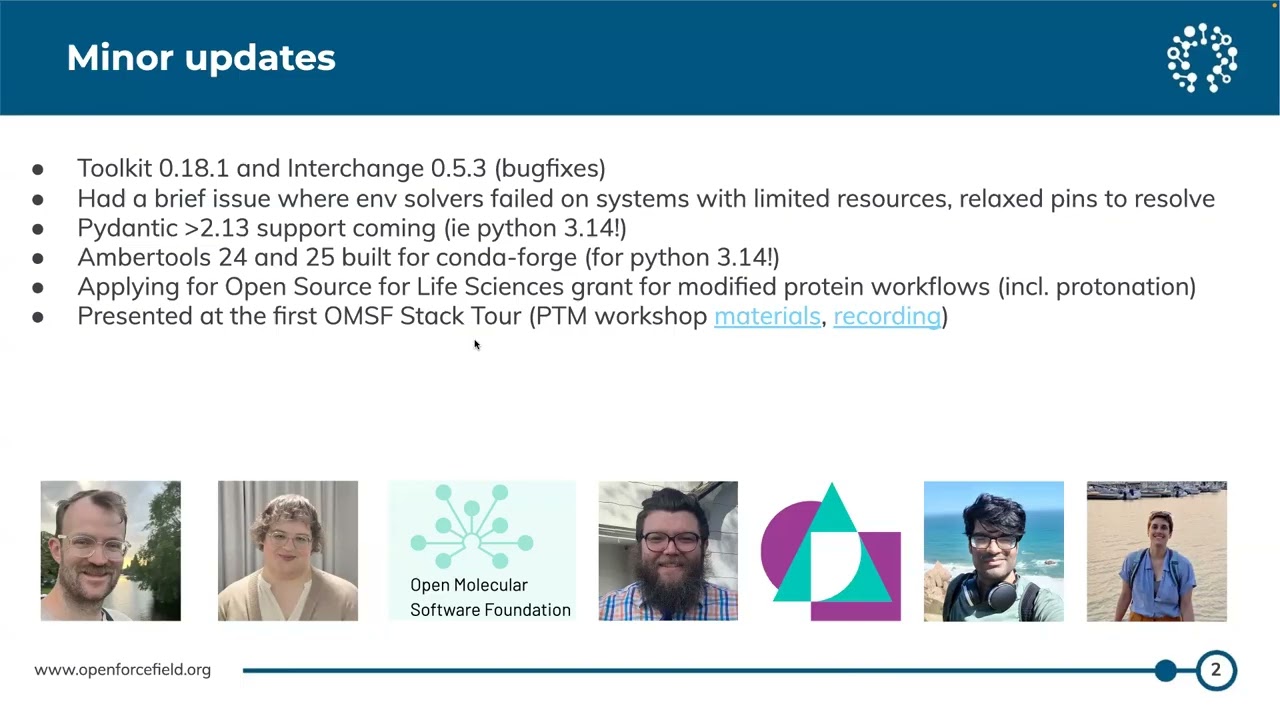
Jeff Wagner, the infrastructure lead at Open Force Field, presents a Q2 2026 roadmap update that focuses on stability improvements and strategic shifts toward scientific goals rather than new features. The quarter began with two minor bug fix releases for Toolkit and Interchange, which resolved previous issues where environment solvers failed on systems with limited resources, such as Linux machines running out of memory during dependency installation. To address this, the team relaxed packaging constraints that previously pinned dependencies to newer versions like Python 3.14, thereby simplifying the solver's task and ensuring smoother installations for users working in constrained environments.
Significant progress has been made regarding software compatibility and tooling support, with the release now including official builds for Python 3.14 alongside Pydantic version 2.13 and higher. This update also brings fresh builds of Amber Tools versions 24 and 25 to align better with common conda-forge dependencies, a project spearheaded by Mike Henry under the OMSF Eco Infra Team. Furthermore, funding efforts are underway through the Open Source for Life Sciences Fund to develop improved workflows for handling modified proteins. The team aims to tackle bottlenecks in ingesting PDB or mmCIF files and is exploring whether light protein preparation tasks, such as protonation and heavy atom replacement, could be included within this grant's scope to automate tedious naming problems using AI-assisted interfaces.
The OpenMMForceFields 0.16 release marks a major milestone by introducing robust support for Smirnoff proteins and virtual sites, which previously required hacky workarounds or did not function at all. This update allows users accessing force fields through the OpenMM package to test the Rosemary alpha version immediately, with future production releases of virtual site force fields expected soon. Beyond feature additions, this release delivers faster performance for large molecules like proteins and corrects several bad behaviors that had previously annoyed users, ensuring a more reliable simulation environment for complex biological systems.
Looking ahead, the infrastructure team is rebalancing its efforts to prioritize science-driven initiatives over minor updates, with colleagues Matt Thompson and Ashley Mitchell focusing on new property calculation engines called DimSim and benchmarks of Rosemary on cyclic peptides respectively. The community will also have opportunities to engage directly through upcoming stack tour events in Chicago near the ACS meeting in late August and another session in Boston in September, where Jeff plans to present introductory materials for OpenForceField and PTM workshops originally developed by Ashley Mitchell. These gatherings aim to foster collaboration while the team continues its transition toward more impactful scientific developments that will be detailed further in upcoming presentations led by Lily.
Read the full video transcript
Hi everyone. I'm Jeff Wagner,
infrastructure lead at Open Force Field,
and this is our Q2 2026 infrastructure
roadmap update.
We have a grab bag of minor updates for
you this quarter. Uh the first is that
we've had two minor bug fix releases, uh
one of tool kit, one of interchange. Uh
these should come through undetected, no
major um
breaks or new features in these.
We also are aware that 2 weeks to 1
month ago we had a brief issue where
environment solvers would fail on
systems with limited resources.
Uh so this would be something like a
Linux machine with like 4 GB of RAM or
something.
Um it would it would try to solve the
versions of the dependencies to install
and and the solver would run out of
resources.
Um we relaxed a number of our packaging
pins to resolve this, so things like
down pinning from Python 3.14 and and
down pinning other small things make the
solver's life very difficult.
Um we removed a few of those and the
problem seemed to go away, but if you
were encountering this, please get in
contact with us.
We're happy to announce that we have
Python Pydantic 2.13 and higher support
coming. And uh for many of you this
doesn't matter, but what this does
translate to, which does matter, is
compatibility with Python 3.14.
Similarly, and this is a big thanks to
Mike Henry, uh initially starting this
work under the banner of Open Free
Energy and now continuing it under
uh the OMSF Eco Infra Team uh ecosystem
infrastructure team,
is um
fresh builds of Amber Tools 24 and 25,
and actually Mike's working on 26 right
now.
But importantly, that updates them to
work with the common dependencies uh
that most of conda-forge keeps up with.
And also, we now have builds for Python
3.14. So I I that might make a lot of
people in this call's lives easier if uh
you've been needing to make environments
with that.
Past that, we have been applying for
some grant funding from private
philanthropy. This is through the Open
Source for Life Sciences Fund.
Um and OMSF is submitting a number of
these. A couple of them involve
OpenForceField, but the infrastructure
team in particular
uh is submitting one for uh improved
workflows for modified protein handling.
Uh I'm thinking of being the PI on this
one, and Ashley Mitchell, um one of the
key personnel.
And so, you know, we're we're coming out
with this force field that's going to
have parameters for proteins. And now
that it seems like the big bottleneck is
how are we going to ingest these PDB or
mmCIF files?
Um it's difficult. We've been showing it
in workshops, but the tooling could be
improved and maybe uh given a more
natural interface with AI to solve sort
of these tedious um atom naming
problems.
And one thing we're realizing in the
process of writing this is that
something like um a light protein prep,
something like protonation and maybe
some heavy atom replacement, could
become in scope for this grant. So,
that'll be submitted soon. Cross your
fingers for us.
Uh finally, I presented at the first
OMSF stack tour. This was in San
Francisco uh two or three weeks ago.
And I presented the introduction to
OpenForceField and
PTM workshop material uh originally made
by and presented by Ashley Mitchell.
I'll go ahead and drop the uh link to
the repo and the recording for that in
the chat cuz that was a really great
one.
We do have two more of these coming up.
One in August. That's going to be in
Chicago adjacent to the ACS meeting, I
think August 28th.
And another one in September that will
be in Boston. So, we'd love to see you
there.
Uh following up on an item from last
month uh or last quarter.
The OpenMMForceFields 0.16 release has
come out. Uh importantly, this includes
support for Smirnoff proteins and
virtual sites.
Uh this is something that didn't used to
work or if it did work, it was very
hacky. Uh now we've we've got quite a
bit of testing put in for these, so
we're confident that these work. Uh I
know that some of you access OpenFF
Force Fields through the OpenMM Force
Fields package, and this means that you
can try out the Rosemary alpha now. Uh
we don't have any virtual site force
fields in production. So,
when we do, boy will you be ready with
this new release. Um
but other than that, there there may be
some uh behavior changes that annoy some
of you, but they were bad behaviors to
begin with. And I'll fight you about
that.
Uh and additionally, faster performance
on large molecules. So, if you were
hamstrung on large small molecules or if
you were looking forward to trying
proteins, uh now that's possible.
Finally, this was a lighter month, uh
lighter quarter.
And this is because we've been
rebalancing effort from the
infrastructure team towards science
goals. Uh so, Matt Thompson has been
working on uh our new
property calculation engine called
DimSim, and Ashley's been working on uh
benchmarks of Rosemary on cyclic
peptides. So, you'll likely hear from
Lily about those in more detail in her
presentation.
Thank you very much.