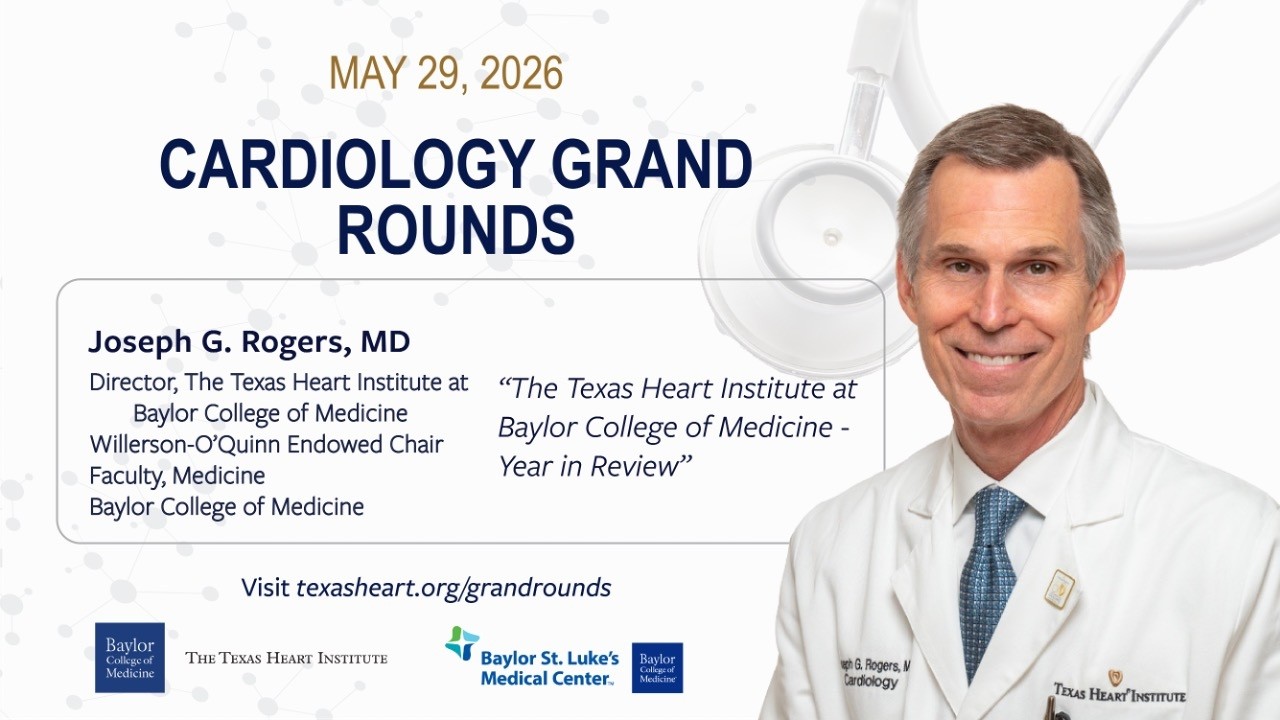
Joseph G. Rogers, M.D. | The Texas Heart Institute at Baylor College of Medicine-Year in Review
Watch on YouTubeVideo summary
Dr. Joseph G. Rogers opens his year-in-review presentation by addressing the significant external and internal challenges faced over the past two years, including shifts in NIH funding, leadership transitions at Baylor College of Medicine, and evolving affiliations with The Texas Heart Institute (THI). Despite these obstacles, he emphasizes that the team remains steadfastly focused on their core mission: improving patient health, advancing scientific knowledge, and providing education. Under the unified leadership of Scott Lykken, quality initiatives have been consolidated across hospital and academic programs to empower teams with real-time data and foster continuous improvement, setting a clear goal to restore the academic cardiovascular program to a Top 10 national ranking through rigorous quality enhancement.
The institute has achieved remarkable strides in surgical and cardiology excellence, highlighted by an isolated CABG mortality rate of zero this year following a thirty-five percent overall reduction since merging surgical and non-surgical quality groups. The program is nearing STS three-star status while maintaining morbidity rates for complications like prolonged ventilation, re-operation needs, renal failure, and stroke that are significantly lower than national averages. In cardiology, the department has seen high guideline compliance in electrophysiology, improved echocardiography turnaround times, expanded cardio-oncology imaging at the Duncan Cancer Center, formalized interventional echo services, and recognition as a national center for hypertrophic cardiomyopathy. Operational efficiency efforts are actively shortening hospital stays to free up nearly ten thousand patient-days annually, while infrastructure renovations aim to create eleven functional cath lab rooms and a hybrid operating room supported by fundraising with the St. Luke's Foundation.
Innovation continues to drive growth through advanced imaging volumes enabled by AI-driven plaque analysis for primary care referrals, robotic cardiac surgery reaching nine hundred cases led by Dr. Liao, and complex aortic repair programs achieving low morbidity via custom device design. The research division secured over twenty-seven million dollars in grants with an NIH success rate near twenty-five percent, leading breakthroughs such as implanting more BiVACOR total artificial hearts than any other global center, conducting first-in-human gene therapy trials for cardiac regeneration spun off into Medley Therapeutics, developing FDA Breakthrough Device Designated electroconductive hydrogels for arrhythmias via Rivio, and extending organ preservation viability through Organ Veep. These achievements are complemented by faculty accolades, including Dr. Christie Ballantyne being named a Distinguished Scientist by the American Heart Association, and educational advancements like transitioning Perfusion Technology into a Master's degree program at Baylor.
Dr. Rogers concludes his address by expressing deep gratitude to those who trust The Texas Heart Institute with their care, acknowledging that every opportunity provided allows them to improve patients' lives. He praises the resilience of the staff, fellows, and administrative team for successfully navigating complex transitions while maintaining an excellence level he believes would make Dr. Cooley and Dr. DeBakey proud. His remarks end on a note of appreciation for the collective effort dedicated to serving the community, followed by applause from the audience recognizing their shared commitment to cardiovascular care and scientific advancement.
Read the full video transcript
Thank you very much, Andrew. I
appreciate it. And thanks everybody for
coming. Um it is really
incredible honor to be able to stand up
in front of this group
and tell you all the great things that
you did this year.
>> [laughter]
>> Um
I would just I'd like to just start by
suggesting that we have lived through um
you know, a a very difficult couple of
years.
Um some of it applied on us externally,
some of it internal.
But think about the amazing change that
we've seen over the last couple of years
with
changes in NIH funding,
um with turnover of the leadership of
the college, with the affiliation
between Baylor and the Texas Heart
Institute. I would argue that
probably the biggest thing that we've
had to focus on is change management and
how we work through these things. And
what I hope to do today is
is just acknowledge the fact that we all
there's there's pebbles in our shoes,
you know, and it
it's not the most easy place to work
some days. There are a lot of sort of
frustrations like there is everywhere in
medicine and health care and science.
But what I want us to do for the next
hour
is just pause and think about some of
the amazing things that happen here. And
I hope at the end of the hour we all
leave with a deeper appreciation for the
fact that despite all of those
distractions that we have, we remain
laser focused on our true north and that
is improving the health of patients who
come to see us, advancing science, and
teaching the next generation of
clinicians and scientists.
So I have no financial disclosures
related to this talk.
Um but I do have a disclosure and that
is there is simply no way
to capture all of the amazing things
that people do throughout a year. And
so, while I have tried to include as
many of you as I could in these
comments, I just want to acknowledge I
haven't captured everyone.
So, but there's next year.
And so, I will try to be distributive
and make sure that we highlight the
amazing work that everybody's doing.
And I just want to start here with
with what we called out when we decided
that we were going to bring the Texas
Heart Institute and Baylor College of
Medicine together,
we said this is going to be our vision.
And our vision is going to restore
the academic program in the hospital
back into the top 10 nationally.
And I'll show you through the next hour
how I think we're making progress in
that direction.
And from my perspective, the way this
all starts is with quality.
And I just I want to acknowledge the
work of Scott Lykken, who is the
director of quality for the heart center
of a cardiovascular center, who's done a
remarkable job. And I just I I want to
highlight to you the fact that our
quality initiative in the center reports
up to the quality committee of the
board. So, this is not something that's
being done even locally. The the the
joint venture board between Baylor and
Baylor St. Luke's
is getting these reports.
Scott has spent an enormous amount of
time and and energy um organizing our
quality initiative and and kind of
redesigning it. We had one that was in
the academic program, one that was in
the hospital. We've combined those so
that we're really working together now.
And Scott's vision was to have a group
that was working on things that are
primarily surgical, and another group
working on things that are primarily
non-surgical.
But the key themes that sort of overarch
all of that are shown at the bottom of
the slide, and that is we are trying
mightily to to develop a best-in-class
so that we can understand quality and
act on quality in real time.
Scott's perspective is to empower the
teams with data so that they can make
actionable changes.
And perhaps most importantly and is to
create a culture of continuous
improvement. We're not always going to
be perfect.
But the question is what can we learn in
an ongoing way so that we can continue
to get better each and every day.
So I'll start with maybe one of the most
visible measures of quality and that is
the US News and World Report rankings.
And
I'll just acknowledge at the beginning
that we are a ranked program.
We are in rare air, but we're not ranked
as highly as we used to be.
And so
what I hope to convince you of is we're
moving we will be moving back in the
right direction based on the work we're
doing. Here are some of the
measures that US News and World Report
aggregates to come up with your final
score. And if you sort of walk through a
lot of this on the left, you can see
that we're actually doing quite well in
cardiovascular.
One space that will tie into a later
comment is we really need to move more
patients through the system.
But I really want to train your eye over
on the right side of the slide. And
these are the things that are in the
control of our medical teams.
And I will just highlight for you that
we are high performing in every one of
these domains.
We're not going to do any better than
five out of five in these.
So I think this acknowledges the fact
that the work that we're doing in the
hospital every day is a very high
quality when we benchmark ourselves
nationally.
Our work is also recognized by our
professional societies. These are the
badges that we have from the American
College of Cardiology that look at the
different domains of Cardiology care,
EP, chest pain, heart failure, TAVR,
cath lab. And we actually
once again have the national distinction
of excellence
for heart care centers.
So again,
while we do, you know, like there are
pebbles in the shoes, we are we're doing
a remarkably good job at at at the at
the work that really matters to our
patients.
So to highlight now for you some of the
work that's gone on in the last year in
the quality domain,
I asked Scott to put together what he
thought some of the most important
highlights were
in some of our programs.
And and under the leadership of Mark
Moon and Scott and others in cardiac
surgery, we've seen a remarkable
reduction in isolated CABG mortality.
And I'll show you a little bit more
about this cuz there's a really amazing
story that's going to emerge, I think,
soon about isolated CABG. But a 35%
reduction in in isolated CABG mortality.
The TAVR program tends to be high
volume,
low morbidity, low mortality.
Great work going on in there.
I'll highlight [clears throat] some of
the work that's happened in EP, but
under the leadership of Abdi Rossic and
our other electrophysiologists,
very high compliance rates with the
national guideline metrics and very low
complication rates.
And Enrique Garcia Sayon, who's here,
has spent a lot of time working on the
operational aspects of the echo lab. And
I'll show you a little bit more granular
data about that in a few slides.
So here's some of the incredible work
that's gone on in the cardiac surgery
group pertaining to quality. And again,
sort of
very intentional work by
all of the cardiac surgeons under Mark's
leadership.
But we are now approaching the point of
becoming a three-star
STS cardiac surgery program. And And I I
don't know if this has changed since
this we made this slide, but Scott and I
had this conversation.
Um the isolated CABG mortality right now
is zero
uh this year. So, I mean really
incredible um performance not only by
the surgeons but by our anesthesiology
teams, the cardiac care teams. And I
think the important way to frame this is
to think about the patients that our
surgeons are operating on. This is an
incredibly sick group of patients to
have this kind of outcome is really
remarkable.
And and to the credit of this group,
all of these cases are being reviewed uh
postoperatively to look for
opportunities for improvement. Scott and
his team are working mightily through
the ICU to shorten lengths of stay, to
decrease the amount of time our patients
are mechanically ventilated. And And an
important initiative has been to focus
on optimizing these patients before they
go into the operating room.
And it's really this concept of having a
shared
uh vision and a shared leadership
uh for this kind of initiative. So, it's
really all of the providers uh who are
working in this space.
Here's the amazing part about this STS
star ranking. And And just so you know
if it's top right, a one-star program
has as expected outcomes, a two-star
program is better than that.
A three-star program represents a top
decile performer nationally.
And we are 1.16
percentage points away from being a
three-star
program in isolated CABG.
And And Scott is laser-focused on this
issue of reducing morbidity, but we are
so close. And And I think a few years
ago, many of us were looking at this and
wondering whether we could get to a
two-star program. So, with a concerted
effort and a focus on quality, I think
this will be something that we all can
be remarkably proud of.
When you look at some of the other
morbidities
in cardiac surgery, we do very, very
well with lower rates than national
average in prolonged ventilation, the
need to go back to the operating room,
renal failure, and stroke. So, across
the morbidity spectrum, we're also doing
very well, but that's the space where we
need to work. How about in cardiology?
Here are some of the different
uh registries that we submit our data
to, and you can see that there are areas
in which we do very, very well. And then
there's some areas in which we have
opportunities to improve. And I think
this is one of the parts of this quality
journey. I I I like this quote by
Foster, who said that quality is not an
accident. It's It's the result of high
intention, sincere effort, intelligent
direction, and skillful execution.
And whenever we approach some benchmark
for quality, the benchmark will move.
People are getting better. This is one
of the challenges with US News & World
Report. We're continuing to get better,
but there are other programs that are
getting better even faster than we are.
We need to catch up. And so, the these
bell-shaped curves in the quality domain
are becoming very, very narrow, and the
difference between being a 50th
percentile program and a 90th percentile
program is oftentimes a few percentage
points.
I mentioned the work that our
electrophysiologists have done.
And this is just one example of some of
the great work. This is looking at the
proportion of patients who had an A-fib
ablation who were treated with an
anticoagulant, and you can see that we
up, almost in every quarter, around
100%.
And I mentioned to you that um Dr.
Garcia-Sayan, when he took on this role,
he took up Whoops-A-Daisy.
He took on this role sort of over on the
left side of this graph, but you can see
the remarkable improvements in EchoLab
performance
um in just uh getting the times down
from the time we put in an order until
the time the patient gets scanned, till
the time where the report comes out. Um
very nice and important improvements,
and this is a large patient cohort. This
is 18,000 patients um
in this uh
on an annual basis that are going
through our lab. I wanted to just
highlight a couple of other things that
are happening in the EchoLab which are
exciting. So,
in recognition of some of the work of
Dr. Diaz and his colleagues for in
cardio-oncology
um in conjunction with the EchoLab,
we're now being able to perform echoes
at the Daniel L. Duncan Cancer Center.
A
a remarkable bit of work by some of our
colleagues in echo is interventional
echo, and Dr. Garcia-Sayan, and Dr.
Coulter, and others
are oftentimes called into the cath lab
or into the operating room to provide
high-level guidance to um our procedural
colleagues about how they can um
uh you know, sort of fix um a lesion in
a more appropriate way, and they get
outstanding expertise. That's now
becoming a formalized service. Um the
EchoLab has been uh acknowledged as one
of three centers nationally as a
hypertrophic cardiomyopathy center of
excellence.
And
you also know that we've had some
challenges with the new uh CV PACS
system uh in the hospital, and we are
decided that we are not going to sit by
passively, that we are going to take a
very active role in trying to make that
better for the entire Common Spirit
system.
And then I'm hopeful that all of you who
are clinical or getting the pushes from
me on a weekly basis about length of
stay, but this ties back into the US
news story that I told you just a minute
ago. The length of stay in this hospital
generally is long and we all understand
that there are a number of reasons for
that. It's also incumbent upon us to
shorten it. And I would say it's
completely within our domain to shorten
it. We have told Redondo that we plan to
shorten our length of stay across the
service line by one day.
Uh which is not a trivial undertaking
and we've started to make some pretty
good progress, but I think the thing I
want you to see is up on the top right
side of the slide. And the number of if
if we shorten the length of stay
the number of days, extra days that we
can have for cardiovascular patients is
approaching 10,000.
So in a system where we actually need to
move more patients through, there's
actually there's a demand for our
services, for our expertise.
And we're often times bed locked. If we
can
work on these processes together and
shorten length of stay, we will increase
our ability to care for more patients.
That also then is reflected in the US
news rankings.
So I think there's some really
interesting data in this slide and I
wanted to highlight this for you because
many of you may not know that this
process has started. It's not been
rolled out publicly yet, but this goes
back to what's going on inside the
hospital. What are their commitments
back to us? So the hospital has started
a strategic planning process
for our key service lines and their
expressed goal
is a couple. They want to restore the
cardiovascular program back to a top 10
program in US News and World Report. And
they intend to have the dominant market
share at the Texas Medical Center within
the next 5 years.
And starting with that premise, we've
worked backwards to understand what are
the investments the hospital's going to
need to make
to achieve those goals.
One of them is to build out centers of
excellence and I've shown you what the
selected centers of excellence are are
on the right side. If your center of
excellence is not shown, come talk to me
after
after the conference and we can figure
out how we slot you in.
But these are the investments that the
hospital believes is going to get us to
this market share goal and back into the
top 10. They also are very interested in
expanding our footprint out beyond the
Texas Medical Center in a much more
aggressive way and to be the preferred
industry partner
for sponsored research and for
innovation to bring into the market.
The The current market shares are shown
up on the right side of the slide. So,
we've got some work to do to get this
done. But the thing I wanted to show you
is down at the bottom left side of the
slide and I pulled this data at 10:52
this morning.
These are the Google star ratings of
Baylor St. Luke's Medical Center and
Houston Methodist Hospital
and we are significantly out in the lead
and I think we should just pause,
smile,
and when we walk out of here, you know,
sort of appreciate the fact that
that we walk around and you know, it's
certainly is not the prettiest hospital
on the block, but I will argue that the
care in this hospital is second to none
on this block.
So,
what are we doing to help with the
infrastructure?
Um I went this week and stopped by Cath
Lab 4. This will be Emerson
Emerson Peron's great delight as the
director of the Cath Lab. This is what
the Cath Lab looks like this week.
Um
So, the renovation has started. The plan
is to renovate five of the 11 labs uh
over the next couple of years, and I'll
show you that timeline in just a second.
But, to highlight for you what this will
ultimately end up looking like, I've
shown you on the right side of the slide
the build-out of the hybrid OR, which
was renovated for some of the
endovascular work that we'll talk about
in a few minutes.
And, the renovations are turning out
remarkably well.
So, uh very exciting. This is what the
construction timeline looks for the like
for the cath labs. We're working on
rooms four and nine now. When that work
is done, uh they'll start on room 11.
And, when room 11 is done, then they
will work on room 10. And, I can't
remember if there's one other or not.
But, each of those renovations takes
about 3 and 1/2 months, and it's
projected that we can get through that
entire portfolio of construction work in
just over 2 years.
And, the hope is that by the end of this
construction that we will have uh 11
functional cath labs. And, how long's it
been, Emerson, since we've had that?
A long time.
And, um we just had a really wonderful
meeting. We um have worked this year
with the Rice MBA uh executive MBA
students
to help us think about new ways to
improve efficiencies in the cath lab so
that we can get more cases done.
I also had the chance to get in front of
the St. Luke's Foundation board, who
asked me, "What are your fundraising
priorities?" And, so I will show you the
slides that I presented to the
foundation board. And, they're very
excited about supporting the
cardiovascular program. I said,
"We need to continue working on the cath
lab. Not only on the renovations, but
making sure that we have the most
contemporary equipment so that we can
maintain a technology gradient with our
competitors and the programs out in the
community.
We have an opportunity to build out the
next hybrid OR, which is not yet funded.
We have needs to build out a more
aggressive platform in the
electrophysiology laboratories.
We could use another robot.
And I will talk about the cardiac
robotic program in a little bit.
We could use some TEE probes. We need
new echo machines. There's some needs in
cardiac advanced cardiac imaging.
These kinds of proposals really
resonated with the board, and I think
they're excited about raising money for
us. And then we talked about some of the
people that they could support,
including
nurse navigators and some research
coordinators. And we also talked about
the fact that they could have the
opportunity to endow grand rounds.
So I think there's a lot of opportunity
for us to go out and fundraise in
conjunction with the hospital that will
support the interests of all of us who
practice inside the walls of Baylor St.
Luke's Medical Center.
So I wanted to turn now a little bit
away from quality and fundraising and
talk to you about what we've been doing
clinically over the last year.
The service line at Baylor St. Luke's is
busy.
We
mean the the numbers here are
impressive. 250 Tavers on an annual
basis. The cath lab doing about 8600
cases.
Enrique and his team in the non-invasive
suite doing over 25,000 non-invasive
studies. And
the cardiac OR is really quite busy at
3300.
So it's a it's a very busy place.
There's a lot of churn, a lot of
throughput through
through the service line.
There's some really
great work that's going on, and I wanted
to highlight a couple of these programs.
And And I wanted to just make sure that
we've that everybody here in the room
and who's listening to this um
appreciates the hard work of Juan Lopez
and Enrique and Shree and Luba Frank.
And I'll just show you that this kind of
dip down here on the green these are the
cardiac CTs CTAs that were performed.
And you can see that we sort of hit a
nadir last summer. And I like to call
this the Lopez effect.
So
So when Juan came he said, "We're going
to fix this and we are going to increase
the throughput and we are going to be a
high quality advanced imaging program."
And you can see with some focused effort
what's happened. The remarkable growth
in coronary CTA CMR program similarly if
you look from last summer till now the
the volumes have gone up. Remember that
that graph the bar on the right side of
the slide is month-to-date so it wasn't
a full month toward the data.
And Dr. Lopez has a very important
perspective for us and that is that this
should be an entry point for patients
into the system that can be accessed by
anybody. So it's very important for us
as cardiovascular professionals that we
can get our patients through but what if
you thought about this a little bit
differently and democratize this so that
primary care doctors could begin
utilizing these kinds of services. And
so Juan's perspective is why don't I get
go out and start marketing these
services to primary care docs. So if
they
if their patient gets imaged and they
have sort of a low risk profile I can
send back recommendations that are
guideline based about how to manage
them.
And if they're if I find a high risk
study we can immediately get them into a
cardiologist for further evaluation
care. It's a great entry point
into the cardiovascular programs here.
And here is an example that Juan shared
with me. This this was a 55-year-old
woman who had no chest pain but was
getting breathless when she exercised.
She was a tobacco user and had
hypertension and diabetes. Somebody who
you would think probably was at high
risk for having
uh atherosclerotic cardiovascular
disease. Her lipid profile is shown
there.
Her hemoglobin A1C was high and she had
a coronary calcium score zero.
And so Dr. Lopez
did a coronary CTA and you can see the
images over on the right side of the
slide and it seems like if I move the
mouse um
uh it advances the slides advance so I'm
I'm not going to take my chances.
But I think if you look in that middle
slide at the top of the LED you can see
that there is a there's a plaque there
that he was able to identify.
And so one of the really interesting
innovations that Dr. Lopez is bringing
to our center is the use of AI-enabled
plaque analysis.
Where we can begin to really take a look
inside those vessels. And this
[clears throat] was a woman again who
had no calcium.
Uh but there was a high level of
suspicion. But with this sort of
approach he's been being able to help us
identify soft plaque. And this is
actually what's the etiology likely of
this woman's exertional breathlessness.
So I think this kind of interplay now
that we have Dr. Lopez and Dr.
Garcia-Sayán and Dr. Tonaru and Dr.
Frank working in this space in really a
dedicated concerted effort.
Let's start that conversation about how
we can utilize those services better.
The other thing that's amazing is I
think many of you who ordered coronary
CTs in the past um have found that it
was cumbersome to slow the heart rates
down and you'd have to
use a beta blocker prep uh in order to
get patients relatively bradycardic. But
with the [clears throat] new scanning
technology and with the new protocols
that's actually no longer necessary.
So I would [clears throat] highly
recommend that we collaborate more with
Dr. Lopez and the advanced imaging team.
I probably don't need to remind this
group of the incredible
program that's been developed in cardiac
surgery by Dr. Liao and supported by Dr.
Moon and Dr. Rosen Garden but
this was Dr. Liao's celebration of the
900th robotic cardiac surgery case and
as far as I know we haven't hit 1,000
cuz I haven't been invited for more cake
yet.
But we're close and you know Ken is
doing some really remarkable work. He's
one of the highest volume robotic
cardiac surgeons in the United States
and I hope you had a chance to see Ken's
grand rounds from a few months ago. If
not, it's available on our website and
you can go back and watch that but
really remarkable work and a lot
people are coming now from all over the
country
again to Baylor St. Luke's and the
Baylor and to the Texas Heart Institute
of Baylor College of Medicine to get
this kind of very unique service that he
offers.
And then I wanted to tell you another
story
of one what I think is one of our
signature programs and it's the aortic
program and I was reflecting on this
case and how this group of
our colleagues makes the extraordinary
look ordinary.
This is the story of a 65-year-old man
who came in with an aortic dissection
and it was very clear in the emergency
room that there was malperfusion from
his
from his head to his legs.
And I I just copied Dr. Caselli's op
note to show you what he found but there
was there was a type one dissection that
involved the the sinuses of Valsalva,
his left common carotid had thrombosed.
They dissected into the innominate up
the left carotid into the left
subclavian down the thoracoabdominal
included the SMA
occluded [clears throat] the left renal
artery, and was compromising blood flow
to the left lower extremity. And when
the pericardium was open, this aorta had
ruptured.
So,
the mortality rate, as you know, with
aortic dissections is about 4% per hour.
Uh this had to be substantially higher
as the aorta had already ruptured.
The procedure that was performed on this
man is shown at the bottom. And I won't
read through everything that happened,
but basically this started with Dr.
Caselli and his team in the cardiac OR
operating all night long.
And then extending into the next day,
and I'll show you in just a second. What
you see on the right side of the slide
is a 3D reconstruction of the aorta, and
you can see the dissection's lab that
starts just above the valve and goes all
the way down into the abdominal aorta.
So,
a- after the case was um taken from uh
the cardiac OR, went to the the vascular
suite.
And at the end, this is what the aorta
of this gentleman looked like. And you
can begin to appreciate, if you can just
sort of train your eye on the right side
of that slide, you can see where the
surgical repair ended and the
endovascular repair started, but
basically reconstructed the entirety of
this aorta.
Uh and this gentleman left the hospital
about a month later and is fine. And so,
really it's just incredible work uh
that's being done by this team.
I had a chance to talk to Gustavo and
Steve Maximus about some of their
endovascular aortic work. Gustavo was
telling me that this was
um probably the busiest year he's had in
his entire career
um in terms of the number of
endovascular cases. And I think you can
begin to appreciate uh
they have um
the uh in the let the CMD are basically
custom-made devices that they're they're
designing with one of the companies
specifically fitted to the anatomy
of the unique anatomy of a patient.
Uh the PMEG are physician-modified
endographs. So,
so Dr. Maximus and Dr. Oderich are
actually
an hour before the operation with very
thoughtful, careful 3D modeling
um modifying and custom-making these
devices so that they fit into the
patients.
Uh and I want to just highlight for you
that they're doing this work under an
IDE,
but I wanted to highlight for you the
remarkably
low morbidity and mortality rate
considering what they're actually doing
in these with these graphs. So, I think
this is amazing work and as you saw
earlier, this is one of the
uh centers of excellence that we'll be
focusing on not just in the heart center
academically, but also in the hospital.
So, I wanted to turn for a few minutes
away from the clinical
part of what we do and think a bit more
about what we do in the research domain.
And I wanted to focus many of my
comments this year on our on our
translational research program.
So, first I and just in case people
haven't seen this, as we've begun to put
the center together,
uh we have a leadership structure for
our research initiative. Uh
the
deputy director for translational and
clinical sciences is Dr. Kay Lou.
The deputy [clears throat] director for
the CVRI is Dr. Werns, and Dr. Werns has
run the CVRI admirably for years.
Um Dr. Darren Woodside is going to focus
us on translational science and
commercialization, and we've not yet
named the directors for clinical
research and outcomes research, but
those will be coming probably in the
next couple of months.
We put together a research advisory
committee that's going to give us a
different perspective. It's going to
open the voice of the faculty to help
guide our initiatives in research.
And I just also wanted to highlight for
you that we have a new director of the
the Cullen Lab, which is the large
animal lab down in B2, and it's Teimour
Ardeshir Shavdi who's done a remarkable
job
um trans- transitioning all of our large
animal protocols over into Baylor.
So, how have we done in the last 12
months? And a year when there was a lot
of uncertainty at NIH, where we were
transitioning all kinds of
administrative tasks.
And I will just highlight for you that
we submitted almost $160 million
worth of grants.
Uh we've received over $27 million of
those. Our funding success at NIH is
just shy of 25% and all of our funding
success is just shy of 50.
And you can kind of break that all out
by the different categories of grants.
It's a remarkable body of work that our
scientists have done over the last year.
I wanted to highlight a couple of these
translational programs that we've been
involved with, and Daniel Timms is here
with us today, who's the inventor of the
BiVACOR total artificial heart.
As of today, and I think I've got this
number right, Daniel. I think it's 14
have been implanted. And I'm happy to
tell you that we have implanted more
than anybody in the world. We've put in
36% of those pumps.
Um in addition, our team travels with
BiVACOR not only across the country, but
around the world because of the
expertise that we have here that started
in the animal lab with the implants, and
it carried over into our ORs and our
intensive care units and our nursing
teams and our perfusion teams.
When we started this program, we had
unprecedented expertise with this
particular device. And I just wanted to
highlight for you we just implanted
another one this week and I grabbed a
quick picture of Thomas in Orlando with
Daniel Timms. But also Alexa Schappi
who's been the primary surgeon here who
recently flew to Taiwan and assisted
with their first implant. Um and then
Karthik Valery who also has done a
remarkable job in the ICU supporting
this program and helping us learn with
every implant.
Um this program is developing rapidly.
Um the plan was to do uh 20 implants and
then go back to FDA with us with a
strategy to do um a pivotal trial as a
bridge to transplant with this device.
I also wanted to highlight the work that
um
the Jim Martin's lab has done and I
think many of you have heard Jim talk
about the work that he's doing in
cardiac regeneration and modifying the
Hippo pathway. And
as a non-molecular biologist I can just
like simply explain this is in a ways
that I can understand it.
But all of you recognize that when we're
born essentially our cardiac heart
cardiac muscle cells stop dividing. And
as we get bigger as we grow those cells
get larger but they don't continue to
divide which is why myocardial
infarctions are so devastating because
you don't replace that injured heart
muscle with new muscle cells.
So Jim and his lab have defined a key
pathway that tells the cells to stop
dividing when they're born.
And then has developed a gene therapy to
turn off the stop signal and allow those
cells to re-enter in the cell cycle
begin to divide. And when you do when
you cause a myocardial infarction in an
animal
and you give the gene therapy you can
see what happens at the bottom right
side of that slide where
in in the slices of heart, you can see
the scar down at the bottom. That white
uh is just fibrous tissue. But, if you
look at what happens if you administer
Dr. Martin's gene therapy, you can see
you can hardly tell that there's scar
there.
And so, in a translational research
initiative,
uh
Jim spun off a company called Medley.
Uh and we are doing first-in-human
uh
it work with this gene therapy.
Uh and Emerson Perin is the primary
operator. I I
That's him actually with the cap and uh
mask on, but I put his smiling mug up
there too so that you would recognize
who's behind there.
And not only did we But, Emerson had had
to invent the catheter
to inject the gene therapy so that he
can go and map very carefully inside the
ventricle what heart muscle's alive,
what heart muscle's not alive, and make
the injections right along that border
zone.
And so,
this is uh been approved by FDA. It's a
nine-patient
dose-escalating um safety study, and I'm
happy to tell you that this week the
eighth of those nine patients has been
completed, and the anticipation is that
as long as there's no adverse safety
signal,
uh this will probably move on then to a
randomized controlled clinical trial.
So, great work. And again, not this I
think an example of the research
portfolio that we have in the center.
I wanted to highlight a couple of
others. So, this is Mehdi Razavi and
Alison Post have spun off a company
called Rivio. And I I talked to you a
couple years ago about their
electroconductive hydrogels, two liquids
that come together to form a semi-solid
that conducts electricity. And Mehdi's
perspective is that he can mitigate some
of the abnormal electrical channels in a
myocardial infarction by injecting this
into the veins and sort of make the
electrical pathway straight again so
that we don't have re-entering cycles.
And this is now spun off into a company
and received from the FDA a breakthrough
device designation. So, really an
important and big
therapeutic advance. And so, watch this
cuz I mean this is going to be really
exciting.
And then some of our other colleagues,
Shaheen Wang and Chris Chan and Gabe Lor
are upstairs in the on the up in the
Cooley building working on a strategy to
prolong organ preservation. And they're
starting with lung, but this also could
be applied to heart and liver and kidney
with the idea that we could extend the
time that an organ is outside the body
and and trying to get
you know, either rein- reinvigorated or
moved. They want to try to extend that
from
a few hours to 100 hours, which would
completely democratize
organ donation in the world.
It also might buy you time to allow
organs to recover from the, you know,
injuries that often occur when patients
go through brain death. Or it might
allow us to genetically modify these
grafts so that they work better, they're
less immunogenic. So, again, they they
spun off a company called Organ Veep and
it'll be really interesting to see them
uh go forward. And then I'm going to go
through these quickly the next couple of
slides, but these are some of our uh
sponsored research trials just to show
you the breadth
of the work that we are doing. And and I
think it's important for us as
clinicians and clinician scientists
um to understand that this is a real
opportunity for our patients to have
access to the latest, most cutting-edge
therapies that are available in the
United States. So, these are a list of
the heart failure trials. This is the
portfolio that sat inside the Texas
Heart Institute with some really
important trials. And finally, it's a
lot of the work that you've seen
recently that's come out of Christie
Ballantyne's lab and his initiatives. Um
focused on some of the new drugs to
lower cholesterol and some really
remarkable work that's being done by
that group.
So,
I I've spent a bit of time talking about
the aortic the endovascular service, but
there's something else that happened
this year that you might not know about
yet. And that is
we were asked, Dr. Odell and his
colleagues were asked to submit a
proposal to the Marcus Foundation for an
aortic center of excellence. And I
thought that that team, along with Nick
Ryan and the development team at Baylor,
put together a phenomenal proposal
that builds out a clinical area that
integrates imaging into an outpatient
clinic that designs a um
a data repository for vascular images
that could be used by all vascular
surgery trials in the world and sets up
a new training center
a new a new for using simulation to
train our colleagues in how to do
endovascular work.
I'm happy to tell you that this was
funded by the Marcus Foundation to the
tune of about 17 million dollars and the
work will start soon. This is what we're
going to use we're going to repurpose
the old THI library
for the simulation center, a suite of
offices, and this remarkable vision that
Dr. Odell has to service a data
repository.
So, I wanted to, as we begin And close,
talk a little bit about our impact. And
I showed this slide um a couple of weeks
ago just to highlight for you what I
think are some of the really important
publications just in the last month.
These are just some of the papers that
have been published recently by our
faculty.
But in an attempt to try to make this a
little bit more
a little broader over the last year.
We put all of our faculty names into an
AI generator and we said, "Tell us where
we published. Show us the high impact
journals that we've published in." And
you can see uh in this pie chart the
number of papers and this sort of the
the um the journals that we've published
in.
And and what the analysis of our
publication record in the last year was
is we have remarkable strengths
in publishing.
And but I what I really wanted to
highlight for you was what AI's
interpretation
of the portfolio was. And
you can bu-
I didn't The prompt wasn't tell us some
really good stuff about our publication
portfolio.
This is what it said. The portfolio is
consistent with a globally competitive
cardiovascular research institution that
demonstrates strengths in clinical
trials, translational medicine,
guideline leadership, AI-enabled
medicine, and multidisciplinary
cardiovascular science.
The concentration of publications in
elite journals reflects substantial
national and international visibility
and influence.
If we are going to become a top 10
program, this is where This is how we do
it, right? We need to have a national
and then international visibility into
the work that we do.
We have two journals and many of you
know this. We We might have more than
this, but I These are the two that I
know about. So, Becker is editing uh
Jack Heart Failure. I'm editing the
Journal of Heart and Lung
Transplantation.
I'll tell you that her impact factor is
better than mine, but Beckham, if you're
listening, I'm coming for you.
And then, our faculty has been
recognized both nationally and locally,
and I wanted to just highlight this for
people because this is really important.
Uh and Christie Ballantyne received one
of the highest honors that you can
receive from the American Heart
Association this year. He was named as a
distinguished scientist
for his lifetime's worth of work on
understanding lipids and the role of
inflammation in atherosclerotic vascular
disease. He was also named the Virgil
Brown Distinguished Achievement Award
winner.
Beckham won the Laura Lynch Executive
Leadership Award. Misra, David, Natesh
all received awards at the uh at the
Cardiovascular Research Symposium
earlier this month.
And then, I also wanted to highlight for
people that Baylor recognizes, once a
year recognizes, our faculty for their
contributions, and you can see these
contributions here, and I'm not going to
read all these. I would like to
highlight one,
and that's Dr. Sanusi's award. That was
actually given It was voted on by the
Medical Executive Committee of the
hospital, and it was a hospital award
based on the work that he's done uh to
advance our efforts in cardiovascular
critical care.
And then, I wanted to just um
again, as we close, I'm thinking a
little bit about education. Thank Kerry
Sprung,
who um has transitioned over to the
School of Health Professions at Baylor
and was charged with figuring out how to
move the School of Perfusion Technology
into
into Baylor, and has done a remarkable
job. And many of you probably don't
realize, but today that is a certificate
program
that lasts 18 months, and we have sort
of an ongoing rotation of students
through the through the Perfusion
School. Kerry had a vision to create a
master's program for this group and so
that will be kicking off
shortly and will be transitioning this
to a master's degree program which is
actually much more marketable and
aligned with what people want in the
space.
And then
and finally
I just would say it is impossible to do
the work that we just talked about
without the work of
our fellows
and the people who come here to train.
You know it
this is the reason
that you can't provide the kind of care
that is provided in this hospital in
community hospitals and it's not because
the attending physicians are in the
hospital day long is because this group
of people has worked remarkably hard for
years and has done an incredible job
taking care of our patients and I just
want to pause
and have the faculty appreciate all of
you. Congratulations on finishing your
training.
>> [applause]
>> I'm also happy to say that I believe
that every one of these people has a
job. So
also good work.
And finally I'll I'll just close this
way to say thank you.
It it is it's not been the easiest year
here there's been a lot of transition a
lot of change.
You are a resilient group of people and
I'm
we're all indebted to you for the work
that you've done
in in whatever domain that you work in
when you walk in the front door with a
commitment to excellence
which would make Dr. Cooley and make Dr.
DeBakey proud of this place.
I want to
acknowledge the incredible work of the
administrative team.
Especially we need to thank Megan who
just forever keeps me out of trouble
and keeps me pointed in the right
direction. Brett Coffman has done a
phenomenal job this year helping figure
out how THI and Baylor come together
into into a functional whole. And I
don't mean to exclude anybody cuz I
think the administrative team has done a
phenomenal job as well. I just want to
be sure that we acknowledge them. So,
thank you very much. I hope that you
walk out of here today and say,
"Wasn't intensely boring,
but
we're really doing remarkable work. And
walk out of here with your head held
high. Enjoy your summer.
Take a few days off and and relax and
enjoy your families and let's keep
advancing the science of cardiovascular
medicine and improving the care of the
patients who trust us every day to make
their lives better. So, thank you very
much."
>> [applause]