Video summary
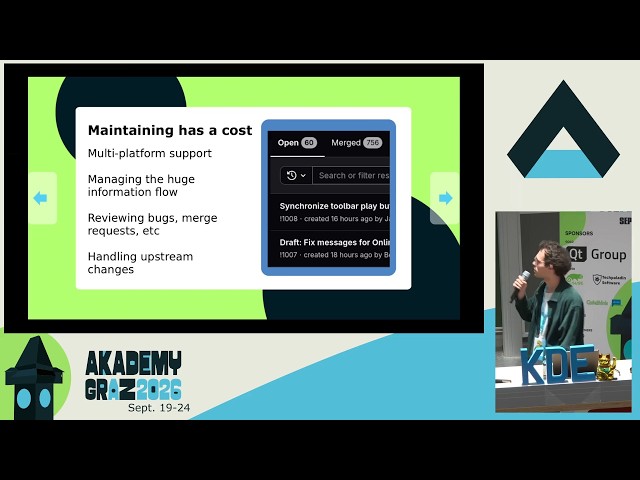
The video features Farid and Julius from the Kdenlive core team stepping in to present an update on the project's status while Jean-Baptiste Mardelle recovers from illness. They highlight that despite being launched in 2003, Kdenlive has maintained relevance for over two decades by actively strengthening its multiplatform support. Significant efforts have been made to stabilize the software across different operating systems, including fixing crashes in KDE frameworks on macOS and improving rendering performance on network drives for Windows. Additionally, the team is working on porting their pipeline from MiniV to MSBC to facilitate a future release on the Microsoft Store, demonstrating a commitment to expanding accessibility while maintaining high quality standards through rigorous testing and code cleanup.
Despite these advancements, the developers acknowledge several technical limitations that currently hinder the software's capabilities. The most significant hurdle remains GPU support, as the underlying MLT framework and the Freyer effects used are still CPU-only, which can impact performance for demanding tasks. Furthermore, Kdenlive currently handles 8-bit color depth rather than the widely expected 10-bit standard found in many modern workflows, and it lacks native Android support despite the growing trend of users relying solely on mobile devices. The team also notes challenges related to managing a large dependency stack and processing upstream changes, which can be time-consuming but are essential for keeping the software up-to-date with industry standards like OpenFX.
To address these issues and foster growth, the project is implementing new features such as the upcoming "Dope Sheet" timeline in version 26.12, which will allow users to manage keyframes and parameters within a unified interface. The team has also modernized their documentation by migrating their website from WordPress to Hugo and secured a trademark for the Kdenlive logo in Europe to protect against infringement. Financially, while recent donation levels have fluctuated compared to previous successful campaigns, the project benefits from dedicated funding that allows core developers like Jean-Baptiste to focus full-time on development. This financial stability has also enabled the team to refactor code and maintain existing features while new contributors drive innovation through fresh feature additions.
Looking toward the future, the Kdenlive community is evolving beyond traditional meetings into new forms of communication, such as podcasts, to better engage with modern audiences. The project shows strong signs of growth, particularly in its developer community, where recent major releases have been driven largely by new contributors rather than just the core team. This expansion not only brings fresh perspectives but also distributes the workload, making it more enjoyable and sustainable for everyone involved. As the team continues to tackle technical challenges and expand their reach, they remain optimistic about Kdenlive's ability to adapt and thrive in a rapidly changing technological landscape.
Read the full video transcript
Hello everyone.
Today we're substituting uh John Baptist
Martell. He's sick. He's here in grass
but uh stayed at the apartment. So I'm
Farid and I'm with Julius. We're part of
the Kaden Life core team. [snorts]
So, Kaden Live has 151 releases.
First launched in 2003,
23 years of a program.
Are we still there yet? Are we are we
there yet?
Do we have GPU support? Are we enjoying
it? Um,
we're here to talk a bit about this.
So, um, yeah.
Yeah. So is K life still relevant? What
are we doing? Um one of our recent
focuses has been to introduce um
[clears throat] or to strengthen
multiplatform support. Um we introduced
Mac OS a few years ago. Um but there are
quite a few challenges um maintaining
multiple platforms. We um had to fix um
crashes in KDE frameworks on Mac OS. We
recently improve improved the um
rendering to network drives on Windows
and also one of our big projects is to
bring our pipeline from MiniV to MSBC
also to be able to release Ken life to
the Microsoft store. So there's quite a
lot um going on on the side of
multiplatform support and also we are
investing a lot on quality assurance. Um
recently we started to make our project
almost uh QML lint clean. So we turned
um most warnings into errors um after we
fixed them. And uh we keep improving our
own render test suit which um
automatically um opens scale and live
projects, renders them and compares them
against visual references.
Um also there are multiple other topics
uh we keep on working like documentation
is uh one of the big topics to improve
but we are really getting there. We
recently ported our pipeline our website
to Hugo from WordPress which also allows
us to improve it now. You will um in a
few days see um a new section about
features being launched on the website.
So we are trying to be a bit more like
marketing style on our website. And one
very fresh news is we just very recently
got the registration of our logo as a
trademark in Europe which will help us
to protect um Ken life against
infringements which we saw a few times
in the past.
So, but we still have uh some
limitations. The biggest one is GPU
support. Our base framework which is MLT
is still only on CPU. The effects that
we use which are mostly Freyer are also
CPU only. So, these are some of the
biggest hurdles that we have at the
moment. Another one is uh bit color bit
depth support. Many people nowadays
expect to have uh work to work with
video that has 10 bit color and
currently we only handle 8 bit.
Uh some popular like effects and presets
that you see on social media shipped out
of the box. We do not have this yet. And
of course no Android support which is
something that uh there's this paradigm
shift in using technology. The the kids
are using only phones. So, we have to
also provide uh eventually support for
Android. Uh some of our short and
midterm plans, we're going to release
2612 with u
the new dope sheet.
Yeah, the new dope sheet. It's just the
code name, but it's basically a new
timeline with uh key frames. Uh we're
also working on integrating some new
features that are coming in MLT which is
uh one of them is color bit depth and
the other one is open effects which is
an industry standard effect uh
uh platform. So we're going to be using
the same effects as uh uh Dainci or
Premiere or whatever.
So this is on the left side is how it
was the effect stack and on the right
side you can see how it is now with the
timeline and stuff. We had here a short
intro video.
So basically it is a new timeline where
you can control the the the key frames
and the parameters all in one interface
in a clip. So if you select a clip, you
see all the effects in the timeline and
you can do it all in one interface. No
need to
um yeah do it separately.
So we are doing quite a lot. We are um
moving forward but there are also some
challenges we are facing with this. I
mentioned multiplatform support um
earlier. It's just we have to have all
the different operating systems.
sometimes we don't have sometimes we we
need to organize devices to test them.
Um so that's challenging and also as you
can see we have right now about 60 um
open yeah 60 open merch requests back
one year ago we had uh around 15 um so
that's huge amount of merge requests
luckily um as far as we can say yet um
most of them are not the usual AI
garbage which other projects may
experience but they really good quality
contributions with um from contributors
um really trying to involve with us and
the community which is very nice to see
and um just thank you to everyone
contributing um just be bit patient um
to give us the time to review your merch
requests but uh yeah it's also a nice
thing to see but uh challenging
um same applies to um yeah proc reports
and um handling upstream changes is also
quite challenging because um K life has
a huge dependency stack and sometimes uh
yeah that takes a lot of time.
Financial support is another big topic.
We had a very successful fundraiser a
few years ago and um where John Baptist
were able to reduce his day job um in
favor of Kaden life and dedicate some um
time on Kaden life development but since
then um yeah we didn't we weren't able
to like get the same amount of donations
again which is also a bit uh like a cap
capacity problem on the team because uh
you really need time to u advertise the
fundraiser. Um so yeah, but uh on the
good uh news, Jean Baptist um worked for
the past year on the project
far just showed from an Lnet fund and um
it's really making good progress and
finally we are a team which also makes
it much more fun to um yeah face all
these challenges.
This is the team. This was one year um
ago as part of the team not everyone but
yeah
so uh one thing that is very nice to see
as well is our last two major releases
most of the new features were made by
new developers. So people just come made
this new feature in actually even the
last one all the new features were just
by new developers and the work jumpist
and Julius have made has been just
maintaining or working on some other
code refactoring. So it is very nice to
see our community grow also dev wise and
um we have a some thing called kaden
life cafe which is our community
meetings
they have not really worked so we're
changing this to do some podcasts like a
k live podcast and try to do some other
kind of communication for for today's um
uh standards of communicating I don't
know uh and also we'll try we're
thinking about getting closer with
creating communities. So, we have some
ideas cooking up. I will not tell you
which ones now, but yeah, soon.
So, I guess this is it. Thank you.
[snorts]
[applause]