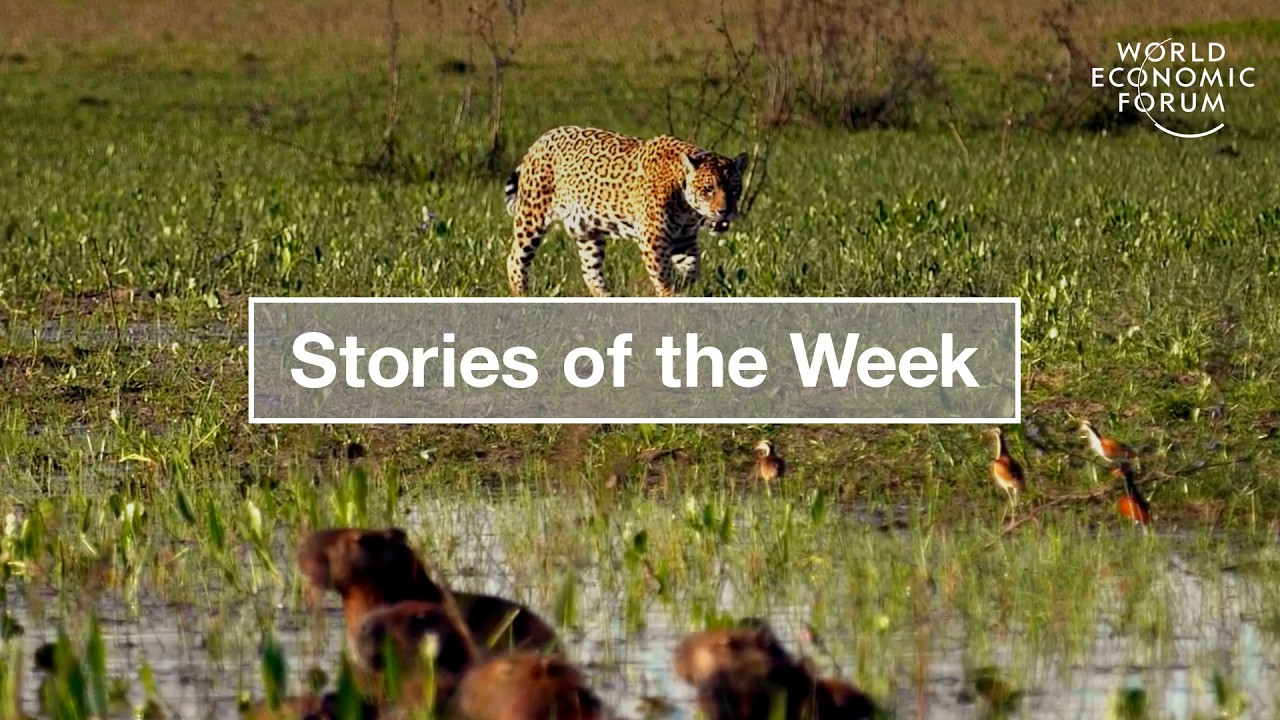
Jaguar Conservation & How Quantum Computing Impacts Data Security | WEF | Stories of the Week
Watch on YouTubeVideo summary
The video addresses the critical threat that quantum computing poses to modern digital security and emphasizes that human inaction is the primary danger rather than the technology itself. Since 1994, experts have known that future quantum computers could break current encryption methods, leading to massive efforts to harvest and store encrypted data now so it can be decrypted later when those machines become powerful enough. While this capability will not result in a single catastrophic hack of all banks or Bitcoin wallets simultaneously, the real risk lies in subtle anomalies appearing within critical infrastructure such as energy grids, water supplies, telecommunications, and banking systems. These small breaches would cumulatively undermine societal trust over time, making it essential to address data security vulnerabilities before quantum computers reach full operational scale.
In parallel with these technological concerns, the transcript highlights successful community-driven initiatives focused on environmental conservation through education and ecotourism. One example involves a project in Bosnia that gamified trash collection and recycling efforts, reaching nearly 1.5 million people by framing waste management as a fun way to connect and improve the community. The organizers stress that data mapping is crucial for understanding pollution sources at their roots rather than just cleaning up beaches later; similarly, another group acts as guardians of mangrove forests, educating locals on why these unique ecosystems are vital. In both cases, education serves as the foundational tool that ensures long-term success, proving that without informed communities, physical cleanup efforts alone cannot solve environmental problems effectively.
The narrative further explores jaguar conservation in Brazil's Pantanal region, where a retired racer turned ecotourism operator to save two orphaned young jaguars who lacked mothers to teach them how to hunt. Because these animals could not see humans while learning survival skills without becoming attached or dependent on people, the team developed strict protocols ensuring the stars of the show—the jaguars—always felt comfortable and had escape routes available during sightings. This approach has successfully reintroduced jaguars into areas where they were previously extinct by creating a sustainable economic cycle that benefits local landowners, residents, and wildlife simultaneously through job creation in ecotourism. Ultimately, protecting apex predators like jaguars safeguards the entire biome they inhabit, demonstrating how ethical tourism can fund conservation while preserving natural behaviors for future generations to observe responsibly.
Read the full video transcript
[music]
>> We've known since 1994 that quantum
computers would at a certain point in
the future break encryption. And so, of
course, there's been huge initiatives
since then to harvest this encrypted
data
>> [music]
>> and stockpile it so that it can be
decrypted while it is still valuable.
>> [music]
>> Trust is the most important currency
[music]
in modern business.
And we as consumers, when we use a
technology, when we use a service
online, we trust that that data is being
protected. When I [music] check my
emails, when I send text messages, when
I check my electronic health records. We
take that for granted because of a thing
called encryption.
>> [music]
>> And that's the math that keeps that data
secure and only visible to the parties
that are intended to see it.
>> [music]
>> Now, we know that quantum computers,
they pose a big risk to that encryption
and at scale they will break that
encryption layer.
>> [music]
[music]
>> Imagine that your diary
>> [music]
>> was found and and made available to
whoever wanted to read it, [music]
right? That's what we're looking at.
>> [music]
>> They're not going to use it to drain all
of the Bitcoin [music]
all at once, right? They're not going to
hack into the top five banks all at
once.
>> [music]
>> We're going to see small changes that by
design fly under the radar. These These
small moments [music] that cumulatively
over that year add up to something very,
very meaningful on a societal level. We
know that one of the first places to
attack if you have this kind of master
key to digital communications would be
critical infrastructure, would be energy
grid, would be where we get our water,
would be
>> [music]
>> banks, etc., etc., telecommunications.
And so, as we start to see anomalies
emerge there, that would be a start to
be an indicator that we've reached that
point in time.
>> [music]
[music]
>> And then put pressure on your banks, put
pressure on
the services that you use day-to-day
where you share that sensitive
information, where you keep those
assets. This [music] point in time is
coming sooner and sooner. And these
timelines are compressing.
So, I like to tell people that the
biggest threat is not actually the
quantum computers,
>> [music]
>> it is human inaction.
>> [music]
[music]
>> How we sort of gamified it was we
created like competition who can collect
the most trash or who can recycle the
most or the better. We really do
showcase it as a very fun way to hang
out with people, meet new people, share
perspectives, and learn something new
and also
bring something positive to your
community.
>> [music]
>> We gained a reach of almost a million
and a half people, which is very
impressive I would say since that's
almost a half of population of Bosnia.
>> [music]
>> You really need to collect data. This is
what one time clean up cannot solve. You
really need to track
>> [music]
>> this kind of material. Where are they
coming from and how they evolve?
>> [music]
>> I think litter data mapping is very
important. Not only in recycle
perspective, but also in economic sense.
Because if you can mapping a liter,
maybe you can get a really good
calculation that stopping this kind of
pollution in the very roots is much
better than collecting and the recycling
them in the beaches.
>> [music]
>> The idea is like they they become like
uh a mangrove guardians. [music]
Like they save the the mangrove and they
can tell everyone that they know that
hey, we have the [music] mangrove. This
is important to us. This is really
unique. Not all the cities have this and
we have the opportunity to have it
[music] and it's so good for the
environment. It's so good for our city.
So, we [music] have to keep it safe.
I think that a cleanup could be like
really successful, but it it it is
nothing without education. Because when
you have education, you can do better
cleanups or [music] you can not do
cleanups at all because people it's not
going to trash
a
>> [music]
>> garbage on the streets. So, for us the
education is the tool for everything.
>> What's special about jaguars that
jaguars are on the top of the food
chain. So, by protecting jaguars, you're
actually not just protecting one
species, you're protecting the whole
biome where they live.
So, when I retired from racing, I wanted
to work with conservation. I didn't know
how to do it. I'm not a biologist, a
vet, or a scientist. So, I decided to
take a 2-year sabbatical traveling all
over the world seeing pretty much any
animal you can imagine in the wild.
We decided [music] to do ecotourism with
jaguars, which are the third largest cat
in the world. They were [music] pretty
much impossible to see, and we wanted to
give access to people from all around
the world to these amazing animals so
these animals could see them in nature
and behaving naturally.
>> [music]
[music]
>> With jaguars and other big cats, the
promise they need to learn how to hunt,
and normally who teaches them is their
mothers.
>> [music]
>> In this case, these jaguars didn't have
any mothers. So, we have to come up with
a whole protocol of teaching them how to
hunt, and at the same time without them
seeing us because we didn't want them to
get attached to people.
>> [music]
>> So, what started as a small project to
save the life of two young jaguars now
has brought back jaguars to places or
even countries where jaguars were
extinct.
Ecotourism needs to be done to a certain
standard remembering that the star of
the show are the animals and they always
need to feel comfortable. So, there are
different ways to approach an animal
when you see them. They always need to
have, let's say, an escape route in case
they don't want to be there. It's
important to control the number of
vehicles in each sighting so the animals
don't feel threatened or disturbed.
Through ecotourism, you protect the
species that live in in that biome. They
bring funds to the local community. In
our case in Pantanal, they create a lot
of different jobs. So, [music] it's a
virtual cycle where the animals, the
local people, land owners,
everybody gain from it.