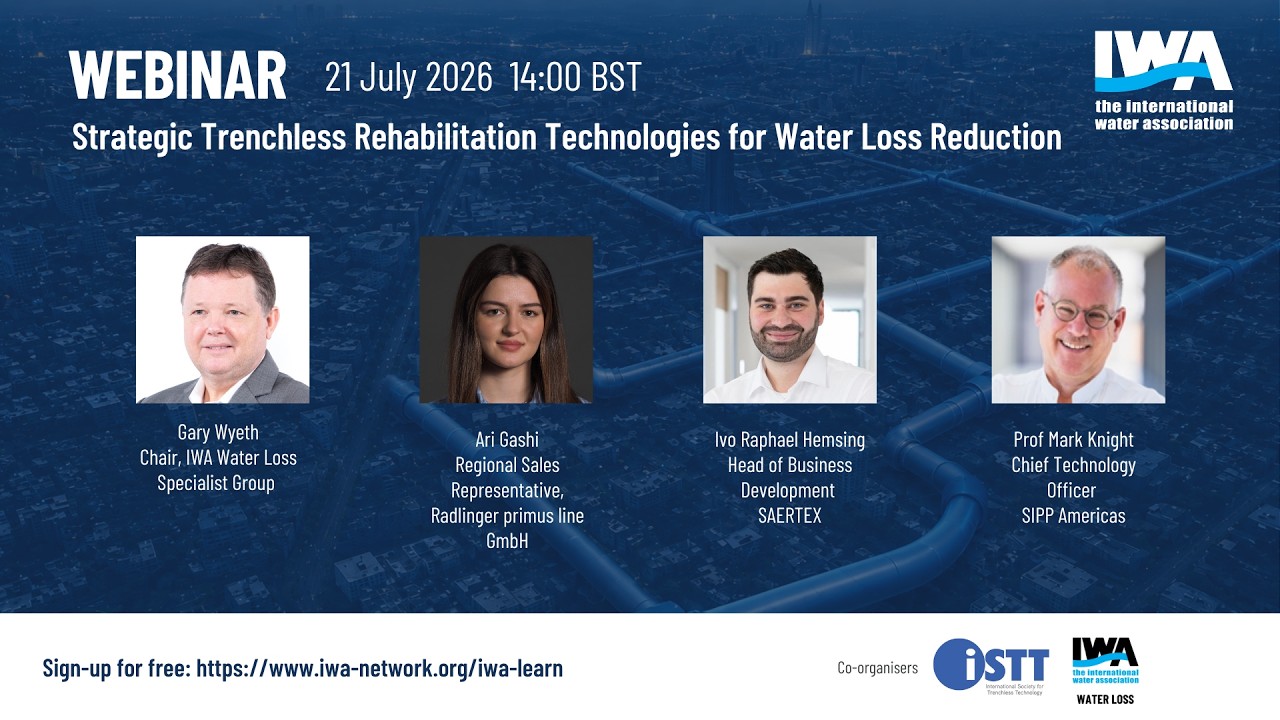
IWA Webinar - Strategic Trenchless Rehabilitation Technologies for Water Loss Reduction
Watch on YouTubeVideo summary
The IWA webinar on strategic trenchless rehabilitation technologies addresses the critical global issue of water loss, where over 30% of treated drinking water is lost due to leaks in aging infrastructure. To combat this, the event brought together experts from the International Society for Trenchless Technology (ISTT) and IWA to showcase three primary solutions: Flexible Fabric Reinforced Pipes (FFRP), Cured-In-Place Pipe (CIP), and Spray-In-Place (SIP). Ari Gashi presented the FFRP system, which utilizes a flexible composite liner reinforced with aramid fibers that are ten times stronger than steel by weight. This technology creates a new structural pressure pipe independent of the host pipe, capable of handling internal loads while the original infrastructure supports external traffic, with proven success in diverse environments ranging from corroded pipes under bridges in Vietnam to rapid flood recovery projects in France.
Evo Heming detailed the CIP method, which employs UV-cured glass-reinforced plastic liners to restore pipes without excavation. Given that more than 70% of Germany's drinking water network exceeds 70 years of age, this technology offers a sustainable solution with a minimum service life of 50 years and CO2 emissions reduced by up to 70% compared to open-cut replacement. The process involves cleaning the host pipe, inserting a liner with a protective foil, and curing it using UV light. Case studies highlighted its versatility in challenging conditions, such as steep gradients in Norway and installations beneath train stations in Germany, demonstrating its ability to extend the life of deteriorating networks efficiently.
Professor Mark Knight introduced SIP technology, an evolution from cement mortar linings that uses rapid-cure polymers applied directly to the pipe interior via a sophisticated, computer-controlled rig. Unlike CIP, which relies on pulled-in liners, SIP sprays polymer resins like aliphatic isocyanate polyureas to build a new wall in a single pass, allowing for very fast return-to-service times of as little as 60 minutes. The system automates quality assurance by monitoring resin flow and temperature, shutting down automatically if material ratios deviate significantly, while also accommodating large-diameter pipes up to 2300 mm by lining pipe halves sequentially to minimize the need for deep pits.
The webinar concluded with a focus on the advanced capabilities of SIP, particularly its ability to handle complex geometries without blocking service connections or creating wrinkles around bends. The ResiLine 320 material used in these projects achieves burst pressures two to four times the operating pressure while maintaining ductility similar to PVC. Real-world applications demonstrated the method's efficiency, such as completing cleaning, lining, disinfection, and reconnection within a nine-hour window on a line with up to 40% wall loss, and successfully lining 28 km of pipe in Marina del Rey despite high groundwater tables. The session also addressed practical considerations for T-junctions and diameter changes, reinforcing the role of these trenchless technologies in modernizing water infrastructure while minimizing environmental impact and service disruption.
Read the full video transcript
Good uh day everybody. Uh welcome to
today's webinar which is uh strategic
trenchless rehabilitation technologies
for water loss uh reduction. Uh my name
is uh Gary W. I'm the chair of the IWA
water loss uh specialist group and I
will be facilitating uh today's webinar.
Um first of all just some housekeeping
rules. Uh this webinar will be recorded
uh and made available on demand on the
IWA website and the IWA connect plus
platform for all IWA members. Um the
speakers are responsible for securing
the copyright permissions for their work
and all opinions, hypotheses, uh
conclusions and recommendations
contained in the presentations are the
sole responsibility of the speakers and
do not necessarily reflect IWA's
opinions.
You will see that uh with the Zoom
version that we're using here, we have
uh two um boxes at the bottom, there's
the chat box, which uh feel free to use
for general requests and general chat
between people, maybe telling each other
where you're from. Um and we have the
Q&A box as well. So at the end of the
three presentations that we're going to
have uh we will have um a Q&A session
and so please feel free over the next
hour to um put your questions in the Q&A
box and then I will go through those
questions and use those to um to quiz
the panelists at the end.
I just want to um talk a little bit
about IWA. So IWA is the global leader
in uh water association with a vision uh
to see a world in which water is wisely
managed to satisfy the needs of human
activities and ecosystems in a equitable
and sustainable way. Uh hopefully most
of you know the IWA um which is why
you're on this webinar because you've
received the uh the invites. But the IWA
is also made up of a number of
specialist groups. Um, and one of the
biggest ones is the water loss uh
specialist group of which I am the
current chair. Um, and Anna Botchko is
the secretary of the group. Uh we have a
very strong management committee with
over 22 members from 17 countries and
we're very strongly supported with over
4,500 active members who receive the
emailer that we send out every two
weeks. You'll see at the bottom um
there's an email address and if you go
to that email address you'll be able to
put your email in and you will start to
receive the emailers from the water loss
specialist group every uh two weeks.
The ISTT, the International Society for
Trenchless Technology, is a nonprofit
organization dedicated to advancing
trenchless technologies worldwide. Uh
last the end of last year, the IST
signed anou with the IWA and there's
already been one webinar and this is the
second one that's promoting the
relationship between the the two
organizations.
uh IST is aims are to connect
professionals, organizations and
industry leaders across the globe,
provide resources, training and events
to support continuous learning which
this webinar is one of them. Promoting
collaboration and sharing of best
practices and driving innovation for
sustainable and resilient
infrastructure. If you need more
information, you can email, you can see
there there's an email info@ist.com
and they'll be able to give you more
information about the organization
itself and how you can get involved with
them.
So we have uh three excellent presenters
today. Um we have Ari Gashi who's the
regional sales representative of uh
Radinga Primus line and she's going to
be presenting on reducing water losses
in aging pipelines using flexible fabric
reinforced pipes or FFRP and she's going
to show some applications and case
studies. We then have Evo Raphael Heming
who's the head of business development
for Certex and he's going to be
presenting on water network
rehabilitation using cured in place pipe
or CIP and an overview with with
references. And then our third speaker
is professor Mark Knight who is the
chief technically tech techn technology
officer of SIP Americas. uh he's going
to be presenting on advances in spray in
place pipe sip
uh pressure pipe rehabilitation
technology developments and uh case
studies.
So without further ado I will uh pass
you over to um Ari Gashi. So Arie is a
regional sales representative at
Radlinger Primus Line. As I've said, uh
after completing her apprenticeship at
the company, she's transitioned into her
current role supporting an international
team across a variety of water main
rehabilitation projects. Through this,
she's gained valuable insight into
challenges faced by network operators
and project um related work. and Arie
will be um talking about reducing water
loss in aging pipelines flexible fabric
reinforced pipes. So over to you Arie.
>> Well, thank you very much Gary for the
introduction and uh hello everyone of
course and thank you very much for
joining today's webinar. Um as Gary said
my name is Ari. Um and over the next 20
minutes I'd like to talk about one of
the biggest challenges uh facing water
utilities today reducing water losses in
aging pipelines. More specifically, I'll
be talking about uh how trenchless
rehabilitation using flexible fabric
reinforcement pipes or FFRP uh can help
utilities reduce um physical water
losses while extending the service life
of existing assets. Before we even talk
about rehabilitation technologies, it's
worth taking a step back and looking at
the challenges we are actually trying to
solve.
Um more than 30% of treated drinking
water is lost globally before reaching
consumers.
Um that corresponds to roughly 126
billion cubic meters every year. That
means that many utilities are dealing
with
uh agent infrastructure as we just saw
um that were installed like decades ago.
Um budgets are limited. uh pipe networks
continue to extend and of course climate
change is placing increasing pressure on
available uh water resources.
This means that reducing water losses is
no longer just a maintenance issue. It
has become an important part of
sustainable asset management and
long-term water security. So every job
does really count.
And now we ask where do these losses
actually come from? In the water sector,
we usually refer to this as nonrevenue
water or NRW.
Um, simply put, NRW is the difference
between um the volume of water entering
the distribution system and the volume
that is actually built to um customers
or consumers.
Some of these losses are of course um
commercial. These include like
inaccurate metering and then of course
um building issues or illegal
connections. But um today's presentation
is going to focus on the physical losses
like leakage, pipes bursts or joint
failures.
um since these typically represent the
largest share of um NRW in many drinking
water systems
and hopefully that's exactly whereation
technologies can make a real difference.
So why do pressure pipelines fail or
pipelines in general fail? Um in reality
there's usually no single reason.
Instead, several factors often interact
over many years. Uh, for example, for
metallic pipelines, um, corrosion
remains one of the most common causes.
Um, internal corrosion gradually reduces
the wall thickness while external
corrosion attacks the pipe from the
outside. Joint failures are another
common issue
like ground settlement uh installation
tolerances or aging ceiling materials
can all cause joints to lose their uh
integrity over time. And then we have
mechanical failures such as longitudinal
cracks um or sudden pipe bursts um that
are often triggered by um pressure
fluctuations or fatigue.
And of course um external influences
such as traffic loads uh soil movement
uh freestall cycles or even earthquakes
can accelerate the deterioration
process.
So
as utilities extend um [clears throat]
or are trying to extend the service life
of existing assets
um we need a solution
or at least
utilities are faced with a dilemma. So
once leakage becomes a recuring problem
utilities are faced with this decision.
Do they replace the pipeline completely
or do they rehabilitate it? And of
course the traditional way uh with open
cut replacement is um a proven method.
However, it comes with um high
excavation costs of course traffic
disruption
um long construction periods and uh
relatively high environmental impacts.
For many utilities especially in urban
areas these indirect costs can actually
exceed the cost of the pipeline itself
and that's where trenchless
rehabilitation uh becomes important
since it comes with minimal excavation
limited disruption
of course fast implementation and way
lower environmental impact.
So as this has brought us to trenchless
technology
um over the past few decades
um this technology have become an
established part of modern pipeline
management.
Um depending on the condition of the of
the host pipe and the
uh project requirements different
rehabilitation methods are uh available.
Some solutions mainly uh provide
corrosion protection uh while others
create a um completely new structural uh
pressure pipe inside the existing
pipeline. Uh but today's presentation is
uh about the flexible fabric reinforced
pipes. Um if you want to find out more
about um these technologies um I have
this live from the IWA website. you can
look it up and you'll find um many many
more.
So, and as I already said um
now that we've looked at the general
concept of trenchless rehabilitation,
we will look at uh FFRP.
Uh one example for this technology is
the Primos line system um which has been
used in drinking water, waste water, gas
and uh industrial application all over
the world.
So now you ask what does the system
consist of? There are essentially two
main components. First of course the
flexible composite liner
and then we have the specially designed
mechanical connectors
um and together these components form a
structural rehabilitation system to
carry the uh internal loads
independently of the host pipe support.
The host pipe becomes a conduit and
takes the ground and also the traffic
load.
And first of all, we're going to have a
closer look at the liner itself.
Although I know it looks relatively
simple from the outside, uh it's
actually a carefully engineered
composite structure.
The outer PE layer protects the liner
against uh abrasion during installation
and throughout its service life. The
real structural element is the seamless
with an aromment reinforcement
um or the keler.
This textile layer absorbs the uh
pulling forces during insulation and
later withstands um the internal
operation um operating pressure. Um,
aramid fibers are extremely strong uh
while remaining lightweight at the same
time. In terms of uh strength to weight
ratio, they're 10 times stronger than
steel which makes them ideal for this
type of application.
And of course then we have the inner PE
layer which provides a hygienic surface
uh suitable for drinking water
applications and it tightens uh the
reinforcement against the transported
medium and together these layers create
a flexible yet highly durable pressure
pipe.
Okay.
And that's not it with that. Um the
system is currently available in
diameters ranging from DN 150 to DN 550.
Um depending on the diameter,
installation lengths of well over 2 km
can be achieved in a single section. And
because of the wall thickness um is
relatively small, the hydraulic capacity
remains high compared to um other
methods. Um another important point is
the pressure rating. Of course um
depending on the diameter again uh
operating pressures of up to 82 bar are
possible. Um the system itself can also
negotiate bands of up to 45° without
additional excavation and in some
project specific situations even larger
bands are possible. Also multiple bands.
Um
the product itself is referenced under
ASMF370825
which complies with 15 international
hygienic approvals for um uh drinking
water.
So
and of course
um
ailitation system is only as reliable as
is connections and that's why connected
technology plays such an important role
as well. Um different connector types
are available
depending on the application and the
existing pipeline material. Of course,
um although the connectors connector
designs um differ slightly, they all
follow the same uh principle. It's to
create a reliable mechanical connection
while uh maintaining a leaktight
pressure system. This is especially
important for drinking water application
where uh long-term oper um sorry
operational reliability is essential.
Also um the system or the system is
designed for a lifespan of 50 years.
And in this cross-section
um this gives you a better understanding
of how um our connectors actually work.
The connectors consist of several
individual components
um that work together. um ceiling
elements prevent leakage of course while
the core and external sleeve um securely
clamp the liner between between the
connector
um and the connector is therefore not
simply attached to the liner. It becomes
an integral part of uh the complete
pressure system.
So that's about it about the um product
itself.
We will move on to the installation.
Here you can see um the installation in
a graphic in a very um yeah simple way.
Uh one of the biggest advantages of
transit rehabilitation is that the
existing pipeline can remain in the
ground as you see here as well. Only
relatively small access pits for points
are required at the beginning and at the
end of the installation section with a
start and destination pit. Um once the
liner has been installed then it carries
the complete operating pressure uh
independently of the host pipe. The
remaining annual space between the liner
and the existing pipeline uh release the
host pipe from the operating conditions.
So the host pipe only needs to carry the
external loads like traffic loads. Um
another important benefit is the
possibility of very long installation
sections of 2,500 m. Um for example
river crossings uh environmentally
sensitive areas and so on.
Now we'll take a closer look at the
installation itself.
Um so the installation itself begins
with the construction of two relatively
small excavation pits as I just
explained. One serves as the insertion
pit so the start bit while the other
acts as the pulling pit so the end pit.
Uh compared with conventional uh
pipeline replacement this uh
the required working area is remarkably
small. Um so especially when working in
highly congested cities and urban
environments um surgical pits are for
daily life um like they allow for daily
life to uh to continue.
So and before any work any
rehabilitation work can start um the
condition of the existing host pipe uh
must first be assessed. So we do have um
a CCTV inspection which provides
information about the um internal
condition of the host pipe and
identifies possible obstacles. Um the
pipeline then is cleaned using scrappers
and or rubber pigs as you can see in the
pictures again. And after cleaning um
the results are verified and documented
with a second CCTV run as you can see
there after the cleaning.
So and once the pipeline have uh has
been prepared um the insulation
equipment is positioned on site. This
mainly consists of the um transport reel
and the uh pulling winch and of course
the insulation tools. Um the exact
layout depends on the available working
space and the project conditions.
And the next step would be the actual
liner installation.
Um we use like using a pulling head
attached to the front end as you can see
there. Um of the liner. It is pulled
through the existing host pipe by a
controlled winching process. Um even
pipelines containing several bends as
you see in the second picture uh can
usually be rehabilitated without
excavation. And throughout the
installation, the pulling forces um are
continuously monitored to ensure um safe
handling of the liner.
Here you can see how the liner um
navigates through um through bands
without without a problem.
So and once the liner has reached its um
final position it is inflated using uh
compressed air with uh one bar. During
this process the folded liner gradually
um unfolds until it reaches the final um
circular shape as you will see right
now.
Great.
>> And now we come to the final uh final
steps or the final step um it's the
connection of the liner to the um
existing pipeline. After the connectors
have been installed um the complete
system under goes um hydrostatic um
pressure testing. So um we can verify
its integrity and for drinking water
applications the pipeline is also
disinfected um before being put back
into service. Only after all these steps
have been um success uh successfully
completed uh can the um rehabilitated
pipeline be recommissioned again.
Now to the most interesting part. So far
we've talked about the technology
itself. We've talked uh about the
installation. But of course the most
important question is how does it
perform under real project conditions?
And therefore I'd like to show you some
different parts um of examples.
We will start in Vietnam where we had to
rehabilitate a DN300 water pipe or pipes
was actually three. Um
it was for portable water with a
pressure rating of six bar and a test
pressure of nine bar. uh we used the
DN300 liner um and it had a total length
of 840 meter.
Now to the project details
um the situation was as follows. The
DN300 steel water man was affected by
corrosion
and required rehabilitation to secure
drinking water quality and extend the
asset service life.
Um so the challenge was actually that
the pipeline was located inside a bridge
structure and traditional pipe
replacement cost would have been
extremely high. Um so of course the
solution was uh primos line um allowing
a trenchless installation with uh
minimal disruption.
Each um trained contractor
uh sorry each line of section was
installed in less than one hour by a
local trained contractor and uh
supervised
um by Primus Line and the outcome was
that the rehabilitation secured the
drinking water supply and it extended
the pipeline service life by 50 years.
Um and it also was completed without uh
without excavation.
We will move on to Spain. And by the
way, congrats to everyone who rooted for
Spain uh for winning the World Cup. So
um congrats. Um but now to uh to more
serious to the more serious part. uh we
had to rehabilitate an uh asbestous
cement trunk water mane um of DN250
which had uh drinking water and a
pressure rating of 7 bar.
We used a DN DN250 and a DN200
uh and it had a total length of um over
10 kilometers.
Now to the project details. Um the 10
kilometers or a little bit more than 10
kilometers as best cement water mane was
in a critical condition
uh since it was causing frequent pipe
failures and wall losses of
approximately 25%.
So the challenge here again was um that
the pipeline crossed uh environmentally
sensitive areas, roads and railways
making conventional open cut replacement
highly disruptive and environmentally
challenging.
Um we then or they then decided to use
the Primus liner in um in 20 trenchless
installation sections
um so we could avoid extensive
excavation and reduced uh construction
time. And as we all thought um the
project reduced the construction period
from 12 to 4 months um achieving up to
30% costs saving as well compared to
open trench uh replacement and we
restored a reliable drinking water
supply.
Moving on to Germany, uh we
rehabilitated uh a siphon with a length
of 1,240 meter.
Um it was installed inside a existing
DN300 P80 uh drinking water siphon
beneath the Finsburg fjord. Um again for
drinking water with a pressure rating of
10 bar um we decided on the DN250
and was it was installed in one
installation section only with 1,240 m.
Um so the details here again uh the
siphon beneath the flwork fjord uh was
installed in the 1970s
uh which is and was a key part of the
city's water supply um and the replacing
the pipeline beneath the fuel would have
been technically difficult and
economically impractical.
Um the challenge was to rehabilitate the
existing pipeline with a single length
um which we did. there was no
possibility for additional access.
Um
we did a CCTV inspection uh cleaned um
the pipe by pigging and rehabilitated
using the primus line system. Of course
the liner was installed in a single pole
um and connected using the primus line
connectors
and it was also inflated with water
instead of air. Um so the outcome was
that at the at that time this was the
longest single primus line installation
in Germany. Um and installation was
completed in eight working days with the
liner pulled in within approximately 3
hours.
And now we have the final project or the
last project which was in France.
Um it was a ground alongside on a street
and 180 uh 20 m in a uh PVC pipe uh
stretching across um a river. It was
again for drinking water um at a
pressure rating of uh 10 bar. We decided
on the DN50
um and we rehabilitated 1,340
m including the river bed crossing in a
PVC pipe.
Um it was after a historic flood uh
destroyed the riverbed and
infrastructure in uh yeah um I don't
think I can pronounce that but uh it
most definitely in France it disrupted
the water supply as you can see here in
the picture. Um the urgent need to
restore the drinking water to the flu
damaged area coupled with the difficult
uh area presented a significant
challenge. Um so the primal line system
was used to install a free floating
pipeline across the riverbed and um
connect uh to the existing networks via
landbased pipelines. So the outcome was
that the water supply was restored uh to
the affected area within 4 days uh
without requiring any on-site hosting
equipment.
And that's about it. Um thank you very
much for your attention and I'm going
back to to Gary. Thank you.
>> Yep. Uh thank you very much Arie. That
was a great uh presentation. Um, I think
what we'll do is we'll wait until all
three speakers have finished and then
we'll have the Q&A discussion after
that. Just a reminder for all people on
the on the webinar, please put your
questions into the Q&A function, not the
chat function because we're we're not uh
watching that, but please put it into
the Q&A and then I'll ask the questions
later. So we're now going to move on to
our second speaker uh who is uh Evo Hems
Singh and he's the head of business
development uh manager in the field of
pressurized pipe rehabilitation at
Certex Multicon. Since 2017 he has
specialized in the planning and
installations of global rehabilitation
projects with CIP. Since then more than
400 installations with the Cereex liner
for pressure applications have been
realized in over 30 countries. So Evo is
going to be presenting on water network
rehabilitation using cured in place pipe
CIP. Over to you Evo.
>> Thank you very much Gary. Um hello
everyone. Yeah welcome to my
presentation uh water network valutation
using cued in place pipe short CIP.
Today I will uh first explain some of
the basics of the standardized
technology using GIP liner material and
then I will use plenty of construction
site images to illustrate projects from
my yeah nearly uh nine years as project
engineer installing liners for drinking
water pipes.
Yeah.
Yeah. I'd uh like to start with
something that's often reported in
regional newspaper around the world.
This fontain uh was very near my
hometown a few years ago and uh
illustrates the impact that disruption
in the water supply or in any kind of
pipeline supply can have on uh big
impact on people's life, the
environment, traffic, and of course the
costs.
But let's uh take a step step back. Um
in my home country, Germany in
particular, the facts clearly show that
replacement and rehabilitation um will
become an even bigger issue. This is
because large parts of the 5,300,000
kilometer long public drinking water
network in in Germany are already up to
or incumbent 70 years old and only about
1% of it is being renewed every year.
Also raw and drinking water losses in
Germany at five to 10% um are is very
low um um by the uh comparison globally
but experts uh estimates that on on a p
per person basis every German will need
to invest approximately€ 10,000 euro
over the next 20 years to keep water
losses uh water losses to five to 10%.
So lost a lot of invest.
Yeah, even uh through there are um
experts absolutely listing here right
now. I'd like to share the top five five
most common problems that I encounter
most frequently. You can see here in the
pictures um there are damages through
corrosion, joint leakage, cracking,
structural uh deformation and yeah not
real uh pressure searches of course also
and yeah but since
nearly everybody here in the audience is
an expert I won't go into further in
detail. Uh so uh I just want to point
out that these common types of damages
or leaks and water systems can be
rehabilitated using UVCP technology
resulting uh in a new estimated service
life of at least 50 years and also the
the host pipe material uh doesn't matter
if it's PE material asbesto cement uh uh
steel iron it doesn't matter.
As shown in the picture, uh liners do
not require large chambers or construct
excavation pits and um yeah are very
well suited for urban areas like cities
helping to protect the environment,
trees.
project produces up to 70% less CO2
emissions than digging and installing
new pipes.
But first, I want to
was too fast. Sorry. First I would like
to classify this technology um that is
UV cured glass reinforced plastic uh
using this table in the standard ISO
11295.
uh due to the high mechanical properties
like uh modulus of elicity um um
resulting from the glass fiber in
combination with the resin independent
and fully structural liner which is then
class A uh with a very th uh thin wall
thickness is possible um which helps
maintain the hydraulic uh integrity of
the water system.
Yeah, here is a gra graphic showing the
construction or the design of a typical
UV CP liner. This is this is here the ZX
liner uh for drinking water
applications. Um I will start from the
outside and then move to the inside.
uh outside there is a damaged uh host
pipe and once the liner has been pulled
into the existing pipe and has cured out
with UV technology there's a thick PVC
foil to protect the liner from from UV
light like the sun and mechanical
stresses and then an additional foil is
used to prevent uh any resin uh any
prevent any resin from escaping.
Um yeah uh to the blue one now. Yeah
that is the most important one. The blue
layer there are well engineered glass
fiber mats mats impregnated with
styrenefree vinyl estster resin for u UV
gap liners. The entire impregnation
process is carried out inhouse at the
factory. So there is no impregnation
directly on the construction site.
uh the the most inner layer is the thick
PA and PA foil to ensure uh the best
possible hydraulic uh performances.
Yeah.
Tests of course the pressure ratings or
maximum operation pressures uh of GP
liners are very important for for the
network operators and owners. uh they
are tested by certified uh party
institutes like here in the picture the
IMAR in uh in Germany Dson on the right
side you can see uh a test stand in the
middle there is the ZX liner without any
kind of host pipe tested it's a DN300
with a wall thickness of 6.3 mm and
first of all this test stand there uh
was uh 10,000 hours tested with more
than 20 bars and afterward after
afterwards uh uh they made an shortterm
internal pressure test and you can see
in the graph after 200 seconds the birth
pressure was nearly 75 bar and uh yeah
with all the safety factors and the
reduction factors out of the standards
and regulations with that dimension we
have then um maxim maximum operating
pressure of 23 bar.
Yeah. Here we can see also the whole
table because the maximum pressures is
depending on the on the dimensions
and uh
yeah it's completely based on the
long-term internal pressures. So the
10,000 hours um and uh we can make also
uh projectwise specific uh uh worth
calculations. So if there is a lot of
groundwater, a lot of traffic over over
the pip pipe, we can also higher up the
wall thickness to withstand all inner
and outer forces.
Here
we can see a small selection of the key
certifications, approvals, standards
like the ISO or the AWWA
and also the regulations and uh yeah my
aim is to show you uh that while this is
an innovative and new technology yes but
it's also a proven and certified system
and I can confirm that uh my team and I
have uh carried out uh more than 400
projects worldwide uh over the last 10
years. And uh to prove that I want to
show you a few uh case studies out of uh
the past um I begin with a very yeah uh
easy one I would say. It's is in Germany
in eastern Germany in the small town
called Toga. Uh this was a show
construction site. We invited there more
than 60 planners, network owners,
operators. Everybody was welcome. It was
a DM600 portable water uh pipe out of
duct tail iron. Um in the pipe sockets,
the the pipe was uh leaking with an
operating pressure of 3 uh 3.5 bar. The
length was only 60 m. Uh but it was
perfect to show our technology to
everybody nearby.
Uh like Ari told us before um first of
all we have to uh yeah clean the host
pipe. It must not perfectly smooth uh
and 100% round but in total we want to
avoid uh yeah sharp edges or obstacles
inside. So we are getting robots inside
or pigs or something else to clean like
water pressure as you can see here in
the picture.
And then after cleaning you can see on
the left side uh on the truck uh that is
our ZX liner H2O with the with the blue
foil on it. Um it's uh getting right now
uh pulled in over a conveyor belt and
it's getting pulled in due to a cable
winch which is on the other side of the
section. Uh behind that you can see also
the UV truck which is um especially for
drinking water.
Here you can see two tech Oh, this is
the other side of the um so uh of the
construction site. As you can see here,
these two technicans are getting
installing so-called PEKA which is a
cylinder to yeah keep the to to save the
uh compressed air inside the liner and
afterwards to get the UV equipment
inside the liner to clear it out.
But before curing and pulling the UV
equipment inside, uh my colleague here
is right now testing every uh every part
of the UV equipment. And only when
everything is completely working, of
course, uh we can here on the right
picture uh getting the light train
inside of the liner.
Oh, and then uh together with the uh UV
equipment inside uh and and outside the
truck, we can we have the full control
uh in the front and in the back there
are cameras. We can we have the full
control before uh installing the liner.
If there's any kind of obstacle or I
don't know wrinkle inside um we will not
start uh the the um installation. And uh
also during the installation we can see
everything also we we have sensors for
the temperatures and uh of course the
operating pressure
uh to what diameter is okay see the
diameter uh it's up to 1,500 mm. Um but
let's go on uh cutting back the cured
liner. As you can see, the liner is now
uh round and hardened. So, uh a
colleague now cut back the liner inside
of the new piece of pipe.
You can see here in the next picture.
That's me checking uh the inner
dimension, the new inner dimension of
the host pipe, checking the wall
thickness. Everything was perfect as
calculated. And then
uh to make sure that everything is tight
fit, we install uh a liner end seal.
Many of you maybe um know this
technology. Uh it's on the market since
decades. And um it's a pretty simple
system. There is the black rubber
material. This is EPDM or other
manufacturers have silicone on it. And
then to make it uh yeah tight uh uh we
install in total uh there three steel
wings which are pressed with a hydraulic
uh expender to the liner and to the to
the new piece of pipe there to ensure
that we have a minimum service life of
50 years.
So that was uh in in in Germany a very I
would say easy uh live demonstration of
Salina. But now I want to show you some
some challenging projects in Northern
Norway in the town Narvik. Very
beautiful there. As you can see this is
a DN 250 section in total with a length
of a little bit more than 350 m. And uh
the the host pipe was yeah into
the mountain with a short turn short um
real lining. So uh we have to do it in
one shot. That was very challenging this
uh 352
meter and uh the house pipe was ductile
iron. And then the network owner or the
customer was asking me what is your
maximum operating pressure with your
liner? window said okay it's 33 bar and
then he said okay then that is our new
maximum operating pressure also in that
pipe especially for us
and the next uh challenge was the the
gradient or slope we had here uh
difference of the of two uh of the two
entries of 101 m and so a slope of or
gradient of 45 degree so 100%
uh I will show you later pictures uh
that was really challenging uh on the
right side you can see in that red
circle uh what's um was course
everything because the very new uh pipes
had uh uh the epdm out of the pipe
socket so every second pipe socket was
leaking that was of course not good for
the pressure test.
But then of course our lineup is right
now coming. As you can see the gradients
um yeah makes it quite difficult or
challenging to get the equipment up to
the mountain. The mountain in total was
I think 650 m high. And so we our
customer there used a sledge and pushed
and pulled the UV equipment up to the
mountain. And on the right you can see
the host pipe, the duct iron pipe. Yeah.
Picked into into the mountain.
Yeah. Also a very beautiful place there.
Yeah. As you can see, um, we in we
pulled in our liner from, yeah, from
from the from the top of the mountain,
uh, it was it was that that was not
challenging because it was like falling.
Uh, and in the next picture,
uh, you can see after getting the air
uh, inside the liner, so the liner is
completely close fit through the host
pipe, uh, we cured it out. On the in the
left picture you can see we have the
full control about the chewing lamps. Uh
every lamp we every single lamp we can
we can control we can control the
temperature really nearly everything
and uh oh not to forget the curing speed
was 1.5 meter per minute. So everything
was done in one day
and yeah after the liner uh was cured
out uh we cut it uh a little bit back
and here we used uh in this project a
new piece of pipe. We coupled that on
with that coupling and then we installed
the yeah the liner and seal onto it like
in the last case study.
And then the next challenge was to get
back to yeah to the town and uh the one
week later or three or on the Monday
there were the um pressure test with 35
bar. So that was also a challenge
because on the on the um blind flange
down uh the down section was the total
uh yeah pressure of more than 17 tons.
So a lot of pressure there 24 hours but
every everything was fine. So I was very
happy
and yeah now we had some very yeah a
show show construction site uh and a
very challenging construction site. Now
a very short one case study what is
normally I would say in in Germany we
call it bread and butter projects. This
is uh 2.4 kilometer of DN1000.
It was a handmade steel pipe with yeah I
think nearly 90 years old and we used a
liner with a wall thickness of 9.3 mm
and as you can yeah see in the picture
here there was it's not only very urban
and not only a lot of traffic it was
also uh a train station above. So uh
yeah it it was really uh yeah not hard
but we have to calculate very carefully
but 9.3 mm due to the standards and
calculations was uh completely fine
and that's uh all from my side. Thank
you very much for your attention. Yeah
and our uh yeah title is also the future
is trenchless I think which which is
quite good for this event here. Thank
you very much.
>> Thank you very much Evo. Good
timekeeping. Um so we will move on to
our last uh speaker before we have the
Q&A session. So our last uh speaker is
uh professor Mark Knight who is the
chief technology officer of SIP Americas
LLC and uh he is a professor in the
department of civil and environmental
engineering at the University of Wateroo
uh for over 27 years and his research
focus has been on pressure and gravity
pipeline rehabilitation, asset
management, trenchless pipe construction
And uh Mark's going to be presenting on
advances in spray in place pipe
technology SIP. Uh so I will hand it
over to you Mark now for your
presentation.
>> Thank you Gary and um thank you for
everybody to uh for attending.
Um, spray and place pipelining, even
though it seems relatively new, as I'll
show you in a second, has been under
development since the 1980s.
And there's a variety of different uh
terms now that are coming into the
industry, which hopefully we'll be able
to standard standardized soon. So SIP
can often mean spray and place pipe
which is the common term in AWAC620.
We call it spray and place polymer
linings because um different polymers
can be used to be able to be sprayed
inside the pipe itself. So in in general
SIP
in North America at least uh refers to
pressure pipe lining. Another term in
the industry is sprayed applied polymer
linings. Um these have been used in um
culverts and other gravity pipes
um in those sections. So that's um a
little bit different but the application
is is similar. um different types of
materials are being used. So what we're
really talking about is another
alternative to uh cured in place
pipelining in CIP which Evo did a great
job in explaining and talking about.
So even though um it may seem relatively
new with respect to some of the
materials, this technology has been in
development over the last uh 40 plus
years. Um really developed in the UK um
in the 1980s in order to be able to u
get rid of cement mortar linings that
were having water quality issues. Um and
they really wanted to um um fix that and
they developed uh epoxy linings that
were could be applied one to 2 mm thick.
Um the issue was relatively slow cure of
those.
By the 1990s they developed the first
rapid cure materials but again they were
limited in application to 1 to 2
millimeters just basically as a barrier
coat. Um and they started to be able to
do same day return to service because
they could speed up that curing process.
In the 2000s um in the UK they started
to develop uh fast cure highbuild
applications. If you familiar with the
old uh 3M spray place pipelining uh
those were the that's where it came
from. But there was also continuing
development in the spray-in place uh
equipment in order to be able to apply
those. they became computer controlled
and they developed um with Yorkshere
water the ster cleanse system to be able
to rapidly [snorts] get a pipe
disinfected and put it back in service.
As we advance in the 2010, there's
basically uh advances again in the spray
equipment innovation.
Um and then braceive stone cleaning came
into the marketplace which uh I'll show
you a little bit later in order to be
able to improve the cleaning
um and bond to the host pipe. And one of
the recent advances in 2019
um Raimac developed the first alifhatic
isocyanide polyora
um which is a facet polymer. It allows
and has NSF approval to basically build
a 1 to 14 mm thick liner uh quickly. um
90 seconds dry to the touch, 15 minutes
after you apply a coat, you can put a
CTV camera in to get um and build
another uh coat applied on top of it um
with a 60-minute return to service. And
by 2023, this material is now being used
in the US, Canada, um Australia, Chile,
Europe, and and now around the globe as
a as a premier uh product.
There are different um polymer resins
that are available. Um we've got
epoxies. Um the issue with epoxies and
spray in place linings is relatively
slow cure. Um and they're temperature
dependent. Um the main thing about all
these uh products we have uh cure which
is important. Uh we also have mechanical
properties that we need to have. Um some
products have very good dry mechanical
properties but when they're saturated in
water um over a period of time they tend
to soften. So we got to make sure that
we have good wet mechanical properties
is a critical point especially for
design of liners. The other issue is
shrinkage. um the higher the exotherm
and the temperature of part A and part B
and when they mix they increase that
temperature the higher that temperature
the more shrinkage that you you get. Um
so what happens is when you get in um
the alifhatic isocyanide polyureas they
kind of compromise and and build that um
hot rapid cure um ability to be able to
do multiple coats without any prepping
between the coats. Um it's got high dry
as well as wet shrinkage and the
temperature uh exotherm is is is very
low. So we can actually get bond um at
service connections as well as to the
pipe. And this product was uh
specifically developed for rehabbing of
water manes especially using the shore
um spray equipment that was also
developed in the UK.
So the SI line SIP lining process is
very different than CIP. What we're
going to do is we're going to use a host
pipe as a form to basically build a new
uh pipe inside that pipe. So what we're
going to do is use um a spray rig where
we've got a part A and a part B
conditions um at the recommended
temperature. And for Resiine 320, that
temperature is close to 30° uh Celsius.
um they're going to get pumped down the
umbilical and they're going to be their
temperature is going to be maintained so
the vicosity of part A and part B are
the same um and then um we're going to
spin cast uh that mix that material in a
Y block and I'll show you what that
looks like and then we are going to
basically cast the pipe. So, what we're
going to do is we're going to get the
spin head um at the far end, and we're
going to pull back um the spray head and
and coat the pipe with a with the
polymer um with a thickness of anywhere
between 1 to 3.5 mm of material at a
given at a given period of time. Um the
air motor is driven by compressed air
and runs at about 10,000 um RPM.
So the process is rather simple. So
we're going to do is we're going to take
droplets of of that material and um
we're going to apply it relatively fast.
So we can line about 150 to 160 m. The
the umbilical length is what really
controls the length of that material.
And we can now build the lining
thickness that you actually require on
the inside of the pipe. of the process
is is relatively simple. A part part A
and part B come in and um go through a Y
block where they mix. So that's the
first time they actually mix. Then they
go through a static mixing tube so that
they're fully mixed. Um and then they
get thrown off as droplets onto that
pipe wall. Um and and the rig pulls back
at a controlled rate. We constantly
measure part A and part B flow to make
sure that they're um on ratio throughout
the lining process and I'll talk a
little bit more about that as as well.
So very um simple um process itself.
Um the key to
um this process is to make sure that
you've got the right equipment um and
the controls in process to be able to
ensure that you're going to get a high
quality lighting. So the rig is a
critical part of that process. Um shore
um in the UK has been leading in
innovation in the development of this
equipment. It's a very computercont
controlled piece of equipment. It
constantly measures the resin flow. It
measures the pullback speed of the
umbilical. Um, and we have the ability
to do weight checks and to make sure
that we're on ratio at the at all the
times. So, the equipment is very
sophisticated. It's automated and once
it's programmed and it starts, it it it
automates the whole process from a
quality assurance and quality control
process. Um there's a detailed record um
that is uh recorded and provided uh to
the owner as well as to the contractor
of um weight checks, temperature um of
the part A and part B flowback speed and
the lining thickness is applied.
If during a lining um application the
material um goes off ratio by 5%.
Um then or more um then the warning is
provided um to the owner as well as the
contractor to say hey there's u we went
up by 5% on ratio. If it goes off by
more than 10% the rig will actually shut
down um and the operator cannot restart
the rig until they go back and do some
weight checks. um on that application.
So quite a bit of quality control and
operations is built into it. A lot of
advancements in the rig. Uh we have the
ability to automatically uh open and
close part A and part B valves. Um so if
there is an issue, we can shut that
material off and um and stop the lining.
Um we don't need people in the pit in
order to be able to start the lining.
Um, you can now there's lining vision
which has a camera fitted at the end so
you can watch the the lining process go
on live. Um, and then we've got
automatically
set and forget lining so the rig
basically does everything and the
operator just monitors the whole
situation.
We also have non-cont flow meters and a
smart weight check process to make sure
that we've got integrity and so people
can't uh cheat the process on the lining
process itself.
So for larger diameter applications um
we can do um anywhere from um 100 mm uh
to 2300 mm in diameter pipes at 16 to 92
in. when we get into larger diameter, we
can go to a power trolley instead of
that um spray head that's being pulled
by the rig. So, this is an automated uh
system that's um autopowered. Um and in
this case, we can do a longer length
because the umbilical is much longer.
So, we can do lining lengths here up to
40 400 meters in length. And if we can
get inside the pipe and collect the
material, then we can have pits to pit
it at around 800 meters. Um, basically
by lining one half of the pipe one day
and then coming back and lining the
other half of the pipe uh the other day.
In lining projects, pits are expensive
and and if you can reduce the number of
pits, you can have a huge impact on the
on the project cost itself.
um on in those side with respect to
design for SIP and CIP
um there's really no difference. We use
the same design equations um same
material properties developed using the
same A ISO and ASM standards. What's
really different between SIP and CIP is
the construction method. We don't have
to wet out a bag. We don't have to
install a bag. um we can just apply
multiple coats on on those applications.
In North America, most of our contract
specifications um are constructionbased
and not performance-based.
Um and um if you really want to use SIP,
then you should really use
performance-based specifications on that
application.
What's really unique about ResiLine 320
is we have an 8 hour recode window. So,
what does that mean? If I apply another
a second coat within 8 hours, you will
not see a seam um between the product
will basically make a homogeneous uh
thick pipe. So again, I can go um
between 1 and 14 in plottable water
networks. If it's raw water, um we can
go beyond 14 millimeters in lining
thickness itself. um this excellent
inner coat bond seam. I don't have to do
any prep um to the liner as long as I
apply that second coat within that 8
hour window. So that gives us a lot of
flexibility.
When we get to um 10 in um which 200 mm
and above, we can apply 3.5 millimeters
per coat. Um the 14 millimeter approval
is four coats at 3.5 millimeters. So we
can apply that basically in one workday,
no problem.
Mechanical properties are very similar
to PVC. So we are basically building a
PVC pipe. Um PVC pipe comes in specific
dimension ratios or DRS. Um we can build
the DR that you need in the field um on
that side. So we're very similar to
build basically building a PVC pipe with
more ductility
um than PVC pipe has. So again we have
excellent long-term 50-year uh design uh
properties. So there's no difference. We
can design for 50 or 75 years. So we can
meet um ISO class um basically one um to
uh or A uh no D to um B for sure. Um and
in many applications in some
applications depending on the issue that
needs to be resolved we can also meet
isoclass A as being a fully structural
liner.
Um, we've done burst testing on the
materials. So, 360 PSI to 474 for a 150
mm diameter uh pipe segment, 3.5 mm
thick. Um, so that's um, you know, um,
more and less suitable for most uh,
municipal applications in North America
that are running at around 80 PSI. So we
can be anywhere between two to four
times the operating pressure of the
system. We'll never have the re uh burst
strengths of uh of a Sarex liner that
Evo was showing, but in many
applications we don't necessarily need
that um that high strength.
Um service connections um we don't uh
block any service connections. We throw
droplets of material around that service
connection and up into that service
connection itself and um so we can
recote those service connections itself.
So we don't have to uh block and open
them up. If we do block them, we can
open them up afterwards. We can also go
through bends and turns. So this is a
project in uh uh in California where we
had to go through two bends. So there's
two coats of 3 mm, so uh 6 millm liner
um through those two bends. In this
case, what we did was we uh did the
first coat pulling in one direction,
moved the equipment, did the second coat
pulling in the other direction, and
we've got a nice uniform coat at the
joints as well as in uh in the bend
section. So we're going to make a
watertight liner itself on on that side.
We can also clean hydrant leads as well.
Um, we can't code hydrant leads, but
there's often more tuberculation in the
hydrant leads. And you can just see the
material sprays up on the inside of that
hydrant lead and and basically cones.
So, from a case study point of view, in
the fall of 2024, we did a project in
Deep River. Uh, we opened up the pipe
between 7:00 a.m. to 8:30 a.m. U, we
started cleaning at 8:30. Uh, we
finished cleaning the pipe at 12:30.
I'll show you some pictures of of that
in a second. Um, between uh 12:30 and
1:30, we uh did what I call uh the CTV
prep as well as prepared the pipe for
lining. Um, basically making sure that
all the joints were cleaned as well as
the services and then and the pipe is
ready for a high quality lining and the
pipe wasn't lining.
in um between 1:30 and 4, we applied two
1.5 mm coats for a total of 3 mm in the
inside of that pipe. And be by 4 to 6
p.m. we had the pipe disinfected and
reconnected and people were drinking
water on that pipe. So, we didn't have
to use any bypass. So, it's a very uh
quick and process. So, there's the pipe
at 9:00 a.m. That pipe had internal
corrosion, didn't have any internal
barrier. Um what we found was wall loss
was up to 40%. Um no external corrosion.
We drag scraped that pipe with um with a
vac truck on the other end. So all the
material went into the vac truck. Um
relatively easy and quick process. And
then we used abrasive stone cleaning to
remove any graphite on the inside of
that pipe. And then we lined it with the
2mm coats. Uh we do bond to the hose
pipe. We've done bond testing um with
coupons. We will um well exceed the 500
to 750 PSI uh bond strength to the
existing host pipe. Um the main thing is
that Raziline 320 has that low exotherm.
So we get very little shrinkage um on
the pipe material itself.
In Marina del Rey we um had to rehab a
um 1.8 28 km of 18 in or for 450 mm
water mane. Um it was relatively deep
with a high water table. We're right
next to the ocean and there were
multiple bends in order to be able to do
uh to do this to do this project. Um
again we were in a very crowded urban
environment. We did lining lengths up to
170 mters um at a given time considering
that the umbilical around 180 mters um
for the rig that was used. There were
many un unidentified bends um that we
had to also take into account and and
line through. So, one of the advantages
is for us to be able to to uh line
through bends and not have any wrinkles
and folds occur um at that at those
bends itself. And then we had a high
tidal groundwater table back into
service. So, we just had to clean the
pipe and liner the pipe. And the
contractor um absolutely loved the
process and says basically it's a very
contractor very simple process in order
to be able to uh to be used
in those applications.
And again this is the uh pre and the
post lining uh v um image of especially
through uh through those bends um on the
6 millimeter installation itself.
So some of the benefits um we can
quickly construct a continuous smooth
watertight lining at joints as well as
at service connections. Um we can clean
and line up to 160 m in one workday. So
it's extremely fast. Um and we've can
build the lining thickness that uh
basically you require um to um to meet
your your needs. So if we reduce uh
construction time, public disturbance,
um we also uh will reduce uh project
cost itself. So I'll turn it back over
to uh Gary.
>> Thank you very much, Mark. That was uh
very comprehensive. Um we'll go into Q&A
now. We've got quite a few questions
that have come in. I don't know if Arie
and Evo can turn on your uh cameras and
then we'll do a panel discussion.
>> Yeah.
>> So, what was interesting I think with
Mark's presentation was that with the
spray lining, if there's any TE's or any
connections, it doesn't block those um
those connections. So, I'm just
wondering, and we've had this question
from a couple of people, uh, Ari and
Evo, with your systems, what actually
happens if you come across a T or
customer connections? How do you deal
with that? I don't know who wants to go
first, Arie.
>> Ladies first.
>> Oh, sorry.
Um, then I'll go first. Um, well, that
that that always depends. Um
but usually um of course we should know
that beforehand uh we usually provide
all like the uh the end client or the
customer should provide all the
information. So um there there is a
possibility to uh to connect the the T
with the with the connectors that's no
problem at all but we usually know that
like in most cases.
>> Okay. Evo anything to add? Uh yeah for
the ZX liner I can I can answer that. Um
there is a technology we have a partner
Nova in in Italy which are producers of
uh this uh yeah side connections of
fittings. Uh it's very new on the market
so right now limited for the dimension
DN300 but it's possible. Yes.
>> Okay. So if I can add in North America
what we tend to do with CIP
is to before you install the liner is to
plug the services with a plug
um and then install the liner do your
pressure test and then drill out the
plugs and drill out your um connections
or or hydrant leads in order to be able
to do those. So those are extra step
steps that have to go into that lining
process with CIP.
>> Okay. And and the next question I guess
is probably for all three of you again.
Um what if the pipe that you're lining
changes diameter or even changes
material? How does that affect the
process that you deal with? Do you can
you just go straight through or can do
you have to stop and and at those
changes?
Who wants to start?
>> Uh maybe we start with EVO this time.
Um yeah um we can the DX liner can be
produced millimeter wise. So normally we
are searching for the smallest point of
the um section we want to rehabilitate
and then uh the liner has um a
calculated stretching on it. But of
course um when there is annual gap
between we can also calculate that. So
maybe then the liner will be a little
bit bigger or thicker but of course it's
uh yeah we we must decide it project
wise.
>> Okay Mark
>> um we can account for diameter changes.
So, um, because we're throwing drops of
material, we can put the skis and the
spread on springs so that we can change,
uh, diameter. I've got a project where
it's an 18 in and goes to 17 in. Um, so
I can do those diameter changes. Um, we
just need to make sure that if we want
an even application of the material that
the spray head is centered in the middle
of the pipe. Um, we can even do a a
centric.