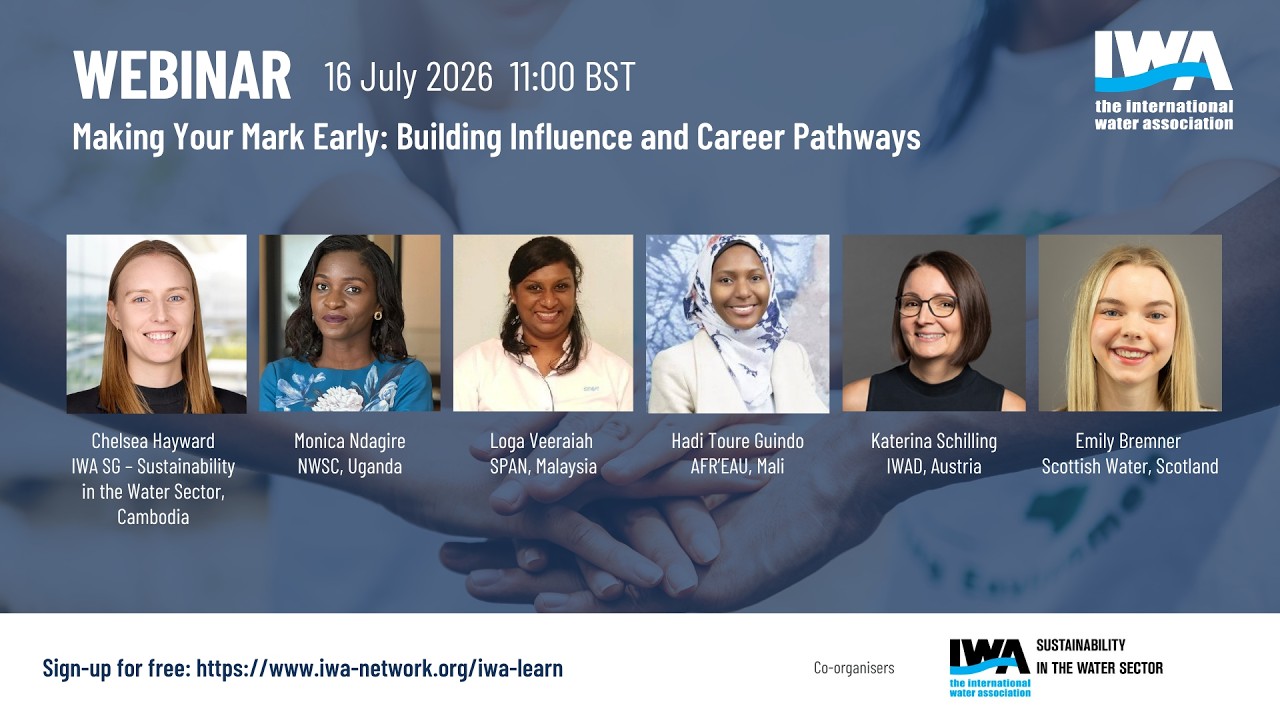
IWA Webinar - Making Your Mark Early: Building Influence and Career Pathways
Watch on YouTubeVideo summary
The webinar "Making Your Mark Early" explored how young professionals can build influence and advance their careers without waiting for formal titles or authority, emphasizing that career paths are rarely linear. Speakers shared personal journeys illustrating that leadership begins with daily contributions, technical expertise, and strategic relationship building rather than hierarchical position. Monica from Uganda highlighted the importance of maintaining connections outside one's current role to access opportunities, noting how taking initiative during a staff shortage opened doors for her return to the sector. Similarly, Hadit Gindo discussed empowering youth in Mali by giving them accountability through research and event leadership, demonstrating that innovative approaches integrating traditional knowledge with science gain acceptance through persistence. Katarina Schilling further reinforced this message by showing how voluntary engagement accelerated her career before she held formal positions, proving that visibility stems from consistent contribution rather than rank.
A central theme across the presentations was the necessity of proactive behavior and resilience in overcoming barriers such as tokenism, fragmented pathways, and resistance to change within traditional engineering sectors. Logan Va emphasized that gender-inclusive innovation is a vital untapped resource and explained how persistently advocating for climate considerations eventually led to new divisions despite initial senior staff resistance. The speakers collectively advised young professionals to embrace organizational disruptions as opportunities to expand their influence beyond comfort zones, noting that titles follow demonstrated leadership rather than preceding it. Core values such as curiosity, integrity, collaboration, courage, and accountability were identified as essential traits, with a strong encouragement for individuals to fail fast in order to learn faster while fostering an environment where diverse voices are valued collectively by all genders.
When addressing the critical question of what young women should focus on during their first five years, the panelists offered unified advice centered on networking early and making oneself visible without waiting for permission. Monica suggested grounding one's efforts in understanding the system and building relationships with admired figures, while Hadit stressed not being shy about asking questions or reaching out to mentors. Katarina added that investing time in professional networks is an investment in future career trajectory, urging participants to lead themselves first before attempting to lead others. Logan reiterated that failure is a necessary part of experience and encouraged attendees to attempt new challenges despite the fear of failing, reinforcing that consistent volunteering and idea-sharing are key to establishing credibility over time.
The session concluded with details about the upcoming IWA World Water Congress & Exhibition in Glasgow, which will feature technical workshops, immersive tours including a trip on the steamship Sir Walter Scott, and forums addressing Sustainable Development Goal 6 investment. The event promises cultural evenings at Kelvin Grove Art Gallery, community fringe programs like street fairs and murals tracing water journeys, and digital operations challenges replacing traditional drilling with crisis simulations to attract wider candidate pools. Additional opportunities include the Emerging Leaders Forum for global peer connection and discounts available through slide codes until year-end for new members. The webinar ended by thanking the speakers and attendees while encouraging continued engagement through IWA programs to support professional development and inclusion in the water sector, with upcoming webinars on indigenous women guardians, strategic trenchless technologies, and regional calls listed for future participation.
Read the full video transcript
Good morning, good afternoon, or good
evening everyone and welcome. My name is
Chelsea Haywood and I'm delighted to be
your moderator for today's IWA Women in
Water webinar, Making Your Mark Early,
Building Influence and Career Pathways.
Many of us begin our careers wondering
how we can make a meaningful impact
before we have a leadership title, years
of experience, or formal authority. The
reality is that careers in water are
rarely linear and influence isn't
something that suddenly appears with a
promotion. It's built through the work
we do every day, the relationships we
develop, the opportunities we choose to
pursue, and the confidence to contribute
our ideas. So today's webinar is about
exploring exactly that. We'll hear from
women at different stages of their
careers, each with a unique perspective
on how they have navigated challenges,
built credibility, expanded their
networks, and created opportunities for
themselves and others. Uh, but before we
begin, there's a bit of housekeeping to
go through. So, next slide, please. So,
this webinar will be recorded and made
available on demand on the IWA Connect
Plus platform with relevant information.
The speakers are responsible for
securing copyright permissions for any
work that they will present of which
they are not the legal copy copyright
holder and the opinions, hypotheses,
conclusions or recommendations contained
in the presentations and other materials
are the sole responsibility of the
speakers and do not necessarily reflect
IWA opinion.
Next uh so throughout this webinar there
will be um a Q&A session uh and so we
want to encourage you to please use the
chat box or the Q&A box uh to send
through any questions that you have for
the panelists
next one.
So we'll begin uh this webinar with our
speaker presentations followed by a
panel discussion. Um, so like I said
throughout the the presentations, please
feel free to submit your questions using
that Q&A or chat function and we'll do
our best to answer as as many of the
questions as we can during the panel
discussions.
Uh, next
uh but before I hand over to our
speakers, I'd like to take a moment to
introduce the IWA women in water program
under which today's webinar is being
delivered. The program was established
to build on the momentum of the women in
water initiative launched at the IWA
World Water Congress in Toronto with the
aim of creating a strong and lasting
global community that extends well
beyond the congress itself. It brings
together women and allies from across
the water sector to connect, share
experiences, learn from one another, and
support women's leadership at every
career stage through ver webinars like
today's uh networking opportunities and
events at the World Water Congress. The
program aims to foster a more inclusive
and supportive profession. The program
also explores how we can advance action,
resilience, and prosperity in the water
sector, recognizing that inclusive and
well-designed water and sanitation
systems create better outcomes and
greater opportunities for women, girls,
and communities around the world. Uh so,
next slide, please.
Uh in Glasgow, there will be a range of
activities and initiatives. Uh we're
ensuring that the the congress is gender
inclusive. Um in the leadup we are
hosting a series of webinars like this
one. Uh and during the congress with
there will be a connection hub uh
different social and networking
activities uh a buddy system as well as
other women in water con content um
presented throughout the congress.
Next slide please. Um so without further
ado like I mentioned we have uh many
wonderful women um from different career
stages joining us today. Uh we have
Monica, Logan, Hardy, Katarina as well
as Emily um who will be sharing uh
insights from their careers on how they
uh made their mark early. Uh so without
further ado, I will hand over to Monica
to start her presentation.
Hi everyone and thank you for joining us
today. I'm Monica and I work with
National Water and Suridge Corporation
Uganda. I'm also a young water
professional from Uganda and an IWA and
ground force youth action for SDG6
fellow. Last week the United Nations
released the SDG6 report on water and
sanitation 2026. I quote, "Water is
increasingly seen as a super connector
linking climate action, food systems,
ecosystems, health, economic development
and resilience across the entire
sustainable development agenda. Thus,
there is need for integrated water
resources management. So, as women in
water, I would like us to all know that
we make a major contribution wherever we
are working. If you're working in
finance, if you're working in accounts,
are you an engineer? Are you working in
water quality?" We all make a great
contribution to achieving SDG6 targets.
However,
progress is possible and happening, but
it hasn't reached some of the people.
For example, my mother in the village
does not have water at her home. I do
not sleep well at night knowing this
hasn't yet been made possible because of
infrastructure challenges. question is
how are you as women in the water sector
contributing to accelerate
implementation so that water and
sanitation goals become a reality for
all by 2030.
Next slide please.
I'll shortly take you through my journey
and be as realistic as possible and
honest.
I started out my career right after high
school. I got a job in hospital. I was
working in Zambia hospital at the
patient's reception and I realized that
toilets are dirty. Even in a private
hospital, sanitation is poor and usually
there is no water or occasionally there
is no water. So in whatever sector
someone is working, we all need water.
And as women, we face the challenges of
not having water most because we need
water when you're on your period. You
need water when you give birth. that
children need water or else they will
have explosive diarrhea and so on. So
after working in the hospital I joined
the university
and in the university I got an
internship at the national water and
sewage corporation. How does this come
about? I did not even know I got the
internship until a colleague that is now
with the world bank let me know that oh
Monica I saw your letter at national t
corporation you were given an internship
placement point I want to emphasize is
as women in water we need to keep our
connections and we need to maintain the
friendships and the networks that we
make because opportunities usually come
through our networks then shortly after
I had finished my internship I went back
to school to the university I had a
colleague who had visited from Germany
and he knew a colleague from Germany
that was working at the construction
site of the same company national water.
Now I had not been to this new site the
bugaloving sur treatment plant but this
colleague said oh I have an engineer
that is managing the site do you want to
visit? I said yes. So when I got there
this gentleman talks me into joining the
sector because this is sanitation. I had
only worked in water. So he told me
about biogas,
waste management, resource recovery and
I pick interest. So as women in water
still I emphasize that you need to keep
your networks and connections while
building your career even before you
join the water sector. The career is
built wherever you are. You don't have
to formally get the letter for you to
get serious about getting what you want.
Then after that, after my internship and
after this visit to the plant, I
remember that during my internship, I
had a very good supervisor who was
already working with National Water. And
because I worked really hard, I used to
work late. I used to stay late to finish
any work that was available. I remember
there was a project called the Lake
Victoria Environment Management Project.
Now, I was so determined that there was
a time they were going to the field to
monitor the lake. They monitored the
water quality of the lake. occasionally.
So there was a time they left me behind.
I took a taxi and delivered myself to
the site which is far away from where I
stayed. I think that this really stayed
with my supervisors at work and they
were really nice people. They kept
encouraging me.
So I kept on hoping to join the sector
later that is even before graduation.
Then later I graduated in environmental
science at Mccary University. Then after
graduation there was no job. So as a
young woman in water it is not obvious
that you're going to join the field. You
have to work towards what you want.
So you have to keep on seeking the
opportunities and determined to
contribute to the sector. What did I do
when I finished university? I requested
someone near home to join their office.
I was looking for a job and I was
desperate. So the gentleman says we do
not have jobs at the moment. But the
person that was cleaning the office fell
sick. I said, "No, I can clean the
office." So, I joined this office as
someone cleaning. I'd already gotten my
degree in environmental science.
This impressed the person so much that
they recommended me to someone in an
office that was nearby. They said, "Hey,
there is this graduate. She's very
hardworking. She can do this and this."
So, I went to see this gentleman. But
when I saw this gentleman, they were
running a freight company. They said,
"No, someone that did science says you
have no business working in a freight
company, but I know someone on the board
of National Water that I can talk to to
see if you can rejoin National Water
because you said you in turned there."
When this person was reached, they said,
"No, the company doesn't work that way.
We advertise if we need people to join.
So, let the person wait and join when
there is an advert." Luckily the same
person reached out when an advert for
quality control officers. So that is how
I applied. But even when I applied, it
wasn't obvious. I didn't get the job
right away. I had to wait one year for
one year and a half. But eventually
I got in. Thank God.
Then when I [clears throat] joined the
company,
I right away joined the young water
professionals program that is run by
IWA. And through this program, I met I
met a mentor. I remember she had gone to
Toronto and won best poster.
How do I meet her? We had run campaigns
for the young water professionals
committee and I was really enthusiastic.
So when she came for the event, she came
looking out for me. She said, "Who is
Monica? I want to meet this person. When
she met me, she said, I want to mentor
you because I have not seen someone this
energetic.
So that is how I met my first mentor. So
I need to emphasize that joining the
professional networks is very important
for women in their early career because
the people are going to guide you. There
are so many things that my mentor has
connected me to so many opportunities
and she still guides me every day that I
am at work.
Next slide please.
So leadership begins before the title.
Leadership starts with contribution and
not a title. As a woman in water or as a
young water professional seeking to grow
in the sector, you do not need to first
get a title.
You do not need to first get a title,
but you can bring initiatives that will
benefit others and that way you'll be
seen and grow. Next slide, please.
But first of all, you need to be really
good at your job. You need to have the
technical expertise for you to be seen
and to be trusted with bigger
opportunities. Next slide, please.
So growth happens beyond your job
through professional networks. I already
said this and there are very many global
opportunities. For example, the IWA
presents opportunities for young women
in the sector. for example, the IWA and
Grant force youth action for SDG
fellowship, the IWA leadership program,
and there are several IWA specialist
groups that young women can join to work
with other people across the world in
the sector. Next slide, please
from local to global engagement. So
local excellence can open doors to
regional and global leadership
opportunities. I'm saying this, you have
to do well locally for you to be seen
globally. So do the best that you can at
your job. A simple cheat code for young
women that I can give you is do whatever
it takes to become excellent at your
first few jobs. The people you work with
will open doors for you. Next slide,
please.
Visibility. Become visible through
offering service to others and not just
visibility for yourself. Offer service
and that way and that way you can be
seen. and make use of networks for
example LinkedIn. Next slide please.
So a call to the women in water. The
water sector needs the talents ideas and
leadership of young women. So if you're
already working in this sector and you
can mentor a few ladies below you please
help them teach them. There are very
many opportunities out there and we can
all shine. Next slide please.
Thank you very much.
Thank you very much, Monica, for for
sharing those insights. And you you
touched on some really good points and
tips there. And I particularly liked um
how you talked about making a
contribution no matter where you work
within the water sector as well. I think
that's really important. Um so we will
go on to Haddie now to provide another
young water professional perspective.
>> Thank you, Chelsea. Can you hear me?
Correct.
Okay, great. Uh, hello everyone. My name
is Hadit Gindo. I am an environmental
engineer uh by profession um and
co-founder and president of an
organization called Afro uh which is a
women led organization based in Mali. I
[snorts] also am um co-chair of the IWA
chapter in Mali that was recently
launched
and I was part of the first cohort of
the fellowship that Monica talked about
during her presentation. So today I want
to share about the story behind um
building the platform I needed and the
title of my presentation.
I think it all started with me
recognizing a gap that I experienced
personally as a young uh water
professional and deciding to build a
platform through which other young
professionals could gain real
responsibility
um and demonstrate their expertise in a
safe uh space. So early in my career I
was fortunate to participate in
trainings uh networking conferences um
and international conferences. These
opportunities were valuable and they
exposed me to new ideas, new
perspectives um and possibilities.
Granted that I come from a from
country and um
knowing that you know the um ability to
speak English just opens doors and opens
resources uh for us um in Mali.
So but I kept seeing the same pattern in
Mali. Young professionals were invited
to participate um in conferences and
activities
um but they [clears throat] were rarely
given the pen and by being given the pen
I mean the power to shape an idea to do
the work and being trusted to produce
knowledge um and carry on activities
professional activities. So there were
closed circles. Access to opportunities
often um dependent on already being
connected to someone. As Monica also
talked about, there were also fragmented
pathways. You will still attend events,
but you don't know where to start. You
don't know how to make your dreams come
true.
And of course you've heard of tokenism,
how uh youth visibility becomes more
important than actually involving young
people in the processes.
Next slide please.
So that gap is one of the reasons why we
created Afro. Um we wanted to create a
platform where young professionals could
do more than just um attend events,
advocate for uh youth enga engagement.
We wanted them to actually organize
events uh research, train and be
hands-on. And that's why the A in Afro
stands for action. And under action, we
create spaces uh for young people. For
example, during a national symposium on
citizen science that we organized um
last month, young people were at the
heart. They defined the teams. They
conveyed the people that they wanted and
they were a able to pull off um a
national event that was very pertinent
in the water sector in Mali.
And this tells a lot about the sector um
and the older generation as well um that
have ideas about what young people
um can or cannot do. So under the F of
Afro there's also form which means
training in in French and we train
students we train young professionals in
soft skills in you know getting a proper
CV um getting well prepared for
interviews um also how to communicate
with confidence on LinkedIn
but also uh through our Afro activities
students and community members are at at
the heart of our research and action
based um uh monitoring water quality
monitoring um experiences.
So the R in Afro uh stands for research
and our uh GMAN project is our
highlights um funded by IIC Delft in the
Netherlands and again it did place the
students and the community members at
the heart of the research on water
quality on the Niger River. So uh making
communities participate effectively in
um research activities, collecting
evidence, discussing findings, it makes
them feel more valuable and um um bring
in some more locally uh led solutions to
the challenges we face um currently. So
for us again I would like to go back to
the metaphor of uh giving young people
the pen. It means that you also provide
them the opportunity to produce
something uh for which they could be
accountable for. Um as young people we
long uh uh we advocate for being given
the opportunity but we also have to be
able to maintain and be accountable for
our actions.
Next slide please.
Um again before I actually uh talk about
the next topic I wanted to also
emphasize um that it's not always
uh how do you say it's not always green
and the the um the struggle is still
there. the barriers still remain and yes
we've uh been able to achieve so many um
so many things but then at the same time
we're still challenged to publish our
work for example and this is partly
because of our composition with a bunch
of young people uh doing research and uh
we are curtainized uh scrutinized by um
you know more experienced people in the
sector and this is also a reality that
we need to face. Um so if we decide to
make our mark, we need to be prepared um
that there are barriers and I I want to
also emphasize that.
But then um Jim Mansa became the clear
uh example of how we can actually apply
research and innovate in the approach of
working with communities. So when we
started a project, we could not just
simply say that um Afro was credible
because we were passionate. We were new
people coming in the sector as a group
of young people that wanted to research
in a different way and we could already
see criticism. I've se I've been in
rooms where I pitched the idea of
citizen science to the national
directorate of hydraulics and they just
looked at me like this young girl is
crazy. She thinks she knows a lot. Um
but um I can proudly say that we're
still working with them and we're
currently trying um a pilot site and
slowly but surely they opened up to the
idea. So we should not be afraid to take
bold steps and actually talk to people
and make them listen to what we have to
say.
So um we organized focus groups in
fishing communities in Bamako and um two
communities in uh Nishair.
The community spoke about what they were
observing for example pollution, plastic
waste, declining fish population and the
changes that happened. Um they also
talked about their traditional knowledge
um that they have traditional practices
that they have of treating water and uh
we conducted field campaigns across six
sites in Bamako and we measured water
quality parameters um pHidity and
dissolved oxygen and what uh was quite
innovative with that is that we combined
that with the community's traditional
approaches and made the synthesis of not
just scientific results that we attain
but also um the background that comes
with the scientific findings to give um
the whole picture of the communities and
um
what's more important with that is also
that after getting all these results we
went back to the communities to
disseminate the results of the research
but also of um the focus groups that we
had And um one of the community members
told us that projects come and go, but
this was the first time that the team
returned to share the results with them.
And this I wanted to really emphasize on
um because this was an initiative that
the creativity of young people um made
happen basically and um because we did
things differently because we got
together we wanted to explore new ways.
we were able we were able to impact the
communities differently.
So this was a le um a leverage for us
for the discussions we had also with the
um people that are more experienced in
the sector and the fact that we were
also not just uh collaborating amongst
each other as young people. who were
also associating um expert researchers
in the field that also um helped. Next
slide please.
>> Hard sorry I don't I hate being the one
who has to
speed things along but if you don't mind
so we can make sure we get our other
speakers in. Thank you.
>> Yes. All right. Um no worries. So again
our communities really okay I'll be
really short and to the point because I
think this is the most important aspect
and it is that yes we are part of
networks we are trying to build we are
trying to be visible but we need to also
make sure that after we've done um all
the work that there is another
generation happening uh sitting there
and um taking the lead. And what I've
also seen in young professional networks
is that um we have a group of people
that start doing a bunch of things and
then it just slowly slows down and
everything is gone. And this is because
we didn't build a generation. We didn't
transmit the knowledge. And
unfortunately that's also happen what
happens between generations because the
more experience when they retire they
don't give us all the information and
often time we have to start from scratch
and we need to break that uh tradition.
We need to pass over um the relay to
other people that are um less
experienced and that can take on um the
lead. That means sacrificing a lot of
our time and effort into mentoring and
really being able to communicate uh
communicate and um um provide expertise
as well if needed.
Last uh slide.
So for me uh gaining visibility and
advancing individually is one aspect of
career success. I'm not going to dismiss
it. It's really important. But I've seen
um again like I said so many initiatives
go silent when the most motivated um
individuals were no longer active. So
for us young professional groups and
even um co-founder of organizations or
even young people started just starting
it is crucial to ensure that when we
move on to other responsibilities
because we will do that we've made an
impact um in the sector by coaching
other people and transmitting um the
knowledge that we gain and the
experiences that we gain from trying to
fight the system. So thank you very much
for your attention.
And um just wanted to finish with uh a
last sentence that when we talk about
holding the pen and making your mark
early, it is also about building the
courage, space and opportunity um for
others to write the future with you.
Thank you very much.
>> Thank you very much. I really love that
analogy of of giving young people the
pen. So thank you very much. And before
we go on to uh Katarina, I just want to
remind everyone um if you have any
questions for any of our speakers to
please um make sure that you um get
those into the Q&A box. Um so I will
hand over to Karina now.
>> Thank you Chelsea. Uh first question,
can you hear me properly?
>> Yes.
>> Perfect. Okay. So uh first of all, thank
you um for inviting me. Also thank you
to Monica and Hardy for the great
presentation so far. Uh my name is
Katrina Schilling. I'm the secretary
general of IWD. Um we are a membership
based association of uh water utilities,
water utility associations and other
stakeholders in the Danube region. So in
Europe um it's basically a smaller
sister association of IWA. We also have
very strong bonds with IWA and the
memorandum of understanding. Um and uh I
will also share a bit how IWA brought me
actually to my current um position. I
don't have any slides. Um I just want to
share basically my journey of
professional development with you that
is now more than two decades long
already. So I'm by far not a young water
professional anymore but I used to be
one and um I love to say actually one of
those early birds um when the whole
young water professional program
actually started within um IWA. So today
I would like to talk about uh the
importance of professional engagement
beyond formal roles or beyond work
profiles, work positions um let's say
and um to take um or to to tell you to
highlight the key message of my talk
already up front um I think my own
experience shows that careers are often
not linear and u many of the most
meaningful opportunities come from
saying Yes, at the right time. Um, they
come from getting involved, building
relationships beyond, um, your formal
job description. So, uh, with that, let
me jump into like my early career. Um,
after obtaining my masters in in
biology, I started to work as a research
assistant at the Vienna University of
Technology. Um I also obtained my um PhD
there and um there we had I can really
recall we had a team meeting at a point
um back in I think 2004 or 2005 and my
professor at the time Helmut Cro who
then became after all the president of
IWA and who was super um excited about
the new young water professional program
um of of IWA. He basically asked who
would like to build a young motor
professional chapter in Austria. So we
are based in Austria. Um who would like
to build that? And you know I mean I was
looking at my colleagues there around
the table and a lot of them were like
looking at the floor um saying like I'm
not here. I don't want to get involved.
No additional work. And I just thought I
mean this sounds great. This sounds
super excited exciting. I want to do
this. raised my hand without thinking
about it just out of I don't know
intuition or whatsoever and this is how
everything um started and um yeah we
started then to build up the first one
of the first young professional chapters
in Europe I think even globally it's
still there um I mean what what Hardi
just mentioned the idea of like moving
from generation to generation of young
border professionals was actually not an
easy task ask. Um, but we managed also
20 years after to to have the the YWP
chapter um um being alive um which I'm
particularly proud of. And um I also got
engaged on an international level. I
joined the World Water Congress in 2006
in Beijing um and and joined the YWP
activities there. And then I mean that
was a lot of luck actually. Uh we also
had the 2008 world water congress in
Vienna and there we thought as YWP
chapter hey um we would like to get
engaged there and um we actually created
the first young water professional
lounge [snorts] at the world water
congress. Um it was a chill out area for
YPS to meet um with a with an agenda
throughout the week. People loved it.
Even the seniors came in because they
thought wow nice place to chill out. Um
and you know by doing all of that by
being engaged also in the gender
development etc. um obviously IWA
headquarters thought I might be suitable
to become um the chair of the
international young water professional
committee um which is now the emerging
water leader steering committee. Um, by
that time I think there was just one
chair before me. Um, Michael Story if
I'm not mistaken. Um, and yeah, as again
I said yes. Um, I had no clue what I was
like signing up for actually. They
didn't brief me a lot. Um, but I just
thought that's an incredible
opportunity, so let's take it. Um, and I
became the chair from 2008 to 2010. And
again, it all started actually at the
World Water Congress in Vienna because
they put me on the closing panel
together with like four or five other
people um to talk from the YP
perspective. Um they told me basically
the evening before I still can recall
it. I was by that time I don't know 28
29. I was frankly speaking scared to
death. Um it was my first experience
like that talking in front of I don't
know 2,00 2,500 people. Um but yeah it
was a great opportunity and I somehow
managed. Um so as you can see um by
becoming engaged in IWA I mean this um
opened a lot of doors. Um these
opportunities exposed me to people and
discussions that I would not have
encountered through my regular job
alone. And um I think for young
professionals this kind of participation
in professional associations can
accelerate learning and open doors that
might not be visible from within your
organization. So the key takeaway
basically from this story is don't
underestimate the value of getting
involved early even in volunteer roles.
Um in addition or next point I would
like to share is that being the chair of
of of young professionals on an
international level opened another I
mean a couple of doors. I became
observer at the board of IWA. I also
joined the strategic council and the
general assembly um as as a YWP observer
representative. Meanwhile, these are
different roles, but at that time it was
like all under one head basically. Um,
and that gave me another uh great
opportunities. I was able to listen to
experienced leaders. I observed
decision- making processes um especially
on the board and I learned how influence
is built and um actually also the board
meetings I learned that most of the most
important um um discussions are not
actually taking place during board
meetings but after um at the dinner at
the bar wherever and um I mean it's that
exposure and that learning that
basically helped me also to uh get to
this position where where I am now in in
leading um also a membership based
association. Um so what I would like to
point out with that is that some of the
most impactful learning experience were
informal and unstructured and they just
happened simply through being present.
Meanwhile, IWA has a lot of really great
opportunities and structured learning
opportunities like the LEAP program etc.
By that time that was not the case but
just being exposed helped me um so much
and and and um I learned quite a lot. Um
just uh two more short points um just
letting know Chelsea because of the time
um the importance of building visibility
and recognition.
I think early in our careers we often
feel that we need formal leadership and
formal leadership title before before we
can make an impact. My experience was
actually the opposite because through
IWA activities I was able to contribute
um take initiative and become visible
within the sector long before holding a
professional senior position in my daily
life job. Right? So visibility comes
from consistent contribution and
[clears throat] not only from hierarchy.
So again key takeaway leadership starts
with participation, proactiveness and
initiative and not with a job title. Um
and finally I just would like to
emphasize the power of professional
networks. Um I mean I think or I hope
you have already seen how much IWA has
contributed to my career development. Um
but yeah, it's one of the most important
lessons that I've learned is that a
strong professional network is
essential. Um a network doesn't only
provide knowledge but also
opportunities, mentors, collaborators,
support and finally also friends. Um and
I found uh quite a few um and I think
essential is also that um being part of
a professional network is not only about
paying your membership fee. Um,
investing time in your network is
investing time in your future. And keep
in mind that the professional network is
only as strong as your willingness and
effort to invest into it. Um, and
finally, constant investment pays off in
the long run, and it still does for me.
Even though I'm not a young professional
anymore, um, I'm still part of IWA. I'm
a fellow by that time. um I had the
opportunity to join different um
committees, working groups, whatsoever.
Um and um I'm still getting
opportunities like this to to speak to
you. So I think it really pays off and
and really my advice for you would be um
get engaged in a community and I mean
you're already there basically because
you're joining that this network or this
this webinar um to to move your career
forward. Thank you so much.
>> Thank you very much Katarina. It's
really interesting to hear how you've um
been able to get involved in in
different IWA initiatives and and be
able to get that leadership experience
before actually having any formal
leadership roles. So, thank you very
much. Uh and last not but not least, I
will hand over to Logan.
Hi everyone. Good morning, good
afternoon or good evening. It's evening
here in Malaysia. I hope everyone's uh
weather out there is um good. It is
truly truly an honor to be here with all
of you uh passionate young water
professionals. I hope uh my name is
Logga Va. I'm a senior executive at the
National Water Services Commission in
Malaysia. Uh today I'm going to share a
little bit of my personal journey as
well like the others. uh not because
it's extraordinary but just because it's
it it actually demonstrates um the key
points that I want to bring to the table
today uh about leadership and about you
know one opportunity and it's always
about one challenge and one courageous
decision at one time and uh let me also
reiterate that the future of water is
not about only about gender it's it's
not only about male or female but it is
about ensuring that we harness the best
talents available. So we all as we
always say you know women must be
empowered to lead innovate and influence
decision and that's why we are here as
well you know we it's like a women help
women kind of uh program I hope and
[snorts]
uh when we speak about innovation we
always think about um you know
artificial intelligence AI digital twins
smart utilities but one of the greatest
opportunity to innovate is um something
much simpler at least in Asia which is
always forgotten. That's why my title is
gender inclusive innovation is the water
sector's biggest untapped resources
because you know the simple thing in
innovation that we can do is we ensure
everyone's voice uh especially young
professional especially women's voices
is heard valued and empowered. Next
slide please.
Since I'm representing the National
Water Services Commission, so I'm just
going to quickly give you an um intro.
Uh uh National Water Services Commission
SPAN we call it in short is the single
uh water regulatory body uh which
governs uh through u economic, technical
and social aspects of water supply and
cate services in Malaysia. Our mission
goes beyond regulating utilities. It is
about ensuring sustainable resilient
generation. Um I think uh why I'm
sharing about span is uh in Malaysia to
you know the time that I entered span 10
years back there is even a prerequisite
for us to you know join span to as a
workforce you need to have at least five
to six years of experience because as a
regulator you should already have some
kind of um experience some kind of um uh
lead at during that time that that was
the perception
So you know um that is uh why you know
being in span is like uh you are working
for one of the highest authority for
water services in Malaysia and uh pretty
happy about that. Next slide please.
Next slide please.
Right. So my journey with IWA has um
quite many of you also shared. Um my
first um you know uh interference with
IWA was in 2008 that is 18 years ago two
decades like how Katrina shared um and
it was IWA conference in Newcastle
University where I did my masters and uh
during that time IWA meets the students
in each university to uh get you know
people to join the YWP and I think one
of the best decisions I've made in to
join IWA at that point of time. So
that's been 18 years there. I was also
sitting exactly where many of you are
today and uh excited, slightly nervous
and wondering where my career would take
me. And um I never imagined that um
after years I have now I think uh
mentored at least 10 to 15 young water
professionals so far uh internationally
even at a national YWP uh level and then
become speaker serve as program
committees chair international forums
speak at international forum so many
many other things. When I joined in
2008, I was that was the rarest dream I
would have had. Right? So none of this
happened overnight. Every conference I
attended, every volunteer role I
accepted, every conversation I initiated
became another building block for my
professional journey. So I started
somewhere and uh I think uh one of the
most important thing is being consistent
about it. So uh since um 2019
I have also joined the water regulators
forum of IWA which is a yearly annual
event and it is only it's a closed group
network only for regulators. So since I
joined spend I've been in the regulators
forum and last year I've also chaired
the regulators forum program committee
um which happened in Bangkok last year
in December.
So my first message for all the young
opportunities that begin simply by
showing up. So just show up and start
somewhere and you know we will never
know where we are going to. Right. Next
slide please.
Yeah. So I've got three um main um uh
the next three slides are the main
points that I want to put forward. I
think this is like you know putting the
aspirational words into a technical
diagram. So the first one is um the
biggest misconception about leadership
it it starts with the title. I think all
the other speakers have already spoken
about it. So I just want to reiterate
that you know the early influence we
want to make does not come from waiting
for the permission. So when we have an
idea or you know we we want to share
about something we don't have to wait
for anyone's permission. It it it really
the early influence and through
leadership it comes from how we um you
know actively occupy the intersections
of credibility, consistency and courage
put forth our ideas. You know uh whether
you are an engineer or a scientist or a
regulator or a researcher, you already
have the ability to lead. So everyone is
a leader actually. But just by pushing
forth a little bit and showing up and
you know raising your concerns in
meeting you know speaking up sharing
your ideas and it it doesn't stop by
only speaking up and sharing your ideas
but it is also very important that we
follow through with volunteering for
projects. You know sometimes your title
change not because you lead it's the
other way around. It's it's you know the
title change because you lead. not the
other way around. So for example, my
dissertation in 2008 was on climate
change in uh Newcastle University in the
UK and uh since then I have been very
interested about climate change and what
it does especially for the water
industry and since I am back I have been
trying to put this idea forward in span
for the past 10 years and of course you
know in the early days I was much much
junior we have uh thanks Chelsea I I
took note of that. So we have a lot of
seniors who are very interested about
the water industry, how we regulate
them, how we set KPIs, but no one wasn't
interested too much in climate or you
know GHG management reporting but
consistently I put this forward and you
know three years back or three and a
half years back they decided oh climate
is really important now we need to have
an ESG and sustainability division. So
um you know we need to do reporting we
need to do GHD management not only for
spend for the industry as a whole and um
you know that's how I became one of the
leading person in the team which
pioneered ESG not spend for Malaysia
pioneered the initiatives for you know
all the other uh utilities as well. Next
slide please. Okay, since I only have
one minute, I'm going to just go through
all the this. I think someone said um
you know, is visibility really
important? Something like that. But I
really think that visibility is is a
strategic requirement that you know, you
build credibility and continuously
generate new avenues for impact. It it's
not about just being visible. This is
me, you know, I can speak. It's not
that. But then the visibility actually
it open doors for us and it it uh
creates the credibility metrics for
ourselves and the relationships are very
valuable you know as much as um the
technical expertise I think uh
networking and creating relationships
are very valuable in the career. Next
slide please.
And you know one of the interesting
parts uh that I wanted to speak about
and I think you know Katherine did speak
about this it's about you know um
structural disruption and this is what's
really needed because in the past it
it's just like climate change right uh
let me put this you know as an example
rather you know in the past we
calculated every engineering uh
expertise or every calculation was based
on some historical data projected for
the future And that's how we calculated.
If anyone of you know hydrarology and
hydraulics, you know this is how
calculations were made. But um now it is
totally different. We can't take the
historical data and project for future
with only those data. The projection
needs to include a lot more other things
and the uh the way we think has to be
different. So I think this is the era of
disruption. It's a lot of things going
um disruption in the way that you know
there is a lot of restructuring there is
a lot of u you know difference made when
we are um you know doing even the
technical jobs and this is an
opportunity for us because this will
help us to become the leaders in the
specific matter. It can be a small
matter. So throughout my career,
organizational restructuring and
changing responsibilities often push me
outside of my comfort zone. And this
kind of disruption is going to push you
outside your comfort zone. But I think
this is the best opportunity for you to
take and uh make it a something which is
really worthwhile. Next slide, please.
And yeah, I think all these key
takeaways, we've already heard it from
all the other speakers, so I won't
repeat them. You know, just stay
curious, integrity and accountability,
collaborate, networking, courage,
proactive, being resilient. You know, we
will fail. So, fail fast and then learn
faster and grow stronger. That's what I
always tell my uh mentees. Next, I'm
coming to end the end of my
presentation.
So this is a forum we had in 2026 in
Malaysia, women and water because this
year's United Nations um you know um
slogan is uh women and I think the water
sector has made through tremendous
progress. Today we see more women
leading utilities, conducting research,
shaping policies and driving innovation.
So this is all worth celebrating but
there is still work to do and I think
women still remain under represented in
uh senior technical and executive
leadership positions. It is a strategic
advantage to um you know for us at this
point of time that you know there is a
lot of uh talks on women empowerment. So
um it's the future of water depends on
all of us and you know it's just not
women or men. I'm not very favorable in
saying you know one gender needs to be
superseded by another. But I think it's
about all of us working together. That's
why in during the forum that we had in
Malaysia, we had actually many males
helping us out and because um you know
we thought it is important to be
inclusive. It's not only about women.
And the last slide please.
So I conclude with this thought. When I
attended my first IWA conference in
2008, I never imagined standing here
today. Someone invested in me. Someone
encouraged me and someone gave me
opportunity.
And you know it's not all the time.
Someone did at some time but then I
didn't stop. So I'm saying the same
thing to you. You don't need to be a
leader to make a difference. You start
by leading yourself and moving forward.
Thank you. Sorry, Chelsea. I took a few
minutes extra.
>> You're okay. Thank you very much, Logan.
Um, and thank you to all of our
speakers. If I can ask you to all please
um, put your cameras on now. And in the
interest of time, I'm just going to go
to kind of one all-encompassing question
and challenge you all to provide a bit
of a lightning answer. try and stick to
30 seconds if possible, but we'll see
how we go. Um, so this question is for
all of you. Imagine a young woman
entering the water sector today. What
should she focus on in her first five
years to maximize both her impact and
her opportunities?
Uh, so we'll go in the order of the
presentations. I'll go to Monica first.
Thank you, Chosen. I think the best
thing I could tell a young woman in her
first years of her career is to ground
hustle in the water sector. Build
important networks, understand the
system, connect with whoever you think
will help you or is somewhere that you
admire to be in the sector. Thank you.
>> Thank you Monica and Haddie.
>> Well, I wanted to say networking. I just
want to say that like when I started I
didn't know anyone in the sector and
knowing that the network that I have
right now if I had it earlier I would
you know go go to the sky. So I would
really emphasize on the networking and
being out there not being shy to ask
questions and uh reaching out to people.
>> Great. Thank you Katarina.
Yeah, very much um along these lines I
have to say um about about networking. I
mean my advice is rather simple. Get
involved, make yourself visible, invest
in relationships, invest in your
network. Um and don't wait for the
permission to contribute. Um I think
that's super important. I mean you can
start super early. Um I think what is
important is that if someone gives you
the opportunity, take it. Um say yes at
the right time. Um and you can start
shaping the future of your career and
also of the water sector from day one
on. Thank you.
>> Absolutely. Thank you. And finally,
Logga.
>> I think what I said last in my last
site, fail. You just need to attempt
more, right? The more you attempt, the
possibilities of you failing is also
more. But just it's okay to fail. You
know, there is no right and wrong and
it's it's not like you have to pass all
the time. So you might fail, there might
be you know great ideas but there might
be ideas which didn't work but then you
know it's all experience. So if you can
um you know have the courage to take
everything as an experience a failure
will take you to the success. So um
don't be afraid of failures. Don't be
afraid to attempt because you're afraid
to fail. Just attempt and then you fail.
It's okay but some sometimes sooner or
later you will succeed.
Totally
agree. Thank you very much everyone. Um
and and thank you for those who did
submit questions through the Q&A and I
can see that our um our speakers have
been answering some of those questions
and they can continue to do so as we
wrap up over the next few minutes. Um
but before we do wrap up, I want to hand
over to Emily uh to give you all a bit
of insight into what to expect uh in
Glasgow later this year.
Thank you, Chelsea, and thank you to all
the presenters so far. That was really
interesting to hear your journeys as
someone who's pretty new into the water
sector and starting out in their career.
So, hi everyone. My name's Emily
Brenner. I'm a specialist graduate at
Scottish Water. I've been working at
Scottish Water for nearly two years now
and since September, I've been part of
the team who are helping to support the
host country program of events for the
IWA World Water Congress and exhibition.
Uh this is one of the biggest uh
international water events uh in the
world which IWA runs every two years.
The last one took place in Toronto back
in 2024 and this year it's coming to the
Scottish events campus here in Glasgow.
Hence why Scottish Water are taking such
a leading role. So if we go on to the
next slide, I've pulled together a kind
of wheel to give you a whistle stop tour
of what you can expect at the event. If
we just click one more time, it will
give you some more detail on these
aspects. So the technical program is the
workshops and presentations and
technical submissions which make up the
congress itself. Uh you will need to
purchase delegates pass to access the
full conference program. Uh we've got
technical tours also. So these are
immersive experiences to take delegates
away from the SEC and showcase the very
best of Scotland's innovative water and
wastewater technology. H tickets for
technical tours can only be purchased
alongside the delegates pass. So, you'll
need to have the conference pass to uh
buy the technical tour tickets. On top
of this, we've had 11 tours approved by
IWA, which was really, really great. And
you can see these on their website just
now. You can see the promotional
material we've pulled together for these
with our flagship tour being a trip to
Lock Cat uh to ride the iconic steam
ship, Sir Walter Scott. So, Lock Cat for
context is Glasgow's main source of w
drinking water and has been since about
1859.
So there's a lot of history up there and
you can learn more about the water
quality sensors that are also used on up
there and attached to the boat. The next
next aspect is the Glasgow summit. H so
a paper has been drafted and sent to the
UN addressing the need for further
investment in sustainable development
goal six uh to close the water and
sanitation gap. The aim of the summit is
to discuss this paper further, pull
together some practical case studies on
how we can make this happen. So it's not
just talk, we want action. Um and this
will be uh followed on by the UN water
conference happening in December. We
also have four UKled forums. Uh these
are all based on the overarching
Congress themes. H registration is on a
first come first serve basis and you can
register your interest now for these on
the IWA Congress website. We have a very
exciting social program that we're
pulling together here at Scottish Water.
will be hosting a cultural evening at
Kelvin Grove Art Gallery and Museum H
which will demonstrate traditions and
heritage across the four home nations. H
tickets again can only be bought with a
delegates pass similar to technical
tours. Uh and Scottish Water is also
leading on a fringe program to engage
with the local community. So this will
include a street fair. We're
commissioning a mural to show the
journey of Glasgow's water coming from
Lock Catherine down. And we'll also be
doing a primary school competition. And
so a school competition with young kids.
The last uh aspect is the exhibition. So
I think this is probably uh the most
relevant to you you guys as an audience.
Um it's made up of lots of different
organization and country pavilions
including the UK pavilion. Uh I think
women in water will also be taking a
stand here. Um it's also home to the
operations challenge and the early
career immersion days. So if we move on
to the next slide, I've got more details
on both of these things. So, I've just
pulled together a quick list of
opportunities which I think are
particularly relevant for young water
professionals at the congress. Like I
said, the first is the exhibition space.
This is the free aspect of the event.
You can register for free online on the
the IWA website. Registration isn't open
yet, but it will be very very soon. So,
please keep an eye out for that. Um,
it's a great place to just chat um and
network and create connections across
different industries within the UK and
global water industry. Um so yeah really
really recommend you go and have a look
at that and register for that and come
up to Glasgow if you can. Within it like
I said within the exhibition space is
the UK uh pavilion. So this will sit in
the heart of the exhibition and
represents all 16 water companies within
the UK and is sponsored by our biggest
supply chain partners. Um what's really
exciting about the UK pavilion this year
is it's been led by four uh young water
professionals across the UK. Um and
they've aimed to create a really
comfortable, easygoing space where you
can network um and chat with different
people. As I mentioned earlier as well,
we'll have the early career immersion
days. So these are taking place uh
within the UK UK pavilion and also the
wider exhibition space and it's designed
to give young water professionals the
chance to step into the global water
arena. Um so essentially you'll be
tasked uh as a knowledge building task
where you'll choose a theme um identify
a problem relating to that theme by
chatting to different exhibitors and uh
come up with an innovative solution to
combat that. Uh there's more details um
on the terms of engagement available on
the UK pavilion website and registration
for the early Canoe immersion days will
be opening shortly as well. Um, just for
context, I'm going to include the links
in my my last slide, so you'll be able
to take a picture of that and and look
further into it. Um, we've also got the
operations challenge, which like I said
is taking place in the exhibition space.
So, it says, "Teams of three can
participate in a crisis simulation, um,
which requires the use of digital skills
to mitigate the situation. This
operations challenge is quite unique
compared to previous years in that it's
traditionally a drilling and tapping
competition, meaning participants
usually need a very specific skill set.
However, making it digital opens the
door for a much wider pool of
candidates. H So I do encourage you to
have a look at that which you can do.
You can register now on the IW Congress
website for that also. Um but the
numbers are quite limited for this. So
um I would encourage you to register as
soon as you can. Uh so the last two um
opportunities I've outlined here are IWA
programs. I don't have as much knowledge
on this as it's not part of the host
country activity, but we do have an
emerging leaders forum. Um, so it's an
open platform for young W professionals
to connect with their peers from around
the world. The forum is a place to share
professional experiences and highlight
the critical responsibility of Young W
professionals working on solutions for
the future. Uh, there's more information
on that on the Congress website. And
we've got a world water camp also taking
place that IW are leading on. Um, so
this isn't within the Congress itself.
It's more of an event running alongside
the Congress, but it will still be in
Glasgow. There's more info on that on
their LinkedIn page, which I've included
a link on there. And I also think
they've put a post up with a website
that they've created to provide more
information.
So if we just go over onto the last
slide, um, thank you for listening. I
hope this has been helpful and it wasn't
too much of an information overload. I
do appreciate there is a lot going on,
but I just wanted to summarize at the
end some of the opportunities which I
think um will be particularly um of
interest to to you. Um, please see the
links there that I've included for the
Congress website and also the UK
Pavilion website. um at the Bilian
website gives you kind of a better
summary I would say on the host country
program. The Congress website is good
and gives you a lot of information. Um
and you can register for things on
there, but I would encourage you to look
at our UK pavilion website also. Um and
it'll give you further information on
everything I've touched on today. If you
do have any further questions, please
use the Q&A chat like Chelsea has said.
Um and thank you again for listening and
I hope to see you all there in Glasgow.
Thank you very much, Emily. And I'd like
to thank all of our wonderful speakers
for sharing their experiences today. Um,
so openly and honestly. I think your
insights have have shown us that there's
no single path to building a successful
career in water. Uh, but there are
definitely some common principles that
that came up there and that can help
along the way. Uh, I'd also like to say
a big thank you to everyone who joined
us today and contributed questions. uh
it conversations like this are a really
important part of building a more
inclusive and supportive water sector.
So if today's discussion has inspired
you, I encourage you to stay connected
through the IWA women in water program,
the young water professionals community
and the many opportunities IWA provides
to connect, volunteer, and continue your
professional development. Um and
speaking of, we've got a few uh events
coming up. So within the women in water
program, we do still have a couple more
webinars within this series. On the 19th
of August, um there will be a webinar
focusing on indigenous women guardians
of water. And then on the 2nd of
September, um a webinar to really dive
into the details of the women in water
program and what to expect in Glasgow.
Next slide.
[clears throat]
There's various other uh webinars and
events coming up as well. Uh the
strategic trenchulus rehabilitation
technologies for water loss reduction um
is coming up on the 21st of July.
Uh next
uh there's a there's also a YWP regional
call focused on the uh Europe region on
the 24th of July. Next
uh of course uh the World Water Congress
and exhibition uh being hosted in
Glasgow from the 4th to the 8th of
October this year. And next and then
shortly after that uh in November is the
digital water summit um to be held in
Istanbul.
Uh and of course uh if you are not
already an IWIA member, highly encourage
you to get involved so that you can make
the most of of the networks and events
and opportunities that IWA has to offer.
Um so if you are um signing up as a new
member there is a discount on offer um
with the code available there on the
slide um available until the end of this
year.
And I think that brings us to the end.
So thank you very much again. Thank you
for bearing with us as we went a bit
over time. Um and I hope you all have a
wonderful day or evening wherever you
are in the world. Thank you very much.