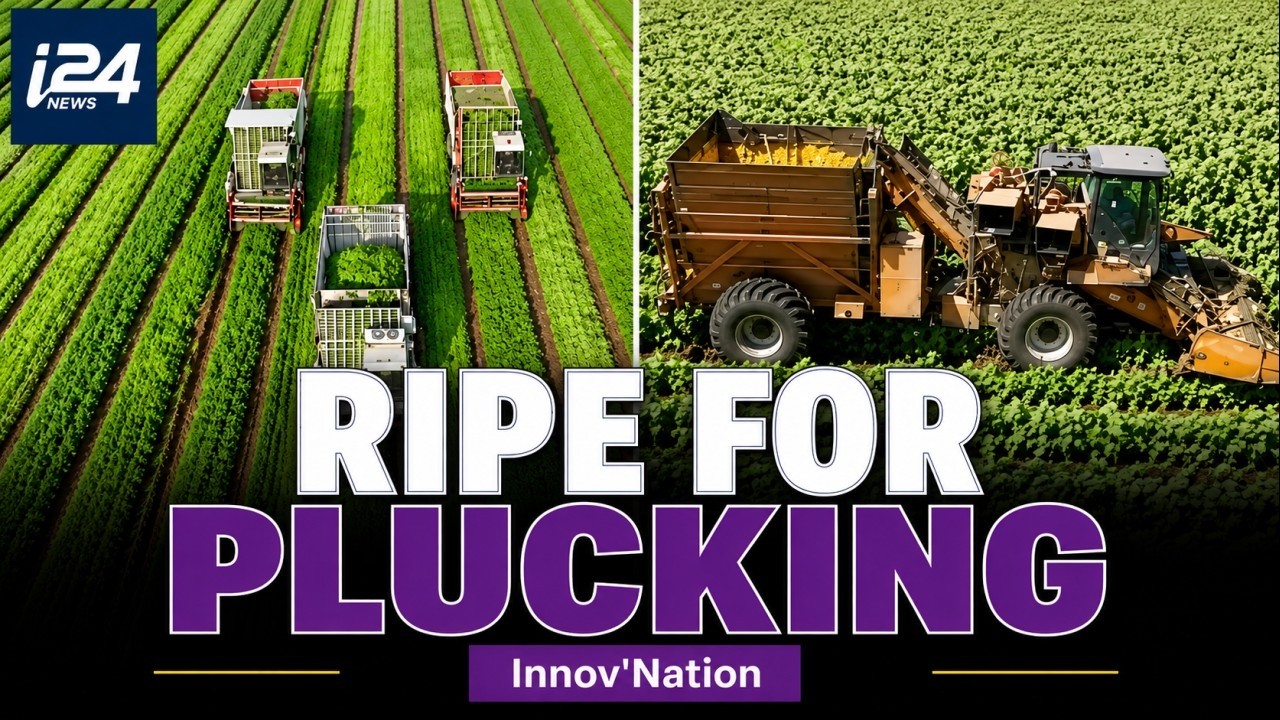
Video summary
The agricultural industry faces a significant challenge in harvesting citrus fruits like oranges and lemons, which alone represent an annual market worth approximately one billion dollars with potential growth reaching ten billion over the next decade. While picking fruit might seem straightforward to humans, it is becoming increasingly difficult due to labor shortages and rising costs, prompting Israeli company NanoVell to develop advanced robotic solutions using artificial intelligence and computer vision. Their robots are designed to identify ripe fruit within dense foliage by mimicking how nature perceives light, allowing them to map the environment, plan precise approaches, and gently harvest without damaging the produce.
The core advantage of this technology lies in its ability to operate consistently where human labor struggles with competition for jobs and fluctuating wages. According to Isaac Mazor, CEO and founder of NanoVell, their robotic systems offer a cost per kilogram that is about 30% lower than traditional manual harvesting methods. Beyond the financial savings, these machines provide growers with reliability; unlike human workers who may leave or be unavailable due to market forces, robots are always ready for command and do not face fierce daily competition for employment, ensuring a stable workforce for agricultural operations worldwide.
Although citrus fruits currently serve as an ideal entry point because they are large, visible, yet difficult for humans to pick without damage, the technology is specifically engineered with sensitivity in mind to prevent bruising or scarring that would render fruit unsellable. The company plans to expand its capabilities beyond oranges and lemons to include other delicate crops such as stone fruits, avocados, and mangoes once they have mastered these initial applications. This strategic expansion aims to address the needs of any crop requiring premium handling where even minor damage results in total loss for the farmer.
Recent validation from a European vote has further solidified confidence in NanoVell's technology and execution capabilities, marking a significant milestone that was considered unlikely given the odds against such innovation. Mazor draws upon his extensive experience building capital equipment businesses in different sectors, including semiconductors, to construct an organization capable of servicing agricultural machinery globally. This achievement not only recognizes their technical prowess but also highlights their value to the farming community as they continue to refine a solution that transforms one of agriculture's most expensive problems into a sustainable and profitable opportunity.
Read the full video transcript
Picking oranges may sound like one of
the simplest jobs in agriculture, but
for farmers it's a billion-dollar
problem problem. It's estimated that the
market for harvesting oranges and lemons
alone is worth around $1 billion a year
with a potential business opportunity of
some $10 billion over the next decade.
Now an Israeli company is betting that
robots could do the picking using
artificial intelligence, computer
vision, and robotic arms to identify and
harvest fruit straight from the tree. So
for more, I'm now joined by Isaac Mazor,
CEO and founder of NanoVell. Hi Isaac,
thank you for joining me.
>> Hi.
>> Um it must be a nightmare for a robot to
pick these oranges because how do you
know that the robot How does the robot
know that it the fruit is ripe, where it
is? How do you do it?
>> Well, first of all, they don't complain.
So he does the job as he's been trained.
And actually we teach him to do the job
and we help him to do the job by by
proper design.
And he actually
uh use several technologies. One is the
AI, of course. The AI, which is his eyes
and brain. He sees the fruit. And he
sees the fruit the way nature sees it.
Therefore, even though the tree is very
dense and high depths in foliage, deep
foliage, still light can get in. So if
light can get in, we can see it as well.
And we see the fruit, we map the fruit,
we map his environment, and we plan
carefully how to approach it, how to
grip it, and how to step how to trim it.
>> So how does it compare to a human
worker?
>> We don't really can compare one to one,
but we compare is the cost per per
kilogram. Um how much you pay eventually
for the picking. And we are about 30%
lower in price, but more important than
that, we are always ready to go. Workers
is not. Workers is a competition.
There's a up, you know, is shrinking and
rise pricing is rising.
Uh the robot will be always in in in
ready for your command. That's the big
advantage beside the cost. This is what
growers is looking for. Is ability to
plan and and to count on something which
is not
subjected to
fierce competition every day.
>> And what about because you focus now on
citrus fruits like oranges?
Why specifically those types of fruit
and like do you want or do you are you
prepared to venture out to other sorts
of fruits or vegetables?
>> The answer is yes, simply. The longer
answer is fruit oranges is what we call
the low hanging fruit. It's large, it's
very visible, and it's tough to pick for
human being. It's okay for robot. So
this is where our contribution is is
entry point is the best. And of course
soon after we expand beyond beyond
citrus to
any fruit that require
premium cutting cutting very carefully
and sensitive to any damage. Because if
you damage the fruit, it's crap, you
know, you scrap the result. So there's
stone fruit, avocado, mango, all are
step by step we'll get it.
>> And what about you just received a
European vote of confidence? Can you
tell us about this?
>> This is a great achievement for us
actually considered the odds, you know,
one one over 50.
And I think it was a great appreciation
to and recognition of our technology.
Our value to the to the community, our
value to the growers, and our execution
capability as very experienced people.
I'm serious entrepreneur. I've been
built I built capital equipment business
in semiconductor actually in very
different market, but still the the
experience is
is valuable for this to build
organization for servicing a capital
equipment across the world.