Video summary
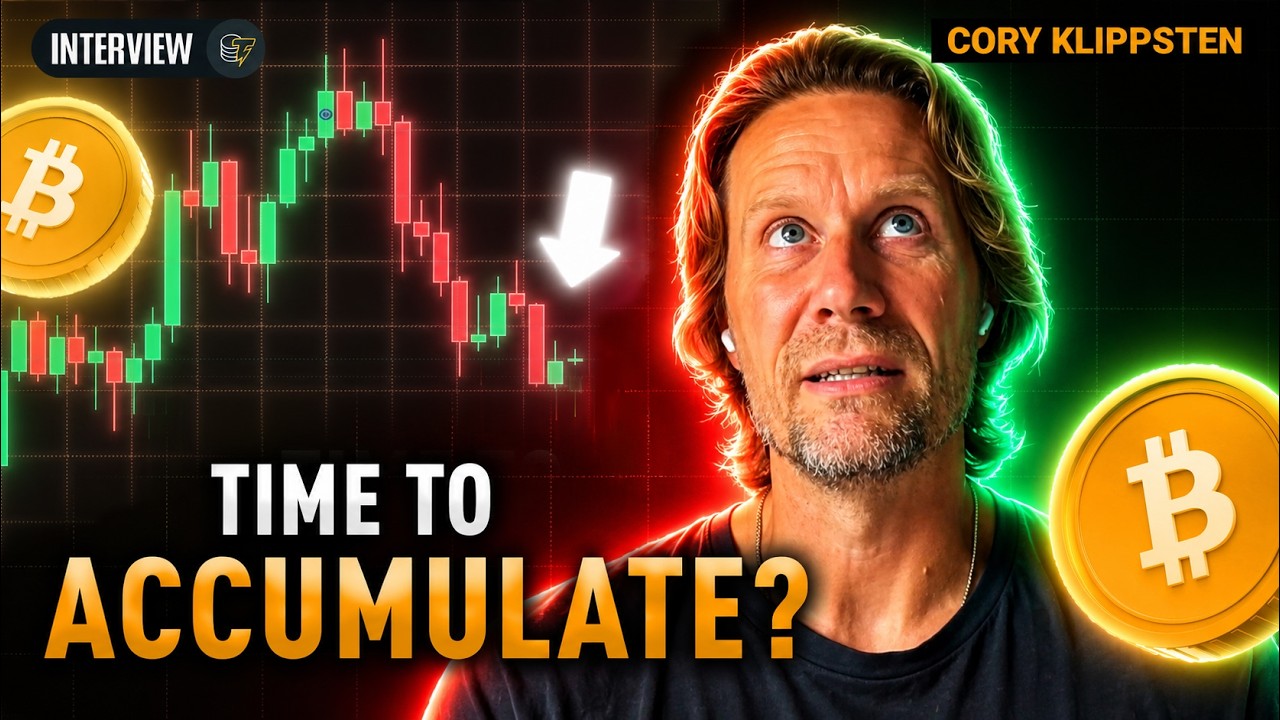
Cory Klippsten argues that the current market conditions suggest we are approaching a significant bottom for Bitcoin rather than facing further declines into uncharted territory. He points out historical patterns indicating that every previous bull market peak has been followed by approximately twelve months of bearish correction, suggesting that if the recent high in October 2025 marks a peak, prices should stabilize or rise again within the next year. Klippsten believes there is a strong probability of Bitcoin reaching new all-time highs around $130,000 before April or May 2028, driven by sustained demand flows that remain resilient even amidst negative news like the recent Coldcard exploit incident. He emphasizes that accumulating at current levels remains a safe strategy regardless of potential short-term volatility, as he does not foresee another massive flush from the lows similar to past cycles.
The discussion also delves into the implications of self-custody versus centralized storage following security breaches involving hardware wallets like Coldcard and various exchange failures. While acknowledging that executives managing other people's money may reasonably outsource custody responsibilities, Klippsten highlights a stark contrast in loss statistics: only 1,300 coins were lost in the specific Coldcard incident compared to over one million coins stolen from centralized entities like Mt. Gox, Celsius, and FTX throughout history. He criticizes the failure of some hardware wallets to ensure seed phrase randomness but notes that many other providers have long verified entropy levels effectively. Klippsten concludes that while bad events will always occur in a decentralized system, relying on human error-prone centralized intermediants has historically resulted in far greater financial devastation for users who trust them with their assets.
Regarding the rejection of BIP 110 and the subsequent debate over Bitcoin's decentralization, Klippsten expresses respect for Hodlnaut but disagrees with his interpretation that miners now control the network due to a lack of consensus on the proposal. He explains that this view stems from a misunderstanding of Bitcoin's game theory and incentive structure, which has proven since 2017 that no single group can force changes against the will of the broader ecosystem. Klippsten predicts that proponents like Hodlnaut will eventually return to their core belief in legacy Bitcoin once they process their emotions regarding the failed proposal, as he views the network's resistance to change not as a sign of centralization but as evidence of its robustness and Satoshi-designed resilience against capture by corporate interests or state actors.
Finally, Klippsten addresses the narrative that certain altcoins might outperform Bitcoin due to revenue generation, asserting his long-held thesis that all viable crypto projects will eventually integrate into traditional finance (TradFi) rather than challenging Bitcoin's dominance as money. He acknowledges that businesses like Hyperliquid may succeed but views them as centralized entities destined for regulation and eventual absorption by the banking system, similar to how TradFi operates today. While he appreciates financial innovation in digitizing assets and improving liquidity access, he maintains a strong preference for holding real Bitcoin over leveraged equity products or paper tokens sold by companies like MicroStrategy. He criticizes their marketing tactics that mimic risky Ponzi schemes of the past and advises investors to limit exposure to such instruments, noting that while these financial engineering tools offer leverage, they carry significant risks that often result in substantial losses when market sentiment shifts against them.
Read the full video transcript
Are we approaching the bottom of the
bear market or we still have to go much
lower? What do you think?
>> I mean, look. I as a
if I if I went deep on any subjects, it
was stats both in undergrad and grad
school. I probably did the most work on
statistics and so I hate small data sets
and extrapolating from three or four
data points.
But, you know,
these things have a way of of people
trading them if they look like memes.
They're kind of hard to break just like
people trading, you know, Fibonacci
levels and and charts that make no sense
except that everybody else is looking at
the same things and trading them, too.
Uh and so every bull market peak has
been followed by a 12-month bear market
that bottomed out 12 months later. So
far, that's just what's happened. And so
if we had a bull market peak in October
of 25, then, you know, this this
12-month
bear market should bottom in October.
And we'll see if we front run that just
like we front ran the uh
the last bull market and having a new
all-time high even before the having,
which was basically because of the ETF
excitement and we hit 73k in in Q1 of
2024,
uh which broke through the previous
all-time high of 69,000. So, you know, I
I think there's a very good chance that
we see 125k, you know, a new a new
all-time high in Bitcoin. I don't Maybe
it's 126, but you know, I think we'll
see 130k or something like that before
the having in 2028.
You know, before April, May of 2028. I
think that's like
pretty freaking likely. You'll never go
wrong accumulating at these levels even
if it has one final flush and we see 57
again or we even see, God forbid, 53. I
think that'll be like a very quick
V-shaped recovery and you'll be off to
the races. I do not see
um
I don't see that kind of final
50% from the lows flush
in the future. It just doesn't seem like
it's there.
When you look at all of the different
sources of demand that are just kind of
automatically flowing into Bitcoin now,
you know, even in the wake of this cold
card thing, you're just, you know,
Bitcoin price unchanged in the face of
bad news. That's usually the sign that
at some point sellers are just
completely exhausted and you start to
march up again.
>> I would like to discuss the situation
with the cold card exploit. This event
had a big impact on the discussion
around self-custody and whether
self-custody
is the way
to hold Bitcoin. Ki Young Ju, the
founder of CryptoQuant, said, quote,
"Even if everyone learns self-custody,
it still wouldn't win. When things go
wrong, humans need someone else to
blame. Self-custody offers no one.
Self-custody isn't the safest option.
The safest option is the is the one you
can actually handle. Would you disagree
with that statement?"
Um so, he's partially right and
partially wrong.
Uh so, there obviously is a need for
executives that are not custodying their
own funds, companies that are basically
spending other people's money, managing
other people's money,
uh will want to cover their A
by outsourcing that responsibility to
somebody else. But, you can also look at
the numbers. So, there's 1,300 coins
lost in this cold card exploit or
stolen, and we'll see how many get
recovered over time. And then there's
something like 1.4 to 1.5 million coins,
more than 1,000 X, that have been lost
to centralized custodian and exchange
blowups. So, 700,000 to Gox, 200 and
some thousand to Celsius, 85,000 to FTX,
another 75,000 to BlockFi, on and on and
on and on. Quadriga, you just keep on
going down the list. And to think that
there won't ever be another hack of a
centralized exchange or custodian in the
history of the future world is is kind
of ludicrous. Obviously, there will be
bad things that happen, and people will
relearn the trade-offs of of taking
responsibility and and figuring out your
own self-custody versus not. Coldcard
was really popular with a lot of the,
you know, most hardcore Bitcoiners, and
they had a lot of advanced safety
features. And of course, it's
embarrassing that they didn't, you know,
basically catch the one thing that
matters the most, which was is your seed
phrase actually random, or is it easily
guessable by somebody with some, you
know, decent amount of computing power.
That is something that you absolutely
can check for.
Other wallet providers have proven that
they have been checking for that all the
time ever since. It's actually very easy
to do a check of a
a seed creation mechanism to see if the
types of seed phrases that come out of
it are in fact random enough, and do
they contain enough entropy? It is sad.
It is small in comparison to the
tragedies that have been foisted upon
the space by centralized players,
usually recruiting people and begging
for their coins to do shady things with
them.
>> Yeah, that's a good argument. I would
like to switch topic to the BIP 110
stories. We had this Bitcoin improvement
proposal that recently was was rejected
because it failed to to gather
consensus. I just want to ask you to
comment on something that Hodlnaut, who
was one of the main proponents of this
BIP 110 proposal, wrote after the
failure of the proposal. He said that
the failure of BIP 110 is Bitcoin's
Independence Day. He said, quote, "Those
already celebrating Bitcoin dependence
day are not simply cheering an outcome
they won. They are treating evidence
that miners in the corporate layer now
control Bitcoin as if it were a grand
cypherpunk victory while ridiculing the
people who fought for decentralization
and for Bitcoin as money. In my opinion
and my heart, legacy Bitcoin is not what
I signed up for. Captured, centralized,
led by suits, no longer about freedom,
sovereignty, or the mission of
separating money from the state."
Um what is your take on this?
>> First of all, I I consider Hodlonaut to
be a good actor. Uh he's he's a heck of
an amateur journalist as well and has
done a nice job uh uncovering
um scandals and patterns in the space
and writing
pretty eloquently about it. So, I
appreciate his contributions. Um
I consider him to be a very very good
guy.
Uh I don't think he'll be gone for long.
I think he'll be back to Bitcoin. Not
the the the main chain, not this little
tiny soon-to-die altcoin that some of
the BIP 10 BIP 110 proponents are about
to launch in a few weeks. I just don't
think that has a chance in in hell of
being anything meaningful.
And uh I don't think there's any way
that somebody like Hodlonaut will be
selling his Bitcoin
for any for any reason. So, you know,
he'll he'll be uh in Bitcoin and will be
a Bitcoiner uh once he kind of gets gets
past
uh the emotions of what's happened is is
probably my guess. And that's probably
true of almost all the the BIP 110
proponents other than uh a very small
handful of people, including some of the
most vocal proponents. I think we'll
just come back around. Whether they do
it silently or publicly is kind of up to
them.
>> Yeah, I mean, basically what happened is
they they kind of I I think have a uh
a fundamental misunderstanding
represented in that statement that just
because they couldn't get
most participants in the Bitcoin
ecosystem to go along with them, the
miners, the businesses,
uh the node runners,
you know, didn't all go along with them.
Doesn't mean that it's controlled by any
one of those three groups. The game
theory of Bitcoin and the incentive
structure is such that uh
just like we saw in 2017, the miners
don't control Bitcoin. We've already
proven that. And if the miners alone
tried to jam something through right
now, they would be blocked again.
So, they don't control it. I think it
all kind of worked out for the best, as
often happens in Bitcoin.
Like that's kind of the magic of the
game theory and the incentives that
Satoshi set up. And the way that it's
continued to develop is is we have
something that's really, really, really
hard to change and it tends to have mean
reversion when it goes too far off in
any one direction.
>> In a recent interview, you said that
altcoins are basically dead. But on the
other hand, there is a narrative
according
for the next
bull market,
there are a few cryptos, a few crypto
protocols that are capable to generate
real revenue, real businesses, and whose
tokens are able to capture value, for
example, hyper liquid, that are
likely to outperform Bitcoin. So, what
do you think about that specific
narrative?
>> Uh so, hyper liquid is a business. Hyper
liquid has a token. I mean, I mean, if
if it's a business that's centralized
and yeah, it will eventually just get
sucked up by TradFi and just be kind of
thought of as an exchange and a bank and
it has, you know, different technology
or whatever, but you know, if they're
allowing people to trade, eventually
everybody will be KYC'd and you know,
usually these these things are kind of
flash in the pan because they operate in
a gray area kind of outside of
regulation for a period of time, but as
soon as they get size, they get people's
attention and then eventually regulators
come for them and basically put them
under the tradfi regime. So, I think
that's probably inevitably where
hyperliquid ends up and that's cool and
all that, you know, I guess value kind
of accrues to the token or whatever.
The the reason I say altcoins are dead
is like all I really care about is
Bitcoin as money.
And there were lots of altcoins saying
that eventually they could pass Bitcoin
as money
for various reasons, you know,
uh Ethereum,
um primarily being the one that would
run those narratives of ultra-sound
money and if you're ETH is money and
stuff like that. And that's just kind of
sounds funny now. Nobody ever actually
says that anymore. Even altcoiners don't
even say that. So, you know, I've been
saying for 7 years, since 2019, I kind
of developed this thesis and started
talking about it that the bull the bull
case, the the best possible outcome for
all of crypto, blockchain, DeFi is to
become part of tradfi and make
incremental improvements to financial IT
and that's what's happening.
You know, I I I did um
the story is a little long in the tooth
cuz it was in it was in Q2, but I think
it was June I did a a banking conference
and I was on a panel with three crypto
executives.
Uh and I was expecting it to be a little
contentious or whatever. And all three
of them would have been very clearly
defined as Bitcoin maximalists like 5
years ago.
They they believe in Bitcoin and crypto
infrastructure and they have no thesis
for altcoins at all and spend 0% of
their time on altcoins.
Um and that's not surprising cuz the
market has spoken and it's just kind of
like these things are for gambling and
maybe they're fine and they're kind of
like trading cards or whatever.
Um or they are trading infrastructure.
In which case, you know, they'll have to
hack it out with regulators cuz trading
infrastructure gets regulated and we'll
see where value accrues and who gets
screwed and who gets put under the thumb
of the government and who kind of you
know, is able to continue doing
something cool. But, I of course, as a
tech guy,
I have a love of financial innovation.
And, you know, I love people working on
cool new and finding new ways to
generate liquidity and improve access to
financial tools and products for people
around the world. Like, all of that's
awesome and I don't have any problem
with that. And, I do think that, you
know, whether you want to call it
tokenization or just like a new a new
way of digitizing records of securities
and assets and whether you want to call
it on chain even though it's not really
on what, you know, for the most part on
decentralized chains. It's just kind of
on things that we're calling blockchain.
Um, that are just kind of shared
databases among a bunch of companies and
consortiums and whatever. You know,
it's all it's all improving liquidity
and access to capital, etc. etc. Like,
somebody used to call me shitcoin PI.
>> [laughter]
>> That was kind of a common nickname for
me a few years ago. Like, I don't care
anymore. It really just doesn't matter
because, you know, Bitcoin is money and
there's nobody pretending to the throne
anymore.
>> You have been criticizing the financial
engineering behind the MicroStrategy.
Um, you recommend your clients or in
general people to hold at least 90% of
real Bitcoin versus
paper Bitcoin which which are all these
financial products connected to Bitcoin
that MicroStrategy sells. So, why do you
think so?
>> So,
not all accurate of my views. So, first
of all, I actually appreciate the
financial strategies of strategy,
um, the company. And, I am still a
believer that and I think the right term
for these companies of whom there are
only two in the US that are actually at
scale and doing the thing. It's just
strategy and strive. I've called them
leveraged Bitcoin equities since fall of
2023 because I think that accurately
describes what they're doing. And all
it's supposed to do is through active
management and selling to the market is
to try to provide something like 1.15 or
1.2 x exposure to Bitcoin in a ticker in
your brokerage account. And if Bitcoin
goes up by a lot over time, that excess
exposure compounds and you end up with
more Bitcoin per share. That's still
very possible, very doable. I think it's
been proven that it is possible. It does
come with a lot of risks. Where I
started to quibble was
uh in the marketing of the securities
associated with strategy and strive and
using for instance for um
for stretch the language of savings
accounts, comparing them to money
markets, you know, not recognizing that
these things are free floating and that
you can't actually enforce peg at $100
for these things. And so some of the
marketing language, you know, really
started to sound like Mashinsky in '21
'22 with Celsius. Obviously, there's a
lot better backing pool cuz he was just
a Ponzi scheme and you know, it was his
balance sheet was mostly his own token,
etc. And you know, he was just like an
absolute criminal fraudster. Um very
different from having the largest pile
of Bitcoin, you know, 800,000 plus
Bitcoins on your balance sheet like
strategy does. So there's, you know,
something actually backing these.
Um the other quibble, again, you know,
probably two more. One minor, which is
just, you know, I I I believe that
leveraged Bitcoin equities should be
marketed to institutions, but if it's
not good enough for smart for smart
money, it really shouldn't be good
enough for retail.
And so I think that they should be
spending and should have for the last
few years spending a lot more time uh
educating Wall Street and getting real
funds and real money managers to see it.
And if they can't see it and can't do
it, then, you know, I'm just not a fan
of them turning around and doing a lot
of AI videos and you know, kind of I
just don't like the marketing. I think
it's a bad look for my industry and I
have to answer for it. For a long time,
had a recommendation of, you know, don't
have more than
20% of your kind of Bitcoin price
exposure outside of real Bitcoin.
Um, I've
I have upped that just watching the
risks and watching people just get way
out over their skis and, you know, I
think strategy hit 540 in after hours
one day, you know, I think it was 450 at
the close in late 2024 and obviously it
it struggled under 100 here for most of
the summer and just kind of recovered
100. So, there's a lot of risk with
that. And that was the best of the
bunch, you know, the fall for all these
other gambles
uh was way way worse. I have friends
that had uh you know, taken out HELOCs
and
picked up big bags of Meta Planet and,
you know, watch that go, you know, down
another 80, 90% things like that. So, I
think people just got kind of
um
enamored of the uh apparent alchemy
that turned out to be fool's gold.
>> Yeah, that's that's interesting. So,
essentially, mostly it's about the
marketing and the way these companies
are presenting their products versus
Bitcoin, for sure.
Um, okay. Yeah, Corey, it's great to
talk to you as always. I hope to see you
soon on our show.
>> Yeah, me too, Giovanni. It's so nice to
see you again and uh let's do it again
soon. Not wait 2 years.