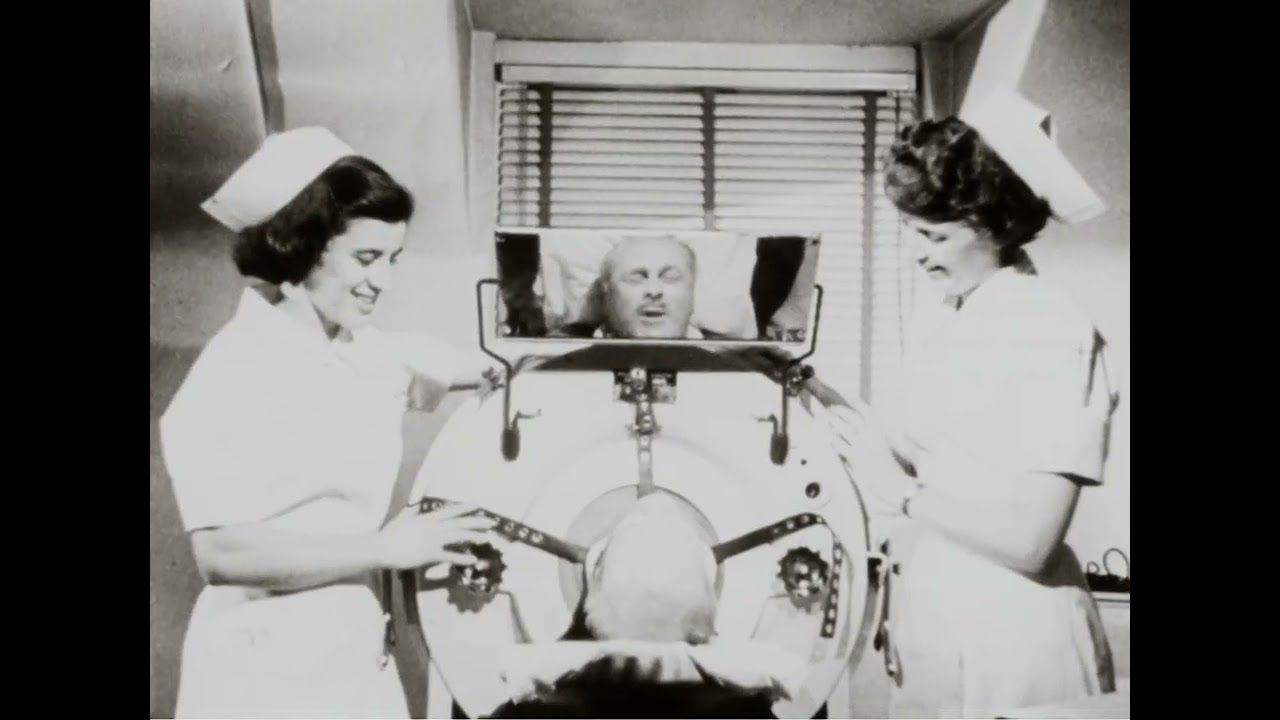
Iron Lung, Polio, March of Dimes, C16, Drew Pearson Films, Washington Merry-Go-Round.
Watch on YouTubeVideo summary
The video features Drew Pearson, a journalist and chairman of the Iron Lung Committee at Providence Hospital in Washington, who decides to experience life inside an iron lung firsthand to report on the reality for polio patients. Upon being lowered into the machine, Pearson immediately feels the intense pressure required to keep air from escaping, noting that while he can move his arms and legs, his body feels separated from his head. He struggles with the mechanical rhythm of breathing, finding it difficult to synchronize his speech with the machine's operation, which prevents him from broadcasting normally. The experience is described as isolating, leaving him in a world where he can only see a small mirror, reinforcing the physical and psychological separation between the patient's mind and their paralyzed body.
Pearson then meets Betty Grant, a young and attractive polio patient who has been in an iron lung since August. She explains that she is currently progressing slowly, sleeping in the machine at night while using a rocking bed and a chest respirator during the day to aid her recovery. Despite her confinement, Betty shares moments of joy, such as being allowed to see her two-year-old daughter, Cathy, over the weekend, which she calls the bright spot of her week. She expresses deep gratitude toward the National Polio Foundation for their financial support, emphasizing that hospital care and equipment are incredibly expensive and that donations from ordinary people make a significant difference in keeping patients alive and hopeful.
The narrative concludes by shifting focus from Pearson's temporary discomfort to Betty's long-term struggle and eventual recovery, highlighting the critical role of the March of Dimes campaign. The video underscores that despite the availability of the Salk polio vaccine, funded largely by the foundation's efforts, the disease has not been completely eradicated, and many individuals still rely on iron lungs for survival. Pearson urges viewers to remember the strange but vital sound of the machine, which represents the breath of new life for thousands, and to continue supporting the fight against polio through donations. The final message is a call to action for the American people to join together in this ongoing battle, ensuring that every community has access to necessary emergency equipment until the disease is fully defeated.
Read the full video transcript
Ladies and gentlemen, you are looking at
the business end of an iron lung.
And that sound that you hear is the air
being forced into the lungs so that the
patient can breathe.
And if anyone should pull the plug,
stopping that air, the patient would die
within a minute.
I think perhaps I should tell you why I
am here in Providence Hospital in
Washington in the polio unit.
Last spring I did some special reporting
on that wonderful discovery, the Salk
polio vaccine.
And I discovered what I think most
people don't know, that the Polio
Foundation borrowed up $9
to pay for that vaccine so that the
children of America could have it
without waiting one more summer.
Well, that investment, as you know, paid
off.
And the children of America were saved
countless cases. Well, some people
thought that this year we wouldn't have
to have a March of Dimes drive, but in
my opinion it's all the more necessary.
Not only to pay back that $9 but to help
thousands of cases,
people who contracted polio long before.
So, I'm delighted to do my small part in
the March of Dimes drive.
And as chairman of the iron lung
committee, it occurred to me that
perhaps
I should do what any ordinary newspaper
man usually does, get the facts
by reporting from inside an iron lung.
So, if you'll excuse me for a minute
until I can put on my pajamas and the
proper apparel,
I'm going to report to you
what it's like
to be inside an iron lung.
Now, with the help of these young
ladies, I'm going to go inside this iron
lung just as nearly as possible like an
ordinary patient and I'll try to report
to you what it's like inside.
>> All right, Mr. Pearson.
Watch your hands.
Step down a bit. That's good.
Mr. Pearson, while you're pushing
through, watch your nose.
>> All right, here we are.
I know a lot of people would like to get
me in a position like this.
>> I can't breathe.
Please, huh?
>> It's a little little tight.
>> It has to be tight so the pressure will
stay in.
>> I see. Well,
you go ahead. You're the bosses.
I'll trust you.
>> All right, now we're pushing you
through. Watch your elbows.
Now, take a breath.
Let it out.
How's it feel?
>> It's pretty good.
>> Going too fast?
>> No.
>> Would you like more pressure, do you
think?
>> A little low.
I don't think so. I think it's all
right.
It's a little hard to
breathe, but I I I'm I'm all right.
I confess that
I don't know how
exactly how to describe this.
You have to synchronize your
I'm because you
of course the lung is
helping you to breathe but I'm not quite
I'm not quite used to
I don't exactly when to breathe and when
to
when to talk.
I don't believe I could really give a
broadcast from this lung
or a telecast.
At least at not the rate of speed I'm
supposed to talk.
You also
You also feel as if you were sort of
away
away in a world all your own
with nothing to look at except
this little mirror
and nothing else in the world except
that.
You of course you you can't uh
your body feels sort of separated from
the
from your head
and uh
you can move with your your arms and
I can move my feet and arms I suppose of
course the
the average patient can't
because that's why he's in the lung
because he's paralyzed.
I I must say that I
I'm I'm glad I don't have polio.
I suppose this uh
neck piece has to be tight in order to
keep the
air out.
>> That's that's to keep the pressure in.
>> Oh, I see.
>> May I ask you a question?
On the way over to
>> know whether I can answer it but
>> On the way over to the hospital today,
what were your thoughts on getting into
an iron lung?
>> Well, what do you know I thought maybe
I'd get a little sleep for a change.
>> I think you found it quite different,
didn't you?
>> Well, it's it is a little different and
I've been in a lot of hot
I've been in a lot of hot tight spots in
Oregon but I think this is about the
tightest.
Uh
Um
Can I have a little water?
>> Yes, sir. Right away.
>> What do you do when you shave in the
morning?
>> Well, you leave that to the nurses or
perhaps maybe an orderly. But, you you
see we do all the work. You don't do
any.
>> Do uh do do uh
You know, my wife would be grateful for
one thing. She never She never She never
likes it when I tweak my mustache and
now I can't
I can't tweak it.
Um but but could you could you could you
would you mind
scratching
the
that uh
place in my
>> Which side? Your right side?
>> Right side of my
That's the side you can find. You were
in the iron lung
>> Yes, I have. I did get in tried out
once.
Like yourself, I was curious and I
wanted to find out just how it felt.
>> Are you from Washington?
>> Yes, sir. I am. In fact, I was born
right here in this hospital on this
floor.
>> ward.
I saw I saw the babies next door.
>> That's the place.
>> Um
By the way,
what time is it?
>> Uh I have about uh quarter to 10.
Uh Mr. Pearson, we have a very nice
young attractive polio patient in the
next room. Would you like to meet her?
Name's Betty Grant. She's been here in
an iron lung since August.
>> I'd I'd I'd I'd love to
I'd love to meet her. Could could could
you could you bring her bring her in?
>> All right. I'll bring her in while Miss
Green brushes you up your hair a little
bit.
>> Yeah.
>> She's a very attractive young lady. You
have to make a good impression.
Looks like they're bringing Betty in
now.
Mr. Pearson, this is Mrs. Grant. This is
Betty Grant.
Betty, do you know Mr. Pearson?
>> It's very nice of you to come in here.
>> I've always wanted to meet you. I read
your column in the post.
But I never thought we'd meet under
these circumstances.
>> I know it's just a little bit
peculiar, I'll admit. Have you been
Excuse me, I haven't quite learned how
to breathe. I see that you have.
But have you been in the lung for some
time?
>> I've been in since the 13th of August.
>> How long you been in the lung?
>> Well, I think I'm
progressing it slow but sure. Uh
Right now, I only sleep in the lung.
At night, I spend the better part of my
day on
the rocking bed and I use
a Monaghan chest respirator also.
>> Well, that's
that's wonderful. You
You you were almost cured.
>> Yes, it's
quite a change.
>> Don't tell me, are you
Did you have any children?
>> Yes, Mr. Pearson, I have one.
I have one little girl. Her name is
Cathy and
she's 2 years old.
>> Can she come to see you in the hospital?
>> Oh, yes, she can. The sister gives
granted special permission to bring her
in over the weekend.
>> And that must be wonderful for you.
>> Oh, yes, it's the bright spot of the
week.
>> Tell me, are you a patient of the
National Polio Found- Foundation?
>> Yes, I am and they're wonderful
people. I don't know what I would have
done without them.
As you know, it's quite expensive now to
be in a
hospital and all this equipment is quite
costly, but
I think if more people realized
the wonderful work that they do and
just how far one of their dimes will go.
They help us.
>> I'm awfully glad to hear you say that
and I I hope an awful lot of people will
remember that during the March of Dimes.
You know, I I want to make a prediction.
The rate you're going, I'm going to
predict that you'll be out of this iron
lung
and back with your little girl before
very long.
And that's one that I I want to make.
>> With God's help, I will live again.
>> And I certainly hope that's going to be
a prediction that'll be more than 83%
accurate.
I'm going to be back in a few minutes
with some more some more predictions.
Now, ladies and gentlemen, how I felt
inside that iron lung is not important.
But how Mrs. Betty Grant felt is all
important. The fact that she's getting
well,
thanks to the Polio Foundation and an
iron lung.
So, remember that when you give to the
March of Dimes. Remember that polio
isn't licked yet and that these iron
lungs are terribly expensive and that
every community needs one, needs one
badly in emergency.
And also remember that sound. It's a
strange sound,
but it's breath.
Breath of a new life
to thousands of people.
>> March of Dimes.
March of Dimes.
>> The fight against polio is our fight.
Over the years, we, the American people,
have joined together to carry on that
fight through the March of Dimes.
We have a powerful new weapon now, a
vaccine.
With widespread use, that vaccine will
bring polio under control.
But please remember that polio is not
beaten yet.
So give.
Give to your March of Dimes.