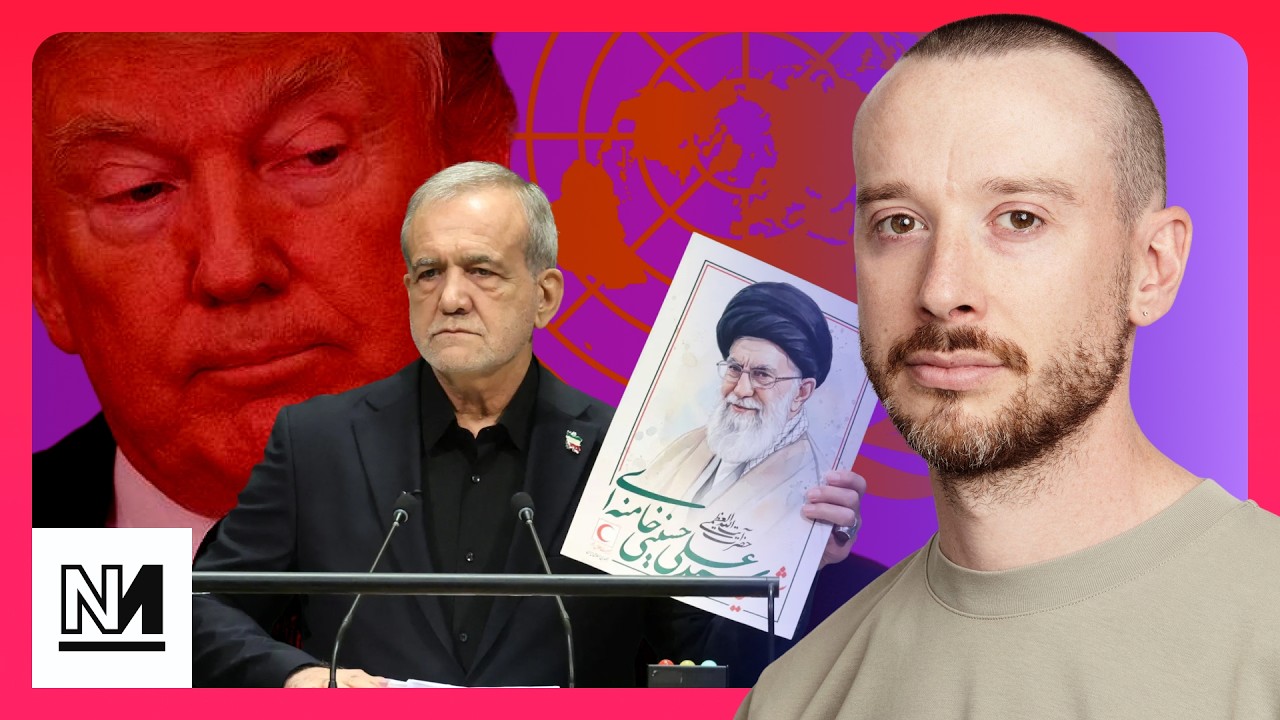
Video summary
Iranian President Pezeshkian delivered a defiant address at the UN General Assembly, directly countering US accusations of terrorism by highlighting American and Israeli attacks on Iranian scientists and children in schools. The speech concluded dramatically as a lone US delegate stormed out of the hall, underscoring the deepening diplomatic rifts. Meanwhile, tensions flared between France and Israel; French President Macron criticized the lack of humanitarian access in Gaza and alleged Hamas inactivity in the West Bank, prompting furious Israeli responses citing recent murders of French citizens there. The diplomatic friction extended to New York, where Mayor Eric Adams called for Netanyahu's arrest due to an ICC warrant but faced immediate backlash from Israeli Ambassador Danny Danon, who demanded Adams' arrest for his comments on Israel.
In a separate development regarding US-UK relations, Andy Burnham, the UK Mayor, surprised observers by implementing sanctions on goods from Israeli settlements in the West Bank, a policy distinct from former Prime Minister Keir Starmer's cautious approach designed to appease Donald Trump. Experts analyzed whether this marked a significant shift or a continuation of Starmer's strategy, concluding that while Starmer was constrained domestically, Burnham acted more boldly driven by Foreign Secretary Ed Miliband and pressure from progressive voters. Although these sanctions represent a "small win," they are viewed as insufficient to force settlers back to Israel for a viable two-state solution, highlighting the ongoing challenges in achieving peace through current diplomatic maneuvers.
Beyond international diplomacy, the video examined the severe socioeconomic impacts of housing crises in areas like Hackney and Islington, where rising costs are displacing not just the poor but also middle-class families who can no longer afford larger homes. This displacement has contributed to a sharp decline in birth rates, with over 90 schools closing since 2019 due to falling fertility rates driven by high housing costs and economic uncertainty. The demographic shift is further reflected in changing consumer habits, where toy sales have shifted from children to adults buying toys as hobbies rather than parents purchasing for their offspring, raising concerns about reduced playtime for younger generations and the long-term health of community infrastructure.
The discussion also turned to critical issues surrounding artificial intelligence safety ahead of a potential meeting between US President Trump and Chinese leader Xi. While both sides express reluctance to slow down AI development, experts advocate for an indefinite international moratorium on frontier AI models to prevent catastrophic risks. Key points include the necessity of controlling chip supply chains to enforce pauses, acknowledging the flaws in current self-regulation models compared to safer industries like aviation, and emphasizing the importance of verifying compliance through monitoring data centers and decommissioning hardware. Experts suggest that while a catastrophic event might eventually spur action, proactive political will and technical solutions—such as destroying chips or isolating factories—could enable safer AI development without waiting for disaster to strike.
Read the full video transcript
Welcome to Navara Live. Coming up
tonight, more drama at the UN as the US
delegation storms out of the Iranian
president's defiant speech. I say
stormed, it was actually one guy sort of
putting his papers and walking out, but
the speech itself was very dramatic. Um,
also a former adviser to the Star
government gives us his take on the
Burnham Trump summit. We have a bit of a
debate um about whether or not Burnham's
meeting with Donald Trump shows how
wrongfooted StarMA's strategy was. Um
also, London is apparently running out
of kids to teach. And could tomorrow's
meeting between Xiinping and Donald
Trump decide the future of humankind? I
speak to an AI expert. Um I'm Michael
Walker and tonight I'm joined by BCA
KMBBE. Um who's wearing a fantastic
t-shirt.
>> I hope you can see it. Yeah. Tell us the
story of of this Zier 74.
>> Zier 74. Yeah. So we've been thinking a
lot recently obviously with all the
Mmore Ed Sheer and D'vorl about you know
what's music's place in terms of you
know pushing political boundaries. Um
this was a festival that took place in
1974 in Zier now known as Democratic
Republic of Congo which my dad is from.
Um and it was a festival originally set
up by the dictator Mabu who kind of
wanted it as this propaganda festival.
Mabu was very much the kind of US
approved uh leader of of Congo. and um
it kind of got taken over by the artists
and it became this kind of amazing sort
of uh festival of unity and of
pan-Africanism and of something I think
politically a lot more positive than how
Mabbouti wanted to utilize it. So I
thought it was just a kind of
interesting shirt to wear today. Um
given everything that's that's happening
and you know all the debate around
politics and music you know music can I
think be a very positive force in
politics. And you were saying before we
went live, I hope you don't mind me
mentioning your dad was the translator
to George Foreman at the Rumble in the
Jungle.
>> Yeah. So, this festival took place as
part of the the infamous Rumble in the
Jungle fight um between George Foreman
and Muhammad Ali. Spoiler, Muhammad Ali
wins. Um and my dad worked as a as a as
a translator um because uh George
Foreman didn't speak uh French and Congo
is a French-speaking country. So, yeah,
bit of lovely bit of history there. Bit
of family connection, French. Yeah. Um,
fascinating. I love that. I want to meet
your dad. Um, if you'd like support our
work, you can sign up at
environia.com/sport.
You can also listen to the show on
Spotify and Apple podcast. Um, do like
this video, subscribe to the channel if
you haven't already, and don't forget to
let us know what you think in the
comments below. I'm trying to read that
faster every time, a bit like the terms
and conditions at the end of an advert.
There are three big issues at this
year's UN General Assembly. artificial
intelligence, Israel's war on Palestine,
and Trump's war on Iran. On that latter
topic, Trump gave a pretty vicious
speech yesterday.
>> But I have a big decision to make.
Will a deal be made with Iran that lets
them rebuild and create a far greater
country than it ever was before? Maybe
one of the greatest in the Middle East
or even the world?
or do I annihilate the Islamic Republic
and do it quickly, never giving them a
chance to kill and destroy people and
countries again.
>> And today at the UN General Assembly,
the Iranian president has hit back.
>> I had prepared a speech to present to
you yesterday. The United States
president described us as terrorists.
We have been the victims of terrorism.
>> I come from an Iran
in which our esteemed supreme leader was
assassinated without any
legal
framework or reason. I come from an Iran
where in truth
they bombed a school.
You see these children
perished under bombs
with weapons used by the United States
and Israel. They were innocent,
had committed no crimes.
one of the small cities in a province in
Iran,
a sports hall where children were busy
playing.
The United States
by using
weapons with multiple warheads,
targeted them.
They martyed, assassinated our
scientists, our men, women, and
children.
innocent children whom in truth had
committed no crimes, no sins.
Terrorists, those who are terrorists and
train and protect terrorists
describe us as such. We have only
defended ourselves. We are not
terrorists. So, if you're listening to
the podcast, the dramatic scene at the
end was the um gentleman who is, I
suppose, a delegate for the United
States sort of putting up his papers and
and walking out. Um I think that speech
from the Iranian president there,
Peshkan, does show the the power of the
UN General Assembly. There have
obviously been so many sort of
historically significant speeches there
over the years. But to have yesterday
Donald Trump calling the Iranians, you
know, terrorists and then it's just so
clear to anyone listening when he holds
up a picture of, you know, the head of
state you killed this guy, hold up the
picture of the girls at that school, you
bombed these people. It's it's so
clearly the case that the Americans
behaved more like terrorists than Iran
over the past 12 months. Right? So and
and that is a message that now gets
broadcast to the world and broadcast to
everyone in that room. Interestingly
obviously how the UN works unfortunately
really and it's a security council that
has most of the power and especially the
permanent members of the security
council. So Britain, France, the United
States, Russia and China. The general
assembly is where it's sort of one
person, one vote where the whole world
turns up and gets a somewhat equal
chance to speak, but its rulings aren't
as binding as the Security Council. So,
the Security Council has more of the
power, but the General Assembly has the
sort of symbolic force and that's what
we've been seeing this week in New York.
Um, two other countries trading blows
this week are the Israelis and the
French. So, Macron said this um at the
UN General Assembly on Tuesday.
What is our credibility worth if we
remain inactive on Gaza? Some claim that
peace has been achieved, but this has
not opened up humanitarian deliveries.
This spectacle, it's shameful. Shame on
all of us.
Just look at what's happening in the
West Bank where day in day out we're
seeing violations and in the name of
what Hamas was never active in the West
Bank.
Now that speech from Macron prompted a
furious response from the Israelis. Um
so the prime minister's office put out
this statement. The grotesque absurdity
of Emanuel Macron statement is
staggering. On Sunday, the eve of
Yamapour just two days ago, Netanel
Shukrun, a French citizen and father of
six, was murdered in his car by a Hamas
terrorist in Judea and Samaria. With his
final breath, he told his son to run.
Hamas terrorists carry out attacks
against Jews almost every day. They have
murdered countless Israeli civilians in
Judea and Samaria. ignorance is no
excuse for erasing their blood. Um the
French have since said this was actually
a confusion um and a result of a
mistransation that what Macron actually
said was that Hamas had never governed
in the West Bank which is more
uncontroversially true than that they're
not active there. Of course, you know,
whatever Benjamin Netanyahu is saying
here, whether or not Hamas are active in
the West Bank, it doesn't really matter
in terms of what people are critiquing
Israel for, which is stealing land,
right? I don't think anyone has ever
suggested um well, one, they shouldn't
be there in the first place. They're
occupying the West Bank and they're
expanding their settlement. So, the idea
that, oh, someone got killed in his car,
so that means we can steal their land.
That's never been a principle of
international law. Um Netanyahu himself
will give his speech to the UN General
Assembly tomorrow. It's likely to be
histrionic. Um he often brings props.
His ambassador to the UN has already
been making some pretty preposterous
claims. No, it's very dangerous what the
mayor is doing. It's irresponsible. We
know we you see the traffic today in New
York City. Dozens of head of states in
town instead of taking care of the
security of the well-being of the
visitors and the veteran of New York is
inciting against Israeli prime minister.
But you know, we are not surprised. He
supported Hamas. He sent up officials
from the the city council to meet with
the representative of Iran. It's
shameful. If someone should be arrested,
Mayor Mandani should be arrested for his
behavior. Prime Minister Netanyahu will
come here on Saturday, will speak in the
general assembly, and the only thing the
mayor can do is listen to the word of
the prime minister.
>> Well, if I were to make a prediction, I
would predict that neither one of them
gets arrested, but that's just me.
>> So, that was Danny Denon. um he is the
Israeli ambassador to the UN and he's
there on Fox News in New York saying
that the democratically elected mayor of
New York should be arrested. Um obvious
it's it's too ridiculous to have to
debunk that Mandani has not committed
any crimes. But obviously the reason
Mamani is calling for Netanyahu to be
arrested, Mandani said he doesn't have
the constitutional power to do it, but
he thinks that morally it should happen
is because there is an arrest warrant by
the ICC, the International Criminal
Court out for um Netanyahu for various
war crimes. So the moral the legal I
mean unfortunately the Americans aren't
signed up to the International Criminal
Court. So actually the ICC doesn't have
legal force in the United States. But
the moral thing to do would be for
Netanyahu to be arrested. Mani doesn't
have that power. Um but he has a point
when he says that Netanyahu should be
arrested. Um the Israelis when they say
that Maani should be arrested, they they
lash out like children a lot. And I
suppose maybe if there were a different
president that would sort of seem more
out of step than sort of maybe it seems
now because that's the kind of thing
that Donald Trump says all the time that
this politician that politician should
be arrested even though Donald Trump
seems to quite like Ma Dani. Um, Ben,
what have you made of um some of these
disputes, the scenes we're seeing from
the UN General Assembly this week?
>> I think the thing that kind of links,
you know, the uh Israeli uh uh UN uh
representative there and and uh the US
is it was a just a kind of childishness
really. You know, I think it's
ridiculous from a diplomacy point of
view that you would make a point of
getting up and you know, shuffling your
papers and shuffling out during what was
a really deeply moving, I thought
emotional speech. Um the use of images I
thought was was really smart and and
really clever actually for the uh
Iranian president to to do so because we
know of course that images often will
stick in the mind a lot more than than
words and when you're seeing the image
of a child you know that's an image of
innocence that I think you know no one
can really dispute and and you know the
idea that a state was going around
murdering you know children it's just
kind of incontrovertibly you know
terrible in incontrovertibly immoral um
this discussion about you know arrest
Mamani I actually thought that there was
a clip that I saw of Mandani talking in
in in the run-up to uh Netanyahu um and
um basically saying look I'm not going
to be out protesting him. I'm not even
encouraging people to go out and protest
him. So he was quite restrained
actually. He actually got some criticism
right from the left who from people who
really wanted him to go much harder
actually on the rhetoric. Um but he's
been very clear in following you know
international law which is you know what
everybody should be doing and you know
the US the Israelis they don't view
international law as a kind of leveling
playing field where you know everyone is
subject to the same rules no matter you
know where you're from or what nation
state you are they view it as mechanisms
for them to achieve their own interests
and I think what's interesting about
this particular UN assembly is it it
does seem to be very openly adversarial
you know more so than maybe I I can ever
really remember and that's not to kind
of romanticize, you know, the kind of
what is now a crumbling world order and
and pretend that, you know, all these
countries always got along, but there
was perhaps more of an acceptance before
of, you know, we're still, yes, we might
disagree here and there, we might not
always be quite lined up in each other's
interest, but but overall, we're still
operating within this framework and that
seems to really kind of disintegrated
now. And it feels very obvious. There's
something very inherently Trumpian
basically now about this UN assembly
that feels quite different and it it
feels more obvious that perhaps we are
moving towards a more multi-polar world
where there are just incredibly uh more
jarring clashing interests that are kind
of right there at the forefront and I
suppose what's interesting to me is
thinking about well you know does that
mean that we're going to be heading
towards a better well because yes it's
great to see some of these power holders
challenged you know finally some of the
hypocrisies being kind of really laid to
bear at the world stage. Um, but I'm
also worried about to what extent that
also means that actually we're just
tipping into something that might just
openly be much worse in this multipolar
world where actually everyone or or more
states are just kind of nakedly working
within their own self-interest and
there's there's not even a kind of
surface level pretense about how we work
together collectively as a world which
was, you know, which is what the UN is
meant to be forged in. It's meant to be
forged in a coming together. um you know
>> it's the two big sort of unknowns in
international politics in the 21st
century. Will the arrival of a
multipolar world mean that there is more
recourse to justice for small states or
um will it mean that we end up in an
anarchctic situation with more wars and
then also um while the sort of liberal
world order I think best represented by
someone like Obama you know was maybe
uh duplicitous
uh dishonest in certain ways are we
going to miss it now it's gone the big
two questions of the 21st century we
sort of seeing that um in New York this
weekend. Andy Bernham's first meeting
with Donald Trump went pretty well for
our current prime minister, but for our
former prime minister, it was a total
humiliation.
>> Mr. President, relations between the US
and the UK have been a little bit up and
down lately.
>> No, I think they're up.
>> What sort of state would you say they're
in now?
>> They were with your last prime minister.
Let me put it that way.
>> So, why do I think that was a
humiliation? Well, it's not because
Donald Trump apparently doesn't like
Kier Starma. Trump is a chaotic,
completely amoral, immoral man. There
are many very decent people who he's
willing to put down. So, I'm not going
to stand here and say, "Oh, because
Trump says he doesn't like K Star Dama,
that means Karma is an idiot." Uh, like
I I I don't take Donald Trump as any
kind of um, you know, guide to who we
shouldn't shouldn't respect. However,
the reason I think that this was
humiliating for K Dharma is because of
what happened before in that meeting.
>> We've all spoken over the years about
the importance of a twostate solution.
If we face a situation where there's a
tender to put settlements on the West
Bank that in effect make a two-state
solution nonviable,
what do we do? Because if we do nothing,
then it further erodess people's trust
in politics. because they think well you
all talk when it comes to it you're not
prepared to follow up on that talk and
and do something.
>> So that was Andy Bernham in front of
Donald Trump defending the UK's decision
to ban exports from Israeli settlements.
Now that's a position a policy a move
that Kharma never dared to do. Karmama
his administration said it wasn't
possible and Kama took a big hit in his
standing at home by refusing that
action. Right? People thought he was
weak. people thought he wasn't standing
up to Israel as he should have been.
However, one supposed benefit for
Britain um was that it would keep Donald
Trump on side. Right? So, the idea is
that yes, Karma, he might not have done
the the thing that you think is right
and just, but he's being a realist. He's
recognizing that Britain isn't in a
particularly strong position in the
world. Um and he can't do bold things in
case Donald Trump then goes and punishes
Britain and we're somewhat defenseless.
That was the argument. However, what
have we seen now? Within weeks of coming
to power, Andy Burnham has implemented
that ban. He's gone much further than K
Star DMA. Um, and as we saw in that clip
there, it's brought very little
approprium from the president. Um, and
indeed, um, even though Bernham has been
much tougher on Israel than Star, Donald
Trump still thinks that Burnham is a
much better guy than Star. Right? So, to
me, this proves that Karmama could have
been much tougher on Israel all along.
Um, you know, I'm I'm not sure I ever
took the line that it was just to not
please the Americans. I think, you know,
Kisama just didn't care that much about
Palestine. That's my interpretation of
Tuesday's meeting. Anyway, um, on this
show though, I do like to hear multiple
views and so I was pleased when Ben
Judah agreed to an interview. So, Ben
was a special adviser to David Lambi
between July 2024 and September 2025.
That was, of course, when Lammy was
foreign secretary. Um Ben is now a
visiting fellow at Chattam House, which
is um where he spoke to me from earlier
today. Um I began our conversation by
asking what Ben took away from Burnham's
first meeting with Trump. I think that
it was perfectly fine first meeting with
Donald Trump. Uh Trump was on relatively
decent behavior and didn't press the UK
particularly hard on a lot of painful
doseas uh that he could have, you know,
such as attacking kind of the recent
sanctions taken on uh West Bank Israeli
settlements by the UK government. The
one thing that I think uh didn't go so
well is I don't think that Bernham went
in sufficiently prepared with strong
enough lines on the chaos deal.
>> Um we'll talk about the Chaos deal in a
moment because I know you've written
about this and you worked on this when
you were in government. Um, I want to
focus on what you just mentioned there,
which was the the sanctions on the
Israeli settlers because my
interpretation really of that meeting
was it was a bit of humiliation for K
Starmmer because Bernham has done
something much bolder on Israel than
Starmmer was ever willing to do. And my
interpretation is that one of the
reasons Stalmar didn't do that is
because he didn't want to um provoke
Donald Trump. Let's say Andy Burnham's
gone in there, defended his position of
sanctioning the the settlers, something
Starmmer never did. And not only is
Trump okay with it, Trump says he
prefers Burnham to Star. So, does this
not show how misplaced and misguided
Star's foreign policy was, especially
when it comes to to Palestine and Gaza?
You know, this is 2026 and K was dealing
with the world in early 2025 in which it
actually wasn't really very clear like
what Trump's views were and how he would
react to these things and the situation
that he was facing and people don't
realize how close it was in fact was the
risk really that Trump would do
something that can only be described as
a new Munich with uh with Putin over the
head of the Ukrainians and he was
putting all his efforts towards uh
avoiding avoiding that and what he did
was bring together a coalition of
non-American leestern countries so
basically that's two categories of
countries that is the Kzuk countries
Canada Australia New Zealand and the UK
together with European Union and its
associates to present an alternative
peace plan for Ukraine that the rest of
the west could live with and what we
learned from that was that if you come
together strong enough way and go to
Trump who likes likes being emperor of
the west. He likes being the big man uh
you know commanding a club and not
attacking them uh as a group. He likes
picking on them individually. The
Americans will go along with it. And
then what we saw was the UK government
beginning with Star but really taking
off with Burnham beginning to deploy
some of that methodology towards
advancing to a more progressive position
on Palestine. And you saw that in the
sanctions uh a small smaller coalition
but bringing together a mixture of Kzak
and European countries to break the seal
on putting sanctions on extremist
Israeli ministers like Smrich and Benv
and then in the recognition of Palestine
which took place uh of course under Kar.
So I view as a kind of a logical
continuation but in answer the question
you're really asking is that could K
have been bolder towards uh Trump uh
than he was? I think definitely he could
have by the end in the last few months I
think there was room to be bolder but
already then he was under such huge
attacks uh domestically that his
authority was diminished in every
direction
>> and I mean the idea that what we're
seeing now is just a logical
continuation of of K star I think that
will be surprising to hear from from
many people because Kama was so
resistant to this kind of thing and I
suppose the big difference to me when it
comes to Andy Bernham and Karma is Andy
Bernham does seem to actually have taken
a position of leadership here so he
announced this ban on settler export
reports and other countries came in
behind him when it came to the
recognition of of of Palestine for
example. Stalmer only mentioned that
after France had already announced they
would do the same thing. So it always
seemed with Star as if he was being
dragged kicking and screaming to do
anything on Gaza whereas Andy Burman and
especially Abilan seems to be on the
front foot here. So the continuity is
Britain and France using these
non-Americanled Western coalitions to
put pressure on the United States.
That's the that's the continuity. The
continuity is not they had exactly the
same policies towards towards uh towards
Palestine and towards the situation in
Gaza in the West Bank. You know, Andy
Bernham's clearly a step up in uh in in
that in that direction. I mean you had
an article on your Substack recently, a
very interesting one which I found very
persuasive at the time which was saying
that Britain doesn't have a foreign
secretary. So the argument was was
basically that the prime minister does
the job now in in the 21st century. Um
obviously you work for for David Lammy
and I sort of interpret within that
argument that you felt that he didn't
have quite as much power as maybe you
were expecting he would. Ed Milliband I
mean he seems to be a pretty powerful
foreign secretary. My assumption is that
he drove this ban on settlement goods.
it wasn't driven by by Andy Bernham. So
are you reassessing that argument?
>> Uh well I think that you know Andy
Bernham was completely behind Ed
Milliband and you look at the house he
was sitting next to Ed when he gave his
kind of speech announcing the ban and
talking and really supporting him and
number 10 had of course signed off on
all of that extensive communication that
had been done. So I would argue what
that shows is how powerful a foreign
secretary can be if he has if a prime
minister is really throwing his full
weight behind him and they're working
together in uh working together in uh in
lock step if a prime minister wants to
lend his power to uh to a foreign
secretary. But what we're seeing with
Trump today is sort of what I was kind
of arguing about, which is that in the
21st century, the prime minister has
just got to do a vast amount of foreign
policy himself because there are so many
summits, there are so many events, there
are so many calls, there are so with,
you know, they live in a kind of
neverending WhatsApp chat and uh see you
again in six weeks time, guys, at the
next NATO summit with other world
leaders. That just really wasn't the
case in the mid 20th century or in the
early uh let alone the early 20th
century when these people traveled very
very infrequently and it was the foreign
secretary who did all of that traveling
sometimes leaving the country for
months.
>> From my perspective Ed Milliband has
shown how you can be a proactive foreign
secretary. He's got a much more
progressive policy on Palestine than
David Lammy ever had. David Lammy has
suffered an awful lot sort of
domestically in terms of the respect he
can command because of how he dealt with
or didn't deal with I suppose the Gaza
issue. David Lammy now apparently wants
to be London mayor. I mean is he not
going to be really regretting his time
as foreign secretary that he didn't go
nearly far enough when it came to
holding Israel to account and will he
not be looking at sort of the success of
Ed Milliband and thinking [ __ ] maybe I
should have done that? Well, I think
it's all about sequence in terms of
changing things like if you know it was
it was very important to get to a point
where the UK was putting sanctions on
Israeli extremists in the government
doing that first and then it was
important to get to a place of
recognizing Palestine as a state which
opened up the pathway towards where Ed
Miband has gone and that's really kind
of one of his key uh legacies is driving
the recognition of Palestine kind of
through government and really pushing
and persuading Kama to go along with
France at that key moment and that had
to happen first in order to sort of open
the open the door to where we where
where we ended up.
>> I think Miliban was asked in parliament
though you know why wasn't this done
earlier when it came to the ban on
settlement goods and he said well we
needed a change of leadership so I mean
his impression is that it wasn't oh we
just needed to wait until 2026 it was
that we needed to wait until there was a
new political dynamic who were willing
to take different positions. Well, I'm
sure you saw that he credited both, you
know, David Lammy and Iette Cooper for
the work they had done and that was
really a criticism of the uh previous
prime minister.
>> That was Benjuda speaking to me earlier
today. Um slightly longer version of
that interview going out where we talk
about the Chaos Islands. Um I mean as
you can tell I kind of disagree with
Benjuda quite fundamentally on on
Palestine and Gaza on the Chaos Islands.
Actually, I was very persuaded by the
argument he put forward. You can check
that out when we put it out. Um, Banana
Seca, I mean, me and Aaron, especially
on the day, uh, I I think after these
sanctions were announced, were sort of
really laying in to Karma, suggesting
that this shows just how sort of weak he
was on this issue that within weeks of
him leaving as prime minister, we have a
much stronger position when it comes to
Palestine. Not a good enough one, right?
We should be sanctioning more than just
the settlements. We should be
sanctioning the Israeli state. But we've
spoken to lots of people on this show um
Daniel Levy one of them even the
Palestinian ambassador who have said um
Hassan Zomler who have said that this is
you know not something to be sniffed at
sort of the policy that Ed Milliband and
Andy Button have come up with yes we
need to go further yes it's not perfect
but it is something that does materially
make a difference and it has shifted the
dial in terms of sort of the
international pressure on Israel so
they're saying this is meaningful um I'm
I'm persuaded by that Um, you know, what
do you think have sort of been there
suggesting that actually this is a
continuation of of StarMA's policy? I
mean, as you can see from the interview,
I wasn't quite convinced.
>> No. And neither was I to to be quite
honest with you. I I don't believe that.
I I think Ed Milliban is right that I
can imagine him being frustrated behind
the scenes that there wasn't uh the
change that was needed quick enough. And
you know, it it's not like the signs
weren't there as well already around
Star's leadership. I know he had other
problems like Peter Manderson and stuff
but the you know a real sticking point
the essential sticking point which is
the thing that brought him down in the
end and has allowed a new prime minister
to be installed Andy Bernham is the
issues on Gaza that is fundamentally why
they lost so many voters at the local
elections and that was projected you
know that that wasn't a a huge shot we
we knew that something like that was
coming and yet karma failed to take
those alarm bells seriously and he
continued to do you know the same the
same things as is so I I don't believe
that there was a kind of grander
long-term plan of, you know, oh, in
later in 2026, we'll be able to start
sneaking in some sanctions. I I just
don't think that that's, you know,
particularly convincing. And and one
thing that I think was interesting about
seeing Andy Bernham meet Donald Trump uh
yesterday was that I think maybe Andy
Burnham has a bit more of an appetite
for disagreement and a little bit more
of an appetite for for a kind of split
with with Trump. Again, it's not as much
as as as I'm sure that we would like,
but you know, I thought it was it was
good that he sort of stood there and
said, you know, we we've introduced
these sanctions alongside some other
European countries, and that's what
we're doing. And Trump was kind of, you
know, he didn't agree obviously because
he doesn't agree with the sanctions,
but, you know, he didn't disagree
necessarily too openly either. And I
thought that was good that he he was
willing to kind of stick stick to stick
to his line on that. There were clearly
other things that they agreed on a lot.
You know, immigration was a kind of key
frame framework that they didn't
necessarily disagree on either. My other
opinion about some of this as well with
regards to I suppose Bernham's uh
conversation with with Trump as well
yesterday was that some of it I think is
also about timing and it'll be
interesting to see future wise how much
Andy Bernham can stick to his guns when
Trump does do the thing where actually
he gets quite furious or he gets quite
angry and he throws his toys out the
prime. We know that Trump goes through
these cycles and I think a lot of it is
very much dependent on what he sees as
an immediate priority. I do think Trump
has long-term goals, but I think
daytoday or week to week, what he sees
as the kind of top or immediate priority
of this is where we have to agree. This
is where, you know, people have to agree
with me, that does change. And for
whatever reason at the moment, maybe
what's going on in the West Bank is not
necessarily um something which he views
as like top top priority. He's got other
priorities perhaps perhaps at the
moment. So, some of it is also about
timing, I think, as well. and Andy Burn
was maybe yet to be tested whereby you
know he's he's up against Trump where
Trump is really fuming starts
threatening you know economic sanctions
like we saw him do I think was it
earlier this year or beginning or last
year you know so that test is yet to
come you know it'd be interesting to see
what Andy Bernham does and how much he
holds firm against a US president who's
not actually that happy with him but I
think the idea that you know this was
always part of some grand plan with with
Star you know I'm not buying it I think
that's a bit you know bit fantastical
for me I also do think that this is I
mean my assessment is that this is
driven by Ed Milliband right that it is
that there was a foreign secretary who
really gave a [ __ ] and made this happen.
Obviously I think Andy Badam is less
interested in international politics and
Karma was just an establishment stoogge
when it came to foreign policy basically
if it was sort of like what the British
deep state likes which is being hard on
Russia he loves it and if it involves
going against American empire sort of
like oh I couldn't possibly. Yeah. Um
whereas Andy Bernham is is sort of I
think not particularly interested in
international policy which means that Ed
Milliban actually has quite a lot of
freedom um to to go out and take as I
say this action is not enough that it is
meaningful. I do think that Andy Bernham
explained the policy in an interesting
way because it was very Andy Bernham,
right? Right? Because obviously for
someone who cares about international
policy, as you should by the way, you
know, you can talk about this via the
history of Israel Palestine, via the
project for a greater Israel of
Netanyahu. But Andy Bernham sort of
translated it into his language, which
is to say, if we've been talking about a
two-state solution all this time, and
then we don't have any consequences for
people making it impossible by expanding
settlements in the West Bank, then that
people are going to lose faith in
politics. So, this is just a simple
issue of us sort of putting our money
where where our mouth is. Now, again,
not far enough. I think that if you if
you really want a two-state state
solution, which at the moment looks
pretty much impossible, you have to put
sanctions on Israel, which are so
extreme um that they not just stop
expanding settlements that anyone in
settlements has to move back to Israel,
you know, and and and and that's going
to have to be like real strong tough
international pressure, not just
sanctioning the export of of settler
goods. all Israeli good should be
sanctioned until the government mandates
that all settlers go back to Israel
because that's the only way you can
possibly have a two-state solution and
if a two-state solution is what our
government wants that's what they should
be pushing for but I think you know I
suppose that's also a way that one could
sort of try and push and burn and say
well if you want to put your money where
your mouth is if you really want to
bring back faith in politics then you
have to do something a bit you know if
you really want a two-state solution
this is you know it's better than the
last guy but there is a lot further you
can go
>> yeah it it opens the floodgates a little
bit. It gets the major a little bit. I
know that there are some people who feel
despondent because of course we know
it's nowhere near enough. But we have to
see the the small win in this along the
way, which is that, you know, you did
this. The people who left the Labour
party went and voted for the Greens
instead. Uh the people who've been
protesting, you know, for the last
several years, particularly those who've
really risked their own personal liberty
with protesting um the prescription of
Palestine action as well. You did this
like you guys have moved this dial. Um
and it's really important that we kind
of seize that and and take hold of that
and and do pressure for that next step.
you know, there's lots of questions like
why haven't we gotten rid of the rest of
the the UK approved steel licenses um
to, you know, arms to Israel, for
example. Why are we potentially still
providing Israel with intelligence from
spy flights over over Gaza? There's lots
here to still do, but there's there's
something here. And and I agree with
you. It's a bit chicken and egg with the
whole, you know, is it Burnham or is it
Ed Milliband? because of course you
could say Andy Bernham installs Ed
Milliband in part because he knows Ed
Milliband is going to be stronger on um
Gaza and he's going to kind of tick that
box a bit better um for those Labour
voters who felt like they had to leave
the party as well. But I agree with you.
I don't think he's necessarily all over
the detail. It's not really perhaps his
his kind of natural comfort zone. He
looked more comfortable talking about
Manchester when he had a little joke
about it, didn't he, than than he did
necessarily talking about the the
nitty-gritty of of what's going on in in
in the West Bank. So there's there's
there's a bit of both I think there in
terms of there's a recognition from
Burnham clearly from the top that the
old line was was not working and they
had to do something. But I think Ed
Milliband I suspect has been given a a
bit of autonomy here to really go out
and and flesh out the detail. He's been
very persuasive on media as well talking
about his own mother and and um as a as
a as someone who went through the the
Holocaust herself and and and became pro
Palestine I think in the later years of
her life. and he's talking about, you
know, that being part of his commitment
to, you know, using words, language.
We've not heard from a foreign secretary
before, a British foreign secretary
about, you know, ethnic cleansing and
and using these these these terms and it
is just rhetoric, but I think it
matters.
>> That is important. Like Ed Milliban
clearly doesn't believe that this is
just a continuation of Starman's policy
like he thinks there's been a break
here. Um, again, I think you're
absolutely right to sort of talk about
this as something which is being pushed
by movements and I think pushed by the
threat of the Greens, right? If Ed
Milliban has a bit more freedom to do
things his own way than previous foreign
secretaries have, then that's partly
because he can say to Andy Bonham, look,
you want to lose Hobbman and St.
Pancress, um, then sort of, you know, do
whatever Donald Trump says, do whatever
Netanyahu says. If you want any chance
whatsoever of winning back those green
voters that you need to win British
cities, then we are going to have to get
genuinely tough on on Israel. And I
think we are seeing the beginning, just
the beginning of that. Britain's
capital, London, is running out of kids.
That's the message from a story in the
Financial Times about schools closing
due to lack of children. Um they report
that more than 90 schools have closed
since 2019 as there just simply are not
enough children enrolling. Um in Hackne
where I live, primary school numbers are
down 15% since the pandemic. So 15% in 5
years, that's a lot. in Islington
they're expected to fall 22% in the next
5 years. Again, these are just huge
figures in a really short space of time.
Um there's also no sign the trend will
reverse. So the fertility rate has
fallen by nearly a third since 2012 to
1.39 children per woman. That's in the
UK um as a whole. Um the BBC made a
recent report on the issue from
Islington where the fertility rate is
actually much lower. It's 0.99.
We live in a onebedroom as well, two
kids. So, our living room becomes our
bedroom, our one bed becomes the kids'
room. And, you know, it's one of those
things where you just have to juggle and
make use of the space. But, um, you
know, isn't this a very lovely area to
live in? It's great, but because of
that, it's really expensive to live in
as well.
>> But what about those who haven't had
kids yet? Is it on their radar? Could
they even imagine raising a family here
in inner London?
>> Hi, everyone. Students Jess, Emily, and
Millie, all in their early 20s and
living in Islington, were happy to have
a chat. It was never something I worried
about, but now I'm kind of like, "Oh, I
need to make sure I'm like settled and
can afford that if that's something I
want in the future." Obviously, that's
very stressful at the moment with like
cost of living and where the job market
is.
>> You definitely do want to have children,
but kind of same thing at Jess as Jess,
there's like a million and one things
that I want to do first. I want to have
a career.
>> It kind of sounds like you've got so
much to think about as it is. The
thought of even considering having a
family, it feels like a whole other step
that is perhaps overwhelming to think
about at the moment or think it feels
relevant. Do I want to bring someone
else into that if I can't actually
support myself at this point when having
conversations with grandparents or
parents and they'll, you know, slide in
a little comment about like, oh, what
happens when you have children? And then
you get to say, I might not. whenever we
discuss this topic because I think this
is one of the big stories of the 21st
century which I find completely
fascinating sort of the decline in the
birth rate the fact that the next
generation is going to be smaller than
the last for the first time in kind of
forever. Um it's important to note there
is a positive story here which is
obviously people have much more choice
as to whether or not to start a family
than they used to. You know the fact
that the fertility rate used to be very
high wasn't because everyone loved kids.
It was because there was massive social
pressure to start a family and have kids
and sort of in certain periods for women
to have as many kids as their husband
demanded. So, the fact that people have
the option to not have kids, fantastic.
I like that clip of the woman at the end
kind of taking pleasure in telling her
grandkids, "Maybe I won't." So, that's
great. Um, at the same time, you saw in
the beginning of that clip there that
one of the reasons people aren't having
so many kids, especially in a place like
London, is because of the cost of
housing. And then also, you know, if
everyone's individual decisions, you
know, which are all made for perfectly
legitimate, reasonable, good, you know,
reasons leads to this societal outcome
of like schools closing because there
just aren't enough kids is a bit sad,
isn't it, Van? I mean, what do you make
of this? Yeah, I mean, well, there's a
certain kind of person who might spin it
in a positive way to say, well, there's
going to be lots, you know, much smaller
class sizes now in uh in London schools
and, you know, that'll be great for for
peoples because class size is one of the
things that gets brought up a lot in
terms of what's wrong with our what's
wrong with our schooling system. But, I
mean, fundamentally, I think it's a it's
a sad thing because I don't think it's
happening by choice. You know, people
were choosing to leave the city because
for whatever reason, you know, out of
individual choice, maybe it would be a
positive story, but I don't think that
is why this is happening. you know,
housing, the housing crisis, I think, is
kind of fundamental to this, right? Um,
and one of the kind of negative things
about um lots of people leaving a
school, lots of pupils leaving a school
within a very short period of time, is
that that impacts things like, you know,
the per pupil funding, for example, that
goes into uh schools. So, basically, the
fewer pupils there are at a school, this
isn't the case with every school because
there's about a million different types
of schools in our education system,
which is a whole other debate in of
itself. I know we've been talking about
grammar schools and all sorts as well,
but you know, generally speaking, when
it comes to comprehensive schools, you
know, the you get funding per pupil. And
so if that dramatically declines very
quickly, then all of a sudden you've got
less funding for a school. You might
say, well, you don't need as much
funding if you don't have as many
pupils, but you know, you still need,
you know, a whole variety of other parts
of the infrastructure of the school,
jobs, all those types of things that
gets, you know, those get um those get
eliminated as well, you know, quite
quickly. and and there's a kind of
societal sort of harm I think that
happens in that local community right
suddenly you know a school which is this
a part of the the local infrastructure
suddenly gets decimated and shrinks very
quickly and I think I think that's a
negative thing I think as somebody on
the left I think that's that's quite a
bad thing actually as well um so overall
I think for me it's it's it's quite a
sad story and you know it's interesting
I suppose to to think about you know
what the right think about this or or
would say about this you know I I I can
imagine, I haven't looked into the
details, but I can imagine this is
hitting certain demographics more than
others. You know, for example, in urban
city centers that, you know, you're more
likely to have people of color there,
for example. Um, those are often the
people who suddenly can't, you know,
can't afford to live in in these places
anymore. So, they get they get
displaced, which can be very disruptive
for for young kids as well.
>> I I mean, in a place like Hackne or
Islington. Yeah.
>> Because it is the it's the case in
Hackne and Islington that you can only
afford to have kids if you're really
really rich.
>> Yeah. or you're in council housing
because basically no no no one in
between those groups can afford a house
big enough to have kids. I you saw that
guy who'd made the decision to stay
there. I don't know if it's in council
housing, but if they're in a one-bedroom
flat with the two kids, maybe they are
sort of privately renting, but that
would be one of the
So, in a way, it doesn't need to be a
leftright issue because it is this sort
of like middle that sort of is a should
be swing voters really or part of
everyone's constituency who are the ones
who can't.
>> I think we should be getting those
people on the left.
>> Yeah. No, 100%. No, but what I mean is I
don't think this is just a story of like
poor people being driven out of
Islington and Hackne. Actually the
people who are most likely to be driven
out of in Islington at this point are
people who are neither rich nor poor.
They're kind of middle class. They might
have quite good jobs but they couldn't.
And I think one of the reasons why the
birth rate so low in these places
because people think well I want to stay
living in Islington or Hackne because
that's where I've lived my whole life
and I can't possibly buy a house with
more than two bedrooms.
>> Yeah. I mean that's
>> and what what we going to do then?
>> Yeah. I mean that's fair. I mean to be
fair a lot of the very poorest who who
didn't have access to council housing in
those places probably already long left
already long been displaced so we are
probably talking about middle class
people but there's a conversation there
of course isn't there about the way in
which the middle class is becoming
proletarialized you they're kind of
joining the the you know an ever growing
uh group of of working-class people and
and the middle class is is is kind of
shrinking as as as well right but but
but I I I agree with that I mean one of
the reasons I live in Dartford in Kent
you know in a different economy I would
have probably lived in like Brixton or I
would have stayed in Wilson Green, you
know, where where I was living before,
but it wasn't a viable option for me if
I wanted to not be in a house share
basically and I wanted to have a hope in
hell of of being able to live, you know,
in in a relatively comfortable space on
on on my own. And it's it these kinds of
like shifts and these demographic
changes and things like that are
producing all kinds of kind of very
undesirable as well kind of uh
conversations that emanating from the
right who were debating last week you
know why there are so many young people
of color at grammar schools for example
which was a really kind of awful quite
racist conversation really that really
ignored a lot of these uh much more
important issues about why people are
being displaced and being moved into
into certain areas and being kind of
pushed out of these these more central
areas and in city centers. Um so someone
in the comment says um park um at the
beginning of the piece Michael said the
fertility rate has decreased. Can
someone clarify what he meant? So this
is it's it's it's unfortunate really
because the term in demographics sort of
the technical term for fertility rate
means how many children a woman can
expect be expected to have in her
lifetime. So it's a it's an estimate. Um
but it has nothing to do with biological
fertility. It's got nothing to do at all
with your ability to conceive. So if you
know people might say if someone has a
fertility problem, it might be that
there's a biological issue which means
that they struggle to conceive a child.
The fertility rate is is completely
different to that. So this is not an
issue of people being unable to conceive
children. It's people deciding to have
fewer children, but it's the same word.
Maybe they should change the word. Um on
the topic of a world with fewer kids, um
this story went completely viral on X
this week. So, it's um from NBC News.
Toy sales among adult only households
have now outpaced households with
children for toy sales, growing 16%
through June, according to a market
research group. Um so, the story is that
55% of revenue from toy sales now comes
from adults. So, the majority comes from
adults, not from kids. Um, the head of
the market research company who did the
study said this. Um, we're seeing toys
increasingly function as hobbies, fandom
ecosystems, and social experiences
rather than traditional children's
products. That's expanding the consumer
base and creating new opportunities for
manufacturers and retailers that
understand how to engage collectors,
enthusiasts, and self-purchases. I love
this phrase. It's very like market
research, self-purchases. Someone buying
the thing for themselves. Um, this uh
prompted lots of people, you know, to
reply with pictures of Children of Men,
the movie, if it's in the movie Children
of Men, um, and yeah, I mean,
>> again, you don't want to be mean. You
don't want to be sort of like saying,
why are you adults buying to, you know,
do whatever the hell you want. If you
want toys, buy toys, whatever your age.
You know, I'm a libertarian to some
degree when it comes to this. I'm like,
do what you want as long as it's not
affecting anyone. But again, at a
societal level, if everyone's individual
choices have led us to an outcome where
like children are a minority in toy
shops because people are they're the
people buying them are now enthusiasts
and collectors.
That's a bit depressing, isn't it?
>> Quite an incredible piece of research, I
have to say, isn't it? I mean, it's like
we talk a lot about this idea of like
wealth kind of going upwards, right? And
and being kind of ever more concentrated
in in in older people. And to an extent,
you can also see that even in the
differences between like, you know,
millennials and Gen Z or maybe
millennials and and younger younger
cohorts and stuff. And maybe this is
another example of that. Like we've also
got the toys. We we've got the economic
ability to be able to buy these these
toys. And again, I agree with you. Like
there's nothing wrong with, you know,
enjoying yourself. There's nothing wrong
with adults, you know, wanting to have,
you know, as much fun as they want.
That's a good thing in many respects
at Disneyland. Apparently the majority
of people at Disneyland are now adults
as well.
>> Oh gosh.
>> And not obviously the majority probably
always are adults, but the majority are
adults without children. So adults going
on their own self purchases you might
call them. I'm not sure.
>> But yeah, I mean it's it's a bit bleak
really, isn't it? I suppose it's maybe
it's a hierarchy of needs thing where
it's like if you're a parent you know
your number one thing of course is to
get clothes on your kids get you know
hot food on the on the table and and
maybe after after that economically
clearly a lot of parents maybe feel like
we haven't got you know the we haven't
got the luxury of then getting you a toy
every every few months and that makes me
sad because I mean me and you're a
similar age right and I remember it was
like the coolest thing in the world to
like leave through the Argos catalog
when you get like a physical catalog and
you know I' I'd like put a little cross
next to all the things I wanted.
>> My Santa's list used to have the page
numbers on it.
>> Oh, see and like kids like you know
that's just not possible for them I feel
like anymore. And you know that's you
know I'm not saying my parents got me
all that stuff cuz your parents
shouldn't buy you every toy you want
obviously. Um but um but yeah it's it's
it's really sad to think that you know
playtime and these things are are not
going to be potentially as much a part
of young people's lives. Again relegated
to the screen perhaps. I I don't know.
Um it's it's quite sad.
>> What's your favorite policy to
sort of resolve some of these issues.
>> Well, housing I think has to be the
number one thing because I think that's
the thing that's really screwing over
just multiple people, multiple
generations. So, we've got to really um
try to build affordable housing, more
social housing, please, far fewer
landlords, please enter and end this
rentier economy madness that is, you
know, it's it's killing us. I think we
should I think the policy goal should
not necessarily be to have more kids
because I think you know it's people's
choice whatever I'm not into like social
pressure but I think we should end the
financial penalty of having kids. So at
the moment lots of people don't have
kids because they can't afford kids or
not even or sometimes they can afford
kids but they don't have kids because of
the financial opportunity cost. their
friends who don't have kids will end up
getting a better career and more income.
And so they think, well, if I have kids,
I'll end up being poor and then it'll be
harder to I think you want to have a
system where having kids does not affect
your lifetime income. So I think that
probably would need to include tax
breaks.
>> I was going to say like the marriage tax
breaks that used to do.
>> Yeah. Except not for for kids. So tax
breaks. Um so for for the promotion that
you might have forgotten or the hours of
work that you might have forgotten and
then obviously loads of housing which
benefits everyone. Um and then free
child care and then I think you know
whether or not it will work in terms of
having more kids I don't know but it
can't do any harm and I think that would
create a fairer system. Maybe the kids
maybe the parents who do have kids can
then afford to take them to Disneyland.
Who knows? When Donald Trump and
Xiinping meet this Thursday, AI will be
at the top of their agenda. Um experts
and some Congress people like Bernie
Sanders have been calling on the two
leaders to agree to slow down AI
progress, but the signs so far aren't
great. This was a headline from CNBC on
Wednesday and so it says Trump she
summit puts AI safety talks on the table
but neither side wants to slow down. Of
course, Trump has publicly dismissed AI
safety concerns over the last two weeks.
He's called them a hoax. Um Trump also
posted on Monday, quote, "Whoever wins
AI wins. We are leading now over China
and everyone else, and I'm going to keep
it that way." Um, now that's unlikely to
be the kind of rhetoric that would get
the Chinese leadership on side. That's
not a great sort of premise for talks.
Um, this doesn't mean, however, there's
been no progress at all when it comes to
collaboration on artificial
intelligence. Over the weekend, US
Treasury Secretary Scott Besson met with
Chinese Vice Premier Heang. Um, and
Scott Bessant told CNBC what they had
agreed.
>> I think the important thing was to start
talking. So to set up the dialogue, we
we've now formalized something called
the
USA China AI dialogues. We've agreed to
meet again probably in 2 months uh in um
in Shenzhen. Uh the second thing is we
want to open a communications line, an
incident line uh so that we have
constant communications especially in
the event of some kind of an incident.
And then we want to start discussing
protocols for what are so both sides can
agree on what the leading AI dangers
are.
>> So what are the stakes in AI talks
between the United States and China. I
spoke earlier to David Krueger, an
assistant professor in responsible AI at
the University of Montreal. Um he
previously worked at DeepMind and the UK
AI Safety Institute. Right now I think
what we need if we want to reduce the
risk to an acceptable level is an
immediate indefinite international
moratorum on frontier development. We
need to stop building more powerful AI
systems. Um so that's something that I
think could basically in principle come
out of this. So Trump and and Xi Jinping
could have a handshake deal saying,
"Yeah, we both agree this is too
dangerous and we're going to figure out
how to make sure that nobody keeps
building these more powerful AI
systems."
>> Presumably, you're not predicting that's
going to happen. You just think that
would be theoretically possible were the
political will there?
>> I think there's some chance. I don't
know, maybe like uh 1% or something.
Like I think Donald Trump is kind of
hard to predict and I don't know that
much about the the Chinese side here.
>> Um
>> I know you spoke to a number of Chinese
scientists, didn't you, earlier this
year because you were with Bernie
Sanders when he was having I suppose a
bit of a summit. Obviously not with the
leadership of the Chinese Communist
Party, but with Chinese AI scientists
who were concerned about this issue. Um
I'm not sure what did you what did you
take away from from that discussion? I
kind of got the sense that they have a
different attitude in general towards
this where in the west I feel like
people historically have been like guys
we have to solve alignment. We have to
solve the safety problems. Um because if
we don't government isn't going to do
anything. Um whereas in China it felt
more like they were like guys we have to
solve these problems because if we don't
government isn't going to let us deploy
these things. Um and I think that's
actually more you know how how it should
be. We should be
unlocking capabilities through this
research. We shouldn't be unlocking
safety. Safety should be something that
we get by default because of policy that
prevents AI companies from doing unsafe
things. You know, I suppose you you've
been on this scene for a while talking
about and thinking about this issue for
for a very long time. You studied under
Joshua Benjio. Um I understand. Um, and
I suppose something you just spoke to
there, I think is so peculiar to people
because it's this idea that the people
at the forefront of these AI companies,
they think that they should be the um it
should be they themselves who as private
individuals or as corporations oversee
the development of super intelligence
and and they should be granted the
societal responsibility to make sure
this all goes okay and you're saying
that from your brief impression in China
obviously they had a completely
different interpretation which was to
say well we'll build it until it gets
dangerous because if it were dangerous
Xiinping is going to not let us build it
anymore. Um how ingrained is that idea
in the sort of American company leaders
that they have the right I suppose to
carry this responsibility and to take
these risks themselves.
>> I actually don't think it's like that. I
think uh I I don't think they feel like
they have the right to do this. I mean,
I think there's some of that, but I
think it's more they just feel like
government isn't going to act. Uh and
that's I think a really common view when
I talk to other people about this issue.
They're like this is such a you know um
lucrative business and of course
companies are just going to you know
lobby the government to prevent
regulation which you know we've seen a
lot of that um and you know I I think
historically also people didn't get it
like people outside of AI really weren't
paying attention um and they're still
not paying enough attention and even
after chat GPT there was a lot of
attention on AI and even some attention
on, you know, AI safety and and loss of
control risk, but
you know, not not enough like the the
appropriate reaction, right, when you
learn that we might lose control of the
AI systems we're building and they might
destroy humanity is uh to basically be
like, wait, is that at all likely? And
then when you learn that yes, it is, you
know, we're talking about like maybe 10%
is a common number that gets thrown
around, then to be like, why on earth
are we doing this? How do we stop? We
have to stop right away. Drop
everything. Figure out how to stop this.
Um, and obviously that's not the
response we've seen yet. Although, we're
getting closer and closer to that as,
you know, we get closer and closer to
actually building the thing.
>> I mean, I suppose that the reason we're
not seeing that isn't because there are
a bunch of people who don't really mind
taking a 1 in 10 chance of dying. is
because lots of people still hear what
you've just said and find it somewhat
implausible. Um I personal position is I
think that if you know Jeffrey Hinton,
Joshua Benjio, Stuart Russell, if they
all think that this is a serious issue
and they develop the technology and they
don't seem to have any particular vested
interest and you know I don't
necessarily think there is a 10% chance
but personally I think there is good
reason to take what they're saying
seriously and act accordingly. Um, but I
suppose to our audience who aren't
convinced, there's many of them, which I
think is very understandable. So, like,
how do you make this argument to people
because you've been making it for a for
a very long time?
>> The recent polling suggests that
Americans largely are convinced that
this is a real risk. Uh, and so I think
the problem lies elsewhere. I think I'm
I'm curious which, you know, why it
still isn't an issue of the prominence
that I described, but I have a bunch of
guesses about why. So one thing is I
think even when people understand that
it's a risk, they don't necessarily
understand how urgent the risk is or how
deep the risk is. So they might think
that we have much longer than we do to
come up with the solution or they might
think that solutions are easier to come
by. So a lot of the conversation now is
about doing better safety testing and
having better guard rails and having
standards and regulations, but that's
not, you know, the reasonable response
here. that's not going to actually
reduce the risk to an acceptable level
because we know that those things are
unreliable. We know that they are quite
likely to fail when we get to super
intelligence. We're building AI that is
going to be like another form of life.
Uh and it's going to basically be able
to do everything that humans can and
more faster, cheaper, better. We don't
know how these systems work. We don't
know how to keep them from misbehaving.
we don't know how to stay in control if
they do misbehave and we don't know how
to test them to make sure that you know
they're not going to misbehave.
>> You were the founding I think research
director for the UK AI Institute and
that often comes up I think because
people often say this is a good you know
they s what can governments do and
people look at this institute as an
example of a government doing something
quite effectively. Obviously, it's the
Chinese government and the American
government here who are really going to
get to determine, you know, if if we
take your sort of interpretation of the
risks AI poses, then it's going to be
the Chinese and the Americans who get to
determine the future of humanity
essentially. Um, but lots of people
pointing to the UK um AI safety
institute as an example of, I suppose, a
middle power doing something quite
useful. Is that your interpretation of
the UK um AIS?
>> UK AC I think they do a very good job at
those things. I think they're one of,
you know, the maybe five, let's say,
leading evaluators in the world. Um, so
they definitely have have talent and
skill. Uh, I think that is something
that can be useful. Um, but ultimately I
don't think it's very useful because we
know that safety testing is flawed. And
unfortunately, the way that it's been
sort of enshrined in practice and in,
you know, governance, I mean, it's
self-regulation. It's not real
governance for the most part. Um
but uh it's gotten the burden of proof
backwards. So these safety tests are
very different from the kind of um
safety practices that you see in other
fields like aviation, nuclear power,
pharmaceuticals, uh where they have, you
know, they take safety very seriously
and they have established processes for
um you know, seeing if something is
safe. And one basic thing that we get
backwards here is
the safety tests we have in AI, they can
only show that a system is dangerous.
They can't really show that it's safe.
And what this means is that in practice,
the policy that we've implemented here
is to say, let's assume that these AI
systems are safe until we can prove that
they're dangerous.
And that's really backwards because it
should be on the people building the
technology to demonstrate convincingly
that it is safe. Uh and unfortunately
they don't know how to do that because
of you know the technical limitations
and technical immaturity of the field.
Um, and and you know, there's other
problems as well, like external
evaluators don't have all the access
that they would need in order to even do
a a best shot at figuring out if it's if
it's uh dangerous. And then often times
there hasn't really been um teeth. If
you do figure out, hey, this model is
dangerous, then what happens? Well,
Anthropic used to say, we won't release
something if we think it has a good
chance of killing a million people or
something like that. Uh and then at the
beginning of this year they just changed
that. They changed their self-governance
responsible scaling policy to say
actually we would still maybe do that
because we're in a race with other
companies.
>> And you seem to think a pause is
plausible. I mean you're campaigning on
it. You're sort of really working
towards raising awareness about this.
What do you see as the most sort of
likely sequence of events where that
might happen? I mean lots of people are
suggesting we we need some kind of
Chernobyl moment. Obviously, no one
wants to sort of wish for a catastrophe,
but a sort of minor one uh is what lots
of people are suggesting might be the
only thing that actually creates a
political momentum to make it happen.
And obviously there are midterms coming
up. It seems like AI is going to be an
issue there. Um Donald Trump could have
a damosine conversion. You never know
with the guy. Um
if if a pause were to happen, what do
you see as the most sort of likely
sequence of events that gets us there?
>> Yeah, it's a great question. I mean, I
would like to think that if we're all
going around saying, "Well, nobody's
going to do anything until a bunch of
people die until we have a huge
catastrophe, then we can take the next
step and be like, "Hey, wait a sec. If
we're all just going to wait for this
catastrophe, why don't we just skip that
part and just jump to doing something?"
If we all know that we're just looking
around waiting for that to happen, you
know? Um, and and I do think that's
possible. I think the idea that you need
the catastrophe in order to get
governments to act, I think that's just
wrong. Um I think what we saw with uh
Jacob Coxin and the news cycle there is
that one person resigning can shift the
conversation in a huge way. Uh and of
course that's on the heels of the
hugging face incident which was
definitely some sort of warning shot and
actually quite a quite a good one
because nobody did die. Um but you know
it was still a huge huge gamecher just
by itself just that one resignation. Um,
so you know, what do I think is the most
likely way to get a pause? Well, I think
it probably still is that we're gonna
see more warning shots because we aren't
going to do the right thing like, you
know, today. Um, I'm I'm I think we
absolutely could. I think it's certainly
possible. Um, there's a lot of, you
know, things are still moving really
fast. There's a lot of momentum. There's
a lot of political will emerging. Um
there's also, you know, a big difference
between a pause uh of a few months at
the frontier AI companies or this kind
of pacing the frontier idea that's
become popular um versus what I'm
proposing which is indefinite an
indefinite pause. So with no fixed end
point um so it could be it still could
be short if we you know we pause we get
a grip on the situation and we're like
oh actually you know we think we can do
this safely if we just XYZ. That's not
what I'm expecting. I'm expecting it to
take longer because there are these
difficult unsolved problems. Um but
yeah, it could also take a long time,
right? And and I think we we can't count
on solving these problems on a deadline.
That's why I think it needs to be
indefinite is we need to give ourselves
the time that we need to figure out what
we're doing technically and then also
like to figure out how we might want to
integrate more advanced AI into society.
Like if we're serious about building
something that could do all the jobs
that humans are doing, that's the most
disruptive, you know, thing technology
we've ever built. um because society is
sort of built on you know the idea that
people's labor has value and that's
where they derive a bunch of their power
including their political power and and
finally this is I suppose this is
jumping a few steps ahead of where we
probably are because Donald Trump is not
a particularly rational man looking to
make a rational deal but if if he were
to be a sensible person um and I suppose
if if if Congress decides to take action
on this front um the big sort of
technical issue everyone is going to
start debating is verification you know
if America stop. How can they check that
China isn't going ahead? Or even if you
know, say OpenAI pace the frontier, how
can they know that Amphropic isn't
racing ahead? Is this a Is this an
irresolvable problem or is there a quite
simple technical fix? I
>> I think it's actually pretty simple. The
hard part is knowing where the chips are
and the factories that build the chips.
Um, if you know where those things are,
you can just take them offline. You can
just decommission them. You can
dismantle the supply chain for the
chips. you can, you know, destroy the
chips. That's like a very very simple
solution that I think would be quite
robust and easy to implement to ensure
that nobody has the means of continuing
to build more powerful AI systems. Um,
now there's a lot of things you can do
besides that, right? You can instead say
let's let's monitor these chips. Uh, you
can for instance have people from
different countries literally at the
data centers um and inspecting that some
protocol is being implemented correctly.
you can say these data centers are only
going to run certain kinds of
computations. For instance, they're only
going to do inference on existing models
instead of training new models. Um, and
we have, you know, a technical protocol
for ensuring that that's the case. And
then we have people from all the
relevant, you know, signatorries, all
the relevant parties, US, China, whoever
else monitoring all the activities at
the data centers to make sure those
protocols are implemented correctly. Um,
you can also like just take all the
chips and like put them on an island
somewhere and, you know, have the
everyone will have the ability to blow
them up at a moment's notice and then
you kind of figure out what to do next.
Um, so I think it's actually really easy
to begin such a pause and then there's
lots of options for how to continue it.
Uh, what I'm also concerned with is the
durability, right? uh because I want it
to be indefinite and for that I think
the main concern is that somebody
somewhere will continue doing this in
secret and they could you know if they
have a bunch of chips that they've
squirreled away they could build a data
center you know underground somewhere
and keep training even if they don't
have the chips maybe they could build
one of these factories one of these fabs
although they're extremely extremely
sophisticated and require regular
servicing and maintenance um so I do
think it would be pretty hard to build
one of those in secret and to carry out
this kind of a secret development
project if we just collected all of the
chips and fabs that currently exist and
um you know monitored them, took them
offline, whatever. Uh
cuz it would probably take a matter of
years and so intelligence agencies from
your rivals would probably figure out
that it's happening in time to have a
diplomatic solution resolution to the to
that um to that development and the
threats that it poses. On the other
hand, um if we don't get rid of the
chips, uh if there's still a bunch of
training capable chips lying around, I
do worry that at any moment one of the
countries might just say, "Hey, we're
going to grab a bunch of these chips and
keep training." And then you only have
like maybe a few weeks or months
potentially until they could be building
something that is, you know, extremely
dangerous. Um and that becomes much more
tense situation. I think you can
potentially resolve that by setting it
up such that it's easy for anybody to
again like destroy the chips or take
them offline. So like if the US tries to
seize them, China can just blow them up
or something like that. But I haven't
thought through all the geopolitics
there cuz you know if that's the
situation then China might decide to
blow them up for another reason like
just because they feel like it's to
their advantage for some other reason
and so you don't necessarily want to
give everyone that power. So there's a
lot of things to think through here
still. Um, fortunately, we're starting
to see, I mean, it's it's a little bit
later than I would like, but we're
starting to see a lot of research um,
coming out looking at this stuff. And
I'm I'm currently working on a very
extensive feasibility study with some
other professors here at Berkeley and
other universities that should be out in
like maybe a week or two.
>> Fascinating. Everything is moving so
fast in this discipline. You say sort
of, you know, talk to people in some
disciplines, they say it might be coming
out next year. In in AI research, it's
coming out in two weeks time. Um, David
Krueger, thank you so much for for
joining us on Navara Media. really
fascinating conversation.
>> Yeah, thanks for having me. It's been
great.
>> That was David Krueger getting on to
bombing data centers, which I think is a
fascinating vision of the future. Uh but
we will wrap up there. Basea, thank you
so much for joining me this evening.
>> Thank you very much for having me.
>> And thank you guys for watching. We'll
be back tomorrow at 6 p.m. For now,
you've been watching Live. Good night.
Thank you.