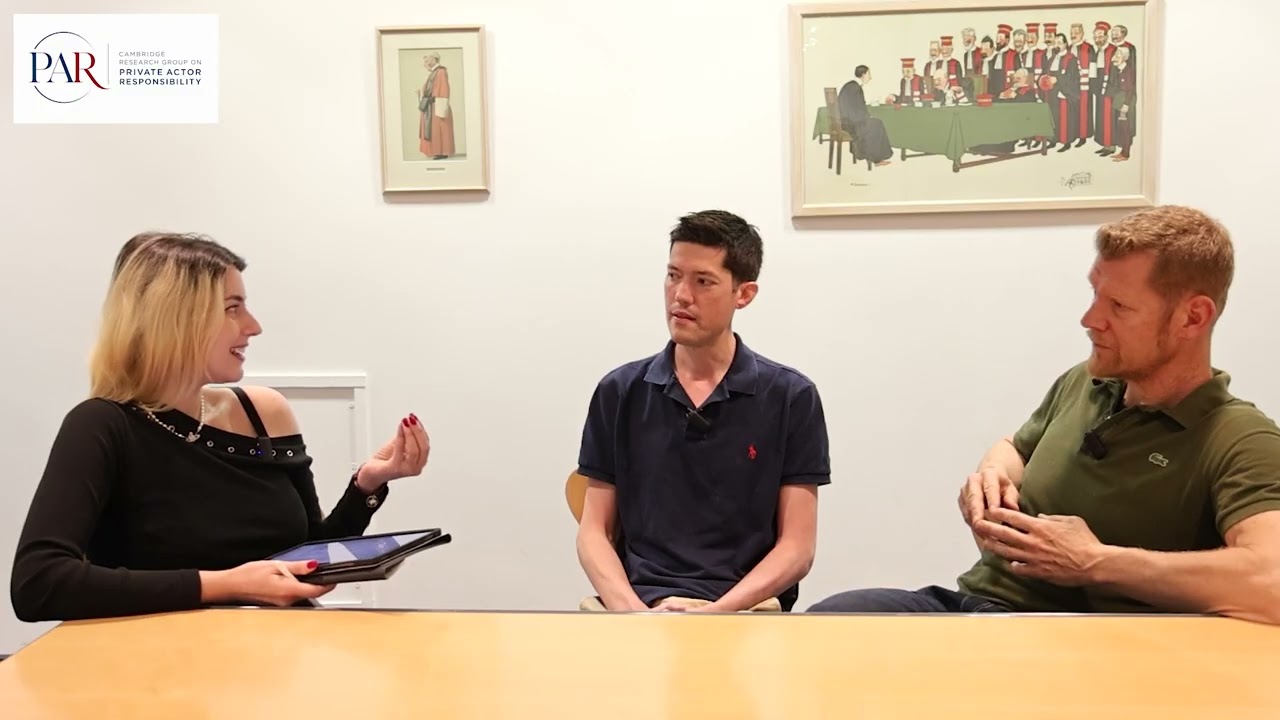
Introducing the Cambridge Research Group on Private Actor Responsibility
Watch on YouTubeVideo summary
The Cambridge Research Group on Private Actor Responsibility was established by Andrew, Henning, and Nina with the primary goal of creating an interdisciplinary space where scholars from diverse fields can engage in open-ended discussions about how to hold non-state entities accountable. Unlike traditional academic settings that focus on formal paper presentations followed by structured Q&A sessions, this group operates under a Chatham House-style rule that encourages free-flowing dialogue without strict attribution or rigid formats. This approach is designed to break down entrenched perspectives and foster creative thinking regarding persistent issues where private actors possess resources rivaling those of states yet often escape effective accountability mechanisms. By bringing together experts from various legal domains, technology sectors, economics, and social sciences, the group aims to critically examine why certain problems remain unresolved and how new methodologies can address them in novel ways.
The scope of the research extends far beyond the immediate concerns of big tech companies, although digital platforms like those involved in AI development and the platform economy are significant areas of study due to their ability to set rules through technology while relying on concepts like party autonomy. The group also investigates broader systemic challenges such as climate change within the Anthropocene era, where private actors drive emissions and biodiversity loss with minimal regulation, and historical injustices linked to slavery that continue to impact institutions today. Furthermore, the research addresses human rights abuses stemming from unregulated corporate power in areas ranging from environmental degradation to indigenous rights violations, highlighting a critical gap between the immense economic influence of these entities and their lack of corresponding legal responsibilities under current soft-law frameworks.
To tackle these complex issues effectively, the group employs diverse methodologies that integrate digital tools with physical realities, considering not just legal technologies but also the social, political, and economic implications of private action. They have already conducted discussions on specific topics such as the role of class-action litigation in addressing AI-related harms, the corporate structuring and financing of major technology firms, and historical cases involving Facebook's involvement in Myanmar regarding genocide responsibility. The long-term vision for the group is not to produce a fixed five-year plan but rather to experiment with engaging local Cambridge expertise while utilizing digital means to connect globally interested researchers. Ultimately, the initiative seeks to identify systemic issues that narrow legal perspectives might miss and to develop comprehensive strategies for holding private actors accountable in an increasingly powerful yet unregulated global landscape.
Read the full video transcript
Oh, hi everyone. Today we're here at the
Faculty of Law, University of Cambridge,
just to introduce the new Cambridge
Research Group on Private Actor
Responsibility. And I'm here with Andrew
and Henning.
So without further ado, why don't we
just start with very brief introductions
and then we can talk more about the work
of the group.
Andrew, would you like to start?
>> Thank you very much. So I'm the
International Law Academic here in the
faculty, also fellow of the Lauterpacht
Centre.
>> Right. So I'm Henning Grosse Rueschmann.
I'm a professor of law here at
Cambridge, mainly working on IP law and
tech and sort of aspects of
international economic law.
>> And I'm Nina. I'm just a PhD candidate
helping out with the work of the
research group.
So Andrew, let's start with you.
How would you describe
the work of the research group on
private actor responsibility to someone
outside the field and what are the big
questions the group is trying to answer?
>> Thank you. So the plan for the research
group was to have a space where people
who are interested in questions of
private actor responsibility could meet
to talk about those issues
but from a very much an
interdisciplinary perspective but also a
kind of Chatham House style perspective.
So the idea was to have a free-flowing
discussion rather than perhaps a
presentation of a paper and then a more
formal Q&A. The hope is that by doing
that we can bring together people from
different disciplines, different areas
of law as well as different disciplines
to think about persistent questions
which are sometimes very topical but
often quite structurally embedded so
they've been going for a long time
in new and exciting ways.
>> Mhm.
So Andrew, could you maybe expand a bit
more on how the group started and kind
of behind the scenes elements of the
the thinking behind the research group?
>> Thank you. Yes, so Henning and I always
had a strong interest in private actor
responsibility typically in the area of
corporations, but we came together a
couple years ago to do the first event
which was focused on corporate
responsibility for historic injustices.
So, um on that basis, we decided
actually there was quite a strong
appetite for thinking about these
questions more broadly. But we also
thought there are difficulties already
in thinking about the questions in new
ways because so many of us are
entrenched in thinking about them in a
particular perspective or, you know, we
take for granted that corporations are
very powerful and often have resources
that rival that of many states. But what
hadn't been done as much was to think
about why it is that we're in this
position, what legal and other
technologies are used to actually
produce this particular circumstance,
and what kind of research questions,
interdisciplinary research questions,
would lead to new and novel research in
this area, and to a better understanding
of why we end up in the position we end
up today where it seems like, in some
cases at least, it's very difficult to
hold private actors responsible for
their conduct. Um and it's very
difficult also to fully appreciate the
relationship between private and public
actors and why it ends up being that so
much work that we might otherwise think
that we should hold the public actor to
account for is actually been done by
private actor. So, we both come from
slightly different but but related
fields of of legal research, um and
that's initially what sort of started
the group. But we very quickly realized
that actually, in order to really get
access to these questions and to think
in new and creative ways about them, we
needed a distinctly interdisciplinary uh
perspective, and the group kind of was
born from that.
>> Um and then, Henning, could you um try
to explain to our viewers uh why this um
topic of private actor responsibility is
such an important area of research
today?
>> Right, I think it's always been an
important area of research, and of
course people have done research with on
that topic across different domains. But
as Andrew was saying, we are trying to
bring all of within law lots of
different domains together and also
bring in external expertise or people
from other disciplines interested in
that. So, for example, one of the
reasons I think it's really crucial to
look at this now is because while we
always had private ordering, like the
idea that companies not only or not only
companies or any sort of private
individual actor not only trying to
perhaps
influence policies made by the state,
international organizations, or other
public policy makers,
we by means of technology and other
means of sort of amplification of these
effects of private ordering, we see
completely new sort of dimensions of
that, right? So, just take the platform
economy where major platforms
not just sort of engage in market
environments with users and compete to
some extent, maybe divide up markets,
but also basically set the rules, right?
And they can just rely on very basic
notions of party autonomy, freedom of
contract to do that, and they can
amplify find that by means of
technology, right? And you see it in the
AI space very much similar developments
where because of the geopolitical
current races amongst for for
domination,
there's hardly any
chance of effective regulation. So, for
because regulation sort of as a tool for
control diminishes, there is, I think, a
strong need to look at the consequences
of that and to also to think about what
might be tools to address that within
private law, within public law, or
outside law altogether.
>> Mhm.
Um and how does the group approach all
of these very important questions? So,
Andre, if you could expand a little bit
about the the aims, the methods,
and the different perspectives that
we're trying to bring together.
>> So, first of all, the the group is meant
to be very creative. So, the idea is
that we're really open to different ways
of thinking about these problems. As
besides here as Henning said that some
of the new challenges arise because of
the developments in technology, which
pushed us to sort of the vanishing point
of law, the perhaps the limits of law.
So, by having people in different
backgrounds and different expertise, we
can think critically about what what the
law is doing and also where the limits
of that are. But also we acknowledge
that in thinking about private access,
we're not just concerned about the kind
of legal technologies that are used to
make some of these things possible, but
also the digital technologies or the
actual physical technologies behind it,
the economic implications, the social
implications, the political reality. And
it's only by thinking about all these
things together that we can then and I'm
thinking then about the relationship
between the private actor and the public
actor that we can perhaps start to
really get to why some of these problems
have been so entrenched, have lasted for
such a long time, and why today with
technology they might be particularly
acute. So, to answer your question, the
methodologies are diverse, you know,
we're looking at different perspectives.
That's the precisely the reason. We have
a number of different speakers who come
to address the group from all around the
world, sometimes online, sometimes in
person. Um and they often bring very
specific expertise or they look at very
specific issues, but the group as a
whole can kind of take in into account
different aspects and different
perspectives. So, the aim therefore is
to kind of bring together all of these
and to use that to think critically
about some of these systemic and and
very current problems.
>> Amazing, thank you. Um and then we
talked a lot about um the big tech,
right? And the responsibility of of tech
companies. So, is that really um the
the only or kind of the the main topic
that we're trying to cover? Are there
any other topics that we're trying to
>> we want to go our thinking around
responsibility way beyond this
particular aspect of big tech actors,
right? The that is when it comes to the
deployment and use of technology one of
the key domains, but you can also think
more broadly about phenomena like the
Anthropocene, so the the idea that
humanity
basically is now the determining factor
of life on our planet and the survival
of the planet itself. And that
essentially, of course,
is due to
those who had the most impact on the
maybe emissions which create climate
change, on the loss of biodiversity. And
again, often this is not solely private
actors, but it is private actors. And
it's also private actors who do a lot of
sort of responsible
um mechanisms trying to avoid harm and
minimize harms, right? So so we're
looking at that broader domain of the
environment. Um maybe also sort of uh
more uh affected indigenous and other
sort of groups by uh private actors. And
uh we have, as in Andrew sort of
suggested earlier, we've started out
actually thinking about historic
injustices, often which still manifest
themselves to some extent here in the
present, right? And um for me, one of
the scenarios where I come to sort of
think about more about that is
that Cambridge we couple of years back
done an inquiry uh on the legacy of
slavery of the university, its colleges,
its alumni, and so on. And and looking
at at that, right? Because the buildings
not this one particularly, because it's
a new building, but many buildings in
Cambridge date back to periods where the
transatlantic chattel slave trade, for
example, brought riches to this country
as to many other sort of European
countries. And many of these sort of
impacts still resonate today. So so I
think we're we're certainly going to go
beyond Big Tech, and we've done some of
that. And of course there's more to come
in the future.
>> So Nina, I wonder if I can ask you a
question as well now. So what made you
interested in joining the group?
>> Um so my kind of main area of interest
is broadly human rights and my PhD is
actually on human rights theory and
jurisprudence and so on. Uh but my um
kind of personal affinities uh draw from
these this area of
um
corporate responsibilities, private
sector responsibilities and so on uh and
from this area of business and human
rights which I've I've made clear to you
to both of you how much I um
uh well disagree with the slow
development of the area of business and
human rights how it lacks um real
regulation. A lot of it is based on soft
law which is not binding. Um
and obviously that's a problem because
of everything that we talked about
today. We have all of these extremely
powerful um actors, private actors that
are almost having the power
of public actors, of of the states
um and the the budgets of ones as well
without any real corresponding
responsibilities that come with it. So
there's a lot of human rights harms,
human rights abuses that stem from it
and in all of these um areas that we
talked about, big tech, environment,
some historical operations and
everything, all of that is extremely uh
in my opinion um unregulated as of yet
and um which stems which which then
leads to a lot of
human rights harms um and that that was
just a um something that I'm personally
>> [laughter]
>> passionate about.
Um and Henning, what are we hoping to
accomplish with the work of the group?
So I mean more broadly, more long-term,
where do we see the the the work going?
>> Um so I think in a way this has come out
of ideas Andrew and I had talking to
people around Cambridge. So, I don't
think we have at the moment a fixed plan
for the next 5 years, whatever. We are
experimenting with ways to engage people
locally. I think Cambridge for someone
who's come here like from like different
jurisdiction, not studied here 10 or so
years ago. For me, one of the main
things what this place has to offer,
which I think the group can tap into to
to a large extent, is expertise from all
different domains and people working
together and being sort of in a in the
vicinity of a relatively small place
geographically. So, to get people from
within Cambridge, lots of people are
coming to visit this place luckily. Like
we have lots of good people coming from
all over the world to to visit this
place. Been able to sort of tap into
that. Um but also so I think like to
maybe experiment with digital technology
as a means to bring in people. So, I
think we're going to over the next 1 or
2 years see how we can engage with
anyone who's interested and maybe that's
a call for those of you who feel that
this is an interesting topic. Think
about maybe like what and how your
research might contribute to it. We'd be
very happy to hear from you. Um so
overall I'd say
it's uh something where by means of
experiment and going back to Andrew's
first question answer to the question
like it's not about formally presenting
a paper. It's about maybe getting
together getting people together to
think about a more systemic issue or
maybe trying to identify some of these
more systemic issues in ways perhaps we
don't see from our specific sometimes
more narrow um you know, perspectives on
on on law, tech, um the society, the
economy, and so on. Yeah.
>> And if I can just uh ask another
question kind of expanding on that. So
we talked about the broader topic
private sector responsibilities, but
perhaps the viewers might want some
specific details of like topics that
we're that we have already tackled and
then we plan on tackling.
>> Yeah, so I can maybe add one or two
which we have so far covered and we'll
hopefully be able to share some video
content on that.
So the way we've usually done this is
that we have sort of a broader
discussion with a couple of people
interested
and then maybe later the speaker or the
main presenter
if that person was willing to do so
would sort of have a shorter interview
as we're doing as we're doing now. So
we've done that for example in relation
to questions on the role of class action
litigation in the US and in Europe in
order to tackle harm which might result
from artificial intelligence
applications. So we had Albert Fox Cahn
and
really interesting discussion around
that. We had Julie Cohen looking um
at questions about the corporate sort of
structuring and financing of Big Tech.
So and I think we had
>> Recently we had Andrew from Melbourne
Law School talking about the role of
Facebook
in Myanmar and the question of
responsibility for genocide.
>> Oh perfect. Thank you and thank you
Andrew so much and thank you to the
viewers for joining joining us today.
Make sure to tune in for other
recordings on private sector
responsibility.
>> Thank you.