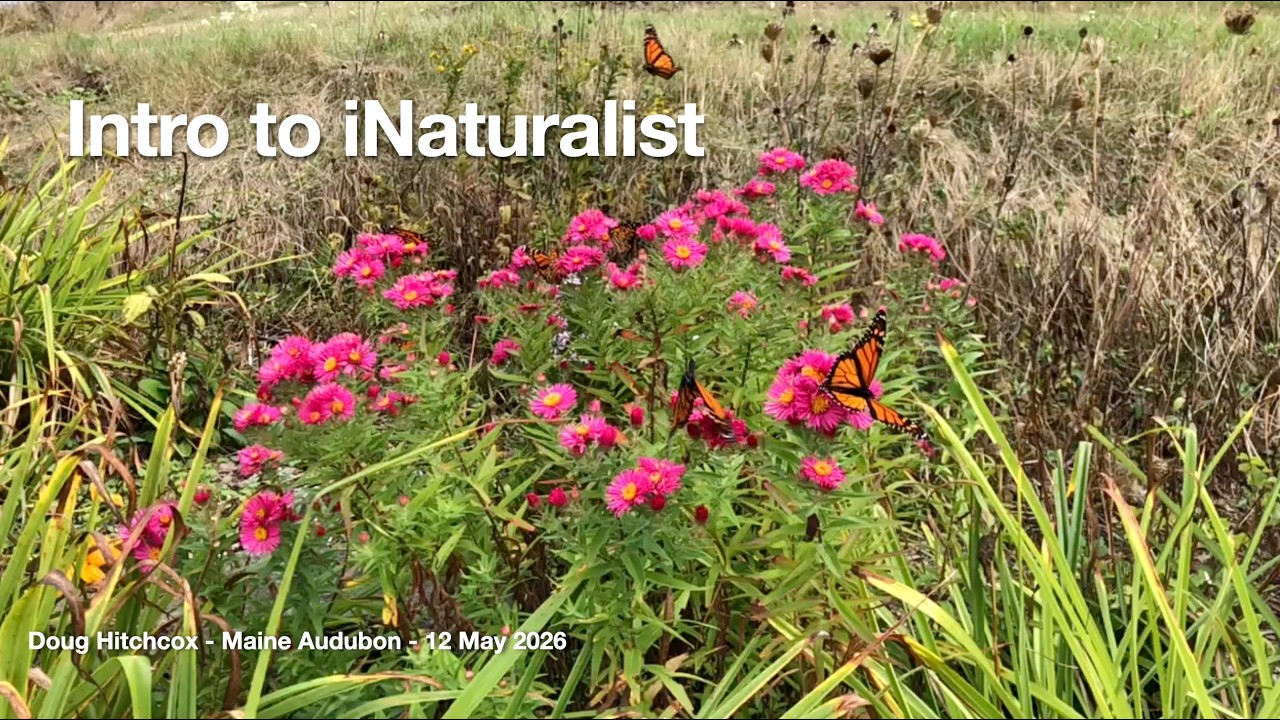
Video summary
iNaturalist serves as a powerful community-driven platform that connects people with nature through a shared database accessible via mobile apps and websites, offering an alternative or complement to organized programs like those from Maine Audubon. Users can easily set up accounts on iOS or Android devices, utilizing the updated application over the classic version to submit observations that automatically capture photos, dates, and locations. The platform leverages augmented reality for real-time identification suggestions while providing confidence indices to help users verify findings; however, it strongly encourages individuals to cross-check AI suggestions with field marks and community input rather than accepting them blindly. This collaborative approach ensures data quality, as records are categorized as "Research Grade" only when a two-thirds majority of the community agrees on an identification, fostering a robust network of experts and enthusiasts working together.
The value of this system extends to tracking specific conservation priorities, such as Maine's amphibians, reptiles, flower flies, and butterflies, which helps update distribution maps for scientific publications like the third edition of the Maine Amphibians and Reptiles book. To protect sensitive habitats, the platform automatically obscures exact locations for endangered species, such as the New England Cottontail, to prevent human disruption while still allowing authorized researchers access to precise data upon request. This responsible approach to nature exploration also promotes passive data collection at sanctuaries like Scarborough Marsh and upcoming field outings, encouraging users to start by identifying familiar backyard plants or insects rather than striving for immediate species-level accuracy, as higher taxonomic levels like family or genus are often acceptable and preferred during the learning process.
Beyond live observations, iNaturalist supports diverse types of data collection, including submissions made years later if metadata regarding date and location is known, as well as the recording of dead birds, tracks, signs, and roadkill, which distinguishes it from eBird that focuses on live detections. Users are guided to upload multiple photos, such as images of whole plants alongside specific leaves, to aid identification and can manage location precision using map circles or batch-upload photos from cameras via the online interface without needing the app. While invasive species can be submitted, the platform advises against duplicating eBird records since both feed into the global GBIF database, ensuring efficient data management. Ultimately, the session concludes with an invitation to download the app, begin observing locally, and contribute to citizen science regardless of initial confidence in identification, emphasizing that every contribution helps build a comprehensive picture of the natural world.
Read the full video transcript
Um, anyways, welcome everyone. I'm going
to edit out all that
fun beginning here. Um, today we're
going to dive in. We're going to talk
about iNaturalist.
Um,
uh, in their own words, they call it a
powerful platform that connects people
with nature and fosters a community of
nature enthusiasts like you. Um,
basically it's this this app um, and
also a
website effectively. It's it's a
database
um, that we can use to document what
we're seeing around. So, I'm going to
give some um, tips on how to use it, uh,
best practices, things that I've
learned, um, and essentially different
ways that you can use it and get
involved.
Real quick, I need to I think I'm
contractually obligated to put this
slide in. Uh, um, if you're not aware
of, you know, well, I hope you're aware
of Maine Audubon since you found this
program, but we are a member-based
organization working to conserve Maine's
wildlife and wildlife habitats. We can
only do programs like this, um, or as I
was talking about the birding basics
series earlier, we had 650 people
registered for birding basics this year,
which is
um,
uh, a record for us. It's the the most
people we've had, um, and being able to
do these programs for free, or as I was
talking about the evergreen walks that
we've been doing, the um,
excuse me, Evergreen Cemetery in
Portland, we've been doing free walks
there each morning for the last uh, two
weeks. So,
again, we can only do free programming
like this with um, the support of our
members. So, if you're not a member,
please consider becoming one, or you
know, maybe make a donation to help
support some of this stuff. Um,
next time you renew.
I want to also make the plug that um, a
couple years ago, so there there's some
updates to this, but I put together this
video.
It's on YouTube. It's under Maine
Audubon's YouTube channel
that basically follows a very similar
slide deck to what I'm going to cover
tonight. So, I will be recording this.
I'll send it out, but if you want a nice
edited video that doesn't have all all
of me
stammering and the the ums, the uhs, the
whatever.
This is a nice we cut it down. It's I
think just just over 10 minutes long
that goes through everything that we are
going to cover here. So, I'll send out
this recording within a few days, but if
you do want kind of a a nice shorter
version, um
we've also got it on on our in Maine
Audubon's YouTube channel.
As a quick outline of what I want to
cover,
really basic getting started with
iNaturalist just quickly pointing out
how to even like set up an account.
Um
this idea that you can contribute both
through observations, but also
helping out with identifications.
That'll be a nice segue into this idea
of essentially connecting with
community, as we like to say.
There's a lot of different ways that you
can use iNaturalist or you can
contribute to it.
Um
we'll talk about some specific
conservation projects, especially here
in Maine that are using iNaturalist
right now
and how you can contribute to them.
And then uh
at the end I I
probably could have fitted in a a little
differently, but I'll have just one or
two slides to point out
some
what I'll call what I'll
call
responsible nature exploration. Just
some some
ethical considerations for what you're
putting on here.
Um and and some of the safeguards built
into iNaturalist to make sure we're not,
you know, potentially putting uh um
any species at risk.
So, even using something like this cool
little uh Eastern Pine Elfin that I had
just seen, that that video that was
playing was um
from a few years ago. I had encountered
uh this little butterfly walking around
on the in the parking lot at Maine
Audubon's headquarters. And it you know,
it's the classic uh
I think of this as as whether you're
intentionally contributing records to
iNaturalist or even the casual, you
know, as I said, walking out into Maine
Audubon's parking lot and just noticing,
you know, a neat butterfly that I don't
see often and I wanted to be able to
record that.
And this at least gets us
What you're looking at is a screenshot
from the iNaturalist website,
iNaturalist.org, after I had submitted
this record. So, there's there's a bunch
of things here that we will talk about
kind of throughout the night, but the
the three important pieces um
might seem a little basic, you know, if
you've done any
uh
projects like this collecting data. Uh I
also uh I like mentioning, you know,
this is the slide. We do a lot of school
programs going, especially schools in
the greater Portland area, teaching kids
how to collect data. And you know, some
of the the the key things here
are going to be No, if the slide will
advance.
A species, knowing what uh we're talking
about. There's a fun bit that iNat Using
iNaturalist, you don't even necessarily
need to know exactly what you're looking
at. iNaturalist can help you identify it
and then the community that uses
iNaturalist can help you
uh identify it as well.
The date,
uh critically important, um especially
for some of the
uh different ways that we'll see that
the data gets presented here. And then a
location. So, as long as you know the
the when, the where, and the who, that
is a a good record for
um the iNaturalist database.
I tried to for a
number of slides on here, I try to do
some screen recordings rather than trust
my internet to play through this. So,
uh I'm going to click play and try to
narrate uh as we go over this. So, a fun
thing, if I click on the species name of
this record, it brings us to the whole
Eastern Pine Elfin page. These are all
the records. Um I think this is filtered
for Maine. So, you can now see or this
must be
a greater area. Excuse me, it's North
America.
So, you can see the seasonal
distribution on that chart.
Scrolling down, we get a nice range map
like this. And this is one of the, you
know, wonderful things about a
um
whatever you want to call it, uh citizen
science project. I know um
community science is a phrase that's
often used nowadays. Although, arguably
community science is a slightly
different thing.
Um contributory science is is another
phrase. The idea that we can all any
person um in this case, you know, with
access to a a phone or a computer
can submit a a record here. And now we
get these great distribution maps.
I will point out this is this is showing
individual occurrences. So, by knowing
the the species, the date, uh and the
location, that's what's going to put a
little, you know, pin on the map here.
I will I just want to be clear,
especially I know I always relate things
back to to eBird, especially if you were
on our Birding Basics um series the last
few months. We looked at a lot of eBird
maps. Those maps used frequency, and
that was the importance we talked about
of having uh complete checklists in
eBird of all the birds that were seen at
that place at that time.
So, important to just, you know, make
that clarification that these are these
You can filter these to look at um
them seasonally, but we're not seeing um
relative abundance uh compared uh across
iNaturalist. That's more of a tip of the
hat to uh
to how eBird works. Um
But, these are still very very valuable.
The other thing I I want to mention
before we go too far is what I would
call almost like the the selfish side of
iNaturalist, like what do you get out of
it?
Um Hopefully, the the motivation that
you are contributing to these projects
uh will be enough, but
even if there is not like a specific
project that people are using
iNaturalist for, um it's amazing it's an
amazing database that you can be putting
records of any living thing you see.
From insects to plants, uh fungus, you
name it. Uh
if it's living, it can go into
iNaturalist. And again,
even if there's not currently a project
going on that is looking for these
records, it never hurts to be collecting
this data.
Um
Often times, uh you can you can, you
know, kind of use
iNaturalist to to get your um
you know,
your ideas started, if you want to think
of it that way.
What I'm showing on the screen here is
so that's my username d hitchcock
my life list is you know what it keeps
for you. This is just in this tree view
showing you know from
the animals the the fungus the plants
protozoans even down here.
It's keeping track of you know
everything that I've seen that I've
submitted in here which from you know
for the listers out there the people who
like you know keeping track of this sort
of thing like it's really cool that it
it
does this for you.
Especially if you are you know if you
are submitting your own photos of these
it works amazingly well for being able
to you know be a repository for your
photos.
I do want to quickly say
I you know I basically use this for you
know most of my wildlife photos. I know
you know
I want to be able to look up like my
photos of a hairy neck tiger beetle.
It's a lot easier for me to look in my
account in iNaturalist and there's my
you know a photo of one versus going
through you know many hard drives that
I've got floating around from you know
somewhere in my office here.
Some of the photos do get compressed a
little bit so if you know if you are I
would say a professional you know that's
not what this is for
there are plenty of other photo hosting
websites like Flickr
that are you know if you're just looking
for a photo repository this isn't it but
it's a really nice benefit of using it
that it's going to you know keep track
of all your photos you can filter that
filter through them and um
and it's just a you know I enjoy just
kind of scrolling through and and see
seeing the things I've seen.
So that again I just threw this slide in
to say there is, you know, almost
you can probably think of a better word,
but it's it's the selfish side, like for
you. You can get a lot out of it, just
yourself.
Um
as I said, let's do a really quick bit
here on signing up, setting up an
account, um because there's a couple
ways that you might use iNaturalist. Um
I'm going to kind of split the screen
here. On the right side, you're going to
be looking at just a a screen recording
from uh my phone, looking at the the App
Store, and then I'll quickly show what
it looks like on the web, as well.
Um
iNaturalist is available on both iOS and
Android, so just about any smartphone
you have should be able to find it. Just
search for the word iNaturalist.
There are now a couple apps out from
iNaturalist. I'll I'll show this on a on
the next slide, but looking for
the one that is now currently just
called iNaturalist is the one that
you'll want to be using.
Um once you've got that downloaded, if
it's your first time using it, it's
going to have you it'll, you know, kind
of walk you through what you're doing.
At the same time, if you just go on a
web browser and go to iNaturalist.org,
when you click the sign up button,
you do need to create an account to use
this. Um any of these records we want
linked to an observer, especially if
there's ever going to be like questions
about them, um knowing who is submitting
them is is kind of just important, but
just email, username, password. Um
I will say, you know, there are these
kind of funny questions. You do need to
consent to iNaturalist to that they'll
um
you know, be
be having access to some of your data,
um
don't worry about this, I guess is is
maybe what I would say. Um
in the many years that I've been using
it, I've never received, you know, they
are not here to spam us. This is These
are the good guys. Um there are plenty
of apps that do
uh similar things um
that aren't
similar things in that they'll try to
identify birds or birds, excuse me.
You can tell I'm
very bird-brained right now.
That will help identify whatever you're
trying to submit to it, um
that I think are perhaps a little more
uh
nefarious.
Here's the the one problem I'll quickly
acknowledge. This is just a folder I
have on on my phone where there are now
three different apps out from
iNaturalist.
Uh some of the the screenshots I'm going
to show are actually from this one that
is now called iNat Classic, iNaturalist
Classic. That was kind of their original
app. They've done a really nice kind of
updated version of it. It came out last
spring, so just just about a year we've
had it now. But I know I see a lot of
people that still have iNaturalist
Classic as it's now called on their
phone, so
uh maybe now is a good chance to make
sure you have the newest version. Um
it's all going to the same place. You
can use both, but I will say the the new
one is a bit slicker.
They also came out with this app called
Seek, which basically allowed you to use
iNaturalist in real time. So, if you
know what augmented reality is, it's
that ability to like hold your phone uh
with the camera open, and in real time
the app would
try to identify and and label whatever
you are pointed at.
So, the first iNaturalist app didn't do
that. So, they came out with Seek so you
could use this kind of augmented reality
and just walk around and ID things. Now,
that's built in. So, the new iNaturalist
app kind of combines these two and it
makes it just a lot sleeker. So, that's
a long-winded way to say
maybe make sure you're using the newest,
most recent um
app. But, uh
depending on what you're using, this
could look a little different um at
various stages.
So, let's talk about um
uh as we say here, observations and
identifications. Uh right when you first
uh are going to launch the app to submit
an observation, you know, ultimately
trying to get to that that end screen
that we were looking at a few minutes
ago.
On your phone, uh launch the iNaturalist
app. This is going to show I just did a
a screen recording this afternoon of me
just stepped into my backyard, saw a
little violet, and said, "I want to
submit that." So.
I'll launch iNaturalist.
Down here, this little camera button is
how you can just press that. This is
that augmented reality view. You can see
it's even coming up with an a a
suggestion
of a identification at the top, common
blue violet.
I snapped the picture.
It'll do this little analysis. It jumped
back to just the genus.
Sorry, let me pause this for a second.
When I
uh after it thought and loaded, you can
see it put it at just the genus level
that it's that it's a violet. And it
gives you this confidence index, which I
really like that it does that.
If you've ever used Merlin for
identifying, you know, birds that are
singing around you,
um in the background, it's coming out
with some sort of confidence interval.
It wants it to hit a certain threshold
before it's going to suggest a species
for you. But, it doesn't show what that
is. So, that's one of my favorite things
about iNaturalist is that it does tell
you
how confident it is.
When you scroll down to the bottom,
notice there's a section that it says it
might also be. So, it's doing this photo
It's running this photo recognition
software. It's also looking at
observations that are nearby to where
you are and coming up with these
suggestions. So, common blue violet,
that's the one that it was actually
saying when we were looking at it
through that augmented view.
But, notice it says, sorry if this is
really small on your screen. If you
can't read that, it says 52.8%
confidence.
I'll click play again. You know, it
comes up with some other violet species
that it you know, we're down below 10%
confidence.
There, this is what it looks like if I
select that one. You can now see that
it's given it's showing that other
confidence. By selecting the other one,
it's now going to show some photos that
you can compare looking at you know,
important field marks like the shape of
the leaves, how hairy the stems are, do
the flowers match. So,
I would say go with the confidence level
that you feel confident with. If you can
match it up with other um
field marks.
I guess it's not in this video, but
there's also sometimes some text along
with these.
Sorry, here it is. Learn more about the
species. We'll often go to it's pulling
from a
usually Wikipedia.
I'll tell you about that one. In this
case, um, I this was just a casual
observation. I knew it was some sort of
violet. So, I'm just going to go ahead
and say, yeah, sure. Let's just use
at that genus level.
I can hit submit. And now it's going to
sit there and wait for me to just click
upload. Sometimes you'll want to wait
till you're like on your home Wi-Fi to
um to upload these, especially if you
have quite a few.
That's how you can do it in real time.
I know another common question is how do
you do these if you have photos that
you've taken, if you're not using like
iNaturalist at the time, if you've just
been, you know, walking around through
the woods, just casually snapping photos
of things. You don't have to be doing
this, again, in real time, uploading
every single one as you go.
So, instead of just clicking on the
camera button, if you press and hold on
it,
you'll get this menu.
That gives you the options to take one
in real time, to open the ID in camera,
that's what we were just looking at,
that augmented reality view. You can
upload sound recordings. I will say
iNaturalist is not great for that, but
they do allow it. Um, and then here's
how you can also get to like your your
photo, um,
album on your phone.
Uh, I shouldn't give them too much grief
about sound recordings. So,
maybe I'll give grief to the the users.
Um,
there are a lot of bad recordings on
iNaturalist. So, I I don't think that
they're uh,
in the way that it can give a good
suggestion of what you have a photo of,
it doesn't often give a good suggestion
of what you're recording.
I'll mention down here it does say
create observation with no evidence.
This is a key part of iNaturalist is
that they do they're basically looking
for what I would call like that that
voucher, whether it's
a photo, maybe a um
maybe a sound recording, something
that's verifiable for what you saw.
They do have this option that you can
create an observation with no evidence.
You didn't get a photo, um
didn't get a recording.
I've had some species like um the first
Canada lynx I ever saw was one just
crossed the road.
Couldn't, you know, I was driving,
wasn't going to take a photo. Um but
boy, did I want like that record. Uh I
wanted to keep track of it for myself. I
wanted it, you know, if someone wanted
to know if if, you know, a state
biologist was curious. I thought that
was still important to get that
documented despite the fact that I
couldn't prove it per se.
So, you can still submit observations,
as they say, with no evidence. Um that
does exist there. But as we'll see, it
might not get up to kind of the a higher
standard
uh that we're looking for with these
records.
Let me click play just to show you that
if we do upload photos,
I think you'll get to see my camera roll
and a picture. Let me jump ahead.
There we go. I was going to say.
There's a cute picture of my cat up
above, but we jumped past it. So, I'll
select that this bird we saw this
morning on the bird walk.
And guess what? With 93% confidence, it
said that that was a
scarlet tanager.
The other suggestion,
um
which is fun to see, it says at 4%
confident that it was an American
goldfinch. Uh oh, just over 1% that it
was a Western Tanager, but sure enough,
it was this nice female Scarlet Tanager.
And I bet like if it wasn't straight on,
um or if I had cropped it a little bit
more, we probably it probably would have
been more confident.
But fun to see, that's, you know, a nice
easy way. Click save, and now your
observations are in iNaturalist. It's, I
think, a lot easier than
uh
than
Well, having done these courses a lot of
times, um
I think it's easier than most people
think. Especially if you're coming from
an eBird background. Um eBird, which, as
we said, you know, it wants a complete
list of everything that was there. Are
you sure you're reporting everything you
saw? It wants to know how many of
everything you saw. Um
eBird
wants a lot from you.
iNaturalist wants to know what you saw,
when, and where.
And that makes it pretty easy to use.
I almost pulled this next slide out, um
because it's it's kind of uh it's a
funny outdated number now.
Um this was a blog post. This was a few
years ago,
uh
where they were celebrating This was
into 2023, I guess. Um Fun to see kind
of the the growth here.
Uh you can see this is the number of
observations um per month uh plotted out
um
since since iNaturalist started. And you
can really see this adoption now. It's
fun to see also the seasonal influence.
Uh of course, a lot of people are
getting out in the
well, in the the northern hemisphere in
the spring. You can certainly see the
bias to um who's using iNaturalist, or
or I should say who
who has the free time um to be logging
uh observations like this.
Some fun numbers from here in Maine.
The first time I did this slide deck, I
guess it was back August 2023, Maine had
just 642,000
observations. Pretty impressive.
I thought it was really impressive that
it was up to 762,000
by
um
less than a year later. This was March
of 2024.
And
fast forward a couple years,
we're now over a million observations,
1.2 million observations just in the
state of Maine
covering 13,000 different species.
Again, this is from, you know, any
living thing being reported, but that is
a just awesome number.
These other two are what we'll kind of
talk about
um
coming up here is these are the number
of observers, so people submitting these
records. But a really great thing of
iNaturalist is that you can also just be
an identifier. You can help identify
um
and uh yeah.
Up.
What am I trying to say? You can help um
confirm what people are are submitting.
Oop, sorry.
This was just going to be one more
example.
Um
just to be clear,
to show how easy this is,
launch your camera. This is actually
This is from the iNaturalist classic. Um
so, observe something.
Uh there was one bit of extra credit
that I wanted to show in here. Um
photograph it.
Upload your photo.
So, a little clunkier compared to the
newer app.
It's going to load some suggestions.
Again, these would Remember, these would
be listed at the bottom of the the newer
version of the app.
Important to compare some of your
options.
In this case, another one that I was
just looking at my in my garden dock.
Which is a good host plant for um
bronzed copper, one of my favorite
butterflies that we have in Maine. They
um they use dock as a host plant. Even
the non-native dock they'll they'll use.
Um
which is a species that's just
kind of disappearing really quickly. Um
but that it's not as bright and
beautiful as a monarch, so people don't
seem to care as much.
Everyone wants to plant milkweed. No one
wants to plant dock. Um unfortunately.
Uh then select your ID. And the last
thing I was going to show is that you
can add multiple observation multiple
photos. So, I would say I would call
this extra credit if you want to go in
and start adding, you know, that first
photo is good for telling that it was a
a dock. The second photo with a closer
look at the leaves, those big broad
leaves, is going to be helpful for
telling that it's broadleaf dock. So, I
know a lot of lot of observations in
iNaturalist just get that
um
a single photo to go with it. But for
especially for plants, um even birds at
different angles it can be really
important or really helpful to have
multiple photos.
Here's three examples. Um again, walking
around my yard. This is um
couple years ago in the summer. I wanted
to show basically varying degrees of of
difficulty.
Um
this first one,
oops, it'll start playing
a pretty distinctive plant. Folks might
recognize it.
We'll let it do its little
loading suggestions here. Helps that
it's very distinctive.
It is the um
common or I know it as spotted
jewelweed, one of the um touch-me-nots.
Um, very distinctive plant, you know,
those those leaves
um
not much you're going to mistake it for.
Now, here's a fun one. Um, great that it
got that, you know, it did say it's
pretty sure it's in the genus Impatiens.
Yep, definitely and I know that it was
um
spotted.
This next one,
um
again, if you're a gardener, you'll
probably know that um
recognize the leaves here, but it's a
fun one when we take a look at, you
know, pulls my
Sorry if I didn't say this before. A
really fun thing Let me go back 1
second. A really fun thing about using
the app is that your phone knows exactly
where you are
and when. So, you don't even really need
to collect that data. Your phone's going
to do that for you. As long as you're
snapping a photo, iNaturalist knows.
Let me just fast forward this.
Here's the funny answer. So, these were
daylilies growing in my garden. Um, it
gets that and you know, that's the one
that I would pick here. But, notice
some of the other options. There's this
daylily leaf miner. So, this is an
insect that bores that that's a leaf
miner, so it's going to be mining. It's
going to be boring in through these
leaves. And it's funny, I didn't notice
that you know, I didn't see any of them
actually in
uh uh
in the leaves here, but it's a funny bit
to realize when you're using a photo
recognition software, you know, it's it
doesn't know the difference between a
a leaf miner and a daylily, but it
certainly knows that they they look the
same. That's how people are are
uploading these.
Here's another fun one. What happens if
you've just taken up close picture of
some bark on a tree?
Let's take a look at what suggestions it
loads.
And kind of funny here.
It does suggest some trees, uh black
oak, red oak. The funny thing is this is
actually a sugar maple. Um so it didn't
even get that and didn't, you know, get
an a maple right. This is where
photographing things like the leaves are
going to be a lot more helpful or even
kind of taking a step back so you can
you can actually see like the patterns
in the bark might be more helpful.
Another funny one.
If we look at
uh uh
the other suggestions, so uh spongy
moth, the new name um of this invasive
species. Spongy moth, guess what they
are often photographed on?
Tree bark. So, the way that uh photo
recognition software works is often, as
we said, not looking at like the
individual species, but I bet almost
every photo of a spongy moth, unless
it's sitting up against like a white
sheet or something that it's been
attracted to at night, it's probably
sitting up against bark. And that's a
good thing to know is one of the
problems with um photo recognition
software.
Especially fun to look down, uh
yellow-bellied sapsucker is also listed
as an option here.
You might say that doesn't look anything
like a yellow-bellied sapsucker, but you
get the two points of
sapsucker photos are often taken with
them part you know, sitting up against
the tree or if someone's uploading
photos of sap wells.
So, you don't even see the bird, but all
those sap well photos are going to have
the sap wells sorry that um
are what the sapsucker would be drilling
into the tree to create the sap that
they'll come back um insects will be
attracted to it etc. Um so
I just you know, random examples here,
but I think these are important to
realize that it's doing its best to come
up with a suggestion, but it can
sometimes give you some pretty wonky
things.
And I know from
from uh reviewing iNaturalist records,
from reviewing eBird records as as
people you know, become seemingly
increasingly dependent on Merlin a lot
of people put a lot of faith in these
um
uh typically AI generated uh
identifications
and this is my quick encouragement to
you to still use your critical thinking
skills and don't just blindly accept
what it's
uh suggesting suggesting here. It will
be wrong
um
but this is where the community comes
in.
Natural transition, am I right?
And this idea of connecting with
community in iNaturalist there's some
really um
uh fun ways that this works.
I'll show you again just a screen
recording. This is me going on to
iNaturalist.org.
Once you have an account you're
submitting sightings uh you can start
following people. I love following Herb
Wilson. Um he is great um
uh uh
What am I looking for? Lepidopterist? Um
always out, you know, finding cool
butterflies and things.
Sorry.
When I open this site, you'll notice
there's this little notification in the
top right, and here are three
observations of mine that people
have helped identify.
This was Weston Barker.
I uploaded this record. It always jumps
to the the new record.
But here it's showing this was a margin
tiger beetle, also called salt marsh
tiger beetle,
that I had submitted. And notice now
underneath
my as it says suggested ID, there are
two other people that have also said
margin tiger beetle. And what that gets
us to
is this up here where it says research
grade.
iNaturalist, the database wants what
they call these research grade records
where you have at least a two-thirds
majority of people agreeing on what
that
observation is of. You're not going to
get that two-thirds
um
level for those records as we talked
about that that might only have
um
like a single or or no photo. This is
why you need the evidence for people to
confirm and look at.
Just to quickly show
on the app, again this is the older
version of the app, but there is a
section where you can see
um
your content and people uh
as they agree with your IDs as well.
You can comment, you can um
change the the identification.
This is the really one of the really
cool parts of iNaturalist.
Just to show some Well, excuse me. Show
some examples.
Um
this was a a fritillary, some butterfly.
I was way up um we were doing surveys
for the main bird atlas.
Uh while being up in kind of remote
areas, you can see we're near the Saint
John River up here in Aroostook County.
Um I knew not many people were going to
be, you know, looking for or or, you
know, doing much um
collecting of data up there. We were
there looking for for birds, but I
figured I would, you know, get some
butterflies as well. I submitted this
just as as a fritillary. I didn't know
which one, one of the big ones. Um
guessed the genus here.
Um
and there's Herb, as I mentioned before.
He certainly knows his butterflies
better than I do.
Sorry, trying to advance. This is just a
a blowing that up so you can see it a
little better. So, Herb suggested that
it was actually Atlantis Fritillary and
wrote some great comments. He says,
"Black spot present on forewing on outer
part of central darker area also present
in Aphrodite, but not in great spangled.
Dark wing margins separate this species
from Aphrodite. Blue eyes also good mark
for Atlantis. The eyes in Aphrodite and
greater spangled are yellow-green."
I said, "Thanks." And I changed my my
identification to also be Atlantis. And
then here's uh Bill Sheehan, great um
birder naturalist from Aroostook County.
Also um put it in as Atlantis
Fritillary. And now you get see it gets
that tag as being research-grade.
As people um
uh you'll you'll see this on each page.
It'll even tell you who the top
identifiers are of
uh any species that you're you're
putting in here.
Um and it can be really fun when you
start realizing like some of these are
are truly like world-class experts in
some of the species that that are
showing up here.
You can get to do this, too. If you just
go into iNaturalist and click on
explore, one thing I love doing is I'll
just filter down to Maine.
And then I filter to just birds. There's
one thing I feel confident in is that I
can identify birds. So, I can go through
here are, you know, recent observations.
Someone uploaded this photo,
probably using the app, and it just said
it was something in the genus Larus, one
of the large white-headed gulls. I look
at that and I say, "Well, that's a
juvenile ring-billed gull."
So, I can suggest that here.
And then when I click done,
it suggests that, and since it's higher
than that
uh what they had put in, there you can
see it changes to ring-billed gull. It
still needs an ID.
Let me pull that back 1 second. It still
says need needs ID because we don't have
2/3 of the people all
um or 2/3 of the
IDs agreeing yet.
And this is where that observer, they
could change theirs to to agree with
ring-billed gull and get it up to
research grade, or if someone else also
voted for ring-billed gull, that would
get it up to research grade.
Another fun example.
I can click on this one. They've
submitted as a a mallard, but since no
one else has done it yet, I can just
click agree.
Got the white on the tail, looks good.
And notice
after I click agree,
it changes over to research grade.
And now that's going to show up on the
maps and be exactly what we want in
iNaturalist.
I think I've one more example here of
what happens if you disagree
with something.
Scrolling through, here's a great
cormorant.
In August, not too common in Portland.
All right, let me slow down a second.
Well, we'll look at it.
There's the cormorant. Looking at it,
that color on the throat looks more
orange than yellow. That's one way to
tell them apart. So, I'm going to go
back to this record and I'm going to
suggest an ID.
And to me it looks like double-crested
cormorant.
I find that from the drop-down.
And I always encourage you to if
especially if you're disagreeing,
then say why. So, I wrote, "The orange
gular pouch better for double-crested,
yellow, and great."
I'll hit done.
Now, when it uploads here or or updates,
notice it still says needs ID and it's
bumped it down, despite me putting in
the species, since my suggestion
of a species differs from the other
species suggested. You can see that in
the top here it switches over to just
the family level, cuz that's that's at
least what we've agreed upon is that
it's within Phalacrocoracidae,
uh the family.
Now, if other if someone else comes in
and agrees with double-crested
cormorant,
there's our two-thirds and that would
get it up to a
um
it would turn it to double-crested and
it would get it to that that research
grade we're looking for.
Couple of their fun or funny examples.
Here is um
Oh, there's Talk about There is a funny
story about how this uh fun critter
ended up um
Real quick, someone This was years ago.
They brought in uh this barred owl that
unfortunately been hit by a car. They
found it on the side of the road in the
winter. When they brought it inside, um
we had it on a table. We were um
discussing it, getting the information.
May not Audubon has the permits to be
able to um accept specimens like that.
Um we use them for educational purposes.
While we were watching the barred owl
dead on the table, it started to move.
Uh the feathers um on its chest started
to move a little bit, and out came this
fly, this louse fly. Um They're these
really like kind of flat-bodied, perfect
for wedging themselves like in between
uh the feathers, um especially on birds.
I only knew of it as some sort of bird,
you know, as I'm typing it into
iNaturalist, I type in bird louse fly,
and, you know, seems good enough to me.
And that um
well, older than 6 years ago at this
point, that was back in uh
February of 20 uh 17. I put this in. And
funny that
What you can see is someone very quickly
agreed with me, bumped it up to uh
you know, it would have been a research
grade uh um
record there. But then
almost 7 years later, someone who
probably knew a bit more about uh louse
flies, they put in this suggestion at
just the family level, and pointed out
that the species that that I had picked,
and I think I had picked it probably
from some the from either being swayed
by the name or whatever the the
AI suggested at the time.
They pointed out that it's a it's a
palearctic species. It's an old world
louse fly. So, not one that was here. It
bumped it down to a different level, and
then
um
uh almost a year later, here someone um
did get it
uh I guess agreeing with that with a
family level again.
So,
sometimes it can take a while. It can be
um
I don't want to say discouraging, but
sometimes you'll you'll submit some
observations that
uh
it might take again um months. In this
case,
it took years
to get this, you know, at least into the
right family.
Um it's still I don't think it's it's at
research grade record right now.
But, it's in there, and I I do like to
say, you know, um
that's in there for all time, and as
people start, you know, studying louse
flies a little more,
um maybe someone can figure out like
which species it is.
All right. Um I want to talk about some
more specific projects. Uh again, we've
we've
just been talking about how you can just
get your observations in here, but
sometimes having a little bit more
purpose. Um
Sorry, you keep getting my my tiger
beetle photos. Quick plug. I I should
have written down the date. I'm going to
do a whole talk on tiger beetles, I
think, in another month or so here.
These have become my favorites uh
beetles uh in in Maine. We've got some
really cool ones with some really uh
amazing kind of natural history and and
everything. So, if you've never seen a
tiger beetle before, you're going to
start finding them as you're out looking
around, especially out birding and
they're pretty cool.
Here's a fun, um,
story I want to tell. Uh, this was a
photo that I had, uh, taken out in my
parents' backyard when I was growing up.
I'm sure you can't read that. It says
July of 2012 out in Hollis, Maine. Um, I
I knew that it was still that date
because of, you know, the the metadata
in the photo. Um,
I'd been going through these. I
submitted it 4 years later, so September
of 2016,
which I think is a good point to make.
You don't have to be, you know, finding
this stuff, um, immediately submitting
it from your phone. If you've got, you
know, if you know the date, the
location,
and you can let iNaturalist identify it
for you,
you can submit any records you want. So,
this one I had uploaded in, um,
in 2016 from 4 years earlier. Um, it was
this ribbon snake that,
you know, I think it was the only one I
had photographed at the time, so wanted
to put it in iNaturalist.
Now, here's one of the fun things about
this. Uh,
Trevor Persons, who's a herpetologist,
um, sends me this email and says, "Hey,
you know, we'd love to use this for the
Maine Amphibian and Reptile
um,
because it was the first record that
they had of one in the town of Hollis.
Awesome.
Even cooler, some years later, uh, now
2021,
uh, in Standish, we were doing it this
was some bird atlas work, too. Saw
another ribbon snake and here is just,
you know, quick shot I took with my cell
phone. You can barely see it, um, in
there, but good enough to ID. And same
thing, got another email right away from
Trevor saying, you know, that it
upgrades Standish to a photo record.
They had a record before, but no um
documentation to go with it.
Why I think this is all so fun and so
cool, if you've been, you know,
following the um
the real important news out there,
is that we now have the third edition of
the Maine Amphibians and Reptiles book
available at your local Maine Audubon
Nature Center.
Quick plug there. But one of the along
with the great species accounts that are
in there are the updated maps from
that project. And really fun to see like
um
Uh where is it? Standish and Hollis are
going to be like down here, I guess. Um
you know, there's my records that I put
in iNaturalist now getting used to to
update the distribution maps of these
um
uh species in this book, which is, you
know,
a fun way to get to see this stuff used.
Picking a random um
uh frog that I had seen. Um this was
another one while out atlasing way up in
New Portland.
Um found this green frog. I do like to
point this one out because you might say
like, uh a green frog, like they're
a common species, they're all over the
place. But it's fun when you start
looking at the map and realizing like
if you're not going to be the one to
report it, like maybe no one else is. Um
there I put the record in. We've got
people agreeing that it's a green frog.
And then scrolling down, we haven't
talked about all these things. You can
annotate your your
um
records to say if it was alive or dead.
Um
the what life stage it was in. But
there's a section called projects. And
this is how a lot of these projects,
like the main amphibian and reptile
project, um how you can directly
contribute to them.
Some of them are set up
like this project that if you submit a
record of a
um an a amphibian
um
an amphibian or reptile in Maine,
it knows it knows what species they are
looking for and what geography
geographic area they're looking for.
So, any of those records are
automatically going to get pulled into
this.
This is how almost every project works
now.
Here's the amphibian reptile. This is uh
older screenshots, so I'm sure they're
well over this now, but just by doing
this they've got oh you know, over
20,000 records as I said. This is a
couple years old since I updated this,
but
that's what they
uh
that's the primary way they're now
getting records into um the survey.
I really want to make a plug for current
project. We've got the the reptiles and
amphibians book with the third edition
just came out, but the most recent um
statewide survey that the state's doing
uh I should also plug the the main bird
atlas. We used eBird for that. Um is
getting published this year. I
we don't have the official date, but
August it should be in our hands, and I
um
having been one of one of the authors on
that and the outreach coordinator for
all those years, um
I cannot wait to see that come
um
you know, to to a solid state, I'll call
it.
Uh
anyways,
I want to make the plug for flower
flies. The the state's now um
is it 2 years
into uh this project, and it's amazing.
You know, I wouldn't have thought that
they would have you know, almost 12,000
observations at this point. Um I
remember when they announced that I
said, "Oh my god, who who's going to
look at flower flies?" But sure enough,
they've got, you know, almost 1,400
uh volunteers that are submitting
observations here. And it's so easy. Use
iNaturalist,
spot something, spot a um
you know, any of the the flower flies,
uh hover flies, uh
Syrphidae,
uh love Latin.
And that'll get your observation into
this. This is one that I love to point
out. I don't know flower flies at all. I
bought the There's a book about um
flower flies of Northeastern United
States.
And it's horrible. There are so many
that look identical. I just don't care.
But I can get good enough photos and
upload them here. And then people on
this project, usually within a day, are
figuring out what species it is and
updating those observations, which
is great.
I'll quickly plug a bunch of Maine
Audubon sanctuaries. Um they should all
be set up now, but we're trying to
collect, you know, passively collect um
data on what
uh what you can find at all of our uh
different sanctuaries.
Scarborough Marsh, we've been doing
bioblitz uh
each summer, gosh, for probably
15 years now. And it's really fun to see
this is this is just a little stretch of
the
um the nature center going down Route 1
along the nature trail that we have
there. And again, this is just from
having volunteers come out on a couple
days each summer,
um we now have hundreds of observations.
So, here are a couple photos from it Um
I think 2 years ago.
I want to make the plug um
we're going to have some outings
associated with this. Um
the ones at Gilsland Farm are we're
going to extend them and do a couple
throughout the summer, but the one that
was scheduled for the 13th, that was
going to be tomorrow um
after late afternoon does need to be
postponed. Um
the person who was going to leave that
leave that is is just out right now. So,
stay tuned. You still can um sign up and
get notifications for the the new dates
for that.
And then I want to make the plug that if
you're up in the greater uh Bangor area
near our our Nature Center at Fields
Pond in Holden um
we want to do the another
this will be, you know, field-based
rather than just me talking to you on
Zoom. These will uh be a great
opportunity to come to our sanctuaries
and and, you know, whip out your phone
or bring your camera and collect some
observations and get help from the
naturalist there. Um but I want to make
the quick plug there's only one person
signed up for the Fields Pond one right
now.
Um
especially giving uh Nathaniel, you
know, the um
the motivation. Uh let's if if you want
to do it, please sign up now so we know
kind of how many people to expect. That
would be super helpful.
As I mentioned at the beginning, I have
just like two slides uh cuz I want to
make this point about kind of
responsible nature exploration, as we'll
call it here. Some of these more
vulnerable species that you might think
um
that you wouldn't want to submit to a
public database. Uh but I'll show you um
some things in place here that that kind
of make it fine.
One example
here is New England Cottontail.
This is a endangered species. There are
a few places,
especially on the southern coast that
you can go find them. Not to be confused
with Eastern Cottontail, the non-native
Cottontail that's now taking over
southern Maine, at least in the greater
Portland area.
That's a
a big problem that's getting out of
control. It's incredible to me how many
Eastern Cottontails are now, especially
on the peninsula in Portland.
Out of control. Especially the the
concern is that they're going to push
our New England Cottontails out of their
habitat. Um
potentially even hybridize, maybe, but
big problem for New England Cottontails.
They need all the protections that they
can get.
Because they are an endangered species,
when you submit
an observation to iNaturalist, instead
of showing an exact pin on the map,
you'll be able to see where you saw it.
But, if you can see, I might not have
pointed this out before. The the little
orange dots on the map here are other
observations
that people have submitted.
And it shows them as being imprecise. It
doesn't show you exactly where. It's
getting, you know, it's fairly close. If
you know the habitat, if you know, you
know, I'll spoil this one. Laudholm
Farm, they've been doing a lot of work
in releasing New England Cottontails
there. So, they tend to be very tame,
and and that's where you can actually
see them if you ever want to see a
really cool mammal.
Um so, I bet all of these are probably
from Laudholm Farm. But, interesting,
you know, how obscured they're shown.
Um here's just another kind of view of
that. So,
uh
again, I I appreciate Sorry, this was
that's what the difference is. Here's me
logged into my account, so I can see my
pin. If you were to try and look up this
observation, here's what it shows.
Basically just this um
uh what is that? Probably 15 km squared
uh where
it was seen. It will not show the exact
location. So, there's a number of
um
mammals like this. There's especially a
lot of plants. Some uh threatened or
endangered
uh plants in the state that I know um
people don't want the exact location
being shared of, but because these
statuses are built into iNaturalist, a
lot of them get automatically obscured.
Keep that in mind. There might be some
things that you say, you know, that
don't have
a a endangered species status, and you
might you might know, you know, that
it's something that shouldn't be
um
shared at that level, and you can
manually go in and obscure the location.
You can um I think it often will just
show at the state level if you obscure
it.
You'll probably get contacted by
someone, you know, some biologist who
will ask you
um
to share that with their project or, you
know, where exactly it was. Every New
England cottontail I've submitted to
iNaturalist, I've had um
Who was it? Corey Sterns, uh biologist
with IFW, reach out and just say like,
"Hey, can you confirm where that was?"
Um and it's almost always where
where they know they are.
Um
that was me talking for a long time. I'm
going to pause now cuz that's my last
slide.
Um
happy to take questions. And there's one
thing I really want to emphasize, it's
that you kind of can't break
iNaturalist.
Um especially
Let me click back here. I love, you
know, kind of calling myself out. Like
here is
this was sloppy of me. I should have
picked a better, you know, a higher taxa
or something. But I knew, you know, it
was a louse fly I found on a bird.
And just to you know, drive this point
home, like eventually we got it kind of
straightened out for the most part. I
should go back in now and probably agree
with this
this higher like family level
identification.
But I I think as
well, as humans, maybe, we always get
really caught up on this this species
level classification for for records,
but um especially
well, at least as birders, we do.
Um
especially when you're looking at
insects, a lot of them you're you're not
going to be able to get down to a a
species level. Um at least not with you
know, most of the photos that we're
going to be able to capture. So,
I think getting to, you know, a family,
a genus,
um
uh should be encouraged a bit more. And
I really like that iNaturalist does have
it um at least a lot more prominently
than
than eBird
seems to encourage.
I'll bet there's some probably specific
questions folks have um especially if
you've used iNaturalist yourself. Um
I think what I'll
do here is maybe stop screen sharing. I
can't see other people's video when I
have the screen sharing on so um I can
pull this back back up if needed.
But
how do people feel?
You're going to download iNaturalist?
You're going to go out?
And there's a fun bit of start with your
backyard. Nice. I see a lot of thumbs up
emojis. That's like
This is the fun part of doing Zoom
presentations is um
you can't read the room if you know what
I mean.
Um
I would encourage you to download it and
just go right in your backyard and
especially start with things that you
know.
If there's a red maple tree in your
backyard and you know it's red maple
because you see those leaves, you know
how to identify them, you know, or
flowers that you've planted. It doesn't
at all, you know, you can put um
uh cultivars and you know, anything that
you can identify. Start with those cuz I
think it'll give you a little more faith
in knowing like what you're assigning
an identification to.
Um
then start going out on you know
a trail. Uh start you know, start
exploring a little bit and when you see
something you don't know what it is
open that app, turn on you know, use its
little
augmented reality AI camera
um whatever.
We use the word we we call too much
stuff AI when it's not now. It's most
it's such a like sales pitch. It's photo
recognition software. It's been around
for longer much longer than you know,
the
what we the transformer models that we
now like talk about with all of these
chat GPT and thing. So,
then start um testing it. See if you can
find, you know, something that's new to
you. See if you can match that ID and
even if you can't, submit the things you
don't know because you're going to see
the awesome community that is
iNaturalist will start suggesting IDs to
you.
Um
it's really fun. Uh
what am I up to now? I've got over a
thousand observations that I've put in
and almost every time, every day, I
should say, when I log into iNaturalist,
there's a new notification. Someone has
suggested an ID. They've they have
agreed with an ID. Um you can always
tell when someone's like doing research
on something because uh it was about a
month ago. Uh I think it was every black
swallowtail record I had submitted like
the same person went through like years
and years worth of observations and they
were like
confirming them all.
Um and I bet that they're just trying to
get them all to research grade before,
you know, there's probably some paper or
something being worked on with black
swallowtails. Um
or to someone who had a bunch of free
time.
And they love their black swallowtails.
Um I don't know, but that's that's one
of the awesome things about
um
uh contributory science, whatever we
want to call it. I think uh
if there's no feel free to drop any
questions in the chat, otherwise I'll
ramble for
10 more seconds. As I say, there's you
know, an encouragement for folks is that
we're, you know, whatever motivations we
have, I think this is one of the best
ways that we can kind of give back to
nature. However, um
however it might end up being used, you
know, I think
um
I think as knowledgeable observers,
especially if you've spent an hour
listening to me ramble about using
iNaturalist, like
go use it.
You can't break it. Um can you hear me,
Doug? And even if you get something
wrong. Yeah, Matthew, go ahead.
It looks like there's a number of
questions. Can you see the chat?
I have the chat open. I don't see Oh, I
see what's happening.
Sorry, someone sent me a direct message,
so I was only seeing that.
Um I didn't see anything in the chat.
Wow, let me
Hm.
Again,
don't you love iNat love Zoom. Sorry,
let me read these. Um
I should have been
at least
Wow, I need to scroll way up.
Um
All right, this will take a second. Uh
app has a white background is the
correct app. Yes, um
if if your if your app looked a little
different than my app, it could just be
the light mode versus dark mode on your
phone.
As long as it's called iNaturalist, it's
probably right.
Um
Sapsuckers, yes. Uh are the counts just
for Maine? How do you set it up
to just count Maine?
Um
I bet that was showing when we were
looking at when we were doing I see it
was from 7:30. Sorry, I didn't see that
15 minutes ago.
Um
We were probably looking at like the
overview. So, when you go to
inaturalist.org, click on explore, you
can filter those down to
um
whatever region you want. That's how I
was getting like the number um
that we pulled there.
I hope that's what you're asking about.
Um Toby asked about invasives. You can
submit anything you want, any living
thing.
Um
it's even uh there's a number of
projects. We were using this to help map
out uh phragmites.
Um the invasive reed
uh around the Scarborough Marsh.
Um
Uh let's see. So, yeah. You can submit
invasives. Um Tom and Ann asked, "Is
there any way to input past eBird
sightings into iNaturalist as a data
dump or do you have in to input one by
one?"
Um
I'll give two answers here. You have As
far as I know, you have to go one by
one.
But, I would also encourage not to
because um iNaturalist and eBird
ultimately are those two databases are
both getting put into
a larger database called um
GBIF.
Uh what is that? The global biodiversity
something something. Um That's the That
is the big repository for all
all these projects everywhere.
And I'm sure people would know whoever's
going to pull from that would be able to
see that there's duplicates.
But,
it doesn't help.
Um I guess it would only be for your
numbers.
Um, Carol, thumbs up.
Better to do family level and let the
community narrow it down. Um, I
submitted a bird a couple months ago
thinking it was leucistic goldfinch and
didn't get a hit.
Um, should I resubmit? Um,
Linda, uh, with that bird, I would give
it time.
I'm I'm surprised I didn't see it.
Uh,
now I'm going to go look for a that
um,
finch.
Um,
resubmit and edit it to just bird.
I guess the one thing
I would say is always is getting it at
least into, um,
>> [sighs]
>> what would I call it? Um,
you can put it in as a bird. If you can
get it to like the the order or family,
then I know, you know, that's where
you're going to get people looking a lot
more.
I see a lot of people that if you don't
add an ID at all,
uh,
what is it iNaturalist calls it like
something. It'll It's literally like
just any, you know, it's something. It's
just in there. And a lot of those
records just don't get seen because no
one's looking for them. Like, there's
this one guy that just loves tiger
beetles. So, every tiger beetle anywhere
in the world, he's IDing as soon as it
gets put in as a anything in tiger
beetles. But, I'm sure
he's probably not seeing tiger beetles
that are just getting put in as like
insect. Um,
cuz he's not,
you know,
probably not. I don't know I don't know
how much free time he has. So, yeah, get
it I would say get it as specific as you
can.
And that is kind of the nice thing with
iNaturalist is like it's it doesn't hurt
to be wrong.
I was wrong with that Laos fly, um,
for 6 years.
Before it got corrected, so.
Yeah, especially if you're not getting
it.
Suggested ID from someone else,
and especially a bird.
Sorry, I'm going to keep looking at the
chat here.
Thanks, downloaded, used it. Yeah, get
back into it. Going to try it tomorrow,
awesome. Had the app.
Yeah, Toby, I've had the app since 2022
and don't see any observations, just
start new. Yeah. Especially,
you know.
If you want to try to like if you had an
older account and want to try to find
it, but.
I would say start a new, it might be
easier.
Got people updating.
Delete iNaturalist classic and just
download.
Core asked about deleting iNaturalist
classic. You know, I there's something
about it that I like I keep it on my
phone just in case.
Then, you know.
I know it works and sometimes the new
ones, you know.
There might be some bugs, so.
One answer is yes, go ahead and delete
it. Like the new one is supposed to be
the better one that we should all be
using. But at the same time.
If it's not broke.
Why get rid of it?
Thanks,
so.
Use the program online without the app.
I
so if I do a trip, sorry the question
was about using the program online
without using the app. If I go on a trip
like for main Audubon we did a tour to
Jamaica back in March and I was taking
tons of photos of
um
butterflies, lizards, flowers, um all
sorts of stuff. And I wasn't taking them
on my phone. I had a big camera. So, I
had dozens of pictures. I knew the
location. I knew the date. And those um
it was easier to drag and drop all those
photos into iNaturalist. I know we
didn't show this because it's like
it's probably how less than 1% of the
records get submitted. You can just drop
a bunch of photos at once, and then one
at a time you like click on a map where
it was, then you click and it'll suggest
an ID. So,
there are other ways to do it. Um
I just didn't show it because I know
it's it's it's
not how most people do it.
It's not a great answer, but um
try it out. It's It is very easy. It's
just there's an upload button right on
the iNaturalist page. You just drop a
photo in, and then it just asks you to
zoom in on a map. The one thing that a
neat thing is that it'll give you this
little circle um
when you click, and then you can adjust
the size of the circle with like how
certain you are um
about uh where it is.
Yeah, if you don't have a a photo and
just put in photo
uh a phone and just put in photos like I
actually like I kind of prefer doing it
that way sometimes because I like taking
I like uploading the photos I take with
my big camera cuz they come out nicer.
And the
you know, the cell phone I just I use
for like the oh, I want to document
this. Oh, a ribbon snake. Like got it.
Um
But I
Yeah, I like using it.
The other eye.
Uh so do you use iNaturalist for
everything but birds? Yes, uh Tom and
Anne asking. Uh yeah, I haven't put any
bird records into iNaturalist because
that's what I'm using eBird for.
Um knowing that they're ultimately
getting into the same database, it just
doesn't
um
it doesn't need to.
The the I guess the one exception
eBird doesn't want you to submit records
of dead birds uh because it really skews
uh detection rates.
Um or things like tracks. Um tracks and
signs. So like if you said if you saw,
you know
What would be a good example? Um
You're on a hike in the winter and you
see, you know, grouse tracks. A ruffed
grouse walked through the snow. And you
you didn't get to see the ruffed grouse,
so you can't submit it to eBird, but you
still want to be able to like re record
that you saw it.
iNaturalist lets you submit
tracks and signs. That's like when we
talked about the sapsucker wells, you
can submit that um
to iNaturalist. In the same way, you
know,
um
a roadkill bird or a window strike, um
something like that, you can submit
deceased
uh birds or animals or you know,
whatever, to iNaturalist. Um eBird
doesn't want that. So that's the
exception. That's when I'll use
iNaturalist for bird stuff.
Good question.
Um
I want to use it in my plants I'm trying
to rewild. Nice. Any tips on how to ID
random plants? Yeah.
Use iNaturalist and see what it randomly
um tells you.
And I'd say, you know, remember back to
the example where I was showing like the
the distinctive plant versus like just
the leaves and then the bark. Like
that's where I would say
um
taking a few photos of like
I usually take like a photo of the
entire plant. Then I'll try to single
get like a single leaf. Especially like
a basal leaf, like when growing from
like down near the um
the bottom of the plant um
or anything that looks unique on it. And
that's a nice thing again in
iNaturalist. It doesn't have to just be
one photo. You can upload, you know,
four photos to go with
um
any observation.
Four, 10, whatever. There's There's
probably a limit at some point, but um
and then someone somewhere is probably
going to help identify it. Um
Yeah.
Sweet. Thanks.
Ah, Matthew, good one.
A a basal, b a s a l, not b a s i l,
leaf.
Haha.
We love a good pun.
Um
that said
I started the day with a bird walk
13 hours ago.
Um
I'm impressed my brain got through this
one.
I'm glad we're not doing the gull ID
talk tonight. That one would have fried
my brain. Um and that said
in 11 hours, we can go do a bird walk
again at Evergreen Cemetery.
Um
So, uh thank you all so much. Love
seeing the um appreciations here. Sorry
I didn't see the chat. That was
a funny mistake on my end. Um
And I promise I'll get those other
recorded the final recordings and stuff
from the
um other talks out
too, but it's a busy time.
Uh anyways, thank you all so much. Have
a good night. Hope to see you out in the
field soon.
Bye, everyone.