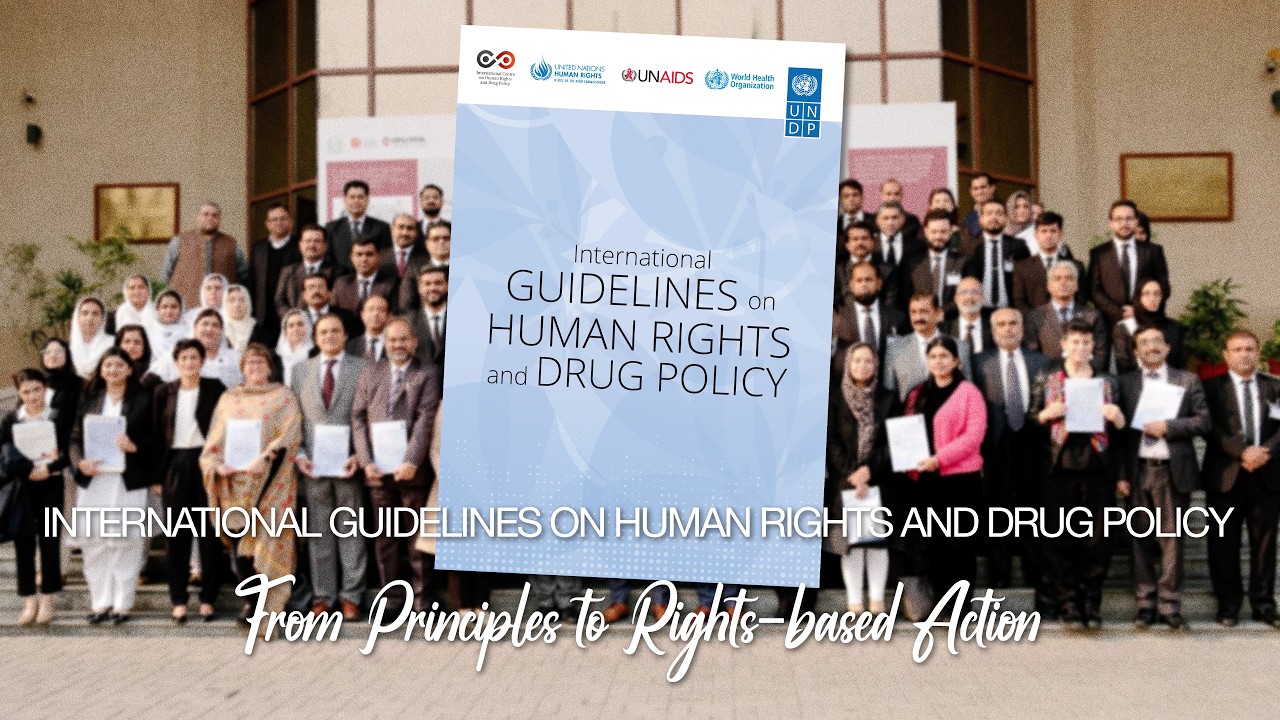
INTERNATIONAL GUIDELINES ON HUMAN RIGHTS AND DRUG POLICY: From Principles to Rights-based Action
Watch on YouTubeVideo summary
The International Guidelines on Human Rights and Drug Policy represent a comprehensive framework designed to align global drug control efforts with fundamental human rights standards, spanning the entire spectrum from cultivation to consumption. Developed through an extensive three-year participatory process involving governments, civil society organizations, academics, and United Nations partners such as WHO and UNAIDS, these guidelines do not create new rights but rather reconcile existing international human rights law with the three major drug policy conventions. Since their launch in 2019, they have served as a vital tool for shifting national policies away from punitive enforcement models that often fail to address root causes, toward approaches centered on public health, harm reduction, and the protection of individual dignity. By providing concrete legal arguments and technical support, the guidelines empower policymakers to design drug strategies that are compliant with international treaties while prioritizing human rights over strict punishment or criminalization.
The practical impact of these guidelines is evident in diverse national contexts where they have driven significant legislative and policy reforms. In Colombia, for instance, the document became a cornerstone of foreign policy engagement and was instrumental in legal challenges before the Constitutional Court regarding forced eradication via aerial spraying and personal autonomy over drug use; this helped pivot enforcement focus toward high-level traffickers rather than low-level growers or users. Similarly, Ghana utilized the guidelines to identify gaps in its new drug laws during national dialogues involving key ministries, leading to the launch of nationwide harm reduction programs and a specific roadmap for reducing stigma against people who use drugs. In Scotland, facing Europe's highest recorded drug-related deaths, authorities used the framework to develop a charter of rights that shifts the narrative from criminalization to public health support, while Brazil has integrated these principles into rebuilding its prevention policies to address broader issues like violence, inequality, and social reinsertion alongside substance consumption itself.
Beyond individual national successes, the guidelines have fostered regional collaboration and advocacy across Latin America and Europe by uniting academia, government officials, human rights offices, and communities of people who use drugs around shared priorities. In Mexico, activists and NGOs have employed the document to sensitize decision-makers on balancing policy objectives with human rights indicators, specifically advancing gender equity while challenging discrimination within supply chain control measures. The guidelines also provide a crucial reference point for countries in transition or seeking EU membership, such as Moldova and Ukraine, reminding stakeholders of their obligations to uphold human rights agendas even amidst political instability. Ultimately, these documents demonstrate that placing human rights at the center of drug policy reform is not an abstract ideal but a tangible strategy that strengthens legal arguments, reduces stigma, improves health outcomes, and creates more just societies capable of addressing complex challenges through inclusive dialogue rather than coercion.
Read the full video transcript
The international guidelines on human
rights and drug policy provides a
comprehensive set of human rights
standards applied to the entire human
experience [music]
of drug control from cultivation to
consumption. The guidelines were result
of a robust three-year participatory
process with governments, civil society,
academics, [music]
and UN partners. They were developed in
partnership with the World Health
Organization, the United Nations
Development [music] Program, the Office
of the High Commissioner for Human
Rights, and UNAIDS.
>> And since their launch in 2019, we've
started to see a range of
implementations experiences taking shape
[music] around the world. These global
experiences are demonstrating the power
and the possibility of placing human
rights at the center of drug policy
reform
>> [music]
>> processes.
>> The guidelines don't invent new rights.
They reconcile human rights to
international human rights framework
with the three drug policy conventions.
And they help us provide policy advice
and technical support to governments and
partner with all stakeholders of how you
can actually develop drug policies that
are compliant with the drug conventions,
but can focus on human rights and public
health more uh and rather than on
enforcement and punitive measures.
>> In many countries, we know that uh drug
policy has been uh based on the punitive
approach, but it didn't work. So, to
shifting that, we have these
international guidelines on human rights
and drug policy helping the government
to developing a
drug policy which is based on human
rights approach.
>> The guidelines are crucial because they
show that the idea of taking human
rights into account with respect to drug
policy isn't some pie-in-the-sky
abstract notion. There are ways
concretely that as policy makers and as
the public consider these, you know, and
wrestle with these tough issues, that it
can make it real and detailed.
>> It's really amazing actually to see how
the guidelines have been used in, you
know, national level policy discussions.
The international guidelines are also
mentioned in the previous EU drug
strategy, for example, explicitly. This
is an incredibly important document that
I think, you know, the whole of drug
policy reform really um stands behind
and and leans on heavily.
>> [music]
>> Columbia was the first country to
include the international [music]
guidelines on human rights and drug
policy into the national policy. So,
they were very, very useful to sort of
focus our um
change in policy. And it was very useful
to present it to society. To us, a
presentation to society. It was very
useful because, as you know, we decided
that we will no longer have a drug
policy focusing on law enforcement
against the lowest levels of the chain,
you know, the
coca bush growers and so on. And the
micro traffickers, uh we wanted drug
policy that will enforce, that will seek
enforcement against the higher echelons.
But beyond that, I have to say that we
have turned human rights into one of the
pillars of our international engagement.
And this is aspirational because I come
from a country that has
huge human rights problems. We know the
country we want to be. And that's why we
have mainstream human rights in all our
foreign policy activities.
>> In our work in Dejusticia, we started
using the guidelines around the right to
a healthy environment and specifically
on the recommendation that the
guidelines provide on the prohibition of
use of agrotoxics in reduction of coca
crops. In that moment, we were
experiencing the very high risk of
resuming aerial spraying of illicit
crops, which is very harmful to human
health and the environment. And the
guidelines gave us the legal arguments
to be able to provide high courts
references that were strong and to
international human rights standards and
to why it was needed to limit the use of
this practice in Colombian drug policy
strategies. So, the Constitutional Court
in Colombia has been one of the her the
first high courts in the world that has
referenced the international guidelines
on human rights in drug policy. It was
used in this court case around forced
eradication with aerial spraying, but
also around drug use in public spaces,
freedom, autonomy of personal use of
drugs. Furthermore, we've also used them
just in general advocacy with government
partners.
>> [music]
>> The international human rights
guidelines
have been very effective for us to use
when in 2023 we had done away with the
death penalty or the capital punishment
for drug-related offenses. The
international human rights guidelines,
they've been the guiding principle for
us to follow in having a more human
rights-centric approach and
in a harm prevention and harm reduction
approach as opposed to going for strict
punishments. We're trying a a different
approach this time and of course those
international human rights guidelines
have been very effective in formulating
the policy
and shaping up the the policy that we
have which is human rights-centric.
>> [music]
>> We have been using the international
guidelines on human rights and drug
policy
>> [music]
>> as part of developing a human
rights-based approach
to a situation in Scotland where we have
the highest recorded drug-related deaths
of any country in Europe.
So, I was asked by the Scottish
government to help develop the shift
from criminalization and stigmatization
of people affected by substance use
to a public health and a human rights
based approach towards people affected
by substance use.
And so, the process that we've been
leading for the last couple of years is
to develop a charter of rights for
people affected by substance use.
And that's been done through a process
of empowering individuals and
communities to understand their rights
and to build a charter and and a toolkit
for its implementation. And we've also
involved uh in a collaborative way what
we call the duty bearers, the decision
makers across design, delivery, and
monitoring of related services.
And together, we've produced the charter
and the toolkit to implement it. It was
launched at the end of last year uh with
the uh support of the uh First Minister
of the Scottish Government uh and the
Office of the High Commissioner for
Human Rights. And we're now just
embarking on the the next phase, which
is the implementation of the charter.
>> The international guidelines on human
rights and drug policy have really been
very useful for me as a country, Ghana,
because when they were launched, um that
was the same period when we had passed
our new law on drugs. We thought it was
necessary to begin to bring everybody on
the table to see how these guidelines
can help us identify the gaps in the law
and how we can plug in to address most
of the challenges. So, in April 2022,
we organized the first-ever national
dialogue, which brought together key
national agencies like um the Ministry
of Interior, Ghana AIDS Commission, the
Human Rights Commission. We brought
together the Ministry of Foreign Affairs
to discuss how as a country we could
ensure that these laws really reflect
human rights provisions that uh protect
people who use drugs. And also to ensure
that we put in place um
services. Through this dialogue, um we
also identify a gap like harm reduction.
And as we speak now, we have
kick-started harm reduction in 2022,
which was a pilot, and we have now
substantively begun a a nationwide
program. We developed um
what we call a national stigma reduction
roadmap for people who use drugs, which
was launched and um currently many of
the institutions are using this a lot of
the time to address issues of stigma.
>> [music]
>> We were involved in the dissemination
and the presentation of the guidelines
on human rights and drug policy in Latin
America. We organized an event in
Mexico, and since then we've been using
the guidelines to sensitize other NGO
members, other um activists in Mexico as
to politicize them and to uh help them
take action in shaping new drug policies
and alternatives to prohibition and to
the war on drugs, but also to use the
guidelines as means to evaluate or
better incorporate other indicators into
the evaluation of drug policies in
Mexico. We've also tried to use the
guidelines to sensitize decision makers
uh for them to understand how to balance
uh policy priorities and also how to
incorporate the approach of human rights
into their decision-making processes,
whether legislative or executive in
implementing programs and policies. So
far, we've made advancements,
particularly in the gender front. Uh
there's still a lot to be done in terms
of discrimination, stigma against people
who use drugs, but also in terms of
better integrating human rights
indicators and actions in uh violence
reduction and um the control of the
supply chain.
>> [music]
>> We are now rebuilding [music]
the policies for prevention in social
reinsertion in the scope of the drug
policy in Brazil. It's extremely
important that we look at
>> [clears throat]
>> um
the rights of people who use drugs. When
we talk about prevention, we are not
talking only about prevention of drug
use, primary prevention. We are also
talking about developing a prevention
policy in a context of inequalities in
the country. We have been discussing and
developing the concept of a
comprehensive prevention. There is a
prevention that talks not only about
drug uh consumption or substance
consumption, substance use, but also
about crime, about violence, and uh
related
deaths. And to discuss that, we
definitely need to discuss human rights,
human rights policies. So, we have been
developing the drug policy in close
cooperation with the Ministry of Human
Rights in the country. And in this
sense, uh the international guidelines
on human rights and drug policies has
been a fundamental uh
instrument to develop and to rebuild
[music] these policies.
>> [music]
>> We were providing to these guidelines
some our cases, but the most important
part was the regional consultation we
did for the guidelines using the
guidelines, but that was important
moment of uh uniting academia, state
government representatives, the um human
rights offices, and and ombudsman from
the countries, and civil society, and
community of people who use drugs. Of
course, it's like with the changing
political environment, it's very hard to
achieve what we wanted,
but actually
guidelines supported the development of
the key priorities and we're still
following them.
>> I want to believe that this book would
be [music] helpful, especially at this
time when human rights is under threat
and the services [music] under threat,
we can just remind
to decision-makers and to stakeholders
[music]
why it is important and for instance, if
it's a country like [music] I don't
know, Moldova or Ukraine
with the status of candidate to EU, you
always have to remind this human rights
>> [music]
>> agenda and it works in fact, it works
because there is certain obligations to
follow and to be then finally considered
[music]
to be a EU member state.