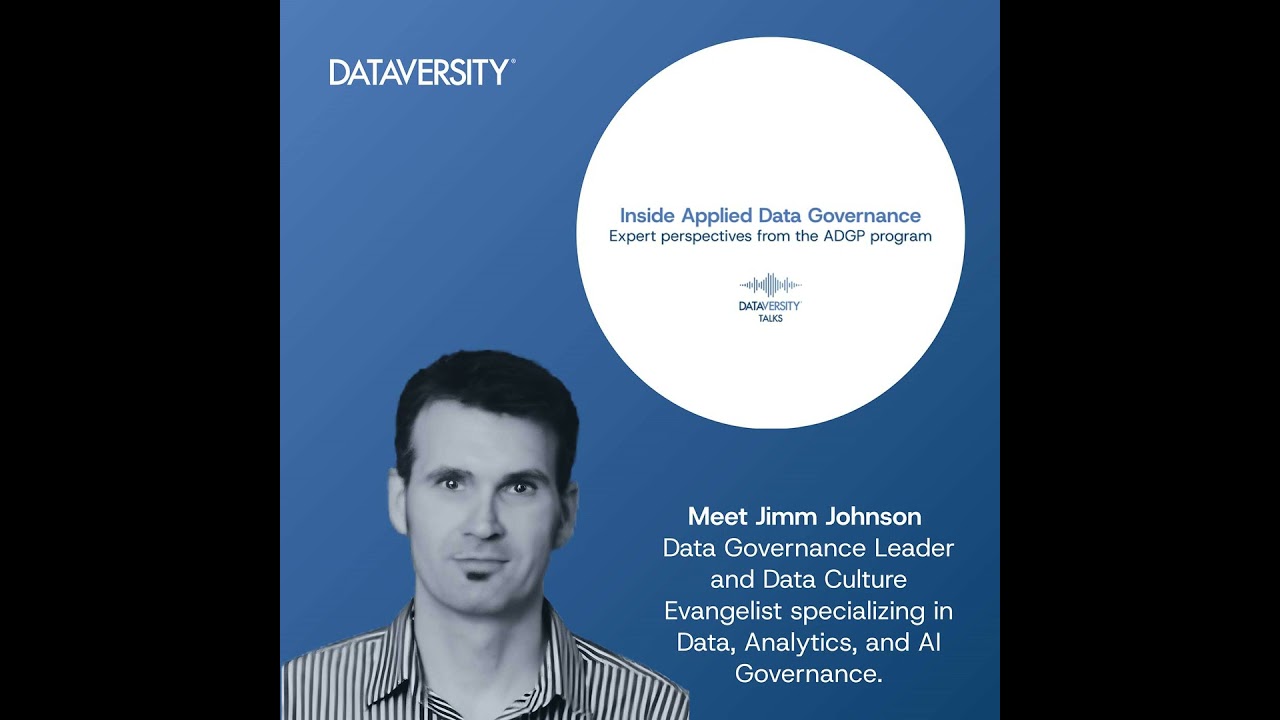
Inside Applied Data Governance: Expert Perspectives from the ADGP Program Episode 5: Policies, St...
Watch on YouTubeVideo summary
The podcast episode features a discussion with Jim Johnson, a key contributor to the ADGP certification program, focusing on the critical role of policy implementation standards and risk management within data governance. Johnson explains that treating data as a valuable asset requires a structured framework similar to how organizations manage people, money, or supplies. Without policies, standards, and risk management, an organization lacks the foundational anchor needed for professional data governance, leading to reactive "firefighting" rather than proactive control. These frameworks act as guard rails that clarify roles and expectations, allowing employees to operate autonomously while ensuring consistency and reliability across the enterprise. If these elements are missing, the discipline of data governance collapses, leaving organizations vulnerable to errors, compliance failures, and unmanaged risks that can severely impact operations.
A significant challenge identified in the conversation is the common underestimation of the time, effort, and cultural shift required to implement effective policies. Organizations often struggle with the friction of compliance, viewing policies as bureaucratic hurdles rather than essential tools for success. Johnson emphasizes that successful implementation requires engaging stakeholders early to overcome perceptions of bureaucracy and ensuring that operational impacts on productivity are considered. Furthermore, there is a tendency to focus too heavily on authority ("the stick") rather than incentives ("the carrot"). The goal is to shift the culture so that adhering to standards becomes the norm and an integral part of doing business, where employees follow rules not because they are forced to, but because it is simply how work gets done.
To address why policies often fail to change behavior, Johnson introduces his "Three Ps" framework: proponents, proportions, and practices. This approach ensures that policy creation is human-centric by involving those most impacted from the start, tailoring the rigor of standards to the actual level of risk rather than over-engineering solutions for low-risk areas, and integrating compliance directly into automated workflows. Success is measured not by the number of published documents but by the gap between what policies say and how people actually behave. By embedding guard rails into daily processes and fostering data literacy, organizations can move from reactive compliance to proactive risk management, preventing bad data from entering the ecosystem at the source and empowering employees to handle data safely and independently.
Ultimately, accountability plays a pivotal role in transforming policies into lived practice by connecting individual actions to broader organizational goals and consequences. Johnson suggests using operant psychology principles to provide immediate rewards for compliance and clear consequences for violations, such as tying data governance metrics to performance reviews or executive KPIs. When employees understand that their adherence to standards protects the enterprise and enables their own autonomy, they are more likely to embrace these practices. The conversation concludes with the insight that if policies feel burdensome, stakeholders should be encouraged to participate in refining them, ensuring that the rules of engagement remain practical, effective, and aligned with the evolving needs of the business.
Read the full video transcript
Hello and welcome. I'm your host Barbara
Nishaw and this is Inside Applied Data
Governance. Whether you're just starting
out in data governance or you've been
working in the field for years, this
podcast is for you where you will learn
real life lessons and practical advice
from the people behind the applied data
governance practitioner certification.
To learn more about the ADGP
certification program, visit
training.dativersity.net.
Hello and welcome to Inside Applied Data
Governance, a podcast where the
practitioners who built the ADGP
certification program share what real
world data governance actually looks
like. I'm your host Barbara Nishaw and
today we're talking to Jim Johnson, one
of the key contributors to the ADGP
certification about policy
implementation standards and risk
management for data governance. Let's
jump right in.
Hi Jim, how are you doing today?
>> I'm doing great. Barbara, how are you?
>> I'm doing wonderful. Very excited to
talk to you.
>> Likewise.
>> Are you all ready to talk about policies
and risk?
>> I am. This is a very exciting topic to
me.
>> That's good. That's good. And so
important. It really is. We spent a lot
of time in the body of knowledge on this
topic and it is very important. So, but
before we get started, we're going to
talk a little bit about you.
>> Well, I really got my start officially
in data governance when I heard the term
data governance in I think it was 2014
at a DJIQ conference. So, I'd spent my
career in every job fixing things,
making process better, making the data
better. And it really never made sense
to me until at that conference I
realized, holy cow, I've been doing this
for a while, and it actually has a name
now. So, that was kind of exciting. Um,
it all comes down to like, you know,
standardizing things, uh, making your
processes better, really building trust
in the data, information assets. Um my
my approach prior to understanding DG
was read the manuals, learn the tools,
create standards, automate everything
you can and build trust and integrity in
all of the data information. And then of
course at the conference I learned all
kinds of other things like metadata
master and all these you know crazy
terms that that started making sense to
some of the problems I had encountered.
I've been cross- sector. I've worked in
uh pharmaceutical banking, health
insurance, quick service restaurants,
healthcare and most recently background
screening. Every industry has something
that you can learn and apply with to
other industries. So that has been
really valuable to me. Um I've learned
so much from each industry that I've
taken all of that forward with all the
other industries that I've worked in.
Data is data no matter what sector
you're in. What changes is data
governance. The scope um and the art of
applying it which is why the applied
part of this is so drastically
important.
>> Thank you so much Jim. So now let's get
started with our topic today. Um our
first question here um we always start
out with the same question because it's
important to know why was it so you know
important to have this policy standards
and risk management as part of the ADG
body of knowledge and what would have
been missing if we didn't have it.
>> Yeah, this is a good question. So
if if data is the new oil and insert any
analogy about data like that that you
wish um then we should really think
about how we're going to manage it
within an organization, right? It's
probably one of the more complex assets
we have. It's shared. It's reusable.
Sometimes it's hard to put a value on
it. We know it's essential for everyone
practically. Um and we know we need good
data for good decisions. So I think
point number one is if if it is an asset
we should manage it like an asset and we
already do that with a lot of other you
know enterprise assets and if you're
going to do that then you need a
framework for accomplishing that and
data governance becomes that decision-m
and accountability framework and if you
have a framework the framework has to
have guard rails to clarify roles and
expectations and behaviors. It will also
clarify the monitoring and the
assessments of gaps or deficiencies or
circumvention etc. uh to minimize
unfavorable impacts because the ultimate
goal really isn't to be big brother and
lock everything down. It's really how do
we how do we allow folks to operate
independently autonomously within that
framework um so they can get their jobs
done right. So, it's like driving. As
long as you follow, you get trained up,
you get a license, you go out and drive,
you have a certain amount of points that
you know on your license that if you
violate the the rules of driving,
something drastically bad could happen
or maybe you just acrew enough points to
lose your license. That's what the
frameworks do. So, my personal opinion
is I think policies and standards and
risks all make an organization or risk
management rather make an organization
stronger if we go about doing them well.
And I mentioned some of these other
asset management frameworks earlier. You
know, HR does it with people, finance
does it with money, supply chain does it
with supplies, it does it with
equipment. If if we do this with data,
we solve so many of the data problems
that everyone across the organization is
manually and semianually trying to solve
on their own repeatedly over and over
all the way downstream in different ways
from interval to interval, person to
person. It's nuts. So what happens if we
don't have policy development um and
standards and risk management? Well, we
would be missing the foundational anchor
of data governance as a professional
discipline. So that means it has to be
in this book. Otherwise, the book would
be a loose collection of tips and
techniques and there would be no
structural integrity. The this this
framework of you know the rules of
engagement as it were is what brings it
all together. It also helps connect
operations and strategy. Without the
policy development, there's no
authority. Without standards, there's no
sense of how well or how good. And so,
you can't measure and then close the the
gaps um and improve the measurements.
And then with without risk management,
there's no what if, there's no
resilience, there's no defense.
Everything is reactive firefighting or
damage when the crisis occurs. And so,
all of that translates to losing the
ability to execute and repeat and
protect the work we do and the assets we
manage. and data governance essentially
collapses, there's just absolutely no
way to sustain it in my opinion.
>> That's a good way to break it down. You
know, it's really the guard rails and uh
you know, making sure we're all doing
something the same way
which you know, let's lead me to the
next question.
What do organizations or practitioners
often misunderstand or underestimate
about this?
>> Yeah, this is a big one. I think there's
a couple. One would be the time and
effort to develop policies and standards
and assess and mitigate and manage
risks. It's, you know, you got to
crowdsource inputs. You got to drive
consensus. You got to agree on content
for policies or which body or source of
standards. Um, lines of business have
their own ways of thinking and doing
things. It's hard to influence change
with some of them. So you have to start
coaching them on enterprise thinking
like you're we're solving problems for
the enterprise not for your particular
need your team your department your
division policy is a must-have standards
or need to have they change more um so
you know not everything has to be a
policy and not unless it's an official
standard that like for example if it's
regulated that should go in policy
standards can be fluid and they should
change over time as you know things
around us change competitive
environments business models etc. I
think number two is the friction of
compliance and operationalization. Um
it's not done when it's published.
There's training and implementation and
communication that has to happen.
There's perceptions you have to overcome
about it being bureaucracy. Oh my god,
another policy kind of a thing or it's a
checkbox item. I'll do the bare bones
minimum to comply and then get on with
my job. You can't develop these in a
vacuum. you have to engage the people
that these policies and standards and
risk management exercises are going to
affect. Um if you don't consider the
operational impact on productivity and
velocity, um it's it's going to manifest
when you roll it out. Um it's not
static. It has to change over time. And
you get them on board in the beginning
and they'll help keep things updated and
refreshed over time. And I think the
last one is probably um they overly
focus on authority instead of
incentives. And so it's it's the carrot
and the stick. You know, you got to some
policies have to be mandated because of
regulatory compliance. They can shut our
doors temporarily, permanently um
partially or completely. And so you got
to do these things. But everything else
it we again rules of engagement. As long
as we all know what the rules are, we
can operate autonomously doing our
autonomously and independently doing our
jobs and getting things done and
contributing to strategic goals. So the
idea there is we need to shift culture
so that standards and policies become
the norm. This is the cost of doing
business. It makes everything more
consistent, reliable and expected. And
as you can tell, as we talked about in
the stakeholder engagement module, this
is a people problem. It's people and
perceptions of bureaucracy. Policies and
standards provide clarity, direction,
independence, and they make us stronger
and better. So, I think it's it's up to
us as data governance professionals to
lean into them and help everyone around
us to lean into them as well.
>> I like what you said about it being part
of the culture and the part of doing
business. So, it's built into everything
and
you don't even know it's a policy
anymore because it's built into the way
that you do things.
>> Yeah. The hidden the hidden integration
implementation of policies and standards
is absolutely the best way.
>> Yeah. cuz some people don't even realize
it just the way they do it.
>> Yeah.
>> If you join our webinars, you already
know strong data governance is what
makes everything else possible.
>> Exactly. And if you're ready to build or
mature your governance practice, the
data training center is where you'll
find the deep dive courses that actually
show you how to do it. And once you've
built that foundation, the applied data
governance certification helps you prove
you can turn governance principles into
real organizational impact.
>> Then bring it all together with the
community at DGIQ plus EDW 2026 where
the governance leaders share what really
works.
>> Start strengthening your governance
journey at dataverity.net.
What does it look like in an
organization and let's think about it
early in our governance in its
governance maturity?
I think this is going to resonate with a
lot of people.
>> So, it's not sophisticated algorithms
and formal cadences and compliance
dashboards and predictive modeling on
things are going to go bad. That's
that's the advanced world, right? If you
are in an environment where everything
is manual or semi-manual, it's reactive,
it's, you know, defensive and
conversational, constant firefighting or
being behind the A-ball, this is
immature risk management early in the
process. Um, if you don't even have a
riskmanagement department and and you're
not talking risk in your strategic plan
or in your projects or, you know, other
uh other areas of operations, that's
also sign of immaturity. Um you know
organizations like that you tend to
operate on tribal knowledge. You got to
know who to call how to get things done
and know it's the phone a friend network
or the know guy network. Those are
single point of failures and
bottlenecks. Um it silos data and risk
too. People and departments and lines of
business don't understand how their data
practices affect other areas. So while
this area is concerned about SSN, I'm
not okay. Well, that's risk to the
enterprise, right? And if you're not
looking at this from an enterprise
standpoint, you're actually contributing
to the risk. And people are doing this
all day long, saving files on file
shares, for example. Um, we had I worked
at a company where somebody took a
picture of sensitive data on the screen
and then emailed it because they
couldn't export the data to to to email
the data. So, they emailed a picture
instead. I mean, people find creative
ways of getting around this. So, how
does it manifest? Otherwise you'll see
errors in reports that people are
complain about um variation in reports
accidental discovery of you know
problems because now that risks have
manif manifested as issues. Audit
findings often time uh surface risk when
you don't fulfill the audit requirements
or your regulatory submissions you you
get failed repeatedly. Um gut checks red
yellow green kinds of things on
executive dashboards that don't have
real data behind them. Shadow IT and
analytics, absolute risk. Um, compliance
blind spots. I I mentioned SSN earlier.
Why aren't we talking about all the
sensitive and confidential data sets at
the organization? Every industry I've
ever been in has focused on I probably a
number of data on account of one hand.
And then one organization, you know, you
you got a policy that mentions a couple
dozen. Why aren't we looking at all of
them? Right? So, what do you do? I think
we need guard rails in plain English
that people can understand. things like
never email a spreadsheet with personal
information in it. Um or get approval to
share data with external parties. You
got to make it common sensical. Um focus
on your crown jewels, the top two or
three data sets that if they were to be
leaked, lost or compromised. Um you can
be shut down partially or completely,
maybe permanently. Um you could
regulatory fines for example. And then I
think the third thing is literacy
through context. You really just have to
start using real world world examples
specific to their jobs. Show how it
impacts
across the organization or at the
organizational level as a whole and get
people talking to each other. A lot of
it has just has to do with I don't know
what's going on. I care about my own
little world, but we're all we're all
sort of part of this bigger organization
and we should all be thinking
organizationally. Like think global and
act local is one of the axioms I use
around that. That's a good one because
people so many times forget this is for
the good of the entire enterprise and it
may be a little more work for you but
that's why you need to do it because
it's the the enterprise as a whole.
>> And then conversely here's what h might
happen if we don't do it or you don't do
your part.
>> Mhm.
>> Exactly.
>> Wake people up too.
>> Yeah, it does because people just don't
stop to think about it what they're
doing. If you could give one piece of
advice to someone responsible for
policies and standards, what would it
be?
>> So I have a rubric on this. I call it
the three Ps and I've mentioned one
earlier. So the first P is proponents.
It has to be humanentric. You can't
create policies and standards. In fact,
any guardrail in my opinion unless you
have sole authority over it. You can't
do that without inviting people to
participate, especially the people who
are most impacted by the standards and
the policies. Get them get them involved
up front. If you don't, you know, shadow
them, watch their workflows, ask them
about the impact and the pain points,
help them understand the need, and then
ultimately find the least painful way to
meet the goal. Um, I think it's called
least viable policy, for example, sort
of like um in agile software
development, the minimal viable product.
It's the same kind of concept. So
proponents. Number two is proportions.
And this is about the right fit. So you
don't have to treat everything like it's
the most monstrously gigantic risk in
the world or the most monstrously large
need for you know a very complicated you
know 20page long standard or policy. You
don't you don't want to overengineer
anything. You got to tailor the policy
or the standard to the need or the risk.
And you want tier. So based on the risk
level, the higher the risk, the
stronger, more rigorous the the policy
standard or guardrail is going to be. If
it's a low risk, then you can do more of
a flexible, lightweight kind of
guideline. Um, you want the minimum
amount of restriction with a maximum
amount of of I guess theoretical
protection because this is all sort of
theoretical until something happens,
right? And then you learn from it and
you mend your policies and standards and
start all over. So proponents is number
one, proportions is number two. That
brings us to number three, which is
practices. And that's how the work gets
done. And you actually alluded to this
earlier. The best way to implement any
policy or standard is to integrate it
into the workflow or the operational
process, ideally automated wherever
possible. It's done. You're forced to
follow it. You follow it because that's
how that's how the process works. And if
you can hardcode these guardrails, like
block action if you're not doing it
right, like a system edit. Don't put an
end date that's before a start date when
you're going to go book an airline
ticket. I mean, this exists everywhere,
right? These these are all
riskmanagement constructs. Keep the data
good. Keep the risks from getting into
the system kind of a thing. Um, and then
engage, education, and feedback. Uh,
because again, it's people on all three
of these. And so it's and you can even
use the three Ps. ensure that they
follow proponents, proportions, and
practices. They all begin with PR, too.
So, it's kind of a tongue twister.
Success. So, here here's here's my
insight on all of that. Success is not,
as many folks and organizations think,
reflected by how many policy standards
and guard rails are written, approved,
and published. It's actually about how
big is the gap between what these guard
rails say and what people actually do.
And the more people do in agreement with
all of your guard rails, that is really
the real mark of success.
>> Thank you. I like the three Ps. That'll
be a good way for people to remember
that
work for me. I hope it works for
everybody else.
>> I was say I always think it's good to
break it down like that. Um, next
question. How does data governance
function as proactive risk management
rather than reactive compliance?
So, you know, it's interesting.
Everywhere that I've
I've built and scaled a data governance
program, I've always inevitably
intersected with risk management. And in
some cases, they already had data
related riskmanagement
practices in place. And in many cases,
other organizations, they did not. And
so, it's always a surprise where they
are. But, you know, the proactive is if
it doesn't exist, we're going to start
it. We're going to partner with risk
management and we're going to we're
going to start getting more data risks
assessed at at regular intervals. And so
I think you know you can shift the
timeline from postmortem to premortem.
If you're going to set up a database,
let's do it then. You always want to go
as close to up as far upstream as
possible as close as possible to what I
call the the drip dring
or input point because you're always
either collecting it from humans or
machines. And if you can harness the if
you can manage any sort of risk of bad
data at that given point um then you're
preventing bad data from getting into
the data ecosystem altogether. So that's
great. You don't want that, right? You
don't want bad data to prol proliferate.
Another way is through the mechanics. So
data quality of source which I was just
talking about. You want you want those
those controls as far up as possible.
You also want access controls. And so
you're going to, in my experience, I've
always partnered with information
security or cyber security depending on
how your organization calls them. Um,
you want to really get into role-based
access controls and start maturing what
that looks like and go get into like it
goes from arbback to Aback to Pback. So
from ROS to attributes to policybased
with all it really means is a a
maturation process to automate more and
more of your security permissions
provisioning and deprovisioning. And if
you can do that, more automation means
less manual maintenance, which
translates to less risk. I've worked at
organizations where
too many people still had access after
they were separated from the company. If
you still have access and you're
disgruntled, that's really not a good
combination. I also worked with a
gentleman who spent about 30% of his
time. We actually sat down and qualified
quantified his time and um he was he was
provisioning and deprovisioning
accounts. They had set up an automated
process, but he was still spending 30%
of his time uh manually doing it. It was
because we had folks internally that
weren't following the process and they
were, you know, emergency emergency do
it and it was not only manual setup, it
was manual deprovisioning when the
automated process ran and then
integrated two different accounts for
the same person. You don't really want
that. Automated data lineage is another
one. If you have if you're mature in
your data cataloges, no more figuring
out how it's calculated or where it
comes from. That's all manual and
semmanual forensics. No, just you can
click see the entire lineage and and
definitions and and it's all good. I
think the last element that I'll add is
it it proactive is you address the
mindset of of folks. Data literacy
increases awareness. Educating people on
what data risks are, what it means to
have a data risk and then how to go
about managing it and mitigating it. Um
that should be part of all data literacy
campaigns, all all data governance
programs. The ultimate goal is to again
give people autonomy and independence,
learn how to handle data safely and
correctly based on regulations and laws
and standards and policies and
understand that risk monitoring is now
the norm. If you spread that wealth of
knowledge and have more people across
the organization following these
standards and policies, they're they're
proactively managing the risks along the
way and identifying them so that they
can be addressed before they become
major issues.
>> Thank you very much. That's a great
answer, you know, and so much of it does
relate back to training and having a
good data literacy program for all
different roles and different levels
within your company.
>> Which leads us to our next question. Why
do governance policies and standards so
often fail to change behavior?
>> So, I don't think this is going to be
any surprise, but I'm going to come back
to the people's side of it again.
>> People are the biggest problem on the
planet. If we've I say this all the
time. I I say facitiously, but I
actually do believe if if we weren't
here, this planet would completely
self-regulate, right? It's mindsets.
It's it's you can't change behaviors
until you change minds. And that takes a
lot more time and effort to change minds
than to change behaviors. But they're
sequential. If you don't change their
mindsets and get folks on board, you're
not going to change their behaviors. You
have to factor in how people get work
done. If they perceive things as
bureaucratic and timeconuming, they're
going to bypass it. They're going to
come up with even new creative ways of
circumventing any sort of controls you
can put in place. So, no, that's bad,
right? We want you to follow the
standards and process. How do you turn
that around? It's almost like plugging
the holes in a dyke. You can stick your
finger and all 10 fingers in 10 holes,
but five more holes are going to pop up.
So, what do you do at that point? Now, I
need another person to come in and start
plugging those holes. So I think
awareness versus integration is a really
good topic for um any sort of education
efforts around all of this. A lot of
folks aren't even aware of corporate
policies. I I had a conversation once
with a director of BI about classified
data and her response was I don't
understand that. I don't what are you
talking about? I said well we have a
corporate policy. Wait what do you mean
there's a corporate policy? Never even
heard of it. Which is fascinating to me
as a as a BI director you're you're
pulling data together and exposing it.
How do you not understand what that
means? Right? That is very and it's
every place I've ever been, I think
there's been some semblance of of annual
training around, you know, some type of
data confidentiality or or regulated
data sets. It obviously it's got to be
more because if you still have folks in
the organization that don't know it,
that's a risk and that means something
might come out of it, right? So you got
to make policies more accessible, more
streamlined, more more integrated in the
tools and technology. Um, make them
guard rails for success and efficiency,
not speed bumps or potholes that people
are going to avoid or or or drive
around, right? Ultimately, they make
people and organizations stronger, more
resilient, and more successful in the
long run. So, I think getting people to
understand that we're trying to help
them towards independence and autonomy
and getting that light bulb to go on can
be extremely helpful.
>> Yeah, that's so important. And I love
what you said is that, you know, we have
to shift the mindset before we can
change the behaviors,
>> you know, cuz we think ends up to be
what we do. So, that's so important.
That leads us to our last question. What
role does accountability play in turning
policies and standards into lived
practice?
>> Wow. So I mean what is what does lack of
accountability in life? I if you could
get through with zero consequences is
anything really going to change? Of
course not. Right? It's basic
psychology. Um zero incentive to change
means people are going to continue that
behavior. So you have to change the
consequences or you have to change the
incentives. So that's a nod to operant
psychology and and literally my
undergraduate degree. So I use this all
the time in data governance. It's you
have to look for immediate faster
rewards and recognition
short-term successes that really start
to showcase what we're talking about.
And if folks don't understand that and
they continue their behaviors, they're
actually
hurting the long-term evolution of
benefits and stability in your
environment and less risk. And so
sometimes you have to, you know, connect
the dots on that. Um, some examples that
I've come across is, you know,
developers using local hard drives for
development. Why? because it was too
cumbersome to get permission to set up a
virtual workstation or using your
personal user account to set up jobs
that are supposed to run automatically
and the person leaves the company and
all of a sudden you've got job failures
all over the place. So change the
standards. This these should become part
of your production deployment checklist
and if it's not met you kick it back. Um
Sarbain actually did this when they
required segregation of duties between
dev test and prod environments and
developers couldn't have access to test
or prod. So if you didn't do codebased
deployment, it would get kicked back. If
I can't push a button and deploy it in
the production environment, it's a
no-go. You need to do that with a lot of
operational processes as well.
>> Um, you can also change the measures.
Um, data governance metrics like data
quality KPIs or compliance KPIs or
successful, you know, completion of
training and and standards met or
standards applied types of of of
metrics. Um, you can tie those to
executive KPIs and strategic goals and
and start mapping those relationships
and educating executives and line of,
you know, line of business staff about
that. You can also tie data governance
metrics to budgets, performance reviews,
program reporting. Um, if you are
consistently not following the standard
or the policy, then yes, maybe there's
there's some escalation warranted or
maybe we make it more formal with uh
some feedback in your performance
review. You can certainly include it in
your data governance program reporting.
I think if policies and standards are
published artifacts and the
accountability and the associated
accountability metrics ought to be
published as well. So you might have to
warm people up to that idea because uh
you know some organizations aren't
right. It's kind of difficult to get
them to think about that. But you know
compliance does it. So all we're asking
is can we apply that to our data and
just formalize it because we want to
measure our progress and show the value
and metrics can actually do that right
and policy and standards are one area
where it really becomes visible you know
integrate them in annual training how
many people completed do they really
read it if you can track whether they
scrolled through the entire document or
just went right to the end and said
check I'm in I'm done I mean you know
you got to tease those apart a little
bit and see what what it really means
but it takes time ultimately you got to
get buy in. You got to share your
successes and you got to crowdsource
everything when it comes to policies and
standards because that buy in um will
make it or break it. And if they break
policy and standard, then you've got
risks and now we've just tied everything
together that we just talked about.
>> That was a great way to end that. It
did. It tied it all together complete
circle.
>> Thank you so much, Jim. This was great.
I have thoroughly enjoyed talking with
you about this. you make uh policies and
risk management sound, you know, much
more interesting. I love it.
>> Yeah, they can be fun. If you have fun
and if you approach everything with fun,
a fun mindset, then I think it becomes a
lot less bureaucratic. So, I I don't
think we should shy away from policies
and standards. It's one of it's
something I've helped every organization
I've worked at do. Um, this was a
delightful conversation because we
touched on a lot of points that I think
will help people understand what it
means to maybe have a little bit of fun
as you're creating policies and
standards. And then you know what? If
you don't like the policies and
standards, then get more involved and
change them. So either way, we're going
to get you involved.
>> Oh, that's a great piece of advice.
Thank you so much.
>> What a delightful conversation.
>> For our listeners, if you'd like to
learn more about the ADGP certification
program and the applied data governance
body of knowledge, visit
training.dataverity.net.
Until next time, I'm Barbara Nishaw and
this has been Inside Applied Data
Governance.