Video summary
The EMF 2026 Infrastructure Review highlights a massive operational scale-up that tested the limits of water, power, and network systems under extreme conditions. The event managed an impressive array of resources, including 81 structures from six suppliers, 750 meters of water piping, and 20 kilometers of power cable, while importing 35.6 kWh of electricity from Belgium. However, the harsh weather presented significant challenges; high temperatures caused batteries to trip due to thermal differentials, and IP Access nano base stations struggled with heat until they cooled, leading to call rejections. Despite these hurdles, the teams successfully consolidated generators for quieter operation, utilized buffer tanks to prevent major water incidents despite high consumption, and maintained a 99.94% uptime on the phone system even after switching to a single reliable Cisco setup midway through the event.
Behind the scenes, dedicated Event Ops and Welfare teams were established to manage over 550 tasks via a Kanban board, while new specialized groups handled critical functions like food production and stage construction. The kitchen doubled its output, running entirely on induction cooktops with zero gas usage, and the network team installed thousands of Ethernet ports and switches to support connectivity, though they faced a cascading Wi-Fi failure caused by a power blip. Stage construction saw Null Sector expand by 45% compared to the previous year, featuring noise-containment containers and a robust video streaming setup capable of handling 2.5 terabytes of footage across five stages, demonstrating the event's commitment to both technical innovation and logistical resilience.
The review concludes with profound gratitude extended to C3 VOC for their expertise and equipment, as well as to the volunteers who contributed an equivalent of 12.5 working years through 373 shifts in various roles. Special thanks were given to those who performed early morning duties, managed composting toilets, responded rapidly to social media updates, and lived on-site to ensure seamless operations. As the event wrapped up, the speaker also offered a sincere apology for running late before officially ending the proceedings, leaving a lasting impression of a community-driven effort that balanced ambitious goals with the realities of extreme environmental conditions.
Read the full video transcript
Thank you for joining us on stage A. Um,
I know that everybody's a super grateful
to these folks, so I'm going to say a
big thank you to the infrastructure
team. We're going to run through
everything that's made this camp so
amazing this weekend. Um, I'll pass it
to Russ to do the introduction. Thanks.
>> [applause]
>> One, two, one, two, there we go. Hello.
Uh, welcome to this, uh,
new game of multi- massively multiplayer
PowerPoint karaoke. I don't know if the
slide deck's still being edited.
It is, very good. Uh, thankfully I don't
have to PowerPoint karaoke most of it
this time because, uh, we have way more
people on the infrastructure crew who
will be, uh, hopefully talking about
their own sides of it, but I will get
started with a little bit of an intro.
So, this year has really felt like EMF
is a different event because of the
size, I think, for for a lot of us. It's
gone from like, "Oh, it's quite fun to
actually run it like a little event." to
actually like, "Oh, no, we have to be
professional and and and really like
try and avoid getting people burnt out,
which we haven't been a a terribly good
terribly good at so far. Um, there were
300 build-up volunteers on site on day
zero, which was last Wednesday. Um,
there are four 340 users in our single
sign-on system now, and those are the
people who are actually working on
getting the event running and and and
who are like kind of the core augur. Uh,
we had have 81 structures on site now
from six suppliers. We had 51 structures
in 2024. That is a just a phenomenal
amount of tents. I can't begin to like
describe how
tedious it is to try and organize this
number of tents, which I've almost had
had to do almost single-handedly this
time. So, if anybody is is up for that
challenge next time, I am looking to
delegate it.
We have 588 m of temporary water pipes
supplying 23 water points.
750, sorry, I've been told. We put more
down.
And and the whole water operation now
has its own team with
with all of that going on, we've been
testing the limits of that quite
substantially this time. 59 fire
extinguisher points, each of which has
at least two fire extinguishers, 20 km
of power cable, and more content on more
stages running for longer.
That means That's good. That's the good
bit.
>> [applause]
>> The bad bit is that this is like a
significant operational challenge to run
now.
And I'm like was very glad this year
that I've been moonlighting as an event
controller at Glastonbury for a few
years, cuz it's really helped to try and
to really help to me to manage
what's going on now. We had multiple
medical emergencies. The hot weather has
really increased the workload there.
Many more minor medical and welfare
issues. Several people we've
unfortunately had to eject from the
site, which is a whole process we have
to go through, which is tedious and
requires
is no nobody wants to do this. Please
don't make me chuck you out. I would
very much prefer not to chuck you out.
We've comprehensively tested the limits
of the mains water supply, as you can
see today.
Um
There is literally there's a 63 mm
diameter pipe that comes into the site,
and we're just using all of it.
Somebody woke me up this morning and
told me there was no water, which was
not correct. Please don't tell me
there's no water. That is a very bad
thing.
We've had
power grid and battery issues as well,
which thankfully, fingers crossed, have
not caused us any problem during the
main event, but
it's
it's it's been a bit of a challenge
getting that up and running and a lot of
supplier liaison and nonsense which I
think the power team will get into. Uh
we've got this year we have two new new
teams. Event Ops is basically running
the event um led by Pez here and uh and
a lot of what my job is as well. And
welfare um
le- uh which was set up very very last
minute by Paul
has been doing incredible job. Um there
really are quite a lot of welfare issues
to deal with on a on a an event this
size. So um both of these have been
doing extremely well but also kind of
burning everybody out on them. So uh
next time we need more people who have
experience with in these things. If you
have experience in these things, please
let me know.
Um a permanent infrastructure which is
the bit of the EMF which keeps running
between events is now 10 servers running
email and Nextcloud and Grist and all of
these things all Mattermost now. We have
Mattermost. We have We have We're using
PostGIS for for for the site planning
these days.
That in itself is like a full-time job
to to manage all of that infrastructure.
Now we like to try and host our own
infrastructure but by God is it a pain
in the ass.
Um next time hopefully we will have
finally ditched GitHub and finally
ditched Google but uh no complete
promises there. Um
>> [applause]
>> one thing at a time and uh and there's
quite a lot of things going on at once.
So I'm now going to hand you over to Pez
to talk about Event Ops.
>> How many slides can we get with that?
>> Clicker. [applause]
Hello everyone. This is the first talk
I've attended so that's fun.
Uh
quite a lot of org don't get to see any
talks.
Uh
first of all I don't know what my slide
I'm on.
>> Right.
>> Uh this is my lovely Event Ops team.
Almost all of them are in the picture.
If you see them, please say thank you.
They are the ones fielding your phone
calls and your radio calls and external
suppliers ringing us and everything else
that's going on and triaging everything
happening around site.
This is the first time we've been an
explicitly dedicated team and it has
made a massive difference to help triage
things for HQ and shield some of the
admin team from what's going on and
reduce the miscommunication a little
bit.
My team are editing the slides as we
speak, so we're going to see how this
goes.
They are in a different order than when
I left them.
Another shot of the team.
We took a 2-hour off-team offsite to go
and play the coffee shop escape room in
Nollag Street earlier today. It was
incredibly efficient. We almost made a
grist just nail that down.
The team who were the Dream Cat team who
watched us making it said it was the
most efficient team they'd witnessed and
I tried really really really hard not to
manage despite the fact that we had the
other half of the team running event
operations from the front there while uh
while they were also submitting coffee
shop orders for things like stop
everyone please stop, which I had to
shout out and everyone stopped, which
was really quite difficult.
Uh
over 550 tasks created across the
build-up and the event. Kanban board is
so long it's broken. You can't scroll
the page. It goes miles off the bottom
there.
Uh
there's a lot of things including more
than 30 reports of low water pressure
today
including
>> [laughter]
>> which included several three phones
ringing at once and people triaging the
same report at exactly the same time. So
thank you for letting us know. We were
aware.
Uh this is how the site looked on day
minus nine. That is the site's official
generator for the first two
uh days of site that you can see there.
We imported uh 35.6 kilowatt hours of
power from Belgium. I drove it here and
powered the site from it.
The power grid was a terrible terrible
spider network by the time we were
finished.
But it worked. It worked. We tested
vehicle to load. It was fine. The only
time it broke is when crew woke up and
tried to turn on three coffee machines
at the same time.
Uh
did not like that. Was very upset.
Uh we have moved a ridiculous amount of
things including we coordinated the
movement of ridiculous amount of things
including all the fans, all the all the
all the furniture, all the tables, etc.
Uh I've two of my favorite photos there.
This is where in the bottom left of one
of our telehandler drivers dropped their
load in front of senior Orga who were
doing a site review at the time. Very
embarrassing. Thank you, Yaron.
And this truck that was really enjoying
being the center of attention as we
unloaded it from both sides. It's having
a good day.
There was 1.6 tons of bottled water
imported via Luton. You drink a lot of
water. This year we've been trying to
have people reuse their bottles. We've
been asking people to sharpie on top of
them. Please reuse them rather than
wasting your bottles.
There were seven radios lost and
recovered. Please remember to check your
radios in and out. The radio that was
lost for the longest, which was seven
days, was my radio which I never checked
out and totally forgot to. And then my
team had been trying to track me down
for three days before they realized it
was our radio.
Fires. You get fires. It's really dry.
You may have seen a change in policy for
this year to please don't set fire to
the site. Well, that was should always
be the case.
Of note, two bin fires of note, two fire
extinguishers accidentally deployed by
crew, one of which into their face,
slightly unfortunately. Uh
two deployed on purpose. We have three
spicy pillows, one proper lipo fire that
occurred this morning. Uh it's currently
in quarantine in spicy pillow soup in
front of HQ. Please don't touch it. Uh
yes, this is the correct procedure for
lipos submerged in water. On a tiny
serious note, please do not charge lipos
unattended. They do explode, especially
in the real extreme heat we've got here.
Uh and this one was in a sealed lipo bag
and it made this small fire way smaller
than it would have been. Uh so, thank
you to the village that did that.
Oh, cool, a new slide. Uh
Fun. [laughter]
Uh
there are 1,231 km of past journeys, 68
passengers squeezed onto one bus. I
believe we also had a overflow minibus
that helped cuz they happened to be
there.
Let's see what happens when we press
next. The slide ended. Fantastic. I'm
handing over to site team. Thank you,
everyone.
>> [applause]
>> Back to me, is it? Or is Benny doing it?
Any any any advance on me on this one?
Okay, here we go.
Uh this one is genuine PowerPoint
karaoke cuz I haven't seen it at all. Um
we had a bunch of very shiny JCB
telehandlers. Well, some of them were
shiny, and some of them were less shiny,
and one of them didn't really work, but
uh we made do. Three telehandlers this
time, just about enough, maybe four next
time. Oh god. Um we had some interesting
Chinese uh cherry pickers, which had
some interesting features where they
would decide you were on a hill halfway
up, so you'd go up, and then it would
like, "Oh, actually, you're on a you're
on a slope, so you can't go down." Which
is uh not ideal. Um
No, you can't slew. That was the
problem. So, uh not not a big fan of
these. They're red, though, which is
nice. Um We got 1.2 km of festoon, 100
110 L bins, never enough gazebos. We
really had a this gazebo thing was
that's included in my 81 structures,
like about 12 3x3 gazebos that we had to
um
try and source, and then we were like,
"Oh, we've got enough now." And then
somebody was like, "Oh, can I get a
gazebo for that?" And it's like, uh I
don't know with gazebos.
Um
We have two 10-ft and one 20-ft
container of long-term storage now.
We'll probably need a bit more, who
knows.
Um
I said 81 temporary structures, 550 m of
meters of timber, and and and and and
over a ton of sheet timber that was used
by the used by the um
construction team. Anyway,
now I will hand you over to the power
team.
>> [applause]
>> Hello everybody. My name's Laurie and
I'm one of the one of the power team.
Electromagnetic field is one of the
weirdest power for festival power for
festivals of any other festival. All
other festivals typically have a
generator per stage, something like
that. And obviously you don't get power
to your tent. So EMF is quite a
considerable harder problem and
challenge to solve.
Previously we had four generators across
the site. Although this year we've done
a little bit of consolidation and we
moved down to three generators. One of
the reasons for that was trying to
improve efficiency on diesel. If you
load your generator up a bit more to
more more towards its maximum, you can
get better diesel efficiency and that's
generally better.
And in the processing of doing that we
also moved to stage five generators
which take adblue, generally better for
the environment. And on the plus side
you may have noticed they're a bit
quieter this year than previous years
which has been quite
well impressed.
>> [applause]
>> Here's
us unloading the generator and we've got
a battery there which I'll talk about a
bit in the moment. And that's one of our
40 ton curtain siders which didn't
contain everything. We have so much
stuff. I'll get to the statistics in a
bit.
>> [snorts]
>> We had two big batteries this year. This
was again to try and keep it even
quieter, maybe turn the generators off
overnight and improve efficiency by
loading up generators with by charging
the battery and then letting the battery
discharge over a long period of time.
Overnight we tend to see sort of small
loads, so in the 40 30 40 kilowatt range
which on a big 200 KVA generator means
that we should be able to once on a
battery
last for a bit longer time.
Um the batteries we had were 150 KVA,
150 kilowatt hours for those who are
interested. Uh LFP cells in a big series
set.
And I will do a live mic swap.
Oh, oh it's turned off.
Check.
Hello, there we go. Hopefully this one's
a bit better.
So yeah, LFP cells in a series
arrangement uh giving 725 volts DC bus
that then gets inverted and gives us
some lovely power.
Unfortunately, like us, the batteries
did not enjoy the heat and we had a
number of issues, especially early on,
where the uh the uh batteries would uh
shut down from typically a differential
temperature, so not that they were just
too hot, but that one side of the
battery would get too hot compared to
the other side, and that would trip the
generator uh trip the battery off, and
then the generator would have to start
back up again later on.
Uh we tried to mitigate this by putting
shade over them, which was mildly
successful, and we did have engineers
come out and managed to
uh revive one of the batteries into
working, but unfortunately the battery
in the north grid running null sector
and volunteer catering, mostly from the
heat and the amount of load we were
putting on it,
uh is currently switched off because
otherwise it will just keep tripping
out, and power outages are annoying.
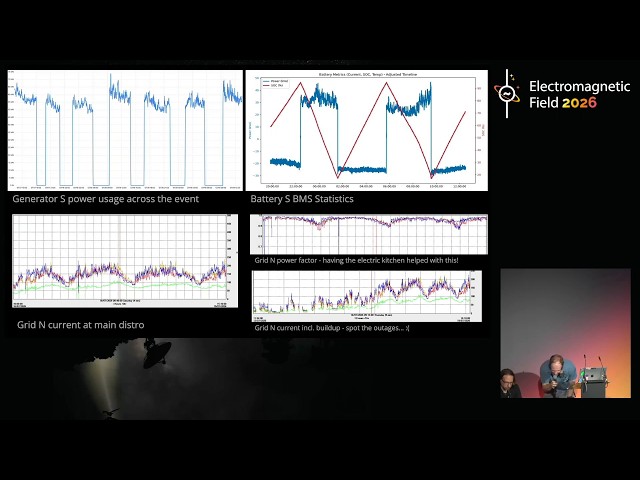
Uh here's some lovely graphs. Because we
have grids with generators and
batteries, the top left is the generator
load, which turns on and off, which is
quite a funky now.
Uh you can see the battery on the top
right with the charge going up and down
as we discharge it in a lovely sortive
fashion uh pattern.
And what else am I supposed to talk
about on this slide?
Uh quite a lot of power. Uh we hit a
peak load on the north grid, mostly due
to null sector and the volunteer
catering again of 200 kVA.
Uh
just briefly hitting the warning limit
on the generator, but I think
appropriate usage of that.
Um we, like a lot of other teams, wrote
our own bits of custom software and
maintained other bits. So, we have a
whole planning system
uh that pulls in from the GIS and
generates the uh
the original map.
And then, we also have the distro and
all that sort of jazz. Uh
no, I don't think it's my radio causing
the interference, I'm afraid. Um and
also outage monitoring, which is at the
bottom right, which is something new
we've been trying out this year.
And that is hopefully improves our
response time. We see when stuff goes
out pretty quickly. Um but we still have
some work to do on that, and there's
always improvements that can be made.
Uh
testing. Uh this was uh for our testing.
Uh I feel like I'm getting quieter and
quieter.
Uh
That's any technical information, if you
want that. And here's the final
statistics. We got 20 km of cable, 22
tons of cable and distro that we have to
handball into the field and then get
back out again.
Uh 405 m of power lock, six different
supplies to Rangle, and the kitchen used
a total of so far 1.8 MWh of energy. And
that is just volunteer catering, never
mind everyone else on site. And yes, the
kitchen is all electric this year. So,
no gas, hence the big electricity bill.
Right, I'm moving on to water.
Who's taking water?
Yeah, Russ Russ is here.
Hello. [applause]
It's me again.
Me again.
So, yeah, this this is the second EMF
with a dedicated water team, and which
is now five people. The actually running
the water at this event is is is a
significant endeavor. It's not it it it
may it may just be simple, right? You
put a hose on the tap and it comes out,
right? But you've got to do managing the
pressure and and and water safety at and
all of this kind of nonsense. So, the
the good news is we did put a buffer
tank on the volunteer kitchen, which was
a very good idea because otherwise we'd
be completely screwed at the moment. And
that stores 10,000 L of water and lets
us fill it slowly when when the
kitchen's not use it using very much.
We also, of course, got to get rid of
all that water once we've used it. So,
we have loads of waste tank waste tanks
and a contractor on site who pumps them
out and takes them away.
A lot of
certain other events sometimes will just
let their showers drain
wherever
into the into the water courses, but we
are in a site of special scientific
interest, so that kind of
that kind of stuff does definitely
doesn't fly here. So,
we have to take all your water away.
We've put pressure reduction valves
everywhere now, so so we can control we
can stop
the water points which are
further downhill from pulling more water
than the ones that are further uphill,
at least in theory. But even even with
those we are hitting the limits.
750 m of fresh water pipes, 11 pressure
reduction valves, eight taps on a stick,
seven sinks, six hand wash stations.
Oh yeah, we've used lots of water. I
think we've used more than that. I think
I think our waste provider said he
chucked away 100,000 L of water on
Friday. So,
I think we'll probably use about
four three 400,000 L in total.
But we'll see.
We'll see when the water bill comes in.
That'll probably cost about like 200
quid in water, but
Yeah, so the the heat the the the heat
has resulted in high demand on and off
site. So, more people are having showers
here and they're having them So,
probably some people are having them
twice a day because because it's hot.
And so
and everybody else elsewhere is having
showers and using water because it's
hot.
The water pressure is well, I I think
it's just cuz we're on the end of a
quite a long pipe that goes to the main
water main and so there's a bit of a
pressure drop over that, but even with
all our pressure reduction valves and
everything else, we're still
not quite managing to to provide enough
water to give you all showers. Sorry. Um
next time we are going to have to go
full, you know, storing a hundreds and
hundreds of thousands of liters of water
on site to make sure that we have enough
water for everybody.
That is a job for next time.
Many thanks.
>> [applause]
>> Hello. I'm Luke. I'm one of the two team
leads for the network team. We have
quite a large team now, which is
actually really useful for all of the
stuff we have to get done.
Um some quick stats. So,
we've got most of our equipment from two
people this year. One of them is Event
Infra. That was all trucked over from
the Netherlands.
We got almost a ton of total equipment
weight including flight cases from them
totaling almost 3,200
Ethernet ports.
That's 79 switches, 130 access points
and two wireless controllers to run it
all.
Uh from our friends at Pylon One, we got
all of our optics and reels and reels of
fiber optic. EMF owns a bunch, but
actually running the event requires a
lot more than we actually have in stock.
So, we were really grateful to get some
from them and various bits for both
internet during build-up before we've
actually built out the proper network
core, but also just in case of backup
and for things where we can't quite
span the event network over there.
And over the course of the event so far,
we've had over 200 Ethernet cable ends
crimped. Uh I came in with a pot of 300
hoping that that would be way more than
we would possibly need and we've gone
through most of it.
Uh
this is what it looked like when we
unloaded the uh van that had just been
driven uh all the way from the
Netherlands. Uh
and uh yeah, there's quite a lot of kit
here and an installation which you can
probably see uh
there in the background, maybe. It's in
the plastic tubs.
Um we have a bunch of people we need to
thank because uh we get equipment from,
as I said, Event Emfront Pylon One, Full
Fibre and Zoom uh in particular are
responsible for looking after and
interacting with uh Openreach for our uh
actual backhaul to get from the field to
uh to the internet, but then uh we have
a whole bunch of providers who provide
us with uh transit, which is the final
bit where we go uh from our network to
the rest of the internet. They're the
ones who are responsible for connecting
us to the actual internet as a whole.
So, thanks to them.
>> [applause]
>> So, uh there's quite a lot of work that
we do before uh even uh
the event has begun in any sort of
sense. Uh so, we made a few visits to
the field beforehand so that we could
actually get some fiber installed in the
ducts that exist. You might see a few
few BT labeled manholes around the site.
Um some of them have our fiber in them
and uh we need to run them through the
ducts and we need to put ends on them
and so there's some fiber splicing
happening in this picture.
Um we build all the DK poles. Uh this
involves some wood, the signs, and uh
the Ohm lights that you see on top as
well as the access points to get
everyone Wi-Fi.
And uh our interesting metric, um we had
this hottest switch graph and we suspect
that maybe the the temperature sensor in
here had gone a bit wrong. Um this
caused our like mean temperature metric
to reach uh like 900 and something
degrees just because this switch was
throwing everything else out. Um but
like on the whole you can see the the
day night cycle
and one of the NOC team members had the
yellow line that you can see spiking and
then disappearing. That was a small
switch with no fans that they had in
their tent and so that's why it spiked
so much higher than everything else.
Um this is a graph of the number of
people connected to each of the Wi-Fi
networks over time and the reason I
bring this up is because you can see
this gap
the one that's the furthest on the
right.
That gap is where we had our Wi-Fi
outage.
Sorry about that. We had a small power
blip which then resulted in it
>> [laughter]
>> We had a small power blip which resulted
in
what we call a cascading failure which
is where everyone's phones and
everything else trying to get back on
the Wi-Fi at the same time meant that
our Wi-Fi controllers got overloaded and
they started just not letting anyone on
the Wi-Fi.
So we did a bunch of things to try and
fix this as quickly as we could. Sorry
about that.
I hope the bar didn't get too
overwhelmed by people suddenly all
wanting to pay in cash for some reason.
Um and yeah there are some lovely views
from about where the APs are. It's great
working on the network team. We have a
lot of fun with it and we've had
fortunately this event more than some
others more time to go on some side
quests which has been good.
Over to the phone team.
>> [applause]
[applause]
>> So I am Alfie from the phones team.
Along with rest of my colleagues we have
built a brand new phone system for us
all.
The thing with these phone systems they
are quite a bit different than what you
would might expect Um, because it's
actually used by not just only our
attendees but our staff and our
volunteers, it can be quite con- um,
what's the word I'm looking for?
Um, important. For example, um, using it
to make sure that the big Tesco order
arrives on time, which is quite useful.
Um, because our lovely team in the knock
have provided us the ability to offsite
communications, we were able to get the
patented um,
big lunchbox solution to have a whole
call system arriving on site well ahead
of time than we normally would have in
in previous years.
Um,
hence Russ's phone call well early into
the event before anyone was on site.
Um, with that I should probably pass on
to um,
to Connor.
>> [applause]
>> Hello.
Thank you very much. So, this year, um,
I If you've been using the phone system,
you might have noticed it's got a fresh
coat of paint. It looks a bit nicer. Um,
we've got some new features all in
there. Um, the UI should be a bit nicer
to use. Um,
and it's a bit shinier overall and
hopefully works a bit better. Um, this
year as well, we've had all of the
extensions get a dedicated phone number
that some people have been using. That's
quite useful, especially if you don't
have a DECT. Um,
let's move on. Oh, no, you're not
supposed to see that.
Cool. So, we've had a brand new phone
call this year. Everything is completely
fresh. Um, we've built this in I want to
say 11 12 weeks. 11, there we go. Um,
and I think for the time scale we have,
um, I'd like to think we've done a
pretty good job uh, considering 99.94%
uptime.
Um, I can't complain with that.
>> [applause]
>> Thank you very much.
Um how do I make this work?
So yeah, new number management, all
shiny, and I think that is on to DECT.
Let's welcome Steffi.
>> Hi, my name's Steph. Uh I do DECT.
Uh
and okay, here we go.
So
uh
new core, uh new core means we have to
have a new software stack for DECT.
Basically, the software for DECT just
handles the binding process when you
put the number into your phone and you
get the number you want out.
Um new stats exporter, new features, but
of course, the main task, did it work?
Yes, it worked great. Coverage was
fantastic.
>> [applause]
>> We had
50 RFPs approximately off li- online
around the site all over. Thank you to
our team for running them out and
uh running them around the site in the
exceptionally hot weather. Uh it was a
thankless job.
Uh but we got at least one in Norsaq,
which uh thank you to Norsaq too. We
dropped this off to them quite early and
it got mounted facing the crowd. And you
all liked it very much. You have 150
calls per hour on that RFP. It was the
busiest RFP for a moment in the entire
site. I've no idea how anyone heard
anything.
But it was there. You did receive the
call. Plastic otherwise was uh very
okay. Um
yeah.
Uh Uh,
we had some new features. Um, for
example, wideband voice support. Uh, we
made the decision at the start of the
event that you were all getting better
audio quality in expense for us needing
more RFPs because, um,
if you enable wideband voice, you get
half the capacity. But, we made it work
by having a load of RFPs. We even had
one DK with two RFPs in,
uh,
which is a new thing. Um, we had new
features if you lost your phone.
Um, for example, you can see the
firmware status if you have a Mitel, and
you can see the handset location, um, if
you lost your phone, you can go on the
website and you can check where it is.
It might give you a reminder of where
you were last sitting, and you can find
it again.
Um, very useful. We also had visual
voicemail.
Um, oh dear, the slides have gotten out
of order.
Hello.
>> It hasn't got the most recent updates.
>> Okay.
Um, I had some stats here, but they are
gone. So, I guess I shall be handing
over to GSM.
Uh,
hello.
>> [applause]
>> We run a 2G network again. You could
call people. You could SMS. If you're
really lucky, you could even get some
packet data. We had Billy, who was
modeling over here, uh, set up a
website, and it worked on at least two
of our phones, even if only for a little
bit. Uh,
we did have a 4G data network.
Uh, Robin, who is probably somewhere in
the audience, uh, put a lot of effort
into planning it all out, applying for
the licenses, getting some small 4G
cells. It was like really, really well
planned. She was really rewarded for her
efforts. She was the only person in the
entire camp you could connect. So, she
got to enjoy it.
Uh,
as much as we'd have liked to try and
fix it so that everyone could enjoy it,
2G took priority, and we all got a bit
busy attending the a Maybe next time.
Uh, the network was quite popular. Uh,
the 2G network that is. We advertised it
a bit more. You bought more SIMs. We
bought 100 more. We had like 100 more
subscribers. Uh, people turn their
phones off when they go to sleep. Uh,
which we you know, which is is kind of
cool. Uh, we got a lot more professional
over antenna mounting. If you saw the
NOC slide where they had like the wooden
poles, we like actually did some
teamwork. So, the the antennas were up
there. Still the same like janky Amazon
antennas from last time, but you know,
it looks professional. Uh,
>> [snorts]
>> we we and you know, that also meant the
cable length was not long enough. And
so, the base the base Yes, that's like
tucked in,
Uh, stack. Very similar to last time.
Uh, we used the Osmocom stack. Uh, new
change we had PyHSS. Uh,
they're like a Python based thing that
supports both 2G and 4G. Uh, I had to
patch it because it kept stealing
people's phones away from like the
normal network to the camp network,
Uh, we had seven uh, IP access
nano base stations and one Sysmocom BTS
that we had last time. Uh,
positioned in strategic dark and cold
across the site to give a really good
coverage. Um,
as before we had licenses from Ofcom so
we could, you know, all doing this
legally. Uh, operating on the DCS 1800
band. And in general, I think for GSM,
uh, you know, last time it was just me
kind of like losing my mind. We did a
lot of planning this time. Uh, you know,
got everything in. And uh, I think that
was really good.
We even had a dashboard so you could see
our BTSs fill up with calls.
Um, we hoped to use this to monitor
failures. Uh, but it turned out the
counters provided by Osmocom didn't
really work.
Uh, and talking of failures. So, I said
we used we had all those IP access nano
BTSs. Those of you who remember last
year might remember we hadn't had the
most luck with those. Uh, with the
higher temperatures this year we had a
few more problems. Uh, if you read the
data sheet of these things, you'll
notice they're only rated up to 45° C
ambient temperature. In a confined dark
and cold baking in the sun, they don't
stand the best chance. We had a joint
mission with the NOC. Uh, I don't know
if you saw that like really hot switch.
This is the dark and cold that was in.
We tried to wrap it in a foil blanket.
It didn't really work. Uh, they kept
rejecting calls. Like you try and place
the call and they'd just be like, "Ah,
it's too hot today." Uh, and then like
not place the call, which is really
convenient and not log anything. Uh when
it cooled down in the evenings they
worked though. So, we were all enjoying
the festival and we're like, "What's up
with the GSM network?" Go back, and oh
they suddenly cooled down and started
working again.
So, about midway through day one, I made
the executive decision to turn off all
the IP access on the BCSs. So, we had
one reliable Cisco phone one running the
entire site. Maybe some of you noticed,
maybe some of you didn't.
Uh we we were really fed up with these
things.
Like it took far too much time debugging
these. But your stats slide, we had
4,000 completed calls since the start of
the festival. Uh we had 1,672
occasions where we might have had
completed calls if the BCSs would like
to accept our request to do that. Uh we
had 16 panic configuration changes by
our ops team trying to fix things. Three
crash outs. One base station that was
shipped to us in the Royal Mail like bag
of shame you get when like your box
broke in transit, and so we had to do
some emergency soldering. Um so yeah,
maybe next time we will like diversify
our strategy, maybe go with like one
huge base station that actually works.
Um and you know, maybe not like switch
softwares around a few days before the
event. Uh one final note from GSM, if
you have one of our SIM cards, uh even
if you didn't necessarily get it to work
on the festival, you can have your keys
if you want to run a network at home, uh
you can go to the phones website. If you
go to services SIMs, it will give you
the keys if you want to do something
with it. Um
There they are, and if you want more
details you can email in.
And now over to Marold I think for pots.
Where are you Marold?
Ah okay, Matt's going to do it.
Hello.
>> [applause]
>> WE ARE RUNNING WAY OVER, so I am going
to talk straight over you all.
Uh 30 slides left. Uh 40 slides left.
Here we go. Loads of phones around the
site. You all used them loads. Thank
you.
Um we had fiber to the DK, and people
were connecting at that speed in the
field.
Uh oh, and all of the other slides have
gone.
So, I'll do it off my laptop. Uh the
main thing I want to say here is a many
thanks to not just the team, but all of
the other people that involved in this.
Um thanks to
um
them for working in 11 weeks on turning
this around. Um EMF has some
requirements for us to use widely used
tools in our critical infrastructure
because that makes it easier to
maintain, reuse in future events when
you consider the inevitability of
volunteer churn.
So,
it was quite an undertaking. So, thanks
to Alfie, Billy, Connor, Eta, Eva,
Glenn, John, Luke, Marold, Paul, Robin,
Steffy, Will, C3G um
inferno.co.uk, the eBay sellers who gave
us three times as many desk phones as we
ordered, and the many other wonderful
people who will lend us time, kit, and
expertise. And to finish, the DECT stats
that we were missing earlier, 323,000
DECT transactions, 12 dropped calls due
to overloaded cells. That's 0.025%
of them, and zero site-wide outages.
Kitchen!
>> [applause]
>> Hi.
I'm Paul. I'm one of the kitchen team
leads, and as you'll know, this festival
runs on volunteers, and volunteers run
on our food.
So, um it's really important everything
goes well. Um we've had a fantastic
year. It's been a massive scale-up
operation this year.
Um
that's not my slide. That's someone
found a recipe for happiness and uh hung
that up in the kitchen, which uh
immediately got vandalized by the real
chefs.
Uh
recipe for a 40 uh for a 44-hour shift,
which I think we did once.
Um someone came in the next morning and
went,
"They've not gone home.
Uh some numbers we've used 0 kg of gas
this year. We are fully on on induction
as has been mentioned. Um we've made 200
kg of apple crumble,
um which is going to be for dinner
tonight.
Um
four four scheduled deliveries by Booker
and then nine actual people having to
drive to Booker again because Booker has
completely shafted us this year.
Um mostly due to them having a power
outage 2 days before the festival and
losing all of their fresh and frozen
stock.
Um
yeah, that was un-fun.
Um so far we've had 174 174 volunteers
across 5 days and then 25 also core crew
who work for the remaining 5 days
without any volunteer support.
Um and we had zero major water, power,
gas incidents, which is massive.
>> [applause]
>> About the water, I would thanks to the
the buffer tanks, we didn't even realize
there was an outage this morning.
Uh we've scaled up a bit. Looking at the
numbers of what we've ordered, we went
from 65 kg of bacon to 175 kg. That's
just for breakfast. Uh 92 kg of sausages
were going to 171, 200 kg of onions to
400. So, we've basically doubled the
amount of food we're serving this year
and um all we've done is make the
kitchen slightly bigger, which I think
is an absolutely epic achievement and
the team deserves a huge amount of
credit for that.
>> [applause]
>> And with all that, we managed a 5%
reduction in knife injuries.
Stages.
>> [applause]
>> Hello, I'm your bus replacement stages
speaker. Um look, we have some stages. I
think you can agree they look wonderful.
Uh there's a lot of truss, there's a lot
of aluminum scaffolding, there's a lot
of stage decking, there's a lot of
amplifiers,
some TVs. Yeah, don't worry about it.
And some intelligent LED lights as well.
If you get a chance this evening, go up
and down the side of stage C cuz it
looks really, really cool.
Um we also had a caption system.
Um this is using Whisper medium model
and all data is processed on site. No
data is leaving this site. So, that's
why we felt comfortable using it for all
the talks.
>> [applause]
>> Null Sector.
Hello. Uh my name's Nick. I'm from the
Null Sector team. Uh who went to Null
Sector this year?
>> [cheering]
>> Who's going back tonight?
Yes, brilliant.
Uh so, uh 2026 we had some key goals. We
wanted to make the area larger. We
wanted to look at people flow.
Uh we wanted to add an algorave music
Well, Jonty wanted to add an algorave
music venue. So, we have an algorave
venue.
Uh and we wanted to spend more time on
world building, scheming, and trying to
make the world that Polybius Biotech in
the year 2097 lives in cuz that's where
you're transported to when you go into
Null Sector.
Um
Charles starts in Fusion 360. He sends
me that. I work in Vectorworks. I don't
like Fusion, he doesn't like
Vectorworks. There we go.
Uh that's the drawing. That's the drone
picture. I think we got it pretty close.
Um
>> [applause]
>> My favorite bit of feedback I've had so
far is why is Null Sector smaller? It's
not. It's 45% bigger than 2024. That is
seven spaces. We got the dance floor in
the algorave tent. We got two bars. If
you've not found the secret bar, you
haven't tried hard enough.
Uh there's 21 vendors across the weekend
have sold stuff in our night market.
That doesn't include the expansion
markets that have been going on in the
daytime. We have 27 different art
installations either in the container or
in the bar or around the space. And one
that I think is really nice, having gone
to their talk yesterday, is Dream Cargo
Arena, a space that's significantly
larger than they have with than they had
last year, and that's where Over Brewed
is.
So, everything is bigger in No Sector.
Uh we love containers. We love
containers. We've got 10 more. I don't
know why we did it. It's really
annoying. Containers are hard. You got
to get them delivered. You got to level
some of them. I put three of them 8-ft
in the wrong place, so we had to move
those again. Uh but containers work
really well for noise protection. And as
you may have noticed, we're no longer
covering the entire North Field in
noise. It all goes off into the woods.
And it almost works too well because you
can stand out outside of No Sector and
not realize that there is a gig going
on. Which is a problem because someone
thought there wasn't a gig going on.
Um
but no, between uh the stage team and
the people we worked with on noise side,
I think we've done a really good job of
having a really loud dance floor, but
not really being able to hear it
outside. The only thing you can weirdly
hear everywhere on site is Jonty's
recorded announcements that happen every
5 minutes. Um I don't know why. It's
just that vocal seems to be enough
louder than everything else. Um so,
somebody's numbers I tried to update
mid-talk, but that's fine. We have 160 m
of truss. We have 5 km of cable. That
number is just at Alexis' cable. I then
had to add
the power cable higher on. 106 fixture
lighting fixtures, 18 speakers, eight
panels of video wall, 150 W of lasers,
230 L
of isopropyl alcohol for our four flame
machines on the roof. We only had one
small fire, and me and Russ put it out
with some cider.
Um
>> [applause]
>> uh 300 L of smoke fluid, over 40 kW of
smoke machines. Yes, I did have to
replug many a smoke machine because as
much as we had the greatest will in the
world to plug them on different
circuits, it didn't always happen.
Unfortunately, the photo of Luke isn't
here, but Luke, who was meant to be our
bar manager, was not able to make it to
EMF. As mentioned in the opening talk,
he fell out of a window 5 weeks ago,
tried to recover from that, was doing
really well, and then he got food
poisoning. So, a huge shout-out to the
Null Sector bar team, who have had to
scale up to run both bars without Luke
being on site.
Uh our great and glorious leader,
Charles, has also got some mobility
issues. So, Charles is now Professor
Xavier, and we only had one incident
involving the scooter. Finally, we
really, really, really have tried hard
to make the theming work. We've had a
bunch of custom assets, custom audio,
custom printing, lots and lots of
dialogue. Hopefully, you've enjoyed the
little scripted sequences that happened.
And on a very final note, if you are
creative and like working like what
thinking about theming and design and
stuff like that, we'd love to hear from
you. We love construction people, we
love production people, but we want to
push for more creative and storytelling
in Null Sector next time.
Uh
oh,
what's that? Oh, yeah, yeah, video.
>> Hello, I'm going to be very, very quick.
We do video, surprisingly. It's
streaming, it's on demand. We had five
stages, that's two more than last year,
and it's two and a half terabytes of raw
and encoded video on our file server.
It's not actually that impressive,
really. Uh we do infobeamers as well.
They're on the projectors or doing the
parently caption system, and you
submitted 100 bits of attendee content.
Here are some of my favorites.
We are in the tents. We have three BMDA
terms. One of them was haunted,
seemingly exercised by a firmware
update. Here it is displaying half of
crab rave offset by half a pitcher.
Um in the tents, we had a companion, we
had Have deck. The buttons suck, but
it's very, very flexible. So, you can
control everything from one surface and
that was quite convenient. Um and then
we had an encoder pushing uh running
Votto next to feed the pipeline. Um you
may have noticed last year the opening
ceremony was released just before the
closing ceremony. Um
the rest took a little bit longer.
Uh this year
uh 95 talks released uh already and the
rest and the YouTube releases will
follow.
>> [applause]
>> Um and seriously, this would not have
been possible without the time uh the
equipment time uh the expertise and
everything else from our friends from
the C3 VOC. Uh so, seriously, many many
thanks.
>> [applause]
>> Um one one more thing as well. Uh we
pulled some favors. Uh so, we're happy
to announce uh happy to announce our
latest service. Uh the EMF stage A feed
has been available via AsiaSat 5 for the
last 45 minutes.
Um there it is. Uh so,
yeah.
>> [applause]
>> Volunteers.
I can do volunteers. So, volunteers,
thank you very much to everyone who
volunteered. You make this event happen.
Uh lots of shifts to fill. You did uh
there's a box there. I can't see it. Uh
373 shifts per hour being signed up for.
Uh now we have 39 different volunteer
roles, many of which were made up in the
field while we were here. Uh 26.6 weeks
of volunteer time or 1 2.5 working years
for a single person.
Special thanks to
people filling slots for lapping in a
shipping container in less than 8 hours
despite them not counting towards meal
tokens. Uh bizarre enthusiasm for 4:30
a.m. shifts driving a golf cart around
very slowly with apologies to people who
arrived a day early. And the three brave
souls who signed up to walk around the
site giving the composting toilet
wheelie bins a good shake. You're
heroes. We won't be shaking your hand.
Sorry.
>> [applause]
>> There's more. People sitting around the
lake on Wednesday who stepped up and put
the chairs out on the stages. Everyone
who responded to our tweet saying that
some shifts needed filling almost
instantly. And our amazing build and
tech and crew who spent extended periods
living on a construction site and will
still be here long after you have left.
Finally, join us.
And I think that is it.
Thank you very much. Sorry to Robin Ince
for running late.
And uh
>> [applause]
>> Yeah, that's it.